
The High Altar of Santo Stefano Church

Altare Maggiore della chiesa di Santo Stefano a Genova, fotografato all’interno durante una visita

The High Altar of Santo Stefano Church.
I had spent many years looking at Santo Stefano Church from the outside, often from its large terrace while photographing Via XX Settembre from above. Yet I had only rarely managed to step inside. For anyone wondering what to see in Genoa when exploring its historic churches, this is one of those places that can look completely different once you finally cross the entrance.
I had visited the terrace many times with my camera, using the elevated viewpoint to photograph the city below. The interior, however, remained something I knew mostly by reputation rather than personal experience. It was one of those curious situations in which I had photographed the same building repeatedly without really knowing what was behind its entrance.
A while ago, I finally had the opportunity to visit Santo Stefano Church thanks to the “Le chiese dei Rolli” event. The visit changed my perception of the building almost immediately. After being so familiar with the terrace and its view, entering the church revealed a very different atmosphere and a much stronger sense of architectural scale.
The High Altar was the detail I chose to photograph. I was drawn to the way it occupies the space without relying on an overwhelming amount of decoration. The interior felt relatively spare, but at the same time monumental, and I wanted the photograph to retain that contrast rather than reducing the scene to a simple image of the altar itself.
I took this photograph myself during that visit. After so many photographs taken from the terrace, it was satisfying to finally turn the camera towards the interior and concentrate on something I had overlooked for so long. The image is therefore connected not only to the church itself, but also to the memory of all those previous visits when I had remained outside.
Santo Stefano Church is in Genoa, Liguria, Italy, in a well-known part of the city associated with Via XX Settembre and its elevated terrace. If you are visiting Genoa and looking for historic churches worth seeing, the building is interesting not only because of its exterior position in the city, but also because of the scale and character of its interior.
What stayed with me most was the combination of simplicity and size. There was no need for a crowded composition or an excess of visual details. The architectural structure itself created the atmosphere, while the High Altar provided a natural point towards which the eye could move.
There is also a small historical connection worth mentioning. Santo Stefano is one of Genoa’s historic religious buildings and its position along an important urban route has made it a recognizable part of the city’s landscape for centuries. The “Le chiese dei Rolli” event gave me the chance to experience this familiar building from a completely different perspective.
That is also why I find this photograph particularly meaningful. I have often written about Genoa through small details and views discovered while walking around the city, and Santo Stefano fits naturally into that collection. Sometimes a familiar location still has something new to offer simply because we change the way we approach it.
The terrace had always been my reason for coming here. I would look towards Via XX Settembre, frame the view and take my photographs, rarely thinking about the interior behind me. This time, however, the camera followed me inside, and the experience became a continuation of those earlier photographs rather than something completely separate.
I have collected the other images from this visit in the dedicated Santo Stefano Church photo gallery. Looking through the full collection gives a broader idea of the interior and of the details I noticed during the visit.
The opportunity to enter the church came through the “Le chiese dei Rolli” event, which opens historic religious buildings to visitors on specific occasions. For information about future editions and possible openings, the useful reference is Visit Genoa.
Looking back at this image, I still find it slightly amusing that I spent so much time photographing Santo Stefano from the terrace before finally discovering what the church looked like from inside. It was a reminder that even familiar places can change when we simply cross a doorway.

Have you ever photographed a building from the outside for years before finally discovering its interior? Add a comment or go to the bottom of the site to read what other visitors have written.
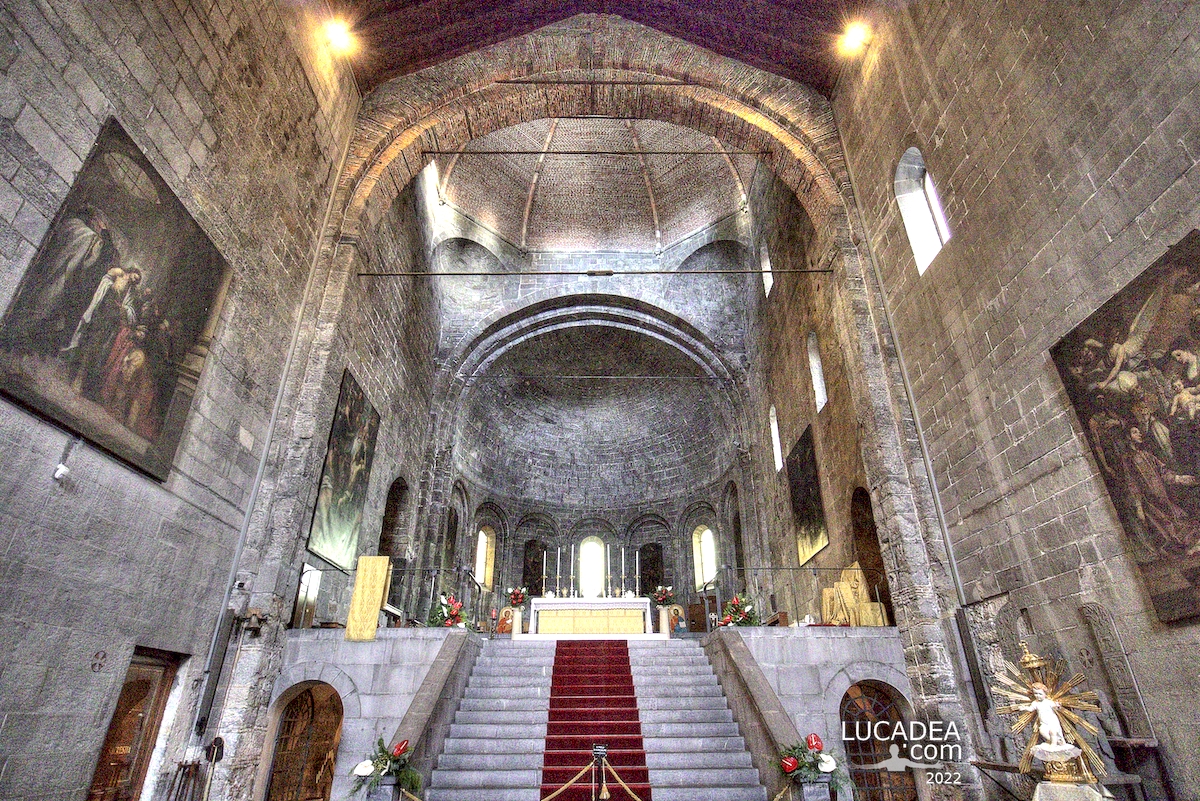
High Altar inside Santo Stefano Church in Genoa, photographed during a visit to the historic building

Photo taken with Canon EOS M100 and lens Canon EF-M 11-22.

Add one  comment to this article or read  here what other visitors have written.
 
Adv
 
Disclamer

The rights on images, videos, choruses, text and all other material on the LUCADEA.com website are governed as per  Copyright page.


This page has been viewed 1 times today.
This month it has been viewed 1 times.
In total it has been viewed 1 times.
 

The Nativity Facade of the Sagrada Familia

La Facciata della Natività della Sagrada Familia a Barcellona

The Nativity Facade of the Sagrada Familia.
Standing in front of this side of the basilica in Barcelona, I found myself looking at an extraordinary number of shapes, figures and small details that seem to multiply the longer you look. The Nativity Facade and the Sagrada Familia are among the places worth seeing in Barcelona, but through my camera I was mainly interested in preserving some of the details that can easily disappear when the building is viewed as a whole.
This photograph came from that attention to detail. The first impression is one of enormous richness, with almost every part of the facade filled with something to discover. Looking more closely through the lens, individual sculptures, columns, plants and human figures begin to separate from the larger composition. It is an architectural scene that naturally encourages you to slow down.
The Nativity Facade is dedicated to the birth of Jesus and has a very different character from the Passion Facade, which I also photographed and featured in another article on the blog. Here, the forms are more organic and the decoration is especially abundant. Architecture and sculpture seem to merge together, creating a complex visual narrative.
The Sagrada Familia stands in Barcelona, Catalonia, Spain, and is Antoni Gaudí’s best-known work. If you are visiting Barcelona, the basilica is almost impossible to miss, but for me its photographic appeal goes beyond the famous overall view. The real fascination begins when individual details become the subject.
I took this photograph myself because I wanted to preserve part of that experience. A photograph showing the entire Sagrada Familia would emphasize its enormous scale, while concentrating on the Nativity Facade allowed me to explore the surfaces, sculptures and smaller elements that make this side so distinctive.
One historical detail is especially important here: Gaudí worked directly on the Nativity Facade and supervised its construction during the later years of his life. It is the only one of the basilica’s three main facades that was largely completed under his direct supervision, making it particularly useful for understanding his architectural vision.
Looking at the photograph, what strikes me most is the lack of a clear separation between structure and decoration. The columns seem to grow alongside the sculptures, natural elements become part of the architecture, and the figures are integrated directly into the surface. Everything contributes to a narrative centered on the birth of Christ.
There are also countless details that become meaningful only when viewed from closer range. The human figures represent episodes associated with the Nativity, while animals and natural motifs help complete the composition. Their abundance contributes to a visual language connected with life, nature and birth.
For me, photographing such a famous monument also means trying not to settle for the standard postcard view. The Sagrada Familia has been photographed countless times, but every detail offers the possibility of a different composition. Moving slightly or concentrating on a smaller section can completely change the way the building is perceived.
The camera helped me do exactly that. Looking through the viewfinder, I could isolate shapes that might otherwise have disappeared into the complexity of the entire basilica. This is one of the things I enjoy most about architectural photography: using the frame to slow down observation and decide what deserves to become the subject.
The Nativity Facade becomes even more interesting when compared with the Passion Facade. In the photograph I shared of the opposite side, I focused on an architecture that feels much more severe, geometric and dramatic. Here, the forms are richer, the decoration is more abundant and the connection with nature is much stronger. The two facades almost seem to tell different moments through completely different visual languages.
That contrast is one of the things that stayed with me. Although both facades belong to the same basilica, they create very different impressions. Photographing both therefore becomes a way of understanding the variety contained within the Sagrada Familia project.
This image naturally connects with the photograph of the Passion Facade already published on the blog. In both cases, I chose to explore the basilica through details rather than simply reproducing its most famous overall view. It is an approach that feels closer to the way I like to photograph, because it allows me to preserve what genuinely caught my attention while I was there.
Looking back at this photograph, I keep thinking about how many details are contained within a relatively limited area. Every time I look at the facade, there seems to be another small element that I had not noticed before. That may be one of the reasons the Sagrada Familia remains such an interesting subject for photography.

If you were standing in front of the Sagrada Familia, would you photograph the entire facade or would you also look for the smaller details of the Nativity? Add a comment or go to the bottom of the site to read what other visitors have written.

Sagrada Familia Nativity Facade in Barcelona with detailed sculptures, figures and distinctive architectural elements

Photo taken with Canon EOS RP and Tamron 16-300 lens.

This is the official website of the Basilica: sagradafamilia.org.

To see all the photos I took of the church, click here:
photo gallery

Where is the cathedral located?

Dedicated to the joyful event of the birth of Jesus, this façade features jubilant decorations in which all the elements evoke life. It focuses on the human and familiar side of Jesus, with a profusion of popular elements such as work tools and pets. Oriented to the east (northeast), it is divided into three portals, dedicated to the theological virtues: hope on the left, faith on the right, and charity in the center, with the Door of Jesus surmounted by the Tree of Life.
Continue and learn more at Wikipedia

Add one  comment to this article or read  here what other visitors have written.
 
Adv
 
Disclamer

The rights on images, videos, choruses, text and all other material on the LUCADEA.com website are governed as per  Copyright page.


This page has been viewed 0 times today.
This month it has been viewed 0 times.
In total it has been viewed 24 times.
 
🏠
  • Italiano