A red Fiat 500 in Spello’s stone alleys

Fiat 500 rossa parcheggiata in un vicolo di Spello in Umbria tra case in pietra del borgo storico

A red Fiat 500 in Spello’s stone alleys.
Among the things to see in Spello, Umbria, Italy, there are not only historic monuments and famous viewpoints, but also the small everyday details that give a village its unique character. Walking through the stone alleys of Spello, I found this red Fiat 500 parked between old houses, a simple element that transformed an ordinary street scene into a photograph with a strong Italian identity.
During my last holiday in Umbria, I visited several of the most beautiful villages in the region, and Spello was certainly one of the places that impressed me the most. I wanted to capture this moment with my camera because the combination of the car, the narrow street and the ancient stone buildings perfectly represented the atmosphere I was experiencing while walking through the village.
The Fiat 500 is more than just a small car. Over time, it has become one of the most recognizable symbols of Italian culture and everyday life. Seeing one parked in a historic alley of Spello creates an interesting contrast between the old stones of the village and an object that belongs to more recent memories. This meeting between history and daily life is often what makes a photograph more personal and memorable.
Spello, located in the province of Perugia, Umbria, Italy, still preserves the charm of a historic center shaped by narrow streets, arches and stone houses. The ancient Roman town of Hispellum left important traces through its walls and monumental gates, while the medieval village remains a place best explored slowly on foot.
A small historical detail about the Fiat 500 is that the modern version was introduced in 1957 and became one of the vehicles that represented Italy’s economic growth after the Second World War. It quickly became a familiar presence in towns and villages throughout the country.
This photograph connects naturally with my other stories about Spello, from the alleys with support arches to Consolare Gate, Urbica Gate and the Baglioni Chapel. Through these images, I have tried to tell not only the famous attractions of the village but also those small details that reveal its everyday personality.
If you are visiting Spello and wondering what to see, remember to look beyond the main landmarks. An old doorway, an architectural detail or even a colorful car can become the most memorable image of your walk.

Have you ever photographed an everyday object that, placed in a historic setting, became the true subject of your picture? Add a comment or go to the bottom of the site to read what other visitors have written.

Red Fiat 500 parked in a stone alley of Spello, Umbria among historic village houses

Photo taken with Canon EOS RP and Canon RF 24-50 lens.

To see all the photos I took in the village, click here:

Here’s where the village is located:

Spello (Hispellum in Latin) is an Italian municipality in the province of Perugia in Umbria. It is part of the circuit of the most beautiful villages in Italy and boasts the Orange Flag tourism and environmental quality mark, awarded by the Italian Touring Club. Spello was founded by the Umbrians and later named Hispellum in Roman times; it was later registered with the Lemonia tribe. It was later declared a “Colonia Giulia” by Caesar and a “Splendidissima Colonia Julia” by Augustus, because it supported him in the wars of Perugia. After Augustus’ victory, he himself ceded to Hispellum a large part of the territories governed by Perusia, and the dominion of the city of Spello extended to the sources of the Clitunno River, which had previously been under the control of Mevania. It was later called “Flavia Costante” by Constantine. Ancient Spello was considered one of the most important cities in Roman Umbria.
Continue and learn more on Wikipedia

Add one  comment to this article or read  here what other visitors have written.
 
Adv
 
Disclamer

The rights on images, videos, choruses, text and all other material on the LUCADEA.com website are governed as per  Copyright page.


This page has been viewed 1 times today.
This month it has been viewed 1 times.
In total it has been viewed 2 times.
 

A view of Dante Alighieri Street in Lavagna

Uno scorcio di via Dante Alighieri a Lavagna

A view of Dante Alighieri Street in Lavagna.
Hidden among the winding streets of the Ligurian coast, Lavagna is a gem full of history and charm. At the heart of this enchanting town lies its historic center, a labyrinth of cobbled alleys and historic buildings that tell centuries-old stories. Walking through the old town of Lavagna is a journey through time, an experience that blends past and present in a fascinating combination.
The narrow cobblestone streets of the historic center of Lavagna invite you to get lost and discover hidden treasures. Along the medieval streets, you can find historic palaces with fascinating architecture and colorful façades that reflect different eras. The elegant Franzoni Palace and Podestà Palace are just two examples of the architecture that can be admired while wandering through the paved streets.
At the center of the old town stands the Basilica of Santo Stefano, an imposing sacred building with a thousand-year history. Founded in the 10th century, the basilica has undergone several modifications over time but has preserved its sacred atmosphere. The frescoes, altars, and sculptures inside tell the religious and artistic history of the region.
Vittorio Veneto Square is the beating heart of the historic center of Lavagna. Surrounded by historic buildings, welcoming cafés, and traditional shops, this square is the perfect place to experience the daily life of the town. With its central well, it is framed by colorful buildings and flowered balconies that add a romantic touch to the space.
The historic center of Lavagna is much more than a collection of old buildings; it is a journey through the history, culture, and timeless beauty of Liguria. With its cobbled streets and historic palaces, it offers a tangible testimony to the richness of its heritage. For anyone wishing to explore the authentic Ligurian spirit, the old town is an essential stop, an unforgettable journey between past layers and present vitality.

Do you know Lavagna? Add a comment or go to the bottom of the site to read what other visitors have written.

Uno scorcio di via Dante Alighieri a Lavagna

Photo taken with Canon EOS RP and lens Canon RF 24-50.

Here’s where I took the photo:

A glimpse of the street dedicated to Dante Alighieri in the center of Lavagna – Un aperçu de la rue dédiée à Dante Alighieri au centre de Lavagna – Un vistazo a la calle dedicada a Dante Alighieri en el centro de Lavagna – Um vislumbre da rua dedicada a Dante Alighieri no centro de Lavagna – Ein Blick auf die Dante Alighieri gewidmete Straße im Zentrum von Lavagna – Một cái nhìn thoáng qua về con đường dành riêng cho Dante Alighieri ở trung tâm Lavagna – 拉瓦尼亚中心但丁·阿利吉耶里专用街道一瞥 – ラヴァーニャの中心部にあるダンテ・アリギエーリに捧げられた通りを垣間見る

The text of this post was written with the help of ChatGPT, a language model from OpenAI.

Add one  comment to this article or read  here what other visitors have written.
 
Adv
 
Disclamer

The rights on images, videos, choruses, text and all other material on the LUCADEA.com website are governed as per  Copyright page.


This page has been viewed 1 times today.
This month it has been viewed 6 times.
In total it has been viewed 6 times.
 

An alley in the city of Funchal on the island of Madeira

Un vicolo della città di Funchal sull'isola di Madera

An alley in the city of Funchal on the island of Madeira.
Walking through the beautiful Portuguese city of Funchal, I often go to the area around the cathedral. In these alleys there are several very charming small restaurants.

Have you ever been to the island of Madeira? Add a comment or go to the bottom of the site to read what other visitors have written.

Un vicolo della città di Funchal sull'isola di Madera

Photo taken with Canon EOS RP and Canon RF 24-50 lens.

To see all the photos of Funchal, click here:
foto gallery

The archipelago consists of two major islands, Madeira and Porto Santo, three smaller uninhabited islands known as the Desertas, and two even smaller, also uninhabited, islands known as the Savage Islands. The largest island is Madeira. The archipelago, together with Cape Verde, the Azores, and the Canary Islands, forms Macaronesia; the Azores and Madeira are part of Portugal, the Canary Islands are part of Spain, and Cape Verde, once Portuguese, is now an independent republic.
Continue and learn more at Wikipedia

An alley in the city of Funchal on the island of Madeira – Une ruelle dans la ville de Funchal sur l’île de Madère – Un callejón en la ciudad de Funchal en la isla de Madeira – Un callejón en la ciudad de Funchal en la isla de Madeira – Eine Gasse in der Stadt Funchal auf der Insel Madeira – Một con hẻm ở thành phố Funchal trên đảo Madeira

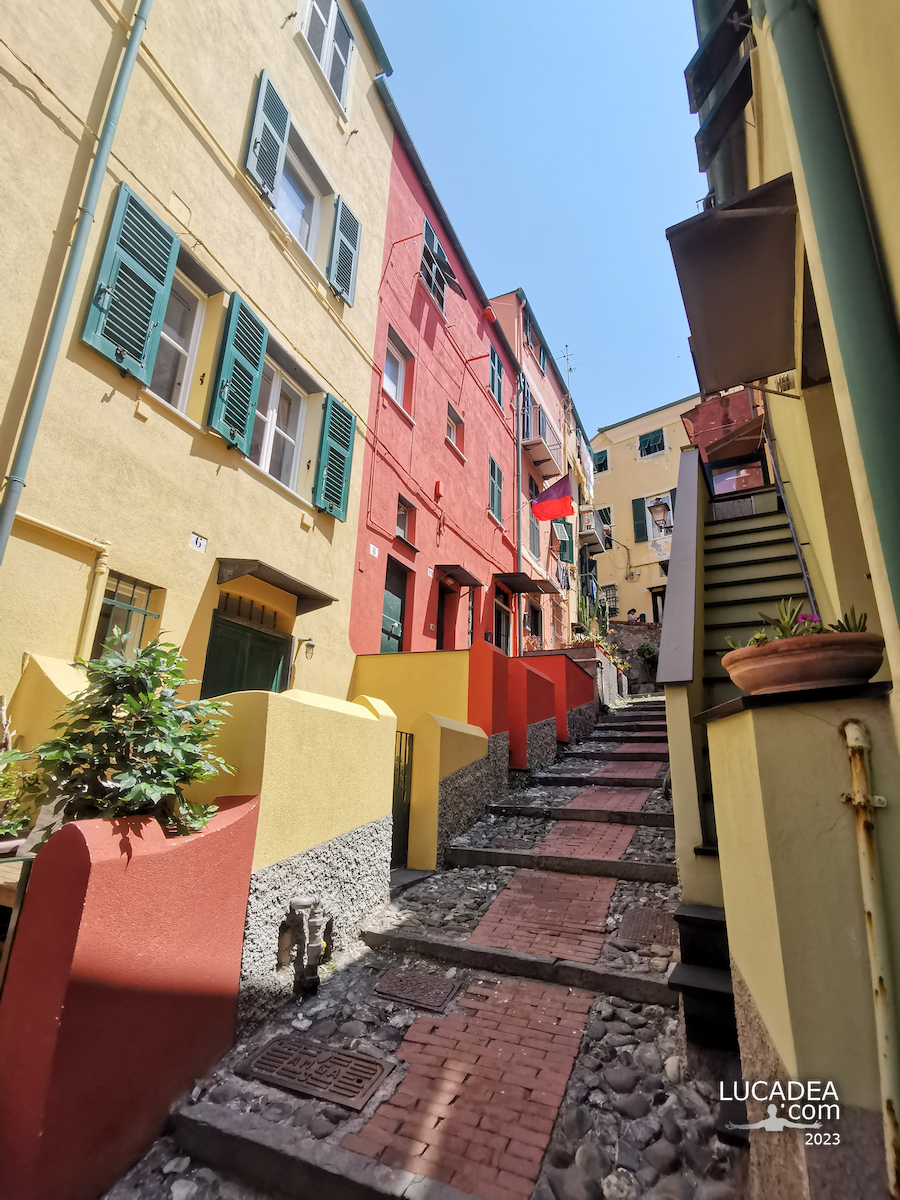
A beautiful creuza in the small village of Boccadasse

Una bella creuza nel piccolo borgo di Boccadasse a Genova

A beautiful creuza in the small village of Boccadasse in Genoa.
Last summer I often had to travel back and forth to Genoa, and whenever I could, I stopped along the way to enjoy the beauty that my region (Liguria) has to offer.
One of these is the small village of Boccadasse, west of Genoa.
This is a typical Ligurian creuza, the small street that climbs up from the sea into the village. Stones on the sides to prevent slipping when it rains, and bricks in the center!

Do you like the photo? Have you ever been to Boccadasse? Add a comment or go to the bottom of the site to read what other visitors have written.

Una bella creuza nel piccolo borgo di Boccadasse a Genova

Photo taken with Honor 20.

All the photos I took in the village, on various visits, are here:
foto gallery

Where is the village located:

Boccadasse (Boca d’azë or Bocadâze in Genoese) is an ancient fishing village in the city of Genoa, part of the Albaro district. In the current administrative division of the municipality of Genoa, it is therefore included in Municipio VIII – Medio Levante, which in addition to Albaro also includes the Foce and San Martino districts.
Continue on Wikipedia

A beautiful creuza in the small village of Boccadasse in Genoa – Une belle creuza dans le petit village de Boccadasse à Gênes – Una hermosa creuza en el pequeño pueblo de Boccadasse en Génova – Uma bela creuza na pequena aldeia de Boccadasse em Génova – Eine wunderschöne Creuza im kleinen Dorf Boccadasse in Genua – Một creuza tuyệt đẹp ở ngôi làng nhỏ Boccadasse ở Genoa – 热那亚博卡达斯小村庄的美丽克鲁扎 – ジェノヴァのボッカダッセの小さな村にある美しいクルーザ

A glimpse of Dante Alighieri street in Lavagna

Scorcio di via Dante Alighieri nel centro storico di Lavagna, tra portici, facciate e architetture liguri

A glimpse of Dante Alighieri street in Lavagna.
Walking through the historic center of Lavagna, Liguria, I stopped at one of those points where a street can tell you more about a town than a formal description ever could. Dante Alighieri street crosses part of the old center, and the close-set houses, arcades and architectural details immediately give it the character I associate with Ligurian historic towns.
This photograph came from paying attention to those details. There is no isolated monument dominating the frame and I was not looking for a spectacular view. I was interested in the street itself, with its buildings following the path and the succession of small architectural elements that make an ordinary walk worth photographing.
If you are wondering what to see in Lavagna, the historic center is certainly a place worth exploring on foot. Many of its most interesting details are found along streets and beneath arcades rather than from a single viewpoint. Walking slowly makes it easier to notice doors, shutters, balconies and the materials used in the older buildings.
One of the details that caught my attention was slate, a material deeply connected with this part of Liguria. Black slate has traditionally been used throughout the area for floors, roofs and architectural details. The nearby Val Fontanabuona became particularly well known for its slate quarries, and the material became an important part of the local building tradition.
In this photograph, the street itself becomes the subject. The façades, shutters, balconies and arcades were not arranged to create a scene; they are simply part of everyday life in the historic center. That is what I enjoy when photographing towns and villages. I prefer finding an image that still feels lived in rather than photographing only the landmarks everyone already knows.
Lavagna, in the Metropolitan City of Genoa, Liguria, Italy, has a compact historic center that can easily be explored on foot. Dante Alighieri street also runs past the Basilica of Santo Stefano, one of the city’s most important religious buildings, so the same walk brings together different architectural details and perspectives.
The arcades also change the way the street feels. The buildings seem to open directly onto the pedestrian space, while the covered walkways create a visual connection between the façades and the street. These are simple features, but they become much more noticeable when you stop to photograph them.
What I like most about this view is its ordinary character. It is not necessarily a photograph built around a famous attraction. It is an image of a street that I could walk along many times and still notice something different. A shutter, a doorway, a decorative detail or a sign can change the way the whole composition is read.
Walking through Lavagna also makes it clear how closely the historic center remains connected to everyday life. Shops, restaurants and homes coexist with older buildings, so the past does not feel separated from the present. It is simply part of the environment people move through every day.
As in some of my other photographs of Ligurian historic centers, I wanted to concentrate here on an urban detail rather than necessarily looking for the most recognizable landmark. It is another small part of the visual story I like to build through streets, narrow passages and architectural details that might otherwise be overlooked.
I took this photograph because I wanted to keep this particular view of Dante Alighieri street, with its simple architecture and everyday atmosphere. When I look at an image like this later, I do not remember only a street. I remember the feeling of moving through the historic center without having to rush.
If you are visiting Lavagna, this is the kind of street where slowing down can reveal more than simply following a list of sights. For me, that is often when a place becomes interesting enough to photograph.

Is there a particular street or corner of Lavagna’s historic center that you would always stop to photograph? Add a comment or go to the bottom of the site to read what other visitors have written.

A glimpse of Dante Alighieri street in Lavagna, with arcades, historic façades and traditional Ligurian architecture

Photo taken with Canon EOS RP and lens Canon RF 24-50.

An alley in the historic center of Perugia

Un vicolo del centro storico di Perugia

Walking through the beautiful historic center of the Umbrian town of Perugia, you encounter a maze of streets and alleys that are perfect for photography. The stone walls and streets are spectacular! Like in this photo.

Do you know the beautiful city of Perugia? Add a comment or go to the bottom of the site to read what other visitors have written.

Un vicolo del centro storico di Perugia

Photo taken with Canon EOS RP and Canon RF 24-50 lens.

To see all the photos of Perugia, click here:

Where is the point, more or less, where I took the shot:

From the main square in the center, the five royal roads branched off, connecting—and still partially connect—the city of Perugia with Cortona (today the Via Cortonese overlaps with the Trasimeno state road), Orvieto (Via Marscianese), Gubbio (Via Eugubina), Città di Castello, and the Via Flaminia (Foligno), which led from Rome to Ariminium (now Romagna).
Continue and learn more at Wikipedia

An alley in the historic center of Perugia – Une ruelle dans le centre historique de Pérouse – Un callejón en el centro histórico de Perugia – Um beco no centro histórico de Perugia – Eine Gasse im historischen Zentrum von Perugia – Một con hẻm ở trung tâm lịch sử của Perugia

A white wooden alley in the silence of Bergen

Un vicolo di legno bianco nel silenzio di Bergen

A white wooden alley in the silence of Bergen.
I took this photo almost without thinking, slipping into a small alley in the city of Bergen while the rest of the city center remained behind, noisier and more distracted. Inside, however, it seemed as if everything had stopped. The white wooden houses huddled together, tall, orderly, with facades punctuated by vertical planks that tell a story of rain, sea, and the slow passage of time.
Walking on this irregular cobblestone, the sound of footsteps immediately changes. It’s more muffled, almost respectful. The pale walls reflect a cold light, typical of Bergen, and the alley seems brighter than it actually is. It’s a light that doesn’t warm, but accompanies, and makes every detail more evident: the gutters, the external pipes, the small windows, all similar, as if following an unwritten rule.
I was especially struck by the sense of tranquil order. There’s nothing picturesque about it in the touristic sense of the word, and perhaps that’s precisely its charm. The benches leaning against the wall, simple, almost invisible, seem there more out of habit than for use. I wondered who really sits in this alley, at what times of day, with what thoughts. Photography often arises from these silent questions.
Bergen is a city that has coexisted with wood for centuries. In this alley, you can clearly feel it: the white is not a random aesthetic choice, but a practical, luminous solution that resists the humid climate and makes the spaces feel more open even when the sky is low. The wooden houses here are not a postcard, they are simply home. And that’s what makes the place so authentic.
While I was shooting, there was no one. No voices, no footsteps behind me. Only the distant sound of the city and the, closer, sound of water flowing from some gutter. I tried to capture precisely this: the feeling of being a guest for a few moments in an everyday, discreet space that doesn’t ask to be photographed but accepts it naturally.
It’s one of those places you probably quickly forget if you don’t really look at it. But once you look carefully, it lingers like a light memory, made of silence, pale wood, and Nordic light.

Have you ever stumbled upon a corner of the city that made you slow down for no apparent reason?
Add a comment or go to the bottom of the site to read what other visitors have written.

Photos taken with Canon EOS RP and Tamron 16-300 lens.

To see all the photos I took in Bergen, click here

A white wooden alley in the silence of Bergen – Une ruelle en bois blanc dans le silence de Bergen – Un callejón de madera blanca en el silencio de Bergen – Um beco de madeira branca no silêncio de Bergen – Eine weiße Holzgasse in der Stille von Bergen – Một con hẻm gỗ trắng trong sự tĩnh lặng của Bergen – 卑尔根寂静中的白色木屋小巷 – ベルゲンの静けさにある白い木造の路地

The text of this post was written with the help of ChatGPT, a language model from OpenAI.

🏠
  • Italiano