Durian at Con Market in Da Nang

Durian al Con Market di Da Nang esposti su banco di mercato vietnamita tra bancarelle e atmosfera affollata

Durian at Con Market in Da Nang.
The moment I step into Con Market in Da Nang, Vietnam, the presence of durian at Con Market in Da Nang becomes immediately noticeable, filling the space with a strong visual and sensory impact as I move through the crowded aisles. The durian at Con Market in Da Nang stands out among stalls and daily market activity, becoming one of the first elements that captures my attention.
As I continue walking, the durian at Con Market in Da Nang appears repeatedly across different vendors, almost like a visual thread connecting the entire market experience. Con Market in Da Nang is one of the most important local markets in central Vietnam, offering a direct look into everyday urban life far from the more polished tourist areas.
If you are visiting Da Nang in Vietnam and wondering what to see beyond beaches and modern attractions, Con Market is often suggested as one of the most authentic places in the city, and the durian at Con Market in Da Nang becomes part of that raw and genuine experience. It is not just a fruit here, but a cultural presence embedded in daily life.
I also remember other market scenes I’ve photographed and shared on lucadea.com, where different countries reveal their own rhythm through food and street life, yet here in Con Market everything feels especially dense and immediate.
A small detail worth noting is that durian is widely known in Southeast Asia as the “king of fruits,” famous for its powerful and divisive aroma, which makes it one of the most recognizable fruits in any local market.

Would you take a moment to stop in front of durian in a place like this? Add a comment or go to the bottom of the site to read what other visitors have written.

Durian al Con Market di Da Nang esposti su banco di mercato vietnamita tra bancarelle e atmosfera affollata

Photo taken with Canon EOS RP and Canon RF 28 lens.

To see all the photos I took at the market, click here:
foto gallery

Add one  comment to this article or read  here what other visitors have written.
 
Adv
 
Disclamer

The rights on images, videos, choruses, text and all other material on the LUCADEA.com website are governed as per  Copyright page.


This page has been viewed 1 times today.
This month it has been viewed 2 times.
In total it has been viewed 2 times.
 

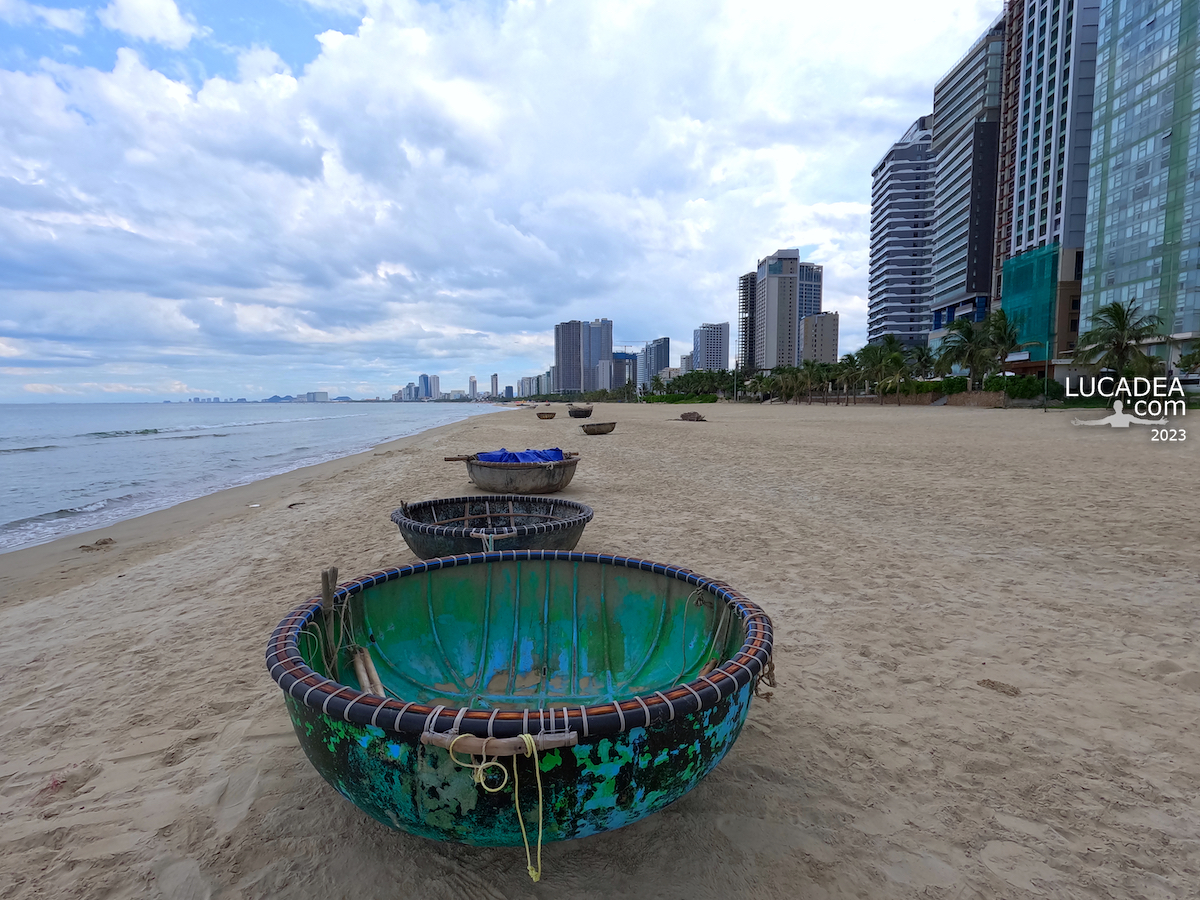
Da Nang beach and Vietnam’s round fishing boats

LSpiaggia di Da Nang in Vietnam con una tipica barca da pesca rotonda vietnamita vicino alla costa.

Da Nang beach and Vietnam’s round fishing boats.
During my trip to Vietnam, I photographed the long coastline of Da Nang, one of the best-known areas of the city, where the sea meets a modern skyline of hotels and tall buildings.
Walking along Da Nang beach, I was especially attracted by the small details that tell a different story about this place: the traditional Vietnamese round fishing boats, known as thuyền thúng or tung chai, which can still be seen near the shore and connected to local fishing traditions. In front of the wide beach and the urban landscape behind it, these small boats create a fascinating contrast between tradition and modern development.
This photograph was created by focusing on that particular element. I wanted to capture with my camera not only the beauty of Da Nang beach, but also a small symbol of Vietnamese daily life that could easily be missed when looking at the larger landscape.
Da Nang beach is located in Da Nang, Vietnam, in the central part of the country, and it is one of the city’s most recognizable coastal areas. The shoreline stretches for several kilometers and has become a popular destination thanks to its sea, sandy beaches and convenient location close to the city.
One interesting detail about these round fishing boats is their unique shape. They were designed to move easily in coastal waters and remain strongly connected to the traditions of Vietnamese fishing communities. Despite their simple appearance, they represent an important relationship between local people and the sea.
What I like about this image is the combination of two different worlds: on one side, a modern beach surrounded by large buildings and resorts; on the other, a small traditional boat that preserves an older way of life. These are exactly the kind of details I try to capture during my travels because they help tell a deeper story about a destination.
In other articles about my journeys around the world, I have tried to collect images that show not only famous places but also everyday details that make each location unique.
Looking at this photograph reminds me how interesting it is to observe a beach not only as a holiday destination, but also as a place where people, history and traditions meet.

Would you like to visit Da Nang beach and see these traditional Vietnamese fishing boats in person? Add a comment or go to the bottom of the site to read what other visitors have written.

Da Nang beach in Vietnam with a traditional round Vietnamese fishing boat near the coastline.

Da Nang beach in Vietnam with a traditional round Vietnamese fishing boat near the coastline.

Da Nang beach in Vietnam with a traditional round Vietnamese fishing boat near the coastline.

Photos taken with the GoPro Hero 10 Black.

Here is also a nice video—again of the beach—but filmed on a different (sunny) day:

Add one  comment to this article or read  here what other visitors have written.
 
Adv
 
Disclamer

The rights on images, videos, choruses, text and all other material on the LUCADEA.com website are governed as per  Copyright page.


This page has been viewed 0 times today.
This month it has been viewed 0 times.
In total it has been viewed 0 times.
 

Flowers and a blue window at Da Nang Marina

Finestra blu aperta con bouganville rosa su muro bianco alla Da Nang Marina, interno semplice visibile sullo sfondo

Flowers and a blue window at Da Nang Marina.
I pause in front of this scene almost unintentionally, drawn in by the strong contrast between the white wall and the deep blue of the window. At Da Nang Marina, corners like this feel designed to slow you down, to make you notice things you might otherwise ignore.
The bougainvillea spills naturally along the side of the frame, its bright color breaking the simplicity of the composition. I move slightly to adjust my perspective, trying to include the flowers without letting them take over the scene. The open blue window creates an unexpected sense of depth, revealing a quiet interior space with just a few pieces of furniture and soft colors that stay in the background.
What stands out to me is the balance. At Da Nang Marina, everything feels intentional without appearing forced. The white wall isn’t perfectly smooth, the paint has subtle imperfections, and that’s exactly what makes it feel real. Inside, a chair and a small cabinet hint at daily life, even though no one is present in the frame.
I take a few shots, focusing on how the elements interact with each other. The bougainvillea acts like a natural frame, while the blue window becomes the anchor of the composition. There’s nothing dramatic happening, and yet the scene holds my attention in a quiet, steady way.
There’s also a small detail that adds another layer to this place: Da Nang Marina was designed to evoke the atmosphere of Greek islands, with its characteristic colors and simple architectural lines, which is why it has become such a popular spot for photography.
I linger for a moment longer, realizing how easily I could have walked past without noticing this small, carefully composed corner.

Have you ever stopped for something this simple and found it unexpectedly memorable? Add a comment or go to the bottom of the site to read what other visitors have written.

Finestra blu aperta con bouganville rosa su muro bianco alla Da Nang Marina, interno semplice visibile sullo sfondo

Photo taken with Canon EOS RP and Tamron 16-300 lens.

To see all the photos I took of the marina, click here:
foto gallery

Flowers and a blue window at Da Nang Marina – Fleurs et fenêtre bleue à la marina de Da Nang – Flores y ventana azul en la Marina de Da Nang – Flores e janela azul na Marina de Da Nang – Blumen und blaues Fenster in der Marina von Da Nang – Hoa và cửa sổ xanh tại Da Nang Marina – 岘港码头的花与蓝色窗户 – ダナンマリーナの花と青い窓

The text of this post was written with the help of ChatGPT, a language model from OpenAI.

The grand staircase of Linh Ung Pagoda in Da Nang

Scalinata monumentale della Linh Ung Pagoda a Da Nang con visitatori che salgono verso l’ingresso decorato del tempio

The grand staircase of Linh Ung Pagoda in Da Nang.
Climbing the steps of Linh Ung Pagoda, I found myself drawn into a slow and steady rhythm, shaped by footsteps, brief pauses, and silent exchanges between people sharing the same path. The staircase stretches upward in a way that feels almost endless, yet it never becomes overwhelming, as if it naturally guides you without asking for effort.
I stopped several times along the way, not just to catch my breath but to observe how the scene unfolds gradually. The stone details along the sides, the subtle decorations, and then, little by little, the temple gate rising at the top. Linh Ung Pagoda reveals itself step by step, never all at once.
What stood out to me was how people interacted with the space. Some walked slowly, others paused halfway, and a few turned back just to capture a different angle. There was no fixed pace, just a shared understanding of the moment. While taking photos, I tried to respect that flow, letting movement become part of the composition rather than interrupting it.
As I moved higher, the entrance of Linh Ung Pagoda became more imposing. The structure’s lines, the soft but defined colors, and the feeling of crossing into something different. It didn’t feel like just an architectural feature, but more like a transition point, something that quietly separates one space from another.
I later learned that many pagodas in Vietnam are designed with elevated and scenic entrances to create a symbolic journey, marking a gradual transition from the outside world to a more spiritual space. Here, that idea feels very real, but also tangible and accessible.
Looking back at the photo, I realize that the staircase itself is the true subject, even more than the gate at the top. It leads the eye and tells the story of the place.

Do you enjoy places that reveal themselves slowly as you move through them? Add a comment or go to the bottom of the site to read what other visitors have written.

Scalinata monumentale della Linh Ung Pagoda a Da Nang con visitatori che salgono verso l’ingresso decorato del tempio

Photo taken with Canon EOS RP and Tamron 16-300 lens.

To see all the photos I took in the pagoda, click here:
foto gallery

Where is the pagoda located:

The staircase of Linh Ung Pagoda in Da Nang – L’escalier de la pagode Linh Ung à Da Nang – La escalinata de la pagoda Linh Ung en Da Nang – A escadaria da pagoda Linh Ung em Da Nang – Die Treppe der Linh Ung Pagode in Da Nang – Cầu thang chùa Linh Ứng tại Đà Nẵng – 岘港灵应寺的台阶 – ダナンのリンウン寺の階段

The text of this post was written with the help of ChatGPT, a language model from OpenAI.

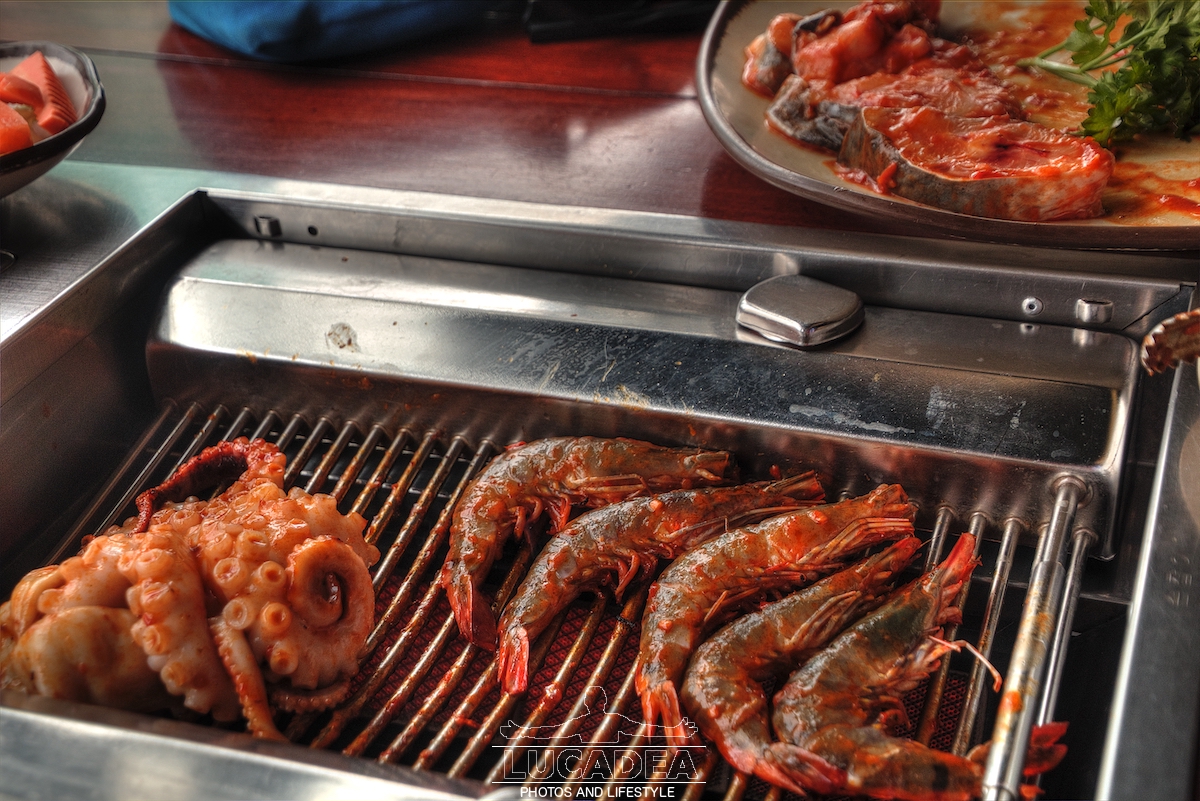
Grilled fish in Vietnam with table cooking

Pesce alla griglia in Vietnam cotto al tavolo su braciere con stile della cucina asiatica

Grilled fish in Vietnam with table cooking.
During my trip to Vietnam, I discovered a different way of experiencing dinner: not just receiving a finished dish, but becoming part of the cooking process. This grilled fish in Vietnam is prepared directly at the table, with a small grill that turns the meal into a shared experience.
In the middle of the table there is a gas burner that is switched on before the food arrives. Once you choose what to order, fish, meat or other ingredients are placed on the grill by the customer or by the waiter. This style of cooking immediately reminded me of Japanese and Korean traditions, where preparing food at the table is an important part of the dining experience. In Vietnam, seafood such as octopus is widely used, but this self-cooking style seems to have influences from other Asian cuisines.
The photograph captures exactly this atmosphere: a different way to discover local food, with the smell of grilling ingredients filling the air and the anticipation of watching the cooking process. The dish I tried was slightly spicy, as many Vietnamese dishes are, but it was still enjoyable even for someone like me who is not a big fan of spicy flavors.
The seafood was perhaps a little firmer than expected, but the taste was interesting and enjoyable. One thing I appreciated was the attention of the staff: even though the restaurant was not particularly crowded, the waitress occasionally came back to check the cooking and make sure everything was going well.
The photograph was taken in Vietnam during a food experience far from ordinary restaurants. If you are visiting Vietnam and wondering what food experiences are worth trying, a table grill is certainly a curious way to discover local habits and Asian culinary influences.
One interesting fact is that in many East Asian cuisines, cooking together at the table is not only a method of preparation but also a social moment. Food becomes a way to spend time together and share the experience.
On my photoblog, I often share encounters with different cuisines, from traditional Italian dishes to flavors discovered during my travels. This image comes from the same curiosity: finding something new and preserving a memory that goes beyond the food itself.

Have you ever tried a cuisine where preparing the meal becomes part of the dinner itself? Add a comment or go to the bottom of the site to read what other visitors have written.

Pesce alla griglia in Vietnam cotto al tavolo su braciere con stile della cucina asiatica

Photo taken with Canon EOS M100 and lens Tamron 16-300.

Grilled fish in Vietnam with table cooking – Poisson grillé au Vietnam avec cuisson à table – Pescado a la parrilla en Vietnam con cocción en mesa – Peixe grelhado no Vietnã com preparo à mesa – Gegrillter Fisch in Vietnam mit Tischzubereitung – Cá nướng ở Việt Nam với cách nấu tại bàn – 越南餐桌烤鱼料理 – ベトナムのテーブルグリル魚料理

The text of this post was written with the help of ChatGPT, a language model from OpenAI.

Colorful spices at Da Nang market

Spezie fresche al Con Market di Da Nang con zenzero, aglio e cipolle colorate disposte in ceste di plastica

Colorful spices at Da Nang market.
As soon as I step into the narrow aisles of Con Market, it’s the colors that strike me before anything else: the deep purple of the onions, the pale white of garlic, and the earthy tones of ginger piled high in plastic baskets. The spices create a vivid patchwork that feels both chaotic and perfectly balanced, a visual rhythm that draws me in without hesitation.
I move closer, careful not to interrupt the natural flow around me. The market in Da Nang moves with a quiet efficiency, where every gesture has meaning. Hands reach into baskets, weigh produce instinctively, and exchange goods in a seamless routine. The scent of ginger is sharp and energizing, while garlic carries a heavier, almost comforting aroma. Together, these spices form the invisible backbone of countless dishes.
I raise my camera and begin to frame the scene. There’s no need to arrange anything—the beauty is already there. The light falls unevenly across the baskets, highlighting textures and imperfections. Each root of ginger looks unique, almost sculptural, while the onions shine softly under the ambient light. It’s a moment that feels raw and unfiltered, exactly what I want to capture.
I linger on the details, noticing how these everyday ingredients hold a deeper cultural significance. In Vietnamese cooking, ginger and garlic are essential, quietly shaping flavors without ever demanding attention. They are the foundation, the subtle presence that makes everything else come alive.
Around me, the market continues its steady pulse. Vendors call out softly, customers negotiate, and life moves forward without pause. I take a few more shots, adjusting my perspective slightly, trying to capture not just the image but the feeling of being here.
When I finally step back, I realize that what stays with me isn’t just the photograph, but the sensory memory of the place—the colors, the smells, the rhythm.

Can you almost smell these spices just by looking at the scene? Add a comment or go to the bottom of the site to read what other visitors have written.

Spezie fresche al Con Market di Da Nang con zenzero, aglio e cipolle colorate disposte in ceste di plastica

Photo taken with Canon EOS RP and lens Canon RF 28.

To see all the photos I took at the market, click here:

Spezie colorate al mercato di Da Nang – Colorful spices at the market in Da Nang – Épices colorées au marché de Da Nang – Especias coloridas en el mercado de Da Nang – Especiarias coloridas no mercado de Da Nang – Bunte Gewürze auf dem Markt in Da Nang – Kleurrijke specerijen op de markt in Da Nang – ダナン市場の色とりどりのスパイス

The text of this post was written with the help of ChatGPT, a language model from OpenAI.

A basket of tamarind at Con Market in Da Nang

Cestino di tamarindo esposto al Con Market di Da Nang, mercato coperto vietnamita con bancarelle di frutta tropicale, luce naturale diffusa e corridoi interni affollati.

The basket of tamarind at Con Market in Da Nang appears right in front of me as I move through the narrow aisles of the market. The basket of tamarind at Con Market in Da Nang feels compact and still, almost fixed in place, while everything around it continues to move without pause. That contrast is what makes me stop.
The sound inside Con Market is constant. Voices overlap, footsteps echo, and vendors call out to customers in a rhythm that never really breaks. In the middle of this flow, the basket of tamarind at Con Market in Da Nang becomes a visual anchor, something that holds my attention because it does not change while everything else does.
I look closer and notice the texture of the fruit, its uneven surface and soft, almost velvety appearance. It is not arranged to impress, but simply placed as part of daily trade. That simplicity makes it feel honest, grounded in routine rather than presentation.
As I stay longer, I begin to see how the market is built from these small, repeated elements. Every stall has its own logic, its own way of organizing goods, and yet everything fits into a larger, continuous movement. The basket of tamarind at Con Market in Da Nang becomes one of those small fixed points that help me read the space.
People pass by without stopping, focused on their own rhythm. I remain still for a moment longer, observing how something so simple can hold attention in such a busy environment. It is not about the object itself, but about how it exists inside the flow of daily life.
When I finally start walking again, the image stays with me more than the noise or the movement around it. It is a small detail, but it lingers.

And I wonder if, in places like this, memory is always built from small things rather than big moments. Add a comment or go to the bottom of the site to read what other visitors have written.

Cestino di tamarindo esposto al Con Market di Da Nang, mercato coperto vietnamita con bancarelle di frutta tropicale, luce naturale diffusa e corridoi interni affollati.

Photo taken with Canon EOS RP and Canon RF 28 lens.

To see all the photos I took at this market, click here:
Galleria delle foto

A basket of tamarind at Con Market in Da Nang – Un panier de tamarin au marché Con de Da Nang – Una cesta de tamarindo en el mercado Con de Da Nang – Um cesto de tamarindo no mercado Con de Da Nang – Ein Korb mit Tamarinde im Con Market Da Nang – Một giỏ me ở chợ Cồn Đà Nẵng – 岘港韩市场的一篮罗望子 – ダナンコン市場のタマリンドのかご

The text of this post was written with the help of ChatGPT, a language model from OpenAI.

Round basket boats along Da Nang beach

La thúng chèo, la tipica barchetta vietnamita

Round basket boats along Da Nang beach.
Walking along the shoreline, you quickly understand what to see in Da Nang Vietnam when these small round boats, known as thúng chèo, start appearing on the sand like quiet witnesses of daily life. Among the places to see in Da Nang, these traditional boats are one of the most authentic and unexpected sights you can encounter.
I walk slowly, letting the scene unfold naturally. The thúng chèo don’t look like typical boats at all; they resemble woven baskets resting on the beach. Still, they are part of everyday work, used by fishermen to carry nets or head out into the water just beyond the shore. If you are visiting and wondering what to see in Da Nang Vietnam, this is one of those simple yet meaningful details that reveals the true character of the place.
Da Nang, Vietnam feels different when you stop and focus on something like this. The sound of the waves blends with distant city noise while a few fishermen gently push their boats toward the sea. It reminds me of other coastal scenes I shared on my site, back in Italy, where boats tell similar stories in completely different shapes. Here, everything feels more essential, almost stripped down to its purpose.
An interesting detail is that these boats are traditionally made from woven bamboo and coated with natural resins to make them waterproof. Their round shape is not just aesthetic—it also comes from a clever historical workaround, as they were once not classified as boats and avoided certain taxes.
I keep watching as some tourists approach, curious, and even try short rides in them. In some areas, these basket boats have become small attractions, but they still retain their original function. They exist somewhere between tradition and modern curiosity, without losing their identity.
If you are thinking about what to see in Da Nang Vietnam, this is one of the most interesting places to pause, not because it is grand, but because it feels real.

Have you ever discovered a place through such a simple detail? Add a comment or go to the bottom of the site to read what other visitors have written.

Photos taken with Honor 20.

Round basket boats on Da Nang beach – Bateaux ronds sur la plage de Da Nang – Barcas redondas en la playa de Da Nang – Barcos redondos na praia de Da Nang – Runde Boote am Strand von Da Nang – Thuyền tròn trên bãi biển Đà Nẵng – 岘港海滩上的圆形小船 – ダナンのビーチにある丸いボート

The text of this post was written with the help of ChatGPT, a language model from OpenAI.

The beautiful golden beach of Da Nang in Vietnam

La bella spiaggia dorata di Da Nang in Vietnam

The beautiful golden beach of Da Nang in Vietnam.
No trip to Vietnam is complete without a visit to Da Nang beach. Or at least for most Vietnamese people, this is one of the most beautiful beaches in the country. With its vast stretches of fine white sand, the endless ocean horizon, and gently swaying palm trees, this destination will leave you speechless.
Get ready to experience breathtaking sunrises that paint the sky in shades of pink, orange, and purple. Da Nang beach is famous for offering a colorful spectacle every morning, creating an atmosphere of serenity and contemplation. Along the beach runs a lively boulevard, the perfect place for a romantic walk or to immerse yourself in the vibrant local culture. You will find stalls offering Vietnamese culinary delicacies and local handicrafts.
Water lovers will find their paradise in Da Nang. Activities such as surfing, snorkeling, and boat excursions are available for those seeking thrills in the open sea.
Just a short walk from the beach, Marble Mountain offers a spiritually rich excursion. Ancient temples, mystical caves, and spectacular views await you at the top, making this mountain an unmissable stop.
In the evening, choose one of the many seaside restaurants to enjoy local delicacies while the sun sets over the horizon. A culinary experience with an unmatched view.
Da Nang is much more than a beach destination; it is a symphony of colors, flavors, and sensations that will stay with you forever. Explore the beach, immerse yourself in the culture, and let yourself be enchanted by the authentic beauty of Da Nang.

Do you know Vietnam?
Add a comment or go to the bottom of the site to read what other visitors have written.

La bella spiaggia dorata di Da Nang in Vietnam

La bella spiaggia dorata di Da Nang in Vietnam

Photos taken with Gopro Hero 10 black.

Where is Da Nang:

Đà Nẵng is a first-class municipality and the fifth most populous city in Vietnam. It lies on the western bank of the Hán River on the coast of the South China Sea and is one of the country’s most important ports. As a first-class municipality, it is under the direct control of the central government. Đà Nẵng is the commercial and cultural center of central Vietnam, as well as the most populous city in the region. Its port and its location on National Route 1 and the North-South Railway make it an important transportation hub. Several UNESCO World Heritage sites are nearby, including the Imperial City of Huế, the ancient town of Hoi An, and the ruins of My Son.
Continue and learn more at Wikipedia

The beautiful golden beach of Da Nang in Vietnam – La belle plage dorée de Da Nang au Vietnam – La hermosa playa dorada de Da Nang en Vietnam – A bela praia dourada de Da Nang, no Vietnã – Der wunderschöne goldene Strand von Da Nang in Vietnam – Bãi biển vàng tuyệt đẹp của Đà Nẵng ở Việt Nam – 越南岘港美丽的金色海滩 – ベトナムのダナンの美しい黄金のビーチ

The text of this post was written with the help of ChatGPT, a language model from OpenAI.

Inside Huyen Khong Cave in Da Nang

Huyen Khong Cave nelle Marble Mountain

Inside Huyen Khong Cave in Da Nang.
As soon as I step inside Huyen Khong Cave, the light immediately catches my attention, falling from above in sharp beams that shift as clouds move across the sky. It’s not a dark cave in the usual sense, but a place where brightness and shadow continuously reshape the space.
I slow down without even thinking about it. The cave feels open, almost exposed, with large gaps in the ceiling that let the sky become part of the scene. Huyen Khong Cave has a different rhythm compared to other caves I’ve visited. There’s air moving gently, carrying a mix of damp stone and faint incense that lingers without ever becoming overwhelming.
I walk deeper, noticing how the details reveal themselves only when I pause. A statue carved into the rock appears softly under a beam of light, then fades again as I shift position. The surfaces around me are uneven, marked by time and touch, telling quiet stories without needing explanation.
There are other visitors, of course. I hear footsteps, whispers, the occasional echo of a voice, but nothing feels intrusive for long. Huyen Khong Cave seems to absorb everything, returning quickly to its calm presence. It’s easy to understand why this place has become so well known within the Marble Mountains, attracting people from all over.
At one point, I stop and just look up. The opening above frames a piece of sky that feels distant, even though it’s right there. It creates a strange balance between being enclosed and exposed at the same time.
A small historical detail comes to mind: during the Vietnam War, caves in this area were used as shelters and even makeshift hospitals, adding a deeper layer to what I’m experiencing now.
I keep moving, searching for quieter corners, small pockets where light and silence align perfectly. These are the moments that stay with me, more than any wide view or obvious highlight.

I wonder how long this atmosphere will last, with more visitors arriving every year and development growing around it. Will it remain this calm, or slowly change into something else? Add a comment or go to the bottom of the site to read what other visitors have written.

Huyen Khong Cave nelle Marble Mountain

Photo taken with Canon EOS M100 and Tamron 16-300 lens.

Here are all the photos of the Marble Mountains:
foto gallery

Here’s where the Marble Mountains are located:

I’ve found very little about this attraction in Italian. But even in English, aside from Wikipedia, there’s not much to find yet.

La luce nella grotta di Huyen Khong – The light inside Huyen Khong Cave – La luz en la cueva de Huyen Khong – La lumière dans la grotte de Huyen Khong – Das Licht in der Höhle Huyen Khong – A luz na caverna de Huyen Khong – Ánh sáng trong hang Huyen Khong – Huyen Khong洞窟の光

The text of this post was written with the help of ChatGPT, a language model from OpenAI.

🏠
  • Italiano