Azalea, a burst of color in one plant

Azalea con centinaia di fiori bianchi e rosa, fotografata durante una passeggiata con il cane

Azalea, a burst of color in one plant.
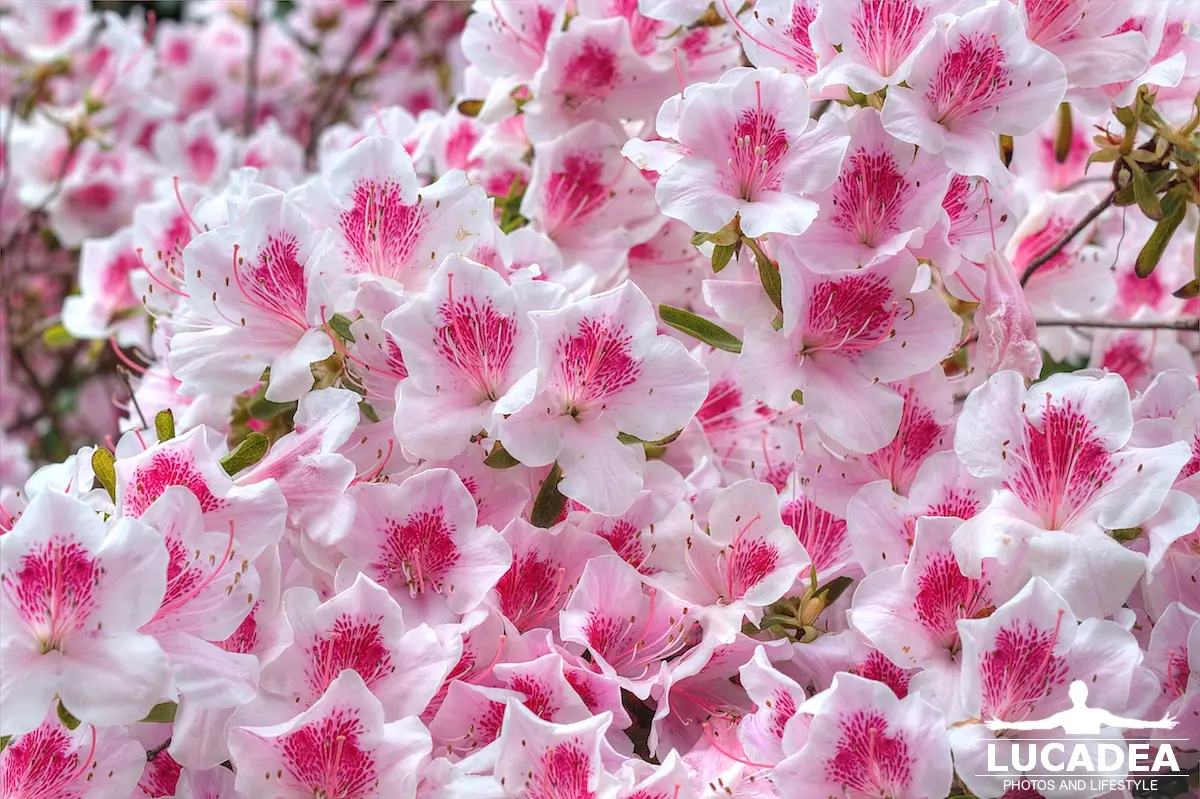
A few days ago, while walking my dog, I came across this beautiful azalea and stopped to take a closer look. There were so many white and pink flowers among the leaves that almost the entire plant seemed to have turned into one large patch of color. It was one of those ordinary moments that suddenly makes you want to take out a camera.
This photograph came from a completely normal walk. I had not gone out looking for something to photograph and I was not heading towards any particular place. Then I noticed the azalea, and the sheer number of flowers made me slow down. From close up, I could see the different shades of the petals, while from a little farther away the whole plant looked almost like a single, enormous bloom.
When photographing a flower, I often find myself looking for one particular detail. This time, however, I was more interested in the overall effect. There were so many flowers that isolating just one would have lost something important about the scene. I wanted the photograph to keep that feeling of abundance, with white and pink flowers spreading naturally among the leaves.
Azaleas belong to the Rhododendron genus and are well known for their abundant flowering. There are many different varieties and colors, but the combination of white and pink is particularly pleasant because the two shades can appear together without making the plant feel visually overwhelming.
What I like about this photograph is that you do not need to know exactly where it was taken to appreciate it. It is simply a plant I happened to find during a walk, yet at that particular moment it was impossible to ignore. Hundreds of small flowers together can turn something completely ordinary into an interesting photographic subject.
Walking my dog often gives me the chance to notice details that I would probably miss if I were simply moving from one place to another. Photography has that effect on me as well: it makes me slow down and look more carefully at things that would normally remain in the background. This azalea was one of those small discoveries.
I particularly like the contrast between the flowers and the green parts of the plant. The foliage creates a quiet background for the blossoms, while having white and pink flowers together keeps the flowering from looking too uniform. There was no need to add anything to the scene. The subject was already complete.
This was not a photograph taken during a trip or in front of a famous landmark. It is a much simpler image, connected to an ordinary moment in everyday life. And perhaps that is exactly why it belongs on this photo blog: not every photograph has to be about a distant place. Sometimes what you find close to home during a walk with the dog is enough.
Some of the other photographs on the blog also come from small details I noticed almost by accident. I like keeping that connection because photography is, at least for me, partly about learning to pay attention to things that we would normally overlook.
What caught my attention most about this azalea was the sheer number of flowers. The white and pink were not really two separate elements; they blended naturally into one another and created the impression of a real burst of color. I wanted to preserve that feeling before continuing my walk.
If you are looking for an azalea in bloom, this is also a good reminder that some of the best subjects can appear in completely unexpected places. You do not necessarily need a botanical garden or a carefully planned visit. Sometimes a short walk is enough to find something worth photographing.

Have you ever come across a plant in full bloom during an ordinary walk and had to stop to photograph it? Add a comment or go to the bottom of the site to read what other visitors have written.

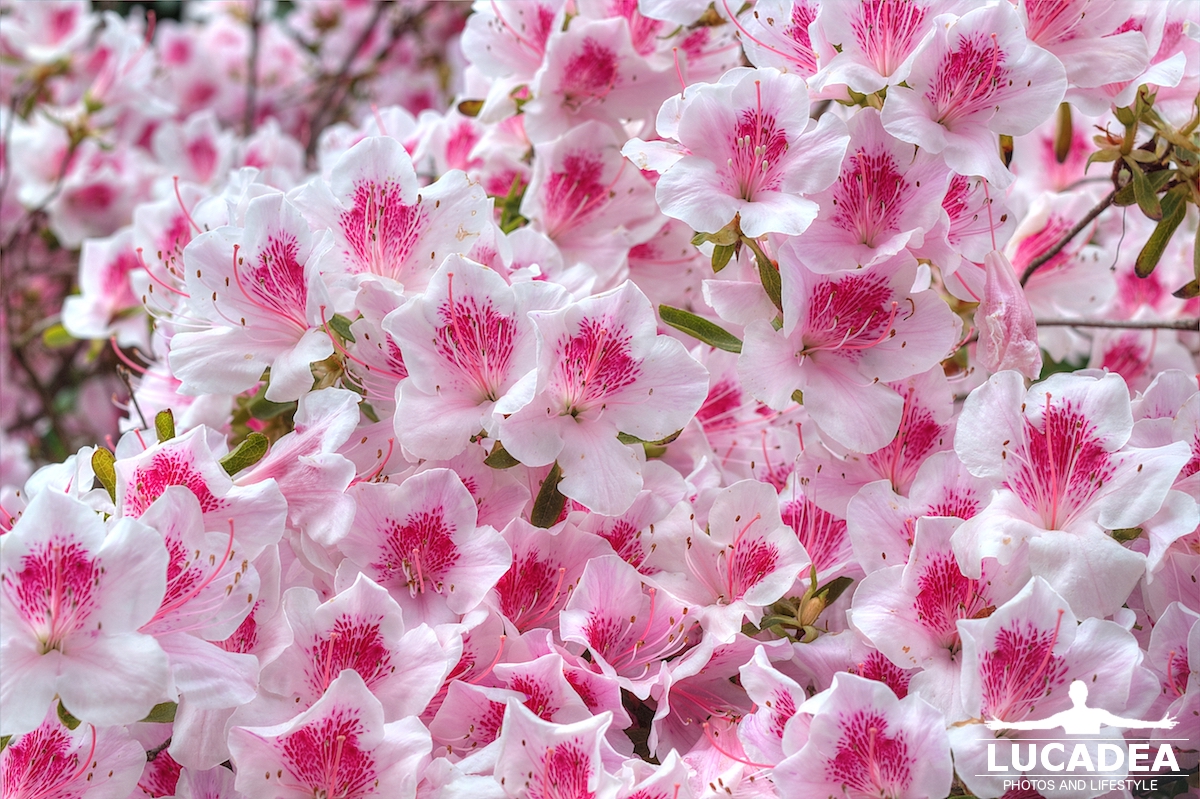
Azalea covered with hundreds of white and pink flowers, photographed during a walk with the dog

Azalea covered with hundreds of white and pink flowers, photographed during a walk with the doge

Photos taken with Canon 600D and Canon EF 40.

Add one  comment to this article or read  here what other visitors have written.
 
Adv
 
Disclamer

The rights on images, videos, choruses, text and all other material on the LUCADEA.com website are governed as per  Copyright page.


This page has been viewed 0 times today.
This month it has been viewed 0 times.
In total it has been viewed 0 times.
 

A woodland flower along the Gromolo stream

Fiore selvatico nel bosco lungo il sentiero del torrente Gromolo vicino a Sestri Levante

A woodland flower along the Gromolo stream.
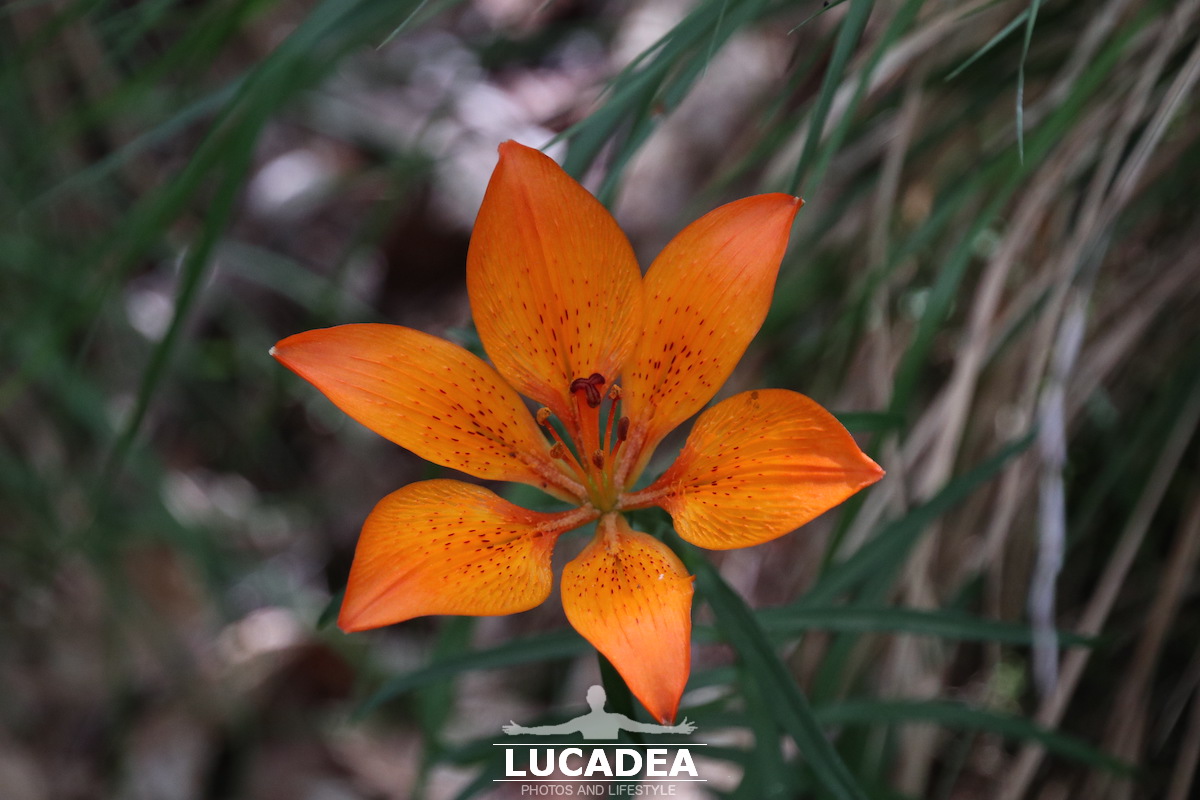
Walking along the path leading to the springs of the Gromolo stream, in Sestri Levante, Liguria, Italy, I came across this small flower that immediately caught my attention because of the contrast with the surrounding landscape. Hidden among the woodland vegetation and the shade of the trees, this wild flower looked almost like a tiny orchid growing quietly along the trail.
I took this photograph some time ago during one of those walks where I am not necessarily looking for famous views, but simply observing the small details that nature places along the way. I enjoy capturing these unexpected encounters because the simplest subjects are often the ones that remain in memory the longest.
The path towards the Gromolo stream springs crosses a green area where the sound of water and the presence of the forest accompany the walk. In this environment, where sunlight reaches the ground filtered through the vegetation, finding such a particular flower was a small but memorable discovery. Its shape reminded me of an orchid, even though it was simply one of the many examples of the rich wild flora found in local woodlands.
This photograph comes from that curiosity: stopping to capture a detail that could easily go unnoticed. A woodland flower does not need to grow in a carefully maintained garden to be beautiful; sometimes the natural setting where it appears is what makes it truly interesting.
One curious detail is that many wild flowers growing in Ligurian forests have developed specific adaptations to survive in areas with limited light, competition from other plants, and seasonal changes. Every part of the vegetation follows its own balance, something that is often invisible during a simple walk.
This image connects with other photographic stories I have shared about trails and green areas around Sestri Levante, because even the landscape close to home continues to offer unexpected subjects to photograph. Sometimes there is no need to travel far to discover something worth capturing.
Nature still has the ability to surprise us with shapes and colors that seem almost designed to attract our attention.

Have you ever stopped to photograph a small natural detail that you did not expect to find? Add a comment or go to the bottom of the site to read what other visitors have written.

Wild flower in the woodland along the Gromolo stream trail near Sestri Levante

Wild flower in the woodland along the Gromolo stream trail near Sestri Levante

Photos taken with Canon EOS M100 and lens Tamron 16-300.

Add one  comment to this article or read  here what other visitors have written.
 
Adv
 
Disclamer

The rights on images, videos, choruses, text and all other material on the LUCADEA.com website are governed as per  Copyright page.


This page has been viewed 1 times today.
This month it has been viewed 1 times.
In total it has been viewed 1 times.
 

Strawberry flower captured in macro detail

Fiore della fragola fotografato in macro nel giardino con petali bianchi e dettagli ravvicinati

Strawberry flower captured in macro detail.
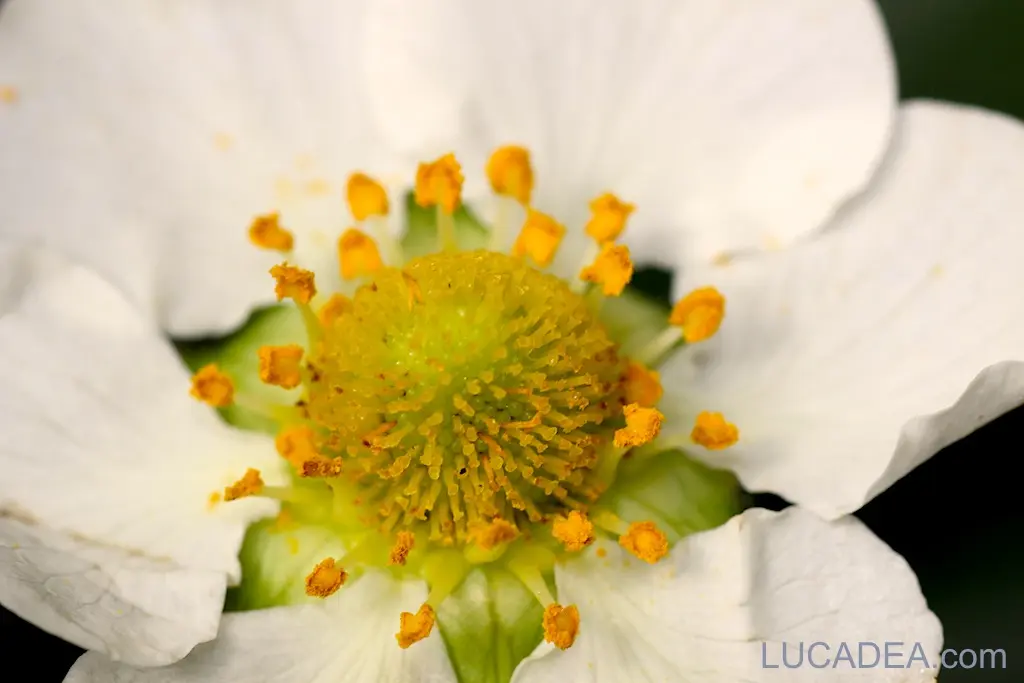
In my garden I found a small subject that immediately caught the attention of my macro lens: the strawberry flower, a delicate detail that is often overlooked compared with the fruit that will appear later. This photograph of a strawberry flower shows the hidden beauty of small natural elements that can be discovered simply by looking more carefully.
Many flowers seem ordinary at first glance, but getting closer with a camera reveals shapes, textures and details that are usually unnoticed. In this case, I wanted to focus on the structure of the strawberry flower, its white petals and the natural form that announces the arrival of the familiar red fruit.
I took this photograph in my garden using a macro lens, a technique that allows me to explore very small subjects and highlight details that are difficult to see with the naked eye. Photography does not always require distant landscapes or famous places. Sometimes the most interesting images are waiting just outside the house.
The strawberry flower is the first step in the process that will eventually produce the strawberries we know and enjoy. Watching this transformation from blossom to fruit is one of the reasons why even a small home garden can become an interesting place for photography.
The strawberry belongs to the Rosaceae family, and its flower usually has five white petals surrounding a central area made of many small reproductive parts. This simple but elegant structure makes it a fascinating subject for close-up photography.
One interesting fact about strawberries is that what we usually consider the fruit is technically not a true fruit. The small seeds visible on the surface are the actual fruits of the plant, while the red and juicy part develops mainly from the enlarged flower base.
On my blog I often share photographs of everyday details because I believe interesting subjects can be found everywhere. Just like the villages, landscapes and small corners I photograph during my travels, a simple flower can also tell a story when observed with attention.
This image of a strawberry flower comes from that curiosity: looking closer, slowing down and discovering that even a small blossom in the garden can become a meaningful photographic subject.

Have you ever photographed a common flower and discovered details you had never noticed before? Add a comment or go to the bottom of the site to read what other visitors have written.

Macro photograph of a strawberry flower in the garden with white petals and fine natural details

Yellow oleander from Peru photographed in the Caribbean

L'oleandro giallo o del Perù fotografato ai Caraibi

Yellow oleander from Peru photographed in the Caribbean.
While walking along a Caribbean beach, I stopped in front of this flower with its intense colors, a detail that I would hardly have found in the same way on a European beach. I do not remember the exact beach where I saw it, but my memory brings me to Antigua, where this yellow oleander caught my attention among sand and tropical vegetation.
Photographing a flower in such a different environment from the ones I usually experience fascinated me because of the contrast between the delicacy of the plant and the surrounding landscape. When we think about the Caribbean, we often imagine only the sea and beaches, but small natural details, like a flower discovered almost by chance, can make a place truly memorable.
The yellow oleander from Peru, also known as Thevetia peruviana or Cascabela thevetia, is an ornamental plant with characteristic yellow trumpet-shaped flowers. After taking this picture, I searched for information and thought this could be the species I had photographed, although corrections from anyone with deeper botanical knowledge are always welcome.
This Caribbean flower stayed in my memory because it represents the kind of unexpected encounter that makes a photograph more personal. I was not looking for a specific botanical subject; I simply stopped because something caught my eye.
The image was born from a simple moment, far from the most typical travel subjects. A small flower on a beach can tell a story just as much as a wide landscape.
It reminded me of another article on the site about natural details discovered during my travels, because in that case too, small elements became the real protagonists of the image.
A small curiosity is that Thevetia peruviana belongs to the same botanical family as the common oleander, but it is native to tropical areas of the Americas and is often cultivated because of its beautiful flowers.

Have you ever photographed a natural detail that you discovered almost by chance during a journey? Add a comment or go to the bottom of the site to read what other visitors have written.

Photos taken with Honor 20.

Thevetia peruviana (Peruvian oleander), also known as yellow oleander, is a plant native to South America. It belongs to the Apocynaceae family. It can be grown both as a shrub and as a small tree.
Continue and learn more at lerosedifirenze.com

Yellow oleander from Peru photographed in the Caribbean – Laurier jaune du Pérou photographié dans les Caraïbes – Adelfa amarilla del Perú fotografiada en el Caribe – Oleandro amarelo do Peru fotografado no Caribe – Gelber Oleander aus Peru in der Karibik fotografiert – Hoa trúc đào vàng Peru được chụp ở Caribe – 加勒比拍摄的秘鲁黄夹竹桃 – カリブ海で撮影したペルーキョウチクトウ

The text of this post was written with the help of ChatGPT, a language model from OpenAI.

The flower called pansy

La viola del pensiero

The flower called pansy.
The pansy, scientifically known as Viola tricolor, is one of the most beloved and cultivated flowering plants in gardens around the world. Belonging to the Violaceae family, this flower is prized not only for its colorful beauty but also for its profound cultural symbolism.
The pansy is an annual or perennial herbaceous plant, depending on the climate. It grows to a height of about 15-20 cm and forms a rosette of oval, serrated basal leaves. The flowers, which bloom from early spring until autumn, are known for their variety of colors, including shades of purple, blue, yellow, white, and even black.
Each flower has five petals: the two upper petals are often a different color than the three lower ones, creating an eye-catching contrast reminiscent of a smiling face, hence the name “pansy.” This unique appearance is one of the reasons the pansy is so popular among gardeners.
Pansies are relatively easy to grow and require little care. Here are some tips for successful cultivation:
1. **Location**: It prefers sunny or partially shaded locations. Adequate sunlight helps promote abundant flowering.
2. **Soil**: It prefers fertile, well-drained soil rich in organic matter. It is helpful to add compost to the soil before planting.
3. **Watering**: It should be watered regularly, keeping the soil moist but not soggy. It is important to avoid allowing the soil to dry out completely between waterings.
4. **Fertilizer**: A balanced fertilizer can be applied monthly during the growing season to encourage flower development.
5. **Pruning**: Removing faded flowers stimulates the production of new buds and prolongs the flowering period.
Pansies have a long history of symbolism that varies from culture to culture. Generally, it is often associated with thought, memory, and love.
In the language of flowers, the pansy is often associated with affectionate thoughts and romantic feelings. Giving it as a gift means saying “I’m thinking of you” or “You’re on my mind.”
Thanks to its ability to bloom for long periods, it is also a symbol of reflection and lasting memory. It is often planted in memorial gardens.
In Christian tradition, the pansy is seen as a symbol of the Trinity, due to its shape resembling three faces in one.
The pansy is versatile and can be used in a variety of ways in the garden: it is perfect for creating colorful borders and filling flowerbeds with its vibrant flowers; grown in pots and containers, the pansy adds color to terraces and balconies. Thanks to its compact size, it is also ideal for rock gardens.

Do you like this flower? Add a comment or go to the bottom of the site to read what other visitors have written.

Photos taken with Canon EOS RP camera and Tamron 16-300 lens.

The nursery I visited was: Vivai Gaggero in Carasco.

The pansy (Viola tricolor L.), also called the tricolor viola, is a plant in the Violaceae family,[1] known primarily for its flowers. It is very common in Europe, growing as a wild, perennial plant. It was introduced to North America, where it has become widespread. It is the ancestor of the cultivated pansy (Viola × wittrockiana), and is therefore sometimes called the wild pansy to distinguish it from the hybrid variety that is widely grown for ornamental purposes.
Continue and learn more at Wikipedia

The flower called pansy – La fleur appelée pensée – La flor llamada pensamiento. – A flor chamada amor-perfeito – Die Blume heißt Stiefmütterchen – Loài hoa có tên là Pansy

The text of this post was written with the help of ChatGPT, a language model from OpenAI.

The bird of paradise flower in Colombo avenue

Il fiore uccello del paradiso fotografato in Corso Colombo a Sestri

The bird of paradise flower in Colombo avenue.
Last year, strolling along Corso Colombo in my hometown of Sestri Levante, I spotted this beautiful flower in the flowerbeds.
The Bird of Paradise flower, scientifically known as Strelitzia reginae, is an exotic ornamental plant that captures attention for its extraordinary beauty and unique shape, reminiscent of a bird in flight. Native to South Africa, this flower is widely cultivated in gardens and greenhouses worldwide, thanks to its hardiness and visual impact.
Strelitzia reginae belongs to the Strelitziaceae family and is an evergreen perennial. It can reach a height of 1–1.5 meters, with large, leathery, dark green leaves that are oval-lanceolate in shape. The leaves are arranged alternately along the stem, creating a visual effect similar to that of bananas, to which Strelitzia is closely related.
The true wonder of Strelitzia reginae lies in its flower. The plant produces a spike-shaped inflorescence, composed of a bluish-green involucre called a spathe, containing five to seven individual flowers. Each flower consists of three bright orange sepals and three deep blue petals. The petals, arranged to resemble the crest and beak of an exotic bird, give the plant its common name, Bird of Paradise.
Strelitzia reginae usually blooms in spring and summer, but in favorable weather conditions it can bloom several times a year. The flowers are long-lasting, both on the plant and as cut flowers, making them ideal for floral arrangements and decorations.
Strelitzia reginae is a relatively easy plant to grow, provided that some basic conditions are met. It prefers a warm, sunny climate, with temperatures never falling below 10-12°C. It is a highly drought-resistant plant, but for optimal growth, it is important to provide regular irrigation during the growing season, while avoiding waterlogging, which could cause root rot.
The ideal soil for Strelitzia reginae is well-drained and rich in organic matter. During spring and summer, it is advisable to fertilize the plant every 4-6 weeks with a balanced fertilizer to encourage flowering. The plant can be grown both in the ground, in gardens in regions with mild climates, and in pots, so it can be sheltered in a greenhouse or indoors during the colder months in regions with harsh winters.
The Bird of Paradise flower is often associated with positive symbolic meanings, such as freedom, exotic beauty, and joy. Thanks to its unique shape and bright colors, it is highly prized as an ornamental plant in public and private gardens, and as a cut flower for floral decorations.
In the garden, Strelitzia reginae can be used as a focal plant, in groups to create exotic effects, or along the edges of flowerbeds. In a pot, it is ideal for decorating terraces, balconies, and bright interiors. Cut flowers are highly sought after by florists for their enduring beauty and ability to add a touch of exoticism to any floral arrangement.
Scientific name: The plant is named after Queen Charlotte of Mecklenburg-Strelitz, wife of King George III of the United Kingdom.
Pollination: In its natural habitat, Strelitzia reginae is pollinated by birds of the Nectarinia genus, which land on the flower and, searching for nectar, transfer pollen from one flower to another.

Are you familiar with this flower? Add a comment or go to the bottom of the site to read what other visitors have written.

Il fiore uccello del paradiso fotografato in Corso Colombo a Sestri

Il fiore uccello del paradiso fotografato in Corso Colombo a Sestri

Photos taken with Canon EOS RP and lens Canon RF 24-50.

The bird of paradise flower photographed in Corso Colombo in Sestri – La fleur de l’oiseau de paradis photographiée sur le Corso Colombo à Sestri – La flor ave del paraíso fotografiada en Corso Colombo en Sestri – A flor ave do paraíso fotografada no Corso Colombo em Sestri – Die Paradiesvogelblume, fotografiert im Corso Colombo in Sestri – Chim hoa thiên đường chụp ảnh ở Corso Colombo ở Sestri

The text of this post was written with the help of ChatGPT, a language model from OpenAI.

A beautiful yellow Asiatic lily

Un bellissimo giglio asiatico giallo

A beautiful yellow Asiatic lily.
Another photo of a beautiful flower, this time a beautiful yellow lily, I think it’s beautiful.

Do you like this flower?
Add a comment or go to the bottom of the site to read what other visitors have written.

Un bellissimo giglio asiatico giallo

Photo taken with Canon EOS RP camera and Tamron 16-300 lens.

The nursery I visited was: Vivai Gaggero in Carasco.

Lilies, commonly known as lilies, are grown mostly as ornamental plants, in gardens for the elegance and scent of their erect stems, in pots for terraces, and industrially for cut flower production.
Continue and learn more at giardinaggio.it

A beautiful yellow Asiatic lily – Un beau lys asiatique jaune – Un hermoso lirio asiático amarillo – Um lindo lírio asiático amarelo – Eine wunderschöne gelbe asiatische Lilie – Một bông huệ châu Á màu vàng tuyệt đẹp

A bumblebee on a flower in Norway

Un bombo su un fiore in Norvegia

A bumblebee on a flower in Norway.
Some time ago, while walking along the paths behind the town of Geiranger in Norway, I saw this beautiful bumblebee sucking nectar from a flower and tried to photograph it.
I adore bumblebees; they are one of my favorite insects (as well as being one of the most useful to the planet).

Do you know the bumblebee? Add a comment or go to the bottom of the site to read what other visitors have written.

Un bombo su un fiore in Norvegia

Photo taken with Canon EOS RP camera and Tamron 16-300 lens.

Like bees, bumblebees collect nectar and pollen for nutrition. They are among the most important and useful pollinating insects for the ecosystem. Generally larger than common bees, bumblebees are characterized by a yellow and black livery, with bands of varying widths depending on the species; some species are all black or have orange bands.
Continue and learn more on Wikipedia

A bumblebee on a flower in Norway – Un bourdon sur une fleur en Norvège – Un abejorro sobre una flor en Noruega – Uma abelha numa flor na Noruega – Eine Hummel auf einer Blume in Norwegen – Một con ong đậu trên một bông hoa ở Na Uy

The yellow of strawflower at Gaggero nursery

Il giallo dell’elicriso al vivaio Gaggero

The yellow of the helichrysum at the Gaggero nursery.
There are flowers that don’t ask for attention, but get it anyway. I photographed the yellow helichrysum bracteantha like this, almost by chance, during a visit to the Gaggero nursery. Yet, looking back at the photo, I realized that everything else had faded into the background. That yellow wasn’t just a color: it was a presence. Dry, clear, luminous, without any concessions to delicacy. A flower that seems made specifically to endure, rather than to please.
The photo was taken among other vases, other shapes, other shades of green. But the helichrysum stands out immediately. Its rigid, almost papery petals reflect the light uniformly, as if they had been precisely cut. There is no softness, no apparent fragility. Looking at it through the lens, I had the feeling that it was a flower out of time, one of those you could find identical days, weeks later, without anything seeming to have changed.
Shooting in a nursery is always special. You’re not in a “natural” environment in the romantic sense of the word, but in a space where nature is cared for, observed, and accompanied. At the Gaggero nursery, this feeling is even more evident: everything is orderly, but never cold. Walking among the rows, photography almost becomes an exercise in attention. You have to choose what to narrate, what to isolate from the context. In this case, it was the flower that chose me.
The Helichrysum bracteantha, often called straw flower, has a characteristic that makes it immediately recognizable: it doesn’t wilt like other flowers. Even once cut, it retains its shape and color, which is perhaps why it’s associated with the idea of ​​duration, of memory. Without needing to know it beforehand, this feeling comes to you anyway, looking at it. It’s a flower that doesn’t fade quickly, that endures.
In the photograph, yellow becomes almost absolute. It’s not a shy yellow, but full, compact. Amidst the greenery of the nursery, it seems like a small declaration of presence, something that says “I’m here” without raising its voice. And it’s precisely this balance between strength and silence that pushed me to stop, focus, and shoot.
Perhaps this is also why I love photographing flowers in contexts like this: because they convey a tangible, everyday beauty that doesn’t need to be spectacular. You just have to look at it.

Has it ever happened to you that a seemingly simple flower could capture your attention more than an entire panorama?
Add a comment or go to the bottom of the site to read what other visitors have written.

Il giallo dell’elicriso al vivaio Gaggero

Photo taken with Canon EOS RP camera and Canon RF 50 lens.

The nursery I visited was: Vivai Gaggero in Carasco.

The genus name derives from two Greek words “helios” (= sun) and “chrysos” (= gold) and refers to the brightness of the flower heads. The specific epithet (italicum) derives from Italian. The common name, Perpetuini, comes from the flower heads of these plants, which have some of the involucral scales dry and scarce that persist unchanged for a long time.
Continue and learn more at Wikipedia

The yellow of strawflower at Gaggero nursery – Le jaune de l’hélichryse au pépinière Gaggero – El amarillo de la siempreviva en el vivero Gaggero – O amarelo da bracteantha no viveiro Gaggero – Das Gelb der Strohblume in der Gärtnerei Gaggero – Sắc vàng của hoa bất tử tại vườn ươm Gaggero – 加盖罗苗圃里的黄色蜡菊 – ガッジェロ園芸場の黄色いムギワラギク

The text of this post was written with the help of ChatGPT, a language model from OpenAI.

The lemon blossom in the foreground

Fiore di limone (zagara) fotografato in macro con petali bianchi e dettagli delicati

The lemon blossom in the foreground.
Some flowers immediately strike you with their color, others with their shape. The lemon blossom, however, has always struck me with its subtlety. In the photo, getting as close as possible, I tried to capture precisely this: the simplicity of the white petals, the lightness of the almost fragile structure, and that sensation of delicacy that seems like it could vanish at any moment.
Observed closely, the lemon blossom in the foreground reveals details that often go unnoticed by the naked eye. The center of the flower, with its yellow hues, creates a soft contrast with the white of the petals. It’s not a sharp contrast, but something more natural, revealed slowly. Light also plays a fundamental role: when it’s right, it can bring out every little detail without weighing down the image.
There’s one thing I’ve always found curious: the lemon blossom isn’t a flower you often give as a gift. Perhaps because, in some way, it represents a promise rather than a result. It’s the beginning of something, the transition that will lead to the fruit. And indeed, thinking of a ripe lemon, it’s hard to imagine that everything starts with such a small and delicate flower.
When taking this photo, I focused on precisely this aspect. Not so much the aesthetic value of the flower itself, but what it represents. A precise, temporary moment, yet one that already contains everything that will come after. It’s one of those images that work just like that: without needing to be flashy, but capable of telling a story.
A brief detail I like to recall is the scent of the orange blossom. Even if you can’t smell it in a photo, anyone who’s smelled it at least once knows how intense and recognizable it is. It’s one of those scents that immediately bring to mind summer, the sun, and perhaps a garden full of citrus fruits.
Looking at this image, I almost instinctively slow down. Stop for a moment and observe, without haste, something that would normally go unnoticed.

Have you ever noticed how fascinating such a simple flower can be when seen up close?
Add a comment or go to the bottom of the site to read what other visitors have written.

Fiore di limone (zagara) fotografato in macro con petali bianchi e dettagli delicati

Lemon blossom in close-up – Fleur de citronnier en gros plan – Flor de limón en primer plano – Flor de limão em primeiro plano – Zitronenblüte in Nahaufnahme – Hoa chanh chụp cận cảnh – 柠檬花特写 – レモンの花のクローズアップ

The text of this post was written with the help of ChatGPT, a language model from OpenAI.

🏠
  • Italiano