

Genovese cima, a taste of Ligurian tradition.
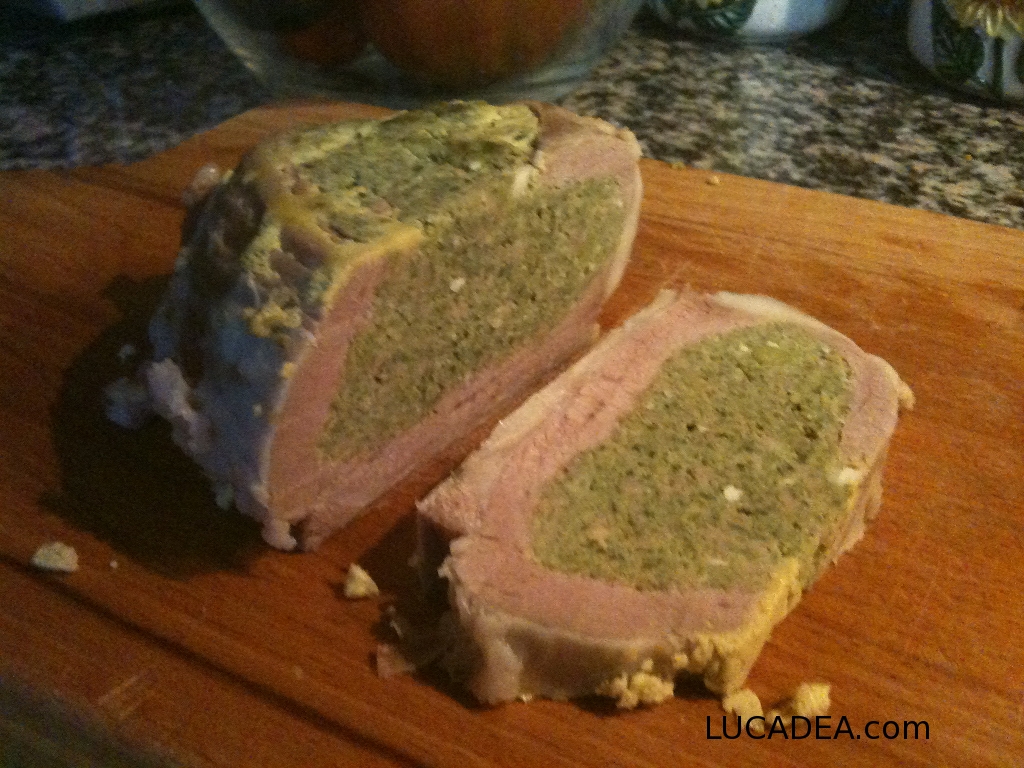
A slice of cima immediately brings to mind the kind of Ligurian cooking that relies on simple ingredients, careful preparation and recipes passed down through generations. This particular dish has an even more personal connection for me because the cima in the photograph was prepared by my mother.
Cima, also known locally as cimma, is one of the traditional dishes most closely associated with Genoa and Liguria. At first glance, it may look like nothing more than a slice of stuffed meat, but cutting into it reveals something much more interesting. The filling creates a pattern of colours and textures, with each ingredient contributing to the appearance as well as the flavour.
I took this photograph because I wanted to preserve that moment before the dish disappeared from the table. In this case, the subject is not simply a traditional Ligurian recipe. It is also part of home cooking and of the memories connected with family meals, which makes the photograph more personal than a picture taken in a restaurant.
Genovese cima is particularly associated with Genoa, Liguria, Italy, although variations can be found throughout the region. If you are wondering what to eat in Liguria to discover something genuinely connected with local traditions, cima is certainly one of the dishes worth knowing. It shows how Ligurian cooking can turn relatively ordinary ingredients into a carefully prepared dish.
The most recognisable feature is the pocket of meat. Traditionally, a piece of veal is opened, filled and then sewn closed before cooking. The filling can include eggs, herbs, pine nuts and other ingredients, with recipes changing according to family traditions and local habits. Once cooked, the cima is allowed to cool before being sliced.
The slice itself is what makes the dish particularly interesting from a photographic point of view. The meat surrounds a compact but varied filling, while the egg helps create the characteristic structure and the other ingredients appear as small details throughout the slice. No two homemade versions necessarily look exactly alike, especially when family recipes are involved.
One small historical detail I find interesting is that cima was not originally conceived simply as an elaborate or luxurious dish. Its roots are connected with domestic cooking and the practical use of available cuts of meat and ingredients. Over time, that practical preparation became part of Ligurian culinary tradition. It is often this kind of everyday cooking, shaped by necessity and then preserved through generations, that gives a regional dish its strongest identity.
For this photograph, I did not have to find a restaurant or trattoria to experience an example of Genoese cooking. I only had to wait for my mother to prepare her cima. That is probably one of the reasons I like the image so much. Behind the dish there is not only a recipe, but also a person, a kitchen and a familiar habit repeated over time.
Cima is also a very rewarding subject to photograph because its appearance changes completely once it is sliced. Before cutting, the preparation looks compact and relatively simple. On the plate, however, the cross-section becomes almost like a small edible mosaic, revealing the ingredients hidden inside.
I have written about Ligurian food several times on my blog, from dishes enjoyed in local restaurants to recipes connected with my own experiences. This photograph fits naturally into those stories because it shows another side of the same culinary tradition: not the restaurant version, but the one that comes from a family kitchen.
Looking at this image, I think the main goal was achieved: to make the viewer a little hungry. Genovese cima is one of those dishes that can be difficult to ignore once it reaches the table, especially when it has been prepared following a family recipe.
Have you ever tasted Genovese cima, perhaps prepared according to a family recipe? Add a comment or go to the bottom of the site to read what other visitors have written.
The rights on images, videos, choruses, text and all other material on the LUCADEA.com website are governed as per Copyright page.


