The plaque under Vacca Gate in Genoa

La lapide affissa sotto Porta dei Vacca a Genova

The plaque attached under Vacca Gate in Genoa.
Walking through the historic center of Genoa, Liguria, Italy, it is always possible to discover small fragments of history hidden among the narrow streets and ancient buildings. One of these is the plaque located under Vacca Gate, one of the most important entrances to the old city and the starting point of the famous Via del Campo.
When I photographed it, I initially thought it was simply an inscription connected with the history of the medieval gate. Its position seemed to suggest exactly that: a testimony related to the construction or events involving one of the city’s ancient entrances.
Only later, while looking for more information, I discovered that this plaque actually refers to a very important episode in Genoa’s history: the victory over the Republic of Pisa in the famous Battle of Meloria in 1284.
That naval battle was one of the decisive events in the long rivalry between the two Maritime Republics. The Genoese victory marked the decline of Pisa’s power and strengthened Genoa’s role as a major maritime force in the Mediterranean.
The plaque was connected with the presence, in this area, of some chains taken from the defeated Pisa harbor. These elements were brought to Genoa as symbols of victory and represented a trophy from the great naval battle.
Once again, I found myself facing one of those small discoveries that make walking through Genoa’s historic center so fascinating. A simple object, almost hidden from the eyes of passers-by, can tell centuries of history, wars, trade, and rivalries between great maritime cities.
This is exactly what Genoa is like: behind every corner, under an old doorway, or along a narrow alley, you can find a testimony of its glorious past.

Did you know about this plaque under Vacca Gate and its connection with the Battle of Meloria? Add a comment or go to the bottom of the site to read what other visitors have written.

Historical plaque under Vacca Gate in Genoa historic center

Photo taken with Canon EOS RP and lens Canon RF 24-50.

For more information on the plaque and the door, I refer you to the beautiful site: dearmissfletcher.com.

Here’s where the door is:

Add one  comment to this article or read  here what other visitors have written.
 
Adv
 
Disclamer

The rights on images, videos, choruses, text and all other material on the LUCADEA.com website are governed as per  Copyright page.


This page has been viewed 1 times today.
This month it has been viewed 1 times.
In total it has been viewed 1 times.
 

The Latin inscription on a doorway in Via del Campo

La scritta latina su un portone in Via del Campo

The Latin inscription on a doorway in Via del Campo.
While walking along the famous Via del Campo in the historic center of Genoa, I found this beautiful doorway with a Latin inscription:

NOT OMNIA – SED BONA ET BENE

Meaning: Not everything, but good and well done.

Add a comment or go to the bottom of the site to read what other visitors have written.

La scritta latina su un portone in Via del Campo

La scritta latina su un portone in Via del Campo

Photos taken with Canon EOS RP and lens Canon RF 24-50.

The Latin writing on a door in Via del Campo in Genoa – L’écriture latine sur une porte de la Via del Campo à Gênes – La escritura latina en una puerta en Via del Campo en Génova – A escrita latina em uma porta na Via del Campo, em Gênova – Die lateinische Schrift auf einer Tür in der Via del Campo in Genua – Dòng chữ Latinh trên cánh cửa ở Via del Campo ở Genoa – 热那亚 Via del Campo 门上的拉丁文 – ジェノヴァのカンポ通りのドアに書かれたラテン語の文字
Add one  comment to this article or read  here what other visitors have written.
 
Adv
 
Disclamer

The rights on images, videos, choruses, text and all other material on the LUCADEA.com website are governed as per  Copyright page.


This page has been viewed 1 times today.
This month it has been viewed 1 times.
In total it has been viewed 3 times.
 

Testa Gate, the historic entrance of Finalborgo

Porta Testa a Finalborgo vista dall’esterno e dall’interno con mura e architettura storica ligure

Testa Gate, the historic entrance of Finalborgo.
Among the places to see in Finalborgo, Liguria, the ancient gates are some of the elements that best reveal the history of this medieval village. This photograph shows Testa Gate in Finalborgo, part of Finale Ligure, Liguria, Italy, captured from two viewpoints, outside and inside, showing one of the most recognizable entrances to the historic centre.
While walking along the old walls of Finalborgo, I stopped to photograph this passage because it still preserves the character of the defensive architecture that surrounded the village. Passing through Testa Gate means moving between two different perspectives of the same place: the outside landscape and the narrow historic streets that lead towards the heart of the village.
I wanted to capture this monument with my camera because historic gates have always fascinated me. They are not only architectural structures built for protection, but also symbolic points where the outside world meets the identity of a town. The two photographs, one taken before entering and one after passing through the gate, show how the same place can change depending on the direction from which it is observed.
If you are visiting Finalborgo, Testa Gate is definitely one of the places worth seeing. Together with Royal Gate, it represents one of the main historic entrances to the village and introduces visitors to a centre filled with medieval walls, historic buildings, squares and narrow lanes.
Finalborgo is located in Finale Ligure, in the province of Savona, Liguria, Italy, and still maintains the structure of a fortified medieval village. A short historical curiosity is that its walls and gates were part of a defensive system created to protect the town and regulate access to the capital of the Marquisate of Finale, ruled for centuries by the Del Carretto family.
Testa Gate is a monument that does not need elaborate decorations to tell its story. Its shape, position and connection with the surrounding walls are enough to make visitors understand the importance of this entrance and the historical role of Finalborgo.
This photograph comes from my passion for Liguria and from the pleasure of discovering places while walking slowly. As with my photographs of San Biagio Basilica, the Courthouse Palace and the streets of Finalborgo published on Lucadea.com, this image focuses on a detail that often represents the first encounter with the village.
Well preserved and still part of the daily path through the historic centre, Testa Gate continues to be one of the symbols of Finalborgo. Walking through it means entering a place where history remains visible in the stones, streets and buildings that surround it.

Which historic gate or entrance has left the strongest impression on you during a visit? Add a comment or go to the bottom of the site to read what other visitors have written.

Testa Gate in Finalborgo viewed from outside and inside with medieval walls and historic Ligurian architecture

Porta Testa a Finalborgo

Photos taken with Canon EOS M100 and Canon EF-S 10-18 lens.

I took dozens of photos in the beautiful town on the western coast of Italy. Click here to see them all:
foto gallery

Porta Testa has inscriptions in Gothic characters on the arch and the coat of arms of Giovanni I del Carretto, along with the construction date of June 10, 1452.
Continue at turismo.comunefinaleligure.it

The Delle Saline Gate in Rapallo

La meravigliosa Porta delle Saline a Rapallo

The Delle Saline Gate in Rapallo.
At the end of the seafront promenade, I stopped once again in front of this old gate leading directly into the heart of the historic center. The Delle Saline Gate is one of those details in Rapallo that can easily be overlooked, yet it is one of the places I think is worth noticing while walking through the town.
I took this photograph myself during a walk through Rapallo. What caught my attention was the way the gate marks the transition between two very different environments. On one side there is the open seafront and the sea; on the other, the narrow streets and more intimate atmosphere of the historic center. It is a physical threshold, but also a small place where the town’s history remains part of everyday life.
If you are wondering what to see in central Rapallo, the Delle Saline Gate is certainly a detail I would include in a walk through the town. It stands at the end of the seafront promenade, right where the historic center begins, and walking through it brings you almost immediately into the older part of Rapallo.
Rapallo is in Liguria, in the Metropolitan City of Genoa, Italy, and several elements of its historic center still make it possible to recognize the structure of the old town. The Delle Saline Gate is one of them. It is not a monument that needs to be viewed from a distance. It is a passage that remains part of the way people move through the city.
That is precisely what I find interesting about it. You do not necessarily need to stop there for a long time. Simply walking through the gate changes the perspective. The sea is suddenly behind you, while the narrow streets of the center begin ahead, with the characteristic atmosphere of Ligurian caruggi.
The name “Delle Saline” is connected with the history of this part of Rapallo and with the activities that once shaped the area. The gate formed one of the entrances towards the inner part of the settlement and remains today as a recognizable reminder of the historic town.
I particularly enjoy photographing it without separating it from its surroundings. In fact, I think the context makes the image more meaningful. An old gate tells a different story when you can see that just a few steps beyond it begins one of the most characteristic parts of the historic center.
This photograph therefore came from a very ordinary walk, without any particular plan to find a special subject. That is often how my local photographs happen. I walk through places I already know, and every now and then something makes me stop, perhaps a subject I have photographed before or simply a familiar place that suddenly looks slightly different.
The Delle Saline Gate is also a good example of how many photographic details can be found very close together in Rapallo. Within a few minutes you can move from the sea into the historic center, from the open promenade into narrow streets, and from broad views to closely packed historic facades.
I have already shared other photographs of Rapallo on the blog, including some fading facade decorations that caught my attention while walking through the town. This image naturally continues that story because the subject is again an element of the everyday urban landscape rather than simply a famous landmark.
Perhaps its slightly hidden position is part of its appeal. Someone walking along the seafront can reach this point and continue without realizing that they are passing through one of the historic entrances to the center. Stopping for a moment and looking more carefully makes all the difference.
When I photograph places like this, I am interested in preserving the relationship between the historic element and the town around it. The Delle Saline Gate is not just something to look at. It is a gate that still forms part of the urban route, connecting the Rapallo of the past with the town people experience today.
It is one of those images I naturally associate with walks through Rapallo because it brings together history, the sea and everyday life in a single view. Perhaps that is one of the best ways to discover the town: not necessarily by searching for grand monuments, but by allowing its quieter corners to catch your attention.

Have you ever walked through the Delle Saline Gate during a visit to Rapallo? Add a comment or go to the bottom of the site to read what other visitors have written.

Delle Saline Gate in Rapallo, an old entrance to the historic center at the end of the seafront promenade

Delle Saline Gate in Rapallo, an old entrance to the historic center at the end of the seafront promenade

Photos taken with Canon EOS RP and lens Canon RF 28.

Where is the door:

It is the only surviving of the five gates of the ancient “walled village,” and owes its name to its proximity to the salt mines, which the Genoese Doria family held a monopoly on. These salt mines operated for many centuries in the flat area near the beach in the center of the gulf.
Continue and learn more at Municipality of Rapallo

Wisteria bloom Sestri Levante

Glicine in fiore a maggio

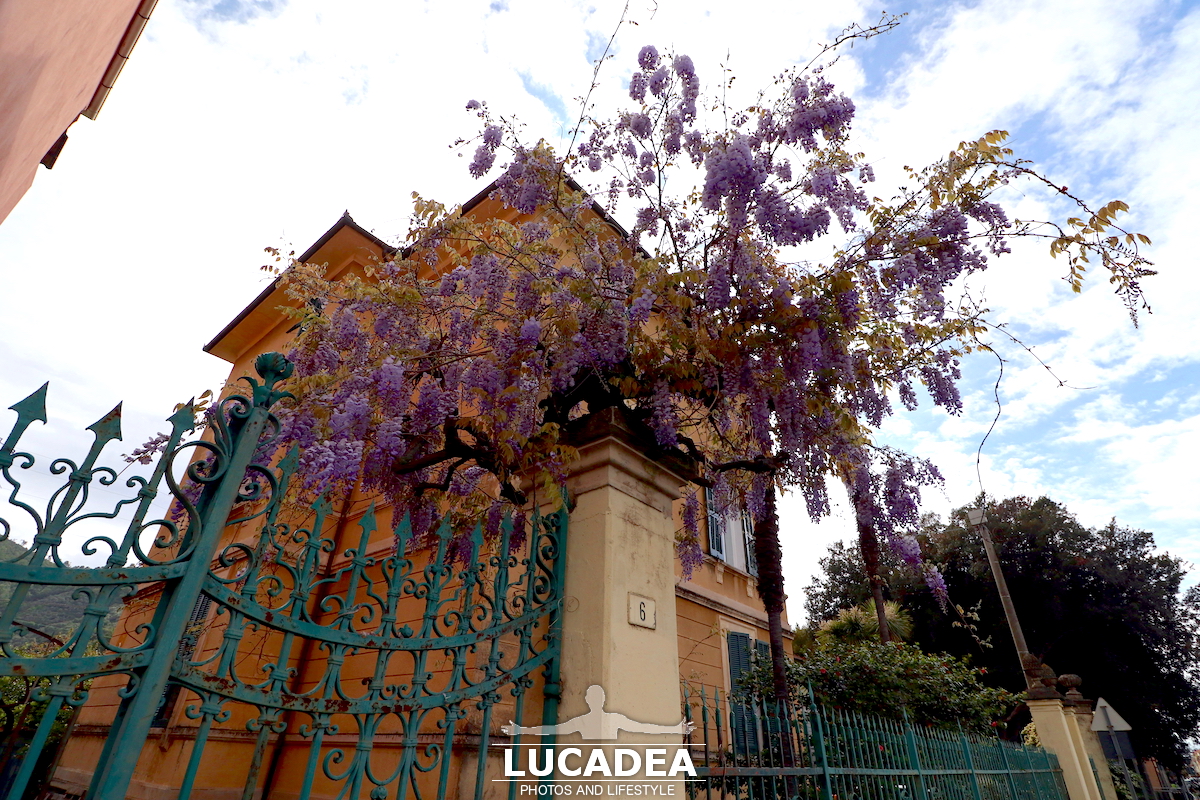
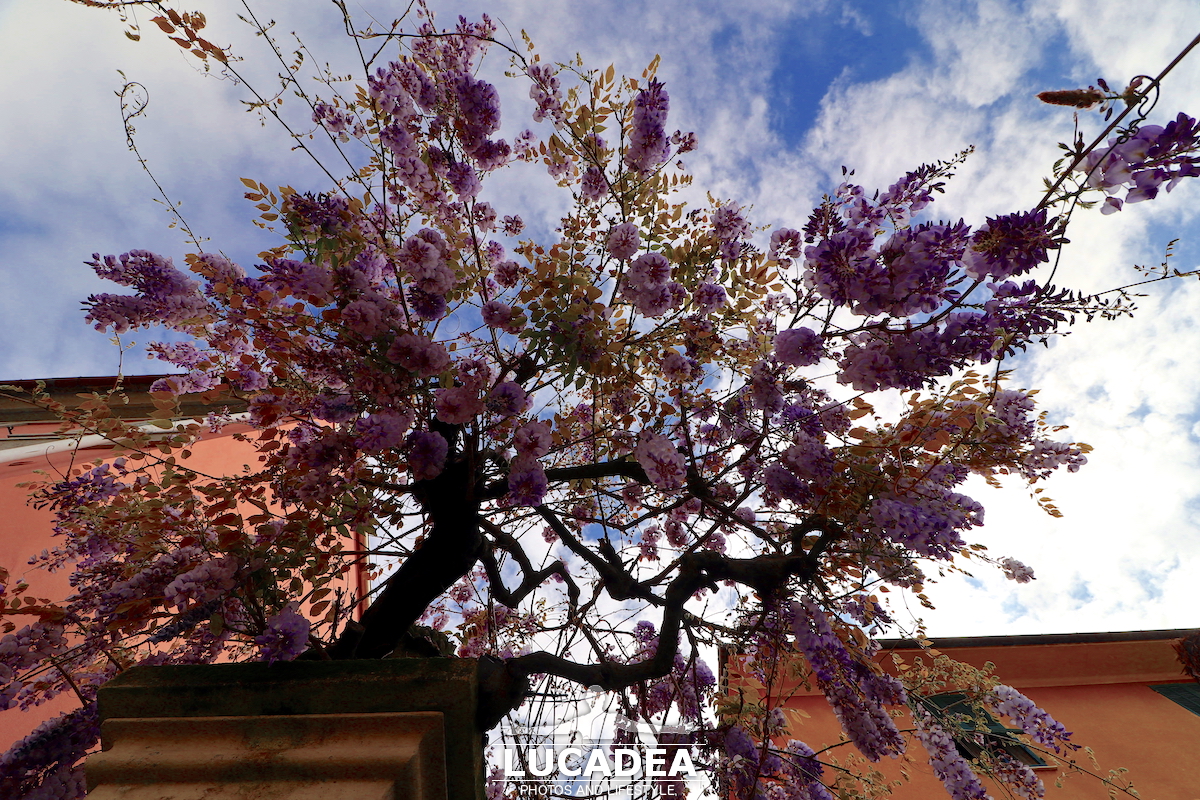
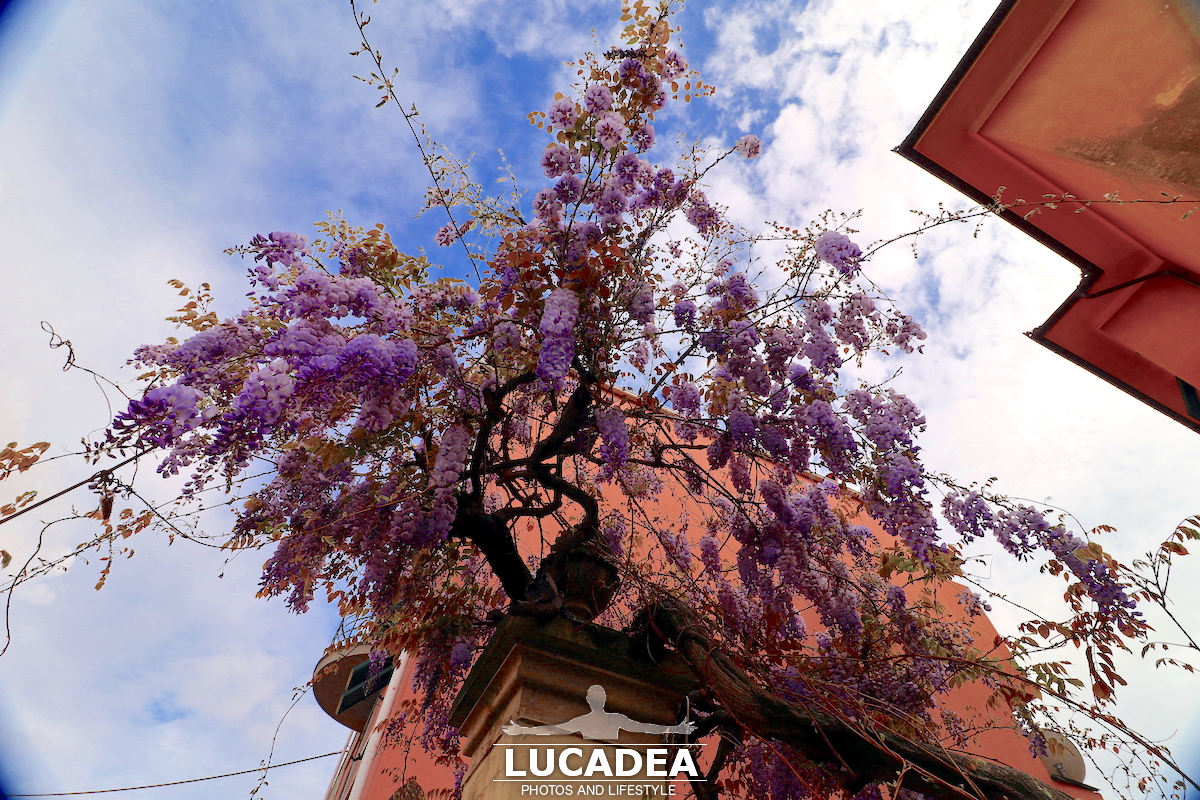
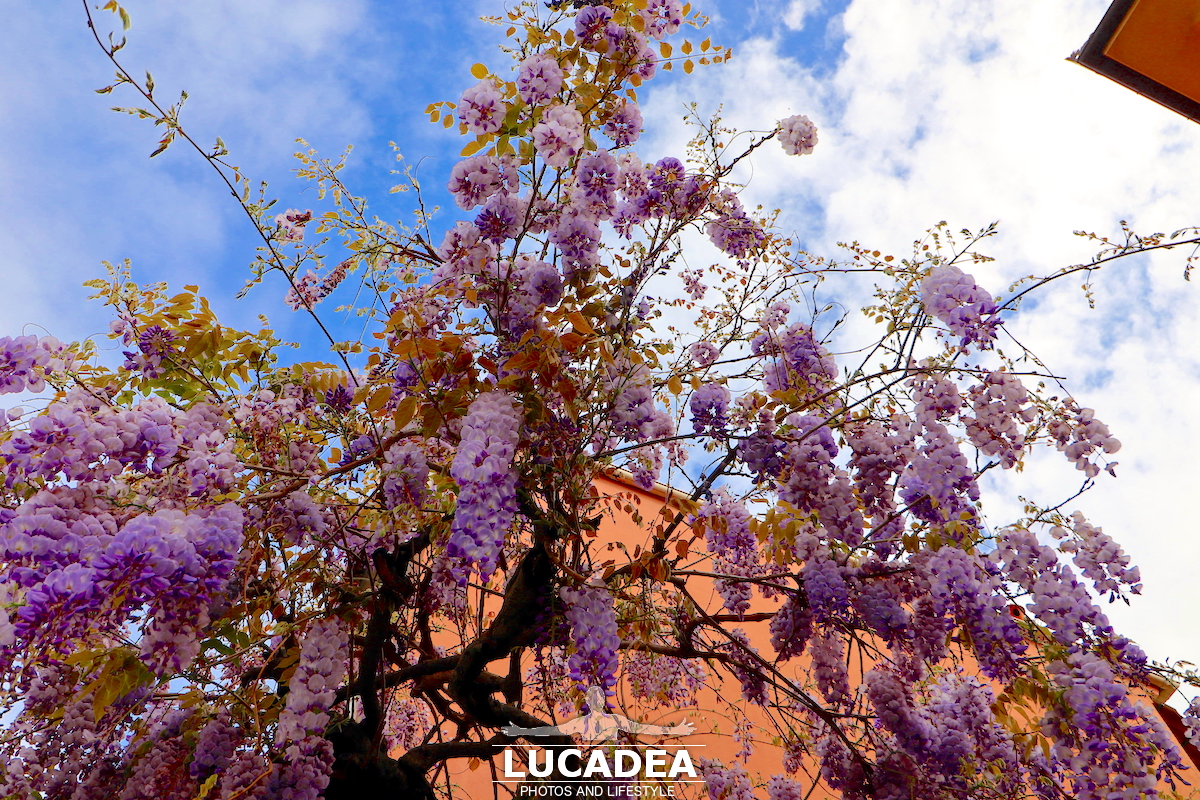
Wisteria in Sestri Levante blooming in May.
Wisteria in Sestri Levante blooming in May always has something spectacular, almost theatrical, about it. It’s one of those plants that don’t go unnoticed: when it blooms, it does so explosively, with cascades of lilac falling from the branches as if trying to invade the entire space around it.
I took this photo a while ago, on a full spring day, though I’m delighted to revisit it today. I was walking near the Lapide area in Sestri Levante, and suddenly I stopped in front of this gate of a villa. It wasn’t so much the villa itself that struck me, but rather the wisteria that was practically embracing it, transforming it into something almost fairytale-like.
The color is what immediately captures the eye: that intense yet delicate lilac, which changes slightly depending on the light. In the morning it seems softer, in the afternoon it becomes deeper, almost velvety. And then there’s the way it grows: unordered, uncontrolled, but free, with its clusters falling and intertwining.
Wisteria is often associated with old houses, wrought-iron gates, and hidden garden pergolas. It’s not just a decorative flower, but almost a natural architectural element. When you see it like this, in full bloom, you get the feeling that the house has always been part of the landscape, as if it were born with it.
I also like the fact that it blooms briefly but intensely. It arrives in spring and in a few weeks completely transforms the space. Then it gives way to summer greenery, almost as if it had put on its show and then discreetly retreats.
Looking back at this image today, I realize that it’s precisely this contrast that makes it special: the strength of the bloom and its impermanence. A small natural reminder that certain beauties don’t last forever, but are remembered better for that very reason.

And have you ever seen a wisteria like this, one that almost “covers” an entire house? Add a comment or go to the bottom of the site to read what other visitors have written.

glicine lilla in fiore su cancello di villa a Sestri Levante

glicine lilla in fiore su cancello di villa a Sestri Levante

Glicine in fiore a maggio

Glicine in fiore a maggio

Photos taken with Canon EOS M100 and lens Canon EF-S 10-18.

Wisteria grow by wrapping themselves around any support, either clockwise (like W. floribunda) or counterclockwise (W. sinensis). They can grow up to 20 m tall and 10 m horizontally.
Continue and learn more on Wikipedia

Wisteria bloom Sestri Levante – Glycine en fleur Sestri Levante – Glicinia en flor Sestri Levante – Flor de glicínia Sestri Levante – Blauregen Blüte Sestri Levante – Hoa tử đằng Sestri Levante – 紫藤花 锡斯特里莱万特 – 藤の花 セストリレヴァンテ

The text of this post was written with the help of ChatGPT, a language model from OpenAI.

Passiria Gate in Merano, a slow passage

orta Passiria a Merano, un passaggio lento

Passiria Gate in Merano, a slow passage.
I took the photo of Porta Passiria last September, during a visit to Merano that I remember as a succession of peaceful steps and light thoughts. It was one of those days when you don’t feel the need to rush, when the city seems to invite you to move at its own pace. Arriving in front of this gate felt natural, almost inevitable, as if it were waiting for me as I walked without a specific destination.
Porta Passiria appeared to me as a point of balance between the inside and the outside, between the more secluded center and what lies beyond. I didn’t have the feeling of being in front of a monument to be observed with detachment, but rather in front of a passage to be crossed with respect. The stones, marked by time, told a silent story, made of daily transits, of people who passed through without leaving a trace except in the wear and tear of the steps.
I remember the September air, fresh but not cold, and that soft light that makes everything gentler. I stopped for a few moments before taking the photo, observing how the shadows rested on the walls and how the gate framed what lay beyond. At that moment I thought that certain places don’t need to be explained, but only crossed, experienced with attention.
Merano has this ability: it accompanies you without imposing itself. Porta Passiria is a perfect example of this. It is not a point of arrival, but a passage that invites you to continue, to explore, to let yourself be surprised by what comes next. Photographing it was a way to capture that moment, to remind myself that even places of transition can have a strong identity.
Looking at that photo again today, I still feel the calm of that September day. Porta Passiria remains there, motionless, while I have moved on. Yet, every time I look at it, I have the feeling of being back in Merano, with the same slow pace and the same curious gaze.

Have you ever crossed a gate that made you slow down instead of pushing you forward? Add a comment or scroll to the bottom of the page to read what other visitors have written.

orta Passiria a Merano, un passaggio lento

Photo taken with a Canon EOS RP camera and a Canon RF 24-50 lens.

To see all the photos I took in Merano, click here:

Where the door is located:

The Passiria Gate (German: Passeirer Tor) controlled the road leading from the Giovo Pass to Merano. It consists of a pointed arch portal on the outer side, while on the city side the arch is segmental. It is surmounted by three floors with a cantilevered roof. On the side facing the city there is a fresco with the coat of arms of Merano. It was directly connected to the overlying Powder Tower (Pulverturm or rather Ortenstein) by walls that are still partly visible.
Continue and learn more on Wikipedia

Porta Passiria in Merano, a slow passage – Porte de la Passiria à Merano, un passage lent – Porta Passiria en Merano, un paso lento – Porta Passiria em Merano, uma passagem lenta – Porta Passiria in Meran, ein langsamer Durchgang – Cổng Passiria ở Merano, một lối đi chậm – 梅拉诺的帕西里亚门,一个缓慢的通道 – メラーノのパッシリア門、ゆっくりした通り道

The text of this post was written with the help of ChatGPT, a language model from OpenAI.

Venere Gate in Spello between stone and time

La monumentale Porta Venere a Spello in Umbria

Venere Gate in Spello between stone and time.
Arriving in Spello, Umbria, Italy, one of the first sights that immediately stands out is Venere Gate, one of the most iconic places to see in Spello. Its Roman structure rises from the ancient walls with a quiet authority, something that doesn’t just belong to the past but still shapes the way you enter the town today. Visiting Spello almost always means passing through this gateway, whether physically or visually.
When I took this photograph, I paused for a while in front of it, trying to frame both the arches and the towering presence above them. Venere Gate in Spello feels more like a threshold than a simple entrance. There’s a clear sense of transition: outside and inside, movement and stillness. The travertine stones carry the marks of time, worn yet incredibly solid, as if they have absorbed centuries of footsteps.
The three arches are easy to distinguish, with the central one naturally drawing your gaze inward. The smaller side arches seem to support that movement, almost guiding you through. Above them, the Towers of Propertius rise with a geometry that immediately catches attention. Their symmetry creates a balance that feels deliberate and carefully designed.
Earlier that day, walking through Spello’s narrow streets filled with flowers, I had already noticed how much care goes into every detail, something I’ve also shared in other posts on this site. But everything seems to start here. Venere Gate acts as a visual anchor, a point that defines the rhythm of the town.
One small historical detail I find fascinating is the name of the towers. They are traditionally linked to the Roman poet Sextus Propertius, who is believed to have been born in this area, although there is no definitive proof. It’s one of those elements that adds depth without needing full certainty.
The light passing through the arches changes throughout the day, creating different contrasts every time you look at it. In that moment, I tried to capture the balance between shadow and light, between solid stone and open space. This image comes from that exact feeling.
If you are visiting Spello and wondering what to see beyond the usual viewpoints, this is definitely a place worth experiencing from up close.

Have you ever walked through an ancient gate and felt like you were stepping into another time? Add a comment or go to the bottom of the site to read what other visitors have written.

Venere Gate in Spello with Roman arches and Propertius towers seen from below in the historic town center

Photo taken with Canon EOS RP and Canon RF 24-50 lens.

To see all the photos I took in the village, click here:

Here’s where the village is located:

Spello (Hispellum in Latin) is an Italian municipality in the province of Perugia in Umbria. It is part of the circuit of the most beautiful villages in Italy and boasts the Orange Flag tourism and environmental quality mark, awarded by the Italian Touring Club. Spello was founded by the Umbrians and later named Hispellum in Roman times; it was later registered with the Lemonia tribe. It was later declared a “Colonia Giulia” by Caesar and a “Splendidissima Colonia Julia” by Augustus, because it supported him in the wars of Perugia. After Augustus’ victory, he himself ceded to Hispellum a large part of the territories governed by Perusia, and the dominion of the city of Spello extended to the sources of the Clitunno River, which had previously been under the control of Mevania. It was later called “Flavia Costante” by Constantine. Ancient Spello was considered one of the most important cities in Roman Umbria.
Continue and learn more on Wikipedia

The Red Lions Gate of Bergamo Alta

La Porta dei Leoni Rossi di Bergamo Alta

The Red Lions Gate of Bergamo Alta.
During my visit to Bergamo Alta, I stopped to photograph one of the most recognizable details of the Basilica of Santa Maria Maggiore: the Red Lions Gate, one of the entrances overlooking the beautiful Piazza del Duomo. Among the things to see in Bergamo Alta, this portal immediately captures attention thanks to its sculptures, architecture and the centuries of history preserved in its stones.
Standing in front of the basilica, I was drawn to the marble porch and the two lion sculptures supporting the columns. I wanted to capture this detail because, in photography, a small architectural element can often tell the story of an entire place.
The Red Lions Gate, also known as the Northern Gate, opens on the left transept of the Basilica of Santa Maria Maggiore. Its name comes from the two red Verona marble lions that support the porch, a structure created in the fourteenth century by Giovanni da Campione.
We are in Bergamo, Lombardy, Italy, and this corner of the city contains centuries of history within a few metres. The Basilica of Santa Maria Maggiore was built from the twelfth century after a vow made by the citizens of Bergamo to the Virgin Mary, asking for protection from the plague. Over time, the church maintained its Romanesque appearance on the outside while the interior was enriched with important Baroque decorations.
What fascinated me while photographing this entrance was the contrast between the strength of the stone, the detailed sculptures and the everyday life continuing in the square outside. It is a place visited by many people, but taking a moment to observe carefully reveals details that are easy to miss.
In other photographs of churches and historic places I have shared on Lucadea, I have often looked for these same elements: not only the famous monument itself, but also the smaller details that help tell a more personal story.
The Red Lions Gate is one of the reasons why Bergamo Alta remains such a fascinating place, where architecture and history are still part of the daily landscape.

Have you ever visited Bergamo Alta and seen this beautiful entrance of Santa Maria Maggiore? Add a comment or go to the bottom of the site to read what other visitors have written.

The Red Lions Gate of Santa Maria Maggiore Basilica in Bergamo Alta with its marble porch details

Photo taken with Canon EOS RP and Canon RF 24-50 lens.

To see all the photos I took in Bergamo, click here:

Where is the door:

The Basilica of Santa Maria Maggiore is a church located in Bergamo’s Città Alta, in Piazza del Duomo. Built in the second half of the 12th century, the exterior retains its original Romanesque-Lombard architectural lines, while the interior is decorated in Baroque style (between 1600 and 1700). It was originally the baptismal church of the Cathedral of San Vincenzo, built next to the complex of the episcopal curia of Bergamo.
Continue and learn more at Wikipedia

Urbica Gate at the entrance of Spello

La Porta Urbica, entrata al borgo di Spello in Umbria

Urbica Gate at the entrance of Spello.
Among the things to see in Spello, Umbria, Italy, the historic gates of the village are some of the first details that introduce visitors to its ancient atmosphere. Urbica Gate is one of the entrances that lead into the historic center, a passage where stone walls, narrow streets and centuries of history meet in a simple but meaningful view.
This photograph comes from the first moments of my walk through the village. Some time ago I visited Spello with my wife, and Urbica Gate was one of the first places that caught my attention when entering the town. I wanted to capture this entrance with my camera because it represents the feeling of crossing a boundary between the outside landscape and the intimate atmosphere of an old Umbrian village.
Historic gates have always had an important role in the life of medieval towns. They were not only openings in defensive walls, but also meeting points where travelers, inhabitants and goods passed through every day. Entering through one of these gates meant leaving the countryside behind and stepping into a protected community shaped by history.
Spello, located in the heart of Umbria, Italy, is also known as the City of Flowers because of the famous Infiorata festival, but its charm goes far beyond this event. The village preserves important traces of its Roman and medieval past, with ancient walls and entrances that still define the character of the historic center. Along the streets it is possible to discover other remarkable places, such as Venere Gate with the Towers of Propertius and Consolare Gate.
A small historical detail about these urban gates is that they were designed not only for defense but also as symbols of identity. The entrance of a town represented the relationship between the inhabitants and the territory around them, becoming a recognizable element of the local history.
What attracted me in this image is the simplicity of the scene. It is not only a photograph of a door, but the beginning of a walk, the first step into a village where every street reveals a different detail. The stone surfaces, the proportions of the entrance and the surrounding buildings create a connection between the present and the past.
After photographing other details of Spello, such as the Baglioni Chapel, the village alleys with their support arches and Venere Gate, this image continues the same photographic journey through the smaller elements that make this village unique. Sometimes the most interesting stories are hidden in the places where people simply pass by.
If you are visiting Spello and wondering what to see, starting your walk from one of its historic gates is a good way to understand the character of the village before discovering its streets and monuments.

Which historic entrance of a village or city has given you the strongest feeling of entering a different time? Add a comment or go to the bottom of the site to read what other visitors have written.

Urbica Gate in Spello, Umbria, historic entrance to the village with ancient stone walls and buildings

Photo taken with Canon EOS RP and Canon RF 24-50 lens.

To see all the photos I took in the village, click here:

Here’s where the door is:

Spello (Hispellum in Latin) is an Italian municipality in the province of Perugia in Umbria. It is part of the circuit of the most beautiful villages in Italy and boasts the Orange Flag tourism and environmental quality mark, awarded by the Italian Touring Club. Spello was founded by the Umbrians and later named Hispellum in Roman times; it was later registered with the Lemonia tribe. It was later declared a “Colonia Giulia” by Caesar and a “Splendidissima Colonia Julia” by Augustus, because it supported him in the wars of Perugia. After Augustus’ victory, he himself ceded to Hispellum a large part of the territories governed by Perusia, and the dominion of the city of Spello extended to the sources of the Clitunno River, which had previously been under the control of Mevania. It was later called “Flavia Costante” by Constantine. Ancient Spello was considered one of the most important cities in Roman Umbria.
Continue and learn more on Wikipedia

Consolare Gate and Clock Tower in Spello

La Porta Consolare e la Torre dell'Orologio di Spello

Consolare Gate and Clock Tower in Spello.
Among the things to see in Spello, Umbria, Italy, Consolare Gate is one of the most recognizable historic entrances of the village and one of the first places that welcomes visitors arriving in the old town. Standing beside the Clock Tower, this ancient gateway introduces a place where Roman history, medieval architecture and everyday village life are still closely connected.
This photograph comes from my attention to the places that mark the beginning of a walk. Some time ago I visited Spello with my wife, and this entrance was one of the first details I wanted to capture with my camera. I was not only photographing a monument, but also the feeling of entering an old village where every stone and architectural element seems to preserve a story.
Consolare Gate has a strong but balanced appearance. It was one of the main entrances to the Roman city and still represents a symbolic connection between the outside world and the historic center of Spello. Next to the gate stands the Clock Tower, a vertical element that completes the view and naturally draws attention upward. At the top of the tower there is a plant that appears to be an olive tree, a small and unusual detail that gives this scene an even more distinctive character.
Spello, also known as the City of Flowers because of the famous Infiorata festival held during Corpus Christi celebrations, preserves many traces of its long history. The ancient Roman town of Hispellum left important evidence in the walls and gates, while the medieval village developed around narrow streets, stone houses and historic squares.
A small historical detail about Consolare Gate is that it still preserves Roman elements and shows the importance of Spello as a settlement connected to the ancient roads of Umbria. The gate was not only a defensive structure but also a welcoming entrance for people arriving in the city.
After photographing other historic entrances of the village, such as Urbica Gate and Venere Gate, this image completes the story of Spello’s ancient gateways. Each entrance offers a different perspective and helps explain how the village has preserved its connection with the past.
What I like about this view is the contrast between the strength of the ancient stones and the small natural element placed above the tower. A simple detail that makes the photograph more alive and shows how history and everyday life continue to exist together.
If you are visiting Spello and wondering what to see, starting your walk from Consolare Gate means entering the village through one of its most representative symbols.

Which historic gate or entrance of an Italian village has impressed you the most during a journey? Add a comment or go to the bottom of the site to read what other visitors have written.

Consolare Gate in Spello, Umbria with the Clock Tower and an olive tree on top of the tower

Photo taken with Canon EOS RP and lens Canon RF 24-50.

Here’s where the door is:

Spello (Hispellum in Latin) is an Italian municipality in the province of Perugia in Umbria. It is part of the circuit of the most beautiful villages in Italy and boasts the Orange Flag tourism and environmental quality mark, awarded by the Italian Touring Club. Spello was founded by the Umbrians and later named Hispellum in Roman times; it was later registered with the Lemonia tribe. It was later declared a “Colonia Giulia” by Caesar and a “Splendidissima Colonia Julia” by Augustus, because it supported him in the wars of Perugia. After Augustus’ victory, he himself ceded to Hispellum a large part of the territories governed by Perusia, and the dominion of the city of Spello extended to the sources of the Clitunno River, which had previously been under the control of Mevania. It was later called “Flavia Costante” by Constantine. Ancient Spello was considered one of the most important cities in Roman Umbria.
Continue and learn more on Wikipedia

🏠
  • Italiano