The marble lion on the steps of San Lorenzo Cathedral

The marble lion on the steps of San Lorenzo Cathedral.
In the heart of Genoa, in Liguria, Italy, two imposing lions stand guard beside the entrance to the city’s cathedral. This photograph shows one of them, taken during a short visit when I had some time to explore the area with my camera.
A couple of days ago, I found myself with an hour to spare and decided to spend it taking photographs around San Lorenzo Cathedral. It is one of those places I can return to again and again without running out of details to notice. The striking façade, with its alternating bands of white marble and dark stone, its richly decorated portals and its two towers of different heights, is an unmistakable landmark in the historic centre of Genoa. This time, however, I wanted to focus on something a little different: one of the stone lions flanking the main staircase.
The picture is a fairly traditional shot, without elaborate effects or unusual angles. I made a few small colour adjustments afterwards, trying to preserve the natural appearance of the scene while bringing out the texture of the sculpture. I like the way the lion seems to watch over everyone approaching the main entrance. Its solid posture and solemn expression make it look almost as though it has been guarding the cathedral for centuries.
There is an interesting historical detail behind these sculptures. Although San Lorenzo is a medieval building, the two lions beside the staircase are much more recent. They were installed in 1840 and were created by sculptor Carlo Rubatto. Their arrival was connected to the major urban changes taking place around the cathedral during the first half of the nineteenth century. A new road was opened towards the harbour, the square in front of the church was enlarged and the street level was lowered. The entrance therefore needed a new staircase, and the two marble lions became part of this renewed setting.
The cathedral itself has a much longer history. Consecrated in 1118 by Pope Gelasius II, it was altered and expanded over several centuries. Its Gothic façade, sculpted portals and distinctive black-and-white stonework are among the most recognisable features of Genoa’s architectural heritage. The nineteenth-century lions add another layer to this remarkable setting, blending naturally with the much older building.
Whenever I return to photograph San Lorenzo, something different catches my eye. Sometimes it is a sculpted detail on the façade, sometimes a worn stone step or an architectural feature I had overlooked on previous visits. This time, it was one of the cathedral’s two guardians. I enjoy these short photographic visits because they remind me that even familiar places can offer new subjects when I take the time to look more carefully.

Have you ever stopped to admire these two lions when visiting San Lorenzo Cathedral? Add a comment or go to the bottom of the site to read what other visitors have written.

Marble lion on the monumental staircase of San Lorenzo Cathedral in Genoa, one of two sculptures guarding the entrance

Photo taken with a Canon EOS M100 camera and Tamron 16-300 lens.

Here are all the photos I took on my last visit to the Cathedral:
foto gallery

If you’re interested, this is the official website that keeps you updated on Catholic initiatives and liturgies: chiesadigenova.it.

Add one  comment to this article or read  here what other visitors have written.
 
Adv
 
Disclamer

The rights on images, videos, choruses, text and all other material on the LUCADEA.com website are governed as per  Copyright page.

This page has been viewed 0 times today.
This month it has been viewed 0 times.
In total it has been viewed 0 times.
 

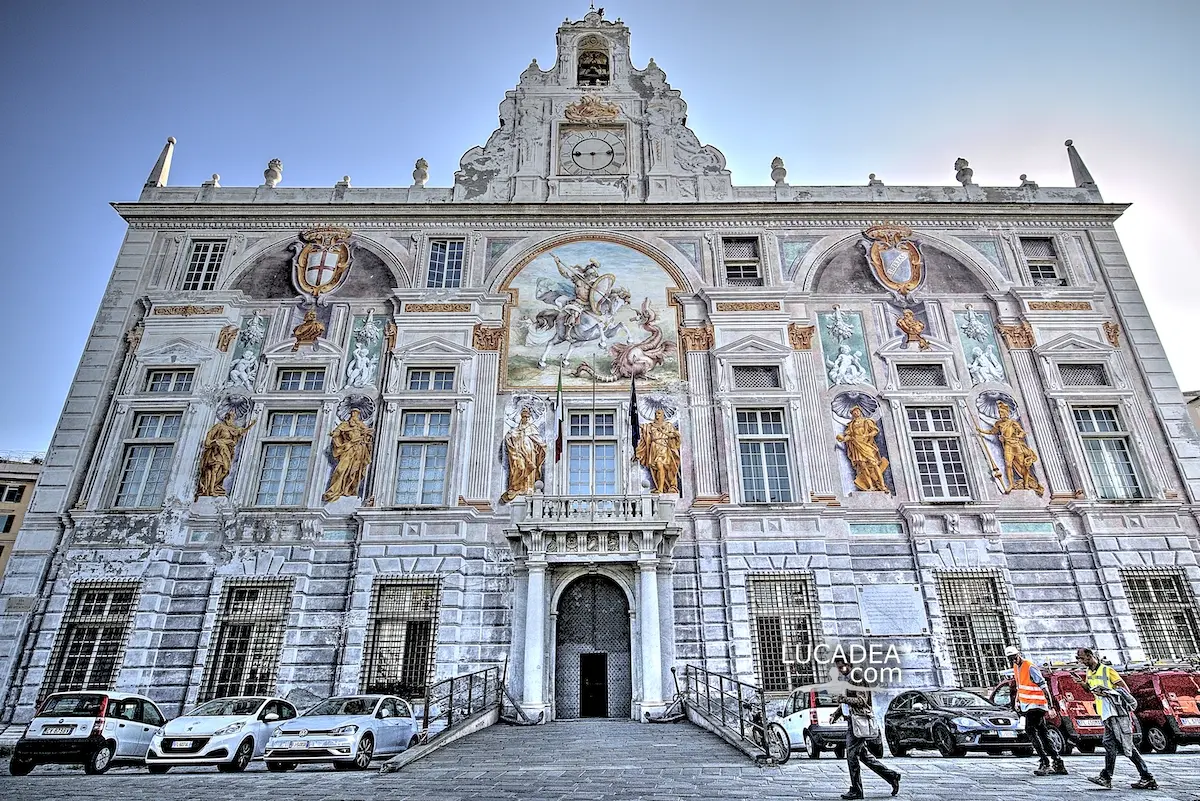
San Giorgio Palace Overlooking Genoa’s Old Port

Il maestoso Palazzo San Giorgio di fronte al Porto Antico di Genova

San Giorgio Palace Overlooking Genoa’s Old Port.
San Giorgio Palace is one of the most recognisable and frequently photographed buildings in Genoa, Italy. Located right beside the Old Port, it immediately catches the attention of visitors, especially because of the large painting on its façade depicting Saint George slaying the dragon. It is one of those familiar views that help define this part of the city and make it such a popular place to stop and take photographs.
The palace occupies a particularly interesting position, directly in front of the Old Port and close to the entrance to Genoa’s historic centre. Here, two different sides of the city meet. On one side are the open spaces of the harbour, with its quays and waterfront; on the other are the narrow streets and alleyways of the old town, where historic buildings stand close together. It is a place where a short walk can take you from the atmosphere of the port straight into the heart of historic Genoa.
Whenever I visit this area, San Giorgio Palace is one of the buildings that naturally draws my attention. Its façade is full of decorative details, but the large image of Saint George is undoubtedly the main attraction. The saint is shown on horseback, armed and facing the dragon. The scene is dramatic and immediately recognisable, giving the building a distinctive appearance that makes it stand out from its surroundings.
Saint George has a special place in Genoa’s identity. The image of the saint fighting the dragon is one of the city’s best-known symbols and also appears in its coat of arms. Seeing such a prominent representation on the façade of this historic building feels particularly appropriate. San Giorgio Palace is not simply an attractive landmark: it is also closely connected with the history of Genoa and its maritime and commercial importance.
The palace itself has a long and fascinating past. Built in the Middle Ages, it became closely associated with the financial and commercial activities of the Republic of Genoa. Its name is linked to the House of Saint George, an institution that played an important role in the city’s economic history. Today, many visitors know the building primarily as one of the most photographed sights around the Old Port, but its historical importance goes far beyond its attractive exterior.
From a photographic point of view, its location offers plenty of interesting possibilities. I particularly like the contrast between the richly decorated façade and the more open surroundings of the harbour. People are constantly walking past, stopping to admire the building or continuing towards the old town. This combination of architecture, movement and maritime atmosphere makes the area especially appealing to photograph.
For anyone visiting Genoa, stopping in front of San Giorgio Palace is almost unavoidable. The building stands in a natural position along the route between the Old Port and the historic centre, inviting visitors to pause and admire its details. The painting of Saint George and the dragon is certainly one of the features that makes it memorable.

Have you ever photographed San Giorgio Palace while walking around Genoa’s Old Port? Add a comment or go to the bottom of the site to read what other visitors have written.

San Giorgio Palace in Genoa, featuring the large façade painting of Saint George slaying the dragon beside the Old Port

Photo taken with a Canon EOS M100 camera and Canon EF-M 11-22 lens.

Where is the building located:

Add one  comment to this article or read  here what other visitors have written.
 
Adv
 
Disclamer

The rights on images, videos, choruses, text and all other material on the LUCADEA.com website are governed as per  Copyright page.


This page has been viewed 1 times today.
This month it has been viewed 2 times.
In total it has been viewed 2 times.
 

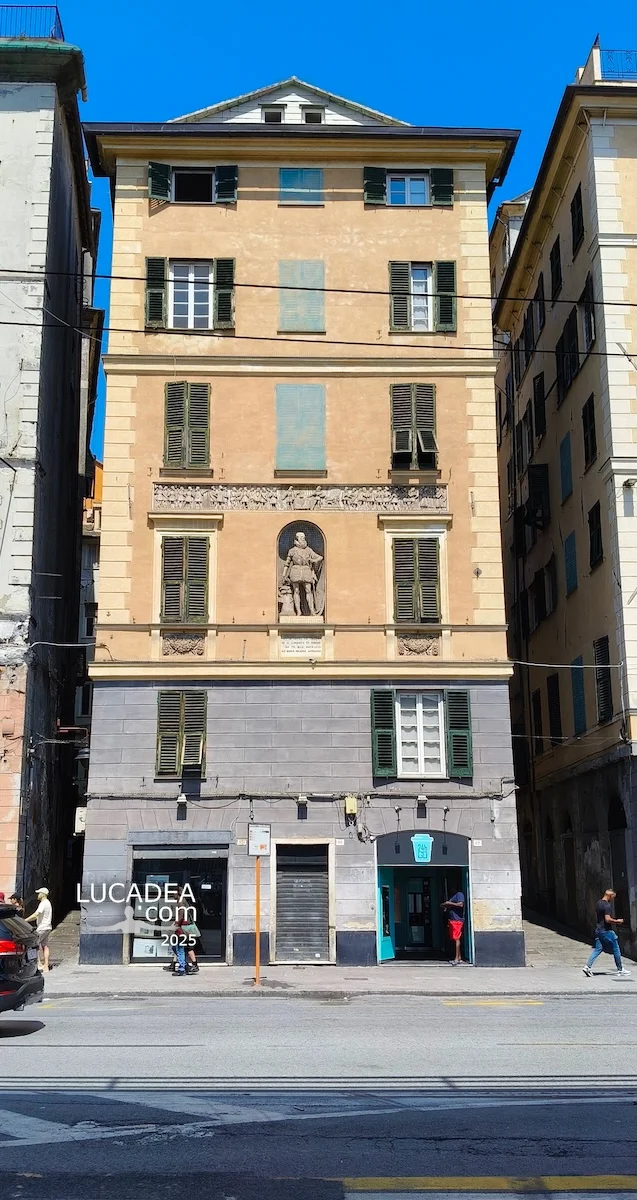
Two Historic Buildings on Via Antonio Gramsci in Genoa

Due palazzi storici in via Antonio Gramsci a Genova, con facciate ocra, persiane scure, statue e fregi scolpiti

Two Historic Buildings on Via Antonio Gramsci in Genoa.
Walking through Genoa’s historic centre, I often find myself looking up at the buildings and noticing architectural details that might otherwise go unnoticed. These two neighbouring buildings on Via Antonio Gramsci caught my attention because of their similar façades, warm colours and decorative features. They stand side by side, separated by a narrow alley that I believe may be Vico dell’Amore.
At first glance, the two buildings seem to share a common architectural character. Their ochre-coloured façades are framed by pale corner details and horizontal stonework, while rows of dark shutters give the windows a distinctive rhythm. Under the bright Ligurian sunshine, the contrast between the warm plaster and the darker elements becomes particularly striking, making the buildings stand out against the blue sky.
Looking more closely, there are several details worth noticing. Both façades feature a statue set inside a central niche, as well as a decorative sculpted band showing a series of human figures. These elements give the buildings a more elaborate appearance than a simple residential façade and invite the viewer to look for details in the sculptures and architectural ornamentation. The grey lower storeys provide a strong visual base, contrasting with the lighter upper sections.
Via Antonio Gramsci lies in Genoa’s Prè district, close to the Old Port. The road was originally known as the Carrettiera Carlo Alberto and was opened during the nineteenth century, forming part of the major urban changes that reshaped this area of the city. Today, walking along the street offers glimpses of Genoa’s architectural past, with historic façades standing alongside shops, businesses and everyday street life.
I enjoy photographing buildings like these because a city is not defined only by its most famous landmarks. Sometimes, a decorative panel, a statue above a doorway or a row of old shutters can tell an equally interesting story about the character of a neighbourhood. These details are especially rewarding to discover while exploring the streets on foot, without a strict itinerary.
I took these photographs in 2025, capturing both the overall appearance of the buildings and some of the details that make their façades distinctive. They are the kind of discoveries I like to share on Lucadea.com, alongside other photographs of Genoa’s historic centre, its architecture and its network of narrow lanes.

Do you recognise these two buildings on Via Antonio Gramsci, and do you know their names or any interesting details about their history? Add a comment or go to the bottom of the site to read what other visitors have written.

Photos taken with Oppo Reno 12.

🏠
  • Italiano