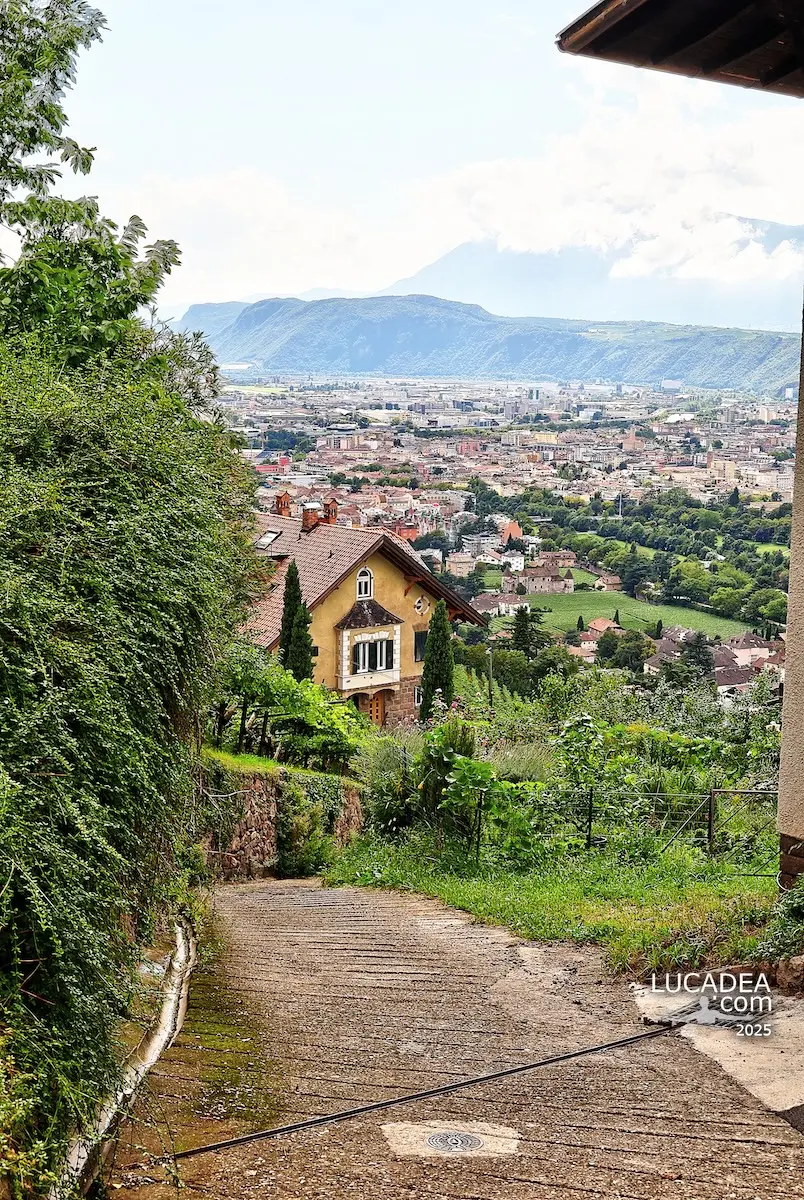
A glimpse of Bolzano from San Osvaldo Walk

Uno scorcio di Bolzano dalla Passeggiata S. Osvaldo

A glimpse of Bolzano from the Passeggiata S. Osvaldo.
The photo was taken along the Passeggiata S. Osvaldo, at a point where walking slows and the gaze is naturally drawn downward. In front of me, the road slopes gently, flanked by a country house that seems to have always been there, discreet, perfectly integrated into the landscape. It’s one of those views that don’t scream for attention, but rather ask you to pause. And I pause, as often happens when I feel a scene deserves to be observed calmly.
The house has a solid and tranquil air, with simple proportions and a natural relationship with the road that passes beside it. It doesn’t dominate the landscape, but complements it. All around, there’s silence, broken only by the occasional footstep and distant sounds, filtered by the altitude. The descending road becomes a guideline for the eye, a sort of invitation to follow the path, even just with your gaze, until you reach what lies beyond.
In the distance, almost secluded, Bolzano appears. The city remains in the background, more suggested than shown, as if unwilling to impose itself. It’s there, recognizable but distant, its roofs and buildings compressed into the space of the valley. From this vantage point, it seems different, quieter, almost shy. The Passeggiata S. Osvaldo has this power: it provides distance, creates a margin, allows you to observe the city without being overwhelmed by it.
Taking this photo was a simple, instinctive gesture. I wasn’t looking for a broad panorama, nor a spectacular vantage point. I was interested in the dialogue between the country house, the road descending, and the city waiting below. A balance made of levels, of successive planes, that beautifully convey the relationship between Bolzano and its surroundings. Here, the city is not separated from nature, but seems to arise from it, naturally.
Looking at the image today, I am reminded of the feeling of tranquility I felt at that moment. It was a sideways view of Bolzano, not the classic postcard view. A glimpse that speaks of passages, of transitions, of that subtle border between countryside and city that makes this place so special. And perhaps that’s precisely what prompted me to stop and take the shot: the feeling of being right in the middle.

Have you ever looked at a city from above and suddenly felt it closer, precisely because of the distance?
Add a comment or go to the bottom of the site to read what other visitors have written.
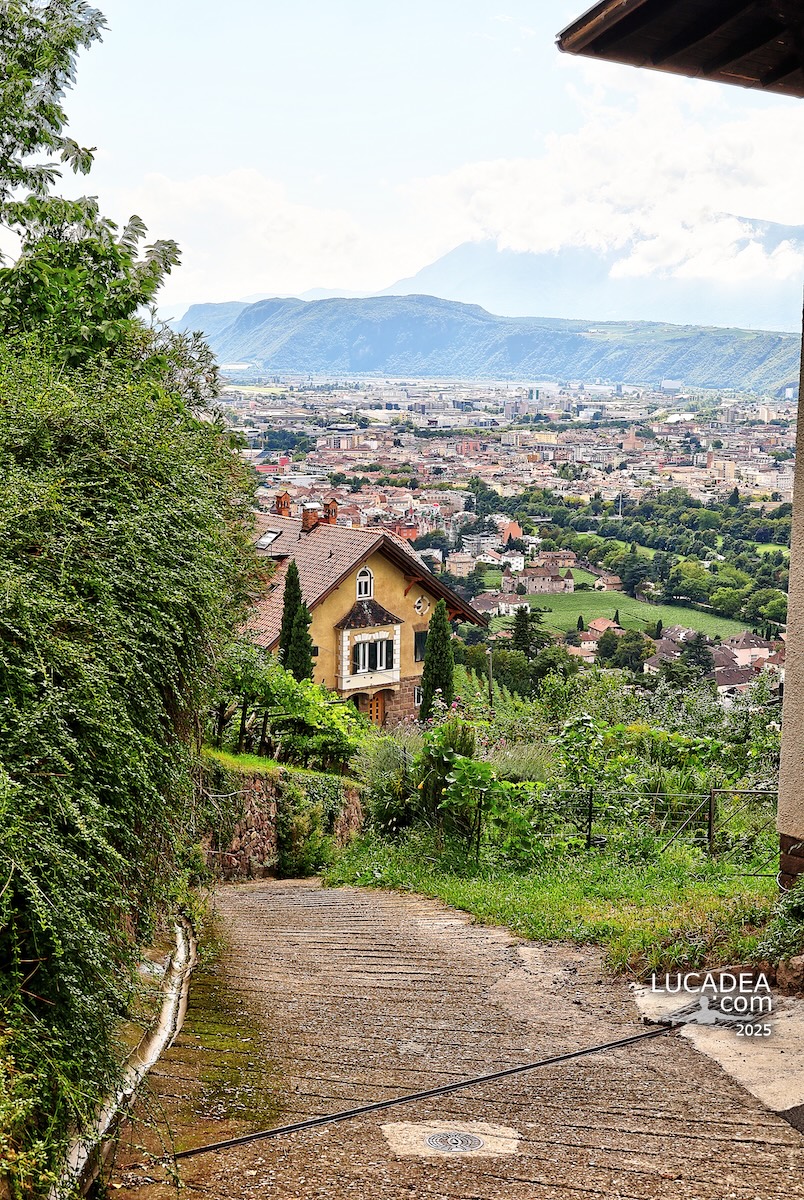
Uno scorcio di Bolzano dalla Passeggiata S. Osvaldo

Photo taken with Canon EOS RP camera and Canon RF 24-50 lens.

To see all the photos I took along the trail, click here:

Here’s where the trail is located:

A glimpse of Bolzano from San Osvaldo Walk – Un aperçu de Bolzano depuis la promenade San Osvaldo – Un vistazo de Bolzano desde el paseo San Osvaldo – Um vislumbre de Bolzano da caminhada San Osvaldo – Ein Blick auf Bozen von der Sankt Oswald Promenade – Một góc nhìn Bolzano từ lối đi San Osvaldo – 从圣奥斯瓦尔多步道眺望博尔扎诺 – サン・オズヴァルド散策路から見たボルツァーノ

The text of this post was written with the help of ChatGPT, a language model from OpenAI.

Add one  comment to this article or read  here what other visitors have written.
 
Adv
 
Disclamer

The rights on images, videos, choruses, text and all other material on the LUCADEA.com website are governed as per  Copyright page.


This page has been viewed 1 times today.
This month it has been viewed 9 times.
In total it has been viewed 32 times.
 

A glimpse of Vicolo dello Stagno in La Spezia

Uno scorcio di Vicolo dello Stagno, La Spezia

A glimpse of Vicolo dello Stagno, La Spezia.
I took this photo of a glimpse of Vicolo dello Stagno almost without thinking, while I was walking slowly through the center of La Spezia, letting the city guide me. I wasn’t looking for a specific place, nor a carefully composed shot: I was simply there, with my camera ready and my eyes open. That alley made itself noticed, with its discretion, like certain places that never raise their voice.
Vicolo dello Stagno is narrow, secluded, made of walls that seem to have known each other forever. The light enters with difficulty, bounces off the light surfaces and then fades, creating a suspended atmosphere. At that moment I had the feeling that everything was still, even though I knew that a few steps away there were livelier streets, traffic, voices, shops. Inside, however, time seemed to have paused.
I remember the silence interrupted only by some distant noise, the footsteps of someone crossing the intersection further on, an open window from which a domestic sound emerged. Photographing that alley was like taking a visual note, a way of saying: “Here, this is a detail that tells the story of the city better than many words.” There was nothing spectacular, yet everything had its own balance.
I like these glimpses because they don’t demand attention, but if you stop for a moment they can give back so much. Vicolo dello Stagno gave me the impression of an everyday La Spezia, lived in, far from the more immediate images of the sea and the port. A city that reveals itself only if you agree to walk without haste, to venture where you perhaps didn’t think you would go.
Looking at that photo again today, the sensations of that moment come back to me: the calm, the curiosity, the pleasure of observing. It’s a shot that doesn’t tell a story of an event, but a state of mind. And perhaps that’s why it continues to speak to me, even after all this time. Have you ever experienced a simple glimpse of an alleyway telling more than an entire city?
Add a comment or go to the bottom of the page to read what other visitors have written.

Uno scorcio di Vicolo dello Stagno, La Spezia

Photo taken with a Canon EOS RP camera and a Canon RF 24-50 lens.

If you want to see all the photos I took in the city, click here:

Where the alley is located:

The La Spezia area was inhabited as early as prehistoric times, as evidenced by the numerous stele statues and the Bronze and Iron Age artifacts found on various occasions in the hills surrounding the Gulf and the adjacent valleys. Later, in historical times, the territory saw the settlement of the Ligurian populations, who were subjugated in 155 BC by the consul Marcus Claudius Marcellus.
Continue reading and learn more on Wikipedia

A glimpse of Vicolo dello Stagno in La Spezia – Un aperçu du Vicolo dello Stagno à La Spezia – Un rincón del Vicolo dello Stagno en La Spezia – Um recanto do Vicolo dello Stagno em La Spezia – Ein Blick auf die Vicolo dello Stagno in La Spezia – Một góc nhỏ của Vicolo dello Stagno ở La Spezia – 拉斯佩齐亚斯塔尼奥小巷一角 – ラ・スペツィア、スターニョ小路の一角

The text of this post was written with the help of ChatGPT, a language model from OpenAI.

Add one  comment to this article or read  here what other visitors have written.
 
Adv
 
Disclamer

The rights on images, videos, choruses, text and all other material on the LUCADEA.com website are governed as per  Copyright page.


This page has been viewed 1 times today.
This month it has been viewed 1 times.
In total it has been viewed 39 times.
 

A glimpse of the sea in Boccadasse, Genoa

Uno scorcio sul mare di Boccadasse a Genova

A glimpse of the sea from Boccadasse in Genoa.
There are photographs that aren’t meant to be spectacular, but to be real. I captured this glimpse of the sea from Boccadasse almost without thinking, stopping somewhere, in one of those narrow passages that descend to the water. In the foreground, the prickly pear tree, with its irregular and slightly dusty blades, almost seems to want to defend the view, as if to say that the sea must be conquered slowly, without haste. Behind it, the warm-colored houses huddle together, creating an imperfect but incredibly harmonious frame.
Boccadasse is like this: it never shows itself all at once. It forces you to look through cracks, corners, alleys that suddenly open up. In this image, the sea appears in the distance, almost timidly, like a reward for those who have had the patience to descend that far. It’s a strip of blue that alone is enough to change your breathing, to slow your pace. I like this discreet way of being seen, far from the broad, immediate views.
The prickly pear isn’t there by chance. It’s a Mediterranean presence, resilient, out of place, yet perfectly consistent with the village’s soul. Its angular shapes contrast with the soft lines of the houses and the calm of the sea, creating a balance that works precisely because it’s not planned. The facades, with their weathered plaster, tell the story of a lived-in, everyday Genoa, far from the monumental image of the historic center.
In the background, near the water, people can be glimpsed. Small, almost anonymous, as if the true subject were not the man but the place itself. It’s a scene I’ve seen dozens of times and it continues to seem new to me, because it changes with the light, the seasons, and the mood of the viewer. In summer, this glimpse smells of salt and sun, but it always maintains a sense of quiet, as if Boccadasse never wants to become completely noisy.
For me, this photograph is a synthesis: nature, architecture, sea, and everyday life coexisting without constraint. It’s one of those moments when Genoa ceases to be a complex city and becomes simply a place to explore with your eyes and heart, letting yourself be guided by the details.

Have you ever discovered the sea only at the last step, through an alley?
Add a comment or go to the bottom of the site to read what other visitors have written.

Uno scorcio sul mare di Boccadasse a Genova

Photo taken with Canon EOS RP and Canon RF 50 lens.

All the photos I took in the village, on various visits, are here:
foto gallery

Where the village is located:

Boccadasse (Boca d’azë or Bocadâze in Genoese) is an ancient fishing village in the city of Genoa, part of the Albaro district. In the current administrative division of the municipality of Genoa, it is therefore included in Municipio VIII – Medio Levante, which in addition to Albaro also includes the Foce and San Martino districts.
Continue on Wikipedia

A glimpse of the sea in Boccadasse, Genoa – Un aperçu de la mer à Boccadasse, Gênes – Un vistazo al mar en Boccadasse, Génova – Um vislumbre do mar em Boccadasse, Gênova – Ein Blick auf das Meer in Boccadasse, Genua – Một góc nhìn ra biển ở Boccadasse, Genova – 博卡达塞的海景一角,热那亚 – ジェノヴァ、ボッカダッセの海への眺め

The text of this post was written with the help of ChatGPT, a language model from OpenAI.

Partigiani d’Italia Street in Santa Margherita

Uno scorcio di via Partigiani d'Italia a Santa Margerita Ligure

Partigiani d’Italia Street in Santa Margherita.
While walking through Santa Margherita Ligure, I stopped to photograph this quiet street view, with colorful façades, green shutters and balconies overlooking the road. It is the kind of Santa Margherita Ligure scene that says something about the town without needing the sea in the frame, and it shows why some of the best things to see in Santa Margherita can be found simply by walking through its streets.
I took the photograph during an ordinary walk through the center, without looking for a particular viewpoint. The arrangement of the buildings caught my attention first. The façades stand close together and create a compact perspective, while windows, shutters and balconies add small differences from one building to another.
Partigiani d’Italia Street is only a short distance from the waterfront and historic center. This makes the area interesting because the more open coastal landscape is never far from the enclosed streets of the town. Even when the sea cannot be seen, its presence remains part of the setting and of the identity of this part of the Tigullio.
Santa Margherita Ligure is in Liguria, in the Metropolitan City of Genoa, Italy, on the Gulf of Tigullio. If you are visiting Santa Margherita Ligure and wondering what to see, the waterfront and harbor are obvious choices, but I also enjoy exploring the streets behind them. They reveal the everyday side of the town through buildings, shops, windows and small architectural details.
I took this photograph myself because the scene seemed simple but representative. Nothing needed to be added or arranged. The colorful buildings, green shutters, balconies and street already provided everything I needed for the image. This is the kind of photograph I often make when I am walking without rushing and allowing small details to catch my attention.
There is a brief historical detail behind the street name. Partigiani d’Italia refers to the Italian partisans who took part in the Resistance during the Second World War. The reference is quietly incorporated into the everyday landscape through the name of the street, creating a link between contemporary life and an important period of Italian history.
I find this kind of connection interesting when photographing towns. History is not always represented by a large monument or an obvious memorial. Sometimes it appears on a street sign or in the name of a road people use every day. Here, the historical reference remains discreet, but it is still part of the environment shown in the photograph.
The buildings themselves are what give the image its strongest visual character. Their close arrangement creates a narrow urban perspective, while balconies and windows break up the façades with small details. The green shutters are particularly familiar in Ligurian architecture, but in this scene they feel like a natural part of the street rather than a decorative addition.
The nearby sea also influences the atmosphere of the town. Within a short walk, the enclosed streets open towards the waterfront and the Gulf of Tigullio. For me, this is one reason Santa Margherita Ligure is interesting to photograph: the relationship between the urban center and the coast changes constantly as you move through the town.
This photograph also connects naturally with other images I have shared from Ligurian historic centers. After photographing streets and details in Chiavari, Lavagna and Sestri Levante, I find myself returning to the same kind of subjects: buildings, storefronts, narrow streets and everyday views that might otherwise be overlooked.
Street photography appeals to me for exactly this reason. I never know in advance what the next photograph will be. It might be a famous square, an old shop window or simply a street that looks different for a few moments. Here, Partigiani d’Italia Street was enough to make me stop.
Looking back at the image, I think it represents a quieter and more everyday side of Santa Margherita Ligure. The town is often associated with the sea and its coastal views, but its identity is also built from the streets and houses where ordinary life continues every day.

What is the simplest everyday street view you have photographed while walking through Liguria? Add a comment or go to the bottom of the site to read what other visitors have written.

View of Partigiani d’Italia Street in Santa Margherita Ligure with colorful façades, green shutters and balconies

Photo taken with Oppo Reno 12.

A glimpse of St. Mark’s Square in Venice

Uno scorcio di piazza San Marco a Venezia

A glimpse of St. Mark’s Square in Venice.
St. Mark’s Square, located in the heart of Venice, is one of the most iconic and fascinating places in the world. Also known as “The Drawing Room of Europe,” this square is a masterpiece of architecture and history, attracting millions of visitors each year.
The square is surrounded by historic buildings of great importance, including St. Mark’s Basilica, St. Mark’s Campanile, the Doge’s Palace, and the Procuratie Vecchie and Procuratie Nuove. Every corner of the square tells a story, with its architecture reflecting centuries of Venetian art and culture. St. Mark’s Basilica, with its façade decorated with mosaics and bas-reliefs, is a splendid example of Byzantine and Gothic art.
One of the square’s most fascinating features is the Clock Tower, built in the 15th century. This tower not only marks the time, but is also a symbol of the wealth and power of the Venetian Republic. Every hour, the statues of the Moors strike their bells, offering visitors a unique spectacle.
St. Mark’s Square is also a vibrant hub of life and culture. Historic cafés like Caffè Florian and Caffè Quadri offer the perfect place to relax and enjoy the square’s unique atmosphere. These cafés have hosted world-renowned artists, writers, and musicians, contributing to an environment rich in creativity and inspiration.
Walking through St. Mark’s Square is an experience that will remain etched in your memory. The view of the Doge’s Palace, with its elegant arches and its history of power and intrigue, is simply breathtaking. The gondolas gliding along the adjacent canals add a touch of romance to this already magical place.
St. Mark’s Square offers a window into Venice’s glorious past and a glimpse of its timeless beauty. Whether admiring the architecture, enjoying a coffee, or simply strolling, every visit to this square is an unforgettable journey into the heart of the Serenissima.

Do you know the famous city of Venice?
Add a comment or go to the bottom of the site to read what other visitors have written.
Uno scorcio di piazza San Marco a Venezia

Photo taken with Honor 20.

To learn more about St. Mark’s Basilica, I recommend its official website.

To see all the other photos of Venice, click here.
foto gallery

Here’s where it is exactly:

The bell tower of St. Mark’s Basilica is one of the most important symbols of the city of Venice. Together with the basilica of the same name and the square below, from which it takes its name, it is the principal monument of Venice and one of the symbols of Italy. Venetians affectionately call it El parón de casa (The Master of the House). Standing 98.6 meters tall, it is one of the tallest bell towers in Italy, standing alone in a corner of St. Mark’s Square, opposite the basilica. Simple in shape, it consists of a fluted brick barrel with a square plan, 12 meters on each side and about 50 meters high, above which sits the arched bell chamber.
Continue and learn more on Wikipedia

A glimpse of St. Mark’s Square in Venice – Un aperçu de la place Saint-Marc à Venise – Un vistazo a la Piazza San Marco en Venecia – Um vislumbre da Praça de São Marcos em Veneza – Ein Blick auf den Markusplatz in Venedig – Một cái nhìn thoáng qua về Quảng trường San Marco ở Venice

This post was written with the help of Copilot, an artificial intelligence-based virtual assistant.

A couple of glimpses of the village of Trevi in ​​Umbria

Un paio di scorci del borgo di Trevi in Umbria

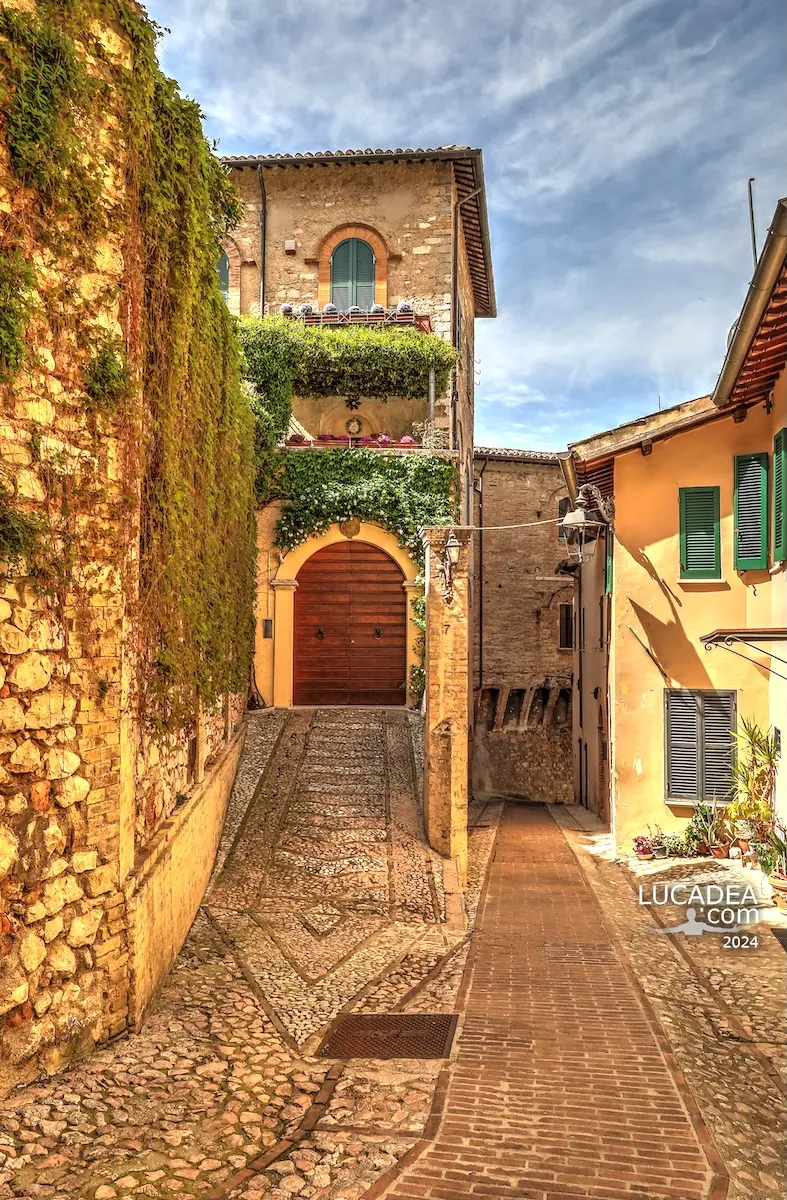
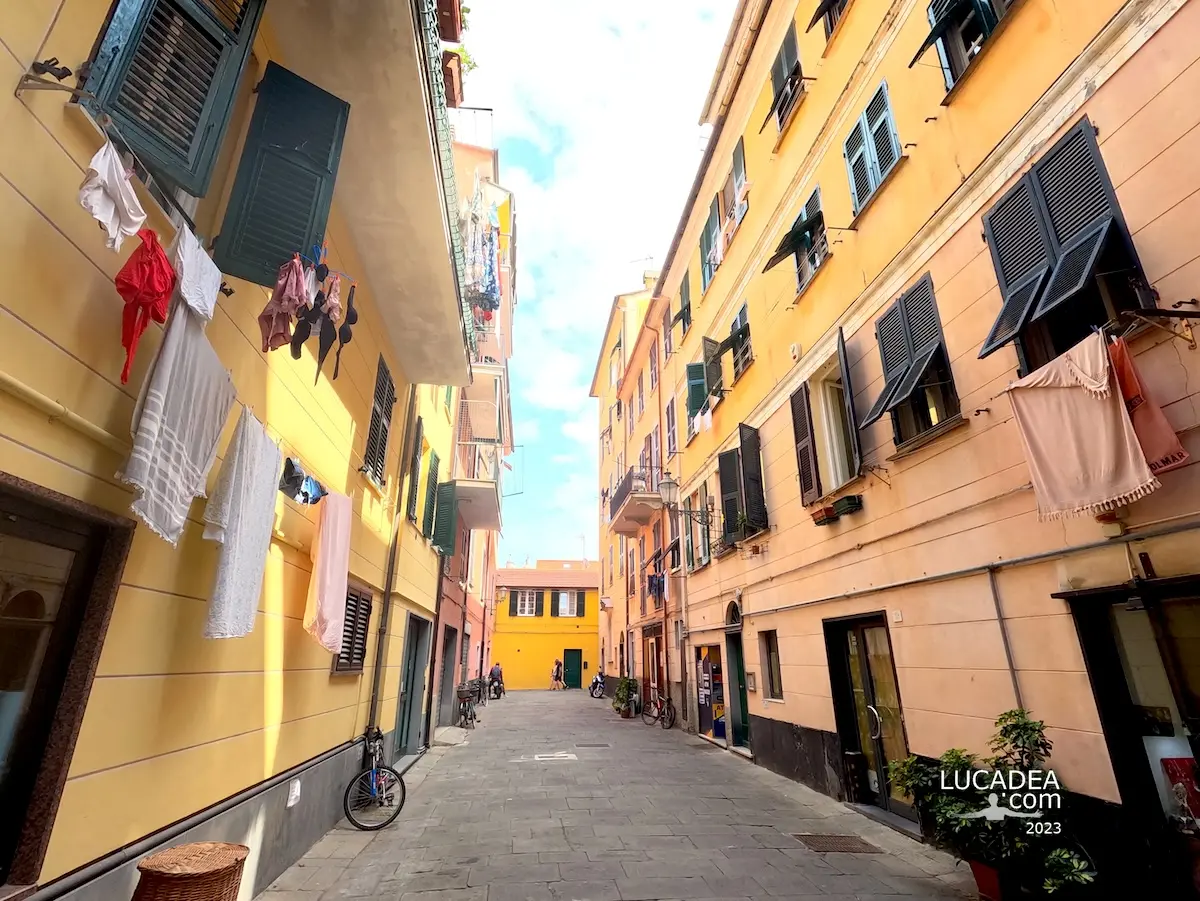
A couple of glimpses of the village of Trevi in ​​Umbria.
Last spring, my wife and I spent a few days visiting the beautiful Umbria region.
We settled in the Perugia area and visited many of the surrounding villages.
These two shots are of the alleys of the beautiful village of Trevi, one of the most beautiful villages in Italy.

Do you know or have you ever visited the village of Trevi?
Add a comment or go to the bottom of the site to read what other visitors have written.

Photos taken with Canon EOS RP camera and Canon RF 24-50 lens.

To see all the photos I took in the village, click here:

Here’s where the village is located:

During the late Middle Ages and the Renaissance, Trevi experienced its golden age, characterized by extraordinary trade that fostered its economic prosperity (it was called “the dry port”), evidenced even today by the numerous palaces in the historic center, worthy of being found in much larger cities. Economic growth was accompanied by lively cultural and social activity. As early as 1469, a Jewish banker was called in to facilitate the circulation of money, one of the few professions such men were authorized to practice. Despite this, he was persecuted and subsequently one of the very first pawnshops was established, followed by the Monte Frumentario and various other charitable and welfare institutions.
Continue and learn more at Wikipedia

A couple of glimpses of the village of Trevi in ​​Umbria – Quelques aperçus du village de Trevi en Ombrie – Un par de vistazos al pueblo de Trevi en Umbría – Alguns vislumbres da aldeia de Trevi, na Úmbria – Ein paar Einblicke in das Dorf Trevi in ​​Umbrien – Một vài cái nhìn thoáng qua về ngôi làng Trevi ở Umbria

A quiet corner of Paolo Costa Square in Chiavari

Uno scorcio di piazza Paolo Costa a Chiavari

A quiet corner of Paolo Costa Square in Chiavari.
Just behind the main alleyways of Chiavari, in Liguria, a few steps away from the better-known streets, there are smaller and quieter corners such as this little square that I photographed quite some time ago. Paolo Costa Square caught my attention because of its intimate character, with buildings, narrow passages and everyday details coming together in a setting that feels very much part of the historic center.
I took this photograph during one of those walks when I was not necessarily looking for the most famous landmark or the most obvious viewpoint. I was more interested in finding a less immediate corner of Chiavari, one that could still convey the atmosphere of the smaller streets behind the main alleyways. When I walk through historic centers with a camera, it is often these modest squares that make me slow down.
When I think about what to see in Chiavari, the historic center, its arcades and its main streets naturally come to mind first. But once you enter the network of side alleys, the town offers many quieter perspectives. Paolo Costa Square is one of them. It is not a monumental urban space, but its smaller scale gives it a character that I find particularly interesting to photograph.
This is Chiavari, in Liguria, in the Metropolitan City of Genoa, Italy, and the square is located just behind the most recognizable part of the historic center. It takes only a small change of direction to leave the busier routes and find a more enclosed urban space that still feels very close to the heart of the town.
I took this photograph myself quite some time ago and, when I looked at it again, it brought back the feeling of walking through those streets. I do not remember trying to create a particularly elaborate composition. The view itself was enough to make me stop. I like photographs that happen this way, almost instinctively, because they often preserve more faithfully the way I experienced a place while walking through it.
One detail that particularly interests me is the name of the square itself. I have not been able to establish with certainty who the Paolo Costa remembered by the name was, and I would rather leave that question open than invent an explanation simply to fill the story. It is a small gap in my research, but also a curiosity that made me look at the place with a little more attention.
Whatever the origin of the name, it does not change the character of the square. Looking at the photograph, what remains with me is the arrangement of the buildings and the way the space opens between the surrounding alleys. It is quite different from the most familiar images associated with Chiavari, and that is precisely why I wanted to keep it in the blog.
One of the things I enjoy about Chiavari’s historic center is how quickly the atmosphere can change while walking. More open streets give way to narrower passages, arcades and closely spaced buildings, creating a sequence of different spaces. A small square like this can feel almost like a visual pause in the middle of that route.
For me, the value of this photograph lies mainly in that feeling of discovery. It was not taken in front of one of the city’s best-known landmarks, but in front of a corner that many people could easily pass without stopping. That is one of the reasons I enjoy photographing historic centers: I do not want to record only the obvious subjects, but also the quieter places that help define the everyday identity of a town.
Looking at the image again after all this time, I still think it is a useful way of showing Chiavari. Not because there is anything spectacular about the scene, but because it reveals a quieter side of the historic center. It is also why I continue to publish photographs taken at different times. Some images need to stay in my archive for a while before I find the right moment to share them.
This square naturally connects with other photographs I have already published on the site about Chiavari and its historic alleyways. Each image captures a different fragment of the same town, and together they create a route made not only of famous places but also of smaller corners such as this one.
If you are visiting Chiavari and wondering what to see, it is worth leaving the main streets for a few minutes and exploring some of the side alleys. You will not always find a monument, and you do not necessarily need to. Sometimes a small square with an interesting perspective is enough to change the way you experience a walk through a historic center.
For me, Paolo Costa Square has remained exactly that: a small corner I came across almost casually and found characteristic enough to photograph. And although I have not managed to discover who Paolo Costa was, perhaps that is a detail I will eventually be able to clarify.

Do you know the story behind the name of Paolo Costa Square in Chiavari? Add a comment or go to the bottom of the site to read what other visitors have written.

A view of Paolo Costa Square in Chiavari among the narrow alleys and arcades of the Ligurian historic center

Photo taken with Gopro Hero 10 black.

Here’s where the square is located:

A glimpse of Camogli, the beautiful seaside village in Liguria.

Uno scorcio di Camogli, il bel borgo marinaro in Liguria

A glimpse of Camogli, the beautiful seaside village in Liguria.
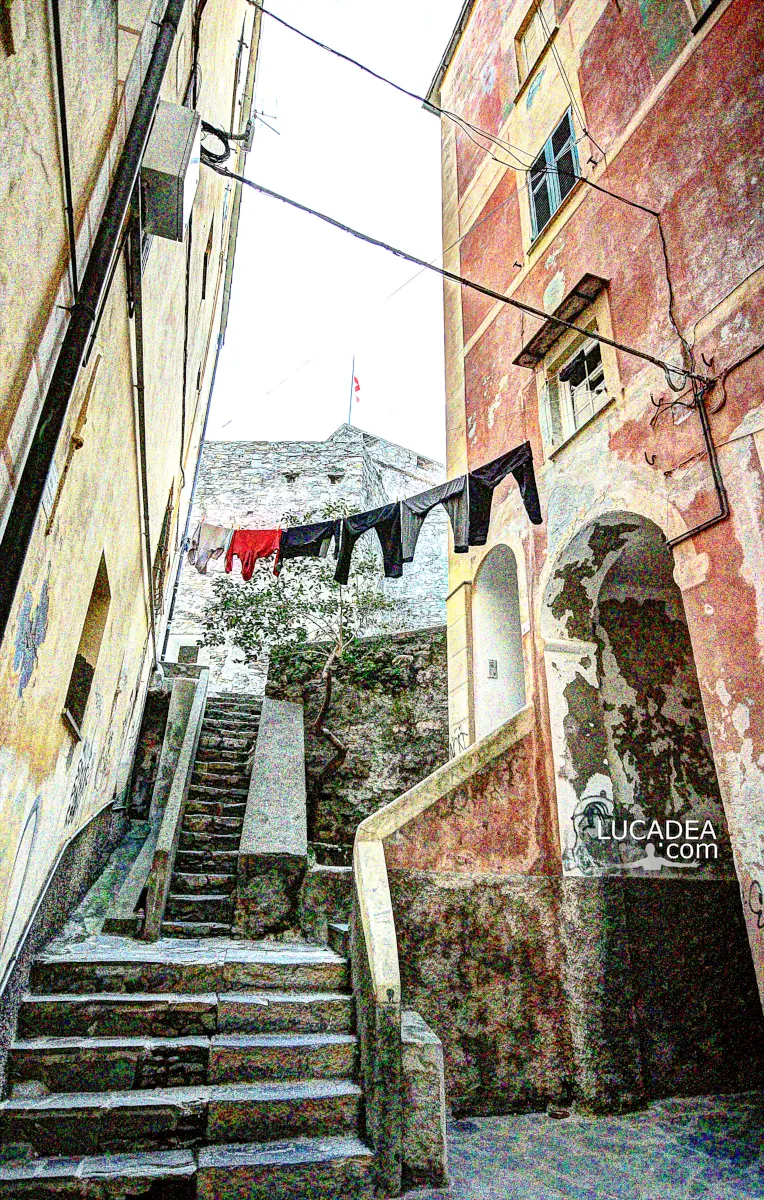
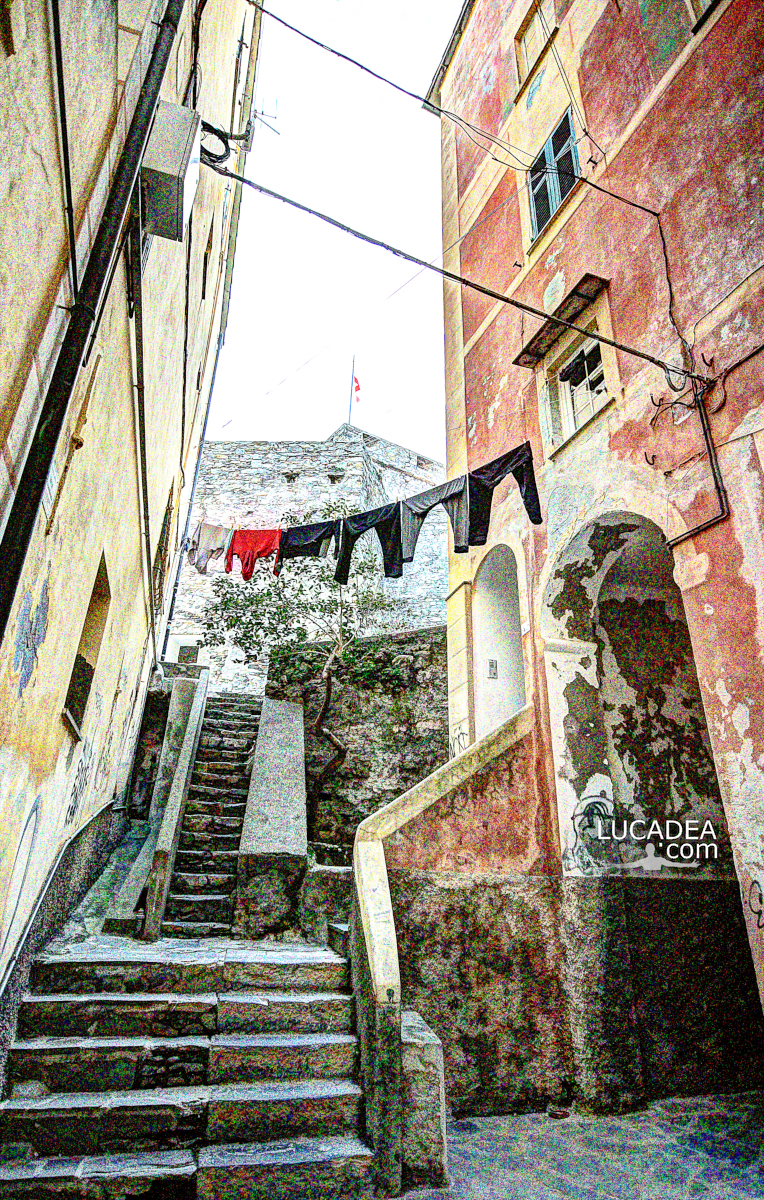
Just behind the Basilica of Santa Maria Assunta and the Dragonara Castle, there is a small cluster of houses with some almost secret alleyways.
This is what you will find yourself facing as you stroll through them, with the inevitable clothesline stretched between one house and the one opposite, so common in seaside villages.

Do you know the village of Camogli? Add a comment or go to the bottom of the site to read what other visitors have written.

Uno scorcio di Camogli, il bel borgo marinaro in Liguria

Photo taken with a Canon EOS M100 camera and a Canon EF-M 11-22 lens.

If you want to see all the photos taken in the beautiful Riviera town, click here:
photo gallery

Here are also a couple of videos I made that same day in the small harbor of Camogli:


Videos recorded with GoPro Hero 10 Black.

The most striking architectural feature of the town is the presence of colorful buildings overlooking the beach. The bright colors and horizontal lines (called floor markers) served the sailors of Camogli to more easily recognize their homes among the various floors of the buildings in the village and return to them after fishing.
Continue and learn more on Wikipedia

A glimpse of Camogli, the beautiful seaside village in Liguria – Un aperçu de Camogli, le magnifique village balnéaire de Ligurie – Un vistazo a Camogli, el hermoso pueblo costero de Liguria – Um vislumbre de Camogli, a bela vila costeira da Ligúria – Ein Blick auf Camogli, das schöne Küstendorf in Ligurien – Nhìn thoáng qua Camogli, ngôi làng ven biển xinh đẹp ở Liguria – 卡莫利一瞥,利古里亚美丽的海滨村庄 – リグーリア州の美しい海辺の村、カモーリを垣間見る

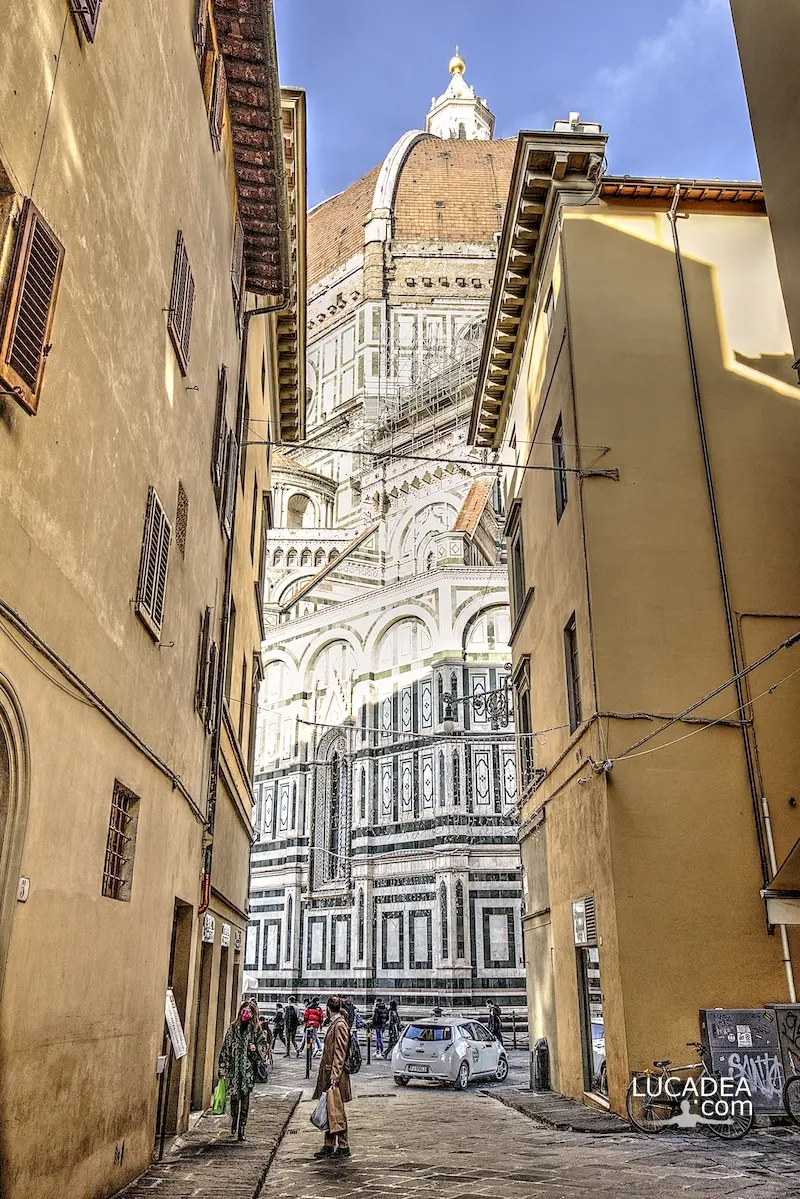
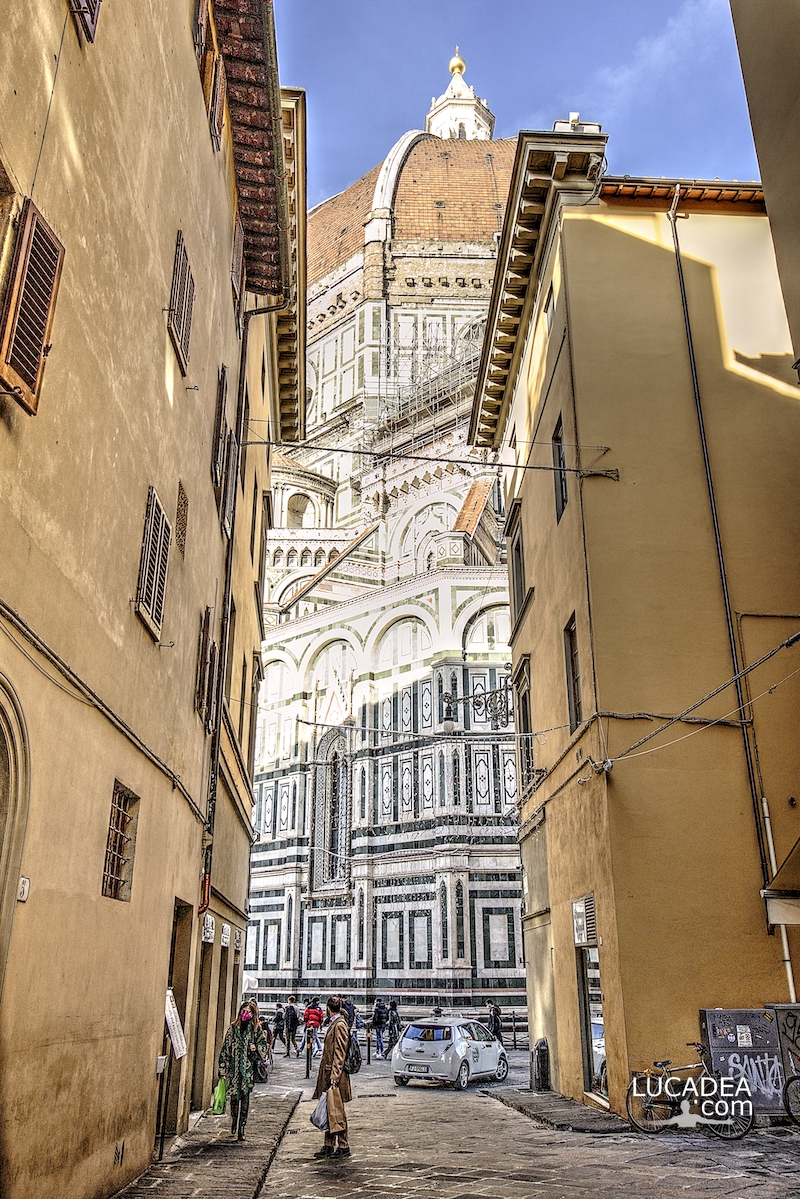
A glimpse of the Florence Cathedral from the alleys

Uno scorcio del Duomo di firenze dai vicoli attorno

A glimpse of Florence’s Duomo from the surrounding alleys.
Walking through the beautiful alleys of the city’s historic center, I suddenly catch a glimpse of the Duomo, which I obviously had to photograph and share with you.

Have you ever been to Florence and visited the Duomo? Add a comment or go to the bottom of the site to read what other visitors have written.

Uno scorcio del Duomo di firenze dai vicoli attorno

Photo taken with Canon EOS M100 camera and Canon EF-M 11-22 lens.

To see all the photos I took in the beautiful Tuscan town, click here:

The Metropolitan Cathedral of Santa Maria del Fiore, commonly known as the Florence Cathedral, is the main church of Florence, the symbol of the city, and one of the most famous in Italy. When it was completed in the 15th century, it was the largest church in the world, while today it is considered the third largest in Europe after St. Peter’s in Rome and the Milan Cathedral. It stands on the foundations of the ancient cathedral of Florence, the church of Santa Reparata, in a part of the city that has hosted places of worship since Roman times.
Continue and learn more on Wikipedia

A glimpse of the Florence Cathedral from the surrounding alleys – Un aperçu de la cathédrale de Florence depuis les ruelles environnantes – Un vistazo a la Catedral de Florencia desde los callejones circundantes – Um vislumbre do Duomo de Florença das vielas circundantes – Ein Blick auf den Dom von Florenz aus den umliegenden Gassen – Nhìn thoáng qua Nhà thờ Florence từ những con hẻm xung quanh – 从周围的小巷瞥见佛罗伦萨大教堂 – 周辺の路地からフィレンツェのドゥオーモを垣間見る

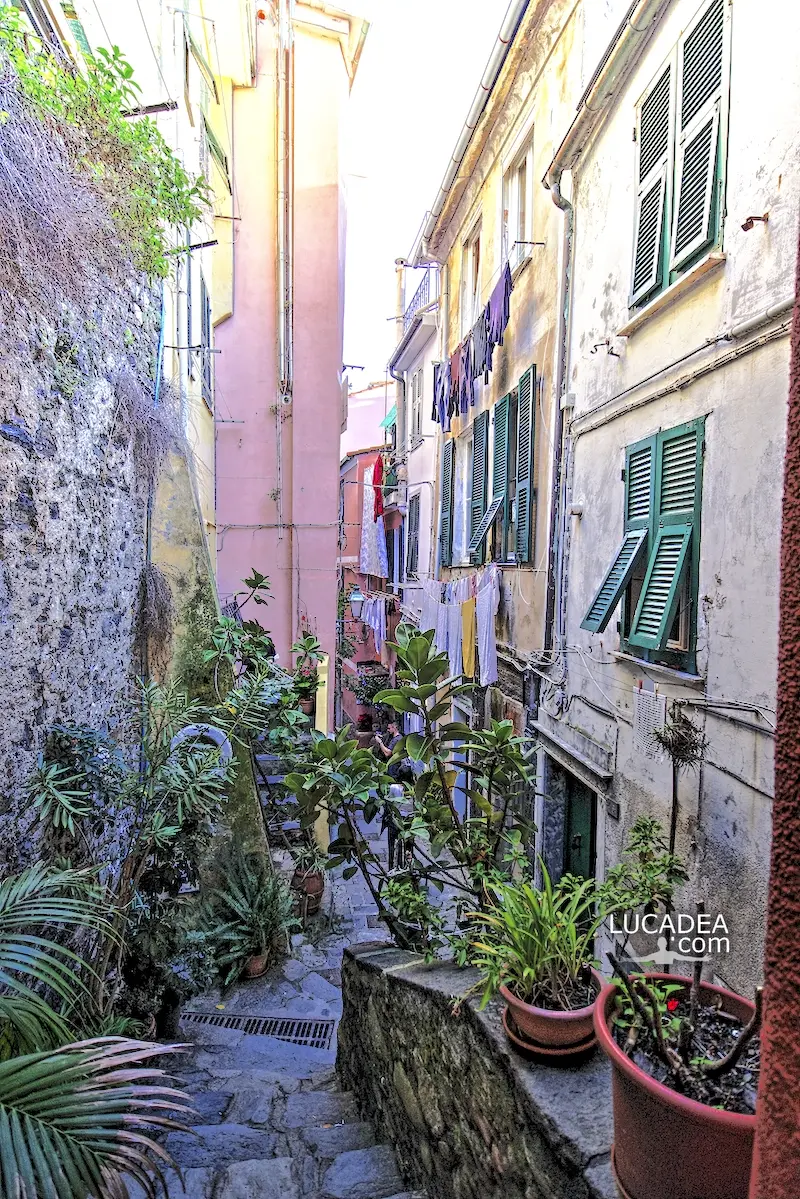
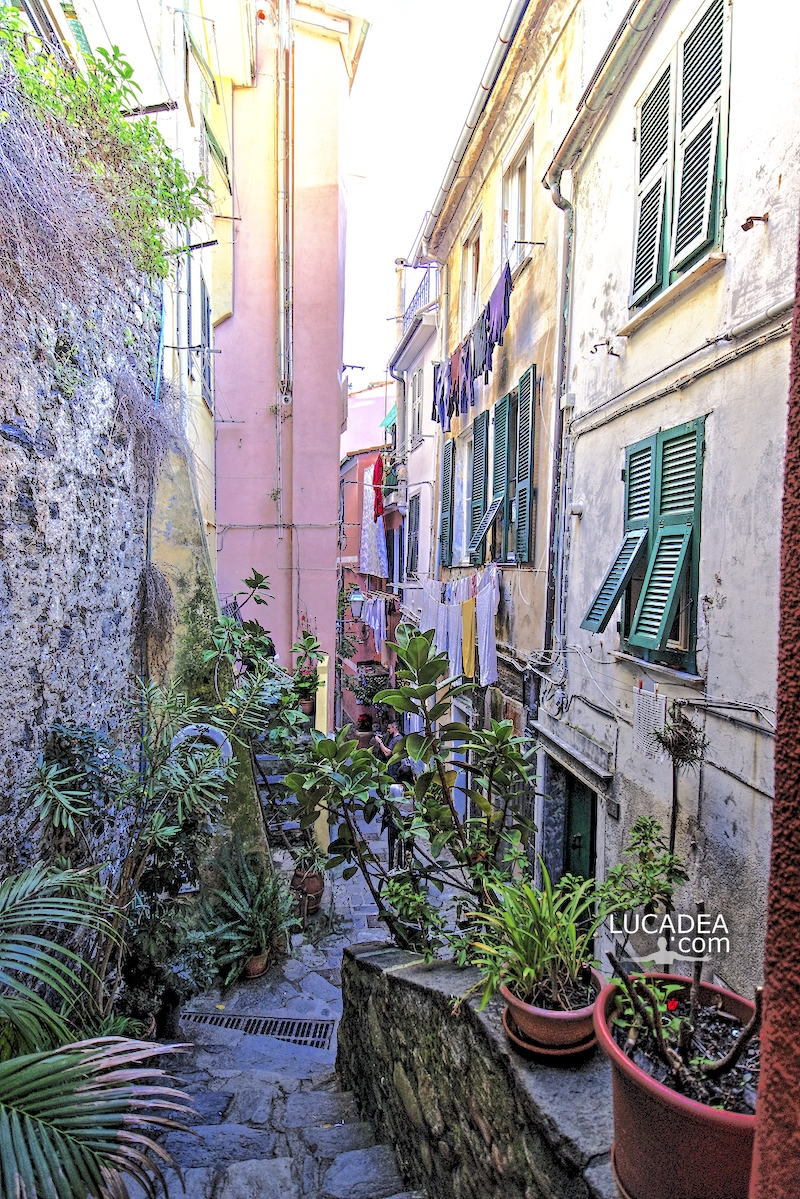
A glimpse of an alley in Vernazza in the Cinque Terre

Uno scorcio di un vicolo di Vernazza alle Cinque Terre

A glimpse of an alley in Vernazza in the Cinque Terre.
If you decide to tour Vernazza but don’t want to walk the paths that connect the Cinque Terre to the village itself, you’ll have to arrive by train (or take the long, winding driveway with no parking near the village). Once you exit the station, the village opens up in all its beauty.
The village is very small, but the narrow streets offer priceless views!

Do you know Vernazza and the Cinque Terre?
Add a comment or go to the bottom of the site to read what other visitors have written.

Uno scorcio di un vicolo di Vernazza alle Cinque Terre

Photo taken with Canon EOS M100 and Canon EF-M 11-22 lens.

Click here to see all the photos I took that day along the path:
foto gallery

A glimpse of an alley in Vernazza in the Cinque Terre – Un aperçu d’une ruelle à Vernazza dans les Cinque Terre – Un vistazo a un callejón en Vernazza en Cinque Terre – Um vislumbre de um beco em Vernazza nas Cinque Terre – Ein Blick in eine Gasse in Vernazza in den Cinque Terre – Nhìn thoáng qua một con hẻm ở Vernazza trong Cinque Terre – 五渔村韦尔纳扎小巷一瞥 – チンクエテッレのヴェルナッツァの路地を垣間見る
🏠
  • Italiano