
Under the Stone of Genoa Latin Inscription

Dettaglio dell’arco marmoreo a Genova con iscrizione latina di Genova e stemma del grifone scolpito nella pietra storica

Under the Stone of Genoa Latin Inscription.
The marble arch stands quietly in front of me, carrying a sense of time that feels almost suspended, and the Latin inscription of Genoa immediately becomes the visual and emotional focus of the scene. The Latin inscription of Genoa is carved into the stone like a message that refuses to fade, guiding my attention through every groove and shadow.
I am in Genoa, Liguria, Italy, walking through a city where stone is never just architecture but a layered memory of centuries. The Latin inscription of Genoa appears here as a fragment of civic identity, something that still connects the present streets with a medieval past. The geometry of the arch, with its alternating marble tones, frames the inscription as if it were part of a larger dialogue between structure and meaning.
The griffin emblem carved nearby adds another level to the composition, suggesting protection and strength. A historical curiosity explains this symbol: the motto associated with Genoa refers to the griffin holding its power over enemies, a medieval representation of the city’s resilience and identity. This detail transforms the stone into something more than decoration, turning it into a statement of belonging and defense.
As I look closer, I think about how many times I might have passed similar details without noticing them. The Latin inscription of Genoa feels like a quiet reminder that cities speak through their surfaces, even when we are not paying attention. I remember a similar atmosphere in another post from my blog, where Genoa revealed itself through equally hidden architectural traces, almost like a visual conversation across time.
If you are visiting Genoa, Liguria, Italy, this is one of those small but meaningful details worth seeing, not because it is grand, but because it carries the weight of centuries in a few carved letters. It makes me wonder how many stories are still written into stone around us, waiting to be read.

What would you notice if you slowed down in front of an old city wall like this? Add a comment or go to the bottom of the site to read what other visitors have written.
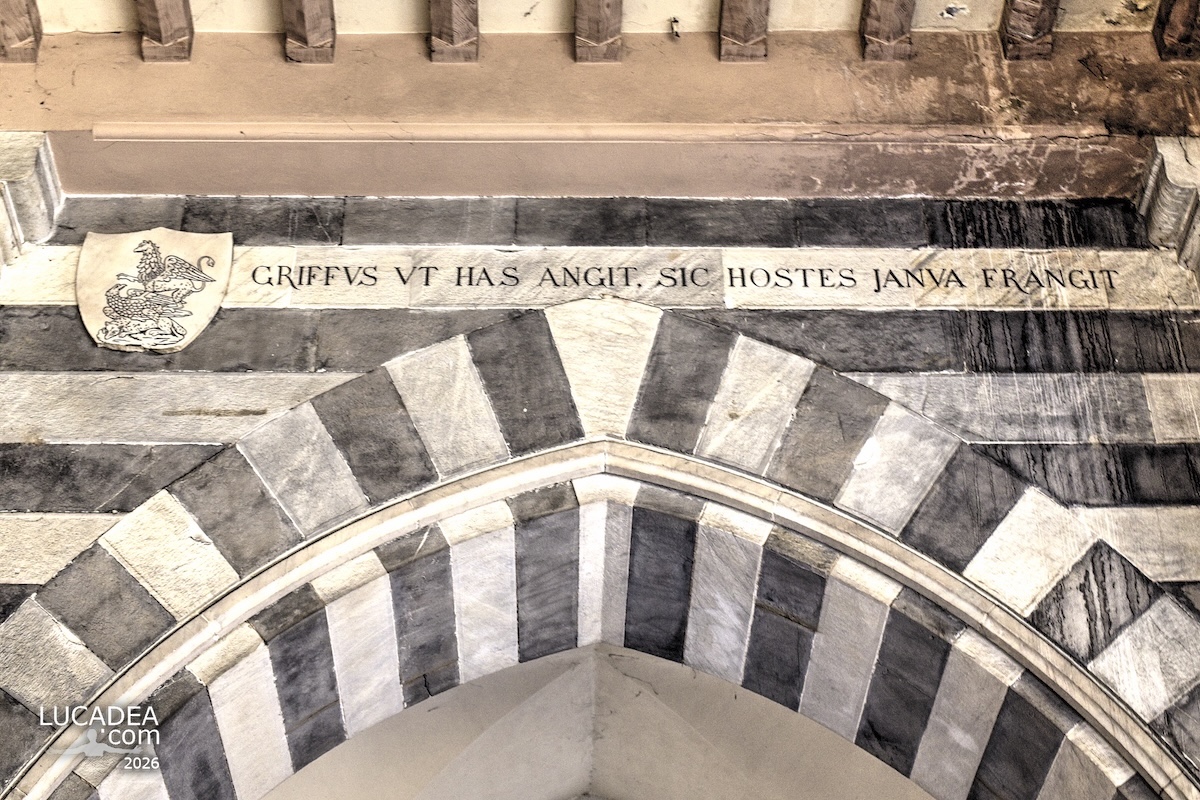
Dettaglio dell’arco marmoreo a Genova con iscrizione latina di Genova e stemma del grifone scolpito nella pietra storica

Photo taken with Canon EOS R50 V and lens Canon RF 28.

Under the Stone of Genoa Latin Inscription – Sous la pierre de Gênes inscription latine – Bajo la piedra de Génova inscripción latina – Sob a pedra de Génova inscrição latina – Unter dem Stein von Genua lateinische Inschrift – Dưới đá Genoa bia khắc Latin – 热那亚石下的拉丁铭文 – ジェノヴァの石の下のラテン碑文

The text of this post was written with the help of ChatGPT, a language model from OpenAI.

Add one  comment to this article or read  here what other visitors have written.
 
Adv
 
Disclamer

The rights on images, videos, choruses, text and all other material on the LUCADEA.com website are governed as per  Copyright page.


This page has been viewed 1 times today.
This month it has been viewed 1 times.
In total it has been viewed 1 times.
 

The motto of Genoa in XX Settembre Street

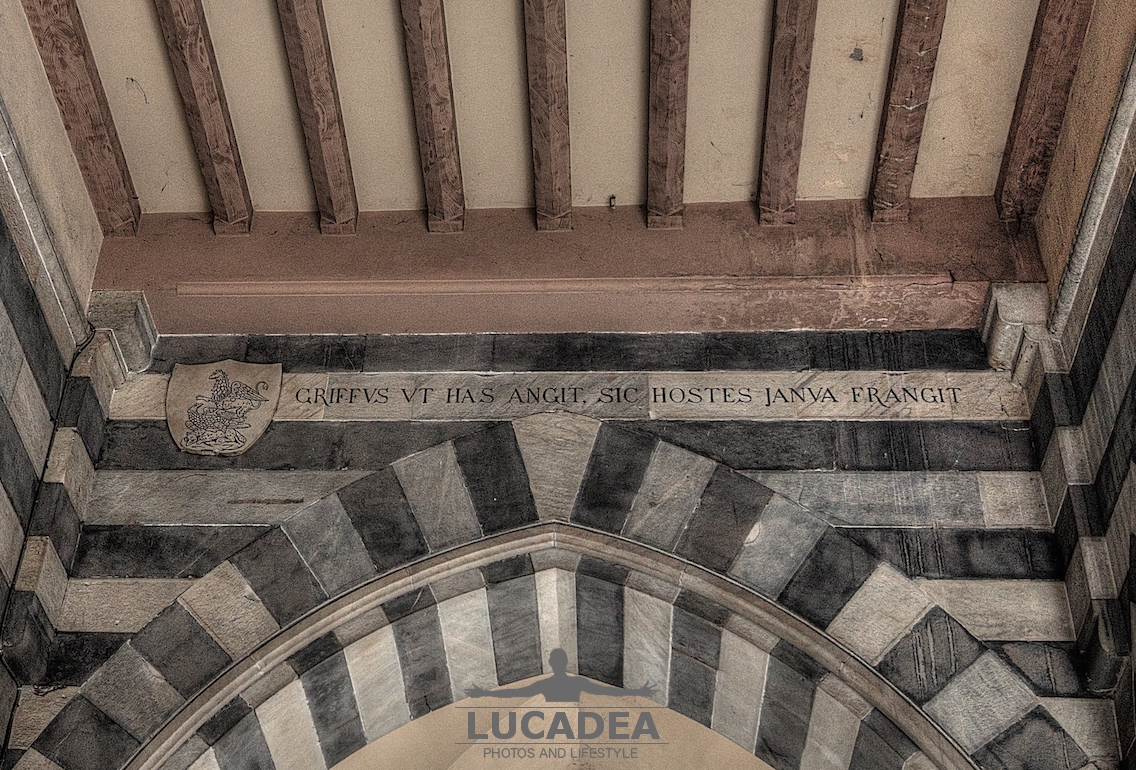
Scritta latina con il motto di Genova e grifone sopra una volta in marmo in via XX Settembre

The motto of Genoa in XX Settembre Street.
While walking along XX Settembre Street, one of the main and most elegant streets of the city, I noticed a Latin inscription placed above one of the many marble vaults decorating the arcades.
The sentence reads: “Griphus ut has angit, sic hostes Ianua frangit”, which can be translated as: “Just as the griffin grips these, so Genoa crushes its enemies.” It is a strong and meaningful phrase that reflects the proud and powerful spirit of the city.
Curious about its meaning, I searched for more information and discovered that it is one of the oldest mottos of Genoa, often referred to as La Superba. This is not just a decorative detail, but a symbol deeply connected to the city’s historical identity and its past as a powerful maritime republic.
Next to the inscription there is also an image of a griffin, a mythological creature that combines the features of an eagle and a lion. In this case, it is depicted clutching an eagle and a fox, reinforcing the symbolic message of strength, control and dominance expressed by the motto.
Walking under the arcades of XX Settembre Street, it is easy to get distracted by shops and the movement of people, but simply looking up can reveal hidden artistic and historical details. This is one of the most fascinating aspects of Genoa: a city that reveals its character through small elements that are often overlooked.
On my blog I often share details and glimpses of the city, and each time there is always something new to discover. Even a simple walk can turn into a small and unexpected historical discovery.

Have you ever noticed this inscription while walking under the arcades? Add a comment or scroll down to read what other visitors have written.

Latin motto of Genoa with griffin on a marble vault in XX Settembre Street

Photo taken with a Canon EOS M100 camera and a Canon EF-S 10-18 lens.

Since it really piqued my curiosity, I looked into it further and found this great page that covers the topic in more detail: amezena.net.

Add one  comment to this article or read  here what other visitors have written.
 
Adv
 
Disclamer

The rights on images, videos, choruses, text and all other material on the LUCADEA.com website are governed as per  Copyright page.

This page has been viewed 1 times today.
This month it has been viewed 1 times.
In total it has been viewed 1 times.
 

Genoa’s motto under XX Settembre arcades

I portici ed il motto di Genova in via XX Settembre

Genoa’s motto under XX Settembre arcades.
While walking under the arcades of XX September Street in Genoa, I captured with my camera a detail that can easily be missed: a neo-Gothic decoration featuring the famous motto connected with the history of the Republic of Genoa. This photograph tells the story of one of the many hidden details that can be discovered along one of the city’s most important streets.
XX September Street in Genoa, Liguria, Italy, is one of the main roads of the modern city centre, connecting important areas between Piazza della Vittoria and Piazza De Ferrari. When I walk along this street, I enjoy looking beyond the obvious path and observing the details above eye level: mosaics, decorated ceilings, and architectural elements that reveal different historical periods.
The arcades of XX September Street are among the most distinctive features of this urban route. Walking beneath them, it is possible to see decorated floors, Liberty style elements and neo-Gothic details that reflect the architectural taste between the late nineteenth and early twentieth centuries. It was in this environment that I found the detail shown in this photograph, near the Zara exit.
I wanted to capture this image because it represents the way I like to explore Genoa: searching for small traces of the past hidden inside everyday life. It is not an isolated monument, but a detail placed along a street used every day by residents and visitors.
The motto shown beneath the arcade reads: “As the Griffin seizes these, so Genoa tears apart its enemies.” The image shows a griffin holding an eagle and a fox, symbols connected with the old rivalries of the Republic of Genoa. The eagle represents imperial authority, while the fox refers to Pisa, one of Genoa’s historic competitors.
A brief historical curiosity concerns the Republic of Genoa itself, one of the Mediterranean’s major maritime powers between the Middle Ages and the modern era. Its history is closely linked with trade, navigation and conflicts for control of important sea routes.
This photograph connects naturally with other stories on my blog dedicated to hidden details of Genoa, such as the articles about the old alleys and historic streets of the city centre. I enjoy showing a Genoa that does not reveal everything immediately, but rewards those who take time to observe.
For me, Genoa’s motto beneath the arcades of XX September Street is a perfect example of how a simple walk can become a photographic discovery. Sometimes all it takes is looking up to find a story still living alongside everyday life.

Have you ever discovered a hidden historical detail while walking through a city? Add a comment or go to the bottom of the site to read what other visitors have written.

Photos taken with Honor 20.

Where is the street:

What is September 20th, the date of Via XX Settembre? On that day in 1870, the Italian army captured Rome after the breach of Porta Pia: it marked the end of the Papal States.
Continue and learn more at Il Post

Griffoni Alley in Genoa’s historic center

Nel cuore di Genova: Vico dei Griffoni

Griffoni Alley in Genoa’s historic center.
Among the narrow streets of Genoa’s historic center, Griffoni Alley is one of those hidden corners that reveal the city through old stones, small details and unexpected views. This photograph shows a quiet alley in the Maddalena district, a small passage connecting Calvi Bridge Street and Saturno Alley while preserving the typical atmosphere of Genoa’s traditional caruggi.
I wanted to capture this alley with my camera because walking through Genoa without a precise destination often leads to discovering the most interesting details. The historic center of Genoa is a continuous maze of narrow streets, buildings standing close together, different architectural styles and small elements that invite you to stop and observe.
Griffoni Alley is one of the places worth seeing in Genoa for anyone who enjoys discovering a city through its less famous corners. It is not a large monument or a celebrated square, but this smaller scale allows visitors to experience the authentic character of the Ligurian city and its everyday atmosphere.
The name of the alley refers to the griffin, a mythical creature with the head of an eagle and the body of a lion, which was adopted as a symbol of Genoa as early as the 13th century. The griffin represented strength and prestige and also appeared on medieval Genoese coins, giving origin to the expression “griffo o croce”.
At the entrance of the alley, visible from Calvi Bridge Street, there is a Latin inscription on a plaque that has been partly damaged over time. Even though the complete text is difficult to read, this small detail adds more charm to the place because it shows the layers of history hidden behind every corner of the old city.
Urban photography often begins with these small discoveries: a worn inscription, an ancient stone, a perspective between two buildings. As I have already shared in photographs dedicated to Genoa’s caruggi on Lucadea.com, this image also focuses not on a famous landmark, but on a small fragment of everyday city life.
Griffoni Alley is located in Genoa, Liguria, Italy, in the heart of one of the largest historic centers in Europe. It is a place discovered by walking slowly, following curiosity and paying attention to details that can easily be missed.
This photograph aims to preserve one of these moments: a small piece of Genoa capable of telling centuries of history through a simple alley.

Which hidden street or corner of Genoa has impressed you the most? Add a comment or go to the bottom of the site to read what other visitors have written.

Griffoni Alley in Genoa historic center, an old Ligurian alley with architectural details

Photo taken with camera Canon EOS RP and lens Canon RF 24-50.

Where the alley is located:

🏠
  • Italiano