Bún Thang, Vietnamese Noodle Soup with Meat and Eggs

Bun ngang in Vietnam

Bún Thang, Vietnamese Noodle Soup with Meat and Eggs.
Vietnamese cuisine offers a wonderful variety of dishes built around fresh ingredients, fragrant broths and carefully balanced flavours. During my travels, I had the chance to try several local specialities, and Bún thang was one of the dishes that caught my attention. It is a Vietnamese noodle soup made with rice noodles, broth, meat and eggs, combining simple ingredients in a surprisingly delicate way.
There are actually several dishes in the photograph, and I believe I have already written separate posts about some of the others. The bowl I chose for myself is the one in the foreground. My memory of the meal is not detailed enough to describe every ingredient with complete certainty, but I remember a bowl of rice noodles in broth, served with slices of meat and strips of egg prepared like a thin omelette.
One ingredient was described to me as Vietnamese mortadella. This was most likely giò lụa, a traditional Vietnamese pork sausage with a smooth texture, often served sliced in soups and other dishes. Along with the noodles and egg, it gave the soup a mixture of textures and flavours without making it feel too heavy.
Bún thang is particularly associated with Hanoi, the capital of Vietnam. The traditional preparation is known for its careful presentation, with ingredients finely sliced and arranged neatly over the noodles. Depending on the recipe, these can include shredded chicken, thin strips of omelette, giò lụa and other garnishes. A well-prepared broth is essential, bringing all the different elements together and giving the soup its delicate flavour.
What I find interesting about dishes like this is the way familiar ingredients can become something distinctive through preparation and presentation. The rice noodles provide a soft base, the meat adds substance, and the egg contributes a gentle flavour and a different texture. The hot broth brings everything together, making the dish comforting without overwhelming the individual ingredients.
When travelling, I do not always know the exact name of every ingredient or the precise method used by the cook. Sometimes what remains is the overall impression: the aroma of the broth, the appearance of the bowl and the pleasure of tasting something unfamiliar. Food is a wonderful way to discover a country’s culture, and even a single meal can introduce us to ingredients and traditions we might never encounter at home.
For anyone interested in trying a home-style version of Bún thang, a simple starting point would be rice noodles, chicken broth, cooked shredded chicken, a thin omelette cut into strips and sliced giò lụa, if available. Cook the noodles according to the packet instructions, heat the broth, prepare and slice the omelette, then arrange the ingredients in bowls and pour the hot broth over them. Fresh herbs and suitable Vietnamese seasonings can be added to bring the dish closer to the version you want to recreate. This is a simplified approach rather than a claim to reproduce every detail of the traditional Hanoi recipe.
As far as I remember, I enjoyed the Bún thang I tried. It may not have been the most memorable meal of the trip, but it was an interesting introduction to another part of Vietnamese food culture. Looking back at the photograph brings that experience to mind and gives me an opportunity to share it with readers who enjoy discovering dishes from around the world.
In my other food and travel posts, I like to record these small discoveries alongside photographs of places, streets and everyday life. A bowl of noodles might seem like a modest subject, but it can open the door to a much wider story about local ingredients and culinary traditions.

Have you ever tried Bún thang or another Vietnamese noodle soup with meat and eggs? I would love to hear what you thought of it and which Vietnamese dishes you would recommend to someone exploring this cuisine for the first time. Add an comment or go to the bottom of the site to read what other visitors have written.

Bún thang Vietnamese noodle soup in the foreground, with rice noodles, savoury broth, sliced meat and thin strips of omelette

Bún thang Vietnamese noodle soup in the foreground, with rice noodles, savoury broth, sliced meat and thin strips of omelette

Photos taken with a Canon EOS M100 camera and a Canon EF-M 22 lens.

Add one  comment to this article or read  here what other visitors have written.
 
Adv
 
Disclamer

The rights on images, videos, choruses, text and all other material on the LUCADEA.com website are governed as per  Copyright page.


This page has been viewed 0 times today.
This month it has been viewed 0 times.
In total it has been viewed 0 times.
 

Bún Ngan: Hanoi’s Vietnamese Duck Noodle Soup

Bun Ngan Hanoi

Bún ngan is a traditional duck noodle soup associated with Hanoi, the capital of Vietnam. I photographed this Vietnamese dish during a visit to the city several months ago, but I still have a few questions about its exact ingredients. What I feel fairly confident about is the duck broth, which gives this local speciality much of its distinctive character.
The name bún ngan refers to a noodle dish prepared with ngan, a type of duck commonly eaten in northern Vietnam. It is a familiar choice in Hanoi, where small restaurants and casual food stalls serve it as part of everyday life. The basic combination is straightforward: duck meat, noodles and a flavourful broth. Depending on the restaurant and the particular recipe, the bowl may also include vegetables, fresh herbs and other toppings.
While looking for more information about the dish, I found descriptions mentioning bamboo shoots, spring onions and coriander. Rice vermicelli is often used, although some versions feature glass noodles instead. The broth is generally prepared by cooking the duck and using its flavour to create a warm, savoury soup. However, I cannot say with certainty which ingredients were included in the bowl shown in my photograph. Rather than guessing, I prefer to keep the description honest and leave the finer details open until I can confirm them.
Hanoi has a rich everyday food culture, and its cuisine goes far beyond internationally famous dishes such as pho. Many local specialities are less familiar to visitors but offer a fascinating glimpse into the way people eat in the Vietnamese capital. Bún ngan is one of those dishes: comforting, filling and built around a combination of noodles, duck and broth that can vary from one establishment to another.
One interesting detail is that bún ngan is enjoyed throughout the year and can be eaten for breakfast or lunch. It is not simply a dish prepared for tourists who want to try something unusual; it is part of the regular food scene in Hanoi. In a city where meals are often enjoyed in small neighbourhood eateries, a bowl of hot duck noodle soup can be a satisfying way to take a break from exploring the busy streets.
Unfortunately, I did not collect enough information about the recipe when I took this picture. I plan to ask Dao to comment on the dish and help me identify its ingredients more accurately. That is one of the enjoyable parts of documenting food while travelling: the photograph preserves the memory, while conversations with people who know the local cuisine can reveal the story behind it.

Have you ever tried bún ngan in Hanoi, or is this Vietnamese duck noodle soup new to you? Add a comment or go to the bottom of the site to read what other visitors have written.

Bún ngan, a Vietnamese duck noodle soup photographed in Hanoi, the capital of Vietnam

Photo taken with a Canon EOS M100 camera and Canon EF-M 22 lens.

Add one  comment to this article or read  here what other visitors have written.
 
Adv
 
Disclamer

The rights on images, videos, choruses, text and all other material on the LUCADEA.com website are governed as per  Copyright page.


This page has been viewed 1 times today.
This month it has been viewed 1 times.
In total it has been viewed 1 times.
 

Hanoi cathedral between faith and urban chaos

Cattedrale cattolica di Hanoi con facciata gotica tra traffico e vita urbana, meta tipica per chi cerca cosa vedere a Hanoi

Hanoi cathedral between faith and urban chaos.
Walking through the center of Hanoi, trying to figure out what to see in Hanoi among the constant motion of the streets, I suddenly found myself standing in front of the Catholic cathedral of Hanoi. Among the places to see in Hanoi, this one stands out immediately, almost unexpectedly, as if it belonged somewhere else entirely.
The noise doesn’t stop. Motorbikes flow around you, people talk, sit, move, live their routines. And right in the middle of it all, the cathedral rises with its Gothic lines and weathered facade. When you search for what to see in Hanoi, you might expect temples or lakes, but this building tells a different story, one shaped by history and contrast.
Here we are in Hanoi, in northern Vietnam, where the cathedral becomes part of everyday life rather than something separated from it. I stood there for a while, watching how people interacted with the space. No one seemed particularly impressed, and that made it even more interesting. It felt real, not staged.
If you are visiting Hanoi and wondering what to see, this is definitely a place worth seeing, not just for its architecture but for the atmosphere around it. It shows how different layers of history can coexist naturally, without needing explanations.
It reminded me of another photo I shared on my site from a nearby street, where colonial buildings and modern life blend in a similar way. Hanoi has this ability to surprise you quietly, without trying too hard.
A small interesting fact: St. Joseph’s Cathedral was built in 1886 during the French colonial period and remains one of the oldest churches in the city, inspired by the famous Notre-Dame in Paris.
If you’re exploring what to see in Hanoi, you might realize that some of the most memorable places are the ones that don’t try to stand out, but simply exist within the rhythm of the city.

Have you ever found something unexpected right in the middle of the chaos? Add a comment or go to the bottom of the site to read what other visitors have written.

Cattedrale cattolica di Hanoi con facciata gotica tra traffico e vita urbana, meta tipica per chi cerca cosa vedere a Hanoi

Photo taken with Canon EOS RP and Canon RF 28 lens.

To see all the photos I took in Hanoi, click here:
foto gallery

Garlic Stalls at a Vietnamese Market

Bancarella del mercato in Vietnam piena di teste d’aglio bianche e violacee impilate in grandi quantità ravvicinate

Garlic Stalls at a Vietnamese Market.
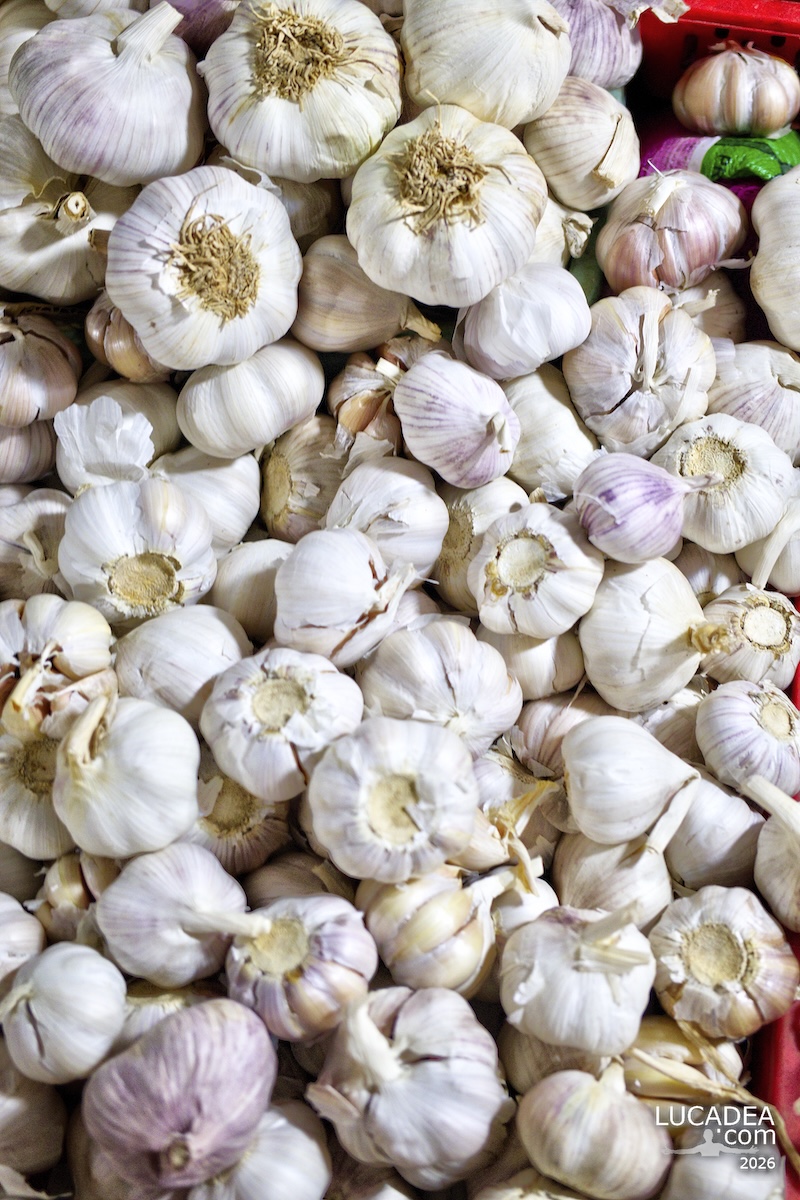
I find myself standing in front of a dense field of garlic that fills the frame so completely that everything else seems to fade into the background, and garlic becomes the immediate focus of this simple yet powerful scene. The garlic is stacked in countless clusters, some bulbs bright white, others marked with soft purple streaks that hint at different varieties and different hands that have shaped their journey to this market in Vietnam. Here, garlic is not just an ingredient but a constant presence, almost like a silent rhythm that structures the movement of sellers and buyers around the stalls.
As I look closer, I imagine the texture of each bulb, the dry papery layers protecting the cloves inside, and I think about how garlic defines so many everyday meals across Vietnam. The garlic here feels alive in its stillness, forming small landscapes of repetition and abundance that speak of harvest and labor. Even without sound or smell, the visual intensity of garlic is enough to fill the senses.
There is a small culinary truth tied to garlic in Vietnamese cuisine: it is often one of the first ingredients to hit the hot oil in a pan, building the aromatic foundation of countless dishes alongside shallots and chili. This simple step transforms garlic into something essential, shaping flavors that feel deeply rooted in local food culture.

Watching this scene, I start to wonder how many journeys each garlic bulb has taken before reaching this point, and how many meals it will continue to influence far beyond this market. How often do we stop and really observe something as ordinary, yet as essential, as garlic? Add a comment or go to the bottom of the site to read what other visitors have written.

Photos taken with Canon EOS R50 V and Canon RF 28 lens.

To see all the photos I took at the market, click here:

Hanoi, colorful houses by Train Street

Case colorate accanto ai binari della Train Street nel centro di Hanoi, Vietnam, uno scorcio della capitale

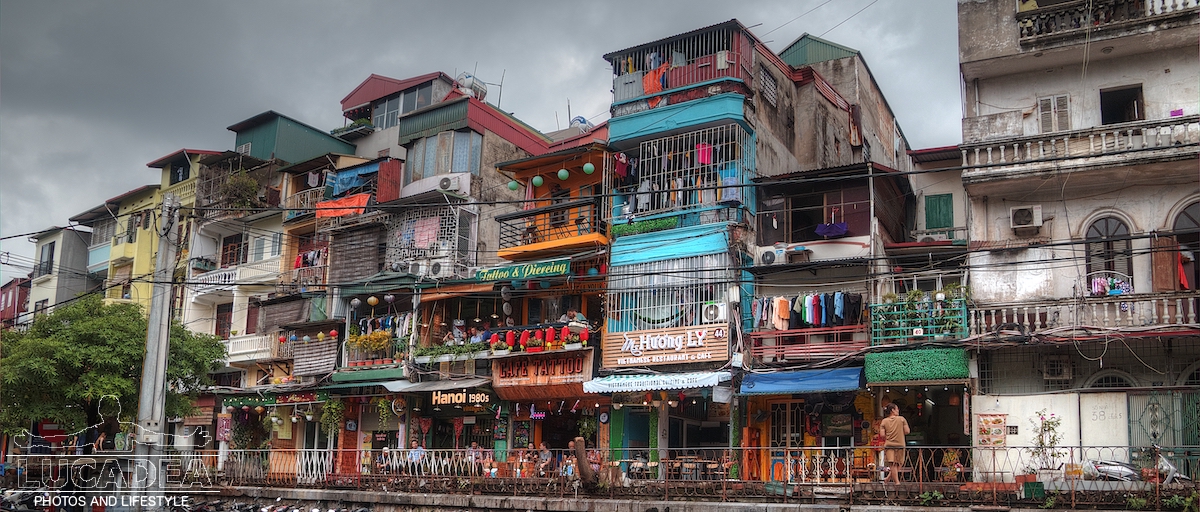
Hanoi, colorful houses by Train Street. Walking through Vietnam’s capital, I came across one of those scenes that seemed to capture several sides of the city at once: narrow colorful houses, greenery, urban noise and, just beyond them, the railway tracks of the famous Train Street. It is one of the things worth seeing in Hanoi, not only because of the train itself, but because of the unusual way the railway runs through such a tightly packed urban setting.
I took this photograph along one side of Train Street, focusing on the small houses built right beside the railway. What caught my attention was the contrast between ordinary homes and the tracks passing almost directly in front of them.
Hanoi, Vietnam, is a city where traffic, people, trees and street businesses constantly seem to share the same limited space. Even when walking without a particular destination, it is easy to turn a corner and find something completely different. These houses along Train Street were exactly the kind of detail that made me stop and take out my camera.
Train Street became famous because the railway passes through an extremely narrow corridor between the surrounding buildings. In some sections there is so little room that, when a train approaches, anyone standing near the tracks has to move away and leave the railway completely clear. It is an unusual urban scene, and the closeness between the railway and everyday life has made this part of Hanoi one of the city’s most recognizable images.
When I took this photograph, the small cafés beside the railway were still part of the experience offered to visitors. People could sit just a few inches from the tracks and wait for the train to pass. Shortly afterwards, however, authorities ordered the closure of several businesses operating too close to the railway because of safety concerns. In that sense, the photograph also preserves a particular moment in the recent life of the neighborhood.
The curiosity of Train Street is that it was not originally created as a tourist attraction. It is an ordinary railway line that has long been part of Hanoi’s urban fabric. Its unusual layout and the growing attention from visitors gradually turned it into one of the most photographed places in the capital.
For me, though, Hanoi is much more than Train Street. What I remember most is the combination of narrow colorful façades, constant traffic, trees along the streets, small lakes and, of course, street food. I like this photograph because it captures only one small part of that atmosphere rather than trying to represent the entire city.
Walking around Hanoi, I often felt that another photograph was waiting just around the next corner. I had a similar feeling in other parts of Vietnam that I have photographed for the blog, including Hoi An, where everyday streets and small details became just as interesting as the better-known sights.
The city felt chaotic, lively and full of contrasts, but that is exactly what made it so interesting to photograph. Train Street is certainly one of its most unusual places, although its relationship with tourism has become more complicated because of safety concerns.

I wonder whether Train Street will still be experienced in the same way in the future. Would you have sat that close to the railway to wait for the train? Add a comment or go to the bottom of the site to read what other visitors have written.

Colorful houses beside the railway tracks on Train Street in Hanoi, Vietnam, a distinctive view of the capital

Photo taken with a Canon EOS M100 camera and Tamron 16-300 lens.

Click here to see all the photos of the city:
foto gallery

Where the city is located:

Hanoi’s urban landscape is characterized by numerous lakes (such as the central Hoan Kiem Lake, or “Lake of the Returned Sword”) as well as various religious buildings—primarily Confucian and Taoist (the Temple of Literature and Ngoc Son Temple), but also Catholic (such as St. Joseph’s Cathedral). Its Old Quarter also features a large number of Buddhist pagodas.
Read more on Wikipedia

Ho Chi Minh Museum in Hanoi

Museo di Ho Chi Minh ad Hanoi in Vietnam con la moderna architettura del complesso storico

Ho Chi Minh Museum in Hanoi.
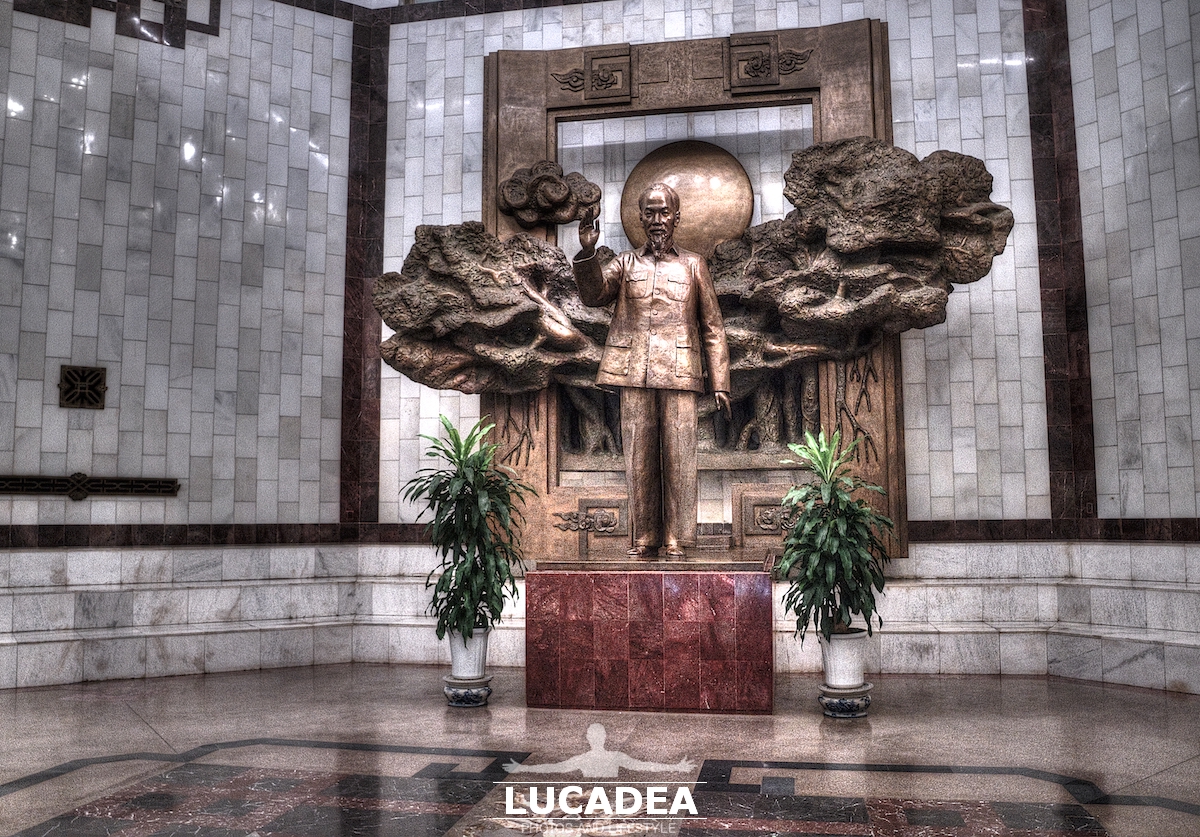
Among the things to see in Hanoi, Vietnam, the Ho Chi Minh Museum is one of the places most connected to the political and cultural history of the country. Located near the Ho Chi Minh Mausoleum, inside the large complex dedicated to the Vietnamese leader, the museum tells his story through photographs, documents and objects related to one of the most important figures in modern Vietnamese history.
I captured this photograph during my trip to Vietnam, when almost a year ago I visited Hanoi and some of its most representative places. While walking around the mausoleum area, I wanted to photograph this building as well, a place that may receive less attention than the main monument but that is equally meaningful for understanding the connection between Vietnam and Ho Chi Minh’s legacy.
The museum stands out from the outside because of its unusual architecture, with modern geometric shapes that contrast with the historical atmosphere of the surrounding area. Inside, the exhibition follows different stages of Ho Chi Minh’s life, from his early years and political education to his role in the creation of the Democratic Republic of Vietnam.
Visiting the Ho Chi Minh Museum offers an opportunity to understand an important part of Vietnamese history, but also to observe how national memory is represented through public spaces. The mausoleum complex is one of the most symbolic areas of Hanoi and is visited every day by both Vietnamese citizens and international travelers.
Hanoi, located in northern Vietnam, Vietnam, is a city where traditional Vietnamese culture, French colonial influences and contemporary history come together. The Ho Chi Minh Museum is located in the Ba Đình district, an area that contains some of the most important political and institutional buildings of the capital.
A small historical detail about Ho Chi Minh is that he was born in 1890 and became the main figure of the Vietnamese independence movement. He served as president of the Democratic Republic of Vietnam until his death in 1969, and his image remains deeply connected with the country’s national identity.
This photograph is part of my travel story through Vietnam, where I tried to capture not only famous landmarks but also places that help explain the history and culture of the country. Like other images I have shared from Vietnam, this one shows how the meaning of a photograph often comes from the context surrounding the subject.
If you are visiting Hanoi and wondering what to see, the Ho Chi Minh Museum is an interesting stop for anyone who wants to understand more about Vietnam’s recent history beyond the most famous views of the capital.

Which museum you visited during a trip helped you understand a country’s history the most? Add a comment or go to the bottom of the site to read what other visitors have written.

Ho Chi Minh Museum in Hanoi Vietnam showing the modern architecture of the historic complex

Photo taken with a Canon EOS M100 camera and Tamron 16-300 lens.

Click here to see all the photos taken in the capital:
foto gallery

The museum is located within the Ho Chi Minh complex in the Ba Dinh district, behind the Ho Chi Minh Mausoleum, and opened to the public in 1990.
Read more on Wikipedia.

A plate of fried rice with meat in Vietnam

Piatto di riso fritto con carne fotografato in Vietnam con ingredienti della cucina asiatica

A plate of fried rice with meat in Vietnam.
During one of my trips through Vietnam, Asia, I found myself once again in front of one of the dishes that often becomes a familiar choice when I travel far from home: fried rice with meat. It is a simple and common preparation, one of the everyday foods worth trying in Vietnam for anyone who wants to experience local cuisine, even if it is not always exactly the flavor I am looking for.
I photographed this dish because food is also part of the story of a journey. Not every meal needs to be surprising or unforgettable; sometimes a photograph simply preserves a moment, a lunch during a day spent far away from my usual habits.
In Vietnam, and more generally throughout many Asian countries, fried rice is a constant presence in restaurants and small local places. It is a practical and versatile dish, prepared in different ways depending on the region and the ingredients available. I usually prefer it with meat and only a few vegetables, although the result is not always what I imagine before ordering it.
This dish was photographed during my journey through Vietnam, but I honestly cannot remember exactly where I ate it among the many places I visited. When traveling for a long time, some details become mixed together, but photographs help bring those moments back.
Fried rice also comes from the idea of transforming already cooked rice into a new meal by adding ingredients such as meat, vegetables, eggs, and seasonings. This approach is common in many Asian cuisines, where simple ingredients are combined with cooking techniques that create different flavors and textures.
This photograph does not tell the story of an extraordinary dish or a special culinary experience, but rather a small piece of travel life. I like keeping these ordinary memories too, because they often represent the everyday atmosphere of a place better than the most famous attractions.
Like the photographs of places I usually share on my blog, this image comes from the desire to capture a real moment: not only the landmarks, but also the small experiences that become part of a journey.

What simple dish from a distant trip do you remember the most? Add a comment or go to the bottom of the site to read what other visitors have written.

Plate of fried rice with meat photographed in Vietnam with ingredients from Asian cuisine

Photo taken with a Canon EOS M100 camera and Canon EF-M 22 lens.

Vietnamese cuisine represents the culinary art developed in Vietnam. There are at least five hundred traditional Vietnamese dishes, a testament to the country’s immense culinary variety. Rice is among the most typical and widely consumed staples. Another notable item is a type of bread known as *Bánh mì*. Chinese cuisine also plays a significant role, having greatly influenced local cooking.
Read more on Wikipedia

Vietnamese coffee or cappuccino? A Vietnam break

Caffè vietnamita e cappuccino in una caffetteria del Vietnam con atmosfera locale

Vietnamese coffee or cappuccino? A Vietnam break.
During my journey through Vietnam, I realized how much coffee is part of everyday life in this country. Sitting in a café, watching people passing by, and choosing a drink to enjoy slowly became one of the small pleasures of travelling here.
This photograph comes from a simple moment: a break in a Vietnamese coffee shop where, as often happens, we had to choose between traditional Vietnamese iced coffee and a classic cappuccino. My wife almost always chooses the first one, while I usually stay faithful to the second.
Vietnamese coffee is one of the experiences worth trying in Vietnam and represents an important part of local culture. The country is one of the largest coffee producers in the world, and coffee is prepared in many different ways, often using the traditional metal filter called phin.
I was in Vietnam during a journey to discover the country, and this image tells more about a daily habit than just a food or drink experience. If you are visiting Vietnam, trying local coffee is certainly one of the best ways to understand a small but meaningful part of the culture.
Vietnamese coffee shops are everywhere, from small independent cafés to large national chains. On this occasion we were at Highlands Coffee, one of the most recognized coffee brands in Vietnam, where traditional drinks and more international options can be found together.
A curious detail is that Vietnamese iced coffee is often prepared with condensed milk and ice, creating a sweet and strong drink with a flavor very different from the traditional Italian espresso.
I enjoy photographing these ordinary moments because they tell stories through habits, people, and small daily rituals. Like other food and tradition images shared on my blog, this photograph was created to preserve a personal memory from a journey.

So what would you choose: a traditional Vietnamese coffee or a classic cappuccino? Add a comment or go to the bottom of the site to read what other visitors have written.

Caffè vietnamita e cappuccino in una caffetteria del Vietnam con atmosfera locale

Photo taken with Honor 20.

However, this isn’t the only type of coffee Vietnamese people drink. In fact, many love their cup of “ca phe nau” (coffee with condensed milk—also known as “ca phe sua” in the south) just as much as the traditional “ca phe den” (literally: black coffee).
Read more and find out more at tuttovietnam.it

Vietnamese coffee or cappuccino? A break in Vietnam – Café vietnamien ou cappuccino ? Une pause au Vietnam – ¿Café vietnamita o capuchino? Una pausa en Vietnam – Café vietnamita ou cappuccino? Uma pausa no Vietnã – Vietnamesischer Kaffee oder Cappuccino? Eine Pause in Vietnam – Cà phê Việt Nam hay cappuccino? Một kỳ nghỉ ở Việt Nam – 越南咖啡还是卡布奇诺?越南的一次休息 – ベトナムコーヒーかカプチーノか?ベトナムでの休憩

The text of this post was written with the help of ChatGPT, a language model from OpenAI.

Hanoi Train Street in the late afternoon light

Train Street a Hanoi nel tardo pomeriggio con binari, locali ai lati, lanterne colorate e persone sedute vicino ai tavoli.

Hanoi Train Street in the late afternoon light.
Hanoi Train Street in the late afternoon reveals itself almost suddenly, like stepping into a scene that exists only for a brief moment each day. The railway tracks run straight through the narrow street, so close to the cafés and tables that it feels almost unreal. Yet this is exactly what makes Hanoi Train Street in the late afternoon so captivating, that quiet sense of anticipation hanging in the air.
I walk slowly along the tracks, careful not to interrupt the people already seated along the sides. Colorful lanterns glow softly even before the daylight fades, adding warmth to the cool tones of the sky above. Shops are open, conversations flow naturally, and every now and then someone glances down the tracks, as if checking whether the calm will last a little longer.
There is something surprisingly ordinary about this extraordinary place. Hanoi Train Street in the late afternoon is not just a tourist attraction, but a living space where daily life unfolds between steel rails and concrete. Overhead, a web of cables stretches from building to building, while chairs and small tables are arranged with an ease that suggests this coexistence has always been part of life here.
I pause to watch the people. Some smile, others are absorbed in conversation, and a few, like me, try to capture the fragile balance between stillness and expectation. The sounds are subtle: voices blending with distant city noise and the occasional metallic echo from the tracks beneath my feet.
Gradually, I become aware that this moment is transitional. The light is shifting, the atmosphere changing, and everything seems to be preparing for something just out of sight. Soon the train will arrive, and in a matter of seconds, this calm setting will transform completely.
I stay a little longer, letting the scene settle into memory, aware that what makes it special is not just what happens, but what is about to happen.

Do you feel drawn to places where everyday life unfolds in such unexpected ways? Add a comment or go to the bottom of the site to read what other visitors have written.

Train Street a Hanoi nel tardo pomeriggio con binari, locali ai lati, lanterne colorate e persone sedute vicino ai tavoli.

Photo taken with Canon EOS RP and Canon RF 28 lens.

To see all the photos I took in Hanoi, click here:
Galleria delle foto

Hanoi Train Street in the late afternoon light – La rue du train de Hanoï en fin d’après-midi – La calle del tren de Hanói al atardecer – A rua do trem de Hanói no fim da tarde – Die Train Street in Hanoi am späten Nachmittag – Phố tàu Hà Nội vào cuối buổi chiều – 河内火车街的傍晚时光 – ハノイのトレインストリートの夕方

The text of this post was written with the help of ChatGPT, a language model from OpenAI.

Breakfast in a typical Vietnamese café

Colazione in un tipico caffe vietnamita

Breakfast in a typical Vietnamese café.
When I was in Vietnam with my wife last year, we sometimes had breakfast in one of the many traditional cafés.
These are meeting and relaxation places, often with a small pond filled with koi carp, where people spend a couple of hours sipping the typical Vietnamese drink or (like me) a more Western-style cappuccino accompanied by a pastry.

Do you know or would like to visit Vietnam? Add a comment or go to the bottom of the site to read what other visitors have written.

Photos taken with Honor 20.

Breakfast in a typical Vietnamese cafe – Petit-déjeuner dans un café typiquement vietnamien – Desayuno en una cafetería típica vietnamita. – Café da manhã em um típico café vietnamita – Frühstück in einem typisch vietnamesischen Café – Ăn sáng tại một quán cà phê điển hình của Việt Nam – 在典型的越南咖啡馆享用早餐 – 典型的なベトナムのカフェで朝食を
🏠
  • Italiano