
Monterosso Rock, the First of the Cinque Terre

Lo scoglio di Monterosso

Monterosso Rock, the First of the Cinque Terre.
In the late afternoon, while spending time on the beach at Monterosso al Mare, my attention was drawn to the large rock that gives this stretch of coastline a distinctive maritime character. It lies to the west of the beach opposite the railway station and is one of the familiar features of this beautiful corner of the Cinque Terre in Liguria.
I took this photograph during a visit to Monterosso, the westernmost village of the Cinque Terre, in the Province of La Spezia, north-western Italy. It is a place with a character of its own, where the sea is always central to the scenery and the beach, rocks and village create a particularly appealing coastal landscape. This rocky landmark is one of the details that make the view instantly recognisable.
You can also see a few young women in the picture, probably among the many tourists who visit these small Ligurian villages. They have stopped to take photographs of themselves, just as so many visitors do when they come across a beautiful setting. I like this little detail because it adds a spontaneous human element to the scene. The photograph is not only about the coastline, but also about the people enjoying it and making their own memories of the place.
What I particularly like about this image is the time of day. In the late afternoon, this part of Monterosso becomes especially beautiful. The atmosphere invites you to slow down, find a comfortable spot and simply watch the sea. I could easily spend hours looking at the gentle waves moving slowly towards the shore and then drawing back again. There is something wonderfully relaxing about that continuous movement, especially when there is no need to hurry anywhere.
I also made a little adjustment to the photograph using HDR processing. As you can see, I enhanced the colours and details slightly, while trying to retain the feeling of the original scene. I wanted the image to bring out the character of the coastline without losing the calm atmosphere that made me stop and take the picture in the first place.
Monterosso al Mare is the first of the five villages when travelling along the Cinque Terre from west to east. It is one of the best-known destinations on the Ligurian coast, appreciated for its seaside setting and its distinctive village atmosphere. Each of the five villages has its own personality, but the sea remains a common thread connecting them all.
For me, this photograph is above all a memory of a peaceful moment by the water. The rock, the people on the beach and the gentle movement of the waves all come together to capture something of Monterosso’s appeal.

Do you also enjoy stopping to watch the sea when you find yourself somewhere as beautiful as this? Add a comment or go to the bottom of the site to read what other visitors have written.
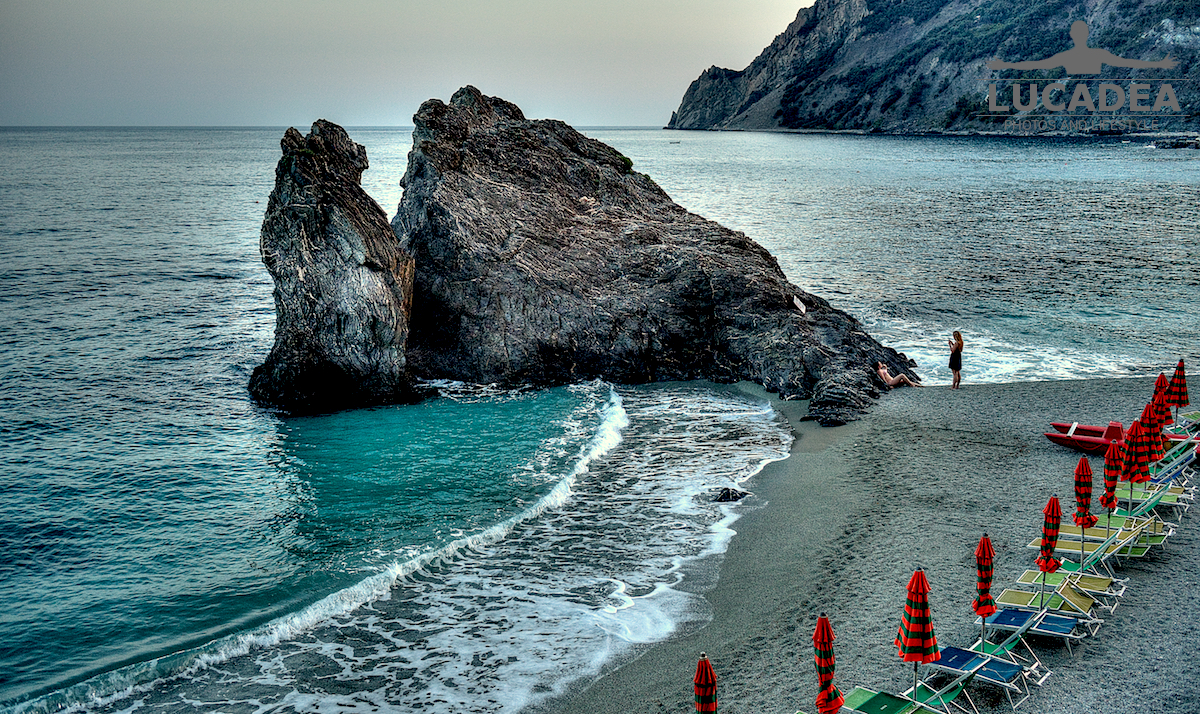
Monterosso Rock beside the beach in the Cinque Terre, with visitors enjoying the shore in the late afternoon

Photo taken with a Canon EOS M100 camera and Canon EF-M 22 lens.

Here’s where Monterosso is:

Add one  comment to this article or read  here what other visitors have written.
 
Adv
 
Disclamer

The rights on images, videos, choruses, text and all other material on the LUCADEA.com website are governed as per  Copyright page.


This page has been viewed 1 times today.
This month it has been viewed 2 times.
In total it has been viewed 2 times.
 

The Monumental Palace of Parliament in Bucharest

The Monumental Palace of Parliament in Bucharest.
The Palace of Parliament in Bucharest, Romania, is one of the most imposing and controversial buildings in Europe. Its enormous size dominates this part of the capital and reflects an important chapter in the country’s recent history: the communist regime of Nicolae Ceaușescu, who wanted to create a monumental complex that would embody his political power. I took the opening photograph from the large square in front of the building and later adjusted it using HDR processing to bring out more of its impressive appearance.
The building is widely known by its former name, Casa Poporului, meaning People’s House. It is now home to Romania’s two parliamentary chambers, the Chamber of Deputies and the Senate. The project was part of Ceaușescu’s ambitious urban redevelopment programme during the 1980s. A huge area of central Bucharest was transformed to make room for a new political and administrative district. Historic neighbourhoods were demolished and many residents were forced to leave their homes.
There is an important detail about the construction date. The plans for the redevelopment of the city took shape in the early 1980s, but work on the Palace of Parliament officially began in 1984, rather than 1980. The project involved a very large team of architects and engineers, led by Anca Petrescu, who was remarkably young when she became its chief architect. Thousands of workers were employed, often in demanding conditions, and vast quantities of building materials were used. Much of the marble, timber and other materials came from Romania itself.
The scale of the building is difficult to appreciate from photographs alone. It is approximately 270 metres long and 245 metres wide, reaches 84 metres above ground and has a total developed area of around 365,000 square metres. Its interiors include monumental halls, grand staircases, marble surfaces, crystal chandeliers, elaborate decorations and extensive corridors. The architectural style combines classical references with the imposing language of monumental state architecture associated with authoritarian regimes.
When the communist regime fell in 1989, the building was still unfinished. According to information published by the parliamentary institution, construction had reached approximately 60 per cent of the planned project. In the following years, the complex was adapted for new institutional purposes. Today it houses the two chambers of the Romanian Parliament, as well as offices and spaces used for conferences and official events. There is a striking historical contrast in the fact that a building originally conceived as a monument to a dictator’s authority now accommodates the institutions of a democratic state.
Its international ranking is also worth clarifying. It is often described as the world’s second-largest administrative building, after the Pentagon. However, the official website of the Palace of Parliament currently places it first among administrative buildings for civil use. Rankings can vary according to the criteria used and the type of floor area being measured.
Standing in front of such an enormous structure, I find it difficult not to think about the contrast between its architectural grandeur and the historical and economic circumstances in which it was built. The HDR treatment in my photograph is intended to bring out the visual impact of the building, but its imposing façade is only one part of a much more complicated story involving political ambition, urban destruction and the lives of the people affected by the redevelopment.
Bucharest has many other interesting places to discover and photograph, but the Palace of Parliament is undoubtedly one of its most unforgettable landmarks. I enjoy documenting buildings like this because a photograph can become an invitation to explore the history behind a place, rather than simply admire its appearance.

Have you ever seen the Palace of Parliament in Bucharest in person? What was your impression of such an enormous and historically significant building? Add a comment or go to the bottom of the site to read what other visitors have written.

Front view of Bucharest's monumental Palace of Parliament, photographed from the square in front with HDR image processing

To see all the photos click here:
foto gallery

Here’s where the building is:

Add one  comment to this article or read  here what other visitors have written.
 
Adv
 
Disclamer

The rights on images, videos, choruses, text and all other material on the LUCADEA.com website are governed as per  Copyright page.


This page has been viewed 1 times today.
This month it has been viewed 2 times.
In total it has been viewed 2 times.
 

The Bay of Silence on May 20, 2016

Baia del Silenzio il 20 maggio 2016

The Bay of Silence on May 20, 2016.
It was a beautiful spring morning in Sestri Levante, Liguria, Italy, with the sunshine lighting up one of the most picturesque bays on the Italian Riviera. It was Friday, May 20, 2016, and when I found myself in front of this wonderful view, I could not resist taking a photograph. The Bay of Silence, also known as Portobello, looked particularly bright and inviting, with the sea creating the perfect setting for a quiet moment and a little time spent enjoying the scenery.
I took this photograph that very morning and later edited it using HDR, or High Dynamic Range, a technique that helps bring out details in both bright and shadowed areas of an image. The result is a photograph with vivid colours, in which the blue sky, the sea and the colourful buildings come together beautifully. I enjoy using this technique when I want to emphasise the colours and details of a landscape, especially when the natural light already provides such a lovely starting point.
The Bay of Silence is one of the best-known places in Sestri Levante, a seaside town whose charm is closely connected to its unusual geography. The historic centre stands on a narrow strip of land that links the mainland to a small peninsula known as the Island. This stretch of land separates two very different bays: the larger Bay of Fables and the smaller, more intimate Bay of Silence. One side is associated with the harbour and its maritime activities, while the other offers a sheltered beach surrounded by colourful houses that seem to reach almost to the water’s edge.
The name Bay of Silence has an interesting story behind it. It was the local poet Giovanni Descalzo who first used this evocative name in 1919, helping to give one of the town’s most beautiful views an identity of its own. The older name, Portobello, has never completely disappeared and is still commonly used by local residents to refer to the bay and its surrounding area.
What makes this place so special is the relationship between the village and the sea. The pastel-coloured houses, with their green shutters and adjoining facades, seem almost to rest directly on the beach. Fishing boats, sand and water that changes colour with the light complete a view that is difficult to get tired of. Even if I have seen this place many times, there is always something worth photographing: a reflection, a boat pulled up on the shore, an open window or simply the changing colours of the sky.
On a morning like that of May 20, the bay shows one of its most attractive sides. Spring is a wonderful season for photographing places like this. The days are already bright, temperatures are pleasant and it is often possible to enjoy the scenery without the crowds that arrive during the summer months. Sestri Levante still has a more relaxed rhythm at this time of year, making it easier to appreciate the details of its historic centre and its beautiful coastline.
This photograph is also a little reminder of a morning that left me with a very pleasant feeling. It was Friday, and along with the satisfaction of having taken a photograph I liked, there was the simple pleasure of approaching the weekend with such beautiful weather. That was why I wanted to share the image and wish everyone a good weekend, hoping that the sunshine would stay with us for the following days.

And what about you? Do you prefer the Bay of Silence on peaceful spring mornings, or during the summer when the beach is full of life? Add a comment or go to the bottom of the site to read what other visitors have written.

The Bay of Silence in Sestri Levante on a bright spring morning, photographed on May 20, 2016

The seaside promenade of Sestri Levante

La passeggiata a mare di Sestri Levante

The seaside promenade of Sestri Levante.
One of my favourite photographs of the seafront promenade is the one that also shows the monumental trees (I believe maritime pines) in the stretch between the Neptune statue and Dani’s kiosk.
In this case, I slightly enhanced the photo with an HDR color effect.

Have you ever walked along the seafront in Sestri Levante? Add a comment or go to the bottom of the site to read what other visitors have written.

La passeggiata a mare di Sestri Levante

Photo taken with Canon EOS RP camera and Canon RF 28 lens.

Here’s where I took the shot:

The seafront promenade of Sestri Levante – La promenade du bord de mer de Sestri Levante – El paseo marítimo de Sestri Levante – O passeio marítimo de Sestri Levante – Die Strandpromenade von Sestri Levante – Đường đi dạo bên bờ biển Sestri Levante

Colorful houses of Corniglia in Cinque Terre alleys

Colorful houses of Corniglia in Cinque Terre with windows and Ligurian village facades

Colorful houses of Corniglia in Cinque Terre alleys.
During my walk through Corniglia on August 14, 2014, I wanted to capture with my camera a small detail of the village’s colorful houses, one of those elements that can easily be missed when focusing only on the most famous views. This photograph of Corniglia tells the story of Cinque Terre houses through colors, windows and architectural details that make the village unique.
In Corniglia, in the municipality of Vernazza, Liguria, Italy, the houses are built along the hillside, following the shape of the promontory and creating a network of narrow streets, steps and small passages. Looking closely at the colorful houses of Corniglia, you can discover details that reveal everyday life in the village: shutters, balconies, different wall tones and simple decorations that make every building slightly different.
That August day started as a trip to Cinque Terre, taking advantage of weather forecasts that suggested a less sunny day than the typical summer conditions. This gave me the chance to focus more on small details rather than only on the most famous panoramic views. Among the many photographs I took that day, I chose this one because it represents a quieter side of the village, away from the classic landscape images usually associated with Corniglia.
I slightly processed the image in HDR to enhance the colors of the facades and highlight the differences between the various surfaces while keeping the original feeling of the scene. The purpose was not to create an artificial image, but to bring back the impression I had while looking at those houses, where every color contributes to the identity of the place.
Corniglia is the highest village of Cinque Terre and, unlike the other villages, it does not have a harbor directly connected to the sea. Its unique position on top of a cliff offers different perspectives and creates a quieter atmosphere among historic streets and homes.
A small curiosity concerns the structure of the village itself: visitors arriving by train must climb the Lardarina staircase, a long series of steps connecting the station level with the historic center. This path is part of the experience of visiting Corniglia and shows the strong relationship between the village and its landscape.
If you are visiting Cinque Terre and looking for places worth seeing, there is much more than famous viewpoints. A simple house, a window or a narrow street can reveal the personality of these villages. Like other photographs I have shared from Cinque Terre, this image was created by observing a small element and turning it into a memory.
The colorful houses of Corniglia, with their particular position and character, are still one of the details that bring my thoughts back to that August day.

Which small detail from a village or town has stayed in your memory after a trip? Add a comment or go to the bottom of the site to read what other visitors have written.

Colorful houses of Corniglia in Cinque Terre with windows and Ligurian village facades

Click here to see more photos.
photo gallery

Here’s where the village is located:

🏠
  • Italiano