A slate-clad building in Lavagna

Un palazzo di Lavagna vestito d’ardesia

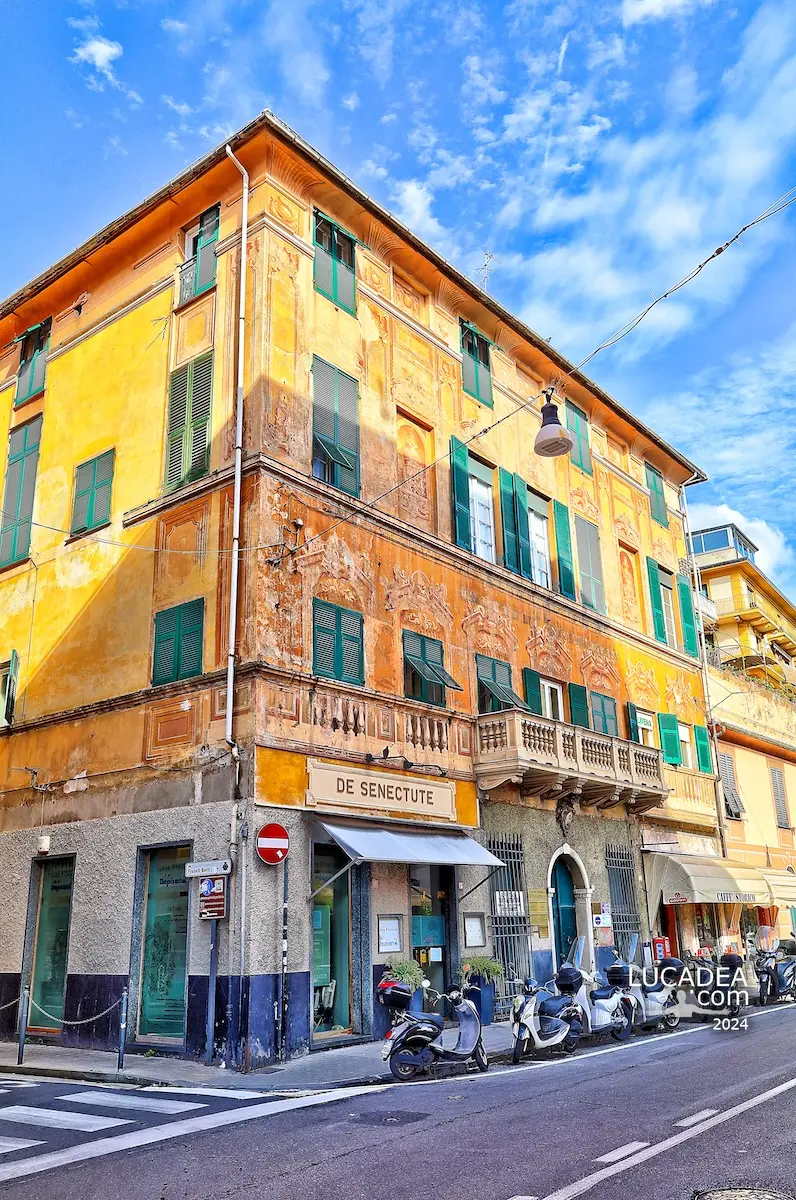
A building in Lavagna clad in slate.
This building in Lavagna immediately struck me with its dual nature. On one side, the elegant, decorated façade, with warm colors and stucco-framed windows that convey a precise idea of ​​urban beauty. On the other, almost suddenly, a wall entirely clad in slate slabs—dark, regular, compact. Photographing it was like capturing a silent dialogue between two materials that couldn’t seem further apart, yet here they coexist without clashing.
I stopped under the porticoes, looking up. The arches give the building solidity, anchoring it to the ground, while above, everything seems to lighten. The painted façade has a narrative quality, as if it wanted to tell a story to passersby. The slate wall, on the other hand, doesn’t explain anything, doesn’t decorate, doesn’t seek attention. It’s there for its function, with that concrete presence that is almost natural in Liguria. In the photos, I sought precisely this contrast, without choosing just one side, but rather letting both speak.
Walking along the corner of the building, the transition is clear but not violent. It’s like moving from one sentence to another in the same conversation. The light changes, the color fades, the surface becomes rougher to the eye. Yet the whole thing works. Perhaps because in Lavagna, slate is not an exception, but a constant, familiar presence, which enters the architecture without needing to be explained.
The use of slate slabs on the lateral or secondary facades is tied to local tradition and the availability of this material in the area. Slate protects, endures, resists time and the elements. In a context like this, it’s not just a practical choice, but also becomes a sign of identity, almost a silent trademark of the city.
Staying there for a few minutes, I had the feeling that this building didn’t want to be looked at all at once, but discovered little by little. First the porticoes, then the decorations, finally that dark wall that closes the story on a more severe note. It’s a building that asks to be photographed not for its immediate beauty, but for its coherence. And maybe that’s exactly what makes it interesting.

Do you ever notice buildings that tell two different stories depending on which side you look at them from? Add a comment or go to the bottom of the site to read what other visitors have written.

Photos taken with Oppo Reno 12.

Where is the building located?

A slate-clad building in Lavagna – Un immeuble de Lavagna habillé d’ardoise – Un edificio de Lavagna revestido de pizarra – Um edifício de Lavagna revestido de ardósia – Ein mit Schiefer verkleidetes Gebäude in Lavagna – Một tòa nhà Lavagna ốp đá phiến – 拉瓦尼亚一座覆以板岩的建筑 – ラヴァーニャのスレート張りの建物

The text of this post was written with the help of ChatGPT, a language model from OpenAI.

Add one  comment to this article or read  here what other visitors have written.
 
Adv
 
Disclamer

The rights on images, videos, choruses, text and all other material on the LUCADEA.com website are governed as per  Copyright page.

This page has been viewed 0 times today.
This month it has been viewed 0 times.
In total it has been viewed 0 times.
 

The House of Divine Providence in Lavagna

Facciata della Casa della Divina Provvidenza a Lavagna lungo una via del centro con edificio semplice e discreto

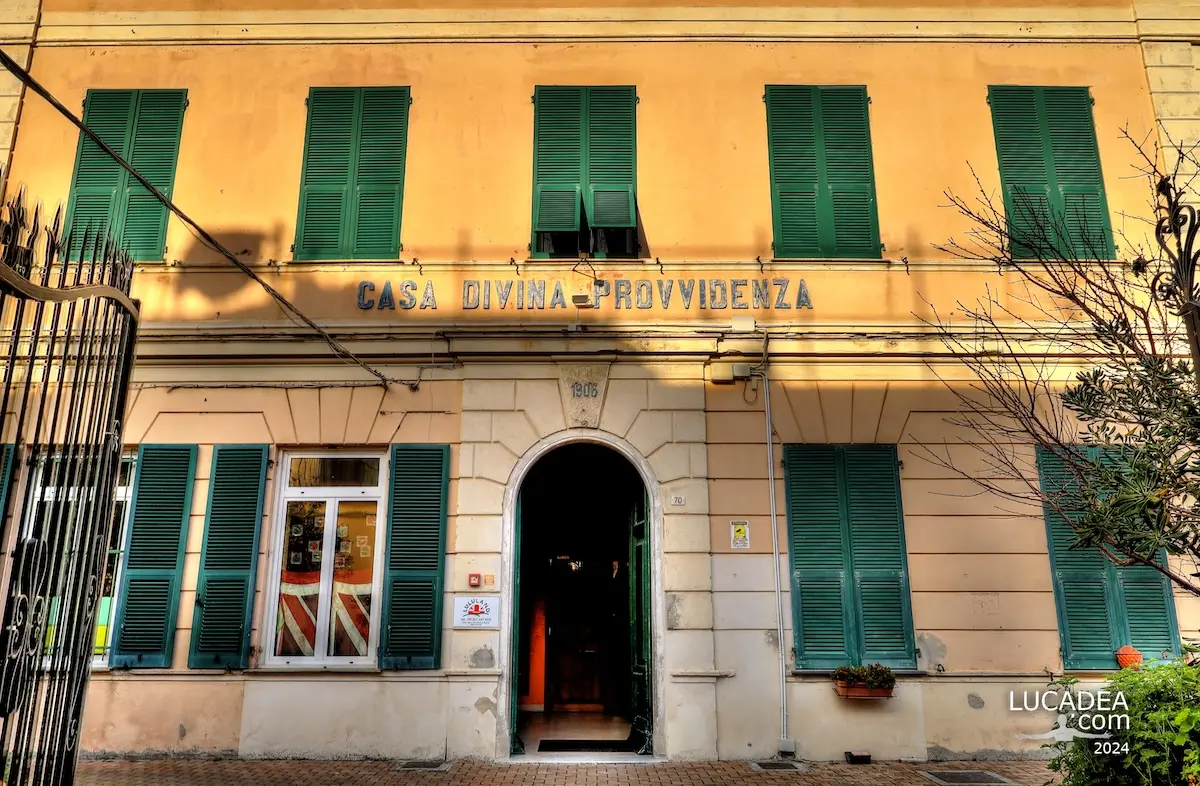
The House of Divine Providence in Lavagna.
Walking through the town center of Lavagna in Liguria, Italy, I found myself pausing in front of this building, a place that most people might overlook while searching for things to see in Lavagna or more visually striking corners of the old town. Yet the House of Divine Providence in Lavagna quietly stands as part of the town’s everyday life, far from the usual highlights visitors tend to notice.
At first glance, there’s nothing particularly eye-catching about it. No elaborate decorations, no dramatic architectural details. It blends into the street almost too well. But sometimes that’s exactly what makes a place worth photographing. I stopped, took a moment, and decided to frame it just as it was. This photo comes from that simple decision: paying attention to something that doesn’t try to stand out.
Lavagna, in the Liguria region of Italy, is often associated with the sea and its promenade, but places like this reveal a different layer of the town. The House of Divine Providence Cordeviola is not just a building; it’s part of a social reality, offering support and care to people in difficult situations. If you want to learn more, there is also a reference online: divincorde.blogspot.com.
If you are visiting Lavagna and looking beyond the typical landmarks, this is the kind of place that tells a more authentic story. It may not appear in guides, but it represents a living part of the community. I’ve explored similar quiet corners in other posts on this site, where the focus shifts from iconic views to everyday scenes that carry their own significance.
There’s also a small historical note worth mentioning: institutions like this became especially important during the 20th century, when private and religious organizations often played a key role in social support before modern welfare systems expanded.
Looking back at the image, I realize it’s not about visual impact but about context. It’s a reminder that photography is sometimes about noticing, not just capturing.

Have you ever stopped to photograph a place that most people would simply walk past? Add a comment or go to the bottom of the site to read what other visitors have written.

Facade of the House of Divine Providence in Lavagna along a quiet street with a simple building in the town center

Photo taken with Canon EOS RP and Canon RF 24-50 lens.

Here’s where it is:

The “Divina Provvidenza – Cordeviola” Educational and Care Community is run by the Gianelline Sisters, “Daughters of Mary Most Holy of the Garden.” It offers a family-like environment, characterized by acceptance, mutual understanding, respect, trust, simplicity, and love, in keeping with the educational style passed down by their founder, Saint Anthony Gianelli. The Community is fully available to minors with serious and urgent family problems.
Continue and learn more at cylex-italia.it

Add one  comment to this article or read  here what other visitors have written.
 
Adv
 
Disclamer

The rights on images, videos, choruses, text and all other material on the LUCADEA.com website are governed as per  Copyright page.


This page has been viewed 0 times today.
This month it has been viewed 0 times.
In total it has been viewed 0 times.
 

A small Madonna in Asilo Maria Teresa Street

Una Madonnina in via Asilo Maria Teresa a Sestri

A small Madonna in Asilo Maria Teresa Street in Sestri Levante.
While walking around my Sestri Levante, I always try to frame unusual objects or details to share and, perhaps, gather more information by searching online or waiting for visitors to add some insights.
In this case, my attention was drawn to this small Madonna emerging from the wall that borders Asilo Maria Teresa Street and, given its position, I assume it is a statuette belonging to what used to be the nursery school.

Do you know this street in Sestri Levante? Add a comment or go to the bottom of the site to read what other visitors have written.

Una Madonnina in via Asilo Maria Teresa a Sestri

Photo taken with Canon EOS RP and lens Tamron 16-300.

Here’s where this street is located:

A statue of the Madonna in via Asilo Maria Teresa in Sestri Levante – Une statue de la Madone dans la via Asilo Maria Teresa à Sestri Levante – Una estatua de la Virgen en via Asilo Maria Teresa en Sestri Levante – Uma estátua de Nossa Senhora na via Asilo Maria Teresa em Sestri Levante – Eine Statue der Madonna in der Via Asilo Maria Teresa in Sestri Levante – Một bức tượng Đức Mẹ qua Asilo Maria Teresa ở Sestri Levante

A detail of the Black Arcades Palace in Chiavari

Un particolare del Palazzo dei Portici Neri a Chiavari

A detail of the Black Arcades Palace in Chiavari.
One of the buildings that fascinates me the most in Chiavari is located on Ravaschieri Street, where it meets Fenice Square, and is known as the Black Arcades Palace.
In addition to being very imposing and ancient, the façade shows the different architectural styles that have overlapped over time.
I don’t know much about the coat of arms that seems to appear, so if anyone wants to look into it…

Update: This is the remaining part of the Torre family coat of arms, which lived in that palace for some time.

Do you know this palace in Chiavari? Add a comment or go to the bottom of the site to read what other visitors have written.

Un particolare del Palazzo dei Portici Neri a Chiavari

Photo taken with Canon EOS RP camera and Tamron 16-300 lens.

Here’s where the building is located:

The Palazzo dei Portici Neri is one of the oldest buildings in the entire city of Chiavari. It is located in the central Piazza Fenice, near the Chiavari Castle and the ancient medieval walls. This palace was built in the 13th century, perhaps as a noble residence.
Continue and learn more at minube.it

A detail of the Portici Neri palace in Chiavari – Un détail du palais Portici Neri à Chiavari – Un detalle del palacio Portici Neri en Chiavari – Um detalhe do palácio Portici Neri em Chiavari – Ein Detail des Portici-Neri-Palastes in Chiavari – Một chi tiết của cung điện Portici Neri ở Chiavari – 基亚瓦里波蒂奇内里宫的细节 – キアーヴァリのポルティーチ ネーリ宮殿の詳細

The palace designed by Benvenuto Pesce Maineri

Il palazzo costruito da Benvenuto Pesce Maineri in via XX Settembre

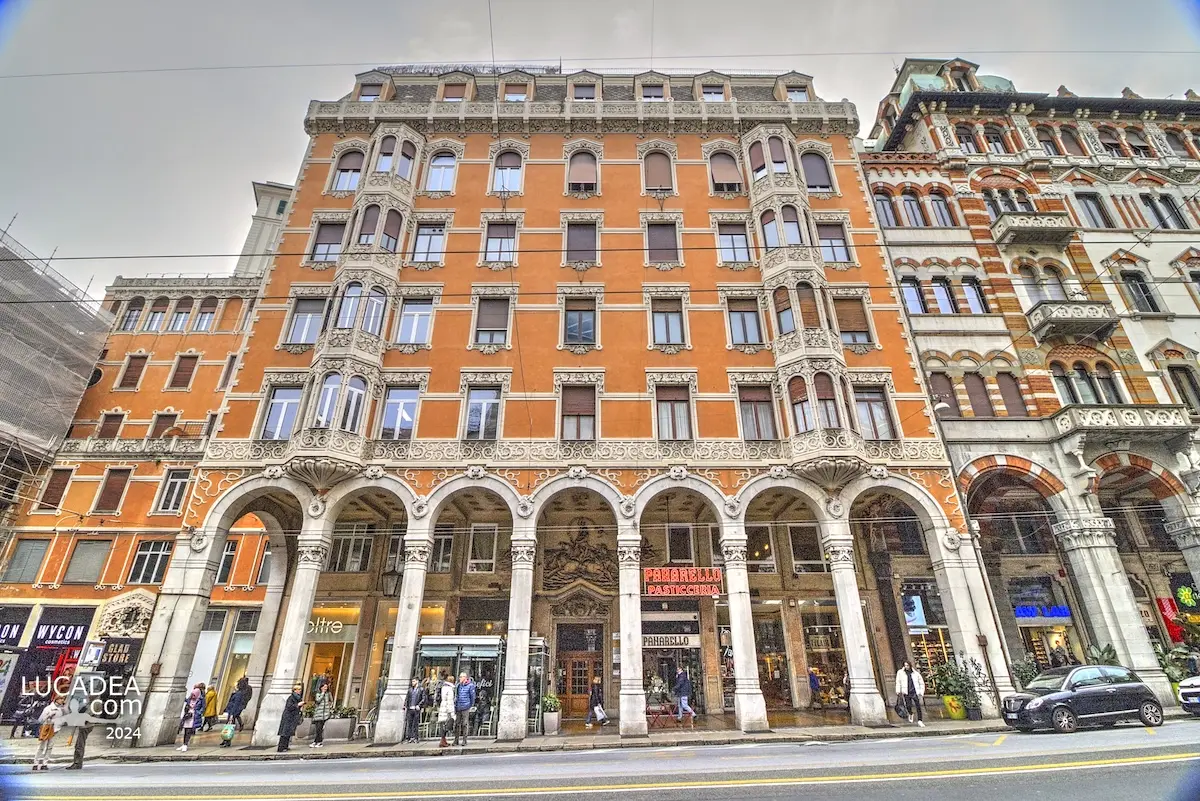
The palace designed by Benvenuto Pesce Maineri on XX Settembre Street.
At number 26 on XX Settembre Street in Genoa there is this beautiful palace, which I have already photographed several times, but only today have I discovered something about it.
It was designed by the urbanist Benvenuto Pesce Maineri, a representative of Art Nouveau and eclecticism.

Do you know or have you ever seen this palace? Add a comment or go to the bottom of the site to read what other visitors have written.

Il palazzo costruito da Benvenuto Pesce Maineri in via XX Settembre

Photo taken with Canon EOS RP camera and Canon EF-S 10-18 lens.

Where exactly is the building located?

Number 26, characterized by a more mature and less academic style, features sea water as its main theme: spiraling seaweed motifs that are repeated on the façade and form the constituent elements of the antherids, leviathans that become the finishing touches of the arches and uprights of the internal railings, dolphins, and mythological motifs.
Continue and learn more at Wikipedia

The building built by Benvenuto Pesce Maineri in via XX Settembre – Le palais construit par Benvenuto Pesce Maineri dans la via XX Settembre – El palacio construido por Benvenuto Pesce Maineri en via XX Settembre – O palácio construído por Benvenuto Pesce Maineri na via XX Settembre – Der von Benvenuto Pesce Maineri in der Via XX Settembre erbaute Palast – Cung điện được xây dựng bởi Benvenuto Pesce Maineri qua XX Settembre –

A building designed by Raffaele Croce in Genoa

Un palazzo progettato da Raffaele Croce a Genova

A building designed by Raffaele Croce in Genoa.
I have seen (and I think photographed) this building located on 20 September Street, not far from the Monumental Bridge, several times, but after some research I found out that it was designed in 1909 by Raffaele Croce.
I really love its style and colors!

Have you ever seen this building and do you know anything more about it? Add a comment or go to the bottom of the site to read what other visitors have written.

Photos taken with Canon EOS RP and lens Canon RF 24-50.

Here is where the palace is located:

A palace designed by Raffaele Croce in Genoa – Un palais conçu par Raffaele Croce à Gênes – Un palacio diseñado por Raffaele Croce en Génova – Um palácio projetado por Raffaele Croce em Génova – Ein von Raffaele Croce entworfener Palast in Genua – Một cung điện được thiết kế bởi Raffaele Croce ở Genoa

A building in Giacomo Matteotti Square in Sestri Levante

Un palazzo in piazza Giacomo Matteotti a Sestri Levante

A building in Giacomo Matteotti Square in Sestri Levante.
In the town hall square of my hometown, there is this beautiful building. Once, the ground floor housed a bank branch; now it hosts a good restaurant.

Do you know this building? Add a comment or go to the bottom of the site to read what other visitors have written.

Un palazzo in piazza Giacomo Matteotti a Sestri Levante

Photo taken with Canon EOS RP and lens Canon RF 24-50.

Where is this building located:

A palace in the square dedicated to Giacomo Matteotti in Sestri Levante – Un palais sur la place dédiée à Giacomo Matteotti à Sestri Levante – Un palacio en la plaza dedicada a Giacomo Matteotti en Sestri Levante – Um palácio na praça dedicada a Giacomo Matteotti em Sestri Levante – Ein Palast auf dem Giacomo Matteotti gewidmeten Platz in Sestri Levante – Một cung điện trong quảng trường dành riêng cho Giacomo Matteotti ở Sestri Levante

Fading Decorations on a Rapallo Building

Le decorazioni che stanno scomparendo in un palazzo di Rapallo

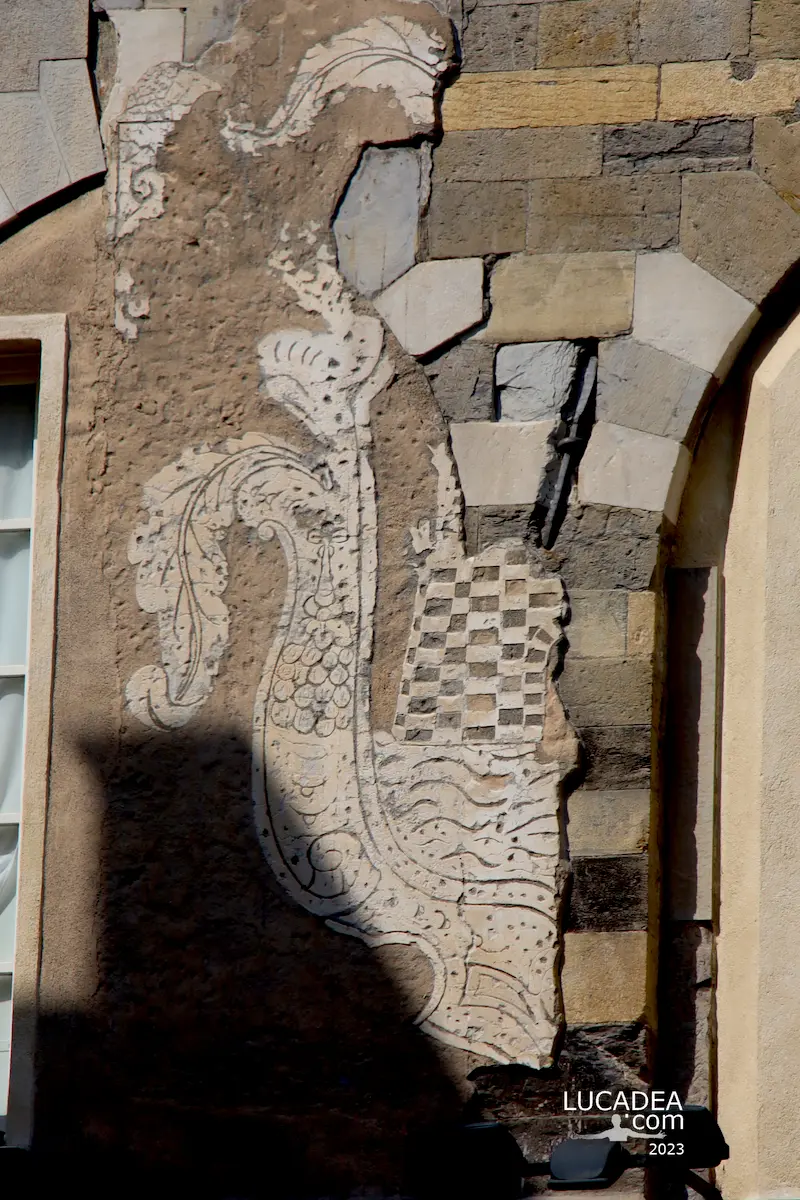
Fading Decorations on a Rapallo Building.
While walking through the center of Rapallo, I stopped in front of a facade that, despite showing clear signs of age, immediately caught my attention. What interested me most were the decorations still visible on the surface, although they have faded so much that you need to look carefully to recognize them.
This is exactly the kind of detail that can easily disappear from everyday view. When walking through a seaside town like Rapallo, it is natural to focus on the waterfront, the busiest streets or the better-known buildings. I found myself looking at this facade almost by chance, trying to understand how much of its original decoration was still there.
I took this photograph myself during that walk. There was no famous monument to capture, just an architectural detail that I felt was worth remembering before time erased it completely. This is one of the reasons I continue to photograph less obvious parts of towns: an image can preserve something that may look very different, or may no longer be visible, a few years from now.
If you are wondering what to see in Rapallo, this particular building is unlikely to appear among the usual landmarks. Yet details like these are part of the character of the urban landscape. Rapallo is in Liguria, in the Metropolitan City of Genoa, Italy, and walking through its center reveals buildings with traces of different periods and architectural traditions.
Here, it was the painted decoration on the facade that caught my eye. It is no longer as clear as it must once have been, and in several areas it almost blends into the plaster. You have to get closer, examine the surface and look for the remaining fragments to imagine how much more visible the decoration may have been in the past.
A small architectural curiosity is that painted facades were once an important feature of many historic buildings in Liguria. Decorative patterns could imitate architectural details, frames and other elements, giving relatively simple buildings a richer visual appearance. Even when only fragments survive, these painted details can still reveal something about the original character of a street.
Looking at this facade, I wondered how many people walk past it every day without noticing these traces. I cannot really blame them, because I probably did the same many times before. Sometimes all it takes is a reason to look upwards and pay attention to what normally remains part of the background.
The passage of time is what made me want to photograph this particular detail. The decorations have not completely disappeared, but their visibility seems to be fading. Some sections can still be recognized, while others are already much harder to distinguish. In that sense, the photograph also becomes a small record of how the facade looked when I encountered it.
I do not know the precise history of this building, and I would rather not attach details to it that I cannot verify. What matters to me is what I actually saw: a decorated facade, worn by time, still retaining enough traces to suggest the care that once went into its appearance.
I have already shared other photographs of architectural details from Rapallo and the surrounding Tigullio area on the blog. This image fits naturally into that collection of small urban discoveries, often far removed from the places that appear in conventional photographs but still capable of telling us something about where we are.
It is interesting how the meaning of a facade can change when you start looking at it closely. At first you see an ordinary building. Then you notice a border, an ornamental pattern or a trace of color. Suddenly, the building seems to have a much longer story than you initially imagined.
What I find most unfortunate is the possibility that these decorations may eventually disappear altogether. I do not know what will happen to the facade, and I would rather not make assumptions about its future. That uncertainty is another reason why I chose to photograph it. At least this image preserves the memory of the details that were still visible when I passed by.
Perhaps this is one of the most interesting sides of urban photography: it is not only about documenting things that are beautiful and perfectly preserved. Signs of aging can have their own value. Faded colors, damaged plaster and almost-lost details can tell the story of a changing city just as clearly as a restored building can.
The next time I walk through Rapallo, I will probably look upwards a little more often. There may be many other details like this still waiting to be noticed on the city’s facades.

Have you ever noticed painted decorations like these on buildings in Rapallo or elsewhere in Liguria? Add a comment or go to the bottom of the site to read what other visitors have written.

Faded decorations on a historic building facade in central Rapallo, still visible despite years of weathering

Photo taken with Canon EOS RP and lens Canon RF 28.

Where is the palace:

The facade of a beautiful palace in Merano

La facciata di un bel palazzo a Merano

The facade of a beautiful building in Merano.
I’ve only been to Merano once, but I remember the moment I stopped in front of this facade well. It wasn’t a planned search; I wasn’t chasing a famous building or a postcard-perfect view. Yet, as soon as I looked up, I felt that the building deserved attention. It’s one of those architectural works that don’t shout, but rather discreetly stand out, relying on the balance of its forms and attention to detail.
The facade tells a story that seems to come from afar. The pale, soft plaster forms the backdrop to an orderly sequence of elegantly framed windows. The green shutters, all aligned but never rigid, add character and depth, creating a color contrast that is typical of this part of South Tyrol. Looking at them, I had the impression that it didn’t take much to imagine the life that goes on behind those windows: tall rooms, full light, silences interrupted only by the noise of the street.
The decorative details are understated yet present, as if the building wanted to recall its history without ostentation. The small protrusions, the balconies, the light cornices speak of an era when even a residential building was designed to last and be beautiful, not just functional. I like this idea of ​​everyday beauty, the kind you encounter while walking and which risks going unnoticed if you don’t slow down.

Below, the city flows: people crossing, open shops, voices, movement. Above, however, everything seems calmer, almost suspended. It’s this contrast that inspired me to photograph the façade, trying to combine urban life with the solid presence of the building. In a single shot, I tried to describe Merano as I perceived it: elegant, composed, with a past that continues to dialogue with the present, without needing to explain too much.

Do you ever stop in front of a façade and feel it has something to say?
comment or go to the bottom of the site to read what other visitors have written.

La facciata di un bel palazzo a Merano

Photo taken with Canon EOS RP camera and Canon RF 24-50 lens.

To see all the photos I took in Merano, click here:

About where I took the photo:

The capital of the Burgraviato district community, it is surrounded by mountains (1,500–3,330 m) and lies on the valley floor at the entrance of three major valleys: the Val Venosta, the Val Passiria, and the Val d’Adige. Crossed by the Passirio stream, which flows into the Adige, it lies on the slopes of the Texel Group (up to 3,480 m above sea level, bordering Austria) and the Salto Plateau (up to 2,800 m).
Continue and learn more at Wikipedia

The facade of a beautiful palace in Merano – La façade d’un beau palais à Merano – La fachada de un hermoso palacio en Merano – A fachada de um belo palácio em Merano – Die Fassade eines schönen Palastes in Meran – Mặt tiền của một cung điện đẹp ở Merano – 梅拉诺一座美丽宫殿的立面 – メラーノの美しい宮殿のファサード

The text of this post was written with the help of ChatGPT, a language model from OpenAI.

A historic building in the small square of Vernazza

Un palazzo storico nella piazzetta di Vernazza alle Cinque Terre

A historic building in the small square of Vernazza in the Cinque Terre.
In the beautiful little square of Vernazza, not far from the Church of Santa Margherita di Antiochia, stands this beautiful building constructed using what may have been a previous historic building.
I searched online but couldn’t find any additional information.

Do you know the Cinque Terre? Add a comment or go to the bottom of the site to read what other visitors have written.

Un palazzo storico nella piazzetta di Vernazza alle Cinque Terre

Photo taken with Canon EOS RP and Tamron 16-300 lens.

To see all the photos of the trail, click here:
photo gallery

Where is this building located?

The village, which grew along the Vernazzola stream (now covered), which forms its central artery, has an exceptionally intact urban fabric, structured into a series of alleys and steep stairways. Above the town of Vernazza, at an altitude of 325 meters above sea level, lies the sanctuary of Nostra Signora di Reggio.
Continue and learn more at Wikipedia

A historic building in the small square of Vernazza in the Cinque Terre – Un bâtiment historique sur la petite place de Vernazza aux Cinque Terre – Un edificio histórico en la pequeña plaza de Vernazza en Cinque Terre – Um edifício histórico na pequena praça de Vernazza, em Cinque Terre – Ein historisches Gebäude auf dem kleinen Platz von Vernazza in den Cinque Terre – Một tòa nhà lịch sử ở quảng trường nhỏ Vernazza ở Cinque Terre
🏠
  • Italiano