
Monterosso Rock, the First of the Cinque Terre

Lo scoglio di Monterosso

Monterosso Rock, the First of the Cinque Terre.
In the late afternoon, while spending time on the beach at Monterosso al Mare, my attention was drawn to the large rock that gives this stretch of coastline a distinctive maritime character. It lies to the west of the beach opposite the railway station and is one of the familiar features of this beautiful corner of the Cinque Terre in Liguria.
I took this photograph during a visit to Monterosso, the westernmost village of the Cinque Terre, in the Province of La Spezia, north-western Italy. It is a place with a character of its own, where the sea is always central to the scenery and the beach, rocks and village create a particularly appealing coastal landscape. This rocky landmark is one of the details that make the view instantly recognisable.
You can also see a few young women in the picture, probably among the many tourists who visit these small Ligurian villages. They have stopped to take photographs of themselves, just as so many visitors do when they come across a beautiful setting. I like this little detail because it adds a spontaneous human element to the scene. The photograph is not only about the coastline, but also about the people enjoying it and making their own memories of the place.
What I particularly like about this image is the time of day. In the late afternoon, this part of Monterosso becomes especially beautiful. The atmosphere invites you to slow down, find a comfortable spot and simply watch the sea. I could easily spend hours looking at the gentle waves moving slowly towards the shore and then drawing back again. There is something wonderfully relaxing about that continuous movement, especially when there is no need to hurry anywhere.
I also made a little adjustment to the photograph using HDR processing. As you can see, I enhanced the colours and details slightly, while trying to retain the feeling of the original scene. I wanted the image to bring out the character of the coastline without losing the calm atmosphere that made me stop and take the picture in the first place.
Monterosso al Mare is the first of the five villages when travelling along the Cinque Terre from west to east. It is one of the best-known destinations on the Ligurian coast, appreciated for its seaside setting and its distinctive village atmosphere. Each of the five villages has its own personality, but the sea remains a common thread connecting them all.
For me, this photograph is above all a memory of a peaceful moment by the water. The rock, the people on the beach and the gentle movement of the waves all come together to capture something of Monterosso’s appeal.

Do you also enjoy stopping to watch the sea when you find yourself somewhere as beautiful as this? Add a comment or go to the bottom of the site to read what other visitors have written.
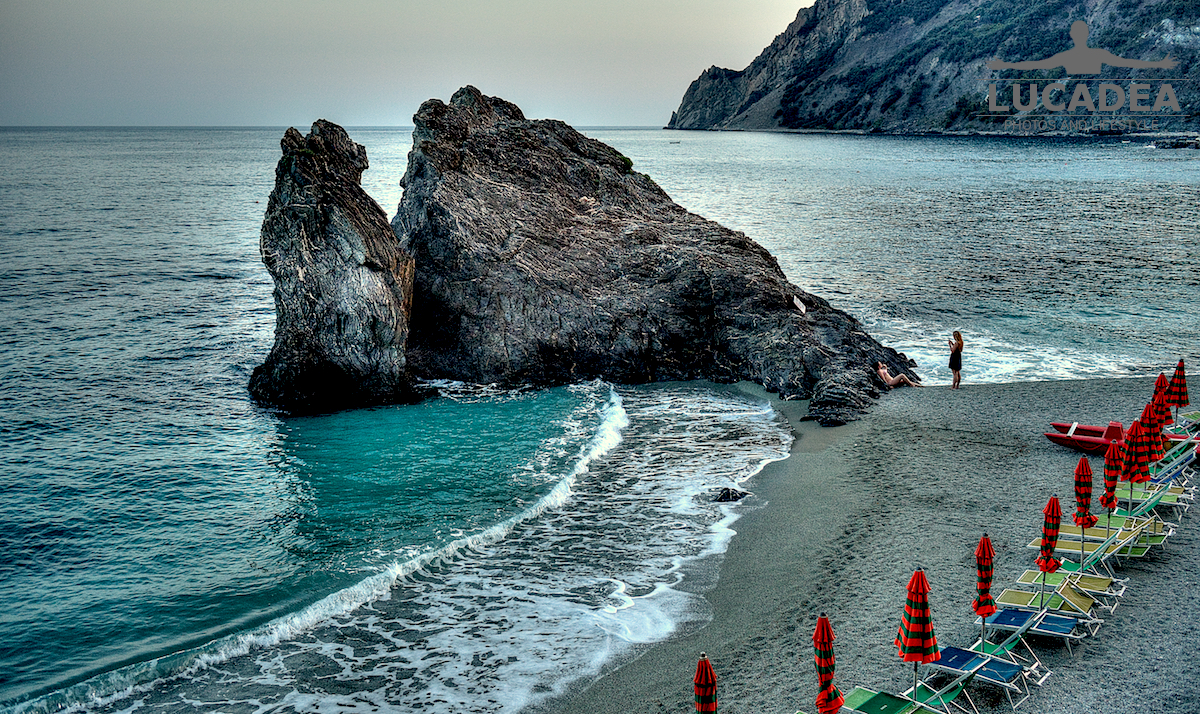
Monterosso Rock beside the beach in the Cinque Terre, with visitors enjoying the shore in the late afternoon

Photo taken with a Canon EOS M100 camera and Canon EF-M 22 lens.

Here’s where Monterosso is:

Add one  comment to this article or read  here what other visitors have written.
 
Adv
 
Disclamer

The rights on images, videos, choruses, text and all other material on the LUCADEA.com website are governed as per  Copyright page.


This page has been viewed 1 times today.
This month it has been viewed 2 times.
In total it has been viewed 2 times.
 

Grecino Bridge, a Landmark of Varese Ligure

Il ponte Grecino a Varese Ligure

Grecino Bridge, a Landmark of Varese Ligure.
When people think of Varese Ligure, a small town in the province of La Spezia, Liguria, two places immediately come to mind. The first is the famous circular square, the heart of the historic centre and the reason behind the town’s nickname, Borgo Rotondo, meaning Round Village. The second is Grecino Bridge, also known as Grexino Bridge, a remarkable old structure that deserves just as much attention.
Dating back to the sixteenth century, the bridge is one of the most distinctive features of Varese Ligure. Its appearance is striking, and it fits naturally into the historic setting of the town. It is more than a simple crossing over the water: it is a piece of local heritage and an architectural landmark that has become part of the identity of this Ligurian village. Looking at it, it is easy to imagine how many generations of residents have crossed it over the centuries, when it served as an everyday connection within the settlement.
Another reason to visit is the small neighbourhood that the bridge leads to, which is also called Grecino. This little district is an interesting part of the historic town in its own right. The bridge and the neighbourhood belong together, and seeing only one without exploring the other would mean missing part of what makes this corner of Varese Ligure special.
I always enjoy discovering places like this in Liguria. The best-known attractions are often the first things visitors look for, but smaller details can reveal just as much about a village and its history. In Varese Ligure, the circular square is undoubtedly the town’s most recognisable feature, yet Grecino Bridge offers another perspective on the character of the place. It reminds us that historic villages are made up of many different elements: squares, passages, bridges and small neighbourhoods that have developed around the practical needs of everyday life.
I took this photograph during a visit to Varese Ligure because I wanted to capture this particularly distinctive landmark. The bridge has a strong visual presence, and its connection with the old neighbourhood makes it an interesting subject to explore with a camera. It is one of those places that encourages you to slow down and look beyond the main attraction.
If you visit Varese Ligure, I would recommend making time for Grecino Bridge as well as the famous circular square. The town has plenty of character, and discovering its less obvious corners is part of the pleasure. On my blog, you can also find other photographs and stories about Liguria’s historic villages and the details that make each of them unique.

Had you heard of Grecino Bridge before, or would it be one of the places you would add to your next visit to Varese Ligure? Add a comment or go to the bottom of the site to read what other visitors have written.

Grecino Bridge, also called Grexino Bridge, in Varese Ligure, a sixteenth-century landmark leading to the historic Grecino district

Photo taken with a Canon EOS M100 camera and Canon EF-S 10-18 lens.

I also shot a nice video while walking on the bridge:

Video recorded with GoPro Hero5.

To see all the photos I took in Varese, click here:
foto gallery

Add one  comment to this article or read  here what other visitors have written.
 
Adv
 
Disclamer

The rights on images, videos, choruses, text and all other material on the LUCADEA.com website are governed as per  Copyright page.


This page has been viewed 1 times today.
This month it has been viewed 1 times.
In total it has been viewed 1 times.
 

Tellaro Harbour, a Jewel of the Gulf of Poets

Il porticciolo di Tellaro, splendido borgo marinaro

Tellaro Harbour, a Jewel of the Gulf of Poets.
This was my first ever visit to Tellaro, a beautiful fishing village on the eastern Ligurian coast, in the province of La Spezia, Italy. Set along the Gulf of Poets, Tellaro is one of those places that can easily be overlooked when compared with more famous destinations in the region. Yet its charm is immediately apparent, and after finally seeing it in person, I understand why it is considered one of Liguria’s most appealing seaside villages.
The photograph shows the small harbour from an unusual viewpoint, almost at sea level. I was standing near what I believe is the little landing stage used by summer boats. From there, the village can be seen from a different perspective, away from the familiar elevated views and the narrow lanes winding between the houses. The buildings seem to rise directly from the waterfront, making the harbour feel like a natural extension of the village itself.
This close relationship with the sea is one of the things that makes Tellaro so distinctive. It does not simply look like a village located beside the coast; it feels like a place whose identity has always been closely connected to the water. The houses are gathered around the small harbour, creating the compact appearance typical of many traditional Ligurian fishing villages. In places like this, the limited space between the hills and the sea has shaped both the layout of the settlement and the everyday life of its inhabitants.
I was particularly impressed by the beauty of the little harbour. Despite its modest size, it can easily compete with much more famous ports and waterfront views elsewhere in Liguria and Italy. In fact, its small scale is probably part of its appeal. There is no need for a large marina or an imposing waterfront to create a memorable scene. Sometimes a few boats, a cluster of houses and the surrounding sea are more than enough.
Tellaro is officially included in the association of Italy’s Most Beautiful Villages. The recognition seems well deserved when you see the village and its setting. Tellaro belongs to the municipality of Lerici, in the province of La Spezia, and is one of the most picturesque places along the Gulf of Poets.
My first visit has certainly made me want to return. I would like to spend more time exploring the narrow streets, discovering other viewpoints and enjoying the village at a slower pace. For now, this photograph of the harbour is a lovely reminder of a place I had wanted to see for a long time.

Have you already visited Tellaro, or is it still one of those beautiful Ligurian villages waiting to be discovered? Add a comment or go to the bottom of the site to read what other visitors have written.

Tellaro's small harbour seen from the landing stage, with the colourful seaside village overlooking the Gulf of Poets in Liguria

Photo taken with a Canon EOS M100 camera and Tamron 16-300 lens.

To see the many photos I took in the fishing village of Tellaro, click here:
foto gallery

Loto, a Small Village in the Ligurian Hills

Il borgo di Loto

Loto, a Small Village in the Ligurian Hills.
Inland from Sestri Levante, away from the familiar seaside streets and beaches of the Ligurian Riviera, there are several small settlements scattered across the surrounding hills. One of them is Loto, a little village that can be found along one of the local roads connecting the communities in this part of the countryside.
The road passes through San Bernardo before joining the route that leads towards Libiola and Montedomenico. A little before reaching Loto, there is also a turning for Selva. These are small place names that may be unfamiliar to visitors who usually stay close to the coast, but they are part of the network of roads that makes exploring the inland area around Sestri Levante so interesting.
I enjoy discovering these lesser-known corners of Liguria. Leaving the busier parts of Sestri Levante behind, the landscape changes and the roads lead into a quieter world of small villages and scattered houses. The coast is never very far away, yet the atmosphere feels quite different from that of the seaside resorts. Here, the journey itself becomes part of the experience, with local roads linking places that are easy to overlook if you follow only the main routes.
Loto is one of those settlements that you might pass through without giving it much thought, especially if you are travelling towards another destination. But these small villages deserve attention in their own right. Their names are part of the local geography and help describe a territory made up of many little communities, each connected to the others by roads that wind through the hills.
I took this photograph during one of my explorations of the Ligurian hinterland. I like documenting places that are less familiar to people visiting the region because they show another side of Liguria. The region is often associated with colourful coastal villages, beaches and harbours, but its inland landscape has a quieter appeal and plenty of places worth discovering.
Loto also fits naturally into a wider exploration of the countryside around Sestri Levante. Nearby names such as San Bernardo, Libiola, Montedomenico and Selva offer useful points of reference for anyone exploring this area. On my blog, I have shared other photographs and stories from Sestri Levante and its surroundings, including places that are far less well known than the coastal attractions.

Have you ever visited Loto or explored the small villages in the hills behind Sestri Levante? Add a comment or go to the bottom of the site to read what other visitors have written.

The small village of Loto in the hills inland from Sestri Levante, along the road towards Libiola and Montedomenico

The small village of Loto in the hills inland from Sestri Levante, along the road towards Libiola and Montedomenico

Photos taken with a Canon EOS M100 camera and a Tamron 16-300 lens.

Where is the little village located:

A Glimpse of Villa Rovereto

Uno scorcio di Villa Rovereto sulle alture di Sestri Levante

A Glimpse of Villa Rovereto.
The hills around Sestri Levante hide small villages that are well worth discovering, especially for anyone who wants to see a quieter side of the Ligurian Riviera. Villa Rovereto is a small but charming hamlet, with narrow lanes, traditional houses and picturesque corners that make it an enjoyable place to explore with a camera.
The village lies along a road that connects the area of Santa Vittoria di Libiola with Casarza Ligure, crossing the ridge near Villa Tassani. This route passes through the hills behind Sestri Levante, away from the busy beaches and waterfront promenades. The landscape here is made up of green slopes, winding roads and small settlements that reflect the long history of life in inland Liguria.
What I like about Villa Rovereto is its intimate scale. Much of the village appears to have been renovated, giving the houses a cared-for appearance while retaining the character of a traditional Ligurian hamlet. It is not a large place, and that is part of its appeal. A short walk is enough to discover its two narrow *carrugi*, the typical lanes that pass between buildings and create a series of interesting views.
For photography, these small spaces can be just as rewarding as a famous landmark. A doorway, a textured wall, a bend in a lane or a patch of sunlight falling across a façade can provide the starting point for a good image. I enjoy taking my time in places like this, looking carefully at the details rather than rushing from one attraction to another. Often, the most memorable photographs come from these quiet moments of observation.
Villa Rovereto belongs to the municipality of Casarza Ligure, in the Metropolitan City of Genoa, Liguria, north-western Italy. Its hillside setting makes it an appealing stop for anyone exploring the secondary roads and villages inland from Sestri Levante. The atmosphere is very different from that of the coastal resorts, offering a glimpse of a landscape shaped by small communities and the rhythms of everyday life.
In this photograph, I wanted to capture one of the village’s characteristic corners. It is the sort of view that might easily be missed when passing through by car, but becomes more interesting when you stop and look around. I often find that exploring these lesser-known places adds another dimension to photographing Liguria, beyond the familiar seaside scenery and historic town centres.

Have you visited Villa Rovereto, or do you know other small villages in the hills around Sestri Levante that deserve to be discovered? Add an comment or go to the bottom of the site to read what other visitors have written.

A glimpse of Villa Rovereto, a small hillside hamlet near Sestri Levante with renovated houses and narrow traditional Ligurian lanes

Photo taken with Honor 20.

Here’s where the hamlet is:

The Village of Ziona in Liguria

Il piccolo borgo di Ziona frazione di Carro in Liguria

The Village of Ziona in Liguria.
Several years ago, while walking along a scenic trail above Passo del Bracco in Liguria, I noticed a small cluster of houses that caught my attention. I only discovered later that the little settlement was Ziona, a hamlet in the municipality of Carro, in the province of La Spezia. Its compact layout and peaceful appearance made it a memorable discovery during my walk.
That day, I had climbed Monte Groppi, a mountain in the Ligurian Apennines where the views extend across the surrounding hills and towards the Val di Vara. This part of the region offers a different landscape from the familiar coastal scenery of beaches and seaside towns. Here, wooded slopes, ridgelines and scattered villages shape the view, making the area particularly appealing to anyone who enjoys walking and exploring away from busy tourist destinations.
From the hillside, Ziona looked like a small group of homes gathered around its church. There is something appealing about villages like this, where buildings stand close together and the settlement seems naturally connected to the landscape. Rather than relying on grand monuments or impressive size, the village has a quiet charm that comes from its simple appearance and its setting among the Ligurian hills.
I enjoy photographing places I discover by chance. Sometimes I set out with a particular destination in mind, but the most memorable moments come from something unexpected along the way. In this case, the village first caught my eye from a distance; only afterwards did I learn its name. Finding out more about a place after taking a photograph adds another layer to the memory, connecting the image with the geography and character of the area.
Ziona is part of the Val di Vara, a broad valley in eastern Liguria known for its green countryside and small rural settlements. The village has a historic core, with narrow lanes and the Church of the Most Holy Name of Mary at its centre. The church’s history reaches back to at least the thirteenth century, making it an important part of the local heritage. You can find more information about the village and its surroundings on the local Ziona territory website.
For me, this photograph brings back the pleasure of exploring the countryside at a relaxed pace and discovering a place I had not planned to visit. The area around Passo del Bracco and Monte Groppi offers a rewarding combination of walking routes and wide views, while the villages scattered across the valley give the landscape a human scale.
Ziona may be small, but that is part of its appeal. A handful of houses, a church and the surrounding hills are enough to create a scene worth remembering. I find that these quiet corners often reveal a side of Liguria that visitors who stay only along the coast might never get to see.

Have you ever come across a small village unexpectedly while out hiking? Add an comment or go to the bottom of the site to read what other visitors have written.

Small village of Ziona, a hamlet of Carro in Liguria's Val di Vara, with houses gathered around its church

Photo taken with a Canon EOS M100 camera and Tamron 16-300 lens.

To see all the photos I took along the trail, click here:

Here’s exactly where it is:

Alley in Monterosso at evening light

Vicolo a Monterosso al Mare nelle Cinque Terre con scalini scuri e luce della sera tra case strette nel centro storico

Alley in Monterosso at evening light.
In this glimpse of Monterosso al Mare in the Cinque Terre, during the summer of 2024, I find myself walking through a narrow passage where the evening light slowly settles between tall walls and dark stone steps. The alley in Monterosso at evening light feels tight and intimate, shaping every movement as the space narrows and opens in small, irregular rhythms.
As I continue through Monterosso al Mare, Liguria, Italy, I start thinking about what to see in Monterosso al Mare beyond its coastline. The answer is not only in the sea views but in these inner paths, where daily life quietly unfolds. The alley in Monterosso at evening light becomes a way of reading the village from the inside rather than from above.
I often recall other Cinque Terre stories shared on lucadea.com, but this moment feels more enclosed and personal. The village reveals a layered structure: Monterosso is the largest of the Cinque Terre and the only one with a wide sandy beach, yet its historic center remains dense, with narrow passages that preserve a medieval layout still clearly visible today.
The alley in Monterosso at evening light continues as the light fades further, and warm reflections appear on the stone ground. If you are visiting the Cinque Terre and wondering what to see in Monterosso al Mare, these hidden walkways often reveal more character than any panoramic viewpoint.
And as I leave this passage behind, I realize how much of the village is defined not by its open spaces, but by these quiet, compressed corridors.

Add a comment or go to the bottom of the site to read what other visitors have written.

Vicolo a Monterosso al Mare nelle Cinque Terre con scalini scuri e luce della sera tra case strette nel centro storico

Photo taken with Oppo Reno 12.

Alley in Monterosso at evening light – Rue à Monterosso à la lumière du soir – Callejón en Monterosso con luz del atardecer – Beco em Monterosso ao entardecer – Gasse in Monterosso im Abendlicht – Ngõ Monterosso trong ánh sáng chiều – 蒙特罗索傍晚光影小巷 – モンテロッソの夕暮れの路地の風景

The text of this post was written with the help of ChatGPT, a language model from OpenAI.

Roma street, the beautiful alley of Lavagna

Via Roma, il bel caruggio di Lavagna

Roma Street, Lavagna’s Old Town.
One of the nicest ways to discover Lavagna, on the Ligurian Riviera in north-western Italy, is to walk through its historic centre. Roma Street is the town’s traditional main street, known locally as the *caruggio*, where shops, historic buildings and everyday life come together in a distinctly Ligurian atmosphere.
Many towns and villages in Liguria have a central street that runs through the old town. Locals call these streets *caruggi*, and they have traditionally been places for shopping, meeting friends and going about daily business. In Lavagna, Roma Street is an important part of the town’s identity. Walking along it gives visitors the chance to enjoy the architecture, look at the shop windows and notice the details that might be missed when travelling by car.
Lavagna lies in the Tigullio area of the Italian Riviera, a stretch of coastline known for its historic towns and seaside scenery. Its old town is worth exploring at a leisurely pace, and Roma Street provides a natural route through its lively centre. Along the way, visitors can find notable landmarks such as the Basilica of Santo Stefano and the Brignardello Portico. The official Liguria tourism guide to Lavagna also describes this traditional street as the commercial heart of the town.
I took this photograph a few months ago, wanting to capture the character of a place that may seem ordinary at first glance but has plenty of charm when you take the time to look around. I enjoy photographing streets like this because their appeal lies in the combination of architecture, local activity and small details that reveal something about the place.
For anyone searching for things to see in Lavagna, a walk along Roma Street is a good way to begin exploring the historic centre. It offers a glimpse of everyday life on the Ligurian Riviera and connects visitors with the town’s traditional character. On Lucadea.com, I also share photographs of Ligurian villages, historic streets and squares that make this region so rewarding to discover.

Have you ever walked along Roma Street in Lavagna, or would you like to visit this charming Ligurian town? Add an comment or go to the bottom of the site to read what other visitors have written.

Roma Street in Lavagna, a traditional old town street in Liguria with historic buildings, local shops and a lively pedestrian atmosphere

Photo taken with Oppo Reno 12.

Here’s where the street is:

The Colourful Houses of Vernazza Harbour

Le case del porticciolo di Vernazza alle Cinque Terre

The Colourful Houses of Vernazza Harbour.
This elevated view captures one of the most characteristic scenes in the Cinque Terre, in Liguria, in the province of La Spezia, Italy. In this photograph, I focus on the small harbour, surrounded by colourful buildings that stand close together beside the sea. The slightly raised viewpoint offers a different perspective from the one visitors experience while walking through the little square or approaching the village from the waterfront.
In the foreground, part of the bell tower of the Church of Santa Margherita di Antiochia comes into view. It is one of Vernazza’s most recognisable architectural features and provides a distinctive element in the composition. From there, the eye moves towards the colourful houses gathered around the harbour. Their varied façades, windows and rooftops create a compact pattern that makes this corner of the Ligurian coast so easy to recognise.
What I find particularly interesting about this photograph is the balance between the architecture and the surrounding landscape. The houses are not merely a backdrop; they are the main subject of the image. Their different colours give character to the waterfront and stand out against the sea below. The bell tower in the foreground adds depth, suggesting the different levels and viewpoints that can be found throughout this small coastal village.
Vernazza is one of the best-known villages of the Cinque Terre, and its distinctive harbour is a major part of its appeal. The little square forms a natural meeting point between the historic centre and the sea. Streets and narrow lanes lead towards the waterfront, where the colourful buildings frame a small stretch of water. Looking down from above makes it easier to appreciate how closely the village is connected to its harbour and how the buildings follow the shape of the inlet.
I took this photograph during my visit, looking for an angle that could bring together the bell tower, the houses and the harbour in a single composition. Sometimes a place can be described more effectively through a small, carefully observed scene than through a wide panoramic view. Here, the colours of the buildings and their relationship with the sea tell much of Vernazza’s story.
On Lucadea.com, I also share other photographic stories featuring Ligurian villages and the landscapes of the Cinque Terre. Each view offers a different way to discover the character of this stretch of the Italian coast.

Would you like to visit Vernazza and admire its harbour from an elevated viewpoint like this one? Add a comment or go to the bottom of the site to read what other visitors have written.

Elevated view of Vernazza harbour in the Cinque Terre, with colourful houses beside the sea and part of the church bell tower in the foreground

Elevated view of Vernazza harbour in the Cinque Terre, with colourful houses beside the sea and part of the church bell tower in the foreground

Photos taken with Canon EOS RP and Tamron 16-300.

Here’s where the village is located:

A Narrow Uphill Lane in Genoa’s Nervi District

Vicoletti di Genova Nervi

A Narrow Uphill Lane in Genoa’s Nervi District.
The narrow uphill lanes of Genoa’s Nervi district are among the most characteristic scenes of the Ligurian coast. Just a short walk away from the sea, it is easy to find a maze of little streets, steps and passages between old houses, where bricks and rounded stones preserve the appearance of a traditional seaside village. A few months ago, I spent some time walking around Nervi, visiting its beautiful parks and enjoying the waterfront promenade. During that walk, this small corner caught my attention.
Almost every village in Liguria is beautiful and full of photographic opportunities. This is a region where a side street, a staircase or a passage between two buildings can suddenly become a wonderful subject for a photograph. Many coastal villages have a distinctive layout: they grew around the sea, while their houses climbed the hillsides, connected to the waterfront and the harbour by narrow lanes, steps and small pathways.
Nervi is a district of Genoa overlooking the Ligurian Sea, and it still preserves many of these charming corners. It is particularly famous for its historic parks and the Anita Garibaldi promenade, one of the most beautiful coastal walks in the Genoa area. The promenade follows the shoreline, offering views of the sea, rocky stretches of coast and small landing places. The parks provide a different atmosphere, with mature trees, gardens and historic villas.
However, Nervi is much more than its gardens and seafront. The old village itself deserves to be explored at a leisurely pace. Its narrow streets and closely packed houses reveal another side of the district, one that is easy to miss if you spend all your time by the water. The small harbour has always played an important role in the life of the neighbourhood. In the past, the sea was closely connected to local work and everyday activities, and the lanes linking the waterfront to the homes were essential routes through the village.
This particular uphill lane appealed to me because of its simplicity. Its paving is typical of many older Ligurian villages, with bricks and rounded stones arranged to form an uneven but distinctive surface. These traditional materials have been part of the local streetscape for generations. The rising path, the walls of the surrounding houses and the perspective leading upwards create a composition that is interesting without needing any spectacular landmark.
I enjoy photographing details like these because they show a different side of Liguria from the familiar views found on postcards. The bays, harbours and sea views are undoubtedly beautiful, but sometimes a small passage between houses captures the atmosphere of a place even more effectively. Every lane has its own light, perspective and character, and taking the time to explore can reveal scenes that might otherwise go unnoticed.
During that walk through Nervi, I came across this little street and immediately liked the view. It is not a famous monument or one of the district’s best-known panoramas. Its charm lies precisely in being an ordinary corner of a traditional Ligurian neighbourhood. A simple scene, but one that invites you to slow down, look around and appreciate the details.

And what about you? When you visit a Ligurian village, do you enjoy wandering through its narrow lanes and uphill streets? Add a comment or go to the bottom of the site to read what other visitors have written.

Narrow uphill lane in Genoa's Nervi district, with traditional brick and rounded stone paving between the old village houses

Photo taken with a Canon EOS M100 camera and a Tamron 16-300 lens.

Click here if you want to see all the photos I took between Nervi, Quinto al Mare and Quarto dei Mille:
photo gallery

🏠
  • Italiano