Under the Stone of Genoa Latin Inscription

Dettaglio dell’arco marmoreo a Genova con iscrizione latina di Genova e stemma del grifone scolpito nella pietra storica

Under the Stone of Genoa Latin Inscription.
The marble arch stands quietly in front of me, carrying a sense of time that feels almost suspended, and the Latin inscription of Genoa immediately becomes the visual and emotional focus of the scene. The Latin inscription of Genoa is carved into the stone like a message that refuses to fade, guiding my attention through every groove and shadow.
I am in Genoa, Liguria, Italy, walking through a city where stone is never just architecture but a layered memory of centuries. The Latin inscription of Genoa appears here as a fragment of civic identity, something that still connects the present streets with a medieval past. The geometry of the arch, with its alternating marble tones, frames the inscription as if it were part of a larger dialogue between structure and meaning.
The griffin emblem carved nearby adds another level to the composition, suggesting protection and strength. A historical curiosity explains this symbol: the motto associated with Genoa refers to the griffin holding its power over enemies, a medieval representation of the city’s resilience and identity. This detail transforms the stone into something more than decoration, turning it into a statement of belonging and defense.
As I look closer, I think about how many times I might have passed similar details without noticing them. The Latin inscription of Genoa feels like a quiet reminder that cities speak through their surfaces, even when we are not paying attention. I remember a similar atmosphere in another post from my blog, where Genoa revealed itself through equally hidden architectural traces, almost like a visual conversation across time.
If you are visiting Genoa, Liguria, Italy, this is one of those small but meaningful details worth seeing, not because it is grand, but because it carries the weight of centuries in a few carved letters. It makes me wonder how many stories are still written into stone around us, waiting to be read.

What would you notice if you slowed down in front of an old city wall like this? Add a comment or go to the bottom of the site to read what other visitors have written.
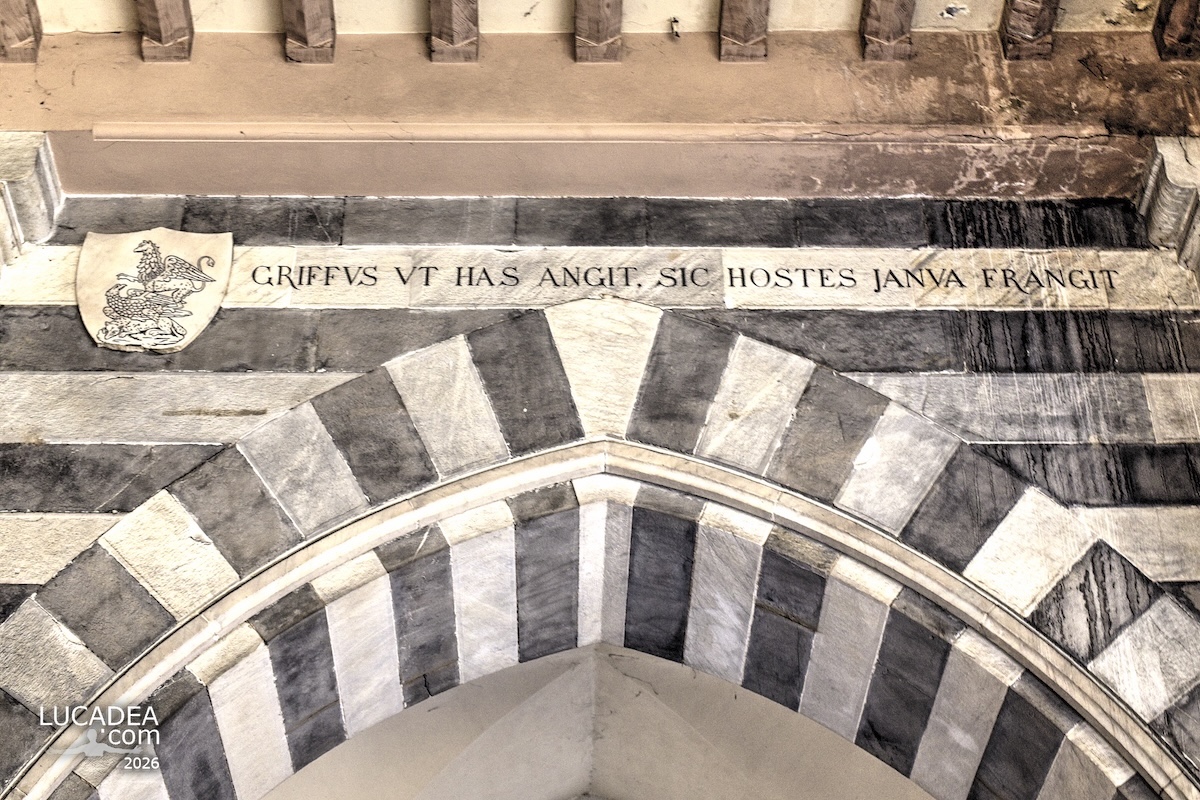
Dettaglio dell’arco marmoreo a Genova con iscrizione latina di Genova e stemma del grifone scolpito nella pietra storica

Photo taken with Canon EOS R50 V and lens Canon RF 28.

Under the Stone of Genoa Latin Inscription – Sous la pierre de Gênes inscription latine – Bajo la piedra de Génova inscripción latina – Sob a pedra de Génova inscrição latina – Unter dem Stein von Genua lateinische Inschrift – Dưới đá Genoa bia khắc Latin – 热那亚石下的拉丁铭文 – ジェノヴァの石の下のラテン碑文

The text of this post was written with the help of ChatGPT, a language model from OpenAI.

Add one  comment to this article or read  here what other visitors have written.
 
Adv
 
Disclamer

The rights on images, videos, choruses, text and all other material on the LUCADEA.com website are governed as per  Copyright page.


This page has been viewed 1 times today.
This month it has been viewed 1 times.
In total it has been viewed 1 times.
 

Details and columns inside Siena Cathedral

Dettagli delle colonne e capitelli nelle navate laterali del duomo di Siena con decorazioni in marmo bianco e nero

Details and columns inside Siena Cathedral.
There is something quietly captivating about walking inside Siena Cathedral, especially along the side aisles of Siena Cathedral where the columns and architectural details seem to guide your gaze without effort. In these views of Siena Cathedral, I focused on columns, capitals, and metopes, trying to frame fragments rather than the whole. Photographing details inside Siena Cathedral naturally slows you down and makes you notice more.
Siena Cathedral, located in Siena, Tuscany, Italy, is one of those places that reveals itself gradually. If you are visiting Siena and wondering what to see inside Siena Cathedral beyond the famous artworks, these side aisles are a place worth exploring. They feel slightly removed from the main flow, offering a quieter and more reflective atmosphere.
In the two shots I captured, I was drawn to the visual rhythm created by the alternating black and white marble columns. They almost pull your eyes upward, creating a natural sense of movement within the frame. The capitals, finely carved, show an incredible level of craftsmanship that feels both distant and immediate at the same time. Then there are the metopes—small decorative elements that might easily be overlooked, yet they play an essential role in shaping the visual identity of the space.
While taking these photos, I was reminded of another piece I shared on the site about architectural details in a coastal church. There too, I found that the smallest elements often hold the strongest visual impact. In Siena, though, everything feels more pronounced, almost theatrical in its presence.
One interesting detail is that the black and white marble pattern is not purely decorative; it reflects the symbolic colors of Siena, tied to local legends and identity. Knowing this adds another layer to what you see, even if the visual impact is already strong on its own.
For anyone looking for meaningful things to see in Siena Cathedral, these quieter corners offer a different perspective—less obvious, but deeply engaging.

Have you ever found yourself drawn more to the hidden details than to the main attractions? Add a comment or go to the bottom of the site to read what other visitors have written.

Photos taken with Canon EOS R50 V and Tamron 16-300 lens.

To see all the photos of the Duomo, click here:
foto gallery

Add one  comment to this article or read  here what other visitors have written.
 
Adv
 
Disclamer

The rights on images, videos, choruses, text and all other material on the LUCADEA.com website are governed as per  Copyright page.


This page has been viewed 1 times today.
This month it has been viewed 1 times.
In total it has been viewed 2 times.
 

The Cordonata steps in the heart of Rome

Cordonata Capitolina a Roma, la monumentale scalinata di Michelangelo verso Piazza del Campidoglio

The Cordonata steps in the heart of Rome.
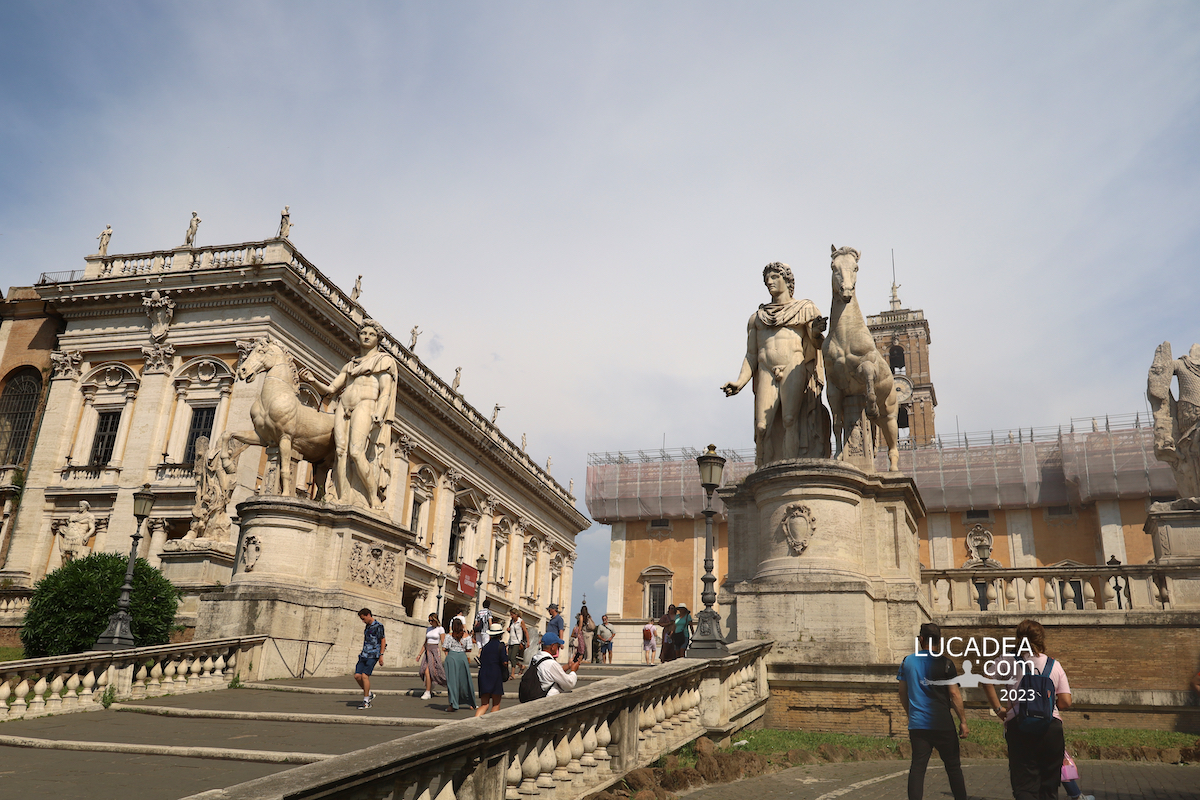
Walking toward Piazza del Campidoglio in Rome, Lazio, Italy, I found myself looking along one of the most recognizable approaches to the Capitoline Hill. The long staircase designed by Michelangelo leads the eye toward the square and immediately reveals the monumental character of this historic part of the city.
This is one of those photographs where the staircase is more than simply the subject. It becomes a way of reading the surrounding space. The Cordonata is different from many monumental stairways because of its relatively gentle incline and low steps, allowing people to move naturally toward the Campidoglio while the sides of the staircase guide the eye upward.
I wanted to capture this view with my camera because of the strength of the perspective. The Cordonata rises from the side of Piazza d’Aracoeli and leads toward Piazza del Campidoglio, creating a carefully designed connection between the lower city and one of the most important historic spaces in Rome.
If you are wondering what to see in Rome connected with Michelangelo, the Cordonata is certainly worth seeing. It is not simply a staircase used to reach the square. It is an essential part of the urban design of the Capitoline complex and still plays an important role in the way the entire site is perceived.
Its construction belongs to the sixteenth century, when Michelangelo worked on the redevelopment of the Capitoline Hill and gave the area a more coherent and monumental appearance. Piazza del Campidoglio, the Senatorial Palace and the surrounding buildings were organized as part of a unified architectural project, while the Cordonata became the principal approach from the city below.
One small curiosity concerns the shape of the staircase itself. The steps are deliberately low and the Cordonata is broad enough to allow horses and riders to climb it. It was therefore conceived not simply as a monumental staircase for pedestrians, but also as a ceremonial route leading toward the Campidoglio.
Decorative elements and sculptures accompany the ascent, gradually preparing the visitor for the architecture of the square. At the center of Piazza del Campidoglio stands the famous equestrian statue of Marcus Aurelius. The statue now visible outdoors is a replica, while the original is preserved in the Capitoline Museums.
What I find particularly interesting is the relationship between this Renaissance setting and everything surrounding it. The Capitoline Hill is one of those places where Rome’s different historical periods seem to exist within a very small area. In just a few minutes, it is possible to move from modern city streets to Renaissance architecture and then toward the remains of ancient Rome.
Looking at my photograph, however, I am not mainly interested in giving a historical explanation of the staircase. What stays with me is the visual effect of the ascent. The steps naturally draw the eye upward, creating a line that seems to invite you toward the square.
This is also what makes Rome so rewarding to photograph. A city as familiar as Rome can easily become reduced to its most famous images, yet even well-known places can look different when the viewpoint changes slightly. The Cordonata is an iconic part of the Campidoglio, but it still offers perspectives worth stopping for.
When I photograph a monumental staircase, I often look for the way it controls the viewer’s gaze rather than simply documenting its architecture. Here, the ascent becomes an invitation into the square, while the proportions of the surrounding buildings gradually reveal the scale of the whole composition.
This photograph also connects naturally with other historic places I have photographed and written about on the blog, where I often focus on architectural details and urban views rather than only the most famous postcard scenes. Over time, these images become a personal visual record of the places I have visited.
For me, the Cordonata Capitolina remains an image of transition: a staircase connecting two levels of the city, but also two different ways of experiencing Rome. As you climb, the city below gradually falls behind and Piazza del Campidoglio begins to open ahead.
Perhaps that is its strongest photographic quality. Nothing needs to be added to the scene. The geometry of the steps, the perspective and the architecture at the top already provide everything needed for an interesting composition.

Have you ever walked up the Cordonata while paying attention to it as a work of art in its own right? Add a comment or go to the bottom of the site to read what other visitors have written.

Cordonata steps in Rome leading to Campidoglio square, a monumental staircase designed by Michelangelo

Photo taken with a Canon EOS RP camera and Canon RF 24-50 lens.

Click here to see all the photos of Rome:
foto gallery

Here is where the staircase is located:

Inside San Lorenzo Cathedral in Genoa

Navata centrale della Cattedrale di San Lorenzo a Genova, con l’altare maggiore e lo scudo di San Giorgio

Inside San Lorenzo Cathedral in Genoa.
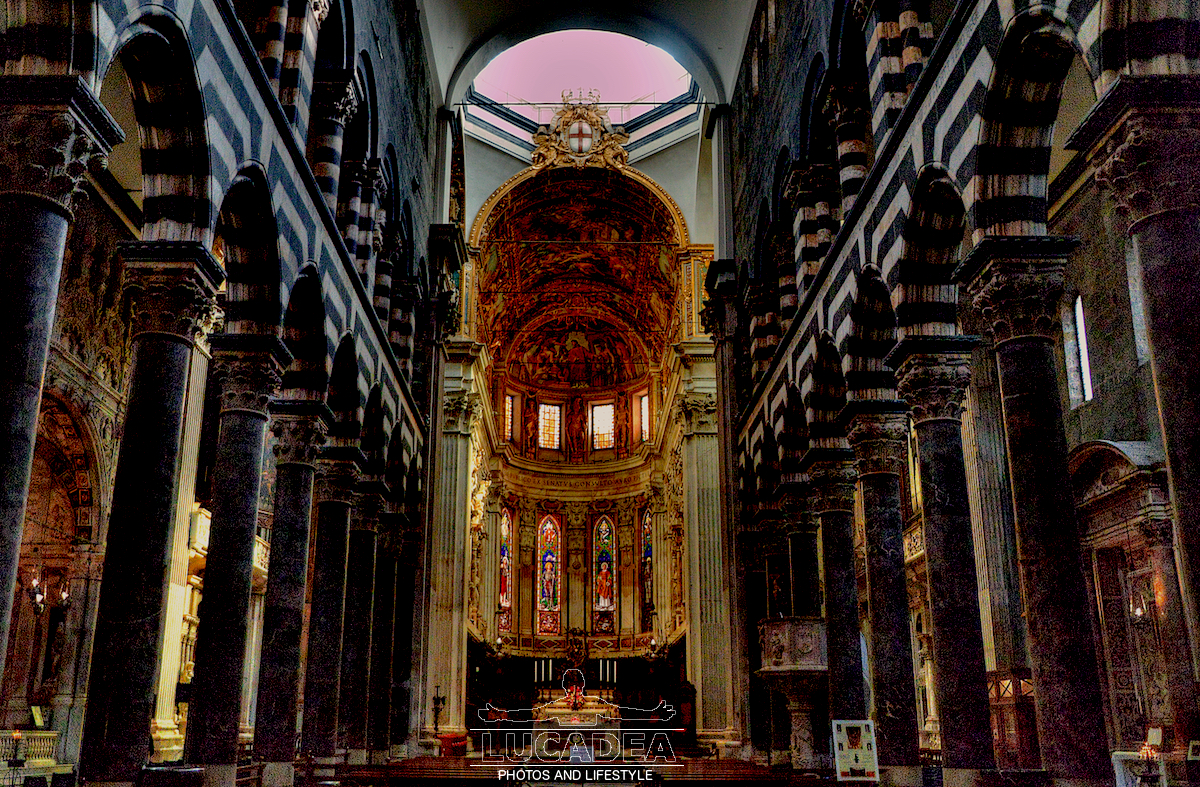
From the central nave, my attention was drawn toward the main altar, while the alternating bands of white and green marble gave the interior a character that feels strongly connected with Genoa. This photograph of San Lorenzo Cathedral captures one of the most recognizable spaces in the historic centre, where architecture, history and one of the city’s best-known symbols meet in the same frame.
The photograph shows the central nave of the cathedral, with the main altar at the end of the perspective. I wanted to photograph this particular view because it gives a sense of the scale of the building while also including some details that can easily be missed when walking through the church without stopping to look closely.
San Lorenzo Cathedral stands in the heart of Genoa, Liguria, Italy, surrounded by the dense historic fabric of the old city. It is one of those places where a short walk can take you between very different parts of Genoa’s history, from narrow streets and historic buildings to monumental churches and richly decorated interiors.
The first thing that stands out in the photograph is the use of marble. The contrast between white and green creates a strong visual rhythm along the architecture and gives the central nave much of its distinctive appearance. When I took the photograph, I wanted the perspective itself to do most of the work, allowing the lines of the nave to lead naturally toward the main altar.
High above, the shield bearing the cross of Saint George can also be seen. The red cross on a white background is one of the symbols most closely associated with Genoa and its history. I particularly like this detail because it connects the religious setting of the cathedral with the civic identity of the city and its long maritime past.
The cathedral developed over several centuries, and that history can still be read in its architecture. San Lorenzo combines Romanesque and Gothic elements with later additions and modifications, creating the layered appearance visible today. The alternating marble on the exterior and interior is among the features that make the cathedral immediately recognizable.
One small historical detail I find especially interesting is that San Lorenzo was not created as a single, perfectly unified project. Its appearance is the result of successive phases of construction and changes carried out over time. That helps explain why different architectural languages can be encountered within the same building without making the overall space feel disconnected.
If you are visiting Genoa and looking for what to see in the historic centre, San Lorenzo is naturally one of the places worth entering rather than simply admiring from outside. For me, however, this photograph was not intended as a tourist guide. I was more interested in capturing the experience of standing along the central axis of the nave and seeing the architecture draw the eye toward the altar.
I took this photograph myself, and I tried to keep the composition relatively open so that the proportions of the interior remained visible. A cathedral like this offers countless details that could each become the subject of a separate photograph, but in this case I preferred to step back visually and let the entire nave become the subject.
This image also fits naturally with the other photographs of Genoa and its historic buildings that I have published on the blog. I often find myself photographing churches, palaces and architectural details while walking through the old city, and each image becomes a small part of a larger personal record of Genoa. Rather than trying to document everything, I prefer to stop when a particular view gives me a reason to take out the camera.
Looking at the photograph again, what stays with me is the combination of perspective and colour. The central nave leads toward the altar, the marble creates a clear rhythm on either side, and the cross of Saint George adds a detail that immediately places the scene in Genoa.
It is only one view of the cathedral, but I think it manages to show why the interior deserves the same attention as the famous exterior.

If you have visited San Lorenzo Cathedral, which detail of its interior caught your eye most? Add a comment or go to the bottom of the site to read what other visitors have written.

Central nave inside San Lorenzo Cathedral in Genoa, with the main altar and the shield of Saint George above

Photo taken with Canon EOS RP and lens Tamron 16-300 and polarizing filter.

Here are all the photos I took during my last visit to the Cathedral:
foto gallery

If you are interested, this is the official website for updates on Catholic initiatives and liturgies: chiesadigenova.it.

The Column of Marcus Aurelius in central Rome

Colonna di Marco Aurelio a Roma in Piazza Colonna, con il fregio scolpito che avvolge il monumento antico

The Column of Marcus Aurelius in central Rome.
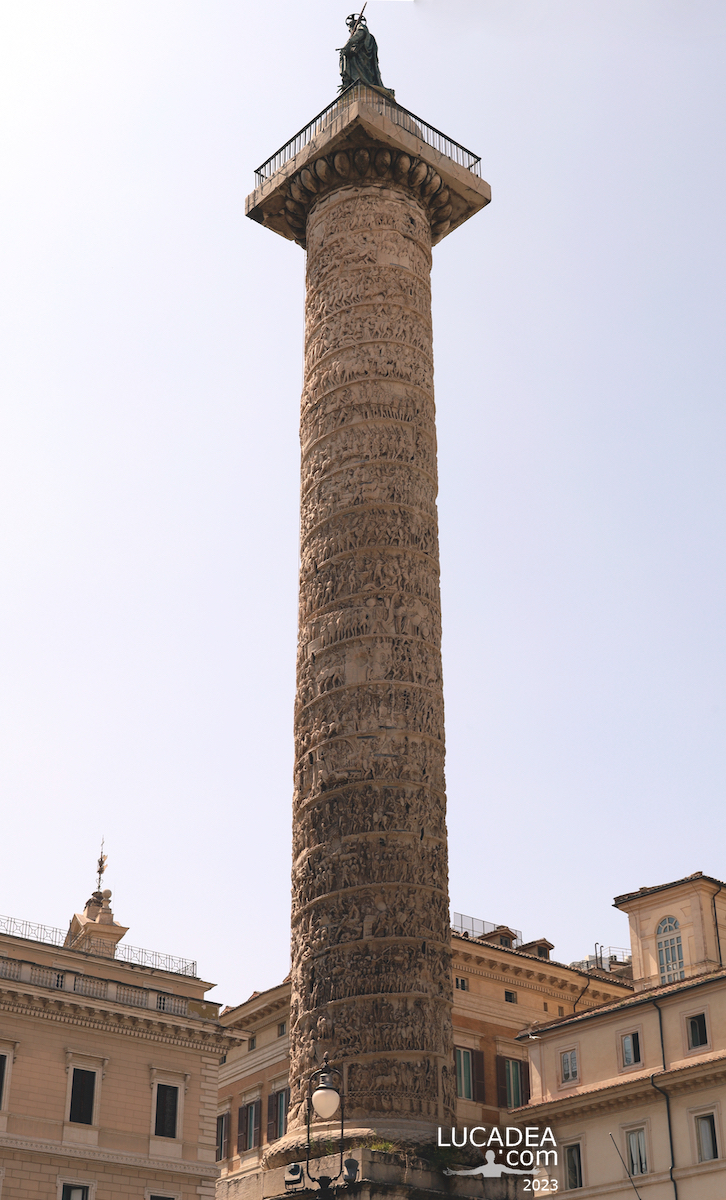
Standing in front of the Column of Marcus Aurelius in Rome, I was immediately drawn to the way its tall shaft rises above Piazza Colonna, surrounded by the buildings and everyday movement of the city. Photographing a monument like this is not simply about capturing its height. Sooner or later, your eyes move toward the carved details covering the marble, following the spiral relief that climbs around the column.
That is what I wanted to preserve in this photograph. I was interested in the contrast between the ancient monument and the modern city around it, and in the feeling of looking at something created many centuries ago while people continue to walk past it every day.
The Column of Marcus Aurelius is one of the most recognizable ancient monuments in Rome. It stands in Piazza Colonna, directly in front of Palazzo Chigi, and its position makes the meeting between ancient and modern Rome particularly visible. You can be surrounded by the sounds and movement of today’s capital and, by simply looking upward, find yourself facing scenes carved almost two thousand years ago.
The column was created to commemorate the military campaigns of Emperor Marcus Aurelius and belongs to the Roman tradition of monumental commemorative columns. Its spiral relief tells stories connected with the emperor’s wars against Germanic peoples. Soldiers, battles, prisoners and scenes of military life appear among the carved figures, creating a continuous narrative that winds around the entire structure.
This is what makes the monument so interesting to photograph. From a distance, the column is mainly an imposing vertical element in the square. Once you start looking closely, however, it becomes a collection of hundreds of small scenes. The closer you look, the more you realize that the surface itself is telling a story.
There is also a small historical detail that I find particularly interesting. The monument is known today as the Column of Marcus Aurelius, but it is also called the Antonine Column, a name connected with the Antonine imperial dynasty. Over the centuries, the monument underwent changes and restoration, and its original summit no longer survives. The statue visible there today represents Saint Paul and was placed on top of the column during the sixteenth century.
That mixture of different periods is one of the things I enjoy most about photographing Rome. The column belongs to ancient history, but the setting in which we see it today belongs entirely to the modern city. Streets, buildings, traffic and people surround a monument that was created for a very different Rome.
I have photographed other corners of ancient Rome as well, and those images often make me notice the same thing: the city’s history is not kept apart from everyday life. It remains visible in the middle of streets and squares, sometimes in places where you might least expect it.
If you are wondering what to see in central Rome, the Column of Marcus Aurelius is certainly worth stopping for. I would not only look at its impressive height, but also take some time to follow the relief and notice how the individual scenes gradually reveal themselves.

When you look at this photograph, which detail of the column catches your eye first? Add a comment or go to the bottom of the site to read what other visitors have written.

Column of Marcus Aurelius in Piazza Colonna, Rome, with the carved spiral relief covering the ancient monument

Photo taken with a Canon EOS RP camera and Canon RF 24-50 lens.

To see all the photos I took in Rome, click here:
foto gallery

Here is where the column is located:

The Column of Marcus Aurelius is an ancient monument in Rome, erected between 180 and 193 to commemorate—possibly after his death—the victories of the Roman Emperor Marcus Aurelius (161–180) over the Marcomanni, Sarmatians, and Quadi peoples, who were settled north of the middle Danube during the Marcomannic Wars.
Read more and find out more on Wikipedia

The cherub on the Grimaldi Chapel portal

Putto scolpito nel marmo sul portale della Cappella Grimaldi in Santa Maria in Castello a Genova

The cherub on the Grimaldi Chapel portal.
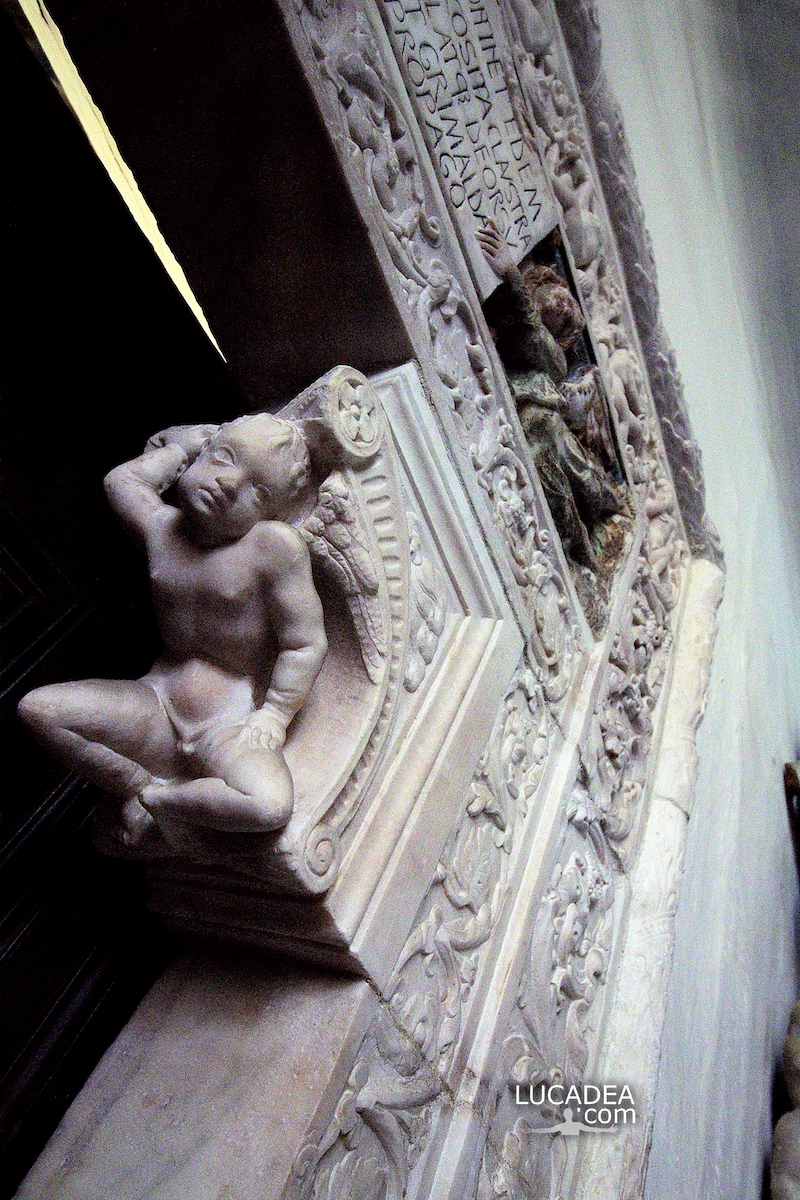
Among the things worth seeing in Genoa, inside Santa Maria in Castello, there are also details that can easily go unnoticed, such as this small marble figure carved into one of the jambs of the Grimaldi Chapel portal. It is exactly the kind of detail in Genoa’s art and architecture that I enjoy looking for with a camera in my hands: not necessarily the whole monument, but a smaller element that can become interesting when seen on its own.
The Grimaldi Chapel offers several photographic opportunities, and near its entrance my attention settled on this little child carved in marble. Whether we call it a cherub, putto or little angel is less important to me than the way the figure has been incorporated into the larger decoration of the portal. What caught my eye was the contrast between the small human form and the much larger architectural structure surrounding it.
When looking at a portal, it is natural to see it as one composition: the marble, the decorative elements, the jambs and the entrance itself. Getting closer, either physically or simply with the eye, reveals a completely different collection of details. This little figure almost seems to invite you to look for it, because it is certainly not the first thing that dominates the entrance.
That is what I like about photographing Genoa. The city has an extraordinary amount of architecture, churches and historic interiors, but very often it is a small decorative detail that makes me stop. In this case, I wanted to isolate part of the portal and let the marble child become the actual subject of the photograph.
The image came from a very simple moment of observation. In front of an entrance containing many different elements, I noticed this particular figure and decided to move closer rather than simply photographing the entire chapel. It is a different way of looking at a place, searching for something that might not immediately attract attention during a normal visit.
A small artistic curiosity is connected with the word “putto”. In European decorative art, the term generally refers to a childlike figure used as an ornamental or symbolic element. Putti can sometimes resemble angels, but the two ideas are not necessarily identical; their meaning depends on the artistic and religious context in which they appear.
The Grimaldi Chapel therefore gave me another example of why looking closely at architectural decoration can be rewarding. Photographing such a small detail changes the way the building is perceived. Instead of seeing only a religious space or a historic monument, I begin to see it as a collection of many individual artistic choices.
If you are visiting Genoa and interested in places worth seeing beyond the larger architectural views, details like this are often where I find the most personal photographic opportunities. They do not necessarily require a long explanation. Sometimes the simple act of noticing them is enough.
This photograph also connects naturally with other posts on my site dedicated to details found inside churches and historic buildings in Genoa. I enjoy collecting these close-up views because they create a different kind of visual record of the city, one made from small discoveries rather than only from its most recognizable landmarks.
Here, I wanted to keep the story deliberately small: a marble child set into one side of a portal, noticed during a visit to the chapel and photographed because something about the figure caught my attention.

When you visit a church, do you find yourself looking for details like this, or do you usually photograph the whole building? Add a comment or go to the bottom of the site to read what other visitors have written.

Marble cherub carved into the portal of the Grimaldi Chapel at Santa Maria in Castello in Genoa

Photo taken with a Canon EOS M100 camera and a Canon EF-S 10-18 lens.

To see all the photos I took at Santa Maria in Castello and in its cloisters, click here:

This is the church’s official website: santamariadicastello.it.

Situated on Castello Hill—the site of Genoa’s earliest ancient settlement—the Church of Santa Maria di Castello is one of the city’s oldest Christian places of worship and one of its most well-preserved and evocative examples of Romanesque architecture.
Read more on Wikipedia

A detail of Florence Cathedral

Lunetta sopra il portone principale del Duomo di Firenze con dettagli decorativi della facciata in marmo

A detail of Florence Cathedral.
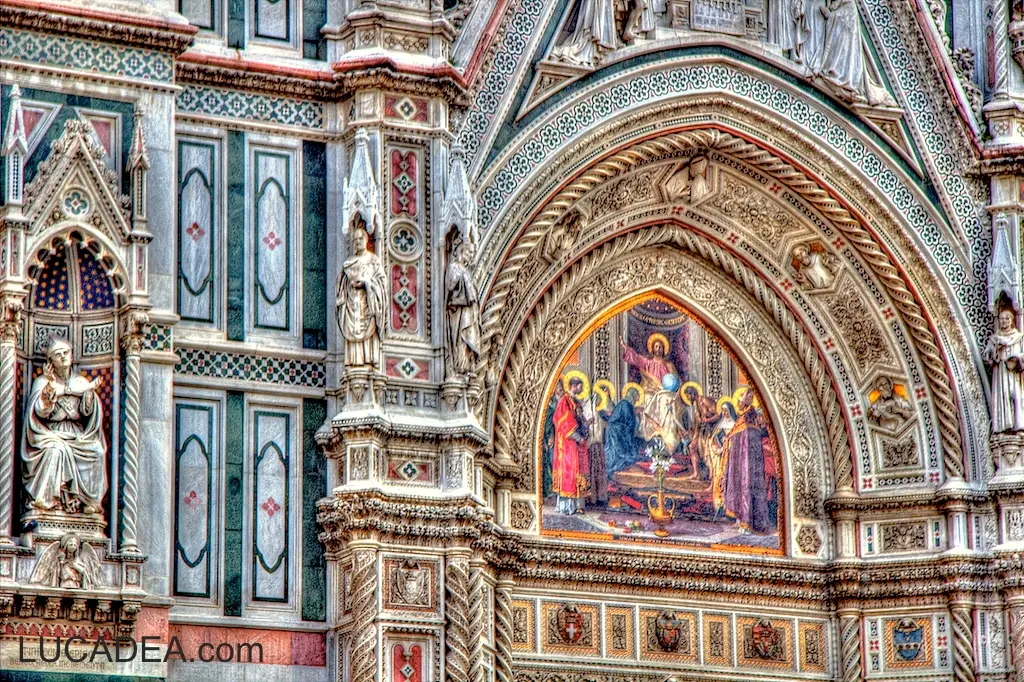
Walking through the historic center of Florence, Tuscany, Italy, it is almost impossible not to stop in front of Santa Maria del Fiore, one of the city’s most recognizable landmarks. If you are wondering what to see in Florence, the cathedral naturally deserves a place at the top of the list, but this time my attention was not on the entire façade. I chose instead to focus on the lunette above the main entrance.
This is exactly the kind of detail I enjoy looking for when photographing famous monuments. The overall view of Florence Cathedral has been captured countless times, while moving closer to a single part of the façade can reveal details that are easily overlooked. I wanted to capture this small section of Santa Maria del Fiore with my camera and give it the attention it deserves on its own.
The façade immediately stands out because of its combination of white, green and red marble, a color scheme that has become an essential part of the visual identity of Florence Cathedral. Looking more closely, however, it is not only the colors that catch the eye. The façade is filled with shapes, frames, sculptures, mosaics and ornamental details that work together to create an extraordinarily rich composition.
The lunette above the entrance is one small part of this larger decorative system. Photographing it means temporarily leaving aside the monumental scale of the cathedral and concentrating on a much smaller area, almost as if I were looking at an individual work of art inside a museum.
Florence, in the heart of Tuscany, is a city where it is remarkably easy to walk past a masterpiece without having time to notice every detail. The Santa Maria del Fiore complex, with the cathedral, Giotto’s Bell Tower and the Baptistery of Saint John, brings an enormous amount of art and history together within a relatively compact area.
A brief historical detail is worth mentioning: the façade we see today is not the original medieval façade. The present design was created during the second half of the nineteenth century and completed toward the end of that century, after the earlier unfinished façade had been removed.
This photograph also connects with the other images I have shared from Florence and with my previous photographs of details from the cathedral complex. After photographing Giotto’s Bell Tower and other elements around the Duomo, I find that returning to smaller architectural details offers a different way of telling the story of the same place.

Which detail of Florence Cathedral would you have photographed? Add a comment or go to the bottom of the site to read what other visitors have written.

Lunette above the main entrance of Florence Cathedral with decorative marble details on the facade

This is the church’s official website: duomo.firenze.it.

To see all the photos I took in the beautiful Tuscan city, click here:

The Metropolitan Cathedral of Santa Maria del Fiore—commonly known as the Florence Cathedral—is the city’s main church, a symbol of Florence, and one of the most famous in Italy. Upon its completion in the 15th century, it was the largest church in the world; today, it is considered the third-largest in Europe, following St. Peter’s in Rome and Milan Cathedral. It stands on the foundations of Florence’s earlier cathedral, the Church of Santa Reparata, on a site that has hosted places of worship since Roman times.
Read more on Wikipedia

Giotto’s Bell Tower in Florence

Campanile di Giotto a Firenze fotografato in HDR con dettagli del marmo bianco verde e rosso

Giotto’s Bell Tower in Florence.
There is probably no need to explain what is shown in this photograph, as it represents one of the most iconic landmarks of Florence. For those who may not recognize it, this is the beautiful bell tower of the Cathedral of Santa Maria del Fiore, designed by Giotto and completed in the 14th century.
I took this picture while walking through the historic center of Florence, aiming to highlight the architectural details and the rich colors of the monument. In this case, I used HDR photography, a technique that enhances both light and shadow, bringing out the textures and geometric decorations of the structure.
The bell tower is one of the finest examples of Italian Gothic architecture. What immediately stands out is the richness of its surfaces, decorated with white, green and red marble that creates a striking visual harmony. Every side of the tower is carefully designed, with panels, niches and geometric patterns that reflect the artistic style of the period.
Florence, the capital of Tuscany, Italy, is a city where every corner is filled with history and art. The cathedral complex, including the church, the bell tower and the baptistery, is one of the most important cultural landmarks in Italy and attracts millions of visitors each year.
A short note about Giotto: he is considered one of the greatest artists of the Middle Ages and played a crucial role in shaping the development of Western art, both in painting and architecture.
This photograph reflects my approach to capturing famous landmarks while still trying to add a personal perspective. Even when photographing such a well-known subject, the choice of light, framing and technique can make a real difference.
If you are visiting Florence and wondering what to see, Giotto’s Bell Tower is definitely a must-see.

Have you ever tried to photograph a famous landmark in a unique way? Add a comment or go to the bottom of the site to read what other visitors have written.

Giotto Bell Tower in Florence photographed in HDR showing white green and red marble details

Photo taken with a Canon 600D camera.

Giotto’s Campanile is the bell tower of Santa Maria del Fiore—Florence’s cathedral—and is located in Piazza del Duomo. Its foundations were excavated around 1298 at the start of the new cathedral’s construction, when Arnolfo di Cambio was the master builder. In 1334, Giotto di Bondone took over the role of master builder. In his *Life of Giotto*, Vasari recounts his arrival—”on July 9, 1334, at the campanile of S. Maria del Fiore”—noting that he immediately began working on the construction of the tower’s first level while showing no interest—according to Giovanni Villani—in the basilica’s construction site.
Read more on Wikipedia

San Martino Cathedral in the heart of Lucca

Cattedrale di San Martino a Lucca con facciata in marmo e campanile nel centro storico

San Martino Cathedral in the heart of Lucca.
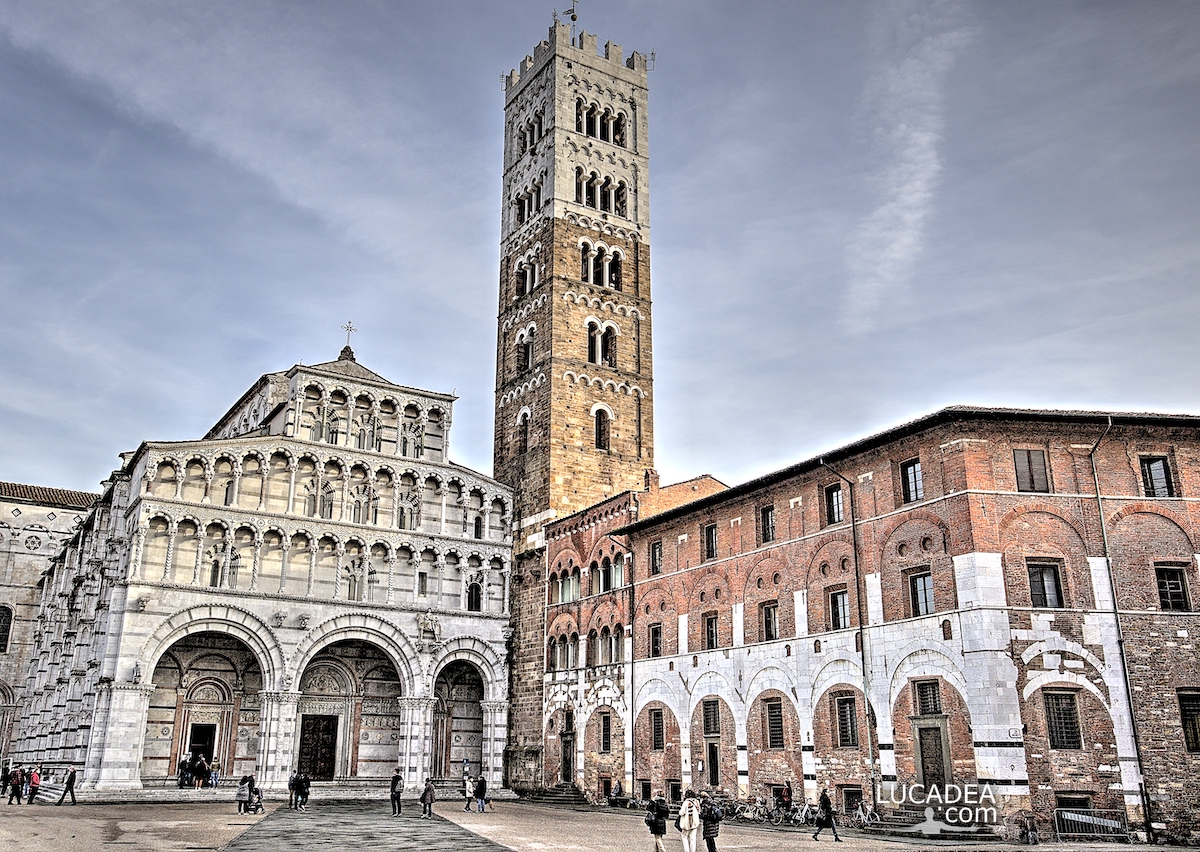
During one of my visits to Lucca, Tuscany, Italy, I photographed San Martino Cathedral, the city’s Duomo and one of the most important places to see in the historic center. Its marble facade, bell tower, and architectural details reveal centuries of history and show a side of Lucca that, I have to admit, I discovered only after visiting the city several times.
When I first visited Lucca, I paid more attention to the beautiful San Michele in Foro Church, thinking it was the main religious landmark of the city. Later, after watching the Italian television program Meraviglie – La penisola dei tesori hosted by Alberto Angela, I learned more about the importance and beauty of San Martino Cathedral and decided to return and explore it with a different perspective.
I wanted to capture this building with my camera because it is a perfect example of how a place can surprise even those who believe they already know it. The facade of the cathedral, with its columns, carved decorations, and the particular asymmetry created by the bell tower, offers countless details that deserve a closer look.
San Martino Cathedral is the main religious building of Lucca and preserves important works of art, including the famous funeral monument to Ilaria del Carretto created by Jacopo della Quercia. A small curiosity concerns the bell tower: built with brick and stone, it is one of the elements that define Lucca’s skyline and blends naturally with the other historic buildings rising above the city roofs.
If you are visiting Lucca, San Martino Cathedral is definitely a place worth seeing because it combines art, architecture, and history in a compact area that can easily be explored while walking through the old town. Its location near the city walls and the main streets also makes it a perfect stop during a visit to the historic center.
This photograph continues my visual journey through Lucca, following the views I shared of San Frediano Basilica, San Michele in Foro Church, and the panoramic view from the Saints John and Reparata bell tower.
Sometimes a place only needs a second look or a deeper story to reveal details that were hidden before.

Have you ever visited San Martino Cathedral while exploring the historic center of Lucca? Add a comment or go to the bottom of the site to read what other visitors have written.

<San Martino Cathedral in Lucca with marble facade and bell tower in the historic city center

Photo taken with a Canon EOS M100 camera and Canon EF-M 11-22 lens.

To see all the photos I took of the Duomo, click here:

Adjoining the west-facing main façade is a portico-narthex that opens onto the square through three large arches—one of which is narrower due to the proximity of the pre-existing bell tower. Guidetto and his assistants installed bas-reliefs depicting the martyrdom of Saint Regulus (shown in the lunette above the entrance to the right aisle), a cycle of the months, and scenes from the life of Saint Martin.
Read more on Wikipedia

Inside Milan Cathedral between art and history

Interno del Duomo di Milano con colonne gotiche, navate, altari e dettagli artistici della celebre cattedrale italiana

Inside Milan Cathedral between art and history.
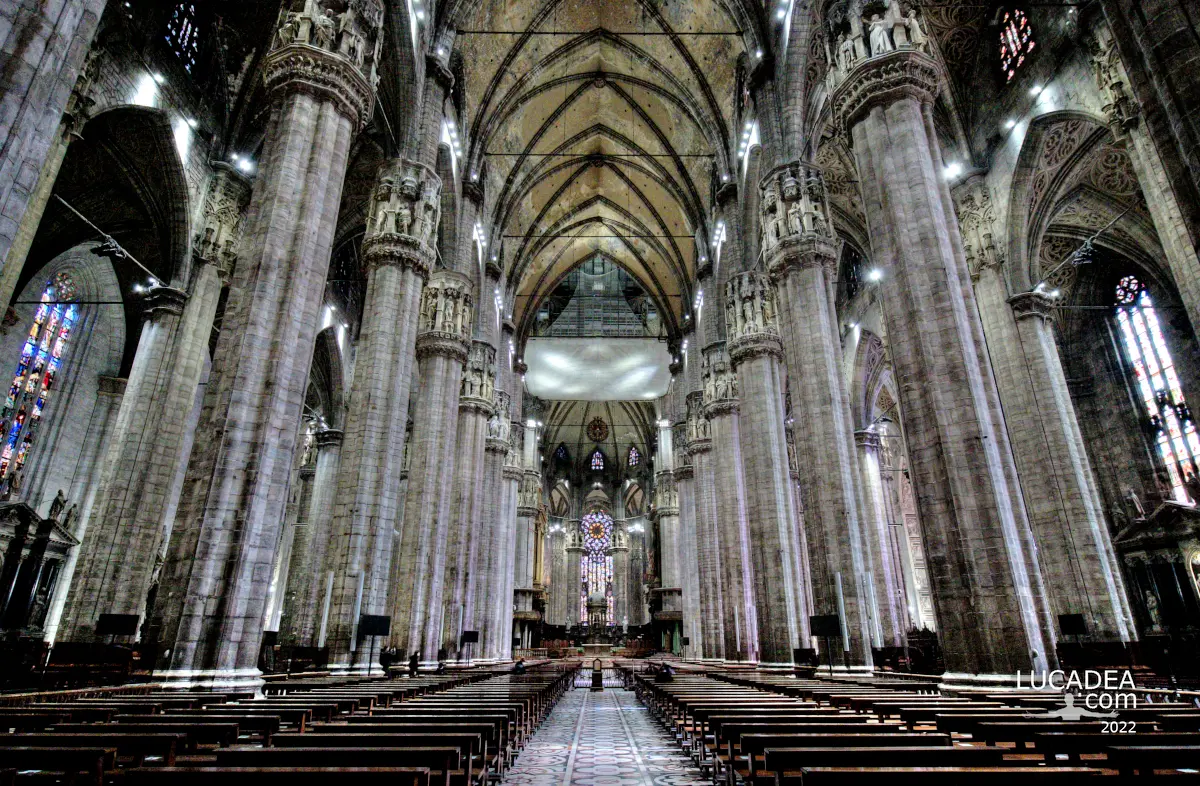
Stepping inside Milan Cathedral, in the heart of Lombardy, Italy, I found one of the most recognizable places to see in Milan and a perfect subject for photography. The interior of Milan Cathedral immediately captures attention with its enormous scale, endless columns, and the impressive sense of depth created by the long central nave.
When I took this photograph, I wanted to preserve more than just the architectural details. I wanted to capture the relationship between the vast space of the cathedral and the people moving through it, because the Duomo is not only a monument to admire but also a living place where history and everyday visits meet.
Walking inside, you discover carved marble, decorated altars, statues, and stained glass windows that add different shades and textures to the atmosphere. The tall columns guide the view toward the main altar, while the Gothic vaults make the ceiling feel even farther away. This combination of scale and detail is what makes photographing Milan Cathedral so fascinating: every angle reveals a different story.
I chose to capture this scene with my camera because some places stay in your memory not only for their appearance but also for the feeling they create. Here, it is the balance between stone, decoration, silence, and movement that makes the experience unique. The architecture naturally leads your eyes through the space, inviting you to look at small details as well as the overall structure.
A short historical note: construction of Milan Cathedral began in 1386 and continued for centuries, involving many generations of craftsmen and artists. This long process helped create a building where different artistic influences can be found while maintaining its strong Gothic identity.
After exploring the interior, visiting the cathedral terraces offers another perspective, with the famous spires rising above the city skyline. I previously photographed another view of Milan from this area, and together these images show two different ways of experiencing the same landmark.
If you are visiting Milan and looking for places to see, the interior of Milan Cathedral is an experience that reveals not only the history of the city but also the incredible attention behind every architectural detail.

Which detail of Milan Cathedral impressed you the most during a visit? Add a comment or go to the bottom of the site to read what other visitors have written.

Interior of Milan Cathedral with Gothic columns, nave, altars and artistic details inside the famous Italian cathedral

Photo taken with a Canon EOS M100 camera and Canon EF-M 11-22 lens.

There is also the official website: duomomilano.it

To see all the photos I took on the roof and inside the Duomo, click here:

🏠
  • Italiano