Jellyfish at the Aquarium of Genoa

Meduse all'Acquario di Genova

Jellyfish at the Aquarium of Genoa.
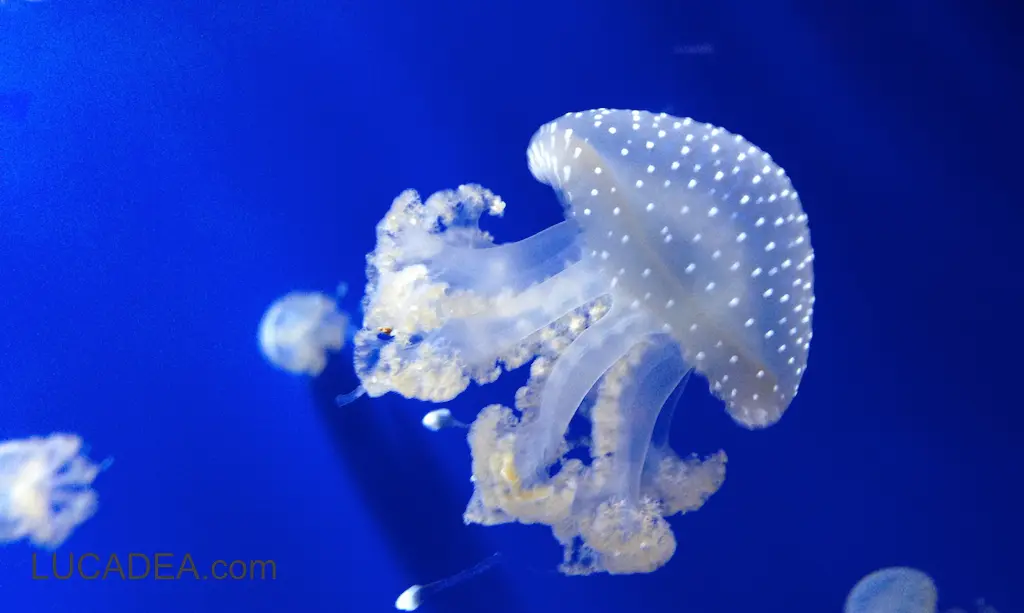
One of the most fascinating sights at the Aquarium of Genoa is a jellyfish floating gracefully inside its illuminated tank. Jellyfish at the Aquarium of Genoa are captivating subjects to watch, with their delicate shapes, translucent bodies and slow, almost hypnotic movements.
Here is a photograph of one of the jellyfish that welcome visitors along the aquarium route. I stopped for a while to observe it and take a picture, trying to capture some of the quiet elegance of these marine animals. They move in such a distinctive way: rather than swimming like fish, they seem to drift through the water, gently pulsing and changing direction as they go.
It had been quite a long time since my last visit to the Aquarium of Genoa. There is a curious habit many of us share: we sometimes overlook the attractions closest to home. Because they are always there, we assume we can visit them whenever we like, and somehow the visit keeps getting postponed. We may be more likely to explore places far away while forgetting to rediscover what is right on our doorstep.
This time I finally went back, and I have to say that I was genuinely impressed. I found the aquarium very beautiful and interesting. It also seemed to me that it had expanded over the years, while continuing to feel fresh and relevant. Walking through the different exhibition areas is an opportunity to see a remarkable variety of marine life and to spend time observing creatures that we would rarely encounter so closely in everyday life.
The Aquarium of Genoa is located in the Porto Antico area, in the historic port district of Genoa, in Liguria, north-western Italy. It is one of the city’s best-known attractions and a place worth visiting whether you are discovering Genoa for the first time or returning after many years.
Jellyfish are particularly rewarding subjects for photography. Their transparent bodies, delicate tentacles and flowing movements create ever-changing shapes in the water. Photographing them through the glass of an aquarium tank is not always straightforward. Reflections, lighting conditions and movement all make it a little challenging, but they also make the attempt more interesting. I like trying to capture a moment in which the animal’s shape and movement are clearly visible.
This picture is a small reminder of a very enjoyable return visit. It also made me think that we should sometimes take the time to explore the places we have nearby, instead of always looking for something new far away. The Aquarium of Genoa certainly deserves another visit.

Have you visited the Aquarium of Genoa recently, or is it one of those places you keep meaning to see again? Add a comment or go to the bottom of the site to read what other visitors have written.

A translucent jellyfish floating inside a tank at the Aquarium of Genoa in the Porto Antico harbour area

Here’s the official website: acquariodigenova.it.

Add one  comment to this article or read  here what other visitors have written.
 
Adv
 
Disclamer

The rights on images, videos, choruses, text and all other material on the LUCADEA.com website are governed as per  Copyright page.


This page has been viewed 2 times today.
This month it has been viewed 2 times.
In total it has been viewed 2 times.
 

The Labours of Hercules on Spinola Palace’s Portal

Le Fatiche di Ercole a Palazzo Gio Batta Spinola

The Labours of Hercules on Spinola Palace’s Portal.
Walking along Goldsmiths Street in Genoa’s historic centre, I came across an elaborate sixteenth-century entrance that deserves more than a passing glance. The portal of Palazzo Gio Batta Spinola, at number 7, is known for its sculptural programme inspired by the Labours of Hercules. Mythological figures, expressive faces and intricate stonework turn an architectural entrance into a scene full of details to discover.
I took this photograph to preserve the character of a work that rewards careful observation. The portal is much more than a frame around a doorway: its sculptures create a visual narrative, bringing together strength, mythology and Renaissance decoration. In a busy street, it is easy to walk past such details without noticing them, especially when attention is focused on reaching the next destination. Stopping for a moment reveals how much craftsmanship has been concentrated in a relatively small space.
Two imposing telamons are among the most striking features. These sculpted male figures appear to support the architectural structure above them, while their feet rest on monstrous heads, one resembling a lion and the other showing a snarling human face. The contrast between the figures and the heads beneath them gives the entrance a distinctive character. Their poses and expressions create a sense of physical effort that connects the sculptures to the heroic subject of the decoration.
On the left, Hercules is recognisable by his beard, the skin of the Nemean Lion draped around him and the club in his hand. In Greek mythology, Hercules became famous for completing twelve labours that tested his strength and courage. On the opposite side stands a clean-shaven man with a more relaxed expression, also holding a club. The contrast between the two figures makes it worth examining their faces, clothing and attributes rather than viewing the portal as a single decorative element.
At the base of the telamons, additional reliefs depict Hercules in different poses. One shows him seated with his club, while another captures the struggle between the hero and a lion. These scenes extend the mythological narrative and link the vertical figures along the sides of the entrance with the ornamentation above them.
Looking upwards, the carved details become even more varied. The metopes feature helmets, shouting heads, round shields and bucrania, or ox skulls, alternating with projecting triglyphs. At the centre is a winged head of Medusa, another reference to classical mythology. Higher up, two draped female figures holding or accompanied by amphorae frame a moustached mask. According to the description traditionally associated with the portal, this mask occupies the position of the original Spinola family coat of arms, which was removed during the Napoleonic period.
The portal is attributed to Giacomo Della Porta, a sixteenth-century architect and sculptor. Its decoration reflects the Renaissance interest in classical mythology and the close relationship between architecture and sculpture. The figures are not merely added embellishments: they form an integral part of the entrance and determine its visual identity.
For anyone interested in learning more about this remarkable piece of Genoese heritage, I also recommend the detailed article on Amezena about the Labours of Hercules portal. It offers further information about the sculptures and their interpretation, providing useful context for anyone who wants to look beyond the overall composition and explore its individual details.
Genoa, in Liguria, Italy, has a historic centre filled with architectural features that reflect the wealth and ambitions of the families who shaped the city over the centuries. Not every discovery requires a visit to a famous landmark or a large monument. Sometimes, the most memorable details are found around a doorway on an ordinary street. This portal is a good example of how a walk through the old town can reveal works of art that might otherwise go unnoticed.
That is what I wanted to capture with my photograph: not only an impressive sculptural composition, but also its place within the everyday fabric of Genoa. On Lucadea.com, I enjoy sharing similar architectural details and lesser-known corners of Liguria, where looking closely can reveal a different side of familiar places.

If you find yourself walking along Goldsmiths Street, take a moment to examine the portal as a whole before looking at the individual figures. The telamons, monstrous heads, Hercules and Medusa each contribute something different to the composition. Which detail would catch your eye first? Add a comment or go to the bottom of the site to read what other visitors have written.

The Labours of Hercules portal at Palazzo Gio Batta Spinola on Goldsmiths Street in Genoa, featuring carved figures and mythological reliefs

Photo taken with Canon EOS RP and lens Canon RF 24-50.

Where is the palace:

Add one  comment to this article or read  here what other visitors have written.
 
Adv
 
Disclamer

The rights on images, videos, choruses, text and all other material on the LUCADEA.com website are governed as per  Copyright page.


This page has been viewed 1 times today.
This month it has been viewed 1 times.
In total it has been viewed 15 times.
 

Vietnamese cuisine: sứa trộn, jellyfish, the recipe

Cucina vietnamita: sứa trộn, la medusa, la ricetta

Vietnamese cuisine: sứa trộn, jellyfish, the recipe.
There are dishes that surprise you just by hearing their name. Sứa trộn, jellyfish salad, is one of them. The first time I made it for my husband, I saw curiosity mixed with fear in his eyes. Then came the first bite, and that was all it took.
In Vietnam, especially in the central area where I live, between the sea and the salty wind, jellyfish is a common ingredient. It doesn’t have as strong a flavor as you might think. It’s delicate, almost neutral. Its strength lies in its texture: crunchy, fresh, slightly springy. It’s this sensation under your teeth that makes the dish so special.
The sứa is cleaned and treated with salt to make it safe and enjoyable to eat. Once ready, it is cut into thin strips and mixed with the freshest ingredients. I love adding julienned green mango for a tangy note, finely chopped carrot for color, fragrant herbs like mint and coriander, and a generous handful of toasted peanuts.
The seasoning is the heart of the dish: fish sauce, lime juice, a little sugar, and chopped fresh chili pepper. It must be the perfect balance of sweet, salty, sour, and spicy. When everything comes together in the bowl, the aromas immediately evoke Vietnam.
I often make it in hot weather. It’s light, refreshing, almost thirst-quenching. It’s not a dish for curious tourists, but for those who truly want to savor the local cuisine, the kind eaten in homes or in small restaurants frequented by Vietnamese.
And every time I bring it to the table, I remember that our cuisine is not just about flavor, but also texture, balance, and freshness.

Ingredients:

300 g of jellyfish, already treated and ready to use
1 julienned green mango (or green papaya)
1 finely chopped carrot
Fresh mint
Fresh cilantro
2 tablespoons fish sauce
Juice of 1 lime
1 teaspoon sugar
Fresh chili pepper to taste
2 tablespoons toasted peanuts

Preparation

Rinse the jellyfish under cool water and let it drain well.
Slice it into thin strips.
In a bowl, combine the mango, carrot, and herbs.
Prepare the dressing by mixing the fish sauce, lime, sugar, and chili pepper.
Add the jellyfish to the vegetables and pour in the dressing.
Mix gently and garnish with toasted peanuts.
Serve immediately, chilled.

Would you like it? Add a comment or go to the bottom of the site to read what other visitors have written.

Photos taken with Oppo Reno 12.

Vietnamese cuisine: sứa trộn, jellyfish, the recipe – Cuisine vietnamienne : sứa trộn, la méduse, la recette – Cocina vietnamita: sứa trộn, la medusa, la receta – Cozinha vietnamita: sứa trộn, a medusa, a receita – Vietnamesische Küche: sứa trộn, Qualle, das Rezept – Ẩm thực Việt Nam: sứa trộn, món sứa, công thức – 越南料理:海蜇沙拉,海蜇,食谱 – ベトナム料理:スアチョン、クラゲ、レシピ

The text of this post was written with the help of ChatGPT, a language model from OpenAI.

Perseus holding Medusa’s head in Florence

Il Perseo che ha ucciso Medusa nella Loggia dei Lanzi a Firenze

Perseus holding Medusa’s head in Florence.
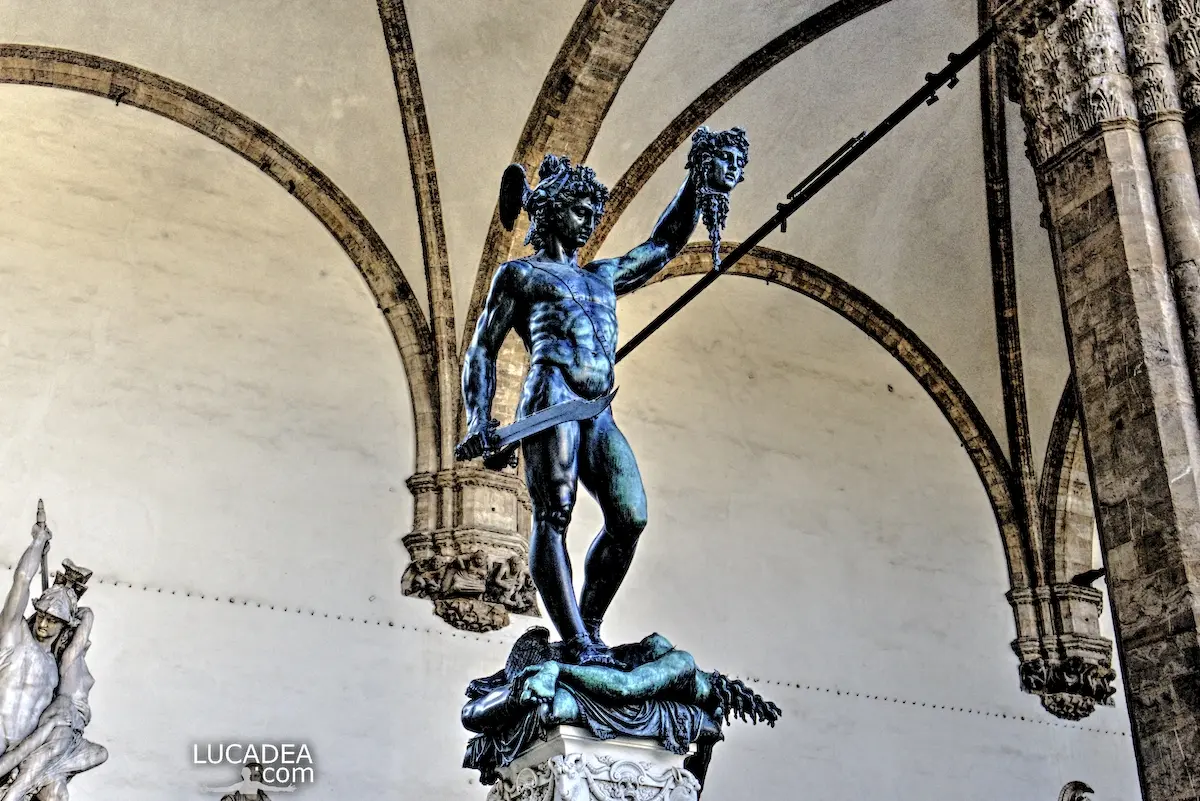
Walking through Piazza della Signoria in Florence, Tuscany, Italy, I found myself once again in front of one of the city’s most striking sculptures: Perseus with the head of Medusa. It’s one of the most searched landmarks when people look for things to see in Florence, and seeing it in person gives a completely different impression compared to photos.
Standing under the Loggia dei Lanzi, the statue feels both protected and exposed at the same time. The darker tone of the bronze stands out against the open square, drawing the eye even among the many famous artworks around. I took this photo because I was intrigued by the balance of the composition: the raised arm of Perseus, the dramatic gesture, and the stillness of the scene captured in metal.
This sculpture, created by Benvenuto Cellini in the 16th century, represents the mythological hero just after defeating Medusa. An interesting historical detail is that it was also meant to symbolize the political power of the Medici family over Florence at the time. Knowing this adds another layer to the image, even if what really caught my attention was the intensity of the pose.
Despite the constant flow of people crossing the square, this corner manages to keep a strong visual presence. It’s not just a landmark to tick off a list, but something that invites you to slow down and really look. If you are visiting Florence and wondering what to see beyond the obvious, taking a moment here can reveal unexpected details.
This moment also reminded me of other photos I’ve taken in the same square, like the Neptune Fountain or the architectural lines of Palazzo Vecchio. Each time, I try to capture something slightly different, something more personal than the typical postcard view.

Have you ever looked again at a famous statue and noticed something completely new? Add a comment or go to the bottom of the site to read what other visitors have written.

Perseus statue holding Medusa’s head under the Loggia dei Lanzi in Piazza della Signoria, Florence

Photo taken with Canon EOS M100 camera and Canon EF-M 11-22 lens.

To see all the photos I took in the beautiful Tuscan town, click here:

Perseus is best remembered for killing the Gorgon Medusa, for saving Andromeda, who later became his wife, from a sea monster, and for being king of Tiryns, after renouncing the throne of Argos in favor of Megapenthes, and of Mycenae, a city he founded himself. By his wife Andromeda, he had many children, including Electryon (his heir and grandfather of Heracles) and Gorgophone (mother of Icarius and grandmother of Penelope, wife of Odysseus).
Continue and learn more at Wikipedia

🏠
  • Italiano