The Sailor Statue on Ibiza’s Waterfront

Statua del marinaio ad Ibiza

The Sailor Statue on Ibiza’s Waterfront.
While walking through the centre of Ibiza Town, on the Balearic island of Ibiza in Spain, I came across this statue dedicated to sailors and the maritime world. It stands in a small central square along the waterfront, directly opposite the harbour. Its presence seems particularly appropriate in a place whose history and daily life have always been closely connected to the sea.
The location gives the monument much of its meaning. Ibiza is internationally famous for its beaches, summer holidays and nightlife, but there is another side to the island that is worth discovering. Its port has long been an important point of connection, welcoming boats and passengers and linking the island with the other Balearic Islands and mainland Spain.
Looking at this statue, I found myself thinking about the many sailors who have spent much of their lives travelling across the sea. Life at sea requires experience, patience and the ability to deal with changing conditions. For an island surrounded by the Mediterranean, the work of those who navigate its waters has always been an important part of its identity.
I particularly like the fact that the statue stands in such a visible public space. It is not hidden away in a museum or placed far from the activity it represents. Instead, it is right in front of the harbour, along the promenade where residents and visitors pass throughout the day. It is easy to stop for a moment, take a closer look and then continue walking towards the town centre or along the waterfront.
Ibiza Town is the capital of the island of Ibiza, part of Spain’s Balearic Islands in the western Mediterranean. Many visitors come here for the beaches and entertainment, but a walk through the town can reveal other interesting details. Monuments, traditional buildings and small public spaces offer glimpses of the island’s character beyond its well-known holiday image.
This photograph caught my attention because of the contrast between the sailor statue and the lively setting around it. The monument recalls a quieter, more traditional connection with the sea, while the harbour and promenade show how important the waterfront remains to the town today.
I think these small discoveries are part of the pleasure of travelling. Sometimes a monument that we might otherwise walk past can tell us something about the place we are visiting and its relationship with the surrounding landscape.

When you visit a seaside town, do you also take time to notice its monuments and the stories they tell about life at sea? Add a comment or go to the bottom of the site to read what other visitors have written.

Sailor statue in a small square along the waterfront of Ibiza Town, standing opposite the harbour in the Balearic Islands

Photo taken with a Canon EOS M100 camera and Tamron 16-300 lens.

Click here to see more photos of the town:
foto gallery

Add one  comment to this article or read  here what other visitors have written.
 
Adv
 
Disclamer

The rights on images, videos, choruses, text and all other material on the LUCADEA.com website are governed as per  Copyright page.


This page has been viewed 1 times today.
This month it has been viewed 1 times.
In total it has been viewed 1 times.
 

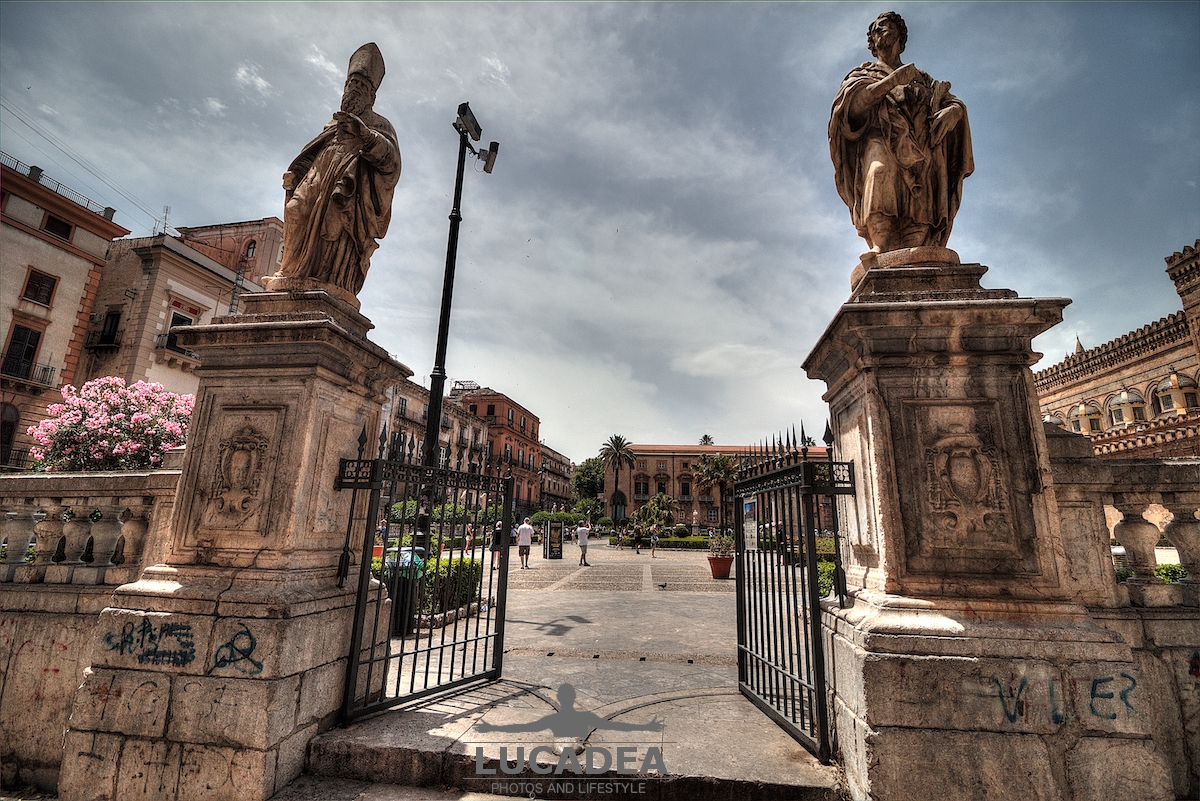
Statues outside Palermo Cathedral

Statue davanti alla Cattedrale di Palermo, fotografate nello spazio esterno del monumento nel centro storico

Statues outside Palermo Cathedral.
During my summer visit to Palermo, I also stopped to photograph some of the details surrounding one of the city’s most recognisable monuments. If you are wondering what to see in Palermo, the cathedral is an obvious place to visit, but the area in front of the building also deserves some attention, especially because of the statues and decorative elements that complete the view of its monumental façade.
I took this photograph myself during that visit, as part of a larger series of images I made around the cathedral. I still had many photographs from Palermo waiting to be published and, as I often do with places that give me several photographic ideas, I preferred to spread them out over time rather than publish everything together. Each image can then tell a slightly different part of the same visit.
The photograph focuses on the statues outside Palermo Cathedral in Sicily. They can easily become secondary details when compared with the enormous façade, towers and architectural complexity of the building itself. Yet they contribute considerably to the appearance of the space in front of the cathedral. I often enjoy looking for precisely these details, because it is easy to concentrate on the main monument and overlook everything around it.
Palermo Cathedral stands in the heart of the historic centre of Palermo, Sicily, Italy, occupying a large area that allows the façade to be seen from several viewpoints. The statues and other decorative features create a visual connection between the cathedral and the surrounding urban space, making the transition between architecture and the city feel more natural.
The history of the cathedral is particularly long and reflects the different cultures and periods that shaped Palermo. The present building began to take shape in the twelfth century under Archbishop Walter Ophamil, and numerous changes were made over the centuries. This layered history is one reason why even a simple photograph of the exterior can reveal several different aspects of the monument.
It is therefore not a building that needs to be photographed only from straight in front. As you change position, different details come into view: statues, columns, arches, decorative elements and sections of the façade that look different depending on where you stand. During that visit I allowed myself to follow these changes, looking for photographs that were not simply another full view of the cathedral.
This image came from that kind of observation. I was not necessarily trying to make the classic photograph of Palermo Cathedral. Instead, I wanted to isolate one of the elements around the exterior that had caught my attention. I like working this way because returning to the same monument from different angles can produce photographs that feel completely different.
If you are exploring what to see around Palermo Cathedral, it is worth looking beyond the main façade. The surrounding space contains architectural and decorative details that can become photographic subjects in their own right. For anyone who enjoys noticing small details while walking, this is one of those places where changing your viewpoint slightly can reveal something new.
What I remember most from that visit is the number of photographs I managed to make without moving very far from the cathedral. I started by photographing the monument as a whole and then gradually moved towards smaller details. This happens to me quite often: once I find an interesting area, I prefer to explore it photographically before moving on.
This photograph also connects naturally with the article I published about the Chapel of Santa Rosalia inside Palermo Cathedral. There I turned the camera towards the interior of the monument, while here I stayed outside and focused on the elements surrounding the façade. They are two different ways of telling the story of the same place.
Looking at this image again, I like the fact that you do not need to know the exact history of every statue to appreciate its role in the composition. The photograph is more about observing the relationship between the figures, the building and the surrounding space than about documenting one precise historical detail.
The cathedral remains the dominant visual reference in this part of Palermo. Its size and architecture give even smaller elements greater importance when they are photographed within its surroundings. That relationship between the monumental building and the details around it is what I wanted to preserve in the image.
I still have several photographs from that summer visit and I will continue to publish them gradually, as I usually do. Some will show more of the cathedral itself, while others will focus on details that might initially seem secondary but were enough to make me stop and take out my camera.
For me, that is also part of what a personal photo blog is about. It is not necessary to publish every photograph from the same place at once. Giving each image its own space allows it to bring back a different moment from the visit and a different way of seeing the same location.

And when you visit a large cathedral, do you also stop to look at the statues and smaller details outside? Add a comment or go to the bottom of the site to read what other visitors have written.

Statues outside Palermo Cathedral, photographed in the open space surrounding the historic monument in Palermo

Photo taken with a Canon EOS RP camera and a Canon EF-S 10-18 lens.

Don’t forget the Cathedral’s official website: cattedrale.palermo.it, which offers a complete virtual tour of the monument.

Click here to see more stunning images of the city:
foto gallery

Add one  comment to this article or read  here what other visitors have written.
 
Adv
 
Disclamer

The rights on images, videos, choruses, text and all other material on the LUCADEA.com website are governed as per  Copyright page.


This page has been viewed 1 times today.
This month it has been viewed 1 times.
In total it has been viewed 3 times.

 

The statues of Palermo Cathedral

Statue decorative della Cattedrale di Palermo vicino al giardino laterale del monumento storico siciliano

The statues of Palermo Cathedral.
Walking around Palermo Cathedral in the historic centre of Palermo, Sicily, I stopped to photograph some of the smaller details that are often overlooked compared with the impressive size of the whole monument.
When people think about Palermo Cathedral, the first images that usually come to mind are the towers, the large structure and the different architectural styles that characterize the building. However, the statues and decorations around the exterior areas are also an important part of the atmosphere of this famous landmark. These figures caught my attention because they complete the view of the cathedral and add another layer of detail to the place.
This photograph comes from my habit of looking beyond the main subject when I visit a location. I often try to capture smaller elements that help remember the experience of being there. In this case, I chose to focus on these statues near the side garden and entrances of the cathedral, details that could easily remain unnoticed while visitors are concentrating on the main façade.
The picture was taken during my visit to Palermo Cathedral, located in Cathedral Square in Palermo, Sicily, Italy. It is one of the most interesting places to see in Palermo and one of the city’s best-known historical landmarks. The building has changed throughout the centuries, combining different architectural influences that reflect the long history of the city.
One of the most curious aspects of Palermo Cathedral is its transformation over time. The monument includes elements from different periods, from the Norman era to later renovations, creating a unique combination of styles that makes it different from many other European churches.
During the same trip I also photographed other corners of Palermo, from historic streets to important buildings, and some of those images are part of the collections dedicated to Sicily on my website. Every small detail helps create a more complete memory of a place.
This photograph is only a small part of Palermo Cathedral, but it represents the pleasure of discovering unexpected details while exploring a famous monument.

Have you ever found an interesting detail while visiting a well-known place? Add a comment or go to the bottom of the site to read what other visitors have written.

Statues near Palermo Cathedral in Sicily showing architectural details of the historic Italian monument

Photo taken with a Canon EOS RP camera and Canon EF-S 10-18 lens.

Click here to see more stunning images of the city:
foto gallery

The Metropolitan Cathedral of the Holy Virgin Mary of the Assumption—known simply as Palermo Cathedral—is the principal Catholic place of worship in the city of Palermo and the seat of the metropolitan archdiocese of the same name.
Since July 3, 2015, it has been a UNESCO World Heritage Site as part of the serial site “Arab-Norman Palermo and the Cathedral Churches of Cefalù and Monreale.”
Read more on Wikipedia

The Danube in the Four Rivers Fountain

Statua del Danubio nella Fontana dei Quattro Fiumi in Piazza Navona a Roma

The Danube in the Four Rivers Fountain.
While walking through the historic center of Rome, I stopped in front of one of the city’s most famous monuments: the Fountain of the Four Rivers. Among the things to see in Rome, this fountain is certainly one of the most recognizable landmarks, a masterpiece of Baroque art that still attracts visitors and photographers from around the world.
For this photograph, I decided to focus on one specific detail: the statue of the Danube. When looking at the fountain as a whole, its impressive scale immediately captures attention, but the individual figures often reveal the deeper meaning behind the artwork. The Danube allows me to explore one of the four great rivers chosen by Bernini to represent the continents known during the seventeenth century.
I was in Rome, Lazio, Italy, and I wanted to capture this detail because it combines art, symbolism, and history in a single sculpture. The Danube represents Europe and is shown close to the papal coat of arms, creating a symbolic connection between the river, the continent, and the Church.
The Fountain of the Four Rivers was created by Gian Lorenzo Bernini in the seventeenth century and stands in the center of Navona Square, one of the most characteristic places in Rome. The four statues represent the Danube for Europe, the Nile for Africa, the Ganges for Asia, and the Rio de la Plata for the Americas. Each figure includes details that describe the culture and geography of the represented region.
A curious detail is that the fountain was built over an ancient Roman basin, while the central obelisk comes from the imperial era and was later included in Bernini’s extraordinary composition.
What I enjoy when photographing famous places is discovering a different perspective. Even a single detail can become the main subject and tell a much larger story than a simple overall view.
On the blog I have shared other photographs from Rome and Italian monuments, often focusing on details that are easy to overlook. Like many of my other images, this shot comes from the pleasure of observing carefully and finding something unexpected.
If you are visiting Rome, take some time to look closely at the Fountain of the Four Rivers in Navona Square, because every statue has its own story.

Have you ever noticed the Danube statue in the Four Rivers Fountain? Add a comment or go to the bottom of the site to read what other visitors have written.

Statua del Danubio nella Fontana dei Quattro Fiumi in Piazza Navona a Roma

Photo taken with a Canon EOS RP camera and Canon RF 24-50 lens.

Click here to see all the photos of Rome:
foto gallery

Here is where the fountain is located:

The Rio de la Plata in the Four Rivers Fountain

La fontana dell Rio della Plata nella Fontana dei Quattro Fiumi a Roma

The Rio de la Plata in the Four Rivers Fountain.
Among the many details of the Four Rivers Fountain in Rome, the Rio de la Plata is one of the sculptures that immediately captures attention because of its dynamic pose and the way Gian Lorenzo Bernini transformed a symbolic figure into something full of movement.
While walking through Piazza Navona in Rome, I wanted to capture this particular detail with my camera, focusing on the representation of the great South American river. This photograph tells the story of a small part of one of Rome’s most famous monuments, an artwork that still fascinates visitors with its complexity and hidden meanings.
The Rio de la Plata in the Four Rivers Fountain represents the American continent and is shown as a strong male figure leaning against a rock, surrounded by elements connected with the lands and resources of the New World. At the feet of the sculpture there is also an armadillo, an animal chosen by Bernini as a geographical reference to South America.
The Four Rivers Fountain is located in Piazza Navona, in the center of Rome, Lazio, Italy, and it is one of the most important masterpieces of Roman Baroque art. Created by Gian Lorenzo Bernini and completed in 1651, the fountain represents the four major rivers of the continents known at that time: the Ganges for Asia, the Nile for Africa, the Danube for Europe and the Rio de la Plata for the Americas.
One interesting detail is the meaning of the river’s name. “Plata” means silver in Spanish and refers to the wealth traditionally associated with the South American regions connected with the river. Bernini used these geographical references to create a composition where nature, history and symbolism come together.
This photograph is part of my personal exploration of the details of the Four Rivers Fountain. I previously shared another image dedicated to the Ganges statue in the same fountain, another example of how each side of this masterpiece has its own story.
I enjoy photographing these details because famous monuments often reveal a different personality when we move closer and focus on a single figure, expression or decorative element.
If you are visiting Rome and looking for interesting details beyond the main view of Piazza Navona, the sculptures of the Four Rivers Fountain are definitely worth observing carefully.

Have you ever stopped to admire the details of the Four Rivers Fountain in Rome, or have you only seen it from a distance? Add a comment or go to the bottom of the site to read what other visitors have written.

Rio de la Plata statue in the Four Rivers Fountain in Rome showing Bernini's Baroque sculpture details

Photo taken with Canon EOS RP and Canon RF 24-50 lens.

Click here to see all the photos of Rome:
foto gallery

Here’s where the fountain is located:

Tradition, which holds Bernini as a rival to his contemporary Borromini, has created the legend according to which the figure representing the Rio de la Plata in the fountain raises his hand toward the church of Sant’Agnese opposite, in a gesture of defense against the building’s imminent collapse. This remains, however, only a legend, as construction of the church of Sant’Agnese in Agone did not begin until later, in 1652.
Continue and learn more at Wikipedia

Ancient marble measures beside Portovenere gate

Le antice vasche in marmo per le misure di grano e vino a Portovenere

Ancient marble measures beside Portovenere gate.
Entering the oldest part of the village, right beside the Borgo Gate, I stopped to look at these small but remarkable pieces of its past. They are ancient marble vessels once used to measure products such as grain and wine, the kind of detail that can easily go unnoticed while walking through Portovenere.
Portovenere in Liguria is one of those places where slowing down is often enough to discover something worth photographing. The Borgo Gate marks the entrance to the historic part of the village and, immediately beside it, these marble measures stand out precisely because they are much less spectacular than the buildings and views usually associated with Portovenere.
I photographed two of the three vessels, concentrating on their shapes and on the texture of the marble. The material itself makes them especially interesting to photograph. They are not simply old containers: they are physical reminders of a time when measuring goods was part of everyday commercial life.
When looking for what to see in Portovenere, most visitors naturally focus on the harbour, the colourful houses and the famous Church of Saint Peter. I often find myself looking at smaller details instead, particularly when an object gives me a way to imagine how the village worked in the past.
These marble vessels are interesting because their purpose was extremely practical. Before modern measurement systems became standard, goods in many communities were measured using containers and units established by local customs. Objects such as these therefore played a role in making commercial exchanges more consistent and easier to control.
Their position beside the Borgo Gate also makes sense when thinking about the everyday life of the old village. People, goods and products passed through this entrance, and places connected with trade naturally needed ways of measuring what was being bought and sold. It is a small historical curiosity, but for me it gives the photograph a much stronger meaning.
What I like about details like these is that they shift the attention away from the most obvious monuments. Portovenere is famous for its dramatic coastline and historic architecture, but the smaller objects found along its streets can sometimes tell a more intimate story.
This photograph came from exactly that kind of observation. I was not looking for the most famous view or another classic postcard image. I simply noticed these old marble measures beside the gate and decided they deserved a place in my photographic record of the village.
That is also what connects this image with other photographs I have shared on the blog from Ligurian historic centres. From the narrow alleys of Genoa to the steep creuze of coastal villages, I often find myself photographing details that might otherwise be passed without a second glance.
For anyone wondering what to see in Portovenere beyond the best-known landmarks, details like these are part of the pleasure of walking through the old village. They do not demand much time, but they can add another layer to the experience.

Would you have noticed these ancient marble measures while passing through the Borgo Gate? Add a comment or go to the bottom of the site to read what other visitors have written.

Ancient marble measures for grain and wine beside the Borgo Gate in Portovenere, Liguria

Ancient marble measures for grain and wine beside the Borgo Gate in Portovenere, Liguria

Photos taken with Canon EOS RP and Canon RF 24-50 lens.

Click here to see all the photos of the village:
foto gallery

Where to find them:

The Beautiful San Lorenzo Cathedral in Genoa

La bellissima cattedrale di San Lorenzo a Genova

The Beautiful San Lorenzo Cathedral in Genoa.
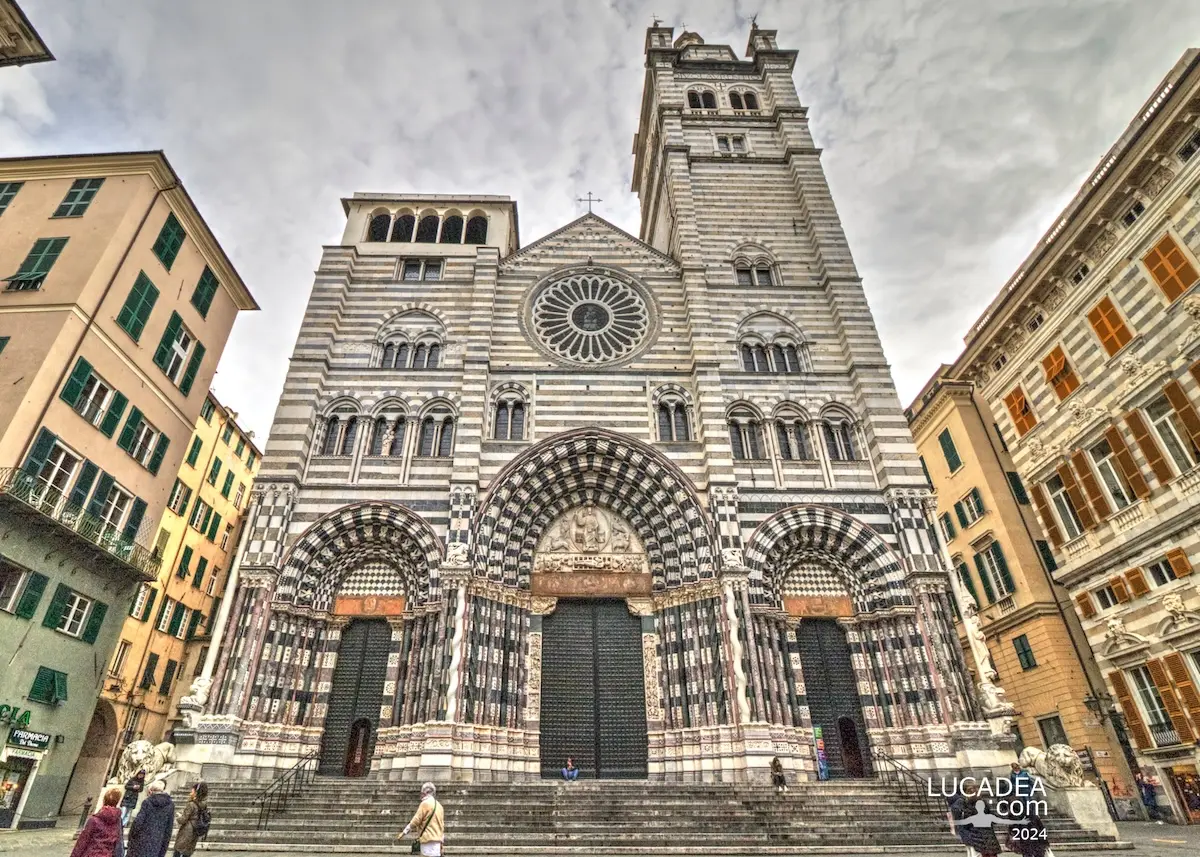
San Lorenzo Cathedral is one of the landmarks I always enjoy seeing whenever I walk through the historic centre of Genoa, Italy. When I am in the city centre, I make a point of passing in front of this beautiful cathedral so I can admire its architecture and appreciate its many details. Even though I have seen it countless times, it never fails to catch my attention.
Located in the heart of Genoa, San Lorenzo Cathedral is an impressive presence among the historic streets and buildings of the city. Its façade is particularly distinctive, with its striking combination of black and white marble that makes it instantly recognisable. It is one of those architectural features that seems to reveal something new every time I stop to look at it.
I have already dedicated several photographs and posts to this magnificent church. My photo collection includes different views taken on various occasions, each one offering a slightly different perspective. Sometimes it is the overall appearance of the building that attracts me; on other occasions, I find myself concentrating on a particular architectural detail. The light, the viewpoint and the way I frame the subject all influence the final image.
The façade is undoubtedly one of the most fascinating parts of the cathedral to photograph. Its decorative elements, columns, arches and contrasting materials create a rich combination of shapes and patterns. I always try to find a composition that conveys something of the building’s grandeur while also drawing attention to details that might otherwise go unnoticed by someone simply walking past.
Another aspect I appreciate is the way the cathedral fits into the surrounding urban landscape. The narrow streets and historic buildings of Genoa provide a remarkable setting for this important religious monument. It is a familiar landmark for local residents and an essential stop for many visitors exploring the city. Even a short pause in front of the cathedral offers an opportunity to appreciate the architecture and take in the atmosphere of this part of the old town.
For me, photographing San Lorenzo Cathedral is a pleasure that never really gets old. I already have several images of it, but whenever I return to the centre of Genoa, I find myself wanting to take another photograph. There is always a different angle to explore, a detail worth highlighting or simply another opportunity to capture the beauty of a place I particularly admire.
With this photograph, I wanted to add another view to my collection dedicated to the cathedral. I am sure that the next time I walk through the historic centre, I will probably stop here again, camera in hand. Some places never lose their appeal, and San Lorenzo Cathedral is certainly one of them.

Have you ever visited San Lorenzo Cathedral in Genoa? Which part of its architecture impressed you the most? Add a comment or go to the bottom of the site to read what other visitors have written.

The façade of San Lorenzo Cathedral in Genoa, featuring its distinctive black and white marble and ornate architectural details

Photo taken with Canon EOS RP and lens Canon EF-S 10-18.

If you are interested, this is the official website that updates you on Catholic initiatives and liturgies: chiesadigenova.it.

Here are all the photos I took on a previous visit:
foto gallery

Here’s where I took the photo:

🏠
  • Italiano