
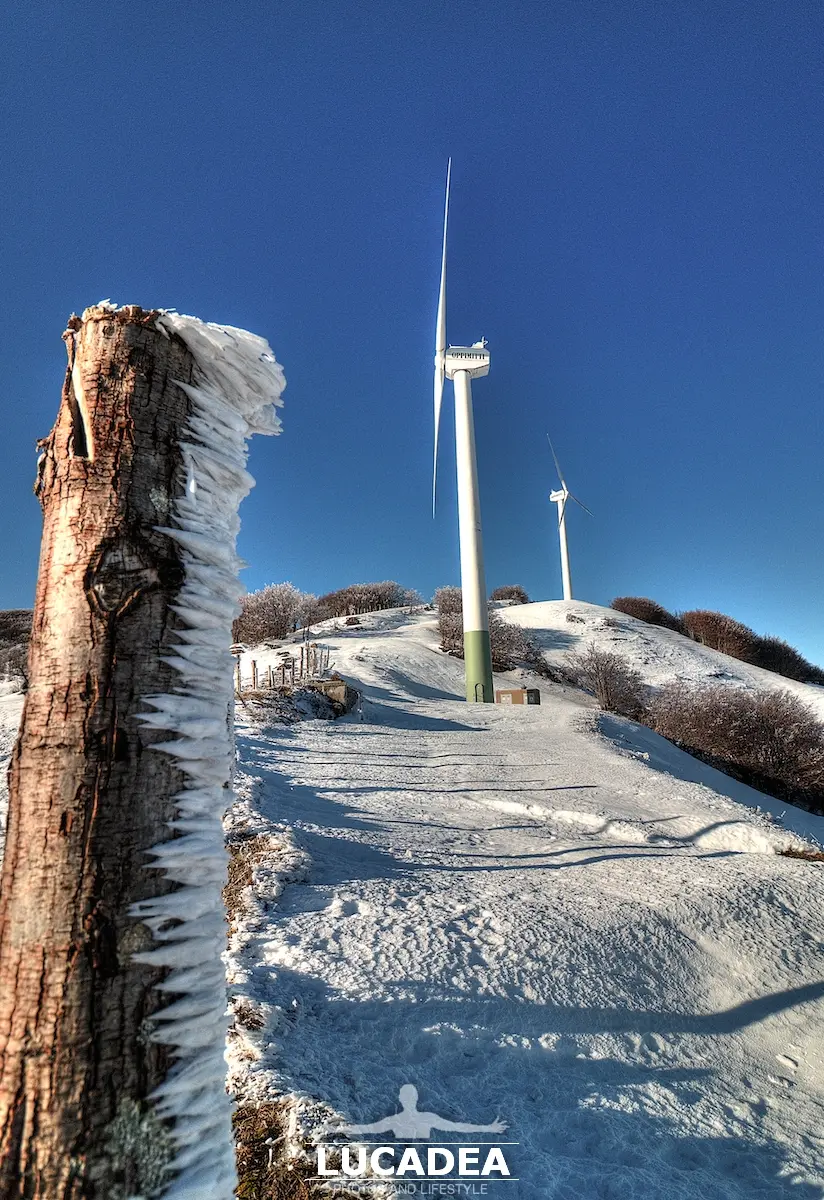
Frozen Snow at Centocroci Pass

La neve ghiacciata rimasta a Centocroci

Frozen Snow at Centocroci Pass.
I can finally start sharing the photographs from my little trip to Centocroci Pass a few weeks ago. After showing you the wonderful snowy panorama I captured with my drone, I will be posting more pictures taken from the ground as well. Today, though, I wanted to begin with a different kind of image: a small winter detail that caught my eye during the outing.
When visiting the mountains in winter, it is easy to concentrate on the wide views, the snow-covered slopes and the distant peaks. These are often the scenes that first attract our attention, and they certainly make wonderful photographs. However, I also enjoy looking for smaller subjects that reveal something about the weather and the conditions of the landscape.
This time, I noticed a pole with some frozen snow still clinging to it. The snow had survived on the shaded side, where it was protected from direct sunlight. It was a simple detail, but one that seemed worth photographing. The contrast between the icy texture and the surrounding landscape made the subject more interesting than it might appear at first glance.
I like these moments during a photographic walk because they encourage me to slow down and look more carefully. Sometimes the best picture is not the grand mountain view but something modest that would be easy to overlook while admiring the scenery. Ice can create fascinating shapes and textures, and even a small patch of frozen snow can tell a story about the cold temperatures and the changing exposure to sunlight.
Another feature I particularly like in this photograph is the background: the wind turbines standing against the mountain landscape. They add a modern element to the scene and create an interesting contrast with the frozen snow in the foreground. The image brings together two very different details, one shaped by winter weather and the other associated with wind energy.
Centocroci Pass lies in the northern Apennines, along the route connecting Liguria with the Parma area of Emilia-Romagna. It is a place where the landscape changes with the seasons, offering different views depending on the weather and the time of year. On a snowy day, even an ordinary roadside object can become an appealing photographic subject.
I still have more pictures from this trip to share, including other views of the snowy landscape. For now, I am happy to start with this little detail, which reminds me that photography is often about noticing what is right in front of us.

When you go to the mountains in winter, do you enjoy photographing small details in the snow and ice, or do you prefer wide panoramic views? Add an comment or go to the bottom of the site to read what other visitors have written.

Frozen snow clinging to a shaded pole at Centocroci Pass, with wind turbines rising in the winter mountain landscape

Photos taken with a Canon EOS M100 camera and Canon EF-S 10-18 lens.

I’ll also leave you a nice video of the snowy pass:

Video realizzato con drone DJI Mavic Mini.

Where is the Pass:

Add one  comment to this article or read  here what other visitors have written.
 
Adv
 
Disclamer

The rights on images, videos, choruses, text and all other material on the LUCADEA.com website are governed as per  Copyright page.


This page has been viewed 0 times today.
This month it has been viewed 0 times.
In total it has been viewed 0 times.
 

The Seven Sisters Waterfall in Geirangerfjord

The Seven Sisters Waterfall in Geirangerfjord.
Some places are so beautiful that one photograph never feels like enough. I believe I have already shared a picture of the Seven Sisters waterfall on Lucadea.com, but looking back through my travel photographs, I felt this remarkable Norwegian landmark deserved another post. The waterfall is one of the best-known sights in Geirangerfjord, a dramatic landscape of steep mountains, deep blue-green water and cascading streams.
Geirangerfjord lies in western Norway and is famous for its spectacular scenery. High cliffs rise directly from the water, green slopes cover parts of the mountainsides, and waterfalls appear along the rocky walls. The combination creates an extraordinary natural setting, which is one of the reasons the fjord is included on the UNESCO World Heritage List. Even in photographs, it is easy to understand why so many travellers consider this area a highlight of Norway.
The Seven Sisters are especially distinctive because the water descends in seven separate streams down the mountainside. Depending on the amount of water flowing over the rocks, the individual falls can appear more or less clearly defined. The waterfall is often at its most impressive during the spring snowmelt and early summer, although rainfall and seasonal conditions also influence how much water reaches the fjord.
One of the most memorable ways to admire the falls is from a boat. Viewed from the water, the scale of the surrounding cliffs becomes much more apparent, and the waterfall seems to emerge directly from the mountain above the fjord. As the boat moves along the water, the view changes constantly, offering different angles of the rocky slopes and the streams descending towards the shoreline. It is an excellent opportunity for photography, although it can be difficult to decide where to point the camera first.
The Seven Sisters are also associated with a local legend. On the opposite side of the fjord is another waterfall known as the Suitor. According to the traditional story, the Suitor tries unsuccessfully to court the seven sisters. The tale gives the landscape a touch of folklore and connects the names of these neighbouring waterfalls in a memorable way.
For anyone who enjoys nature and travel photography, Geirangerfjord is a place that invites you to take picture after picture. The changing light, the steep mountain walls and the movement of the water make every view slightly different. This is also why I enjoy revisiting places through my photographs. Even when I have already written about a destination, another image can bring back the atmosphere of the trip and reveal a detail worth sharing.
If you are planning a visit, a sightseeing cruise is one of the best ways to experience the waterfall from the fjord itself. The surrounding landscape is impressive throughout the journey, with historic mountain farms and other famous waterfalls adding to the scenery.

Have you ever seen the Seven Sisters waterfall in person, or would you like to explore Geirangerfjord on a boat trip? Add an comment or go to the bottom of the site to read what other visitors have written.

For more details, visit the official Norwegian tourism page about the Seven Sisters waterfall.

The Seven Sisters waterfall streams down a steep mountainside into Geirangerfjord, surrounded by Norway's dramatic fjord scenery

Photo taken with iPhone 5.

Add one  comment to this article or read  here what other visitors have written.
 
Adv
 
Disclamer

The rights on images, videos, choruses, text and all other material on the LUCADEA.com website are governed as per  Copyright page.


This page has been viewed 0 times today.
This month it has been viewed 0 times.
In total it has been viewed 0 times.
 

Pink Flower Petals on the Ground

Petali rosa a terra

Pink Flower Petals on the Ground.
Sometimes a photograph catches my attention because of a simple detail rather than an impressive landscape or an unusual subject. This picture, taken quite some time ago, shows a scattering of pink flower petals covering the edge of a path. I no longer remember which plant they came from, but I still like the way they looked against the rough ground.
The petals create a colourful trail along the side of the path, spreading across the gravel and collecting around small stones, patches of moss and fallen twigs. Their bright pink colour stands out against the muted grey of the ground and the fresh green of the surrounding vegetation. Nothing about the scene looks arranged or carefully planned. It is simply a small moment in nature that caught my eye as I passed by.
What I find most appealing is the way the petals are distributed across the photograph. They are densely gathered in the foreground, forming an almost continuous carpet, then become more scattered as the path leads towards the upper part of the image. This natural arrangement creates a sense of depth and gently guides the eye through the scene.
I cannot confidently identify the flowers from this photograph alone, and I would rather leave the plant unnamed than guess. The exact species was not what mattered to me when I took the picture. I was more interested in the colours, the textures and the contrast between the delicate petals and the uneven surface beneath them.
This is one of the things I enjoy about photography: ordinary places can reveal interesting compositions if we take a moment to look more carefully. A path is usually something we focus on while walking towards a destination, not something we stop to examine. Yet even along its edge, there may be an arrangement of colours and shapes that deserves attention.
The grass, little branches, stones and moss all contribute to the photograph. They make the scene feel natural and slightly untidy, as it would appear outdoors rather than in a carefully arranged still life. The petals seem to have fallen where the wind or the weather carried them, creating a temporary pattern that might soon disappear.
That fleeting quality is part of the reason I like keeping photographs of small details. Flower petals may remain on the ground for only a short time before rain or wind scatters them further, but an image preserves the moment and allows me to look at it again years later.

When you are out walking, do you ever stop to photograph fallen petals and other small details, or do you prefer to capture flowers while they are still blooming? Add an comment or go to the bottom of the site to read what other visitors have written.

Pink flower petals scattered along a gravel path, surrounded by wild grass, small stones, moss and fallen twigs

Photo taken with Canon EOS M100 camera and Canon EF-S 10-18 lens.

Riva Trigoso from Montepagano Hill

La vista di Riva Trigoso da Montepagano

Riva Trigoso from Montepagano Hill.
Some of the most rewarding views are found in places we have known for years without ever really exploring them. I discovered the Montepagano trail behind Riva Trigoso only recently, and it turned out to be a lovely way to see this part of the Ligurian coast from a completely different perspective.
Riva Trigoso is part of the municipality of Sestri Levante, in Liguria, northwestern Italy. Many visitors know the area for its seaside setting, beaches and small harbour, but the hills rising just behind the town offer another experience: quiet paths, green surroundings and viewpoints overlooking the rooftops and the sea.
The walk begins behind the San Bartolomeo cemetery, where the trail starts climbing into the hills. As the path gains height, the atmosphere gradually changes. The sounds and activity of the town feel more distant, while the surrounding vegetation and the landscape become the main focus. It is a pleasant reminder that you do not always need to travel far to find a new place to explore.
Montepagano and its park make this route particularly appealing for anyone who enjoys walking outdoors. The climb leads towards a viewpoint at the top, where the landscape opens up over Riva Trigoso. From there, the town can be admired as a whole, with its buildings set between the green hills and the Ligurian Sea. Seeing a familiar place from above reveals details that are easy to miss from street level, and the coastline takes on a different shape when viewed from the hillside.
One of the things I enjoy most about discovering trails like this is the contrast between the quiet of the countryside and the lively atmosphere of a coastal town. Within a relatively short walk, the scenery changes from streets and houses to vegetation, slopes and open views. It is the kind of outing that can easily become a favourite for a free afternoon.
The route can continue downhill towards the waterfall area of the Petronio stream, making it possible to experience different parts of the landscape along the way. Trail conditions can vary, so it is sensible to check the route before setting off, particularly after heavy rain.
For anyone searching for scenic walks near Riva Trigoso or panoramic viewpoints around Sestri Levante, Montepagano is a place worth considering. It has encouraged me to look beyond the familiar seaside scenes and appreciate the hills that form such an important part of Liguria’s character. I would like to return at a different time of day and see how the changing light transforms the view.

Have you walked the Montepagano trail, or would you like to discover this viewpoint above Riva Trigoso? Add an comment or go to the bottom of the site to read what other visitors have written.

Panoramic view of Riva Trigoso from the Montepagano viewpoint, reached by a hillside trail above the Ligurian coast

Photo taken with a Canon EOS M100 camera and a Tamron 16-300 lens.

A Beautiful Yellow Asiatic Lily

Un bellissimo giglio asiatico giallo

A Beautiful Yellow Asiatic Lily.
Another flower photograph, this time featuring a beautiful yellow Asiatic lily. Its bright petals immediately catch the eye, bringing a touch of sunshine and colour to the scene. I enjoy photographing flowers because they offer so many interesting details to discover, from the delicate shape of each petal to the subtle variations in colour that make every bloom unique.
Yellow is a cheerful, luminous colour, and it gives this flower a particularly striking appearance. The open petals spread out gracefully, creating an elegant shape that stands out against the surrounding green foliage. Even a single flower can become a wonderful photographic subject when its natural form and colour are allowed to take centre stage.
I believe this may be an Asiatic lily, although I cannot be completely certain of the exact variety from the description alone. Asiatic lilies are popular ornamental plants, known for their colourful flowers and their wide range of shades. They can bloom in yellow, orange, red, pink and other attractive colours, making them a favourite choice for gardens and flower displays.
When I take photographs of flowers, I like to pay attention to the way light falls across the petals. A slight change in angle can reveal new details, emphasise the texture or make the colour appear even more intense. Flower photography does not always require complicated equipment or an elaborate setting. Sometimes, the most effective image is simply one that captures the flower as it is, with its natural beauty clearly visible.
Flowers also remind me how quickly nature changes. A bud gradually opens, the petals reach their fullest colour, and eventually the bloom begins to fade. Photographing a flower preserves a small moment in that cycle, allowing us to enjoy it again long after the flowering season has passed.
I like including these close-up photographs among my pictures of landscapes, towns and travel destinations. They offer a different perspective and encourage me to notice the beauty of ordinary things. A colourful flower can be just as rewarding to photograph as a famous landmark, especially when its shape and colour create such a pleasing composition.
If you enjoy gardening, yellow lilies can also provide inspiration when choosing plants for a colourful flower bed or a garden display. Their vivid blooms bring brightness to the surroundings and combine beautifully with green leaves and other seasonal flowers.

Do you enjoy photographing flowers as much as I do, and which colour do you find most beautiful in a garden? Add an comment or go to the bottom of the site to read what other visitors have written.

Close-up photograph of a beautiful yellow Asiatic lily in bloom, showing its bright petals and delicate natural details

Photo taken with Canon EOS RP camera and Tamron 16-300 lens.

The nursery I visited was: Vivai Gaggero in Carasco.

Water Reflections on a Green Leaf

Riflessi d'acqua su una foglia verde

Water Reflections on a Green Leaf.
Sometimes the simplest subjects offer the most rewarding photographic opportunities. This intensely green leaf, dotted with clear water droplets, caught my attention because of the beautiful contrast between its rich colour and the sparkling reflections on its surface. What might normally go unnoticed becomes fascinating when we take a closer look.
The droplets appear like tiny glass beads resting delicately on the leaf. Each one catches the light in its own way, creating bright highlights against the deep green background. Some reflect fragments of the surrounding environment, turning into miniature mirrors that seem to hold a small world inside them. Their rounded shapes also add a sense of depth and texture to the photograph.
The leaf itself has plenty of details worth exploring. Its fine veins form a delicate network of lines, guiding the eye across the surface and revealing the structure of the plant. The green tones look rich and vibrant, while the water adds a contrasting shine that makes the whole scene feel fresh and alive. Together, these natural elements create a simple composition that is both visually interesting and calming.
I enjoy this kind of nature photography because it encourages me to slow down and pay attention to things that are easy to overlook. A dramatic landscape or a famous landmark can certainly make a wonderful subject, but a small detail found close to home can be just as rewarding. Sometimes, all it takes is a little patience and a willingness to look at familiar things from a different perspective.
Water droplets are especially interesting because their appearance changes with the light and the viewing angle. A tiny highlight can make one droplet sparkle, while another may reveal a faint reflection of the world around it. The leaf’s natural texture provides the perfect setting for these details, creating a contrast between the softness of the green surface and the brilliance of the water.
There is also something temporary about this scene. When the sun comes out or the wind begins to blow, the droplets may soon disappear through evaporation. The photograph preserves that brief moment, when water and light come together to create a small natural spectacle.
I like including these close-up observations alongside my photographs of landscapes, towns and travel destinations. They remind me that beauty is not always found in distant places or grand attractions. Sometimes it is right in front of us, waiting to be noticed.

Have you ever stopped to admire water droplets on a leaf and noticed how beautifully they reflect the light? Add an comment or go to the bottom of the site to read what other visitors have written.

Water droplets resting on a vivid green leaf, highlighting its natural veins, sparkling reflections and delicate surface texture

Photo taken with Canon EOS RP and Tamron 16-300.

🏠
  • Italiano