Da Nang, stone rooster at Linh Ung Pagoda

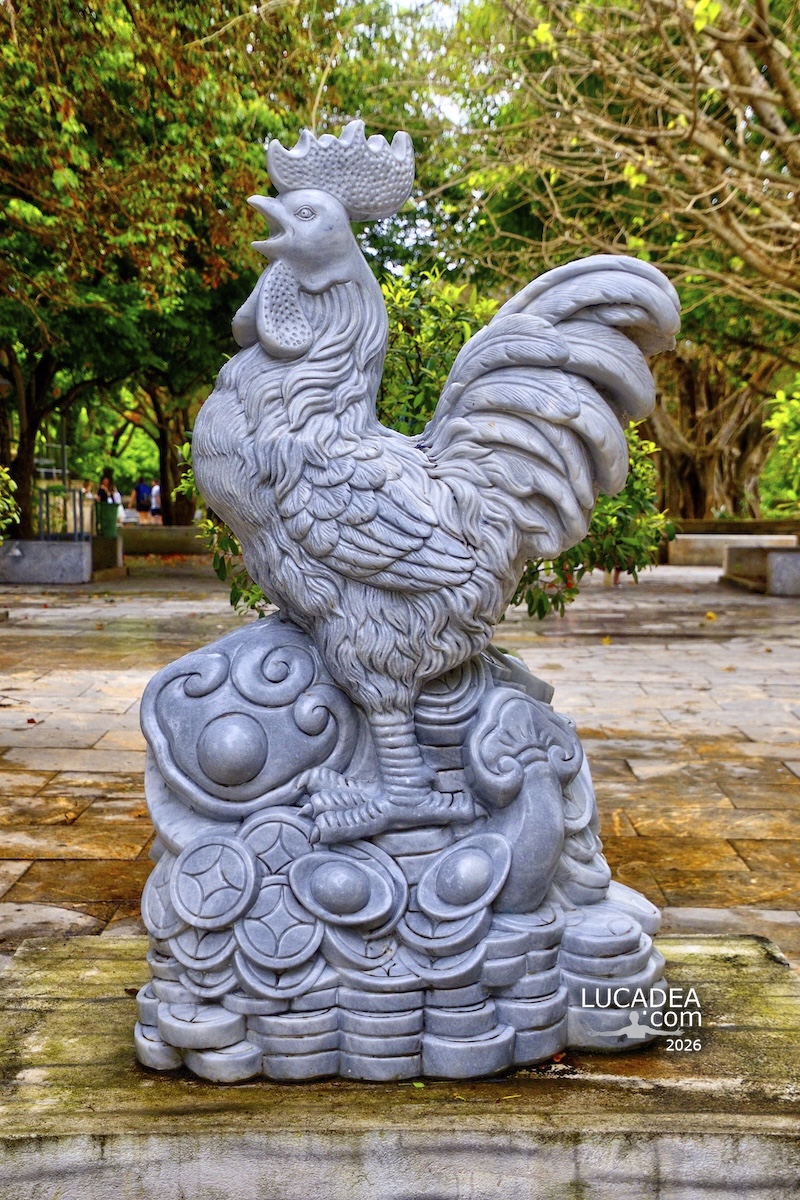
Statua del gallo a Linh Ung Pagoda a Da Nang in Vietnam con base decorata e contesto naturale del tempio buddhista

Da Nang, stone rooster at Linh Ung Pagoda.
The stone rooster at Linh Ung Pagoda Da Nang immediately stands out as a quiet but powerful detail within the temple complex, and the stone rooster at Linh Ung Pagoda Da Nang feels like one of those small elements that carries symbolic weight beyond its size. The stone rooster at Linh Ung Pagoda Da Nang sits on an ornate base, surrounded by greenery and the calm atmosphere of the sacred site.
I am in Da Nang, Vietnam, inside the Linh Ung Pagoda area, a place where religious architecture blends naturally with landscape and open space. The stone rooster at Linh Ung Pagoda Da Nang appears almost unexpectedly among the larger structures, yet it contributes to the visual and symbolic rhythm of the temple.
In Vietnamese and broader Asian tradition, the rooster is often associated with vigilance, protection, and the transition between darkness and light. This makes its presence in a spiritual context particularly meaningful, even when it is not the central monument of the site.
If you are visiting Da Nang, Vietnam, Linh Ung Pagoda is widely known for its monumental statues and panoramic views over the coastline, but details like this stone rooster reveal a more intimate layer of the place, where craftsmanship and symbolism coexist in quieter forms.
I have already mentioned similar observations in other travel stories on this site about Southeast Asian temples, where small sculptural elements often carry as much meaning as the main structures.
Standing here for a moment, I watch how the stone rooster at Linh Ung Pagoda Da Nang interacts with the surrounding space, not by dominating it, but by completing it in a subtle way. It makes me think about how many visitors might pass without noticing it at all.

Have you ever discovered a place’s meaning through a single small detail rather than its main landmark? Add a comment or go to the bottom of the site to read what other visitors have written.
Statua del gallo a Linh Ung Pagoda a Da Nang in Vietnam con base decorata e contesto naturale del tempio buddhista

Photo taken with Canon EOS R50 V and Tamron 16-300 lens.

To see all the photos I took in the pagoda, click here:
foto gallery

Where is the pagoda located:

Add one  comment to this article or read  here what other visitors have written.
 
Adv
 
Disclamer

The rights on images, videos, choruses, text and all other material on the LUCADEA.com website are governed as per  Copyright page.


This page has been viewed 0 times today.
This month it has been viewed 0 times.
In total it has been viewed 1 times.
 

The great white Buddha at Ong Nui temple

Grande statua bianca del Buddha al tempio Ong Nui in Vietnam, con lunga scalinata centrale e vegetazione ai lati

The great white Buddha at Ong Nui temple.
The staircase stretches upward in a straight, almost hypnotic line, pulling my eyes toward the massive Buddha sitting quietly above everything else. The Buddha seems to merge with the pale sky, its white surface dissolving into the soft light, creating a calm yet striking presence that immediately anchors the scene.
As I follow the steps visually, I begin to notice the human scale hidden within the composition. Tiny figures move along the stairs, emphasizing just how immense the Buddha truly is. The structure feels deliberate, designed to slow down both the body and the gaze. The Buddha sits in a meditative pose, its robe carved with flowing lines that appear soft despite the solid material. There is no motion, yet it feels deeply alive.
Ong Nui temple, also known as Linh Phong Pagoda, is home to one of the largest seated Buddha statues in Vietnam, and that fact becomes almost obvious just by looking at it. The size is not overwhelming in a chaotic way, but rather grounding, as if everything here is meant to guide visitors toward stillness and reflection.
The rocky slopes on both sides frame the staircase naturally, while the green vegetation breaks the dominance of white and adds texture to the scene. This balance between nature and structure gives the image a sense of harmony. And above it all, the Buddha remains unchanged, a fixed point that contrasts with the subtle movement of people below.
There is an implied silence in this place. Even without hearing anything, I can almost feel the quiet atmosphere surrounding the temple. The Buddha does not demand attention; it simply exists, and that is enough to shift the way you perceive the space around you.
Looking back at this moment, I wonder if the real experience was the physical climb or that instant when I lifted my eyes and truly understood the scale of the Buddha.

Have you ever stood in front of something so vast that it made you feel small in a comforting way? Add a comment or go to the bottom of the site to read what other visitors have written.

Photos taken with Canon EOS R50 V and Tamron 16-300 lens.

To see all the photos of the complex, click here:
foto gallery

The great white Buddha of Ong Nui temple – Le grand Bouddha blanc du temple Ong Nui – El gran Buda blanco del templo Ong Nui – O grande Buda branco do templo Ong Nui – Der große weiße Buddha des Ong Nui Tempels – Tượng Phật trắng lớn tại chùa Ong Nui – 翁努寺的巨大白色佛像 – オングヌイ寺の大きな白い仏像

The text of this post was written with the help of ChatGPT, a language model from OpenAI.

Add one  comment to this article or read  here what other visitors have written.
 
Adv
 
Disclamer

The rights on images, videos, choruses, text and all other material on the LUCADEA.com website are governed as per  Copyright page.


This page has been viewed 1 times today.
This month it has been viewed 1 times.
In total it has been viewed 1 times.
 

Thien Mu Pagoda and Hue’s Seven-Tiered Tower

La torre a sette piani della Thien Mu Pagoda a Hue si erge sopra il complesso buddhista con vegetazione e atmosfera tranquilla sul fiume dei Profumi

Thien Mu Pagoda and Hue’s Seven-Tiered Tower.
I approach the banks of the Perfume River with a clear thought in mind: Thien Mu Pagoda is not a place to be seen quickly, and especially Thien Mu Pagoda feels like it breathes together with the landscape around it. The first impression is never only visual, but almost physical, as if the air itself changes density while the seven-storey tower of Thien Mu Pagoda rises in front of me.
The structure emerges with a strong vertical presence, and the seven-storey tower of Thien Mu Pagoda immediately becomes the focal point guiding my gaze. I walk slowly, without a precise direction, letting the architectural lines lead me instead. The surface of the complex is never uniform: there are corners, openings, passages that suddenly appear, and within all this Thien Mu Pagoda maintains a quiet and steady calm. It is interesting to know that this tower, called Phuoc Duyen, is one of the most recognizable symbols of Hue and was built in the 19th century to honor the Buddhist tradition of the city.
I stop for a few minutes at the base of the seven-storey tower of Thien Mu Pagoda, watching how its octagonal shape seems to interact with the surrounding space. It is not just an architectural element, but a presence that seems to hold time and memory. Around it, silence is broken only by distant small sounds, and this makes Thien Mu Pagoda even more intense in perception.
As I continue exploring the complex, I am struck by the simplicity of the contrast between vegetation and the tower’s lines. Nothing feels excessive; everything seems naturally balanced, almost spontaneous. Thien Mu Pagoda does not impose itself, it accompanies you instead. And this is exactly what makes it so memorable.
A small curiosity: the seven-storey tower is often considered the unofficial symbol of Hue because it represents the city’s historical and spiritual continuity, visible from afar along the river and used for centuries as a landmark for those arriving by boat.

As I stand there a little longer, I wonder how much a place can change depending on a single iconic structure. And you, what would you notice first when arriving at Thien Mu Pagoda? Add a comment or go to the bottom of the site to read what other visitors have written.

Photos taken with Canon EOS RP camera and Tamron 16-300 lens.

To see all the photos of the pagoda, click here:
foto gallery

La Thien Mu Pagoda e la torre a sette piani di Hue – Thien Mu Pagoda and the seven-storey tower of Hue – La pagode Thien Mu et la tour à sept étages de Hué – La pagoda Thien Mu y la torre de siete pisos de Hue – A Pagoda Thien Mu e a torre de sete andares de Hue – Die Thien Mu Pagode und der siebenstöckige Turm von Huế – Tháp bảy tầng của chùa Thiên Mụ ở Huế – フエのティエンムー寺と七層の塔 – 顺化天姥寺与七层塔 – フエのティエンムー寺と七層の塔

The text of this post was written with the help of ChatGPT, a language model from OpenAI.

The grand staircase of Linh Ung Pagoda in Da Nang

Scalinata monumentale della Linh Ung Pagoda a Da Nang con visitatori che salgono verso l’ingresso decorato del tempio

The grand staircase of Linh Ung Pagoda in Da Nang.
Climbing the steps of Linh Ung Pagoda, I found myself drawn into a slow and steady rhythm, shaped by footsteps, brief pauses, and silent exchanges between people sharing the same path. The staircase stretches upward in a way that feels almost endless, yet it never becomes overwhelming, as if it naturally guides you without asking for effort.
I stopped several times along the way, not just to catch my breath but to observe how the scene unfolds gradually. The stone details along the sides, the subtle decorations, and then, little by little, the temple gate rising at the top. Linh Ung Pagoda reveals itself step by step, never all at once.
What stood out to me was how people interacted with the space. Some walked slowly, others paused halfway, and a few turned back just to capture a different angle. There was no fixed pace, just a shared understanding of the moment. While taking photos, I tried to respect that flow, letting movement become part of the composition rather than interrupting it.
As I moved higher, the entrance of Linh Ung Pagoda became more imposing. The structure’s lines, the soft but defined colors, and the feeling of crossing into something different. It didn’t feel like just an architectural feature, but more like a transition point, something that quietly separates one space from another.
I later learned that many pagodas in Vietnam are designed with elevated and scenic entrances to create a symbolic journey, marking a gradual transition from the outside world to a more spiritual space. Here, that idea feels very real, but also tangible and accessible.
Looking back at the photo, I realize that the staircase itself is the true subject, even more than the gate at the top. It leads the eye and tells the story of the place.

Do you enjoy places that reveal themselves slowly as you move through them? Add a comment or go to the bottom of the site to read what other visitors have written.

Scalinata monumentale della Linh Ung Pagoda a Da Nang con visitatori che salgono verso l’ingresso decorato del tempio

Photo taken with Canon EOS RP and Tamron 16-300 lens.

To see all the photos I took in the pagoda, click here:
foto gallery

Where is the pagoda located:

Ba Na Hills in Vietnam and its wonders

Ba Na Hills e le sue meraviglie

Ba Na Hills in Vietnam and its wonders.
Not far from Da Nang is this tourist attraction that is not just the Golden Bridge.
During my visit, I had the pleasure of seeing many of the attractions available to visitors: at the bottom there is the complex that welcomes tourists and from which the cable cars depart for the summit. Then, as the cable car approaches the terminal, you can glimpse the bridge supported by stone hands (the famous Golden Bridge). Then, between one pagoda and another, you arrive at the French Village: a citadel that seems to be in Europe and not in Vietnam.
A spectacle!

Do you know Vietnam?
Add a comment or go to the bottom of the site to read what other visitors have written.

Ba Na Hills e le sue meraviglie

Ba Na Hills e le sue meraviglie

Ba Na Hills e le sue meraviglie

Ba Na Hills e le sue meraviglie

Ba Na Hills e le sue meraviglie

Photos taken with a Canon EOS M100 camera and a Tamron 16-300 lens.

Of course, being a tourist attraction, there’s also an official website: banahills.sunworld.vn.

Click here to see all the photos of the entire complex:
photo gallery

Where the tourist complex is located:

The tourist resort of Ba Na Hills in Vietnam and its wonders – La station touristique de Ba Na Hills au Vietnam et ses merveilles – El complejo turístico de Ba Na Hills en Vietnam y sus maravillas – A estância turística de Ba Na Hills no Vietnã e suas maravilhas – Der Touristenort Ba Na Hills in Vietnam und seine Wunder – Khu du lịch Bà Nà Hills ở Việt Nam và những điều kỳ thú – 越南巴拿山旅游胜地及其奇观 – ベトナムの観光地バナヒルズとその素晴らしさ

The pagoda on a pylon in Hanoi

La pagoda su un pilone ad Hanoi

The Pagoda on a Pylon in Hanoi.
One of the most famous pagodas in all of Vietnam, not for its size but for the fact that it stands atop a single column.
It’s truly unique and for this reason it’s often visited.
It’s also close to the Ho Chi Minh Mausoleum, where his remains are kept, and his museum.
A must-see when visiting the Vietnamese capital.

Do you know Vietnam? Add a comment or go to the bottom of the site to read what other visitors have written.

La pagoda su un pilone ad Hanoi

La pagoda su un pilone ad Hanoi

Photos taken with Canon EOS M100 and Tamron 16-300 lens.

Click here to see all the photos of the city:
foto gallery

Here is where this monument is located:

The pagoda on a pylon in Hanoi – La pagode sur un pylône à Hanoï – La pagoda en un pilón en Hanoi – O pagode em um pilão em Hanói – Die Pagode auf einem Pylon in Hanoi – Chùa trên một cột tháp ở Hà Nội – 河内塔上的宝塔 – ハノイのパイロンの塔

The beautiful Bai Dinh Temple in Vietnam

Ninh Binh: Bai Dinh Pagoda

The splendid Bai Dinh Temple in Vietnam.
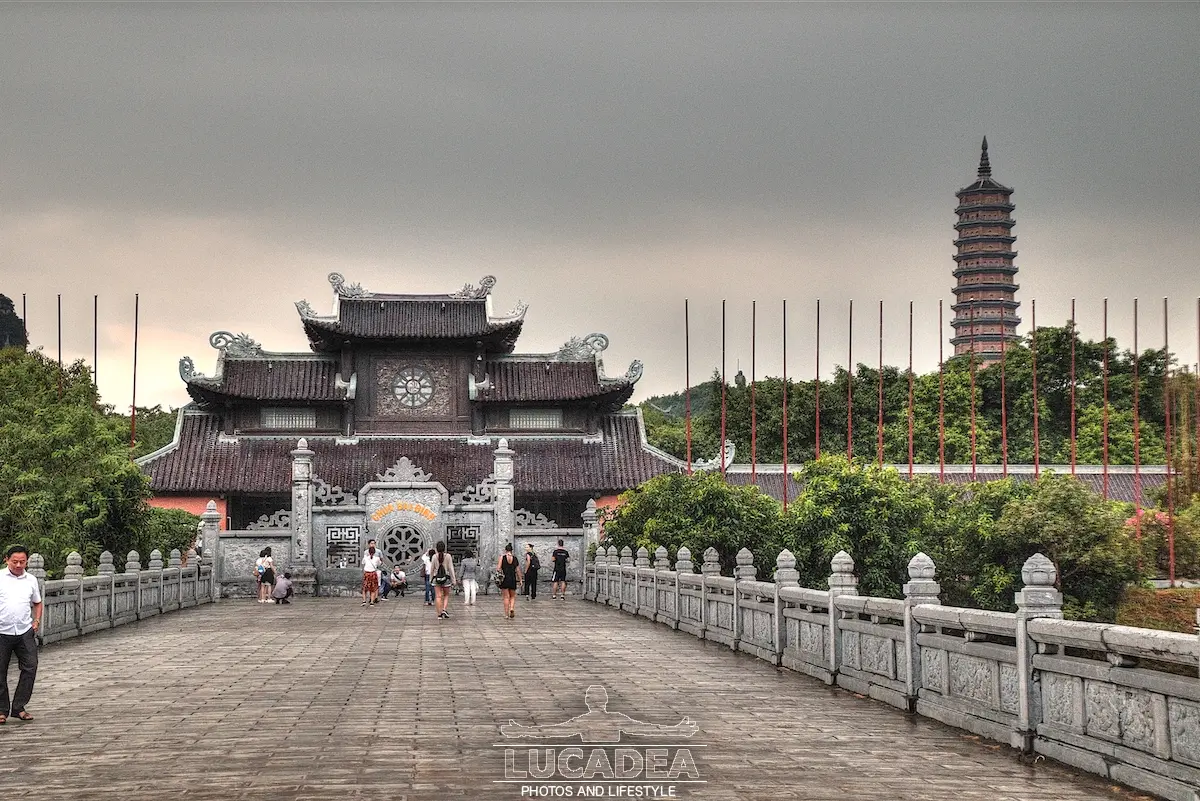
One of the largest temple complexes in Vietnam and all of Asia, located in the beautiful Ninh Binh region.
It extends over a vast area (so much so that electric minivans can be used to reach the main gate, for a fee) and is all uphill.
At the top is the original temple, to which a series of new buildings and statues have been added since 2010.
In the photo, you can see the main entrance and, to the right, the imposing tower (stupa) visible from many kilometers away.

Have you ever been to Vietnam or would like to go? Add your own comment or go to the bottom of the site to read what other visitors have written.

Ninh Binh: Bai Dinh Pagoda

Photo taken with Canon EOS M100 and lens Tamron 16-300.

There isn’t much online in Italian but not even in English. However, there is the official website: chuabaidinhninhbinh.vn.

If you’d like to see all the photos of the site, click here:
photo gallery

Here’s where the complex is located:

The splendid Bai Dinh Temple in Vietnam – Le splendide temple Bai Dinh au Vietnam – El espléndido Templo Bai Dinh en Vietnam – O esplêndido Templo Bai Dinh no Vietnã – Der prächtige Bai-Dinh-Tempel in Vietnam – Chùa Bái Đính tráng lệ ở Việt Nam – 越南辉煌的白亭寺 – ベトナムの華麗なバイディン寺院

Linh Ung Pagoda and the Lady Buddha

La pagoda Linh Ung vicino a Da Nang in Vietnam

Linh Ung Pagoda and the Lady Buddha. On the Thọ Quang peninsula, northeast of Da Nang, Linh Ung Pagoda caught my attention from the moment I arrived, surrounded by mountains, temples and large statues overlooking the sea. It is one of the places worth seeing near Da Nang if you want to leave the city behind for a while and reach a completely different setting without travelling far.
These photographs come from a visit in which I slowly walked through the whole pagoda complex, stopping whenever a detail caught my eye. The first view is the impressive entrance with its three gates, which gives the first of my photographs a strong sense of scale. Once through the entrance, the space opens up and the atmosphere changes.
In the main square I found the temple and, in front of it, a remarkable collection of carefully arranged bonsai trees. This contrast between religious architecture and the small, precisely shaped trees was one of the details I enjoyed photographing. The bonsai make the scene feel more intimate, while the buildings and statues immediately reveal the religious character of the place.
The walk continues through a fairly large area where smaller temples, statues and decorative trees appear one after another. There is no single element dominating the entire visit. Instead, the experience is made up of many smaller views, and each turn offers something different to look at. For me, that succession of details is part of what makes Linh Ung Pagoda interesting beyond its most famous landmark.
The setting of the Thọ Quang peninsula adds another important part to the experience. This mountainous area lies close to Da Nang, Vietnam, making it possible to move from the urban environment to a much quieter and more scenic landscape in a relatively short time. If you are visiting Da Nang and wondering what to see beyond the central areas, this is one of the places I would remember for the combination of nature and religious architecture.
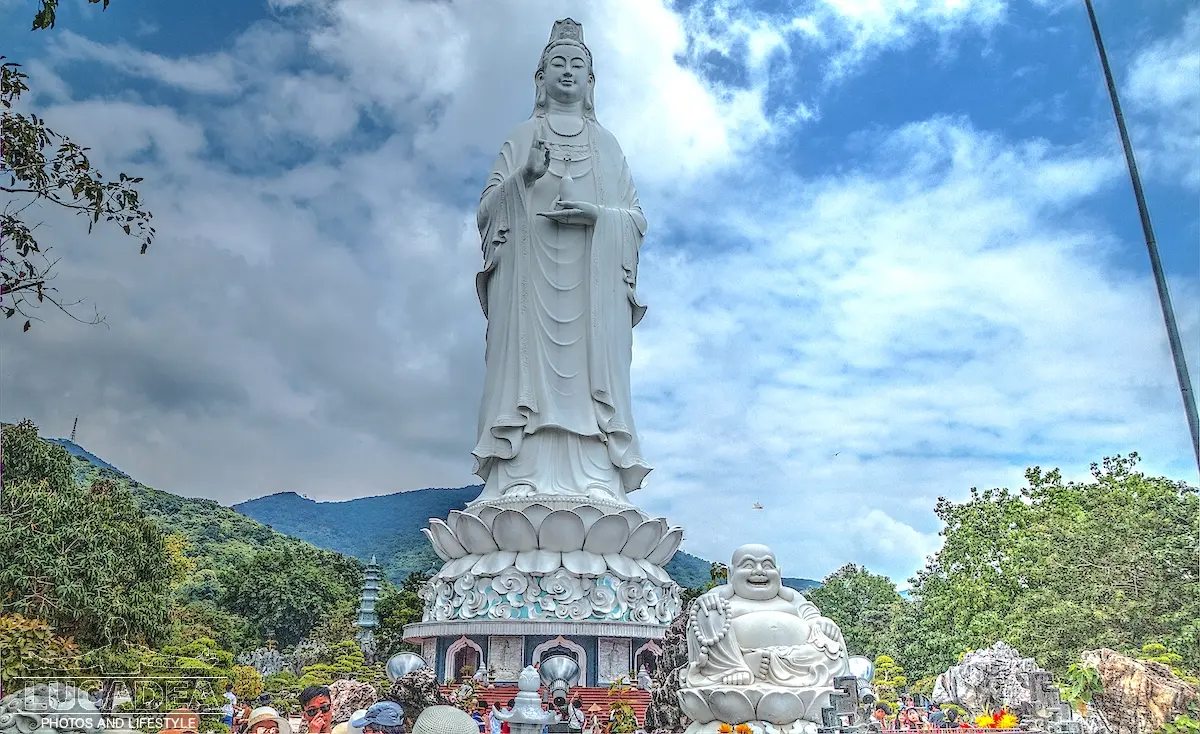
Then comes the most recognizable sight of the entire complex: the Lady Buddha statue, a large representation of Quan Âm that dominates the area. At 67 metres high, it is impossible to overlook, and its position makes it visible from a considerable distance, including from parts of Da Nang itself.
One small curiosity is that this particular Linh Ung Pagoda complex on the Sơn Trà Peninsula is not an ancient temple in the traditional sense. Its development belongs to the contemporary era, which makes its monumental appearance even more interesting when compared with the much older Buddhist sites found elsewhere in Asia.
What I wanted to capture in these photographs was not simply the main monument, but the progression of the visit: the imposing entrance, the square with the bonsai, the smaller buildings and statues, and finally the enormous Lady Buddha. Three different moments that together give a better sense of how varied the complex is.
Linh Ung Pagoda stayed in my memory because of that variety. You do not have to stand in front of one single monument to appreciate it. Walking slowly, looking around and paying attention to the smaller details gradually builds a much more complete picture of the place. It reminds me of other walks I have photographed and shared on the blog, where a simple route became a collection of small scenes worth remembering.

Which of these three views would you most like to see in person? Add a comment or go to the bottom of the site to read what other visitors have written.

Linh Ung Pagoda near Da Nang with its grand entrance, bonsai trees and Lady Buddha statue

Linh Ung Pagoda near Da Nang with its grand entrance, bonsai trees and Lady Buddha statue

Linh Ung Pagoda near Da Nang with its grand entrance, bonsai trees and Lady Buddha statue

Photos taken with Canon EOS M100 camera and Tamron 16-300 lens.

I searched online, but there’s very little in Italian; there is the official tourism page of the city of Da Nang describing the area danangfantasticity.com and also on Wikipedia, in English, there is very little.

Click here to see the other images I took on the Thọ Quang Peninsula:
foto gallery

Here’s where the pagoda is located:

🏠
  • Italiano