
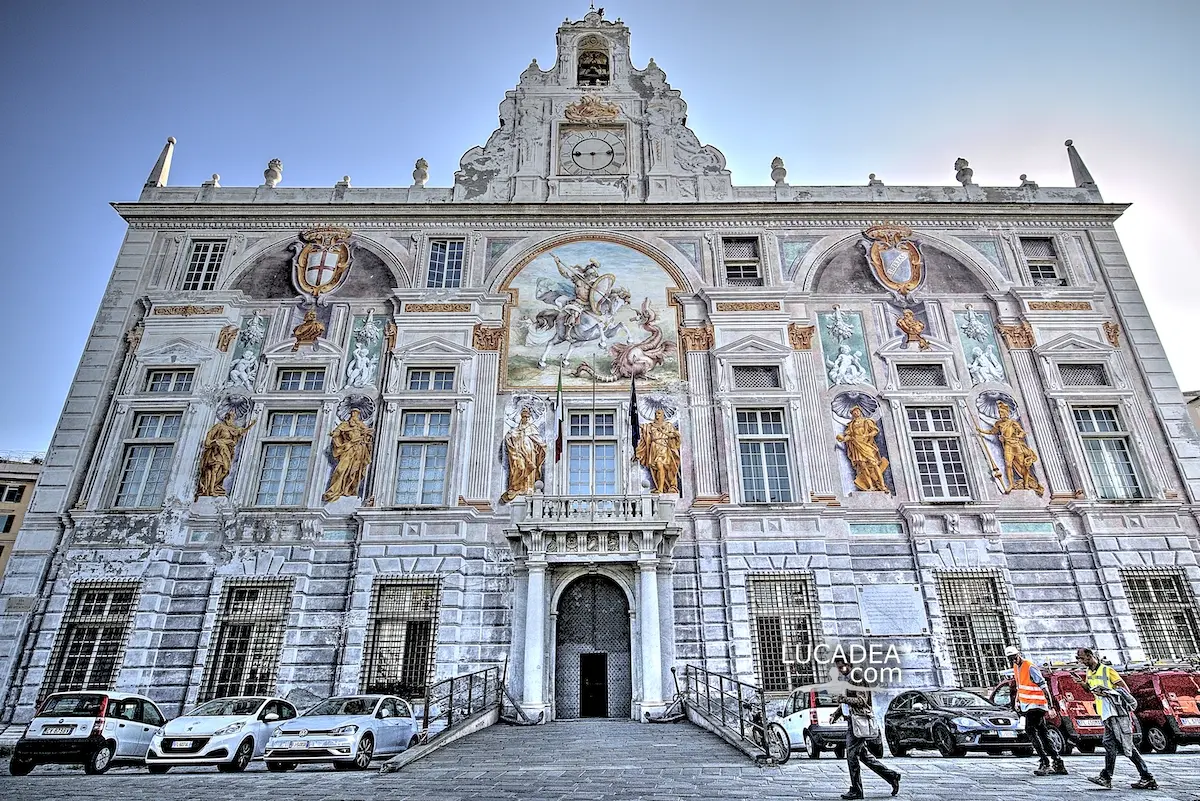
San Giorgio Palace Overlooking Genoa’s Old Port

Il maestoso Palazzo San Giorgio di fronte al Porto Antico di Genova

San Giorgio Palace Overlooking Genoa’s Old Port.
San Giorgio Palace is one of the most recognisable and frequently photographed buildings in Genoa, Italy. Located right beside the Old Port, it immediately catches the attention of visitors, especially because of the large painting on its façade depicting Saint George slaying the dragon. It is one of those familiar views that help define this part of the city and make it such a popular place to stop and take photographs.
The palace occupies a particularly interesting position, directly in front of the Old Port and close to the entrance to Genoa’s historic centre. Here, two different sides of the city meet. On one side are the open spaces of the harbour, with its quays and waterfront; on the other are the narrow streets and alleyways of the old town, where historic buildings stand close together. It is a place where a short walk can take you from the atmosphere of the port straight into the heart of historic Genoa.
Whenever I visit this area, San Giorgio Palace is one of the buildings that naturally draws my attention. Its façade is full of decorative details, but the large image of Saint George is undoubtedly the main attraction. The saint is shown on horseback, armed and facing the dragon. The scene is dramatic and immediately recognisable, giving the building a distinctive appearance that makes it stand out from its surroundings.
Saint George has a special place in Genoa’s identity. The image of the saint fighting the dragon is one of the city’s best-known symbols and also appears in its coat of arms. Seeing such a prominent representation on the façade of this historic building feels particularly appropriate. San Giorgio Palace is not simply an attractive landmark: it is also closely connected with the history of Genoa and its maritime and commercial importance.
The palace itself has a long and fascinating past. Built in the Middle Ages, it became closely associated with the financial and commercial activities of the Republic of Genoa. Its name is linked to the House of Saint George, an institution that played an important role in the city’s economic history. Today, many visitors know the building primarily as one of the most photographed sights around the Old Port, but its historical importance goes far beyond its attractive exterior.
From a photographic point of view, its location offers plenty of interesting possibilities. I particularly like the contrast between the richly decorated façade and the more open surroundings of the harbour. People are constantly walking past, stopping to admire the building or continuing towards the old town. This combination of architecture, movement and maritime atmosphere makes the area especially appealing to photograph.
For anyone visiting Genoa, stopping in front of San Giorgio Palace is almost unavoidable. The building stands in a natural position along the route between the Old Port and the historic centre, inviting visitors to pause and admire its details. The painting of Saint George and the dragon is certainly one of the features that makes it memorable.

Have you ever photographed San Giorgio Palace while walking around Genoa’s Old Port? Add a comment or go to the bottom of the site to read what other visitors have written.

San Giorgio Palace in Genoa, featuring the large façade painting of Saint George slaying the dragon beside the Old Port

Photo taken with a Canon EOS M100 camera and Canon EF-M 11-22 lens.

Where is the building located:

Add one  comment to this article or read  here what other visitors have written.
 
Adv
 
Disclamer

The rights on images, videos, choruses, text and all other material on the LUCADEA.com website are governed as per  Copyright page.


This page has been viewed 1 times today.
This month it has been viewed 2 times.
In total it has been viewed 2 times.
 

Palace of Saint George in Genoa

Palazzo San Giorgio

Palace of Saint George in Genoa.
Whenever I walk around the Old Port, I find it difficult to pass this historic building without stopping to admire its elegant façade. The Palace of Saint George is one of the landmarks that best expresses Genoa’s long relationship with the sea, maritime trade and civic history. Standing close to the waterfront in Genoa, Liguria, Italy, the palace immediately catches the eye with its architectural details and colourful painted decorations.
The sea-facing façade is especially striking. Among its painted figures, one of the most recognisable is Saint George defeating the dragon. This image is much more than a decorative feature: Saint George was the patron saint of the Republic of Genoa, and the red cross on a white background associated with him remains an important symbol of the city’s historical identity. It is a detail that connects the building to the proud maritime republic that once played a major role in Mediterranean commerce.
The palace itself has a long and fascinating past. Construction began in the second half of the thirteenth century, when Guglielmo Boccanegra commissioned a public building near the harbour, close to the centre of Genoa’s commercial activity. Over the centuries, the building changed its purpose and appearance. It later became the headquarters of the Bank of Saint George, a powerful financial institution involved in managing public finances and revenues connected with the Republic. Its Renaissance appearance developed through later extensions and decorative work, including the celebrated frescoes painted by Lazzaro Tavarone between 1606 and 1608.
When I photograph historic places, I enjoy looking beyond the overall view and paying attention to the details that give each building its own character. Here, the painted façade offers plenty to discover, from the central scene of Saint George and the dragon to the surrounding figures and architectural decorations. I took this photograph to capture the charm of a building that continues to stand out, even in an area visited by so many people.
The Palace of Saint George is an excellent stop for anyone exploring Genoa’s Old Port. From here, it is easy to continue towards the historic lanes, the arcades of Sottoripa and other landmarks in the old city. If you are searching for historic buildings to see in Genoa, this palace deserves a place on your itinerary, even if you only have a few minutes to spare.
I also enjoy photographing the city’s less obvious details, from old façades and narrow streets to the squares that reveal different layers of Genoese history. Each image becomes a way to remember a place and share a little of its atmosphere.

When you visit Genoa’s Old Port, do you stop to admire the painted façade of the Palace of Saint George? Add an comment or go to the bottom of the site to read what other visitors have written.

The Palace of Saint George in Genoa, a historic building overlooking the Old Port with a painted façade depicting Saint George and the dragon

The Palace of Saint George in Genoa, a historic building overlooking the Old Port with a painted façade depicting Saint George and the dragon

Photos taken with a Canon EOS M100 camera and Tamron 16-300 lens.

Where is the building located:

Add one  comment to this article or read  here what other visitors have written.
 
Adv
 
Disclamer

The rights on images, videos, choruses, text and all other material on the LUCADEA.com website are governed as per  Copyright page.


This page has been viewed 1 times today.
This month it has been viewed 1 times.
In total it has been viewed 1 times.
 

The Entrance of Palazzo Ducale from Matteotti Square

Ingresso di Palazzo Ducale da piazza Giacomo Matteotti a Genova con facciata storica e passaggio urbano nel centro città

The Entrance of Palazzo Ducale from Matteotti Square.
Standing in front of the entrance of Palazzo Ducale from Piazza Giacomo Matteotti in Genoa, Liguria, Italy, I immediately feel how the space shifts from the everyday flow of the city into something more structured and almost ceremonial. The entrance of Palazzo Ducale from Matteotti Square creates a clear transition, as if the urban rhythm slows down right at this threshold.
Looking closely at the entrance of Palazzo Ducale from Matteotti Square in Genoa, I notice how the stone façade interacts with light and movement, constantly reshaped by people passing through. Palazzo Ducale is one of the most significant buildings in Genoa, and this access point is often the one that introduces visitors to its inner courtyards and historic halls.
If you are visiting Genoa and wondering what to see in the historic center, Palazzo Ducale is frequently mentioned as one of the key landmarks, and this entrance from Piazza Giacomo Matteotti is one of the most direct ways to experience its atmosphere. It is not just an architectural passage, but a symbolic gateway into centuries of civic and cultural history.
I have also photographed other parts of Genoa and shared them on lucadea.com, where similar moments of transition between streets and historic buildings often appear, but here the contrast between square and palace feels particularly strong.
A historical note often associated with Palazzo Ducale is its long role as a political center during the time of the Republic of Genoa, a function that still echoes today through its exhibitions and cultural events.

Have you ever walked through an entrance that made you feel like you were stepping into another layer of the city? Add a comment or go to the bottom of the site to read what other visitors have written.

Ingresso di Palazzo Ducale da piazza Giacomo Matteotti a Genova con facciata storica e passaggio urbano nel centro città

Photo taken with Canon EOS R50 V and lens Canon RF 28.

Where I took the photo:

Entrance of Palazzo Ducale from Piazza Matteotti in Genoa – Entrée du Palazzo Ducale depuis la Piazza Matteotti à Gênes – Entrada del Palazzo Ducale desde Piazza Matteotti en Génova – Entrada do Palazzo Ducale a partir da Piazza Matteotti em Génova – Eingang des Palazzo Ducale von der Piazza Matteotti in Genua – Lối vào Palazzo Ducale từ Quảng trường Matteotti ở Genoa – 热那亚马泰奥蒂广场的公爵宫入口 – ジェノヴァのマッテオッティ広場からのドゥカーレ宮の入口

The text of this post was written with the help of ChatGPT, a language model from OpenAI.

The Old Town Gate of Portovenere

La Porta del Borgo di Portovenere

The Old Town Gate of Portovenere.
The Old Town Gate of Portovenere, in Liguria, in the province of La Spezia, Italy, is one of the most charming entrances to the historic centre of this beautiful village overlooking the Gulf of Poets. I find it fascinating to imagine how many people have passed beneath its arch over the centuries and how many stories these ancient stones could tell. It is a place where medieval architecture remains part of everyday life in the village.
The gate stands within the old defensive walls and opens onto Giovanni Capellini Street, the characteristic narrow lane that runs through the heart of the historic centre. Beyond the entrance, a maze of narrow alleys, stairways, arches and tall, colourful houses invites visitors to explore. Every turn seems to reveal another interesting view. This is more than a simple passage into the village: walking through it feels like stepping into another period of history.
The Old Town Gate is closely connected to Portovenere’s medieval past and its relationship with the Republic of Genoa. During the twelfth century, Genoa developed the village into an important fortified settlement on the eastern Ligurian coast. Above the entrance, the historic inscription “Colonia Ianuensis 1113” recalls the village’s connection with Genoa. The gate and the surrounding walls formed part of a defensive system designed to protect a strategically important settlement for trade and coastal control.
What catches my attention most is the imposing simplicity of the stone structure. Elaborate decoration is not necessary to make this entrance impressive. The strength of the arch, the uneven surfaces of the stone blocks and the contrast with the buildings around it give the gate its distinctive character. Imagining Portovenere as it might have appeared centuries ago makes it easier to appreciate how important this entrance must have been for both residents and visitors arriving at the village.
Once through the gate, I can follow the narrow main lane and explore at my own pace, passing shops, small restaurants and picturesque corners along the way. The streets also lead towards some of Portovenere’s best-known landmarks, including the Church of San Pietro and Doria Castle, both important features of the village’s historic landscape.
On Lucadea.com, I enjoy sharing architectural details like this because small features often reveal something special about a place. The Old Town Gate is more than an ancient entrance: it is a tangible reminder of Portovenere’s past and an invitation to discover its historic streets.

When you visit a historic village, do you stop to admire its old gates and defensive walls, or do you prefer to wander straight into the narrow streets? Add a comment or go to the bottom of the site to read what other visitors have written.

The Old Town Gate of Portovenere, a medieval stone archway set within the historic defensive walls of this Ligurian village in Italy

Photo taken with Canon EOS RP camera and Canon RF 24-50 lens.

At another time, I also recorded a short video of me walking around the village:

Video recorded with GoPro Hero5.

Click here to see all the photos of the village:
foto gallery

Where is Portovenere?

🏠
  • Italiano