
Chicken feet in Sa Pa, Vietnam

Zampe di gallina esposte su un tavolo a Sa Pa in Vietnam pronte per essere grigliate

Chicken feet in Sa Pa, Vietnam.
During my trip to northern Vietnam, I came across a scene that might feel unusual for many of us: a table filled with different cuts of meat ready to be chosen and grilled. Among them, chicken feet were certainly one of the most curious and, for me, slightly surprising items.
Chicken feet in Sa Pa, Vietnam, are a type of food commonly found across much of Asia, where no part of the animal is wasted and every element has its place in the kitchen. In this case, they were displayed together with other cuts, some already prepared on skewers and ready to be cooked over the grill.
I have to admit that visually they still make quite an impression on me. We are no longer used to seeing this kind of food on our tables, even though in the past, chicken feet were also used in Italy, especially for making broths and soups. In some places, this tradition still exists today, although it is less common.
The scene I photographed says a lot about the way food is experienced in these areas. It is not just about eating, but also about sharing a moment: you choose what you want, watch it being prepared and often take part in the cooking process. It becomes a social and sensory experience that brings you closer to a different food culture.
Sa Pa, a town located in the mountains of northern Vietnam, is known for this kind of street food and small local eateries. Tables full of ingredients act almost like displays, allowing each person to select exactly what they want to eat and create a personalised meal.
Even if these dishes may seem unusual at first glance, they are part of a rich culinary tradition that values simple ingredients and direct cooking methods like grilling. Often, moving beyond the initial impression can lead to discovering new and interesting flavours.
This photograph is part of a wider collection dedicated to food around the world, where I try to tell stories not only about well-known dishes but also about those that surprise and spark curiosity.

Have you ever found yourself in front of a dish that made you hesitate just because of how it looked? Add a comment or go to the bottom of the site to read what other visitors have written.
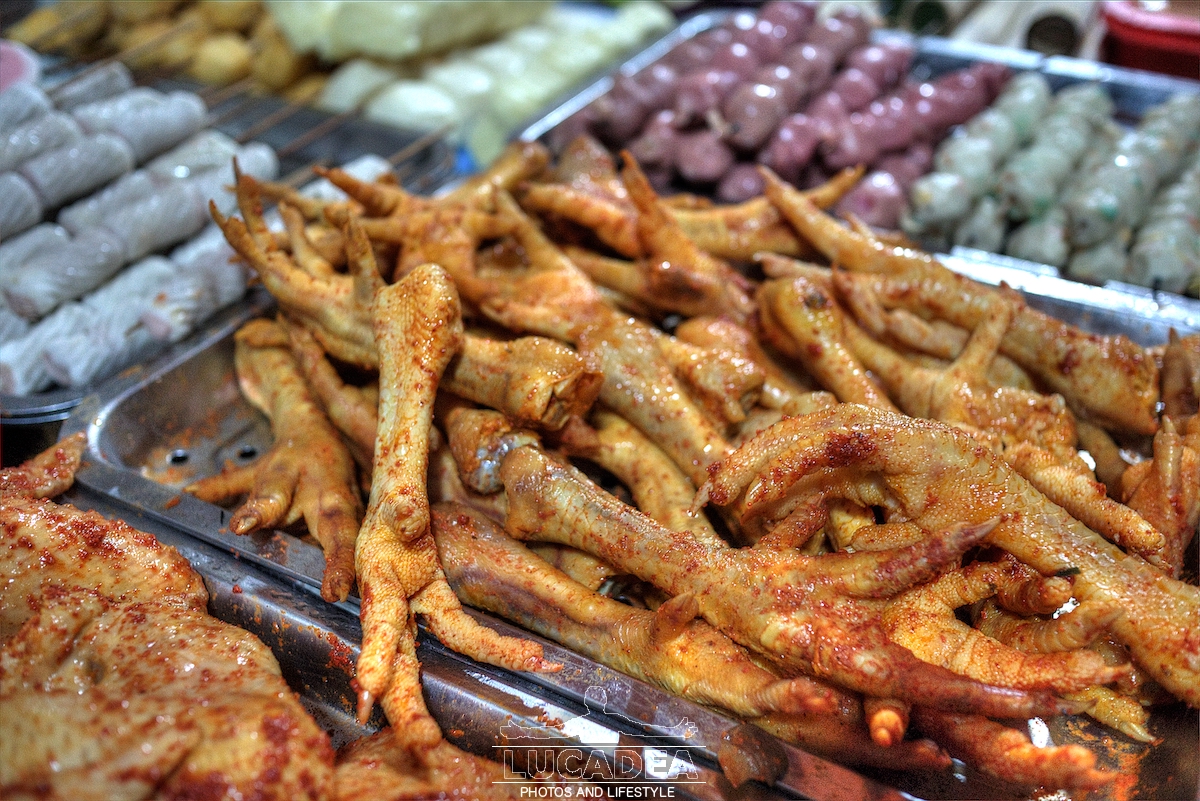
Chicken feet displayed on a table in Sa Pa Vietnam ready to be grilled

Photo taken with Canon EOS M100 and lens Canon EF-M 22.

Add one  comment to this article or read  here what other visitors have written.
 
Adv
 
Disclamer

The rights on images, videos, choruses, text and all other material on the LUCADEA.com website are governed as per  Copyright page.


This page has been viewed 0 times today.
This month it has been viewed 0 times.
In total it has been viewed 0 times.
 

The Buddha statue on the summit of Mount Fansipan

Buddha a Fansipan in Vietnam

The Buddha statue on the summit of Mount Fansipan in Vietnam.
An immense statue dedicated to this great figure, located right at the top of the Asian country.
Beyond the statue itself, which is already impressive, there is also this staircase with a fountain that makes it even more majestic.

Have you ever been to Vietnam? Add your own comment or go to the bottom of the site to read what other visitors have written.

Buddha a Fansipan in Vietnam

Buddha a Fansipan in Vietnam

Photos taken with Canon EOS M100 camera and Tamron 16-300 lens.

This is a time-lapse video I shot that day:

Click here to see all the photos I took there:
foto gallery

Here’s where the mountain is located:

La statua di Buddha sulla cima del monte Fansipan in Vietnam – La statue de Bouddha au sommet du mont Fansipan au Vietnam – La estatua de Buda en la cima del monte Fansipan en Vietnam – A estátua de Buda no topo do Monte Fansipan, no Vietnã – Die Buddha-Statue auf dem Berg Fansipan in Vietnam – Tượng Phật trên đỉnh Fanxipan của Việt Nam – 越南番西邦山顶的佛像 – ベトナムのファンシーパン山の頂上にある仏像
Add one  comment to this article or read  here what other visitors have written.
 
Adv
 
Disclamer

The rights on images, videos, choruses, text and all other material on the LUCADEA.com website are governed as per  Copyright page.


This page has been viewed 2 times today.
This month it has been viewed 2 times.
In total it has been viewed 5 times.
 

The famous cable car station in Sa Pa

La stazione del treno di Sa Pa

The famous cable car station in Sa Pa. Among the buildings I came across in the Vietnamese town, this is certainly one of the ones that caught my attention most, both for its unusual appearance and for its direct connection with the journey towards Phan Xi Pang. The Sa Pa cable car station is the starting point for the route leading towards the highest mountain in Indochina.
Standing in front of the building, what immediately caught my eye was its architectural character. The shapes, colors and decorative details clearly suggest French influence, something that can still be seen in several buildings around northern Vietnam. That contrast is what made the scene interesting to me: I was in a mountain town surrounded by the landscapes of northern Vietnam, looking at a structure with a distinctly European character.
I had not come here to photograph a conventional railway station, but the cable car station used for the journey towards Fansipan. This distinction is important because the route towards the mountain combines different forms of transport. From Sa Pa, the Mường Hoa mountain railway can take visitors towards the cable car area, where the journey continues by cable car up the mountain. The building in my photograph belongs to this route towards the summit.
I wanted to capture the station with my camera because it seemed like an unusual subject, especially because of the way the architecture becomes part of the experience of Sa Pa. When I think of this part of Vietnam, I usually picture mountains, rice terraces, clouds and small villages. Yet this building has also become part of the visual identity of the town.
The cable car leads towards Fansipan, a mountain rising to 3,143 metres. It is the highest point in Vietnam and across Indochina, and that makes the station much more than just a functional building. From here, the journey towards one of the most spectacular places in northern Vietnam begins.
One interesting detail is how much easier the cable car has made reaching the summit compared with the traditional mountain route. Today, the journey to Fansipan has become one of the best-known experiences around Sa Pa, with the cable car crossing the mountainous landscape before reaching the high-altitude area.
What I particularly like about this photograph is the almost monumental character of the station. It is not simply a piece of transport infrastructure, but a building designed as part of a larger experience: the journey towards the “Roof of Indochina”. That is why I chose to stop and photograph it rather than simply treating it as the place where I had to continue my journey.
This photograph also connects naturally with another image I published on the blog, dedicated to Phan Xi Pang. If you want to continue this photographic journey, you can also see my photograph of Phan Xi Pang, which represents the destination towards which this station leads.
What I find most interesting is the relationship between the building and everything beyond it. The station is a starting point, while the real destination lies much higher, among the mountains. Yet simply looking at the building already reveals something about Sa Pa: it is a place where the natural landscape and the structures created to reach it constantly meet.

If you were visiting Sa Pa and planning to go up Fansipan, would you stop for a moment to look at and photograph this distinctive cable car station? Add a comment or go to the bottom of the site to read what other visitors have written.

Sa Pa cable car station in Vietnam, with a French-influenced façade for the route towards Fansipan

Photo taken with a Canon EOS M100 camera and a Tamron 16-300 lens.

Click here to see all the photos:
photo gallery

Sapa, nestled among the majestic mountains of northern Tonkin at an altitude of approximately 1,600 meters, is one of the most fascinating mountain resorts in Vietnam. Located less than 350 km from Hanoi and just over 30 km from the city of Lao Cai, the provincial capital, Sapa is a destination that attracts visitors for its natural beauty and the cultural richness of its ethnic communities.
Continue and learn more on tuttovietnam.it

Mixed grill in Sa Pa, Vietnam

Grigliata mista a Sa Pa

Mixed grill in Sa Pa, Vietnam.
A good portion of Vietnamese street food consists of dishes grilled on makeshift stoves.
There are scooters driving around with everything on the rack: display case, grill, dishes, and driver (cook).
This was a much more chic (in quotes) place as it was inside a garden.
At the entrance was a nice table with all the cuts of meat and vegetables to choose from for grilling.
This is the final result (obviously, it’s not just my meat, but also Dao’s).
If you look closely, there’s also a part that horrifies me a little: the chicken feet (which I’ve already written a post about here).

The rest of the meat: beef, pork, bacon, offal, and a sausage.

Do you know Vietnam? Add a comment or go to the bottom of the site to read what other visitors have written.

Grigliata mista a Sa Pa

Photo taken with Canon EOS M100 and lens Canon EF-M 22.

Mixed grill in Sa Pa, Vietnam – Grillades mixtes à Sa Pa, Vietnam – Parrillada mixta en Sa Pa, Vietnam – Churrasco misto em Sa Pa, Vietname – Gemischter Grill in Sa Pa, Vietnam – Món nướng thập cẩm ở Sa Pa, Việt Nam – 越南沙巴的什锦烤肉 – ベトナム、サパのミックスグリル
🏠
  • Italiano