The Coronation of the Virgin in Siena Cathedral

Mosaico dorato con l'Incoronazione della Vergine nel timpano triangolare della facciata del Duomo di Siena, ripreso in dettaglio

The Coronation of the Virgin in Siena Cathedral.
The golden mosaic depicting the Coronation of the Virgin is one of the details that draws attention to the façade of Siena Cathedral in Tuscany, Italy. In these two photographs, I have chosen to focus specifically on the triangular gable above the central entrance, rather than showing the entire cathedral. The first image captures the mosaic as a whole, while the second takes a closer look at the figures and details of the composition.
When visiting a church with so many architectural and decorative features, it is easy to be impressed by the grandeur of the building as a whole. Siena Cathedral’s façade, with its marble surfaces and elaborate ornamentation, offers countless photographic opportunities. Sometimes, however, I find it more interesting to isolate a single element and give it my full attention, using a more focused photograph to tell its story.
Here, it is the golden background of the mosaic that immediately catches the eye. Its warm tones contrast with the marble surrounding the gable and help bring the scene to life. At the centre is the Coronation of the Virgin, a religious subject widely represented in Christian art, depicting Mary being crowned in heaven. The mosaic places this sacred scene within the geometric outline of the upper façade, bringing together the triangular shape and the figurative decoration in a harmonious composition.
I like the way two photographs of the same subject can create different impressions. The wider view makes it easier to appreciate the shape of the gable and how the mosaic fits into the architecture of the cathedral. Moving closer shifts the attention towards the figures, colours and smaller details that might be difficult to distinguish from a distance. It is a simple way to explore the same subject from two perspectives while keeping its most distinctive features in focus.
Siena Cathedral is one of the city’s great artistic landmarks, preserving a remarkable heritage of artworks, decorations and architectural features that reflect centuries of history. Even a single detail on the façade, such as this mosaic, contributes to the building’s distinctive appearance and deserves a moment of careful observation.
On Lucadea.com, I enjoy sharing details like these that I come across while travelling. Alongside complete views of famous monuments, I like to photograph features that might escape the attention of visitors who walk past without looking up. In this case, the two images offer a chance to appreciate both the shape of the gable and the richness of the golden mosaic.

When visiting a historic city, do you prefer photographing entire monuments, or do you also take time to capture their decorative details? Add a comment or go to the bottom of the site to read what other visitors have written.
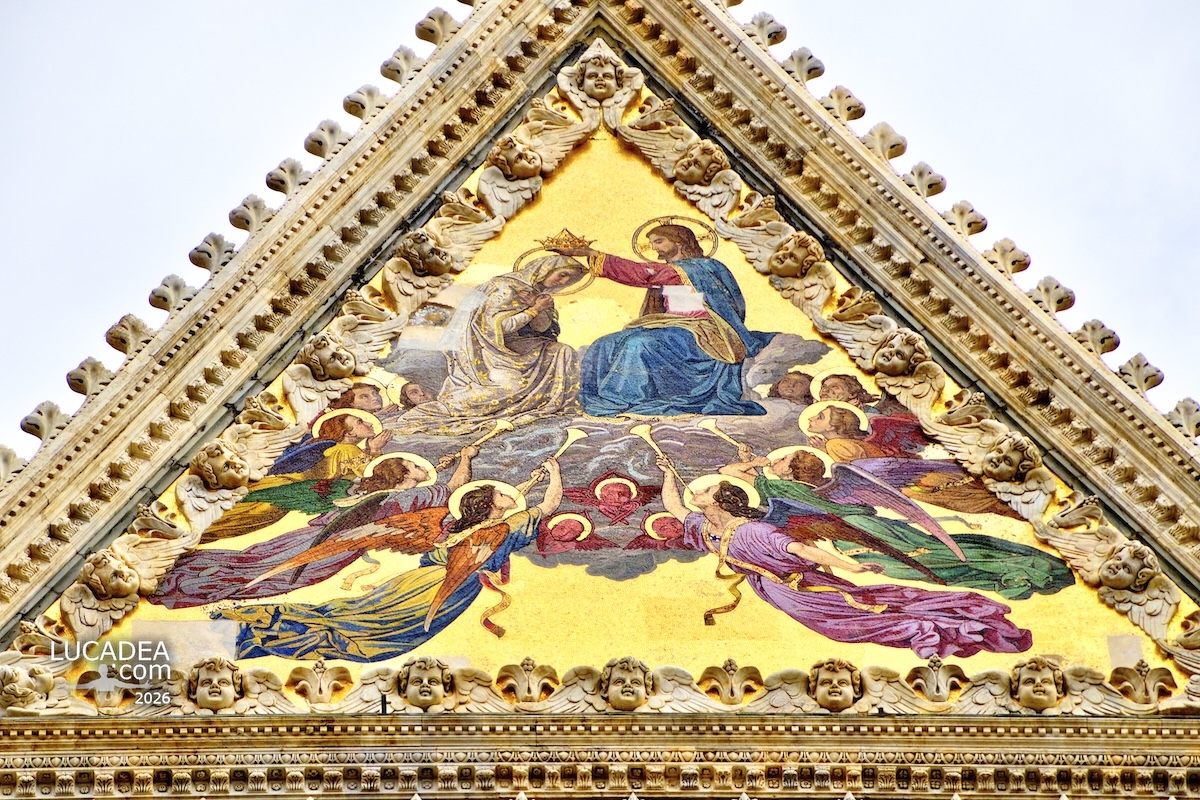
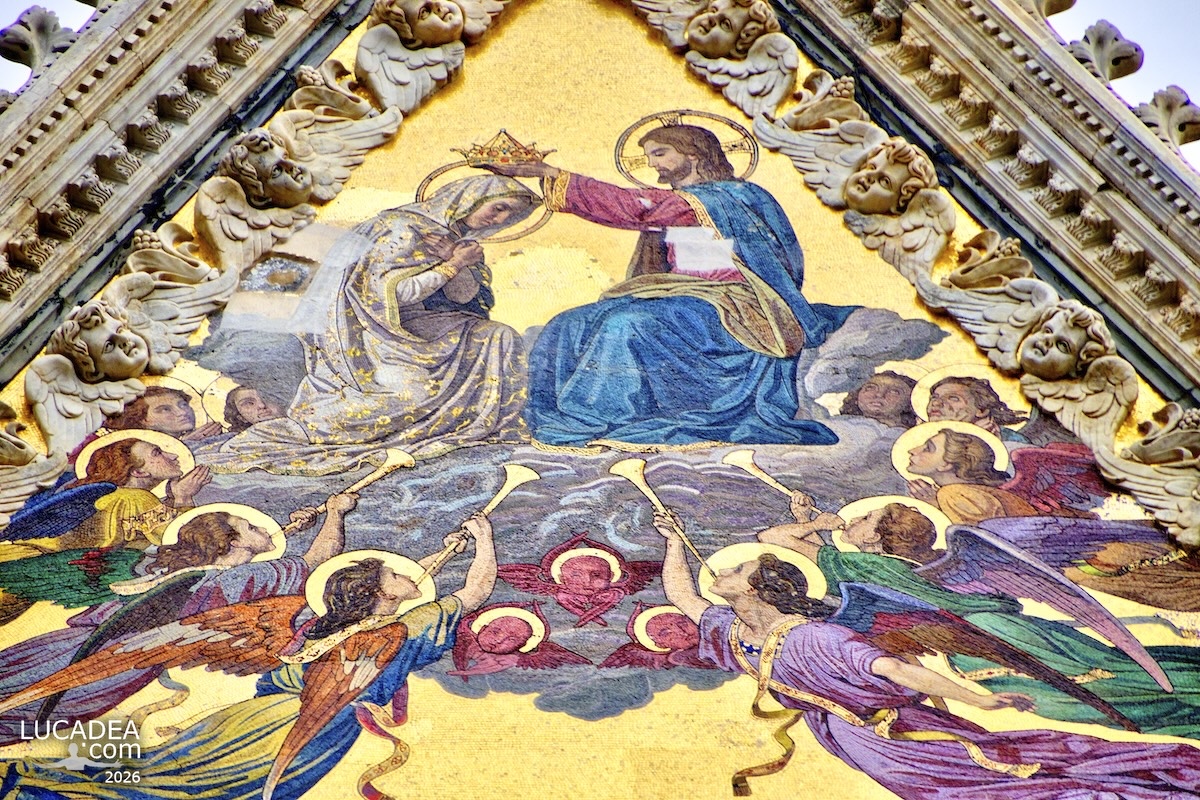
Golden mosaic depicting the Coronation of the Virgin in the triangular gable of Siena Cathedral's façade, photographed in close detail

Golden mosaic depicting the Coronation of the Virgin in the triangular gable of Siena Cathedral's façade, photographed in close detail

Photos taken with a Canon EOS R50 V camera and Tamron 16-300 lens.

To see all the photos of the Duomo click here:
foto gallery

Add one  comment to this article or read  here what other visitors have written.
 
Adv
 
Disclamer

The rights on images, videos, choruses, text and all other material on the LUCADEA.com website are governed as per  Copyright page.


This page has been viewed 1 times today.
This month it has been viewed 1 times.
In total it has been viewed 1 times.
 

The Saint Ambrose Bronze Door of Milan Cathedral

Un particole di uno dei portali del Duomo di Milano

The Saint Ambrose Bronze Door of Milan Cathedral.
During my visit to Milan Cathedral, one of the details that caught my attention most was one of its five monumental bronze doors. As I was leaving the Cathedral after the visit, I stopped to admire this particular entrance, dedicated to Saint Ambrose, the patron saint of Milan. Its sculpted panels depict episodes connected with the life and works of this important religious figure.
The door was created by Giannino Castiglioni, a Milanese sculptor who made a significant contribution to Italian sculpture in the twentieth century. The bronze panels form a visual narrative, with figures and scenes arranged across the surface. What might otherwise be simply an entrance becomes a work of art in its own right, telling a story through sculpted images.
Saint Ambrose occupies a special place in Milan’s history. He was bishop of the city in the fourth century and became one of the most influential figures in its religious and civic life. His legacy has remained closely connected with Milan’s identity, and he is still celebrated as the city’s patron saint. His feast day, on December 7, is an important date in the local calendar and remains a much-loved Milanese tradition.
Looking closely at the bronze door, it is easy to appreciate how an architectural element designed for everyday use can also become a remarkable artistic surface. Bronze allows the sculptor to create raised figures and intricate details, while the changing light produces contrasts between highlights and shadows. The reliefs seem to emerge from the metal, encouraging visitors to pause and follow the scenes one by one.
Milan Cathedral is best known for its imposing Gothic architecture, its countless statues, its spires and its extraordinary scale. Yet a visit to such an important monument is also an opportunity to discover details that can be just as fascinating as the overall structure. The monumental doors are part of this artistic heritage, and each one deserves attention for its decoration and subject.
What particularly impressed me was the meeting of history and sculpture. The story of Saint Ambrose, a figure so deeply associated with Milan, is presented through the artistic work of Giannino Castiglioni. The result belongs naturally to the setting of the Cathedral while offering visitors another way to appreciate its cultural and artistic richness.
The photograph I took preserves the memory of this detail, which I noticed towards the end of my visit. It is easy to focus on the immense scale of the building and overlook its individual elements, but taking a closer look reveals stories that are an essential part of the monument. This bronze door is a fine example of how art, faith and the history of a city can come together in a single architectural feature.

And what about you? When visiting a great cathedral, do you also take time to admire its doors and smaller artistic details? Add a comment or go to the bottom of the site to read what other visitors have written.

Detail of the bronze door dedicated to Saint Ambrose, created by Giannino Castiglioni for Milan Cathedral

Photo taken with a Canon EOS M100 camera and Canon EF-M 11-22 lens.

To see all the photos I took on the roof and inside the Duomo click here:

Add one  comment to this article or read  here what other visitors have written.
 
Adv
 
Disclamer

The rights on images, videos, choruses, text and all other material on the LUCADEA.com website are governed as per  Copyright page.


This page has been viewed 1 times today.
This month it has been viewed 2 times.
In total it has been viewed 2 times.
 

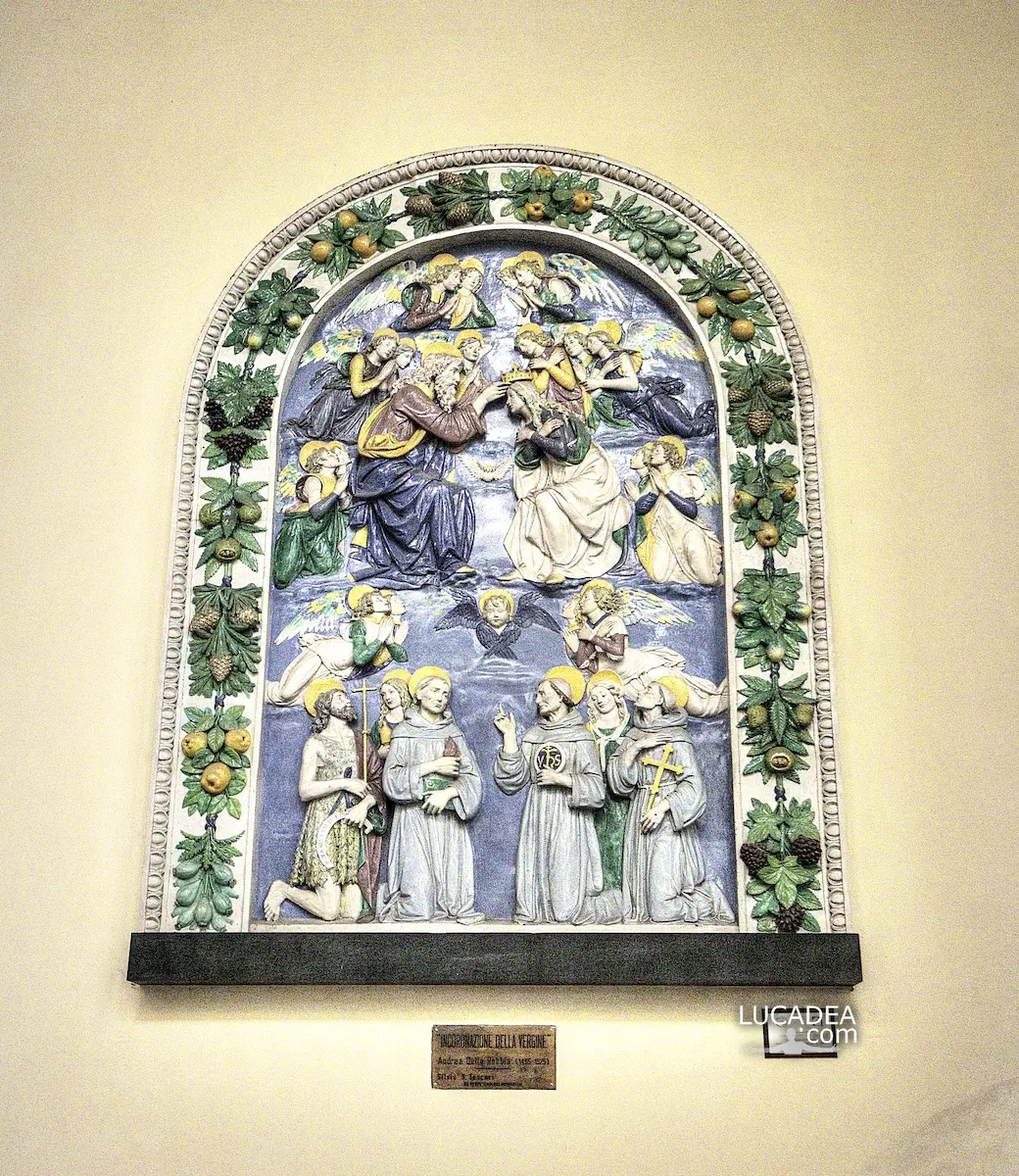
Andrea della Robbia’s Altarpiece in La Spezia

L'Ancona di Andrea della Robbia a La Spezia

Andrea della Robbia’s Altarpiece in La Spezia.
Among the works of art I have discovered in La Spezia, in the Liguria region of Italy, this beautiful glazed terracotta altarpiece is one of the most memorable. It is housed in the Abbey Church of Santa Maria Assunta and offers a wonderful opportunity to appreciate the artistic traditions of the Italian Renaissance.
The composition depicts the Coronation of the Virgin, surrounded by angels and saints, with the Holy Spirit forming part of the sacred scene. The arrangement of the figures, the carefully modelled details and the luminous finish make the artwork particularly appealing. Its glazed surface catches the light and helps distinguish the different elements of the composition, giving the scene a distinctive appearance.
Glazed terracotta became one of the defining artistic techniques associated with the Della Robbia family. By applying a glossy glaze to clay sculptures, artists created colourful surfaces that were both attractive and durable. This approach combined the modelling of traditional sculpture with the finish of glazed ceramics, allowing figures and decorative details to retain their visual impact over time.
The altarpiece is attributed to Andrea della Robbia, a Florentine artist who lived during the fifteenth and early sixteenth centuries. He was the nephew of Luca della Robbia, the celebrated sculptor who helped establish the family’s reputation for glazed terracotta. Andrea continued this artistic tradition, producing religious works for churches and other places of worship. His sculptures are often admired for their expressive faces, balanced compositions and carefully arranged figures.
Visiting Santa Maria Assunta offers a chance to discover a cultural side of La Spezia that can easily be overlooked by those who focus mainly on the harbour, the waterfront and the surrounding coastline. The city has artistic treasures that reward visitors who take the time to explore its churches and historic buildings. Sometimes an unexpected discovery becomes one of the most memorable parts of a visit.
For me, this altarpiece is among the most beautiful artistic works I have encountered in the city. There are certainly many other places and artworks in La Spezia that deserve attention, and I hope to share more of these discoveries in future articles. On Lucadea.com, I enjoy collecting photographs and personal impressions from places I visit, especially when they reveal something interesting about local history and culture.
Photographing a work of art allows me to keep a visual memory of the visit and return to its details later. However, a photograph can only convey part of the experience. Seeing the sculpture in person makes it easier to appreciate its scale, the craftsmanship and the way the light reflects off the glazed surface.

Have you visited Santa Maria Assunta in La Spezia, and have you had the opportunity to admire this remarkable altarpiece attributed to Andrea della Robbia? Add a comment or go to the bottom of the site to read what other visitors have written.

Glazed terracotta altarpiece attributed to Andrea della Robbia in Santa Maria Assunta Church in La Spezia, Italy

Photo taken with a Canon EOS M100 camera and Canon EF-M 11-22 lens.

Here’s the page on the diocesilaspezia.it website.

If you want to see all the photos I took in the church, click here:

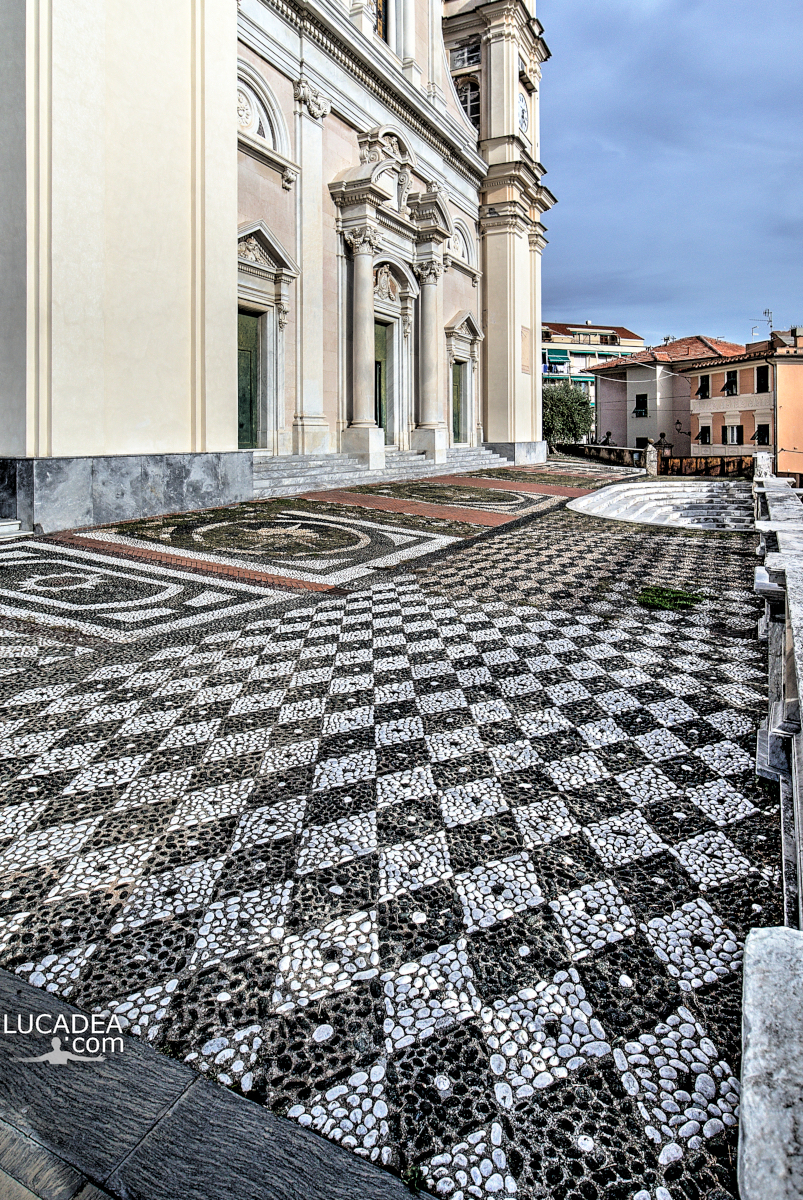
The risseu of Santo Stefano churchyard in Lavagna

Sagrato della Basilica di Santo Stefano a Lavagna con risseu liguri in ciottoli bianchi e neri disposti in motivi geometrici tradizionali

The risseu of Santo Stefano churchyard in Lavagna.
I stand on the churchyard of the Basilica of Santo Stefano in Lavagna, where the risseu of the Santo Stefano churchyard immediately becomes the visual focus of the scene. The risseu of Lavagna forms intricate geometric patterns made of light and dark pebbles, turning the ground into a carefully composed mosaic that feels both artistic and architectural.
Moving slowly across the space, I notice how the risseu of the Santo Stefano churchyard in Lavagna guides the eye through repeating shapes and balanced contrasts. The churchyard itself becomes more than an entrance; it is a surface designed with patience, where every stone contributes to a larger visual rhythm.
We are in Lavagna, Liguria, Italy, a coastal town where tradition and architecture often merge in subtle ways. In this case, the risseu of Lavagna reflects a long-standing Ligurian practice of using sea-worn stones to decorate sacred and public spaces with geometric precision.
If you are exploring Liguria, this churchyard is one of those places worth seeing not only for the church itself but for the ground you walk on. It connects naturally with other visual details I’ve shared on this photoblog, where texture and material often tell stories as important as entire buildings.
A small curiosity: the risseu technique was traditionally created entirely by hand, placing each pebble individually, often without preliminary drawings, relying on experience and visual memory.

And as I look down again, I wonder if the true beauty of the risseu of Santo Stefano churchyard in Lavagna lies in its silence and order rather than in any single pattern. Add a comment or go to the bottom of the site to read what other visitors have written.

Sagrato della Basilica di Santo Stefano a Lavagna con risseu liguri in ciottoli bianchi e neri disposti in motivi geometrici tradizionali

Photo taken with Canon EOS M100 camera and Canon EF-M 11-22 lens.

The material available in different areas has influenced the installation techniques and the possibility of creating decorations, based on the shapes and colors of the available stone elements. In alluvial plains, rounded pebbles taken from riverbeds are preferred; Near the sea, lenticular pebbles, collected from beaches, are preferred; in the mountains, elongated pebbles from streams are preferred.
Continue and learn more at Wikipedia

I risseu del sagrato della Basilica di Santo Stefano a Lavagna – The risseu of the churchyard of the Basilica of Santo Stefano in Lavagna – Les risseu du parvis de la basilique Santo Stefano à Lavagna – Los risseu del atrio de la Basílica de Santo Stefano en Lavagna – Die Risseu des Kirchhofs der Basilika Santo Stefano in Lavagna – Những bức risseu của sân nhà thờ Basilica Santo Stefano ở Lavagna – 拉瓦尼亚圣斯特凡诺大教堂前庭的卵石装饰 – ラヴァーニャのサント・ステファノ大聖堂の中庭のリッセウ

The text of this post was written with the help of ChatGPT, a language model from OpenAI.

Inside Rapallo’s Basilica of Saints Gervasius and Protasius

Interno della Basilica dei Santi Gervasio e Protasio nel centro di Rapallo, con decorazioni e altari

Inside Rapallo’s Basilica of Saints Gervasius and Protasius.
Walking into the basilica in the heart of Rapallo, I suddenly found myself in an environment that felt very different from the streets outside. If you are wondering what to see in Rapallo, the interiors of its churches are worth noticing too, especially when you enter without expecting such a richly detailed space.
Some time ago, I stepped inside the basilica during a walk through town and was immediately struck by the interior. I only had my phone with me, which unfortunately meant that I could not take as many photographs as I would have liked. I still wanted to capture a few details, though, because it seemed a shame to leave without at least one image of what I had just seen.
I took this photograph myself, so for me it is also a record of that particular visit. It was not the result of a planned photographic session. In fact, I had simply been walking through the center. Sometimes that is exactly when I find something worth photographing: I enter a church out of curiosity and almost immediately start wishing I had brought my camera.
The Basilica of Saints Gervasius and Protasius stands in the center of Rapallo, in Liguria, in the Metropolitan City of Genoa, Italy. Its position makes it part of the everyday fabric of the town. You can encounter it while walking through the central streets, yet once inside, the change of atmosphere is quite noticeable.
What caught my attention most was the number of elements competing for your eyes. There are architectural details, decorations and altars, but also many smaller features that can easily be missed if you simply walk through without stopping.
It is one of those places where a single photograph cannot really reproduce the whole experience. In person, you can follow the depth of the building, move your attention from one detail to another and discover elements that inevitably become less obvious once they are reduced to a single frame.
One small historical curiosity is that the basilica has very old origins and has undergone various changes and renovations over the centuries. Its dedication to Saints Gervasius and Protasius belongs to an ancient Christian tradition, while the building we see today reflects interventions made during different periods.
I do not want to turn this photograph into a history lesson about the church. What I want to remember is the simple experience of entering it. After walking through the streets of Rapallo, I suddenly found myself in a more enclosed and richly decorated environment, and I felt the need to photograph it.
Having only my phone with me also forced me to make a choice. Since I could not take many photographs, I tried to concentrate on what I could actually frame. This happens quite often when I go for a walk without planning a proper photographic outing: an interesting subject appears unexpectedly, and I have to work with whatever equipment I happen to have with me.
In this case, it was enough to preserve a memory of the interior. Looking at the photograph now brings me back to that moment, when I had entered almost casually and then started paying much closer attention to the space around me.
I have photographed Rapallo many times, and I have already shared several views of the town on the blog, from its old caruggi to the Delle Saline Gate and the historic building facades. This image adds another piece to that collection, this time from inside one of the town’s most important religious buildings.
I like building this kind of photographic record gradually. One walk can lead to a street, a gate, a facade and, almost unexpectedly, the interior of a church. They are different subjects, but together they create a more complete impression of the town.
If I returned to the basilica today with my camera, I would probably spend much more time photographing it. There are several details I would like to observe and capture more carefully. For now, however, I am happy to have this image as a reminder of that unplanned visit.
It is interesting how even a photograph taken with a simple phone can preserve the memory of a moment so well. You do not always need the best equipment to record something that genuinely catches your attention.

Have you ever visited the interior of the Basilica of Saints Gervasius and Protasius in Rapallo? Add a comment or go to the bottom of the site to read what other visitors have written.

Interior of the Basilica of Saints Gervasius and Protasius in central Rapallo, with ornate decorations and altars

Photo taken with Honor 20.

Here is the basilica’s official website: santigervasioeprotasio.com.

Here is the location of the church:

The Archipresbyterial-Collegiate Basilica of Saints Gervasius and Protasius is a Catholic place of worship located in the municipality of Rapallo, between Corso Italia and Piazza Matteo Canessa, in the metropolitan city of Genoa. The church is the seat of the parish of the same name in the Vicariate of Rapallo-Santa Margherita Ligure of the Diocese of Chiavari. In May 1925, Pope Pius XI elevated it to the dignity of a minor basilica.
Continue and learn more at Wikipedia

The altar of Santa Maria delle Vigne in Genoa

L'altare di Santa Maria delle Vigne a Genova

The altar of Santa Maria delle Vigne in Genoa.
The altar of Santa Maria delle Vigne in Genoa is a significant element of the historic church located in the heart of the city’s old town. This church, dating back to the 10th century, is one of the oldest in Genoa and is dedicated to the Virgin Mary.
Origins: The church’s origins go back to the 10th century, when a small chapel dedicated to the Virgin Mary was built. The church takes the name “delle Vigne” from the vineyards that once surrounded the area.

Have you ever visited the church? Add your own comment or go to the bottom of the site to read what other visitors have written.

L'altare di Santa Maria delle Vigne a Genova

Photos taken with Canon EOS M100 and Canon EF-S 10-18 lens.

To see all the photos I took in the basilica, click here:

Where is the church:

On the high altar, Giacomo Antonio Ponsonelli’s last work (1730) based on a design by Pierre Puget, stands a statue of the Madonna, supported by angels, also by the artist. The presbytery contains several eighteenth-century paintings: the Nativity of the Virgin by Giuseppe Cades (painted in Rome in 1784, originally intended for the church of San Carlo al Corso), the Presentation of the Virgin by Giovanni David (1785), and the Annunciation by Carlo Giuseppe Ratti (1787).
Continue and learn more at Wikipedia

The altar of the church of Santa Maria delle Vigne in Genoa – L’autel de l’église de Santa Maria delle Vigne à Gênes – El altar de la iglesia de Santa Maria delle Vigne en Génova – O altar da igreja de Santa Maria delle Vigne em Gênova – Der Altar der Kirche Santa Maria delle Vigne in Genua – Bàn thờ của nhà thờ Santa Maria delle Vigne ở Genoa – 热那亚圣玛丽亚德尔维涅教堂的祭坛 – ジェノヴァのサンタ・マリア・デッレ・ヴィーニェ教会の祭壇

The text of this post was written with the help of ChatGPT, a language model from OpenAI.

A small Madonna in Asilo Maria Teresa Street

Una Madonnina in via Asilo Maria Teresa a Sestri

A small Madonna in Asilo Maria Teresa Street in Sestri Levante.
While walking around my Sestri Levante, I always try to frame unusual objects or details to share and, perhaps, gather more information by searching online or waiting for visitors to add some insights.
In this case, my attention was drawn to this small Madonna emerging from the wall that borders Asilo Maria Teresa Street and, given its position, I assume it is a statuette belonging to what used to be the nursery school.

Do you know this street in Sestri Levante? Add a comment or go to the bottom of the site to read what other visitors have written.

Una Madonnina in via Asilo Maria Teresa a Sestri

Photo taken with Canon EOS RP and lens Tamron 16-300.

Here’s where this street is located:

A statue of the Madonna in via Asilo Maria Teresa in Sestri Levante – Une statue de la Madone dans la via Asilo Maria Teresa à Sestri Levante – Una estatua de la Virgen en via Asilo Maria Teresa en Sestri Levante – Uma estátua de Nossa Senhora na via Asilo Maria Teresa em Sestri Levante – Eine Statue der Madonna in der Via Asilo Maria Teresa in Sestri Levante – Một bức tượng Đức Mẹ qua Asilo Maria Teresa ở Sestri Levante

Inside the Cathedral of Our Lady of the Garden in Chiavari

All'interno della Cattedrale di NS dell'Orto a Chiavari

Inside the Cathedral of Our Lady of the Garden in Chiavari.
The beautiful cathedral of Chiavari, photographed some time ago.

Have you ever visited this church? Add a comment or go to the bottom of the site to read what other visitors have written.

All'interno della Cattedrale di NS dell'Orto a Chiavari

Photo taken with Canon EOS RP camera and Canon RF 24-50 lens.

The Cathedral of Nostra Signora dell’Orto is a Catholic place of worship located in the municipality of Chiavari, in Piazza Nostra Signora dell’Orto, in the metropolitan city of Genoa. The episcopal seat of the Diocese of Chiavari, it is also a Marian shrine and the seat of the parish of the same name in the Vicariate of Chiavari-Lavagna.
Continue and learn more on Wikipedia

The interior of the Cathedral of Our Lady of the Garden in Chiavari – L’intérieur de la cathédrale Notre-Dame du Jardin de Chiavari – El interior de la Catedral de Nuestra Señora del Jardín en Chiavari – O interior da Catedral de Nossa Senhora do Jardim em Chiavari – Das Innere der Kathedrale Unserer Lieben Frau vom Garten in Chiavari – Nội thất của Nhà thờ Đức Mẹ Vườn ở Chiavari – 基亚瓦里花园圣母大教堂的内部 – キアヴァリの庭の聖母大聖堂の内部

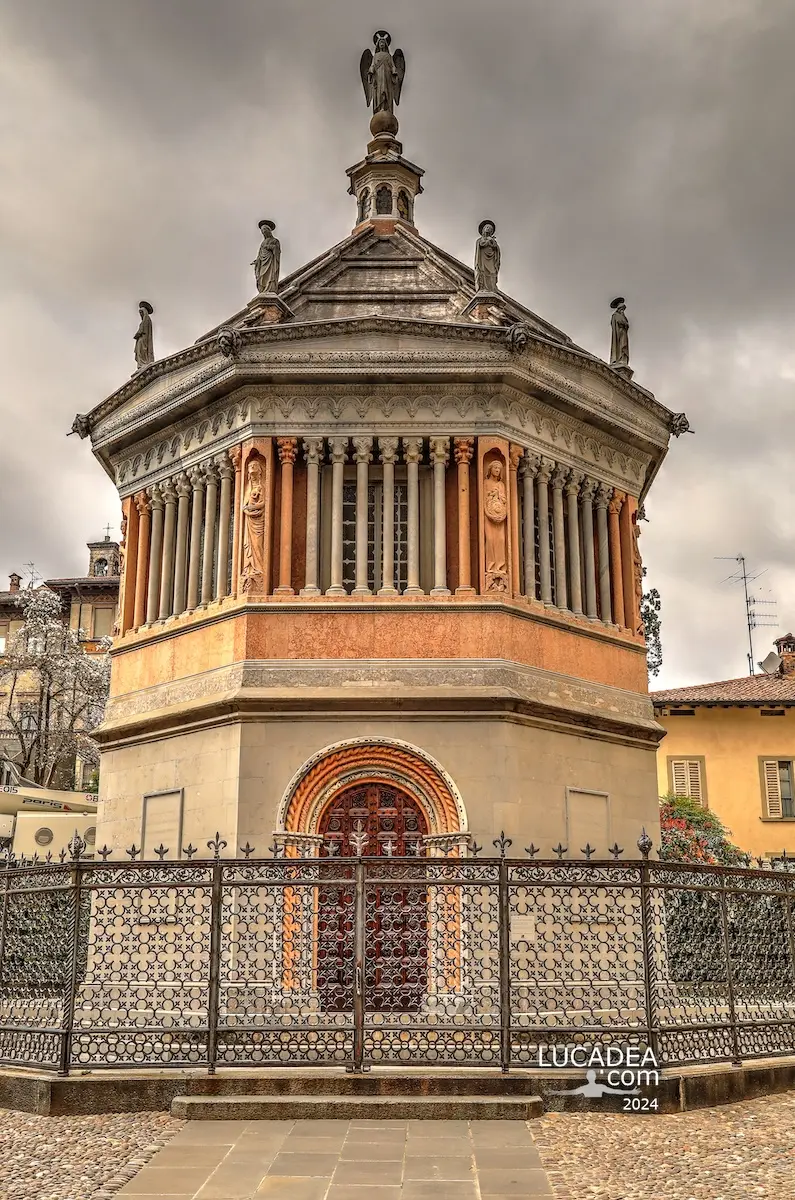
The Baptistery of the Cathedral of Bergamo

Il Battistero della Cattedrale di Bergamo

The Baptistery of the Cathedral of Bergamo.
In the heart of Bergamo’s Upper Town, surrounded by ancient walls and narrow cobbled streets, stands the imposing Cathedral of Saint Alexander, one of the most important examples of sacred art in Lombardy. Among its most precious gems is the Baptistery, a structure of great artistic and historical significance that enchants visitors with its beauty and intrinsic spirituality.
The Baptistery of the Cathedral of Bergamo, dedicated to Saint John the Baptist, dates back to the medieval period, with some parts going as far back as the 9th century. Its architecture reflects the Romanesque style, with later Gothic and Renaissance influences, bearing witness to the different historical periods that shaped the city over the centuries.
The exterior of the Baptistery is characterized by a simple yet elegant façade, decorated with blind arches, pilasters, and a portal adorned with sacred sculptures. Inside, medieval frescoes and Renaissance architectural elements create an atmosphere of sacredness and contemplation.
One of the Baptistery’s greatest treasures is the frescoes that decorate its walls, mainly dating from the 13th and 14th centuries. These works of sacred art, created by anonymous artists of the time, depict biblical stories and scenes from the life of Saint John the Baptist, bringing faith and devotion to life.
Among the most famous frescoes is the cycle of the life of Saint John the Baptist, which includes episodes such as his miraculous birth, his ministry in the desert, and his martyrdom. The vivid representations and skillful use of color give them a timeless charm, transporting visitors on a spiritual journey through the history of Christianity.
The Baptistery is a place of great spiritual importance for the people of Bergamo and for visitors seeking reflection and contemplation. It is here that many Christians receive the sacrament of baptism, a rite of initiation into the Christian faith symbolizing spiritual rebirth and communion with God.
Beyond its liturgical function, the Baptistery also represents a symbol of the continuity of the Christian faith through the centuries. Generations of believers have left their mark on this sacred place, helping preserve its beauty and historical importance for future generations.
The Baptistery of the Cathedral of Bergamo is open to visitors who wish to admire its artistic beauty and experience a moment of spirituality. Tourists can join guided tours organized by the local diocese or explore the Baptistery on their own, letting themselves be captivated by its artworks and evocative atmosphere.
In conclusion, the Baptistery of the Cathedral of Bergamo represents a masterpiece of sacred art and a place of deep spiritual significance. With its fascinating architecture, breathtaking decorations, and millennia-old history, it continues to inspire and uplift those who visit, offering a unique experience of beauty and contemplation.

Do you know Bergamo? Add a comment or go to the bottom of the site to read what other visitors have written.

Il Battistero della Cattedrale di Bergamo

Photo taken with Canon EOS RP and Canon RF 24-50 lens.

This is the Cathedral’s official website: cattedraledibergamo.it.

To see all the photos I took in Bergamo, click here:

Where is the baptistery located:

The Marble Assumption Statue in Sestri Levante

La statua marmorea dell’Assunta a Sestri Levante

The Marble Assumption Statue in Sestri Levante.
Inside the Basilica of Santa Maria di Nazareth, in the centre of Sestri Levante on the Ligurian Riviera in north-western Italy, a remarkable marble sculpture draws attention to the artistic heritage preserved within this historic church. The statue of the Assumption of the Virgin Mary stands above the main altar, forming the focal point of a richly decorated sacred space.
The sculpture depicts the Virgin Mary being taken up into heaven, surrounded by cherubs supporting the Holy House of Nazareth. This unusual iconographic detail gives the composition a special meaning. It connects the familiar Christian theme of the Assumption with the devotion to Our Lady of Nazareth, whose name is carried by the basilica itself. The small house beneath the heavenly figures is therefore more than an ornamental element: it helps express the religious identity associated with this place of worship.
The work is attributed to Francesco Maria Schiaffino, a Genoese sculptor active during the eighteenth century. His artistic language is associated with graceful forms and a lively treatment of marble. Here, the Virgin’s elongated silhouette guides the eye upwards, while the folds of her mantle create a sense of movement and lightness. The surrounding cherubs add rhythm to the composition, bringing together the different figures in a carefully balanced sculptural group.
The polychrome marble altar, dated 1762, provides an elaborate setting for the statue. Its coloured stonework frames the sculpture and reinforces the solemn atmosphere of the sanctuary. When photographing religious art, I like to pay attention not only to the main subject but also to the relationship between the artwork and its surroundings. The textures of the marble, the arrangement of the figures and the details of the altar all contribute to the impression made by the whole composition.
The Basilica of Santa Maria di Nazareth began to be built in 1604. Located in Matteotti Square, close to the town hall, it stands in an important part of Sestri Levante, near the historic centre and the narrow strip of land leading towards the peninsula known as the Isola. The church is one of the town’s significant religious and artistic landmarks, offering visitors an opportunity to discover a quieter side of the Ligurian Riviera beyond its beaches and seaside views.
I took this photograph to remember a sculpture that combines artistic skill, religious symbolism and local devotion. Much like the historic churches and monuments I enjoy photographing around Liguria, this work rewards anyone willing to pause and look beyond the first impression.

Have you visited this basilica, and did you notice the little Holy House beneath the figure of the Virgin Mary? Add an comment or go to the bottom of the site to read what other visitors have written.

Photos taken with Oppo Reno 12.

Here’s where the basilica is located:

🏠
  • Italiano