Flavoured Salt at Barcelona’s Boqueria Market

Il sale come souvenir al mercato della Boqueria a Barcellona

Flavoured Salt at Barcelona’s Boqueria Market.
Whenever my ship calls at Barcelona, I try to make time to go ashore and visit La Rambla. If the schedule allows, I enjoy stopping at the Boqueria Market for a snack before exploring a little more of the city. Even during a short port visit, this lively market is a place where I can enjoy the atmosphere and discover something unexpected.
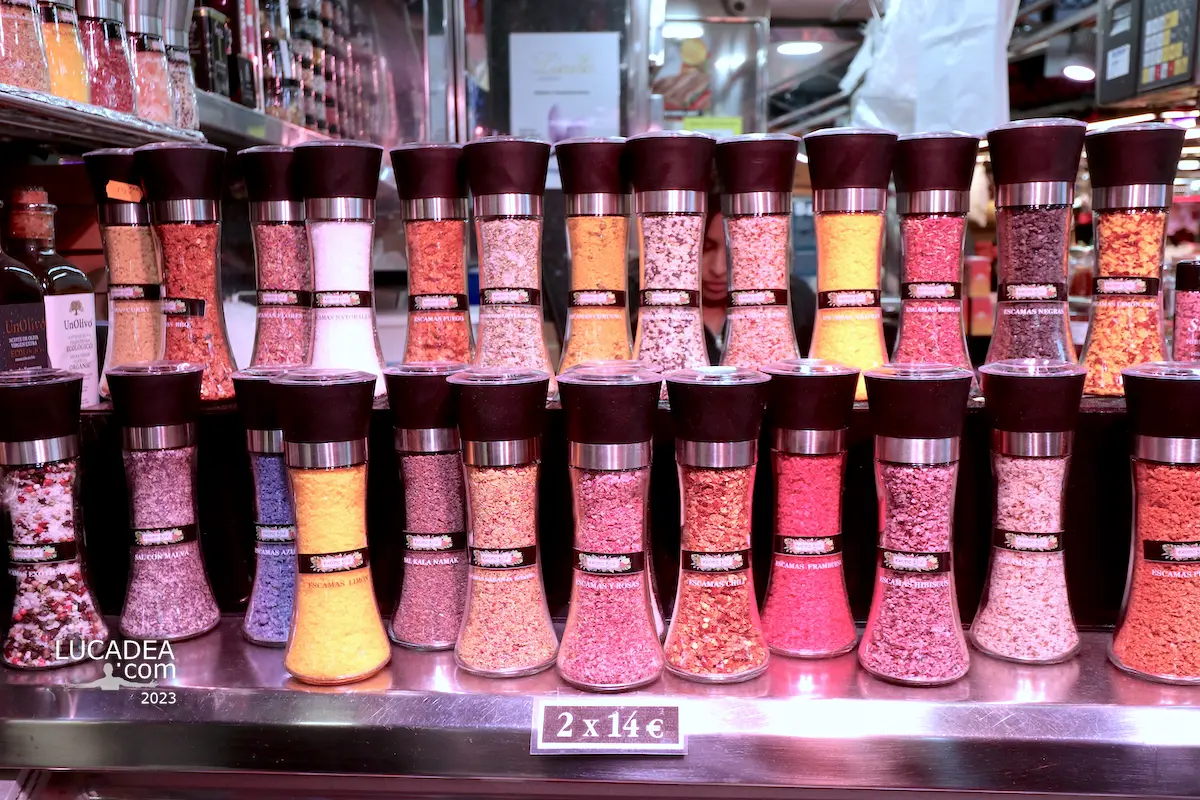
La Boqueria is one of Barcelona’s best-known markets and attracts plenty of visitors. With so many tourists walking through its aisles, the stalls naturally offer products that catch the eye and reflect current trends. During my most recent visit, one particular item stood out: flavoured salt. I noticed it at stall after stall, displayed in an impressive range of colours and varieties. I had never imagined there could be so many different kinds.
There was blue salt, saffron salt and a blend labelled cinco pimientas, made with five types of pepper. Other varieties combined orange with pink peppercorns, tomato, Merlot wine, turmeric or raspberry. I also saw Himalayan pink salt, garlic salt, basil and lemon, wasabi and chilli. The Spanish names on the labels made browsing even more interesting, as each jar seemed to promise a different flavour and a different use in the kitchen. And that was only the selection I happened to notice; there were so many options that I could probably have spent much longer looking through them.
What surprised me most was how an everyday ingredient could be presented as such a colourful and varied product. Salt is something most of us keep in the kitchen without thinking about it very much, yet these blends turn it into an attractive little gift. For someone who enjoys cooking, a small jar of unusual salt could be a practical souvenir from Barcelona, especially compared with the more familiar tourist trinkets.
I found myself wondering how many of these combinations come from established culinary traditions and how many have been developed to appeal to visitors looking for something distinctive to take home. Either way, the display was fun to discover. It was a reminder that markets are not just places to buy food: they also reveal what sellers believe people might enjoy, taste or give as a present.
I always like these little discoveries when travelling. The Boqueria is well known for its fresh produce and snacks, but a walk through the stalls can also turn up something I never expected to see. I took this photograph during one of those visits, drawn to the variety of salts and the unusual idea of turning such a simple kitchen staple into a souvenir.

Barcelona has plenty to offer even when time ashore is limited, and I enjoy finding small details that make each visit memorable. Which of these flavoured salts would you choose to take home? Add an comment or go to the bottom of the site to read what other visitors have written.

Flavoured salts at Barcelona's Boqueria Market, displayed in colourful varieties with spices, fruit and herbs for sale

Flavoured salts at Barcelona's Boqueria Market, displayed in colourful varieties with spices, fruit and herbs for sale

Flavoured salts at Barcelona's Boqueria Market, displayed in colourful varieties with spices, fruit and herbs for sale

Photos taken with a Canon EOS M100 camera and Canon EF-M 11-22 lens.

Here’s where this market is located:

Add one  comment to this article or read  here what other visitors have written.
 
Adv
 
Disclamer

The rights on images, videos, choruses, text and all other material on the LUCADEA.com website are governed as per  Copyright page.


This page has been viewed 0 times today.
This month it has been viewed 0 times.
In total it has been viewed 0 times.
 

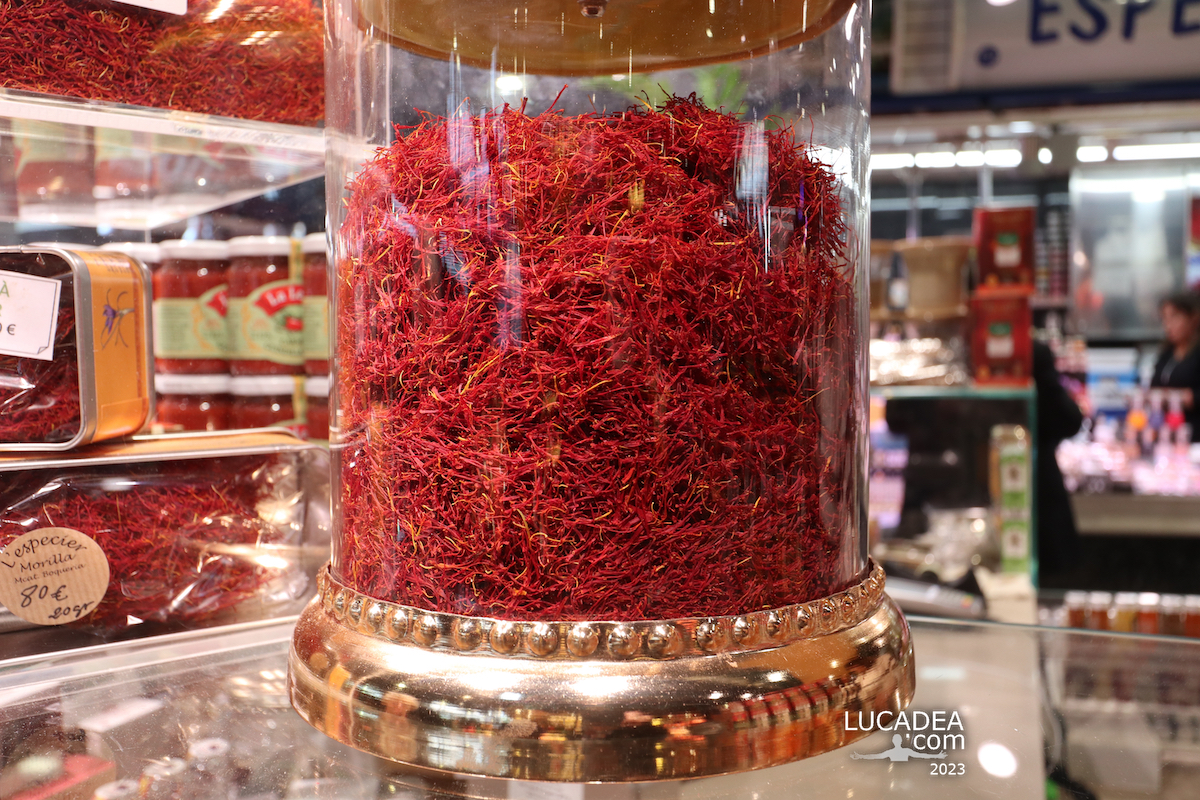
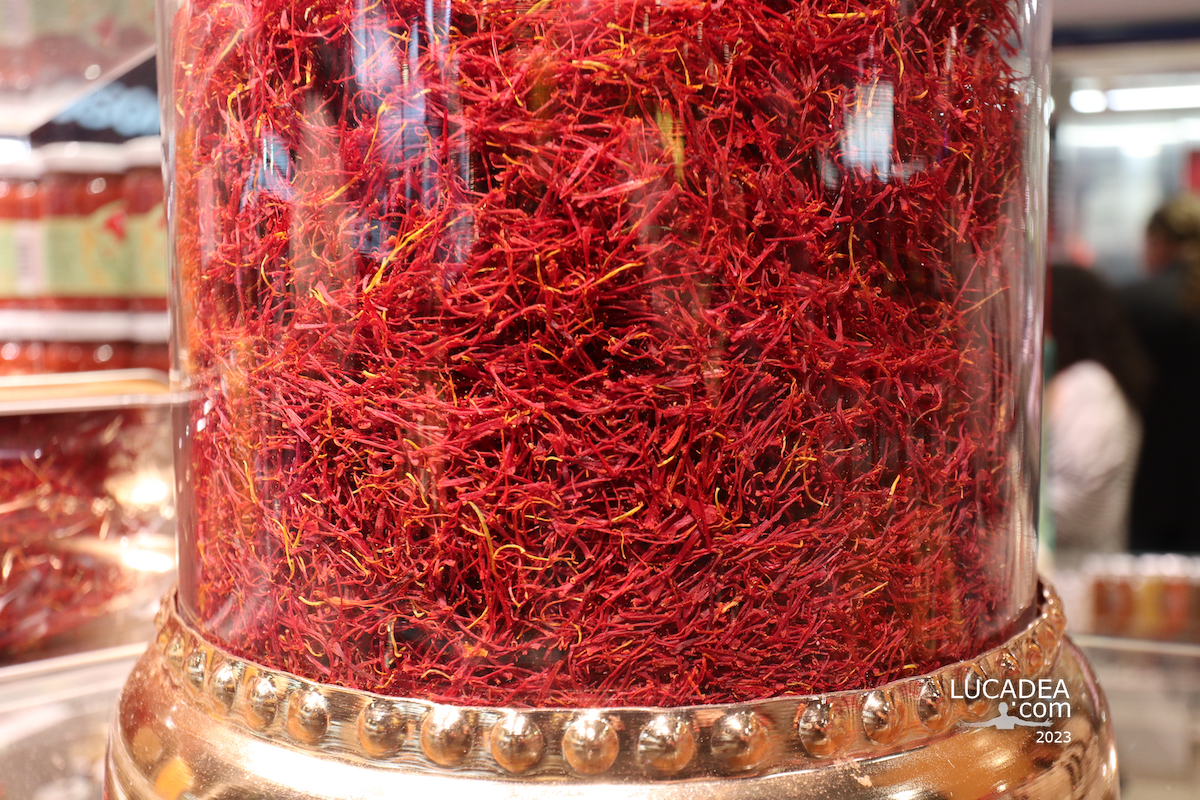
Saffron for sale at Barcelona’s Boqueria Market

Lo zafferano in vendita al mercato della Boqueria a Barcellona

Saffron for sale at Barcelona’s Boqueria Market.
A few months ago, while passing through Barcelona, I stopped to eat at the famous Boqueria Market, admittedly doing what a good tourist is supposed to do. Among all the stalls and products on display, however, it was the saffron that caught my attention, particularly because of the different packages and prices being offered.
Barcelona’s Boqueria Market is one of those places where, even without deliberately looking for it, you can get an idea of what visitors are interested in. It is heavily frequented by tourists, and spending a little time looking at the stalls can reveal which products seem to attract the most attention.
That day I noticed several stalls selling saffron in different quantities and at different prices. That small detail was enough to make me stop and take a photograph. Among fruit, spices, fresh produce and all the other things displayed around the market, those tiny packages of saffron naturally stood out.
I have never been particularly good at judging the price of spices, but one thing seemed obvious: saffron is certainly not cheap. It does not literally cost as much as gold, of course, but when you consider the very small quantities in which it is sold, the price can certainly feel rather high.
The photograph comes from a simple observation during my visit. I like it when travelling gives me opportunities to photograph apparently ordinary things, because these small details often become the images that bring back the atmosphere of a place most clearly. I did not photograph one of the classic views of the Boqueria, but a product displayed on a stall, something that still says a great deal about the experience of being inside the market.
If you are wondering what to see at Barcelona’s Boqueria Market, there are obviously countless colourful products and stalls that can catch your eye. I often find myself stopping instead for details that may not appear in the most familiar photographs. In this case, the saffron interested me precisely because of the contrast between the tiny amount of product and its relatively high value.
There is also a small curiosity behind saffron’s price. The spice comes from the stigmas of the Crocus sativus flower, which have to be harvested by hand. The labour involved, together with the tiny amount of spice obtained from each flower, helps explain why saffron is such an expensive ingredient.
The Boqueria, officially Mercat de Sant Josep de la Boqueria, stands along La Rambla in central Barcelona, and its commercial history goes back much further than its modern reputation as a tourist attraction. For me, though, it remains above all a place to explore through details: a stall, an unusual product, or an interesting way of displaying something for sale.
That is what I enjoy when I take my camera with me while travelling. I am not necessarily looking for the most famous monument or the photograph that everyone has already taken. Sometimes I simply stop because something has caught my attention at that particular moment.
And that day, with its small packets and different prices, saffron managed to do exactly that.
I have also photographed other markets and food products during my travels, because I find food one of the quickest ways to remember a place. Sometimes a single photograph of a market stall is enough to bring back an entire walk through a city.

Would you have bought the saffron at the Boqueria, or would you also have thought it was being sold at a rather high price? Add a comment or go to the bottom of the site to read what other visitors have written.

Saffron packages displayed for sale among the stalls of Barcelona's famous Boqueria Market

Saffron packages displayed for sale among the stalls of Barcelona's famous Boqueria Market

Saffron packages displayed for sale among the stalls of Barcelona's famous Boqueria Market

Photos taken with a Canon EOS M100 camera and Canon EF-M 11-22 lens.

Here is where the famous market on La Rambla is located:

Add one  comment to this article or read  here what other visitors have written.
 
Adv
 
Disclamer

The rights on images, videos, choruses, text and all other material on the LUCADEA.com website are governed as per  Copyright page.


This page has been viewed 1 times today.
This month it has been viewed 2 times.
In total it has been viewed 4 times.
 

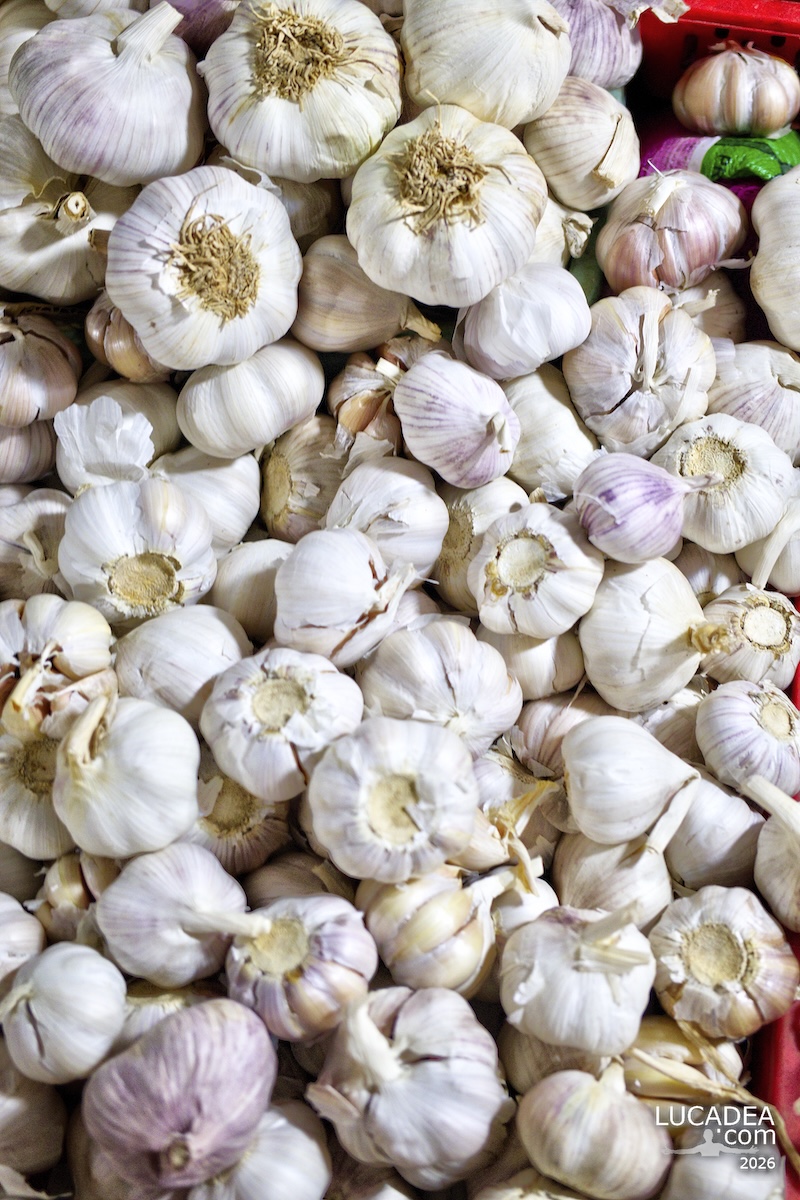
Garlic Stalls at a Vietnamese Market

Bancarella del mercato in Vietnam piena di teste d’aglio bianche e violacee impilate in grandi quantità ravvicinate

Garlic Stalls at a Vietnamese Market.
I find myself standing in front of a dense field of garlic that fills the frame so completely that everything else seems to fade into the background, and garlic becomes the immediate focus of this simple yet powerful scene. The garlic is stacked in countless clusters, some bulbs bright white, others marked with soft purple streaks that hint at different varieties and different hands that have shaped their journey to this market in Vietnam. Here, garlic is not just an ingredient but a constant presence, almost like a silent rhythm that structures the movement of sellers and buyers around the stalls.
As I look closer, I imagine the texture of each bulb, the dry papery layers protecting the cloves inside, and I think about how garlic defines so many everyday meals across Vietnam. The garlic here feels alive in its stillness, forming small landscapes of repetition and abundance that speak of harvest and labor. Even without sound or smell, the visual intensity of garlic is enough to fill the senses.
There is a small culinary truth tied to garlic in Vietnamese cuisine: it is often one of the first ingredients to hit the hot oil in a pan, building the aromatic foundation of countless dishes alongside shallots and chili. This simple step transforms garlic into something essential, shaping flavors that feel deeply rooted in local food culture.

Watching this scene, I start to wonder how many journeys each garlic bulb has taken before reaching this point, and how many meals it will continue to influence far beyond this market. How often do we stop and really observe something as ordinary, yet as essential, as garlic? Add a comment or go to the bottom of the site to read what other visitors have written.

Photos taken with Canon EOS R50 V and Canon RF 28 lens.

To see all the photos I took at the market, click here:

Spices at Olivar Market in Palma

Banco di spezie al mercato dell’Olivar a Palma di Maiorca con curry, peperoncino e colori diversi

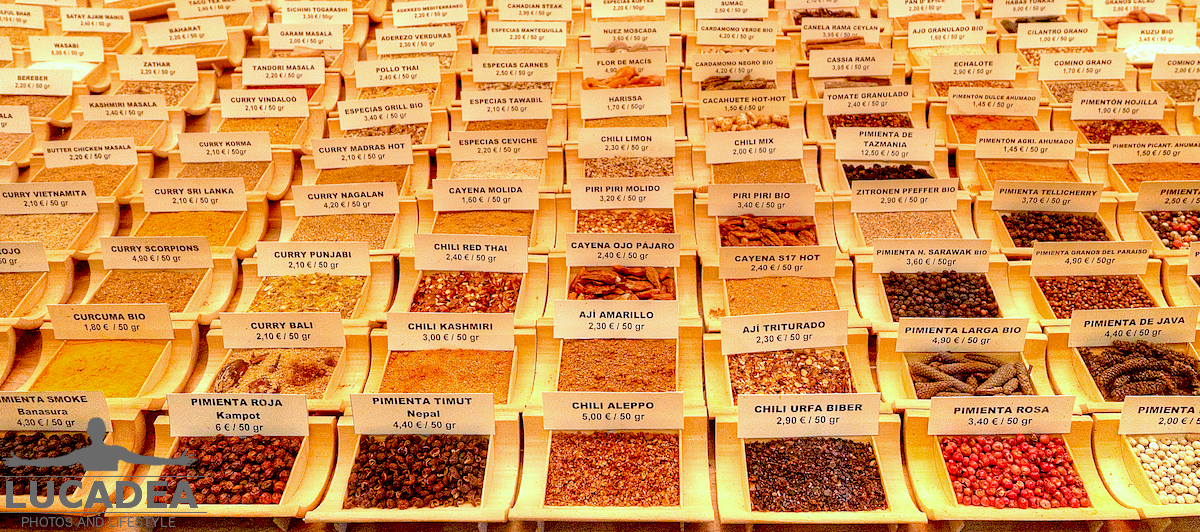
Spices at Olivar Market in Palma.
Among the colors and aromas of Olivar Market, I wanted to capture with my camera a small detail that tells a much bigger story: a journey through cultures and traditions represented by spices in Palma de Mallorca. This photograph comes from my attention to those simple elements often discovered while travelling, details that can reveal the identity of a place better than a large landmark.
Walking through Olivar Market in Palma de Mallorca, Balearic Islands, Spain, I stopped in front of this display filled with colorful containers and labels, each one suggesting a different story. It was not simply a collection of spices for sale, but a meeting point of flavors coming from different parts of the world, from Asia to the Mediterranean, from the Middle East to Latin America.
What immediately attracted my attention was the extraordinary variety of products available. Among the many names visible were Saharat, Zathar, Kashmiri Masala, Butter Chicken Masala, Garam Masala, Tandori Masala, Curry Vindaloo, Curry Korma, Curry Sri Lanka and Curry Madras Hot. Alongside these famous blends, there were also more unusual ingredients such as Chili Urfa Biber, Timut Pepper from Nepal, Black Cardamom, Mace Flower, Ají Amarillo and several varieties of pepper from distant regions.
I chose to photograph this stall because it represents the way a market can become a meeting place between people, cultures and culinary traditions. The image is not only about bright colors and carefully arranged containers; it suggests aromas, recipes and distant journeys hidden inside small packages.
Olivar Market is one of the places worth seeing in Palma de Mallorca if you want to experience a more everyday side of the city. Opened in the twentieth century, it remains a reference point for fresh products, local specialties and an atmosphere that feels more authentic than the busiest tourist areas.
A small curiosity about spice blends is that many famous mixtures, such as Garam Masala and different types of curry, do not have a single fixed recipe. Their ingredients often change according to region, family tradition and culinary use, making every version slightly different.
This photograph reflects my way of exploring places through simple details. After photographing streets, squares and architecture, I also enjoy finding stories in markets and everyday scenes. Like other images I have shared from local markets and urban life, this one tries to capture a place through something that might easily be overlooked.

If you were standing in front of this display, which spice or blend would you choose first? Add a comment or go to the bottom of the site to read what other visitors have written.

Spice stall at Olivar Market in Palma de Mallorca with colorful curry, masala and chili containers

Photo taken with a Canon EOS M100 camera and Canon EF-S 10-18 lens.

The term “spezie” (spices) generally refers to aromatic substances of plant origin (such as tarragon, thyme, lemon balm, juniper, marjoram, and saffron) used to flavor and season foods and beverages, and—especially in the past—in medicine and pharmacy. The word is “spezie” in both the plural and the singular (derived from “specie”), though the form “spezia” is also common in everyday usage.
Read more on Wikipedia

Colorful spices at Da Nang market

Spezie fresche al Con Market di Da Nang con zenzero, aglio e cipolle colorate disposte in ceste di plastica

Colorful spices at Da Nang market.
As soon as I step into the narrow aisles of Con Market, it’s the colors that strike me before anything else: the deep purple of the onions, the pale white of garlic, and the earthy tones of ginger piled high in plastic baskets. The spices create a vivid patchwork that feels both chaotic and perfectly balanced, a visual rhythm that draws me in without hesitation.
I move closer, careful not to interrupt the natural flow around me. The market in Da Nang moves with a quiet efficiency, where every gesture has meaning. Hands reach into baskets, weigh produce instinctively, and exchange goods in a seamless routine. The scent of ginger is sharp and energizing, while garlic carries a heavier, almost comforting aroma. Together, these spices form the invisible backbone of countless dishes.
I raise my camera and begin to frame the scene. There’s no need to arrange anything—the beauty is already there. The light falls unevenly across the baskets, highlighting textures and imperfections. Each root of ginger looks unique, almost sculptural, while the onions shine softly under the ambient light. It’s a moment that feels raw and unfiltered, exactly what I want to capture.
I linger on the details, noticing how these everyday ingredients hold a deeper cultural significance. In Vietnamese cooking, ginger and garlic are essential, quietly shaping flavors without ever demanding attention. They are the foundation, the subtle presence that makes everything else come alive.
Around me, the market continues its steady pulse. Vendors call out softly, customers negotiate, and life moves forward without pause. I take a few more shots, adjusting my perspective slightly, trying to capture not just the image but the feeling of being here.
When I finally step back, I realize that what stays with me isn’t just the photograph, but the sensory memory of the place—the colors, the smells, the rhythm.

Can you almost smell these spices just by looking at the scene? Add a comment or go to the bottom of the site to read what other visitors have written.

Spezie fresche al Con Market di Da Nang con zenzero, aglio e cipolle colorate disposte in ceste di plastica

Photo taken with Canon EOS RP and lens Canon RF 28.

To see all the photos I took at the market, click here:

Spezie colorate al mercato di Da Nang – Colorful spices at the market in Da Nang – Épices colorées au marché de Da Nang – Especias coloridas en el mercado de Da Nang – Especiarias coloridas no mercado de Da Nang – Bunte Gewürze auf dem Markt in Da Nang – Kleurrijke specerijen op de markt in Da Nang – ダナン市場の色とりどりのスパイス

The text of this post was written with the help of ChatGPT, a language model from OpenAI.

A myriad of spices at La Boqueria in Barcelona

Una miriade di spezie al mercato della Boqueria di Barcellona

A myriad of spices at La Boqueria in Barcelona.
Walking through La Boqueria market in Barcelona, Spain, I stopped in front of a display full of colorful spices, one of those small details that show what to see in Barcelona beyond the most famous landmarks. La Boqueria is one of the city’s best-known markets and, although it has become a very popular tourist destination, it still manages to surprise visitors with the incredible variety of products found inside.
Whenever I visit a market like this, I try to focus on the details that tell the story of the place. It is not only the fresh fruit stalls or the ready-to-eat food that catch my attention, but also those smaller corners where colors, shapes, and textures create unexpected photographic moments. This spice stall was exactly one of those scenes that made me stop and take out my camera.
In front of me there were containers filled with spices of all kinds. Some were carefully arranged in small bottles, while others were displayed loose and ready to be weighed. The colors were countless: the deep red of paprika, the bright yellow of turmeric, darker shades from aromatic mixtures, and many other tones that transformed the stall into a natural composition.
What impressed me most was not only the visual aspect. Standing close to the stall, I could almost imagine the aromas of the spices, a combination of intense scents connected to distant cuisines and different traditions. This mix of colors and sensations is what makes a visit to La Boqueria such a unique experience.
I have already shared other details from this market on the site, including the dried fruit stalls at La Boqueria in Barcelona and the grilled octopus with hummus enjoyed at La Boqueria. They are two very different experiences, but both show how many photographic ideas can be found inside this market.
La Boqueria was established in the 19th century and has become one of the symbols of Barcelona’s food culture. Even if tourism now plays an important role, small details like this spice stall still reveal the character of the place.

Have you ever visited La Boqueria and which stall caught your attention the most? Add a comment or go to the bottom of the site to read what other visitors have written.

Colorful spices displayed at a stall inside La Boqueria market in Barcelona

Colorful spices displayed at a stall inside La Boqueria market in Barcelona

Colorful spices displayed at a stall inside La Boqueria market in Barcelona

Colorful spices displayed at a stall inside La Boqueria market in Barcelona

Photos taken with Canon EOS M100 camera and Canon EF-M 11-22 lens.

Here’s where this market is located:

La Boqueria is the most famous market in Spain and one of the largest in Catalonia, covering 2,583 square meters and boasting more than 300 stalls. It is also one of the oldest markets in Spain: founded in the early 17th century on the outskirts of the city on the Pla de la Boqueria plain (which is now a small square in front of the current market) to avoid paying taxes on goods, it was later inaugurated in 1836, where it still stands today, halfway down the popular Rambla, between the Palacio de la Virreina and the Liceu Theatre.
Continue and learn more at Wikipedia

A basket with almost all the spices used in Vietnam

Cesta di spezie in Vietnam

A basket with almost all the spices used in Vietnam.
This could almost be the essence (or the majority of it) of the famous Vietnamese cuisine.
This was a street vendor’s basket. In Vietnam, in fact, on every corner and every dozen meters, there’s someone selling something to take home or to eat there.
Street food par excellence, I’d say!
From left, clockwise, ginger, garlic, onion, red chili pepper, lime; in the center, garlic again, but peeled.
Almost every dish contains at least one, if not more, of these spices.
In particular, I’d say garlic and chili pepper: almost all dishes, unless specifically requested at the time of ordering, are quite spicy.

Do you like Asian cuisine, and Vietnamese in particular?
Add a comment or go to the bottom of the site to read what other visitors have written.

Cesta di spezie in Vietnam

Cesta di spezie in Vietnam

Photos taken with Canon EOS M100 and lens Canon EF-M 22.

A basket with almost all the spices used in Vietnam – Un panier avec presque toutes les épices utilisées au Vietnam – Una canasta con casi todas las especias que se usan en Vietnam – Uma cesta com quase todas as especiarias usadas no Vietnã – Ein Korb mit fast allen in Vietnam verwendeten Gewürzen – Một giỏ với hầu hết các loại gia vị được sử dụng ở Việt Nam – 一个篮子里装了越南几乎所有的香料 – ベトナムで使われるほぼすべてのスパイスが入ったバスケット

Bún bò huế, Vietnamese soup

Bún bò huế, zuppa vietnamita

Bún bò huế, Vietnamese soup.
One of Vietnam’s most typical soups, originally from the city of Hué. Rice noodles, beef, and lots of spices.
This was the breakfast my Dao had yesterday morning. Definitely not my style.
I must say the soup itself was pleasant and the flavors weren’t too strong. Obviously, before adding the chili pepper…
Another thing that didn’t quite please me was that little purple bit, which I thought was tofu, but was actually solidified blood.
Anyway, I didn’t mind tasting it!

Do you like Asian cuisine, and Vietnamese in particular? Add a comment or go to the bottom of the site to read what other visitors have written.
If you want to know more about Vietnamese cuisine, there are many interesting recipe books on Amazon.

Bún bò huế, zuppa vietnamita

Bún bò huế, zuppa vietnamita

Photos taken with Canon EOS M100 and lens Canon EF-M 22.

Vietnamese cuisine is the expression of the culinary art developed in Vietnam. There are at least five hundred traditional Vietnamese dishes, demonstrating the extreme variety of the country’s cuisine. Among the typical and most widespread products is rice. Chinese cuisine is also important and has significantly influenced local cuisine.
Continue and learn more on Wikipedia

Bún bò huế, a typical soup of Vietnamese cuisine – Bún bò huế, une soupe typique de la cuisine vietnamienne – Bún bò huế, una sopa típica de la cocina vietnamita – Bún bò huế, uma sopa típica da culinária vietnamita – Bún bò huế, eine typische Suppe der vietnamesischen Küche – Bún bò Huế, món canh đặc trưng của ẩm thực Việt Nam – Bún bò huế,一种典型的越南菜汤 – ベトナム料理の代表的なスープ、Bún bò huế
🏠
  • Italiano