
The Villa Rocca Staircase Seen from Above

La scalinata del Parco di villa Rocca dall'alto

The Villa Rocca Staircase Seen from Above.
The staircase in the park of Villa Rocca in Chiavari, Liguria, is one of the features that caught my attention during my visit. A few months earlier, I had already shared a couple of photographs of the same monumental staircase, but those pictures were taken from below. This time I wanted to show it from a different perspective, looking down from above and focusing on the shapes and lines that make this part of the park so interesting.
What I particularly like about this photograph is the geometry of the double staircase. From this viewpoint, it is easier to appreciate the overall design of the two flights and the way they lead towards the open space at the bottom. The parallel lines create a strong visual pattern, guiding the eye through the composition and giving the photograph a sense of order and balance.
There is another detail I really enjoy: the cobblestone paving in the open area at the foot of the stairs. It adds a different texture to the scene and makes the composition more varied. The regular shapes of the steps contrast with the many small stones that form the surface below. I like the way these two elements work together, creating an image that is interesting without needing anything else to attract attention.
This is not the first time I have photographed this part of Villa Rocca. In my earlier pictures, taken from below, I wanted to show the impressive appearance of the staircase and the way it rises in front of the viewer. Changing position gives a completely different result. From above, the whole arrangement becomes easier to read, and the relationship between the two flights and the cobbled area is much more evident.
Villa Rocca Park is located in Chiavari, in the Metropolitan City of Genoa, in the Italian region of Liguria. It is a place where I found several details worth stopping for and photographing. Sometimes, returning to a subject that has already appeared in one of my photographs is a good opportunity to discover something new. The subject remains the same, but a different viewpoint can completely change the picture.
That is one of the things I enjoy most about photography: looking at a familiar place from another angle and finding a composition I had not noticed before. In this case, the double staircase and the cobbled paving were the details I wanted to bring together.

Which view do you prefer: the photographs taken from below or this overhead perspective? Add a comment or go to the bottom of the site to read what other visitors have written.

The double staircase in Villa Rocca Park in Chiavari, photographed from above with the cobblestone paved area at the bottom

Photo taken with a Canon EOS M100 camera and Canon EF-S 10-18 lens.

Add one  comment to this article or read  here what other visitors have written.
 
Adv
 
Disclamer

The rights on images, videos, choruses, text and all other material on the LUCADEA.com website are governed as per  Copyright page.


This page has been viewed 1 times today.
This month it has been viewed 2 times.
In total it has been viewed 2 times.
 

The Cordonata steps in the heart of Rome

Cordonata Capitolina a Roma, la monumentale scalinata di Michelangelo verso Piazza del Campidoglio

The Cordonata steps in the heart of Rome.
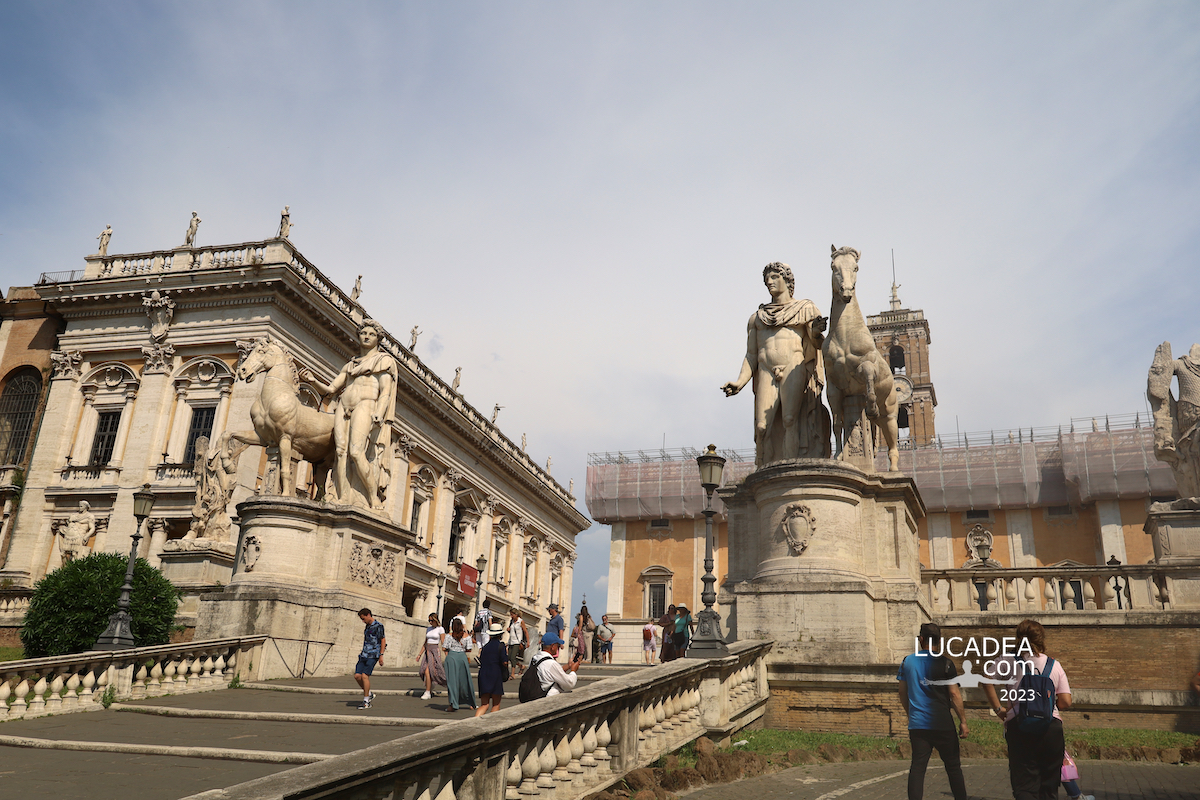
Walking toward Piazza del Campidoglio in Rome, Lazio, Italy, I found myself looking along one of the most recognizable approaches to the Capitoline Hill. The long staircase designed by Michelangelo leads the eye toward the square and immediately reveals the monumental character of this historic part of the city.
This is one of those photographs where the staircase is more than simply the subject. It becomes a way of reading the surrounding space. The Cordonata is different from many monumental stairways because of its relatively gentle incline and low steps, allowing people to move naturally toward the Campidoglio while the sides of the staircase guide the eye upward.
I wanted to capture this view with my camera because of the strength of the perspective. The Cordonata rises from the side of Piazza d’Aracoeli and leads toward Piazza del Campidoglio, creating a carefully designed connection between the lower city and one of the most important historic spaces in Rome.
If you are wondering what to see in Rome connected with Michelangelo, the Cordonata is certainly worth seeing. It is not simply a staircase used to reach the square. It is an essential part of the urban design of the Capitoline complex and still plays an important role in the way the entire site is perceived.
Its construction belongs to the sixteenth century, when Michelangelo worked on the redevelopment of the Capitoline Hill and gave the area a more coherent and monumental appearance. Piazza del Campidoglio, the Senatorial Palace and the surrounding buildings were organized as part of a unified architectural project, while the Cordonata became the principal approach from the city below.
One small curiosity concerns the shape of the staircase itself. The steps are deliberately low and the Cordonata is broad enough to allow horses and riders to climb it. It was therefore conceived not simply as a monumental staircase for pedestrians, but also as a ceremonial route leading toward the Campidoglio.
Decorative elements and sculptures accompany the ascent, gradually preparing the visitor for the architecture of the square. At the center of Piazza del Campidoglio stands the famous equestrian statue of Marcus Aurelius. The statue now visible outdoors is a replica, while the original is preserved in the Capitoline Museums.
What I find particularly interesting is the relationship between this Renaissance setting and everything surrounding it. The Capitoline Hill is one of those places where Rome’s different historical periods seem to exist within a very small area. In just a few minutes, it is possible to move from modern city streets to Renaissance architecture and then toward the remains of ancient Rome.
Looking at my photograph, however, I am not mainly interested in giving a historical explanation of the staircase. What stays with me is the visual effect of the ascent. The steps naturally draw the eye upward, creating a line that seems to invite you toward the square.
This is also what makes Rome so rewarding to photograph. A city as familiar as Rome can easily become reduced to its most famous images, yet even well-known places can look different when the viewpoint changes slightly. The Cordonata is an iconic part of the Campidoglio, but it still offers perspectives worth stopping for.
When I photograph a monumental staircase, I often look for the way it controls the viewer’s gaze rather than simply documenting its architecture. Here, the ascent becomes an invitation into the square, while the proportions of the surrounding buildings gradually reveal the scale of the whole composition.
This photograph also connects naturally with other historic places I have photographed and written about on the blog, where I often focus on architectural details and urban views rather than only the most famous postcard scenes. Over time, these images become a personal visual record of the places I have visited.
For me, the Cordonata Capitolina remains an image of transition: a staircase connecting two levels of the city, but also two different ways of experiencing Rome. As you climb, the city below gradually falls behind and Piazza del Campidoglio begins to open ahead.
Perhaps that is its strongest photographic quality. Nothing needs to be added to the scene. The geometry of the steps, the perspective and the architecture at the top already provide everything needed for an interesting composition.

Have you ever walked up the Cordonata while paying attention to it as a work of art in its own right? Add a comment or go to the bottom of the site to read what other visitors have written.

Cordonata steps in Rome leading to Campidoglio square, a monumental staircase designed by Michelangelo

Photo taken with a Canon EOS RP camera and Canon RF 24-50 lens.

Click here to see all the photos of Rome:
foto gallery

Here is where the staircase is located:

Add one  comment to this article or read  here what other visitors have written.
 
Adv
 
Disclamer

The rights on images, videos, choruses, text and all other material on the LUCADEA.com website are governed as per  Copyright page.

This page has been viewed 1 times today.
This month it has been viewed 1 times.
In total it has been viewed 5 times.
 

The steps of Pretoria Fountain in Palermo

Scalinata della Fontana Pretoria nel centro storico di Palermo, con le numerose statue visibili dalla piazza

The steps of Pretoria Fountain in Palermo.
Walking through the historic centre of Palermo, I came across one of those views that naturally made me stop. From the staircase leading towards the square, the large number of statues that make up Pretoria Fountain gradually comes into view, creating one of the city’s most recognisable monumental scenes.
For this photograph, I wanted to keep the perspective from the staircase and let the statues become the main focus of the image. It is different from the usual frontal view and makes it easier to appreciate how complex the fountain is, with its many figures overlapping and creating an almost theatrical composition.
Pretoria Fountain stands in the heart of Palermo’s historic centre, in the square of the same name, beside the Palazzo delle Aquile and close to Piazza Bellini. If you are wondering what to see in central Palermo, this is one of those places that can easily become part of a walk through the old city and deserves a little time to be observed rather than simply passed by.
What caught my attention most was the relationship between the staircase and the fountain. As you move up or down the steps, the statues constantly change in relation to your viewpoint, and the composition seems to shift with every few steps. As a photographer, these small changes in perspective are often enough to make me stop.
I took this photograph myself during my summer visit to Palermo. I still had many images to make around the city and, when I reached this square, I preferred to look for a viewpoint that could tell something about the monument without relying on the usual overall composition.
The history of Pretoria Fountain is particularly unusual. The fountain was created in Florence during the sixteenth century for a villa, but it was later purchased by the city of Palermo and moved to Sicily. The complex was then reassembled in its new location, with further work and adaptations made to fit the square.
That origin makes the monument even more interesting to me. While walking through Palermo, you are looking at a fountain that has become deeply connected with the city even though it was originally created somewhere else. Knowing this changes the way I see the photograph: the statues become not only decorative figures, but also traces of a story involving movement, transformation and a completely new setting.
The square itself has a strong influence on how the fountain is perceived. The monument occupies much of the central space and the figures are arranged across several levels, creating a very dense visual presence. From the staircase, however, the composition feels even more layered.
I enjoy photographs like this because they do not necessarily need to show everything. Sometimes a particular section of a monument can convey my experience of being there better than a complete view. In this case, I chose the staircase because it allowed me to approach the fountain visually and let the statues emerge one after another.
Looking at the photograph, you can almost imagine the experience of someone arriving in the square for the first time. One figure appears first, then others emerge behind it, and only gradually does the scale of the entire composition become clear. I find that perspective more interesting than a straightforward frontal photograph.
Pretoria Fountain is also a good example of how much art and architecture are concentrated within a relatively small part of Palermo. Walking through the historic centre, you constantly move from one square to another, and simply changing direction or climbing a staircase can reveal another possible photographic subject.
In other stories from my visit to Palermo, I have also focused on this way of looking at the city, paying attention to smaller details rather than only photographing its most famous landmarks. After photographing the two lions of Teatro Massimo, for example, it felt natural to continue looking for architectural details that might otherwise remain secondary to the larger view.
This image comes from the same approach. I did not simply want to document Pretoria Fountain. I wanted to preserve the particular viewpoint I had in front of me at that moment.
The history of the fountain certainly adds something to the photograph, but in the end I prefer to let the image do most of the talking. There are monuments where a little historical context helps us understand what we are looking at, but eventually there comes a moment when the best thing to do is simply observe.
And this staircase, with all those statues gathered in front of me, felt like exactly that kind of moment.

Have you ever stopped to look at Pretoria Fountain from the staircase? Add a comment or go to the bottom of the site to read what other visitors have written.

Steps leading to Pretoria Fountain in Palermo's historic centre, with its many statues visible from the square

Photo taken with Canon EOS M100 and lens Tamron 16-300.

Here is where the fountain is located:

Click here to see other photos taken in the city:
foto gallery

The great white Buddha at Ong Nui temple

Grande statua bianca del Buddha al tempio Ong Nui in Vietnam, con lunga scalinata centrale e vegetazione ai lati

The great white Buddha at Ong Nui temple.
The staircase stretches upward in a straight, almost hypnotic line, pulling my eyes toward the massive Buddha sitting quietly above everything else. The Buddha seems to merge with the pale sky, its white surface dissolving into the soft light, creating a calm yet striking presence that immediately anchors the scene.
As I follow the steps visually, I begin to notice the human scale hidden within the composition. Tiny figures move along the stairs, emphasizing just how immense the Buddha truly is. The structure feels deliberate, designed to slow down both the body and the gaze. The Buddha sits in a meditative pose, its robe carved with flowing lines that appear soft despite the solid material. There is no motion, yet it feels deeply alive.
Ong Nui temple, also known as Linh Phong Pagoda, is home to one of the largest seated Buddha statues in Vietnam, and that fact becomes almost obvious just by looking at it. The size is not overwhelming in a chaotic way, but rather grounding, as if everything here is meant to guide visitors toward stillness and reflection.
The rocky slopes on both sides frame the staircase naturally, while the green vegetation breaks the dominance of white and adds texture to the scene. This balance between nature and structure gives the image a sense of harmony. And above it all, the Buddha remains unchanged, a fixed point that contrasts with the subtle movement of people below.
There is an implied silence in this place. Even without hearing anything, I can almost feel the quiet atmosphere surrounding the temple. The Buddha does not demand attention; it simply exists, and that is enough to shift the way you perceive the space around you.
Looking back at this moment, I wonder if the real experience was the physical climb or that instant when I lifted my eyes and truly understood the scale of the Buddha.

Have you ever stood in front of something so vast that it made you feel small in a comforting way? Add a comment or go to the bottom of the site to read what other visitors have written.

Photos taken with Canon EOS R50 V and Tamron 16-300 lens.

To see all the photos of the complex, click here:
foto gallery

The great white Buddha of Ong Nui temple – Le grand Bouddha blanc du temple Ong Nui – El gran Buda blanco del templo Ong Nui – O grande Buda branco do templo Ong Nui – Der große weiße Buddha des Ong Nui Tempels – Tượng Phật trắng lớn tại chùa Ong Nui – 翁努寺的巨大白色佛像 – オングヌイ寺の大きな白い仏像

The text of this post was written with the help of ChatGPT, a language model from OpenAI.

The grand staircase of Linh Ung Pagoda in Da Nang

Scalinata monumentale della Linh Ung Pagoda a Da Nang con visitatori che salgono verso l’ingresso decorato del tempio

The grand staircase of Linh Ung Pagoda in Da Nang.
Climbing the steps of Linh Ung Pagoda, I found myself drawn into a slow and steady rhythm, shaped by footsteps, brief pauses, and silent exchanges between people sharing the same path. The staircase stretches upward in a way that feels almost endless, yet it never becomes overwhelming, as if it naturally guides you without asking for effort.
I stopped several times along the way, not just to catch my breath but to observe how the scene unfolds gradually. The stone details along the sides, the subtle decorations, and then, little by little, the temple gate rising at the top. Linh Ung Pagoda reveals itself step by step, never all at once.
What stood out to me was how people interacted with the space. Some walked slowly, others paused halfway, and a few turned back just to capture a different angle. There was no fixed pace, just a shared understanding of the moment. While taking photos, I tried to respect that flow, letting movement become part of the composition rather than interrupting it.
As I moved higher, the entrance of Linh Ung Pagoda became more imposing. The structure’s lines, the soft but defined colors, and the feeling of crossing into something different. It didn’t feel like just an architectural feature, but more like a transition point, something that quietly separates one space from another.
I later learned that many pagodas in Vietnam are designed with elevated and scenic entrances to create a symbolic journey, marking a gradual transition from the outside world to a more spiritual space. Here, that idea feels very real, but also tangible and accessible.
Looking back at the photo, I realize that the staircase itself is the true subject, even more than the gate at the top. It leads the eye and tells the story of the place.

Do you enjoy places that reveal themselves slowly as you move through them? Add a comment or go to the bottom of the site to read what other visitors have written.

Scalinata monumentale della Linh Ung Pagoda a Da Nang con visitatori che salgono verso l’ingresso decorato del tempio

Photo taken with Canon EOS RP and Tamron 16-300 lens.

To see all the photos I took in the pagoda, click here:
foto gallery

Where is the pagoda located:

The Stone Staircase of San Pietro

La scalinata in pietra della chiesa di San Pietro a Portovenere

The Stone Staircase of San Pietro.
The stone staircase of the Church of San Pietro in Portovenere, Liguria, in the province of La Spezia, Italy, is one of those architectural details that help make this beautiful seaside village so distinctive. The church stands on a rocky promontory extending into the Gulf of Poets, directly opposite Palmaria Island, and is one of the most recognisable landmarks along the Ligurian coast. In this particular view, the focus is on the steps leading to the terrace beside the bell tower.
I enjoy looking at details like these because they tell the story of a place in a different way from the familiar views of its main monuments. A stone staircase might seem like a simple, almost secondary feature, but in a setting like Portovenere it becomes an essential part of the landscape. The worn surfaces, irregular shapes and relationship with the surrounding structures create an atmosphere that immediately evokes the village’s long history.
The Church of San Pietro has very ancient origins. The present complex brings together an older section associated with early Christian and Romanesque architecture and a Gothic structure built by the Genoese during the thirteenth century. The distinctive alternating bands of light and dark stone have become one of Portovenere’s most recognisable architectural features. Its dramatic position between the rocky headland and the open sea makes the entire complex even more remarkable.
The staircase leads visitors towards the terrace beside the bell tower, where beautiful views open across the coastline and the waters surrounding the promontory. It is a place worth exploring slowly, noticing how the stonework blends with the natural rock and how the architecture seems to follow the shape of the ground. Here, the landscape is not simply a backdrop; it is an essential part of the experience.
When exploring places like this, I often try to pay attention to less obvious features that might go unnoticed while everyone searches for the most famous photograph. A staircase, an old wall or a corner beside a bell tower can reveal a great deal about a place’s character and offer interesting photographic perspectives.
On Lucadea.com, I share photographs of landscapes, villages and architectural details discovered during my travels. This staircase is another small fragment of Portovenere, a place where history and natural beauty come together in a remarkable way.

Have you visited the Church of San Pietro in Portovenere? Do you also stop to admire architectural details, or are you more drawn to the views across the sea? Add a comment or go to the bottom of the site to read what other visitors have written.

Stone staircase at the Church of San Pietro in Portovenere, with steps leading to the terrace beside the historic bell tower

Photo taken with Canon EOS RP and Canon RF 24-50 lens.

I also recorded a short video of me walking around the village:

Video recorded with Gopro Hero5.

Click here to see all the photos of the village:
foto gallery

Where is the church:

The Buddha statue on the summit of Mount Fansipan

Buddha a Fansipan in Vietnam

The Buddha statue on the summit of Mount Fansipan in Vietnam.
An immense statue dedicated to this great figure, located right at the top of the Asian country.
Beyond the statue itself, which is already impressive, there is also this staircase with a fountain that makes it even more majestic.

Have you ever been to Vietnam? Add your own comment or go to the bottom of the site to read what other visitors have written.

Buddha a Fansipan in Vietnam

Buddha a Fansipan in Vietnam

Photos taken with Canon EOS M100 camera and Tamron 16-300 lens.

This is a time-lapse video I shot that day:

Click here to see all the photos I took there:
foto gallery

Here’s where the mountain is located:

La statua di Buddha sulla cima del monte Fansipan in Vietnam – La statue de Bouddha au sommet du mont Fansipan au Vietnam – La estatua de Buda en la cima del monte Fansipan en Vietnam – A estátua de Buda no topo do Monte Fansipan, no Vietnã – Die Buddha-Statue auf dem Berg Fansipan in Vietnam – Tượng Phật trên đỉnh Fanxipan của Việt Nam – 越南番西邦山顶的佛像 – ベトナムのファンシーパン山の頂上にある仏像

The straight Palestro street in Genoa

La dritta via Palestro a Genova

The straight Palestro street in Genoa.
From Piazza Corvetto, this long, straight street leads to the beautiful monumental staircase that ascends to the hills of the Castelletto neighborhood.
Via Palestro is one of the most fascinating and historically rich streets in Genoa. Located in the heart of the city, it represents a meeting point between the glorious past and the dynamic present of this wonderful port city. With a mix of historic buildings, businesses, and green spaces, Via Palestro is a microcosm of Genoese life.
The name “Via Palestro” originates from the historic Battle of Palestro in 1859, a crucial stage in the Second Italian War of Independence. This battle saw the victory of the Franco-Piedmontese troops against the Austrian army and represents an important moment in the process of Italian unification. Naming a street after this event pays tribute to the sacrifices and courage demonstrated during that period.
Walking along Via Palestro, you can admire a variety of architectural styles that reflect the city’s different historical eras. Nineteenth-century buildings with their wrought-iron balconies stand alongside more modern structures, creating an eclectic and fascinating cityscape. The elegant facades and decorated doorways testify to Genoa’s rich history and culture.
Palazzo Doria Spinola: One of the most notable buildings along Via Palestro is the Palazzo Doria Spinola, a magnificent historic residence that now houses important institutional offices. This palace is a perfect example of Genoese Renaissance architecture.
Teatro Politeama Genovese: One of Genoa’s most famous theaters.
Gardens of Villa Gruber: These nearby gardens offer a green space where residents and visitors can relax and enjoy a moment of tranquility amid the hustle and bustle of the city. They are an ideal place for strolls and panoramic views of the city.
Church of San Bartolomeo degli Armeni: This church, not far from Via Palestro, is a historic place of worship that houses valuable works of art, including the famous miraculous crucifix attributed to Saint Bartholomew.

Do you know this street in Genoa? Add a comment or go to the bottom of the site to read what other visitors have written.

Photos taken with Canon EOS RP and lens Tamron 16-300.

Here’s where the street is:

The Battle of Palestro is an episode of the Second Italian War of Independence. It was fought on May 31, 1859, in Palestro, preceded by a smaller battle the day before. Piedmontese troops under King Victor Emmanuel II of Savoy conquered Palestro and several nearby towns near Vercelli on May 30, 1859. Their aim was to cover a large maneuver by the allied French army, commanded by Napoleon III of France, which was taking place further north and aimed at Milan. The following day, the Austrians under General Fredrick Zobel attempted to recapture their lost positions and were repelled near Palestro by Enrico Cialdini’s 4th Piedmontese Division, effectively supported by the French 3rd Zouave Regiment. The Franco-Piedmontese victory on May 31 further disoriented the Austrians and allowed Napoleon III to carry out his maneuver towards Milan.
Continue and learn more at Wikipedia

The straight street called Palestro in Genoa – La rue droite appelée Palestro à Gênes – La calle recta llamada Palestro en Génova – A rua reta chamada Palestro em Gênova – Die gerade Straße namens Palestro in Genua – Con đường thẳng tắp mang tên Palestro ở Genoa

The text of this post was written with the help of ChatGPT, a language model from OpenAI.

The stone steps of San Francesco in Bevagna

La scalinata della chiesa di San Francesco a Bevagna

The stone steps of San Francesco in Bevagna.
While walking through the narrow streets of this Umbrian village, I found this view of the Church of San Francesco, one of the places worth seeing in Bevagna for anyone who loves historic Italian towns and their authentic details. This photograph of the stone staircase captures a small corner of Bevagna, Umbria, Italy, where architecture and everyday spaces blend together naturally.
I was exploring the village when these steps leading towards the church caught my attention. The texture of the stone, the gentle perspective created by the staircase and the way the building fits into the surrounding streets created a simple but meaningful scene. I wanted to capture this detail with my camera because it represented the quiet character of the village rather than a famous viewpoint.
Bevagna is a place where many discoveries come from simply walking without a strict route. Every street and small passage can reveal a different composition, and this staircase of San Francesco is a good example of how the identity of a village is often hidden in its smallest details. The image is not only about a church entrance; it is about the relationship between people, architecture and the paths they have followed for centuries.
For visitors wondering what to see in Bevagna, the historic centre offers many perspectives beyond the main squares and better-known buildings. The beauty of the village is also found in places like this, where a simple staircase becomes part of the story of the town. The stone steps invite you to slow down and observe the materials, shapes and signs left by time.
The Church of San Francesco is connected with the Franciscan tradition that has played an important role in Umbrian history. Its architecture reflects the medieval origins of the building and the influence of religious communities in the development of local towns. A small historical curiosity is that Umbria has preserved many places connected with Saint Francis of Assisi, creating a cultural landscape strongly associated with his legacy.
This photograph was taken during my visit to Bevagna, and it represents the kind of detail I often look for when I travel: a scene that does not need dramatic elements to tell a story. As with other images I have shared on Lucadea.com about Umbrian villages, I enjoy focusing on the connection between places and the small visual memories they leave behind.
If you are visiting Umbria, this kind of corner is one of the reasons why Bevagna is a place worth seeing: not only for its history, but also for the atmosphere found while walking through its streets. The staircase becomes a quiet meeting point between the past and the present, a simple subject that preserves the feeling of the journey.

Which detail of Bevagna would you choose to photograph during a walk through the village? Add a comment or go to the bottom of the site to read what other visitors have written.

Stone staircase leading to San Francesco Church in Bevagna, showing a historic Umbrian village corner

Photo taken with Canon EOS RP and Canon RF 24-50 lens.

To see all the photos I took in the village, click here:

Here’s where the staircase is located:

Filippo Silvestri (Bevagna, June 22, 1873 – Portici, June 10, 1949) was an Italian entomologist. His subsequent career developed within this institution, becoming director of the Higher Agricultural Institute of Portici between 1920 and 1930 and bringing it to worldwide fame. The institute’s insect collection, which includes approximately two thousand species collected by Silvestri in over half a century of activity, is still considered among the most important in the world.
Continue and learn more at Wikipedia

A Glimpse of Varese Ligure

Uno scorcio di Varese Ligure

A Glimpse of Varese Ligure.
Walking through the narrow lanes of the Borgo Rotondo in Varese Ligure, I often find myself slowing down when a small architectural detail suddenly gives the street its character. This is one of those views: a stone stairway, old plastered walls, green shutters, potted plants and a broad supporting arch come together in a compact corner of the historic centre. It is also a good example of what to see in Varese Ligure when the quieter details are more interesting than a single famous landmark.
Every time I return to the Borgo Rotondo, I end up taking several photographs around the historic centre and Piazza Fieschi. I like looking at the connections between the houses, especially where stairs, passages and arches create different levels within a very small space. This particular scene caught my attention because the stairway does not simply lead somewhere; it also frames the lane behind it. The arch above becomes almost a second doorway, while the green shutters and plants give the old stone and plaster a distinctly lived-in feeling.
I took this photograph myself, focusing on the whole arrangement rather than on one isolated architectural feature. The composition is vertical, which allows the eye to move naturally from the paving in the foreground up the steps, under the arch and toward the buildings beyond. The green railings repeat the colour of the shutters, while the terracotta pots add another small layer of everyday detail. The wall surfaces are not perfectly uniform, and that is precisely what makes the scene work for me: the marks, repairs and changes in texture show that these buildings have been used and maintained over time.
Varese Ligure is in Liguria, in the province of La Spezia, Italy, and the Borgo Rotondo is especially recognizable for the way its historic houses developed around Piazza Fieschi. The circular arrangement is a small architectural curiosity that becomes easier to understand once you walk through the surrounding lanes. From inside the streets, the overall shape is less obvious, but the sequence of arches, passages and stairways gives the settlement a distinctive sense of continuity.
If you are visiting Varese Ligure, this is the kind of corner worth seeing without rushing from one attraction to another. The photograph suggests a simple way of exploring the village: look at the transitions between buildings, notice the stairs and follow the smaller passages. For me, these details often say more about a place than a broad view ever could. They also explain why I keep returning to the same historic centres with my camera: familiar streets can still reveal a different composition each time.
The arch of the photograph is particularly important to the way I see the scene. Structurally, an arch of this kind can help connect and support neighbouring masonry walls, but visually it does something else as well. It creates a strong horizontal line above the stairway and separates the closer part of the lane from the buildings farther inside. The effect is almost like finding a frame already built into the street.
The watermark in the photograph carries the year 2024. I do not have EXIF information from the image file that would allow me to establish a precise shooting date or time, so I prefer to leave those details open rather than attach an unsupported date to the photograph.
This image also connects naturally with the other photographs I have published on Lucadea.com about Ligurian villages and historic centres. I enjoy returning to that same photographic thread, because every small street seems to offer another combination of stone, colour, plants and old architecture. Here, the relationship between the stairway and the arch is what made me stop, but the green shutters and terracotta pots are what keep the image visually alive.

Which detail would catch your eye first here: the arch, the green shutters or the line of terracotta pots? Add a comment or go to the bottom of the site to read what other visitors have written.

Stone stairway in Varese Ligure’s Borgo Rotondo, framed by an old arch, green shutters and terracotta pots

Photo taken with Canon EOS RP and Canon RF 28 lens.

If you want to see all the photos taken in Varese Ligure, click here:
foto gallery

Here’s where the town is located:

🏠
  • Italiano