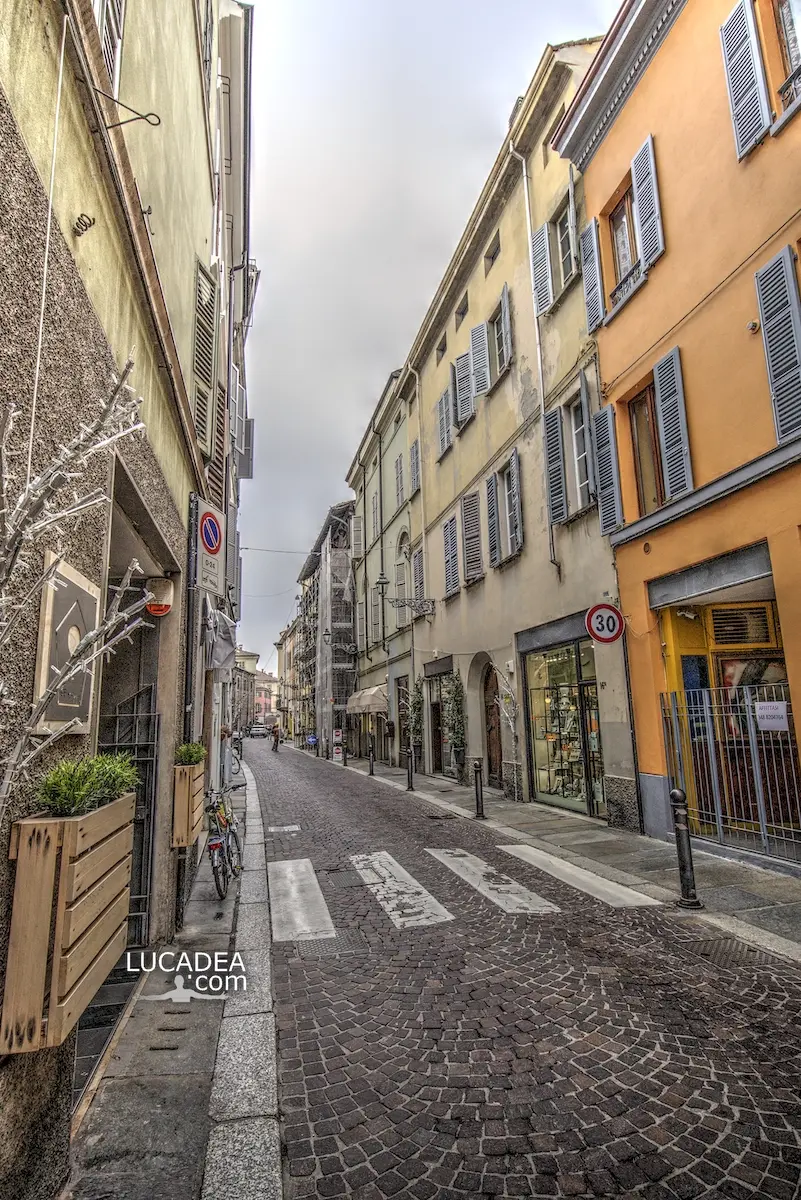
The Narrow Streets of Parma’s Historic Centre

I vicoli del centro storico di Parma

The Narrow Streets of Parma’s Historic Centre.
Walking through the historic centre of Parma, in the Emilia-Romagna region of Italy, I enjoyed exploring its characterful streets, small craft shops and places where good food is never far away. It is the kind of city centre that invites you to slow down, look around and follow whichever little street happens to catch your attention.
What I particularly liked was the atmosphere of these narrow lanes. Traditional façades, shop windows and unexpected views between the buildings give the streets plenty of character. You do not always need to visit a famous landmark to find something worth photographing. Sometimes an ordinary street corner, a small shop or an interesting doorway can capture the spirit of a place just as well.
As I wandered through Parma, I found myself thinking about the *caruggi* of Liguria, the narrow alleys in the region’s historic centres that I often photograph and share here. There is a similar pleasure in turning into a side street, discovering a small independent business and seeing everyday life unfold among old buildings. The two places are certainly different, each with its own history and identity, but the atmosphere brought those familiar Ligurian streets to mind.
Parma is famous for its food traditions, and a walk through the old town offers plenty of opportunities to appreciate that side of local life. Along the way, small shops and inviting places to eat add to the experience. Yet there is more to the city than its celebrated cuisine. Its streets also reveal a rich urban character, with details that reward anyone willing to explore at a relaxed pace.
For street photography, these lanes provide plenty of inspiration. The changing perspectives, signs, colours and architectural details make every turn a little different. I enjoy photographing this kind of setting because it captures more than buildings: it records the feeling of being there, moving through the city and noticing things that might otherwise go unseen.
One of the pleasures of travelling is discovering places that unexpectedly remind you of somewhere familiar. In Parma, these streets brought back memories of the Ligurian alleys that appear so often in my photographs.

Have you explored the historic centre of Parma? And have you ever found a street in another city that reminded you of somewhere you already knew and loved? Add an comment or go to the bottom of the site to read what other visitors have written.

Narrow streets in Parma's historic centre, with traditional buildings, small craft shops and charming views between old façades

Photo taken with a Canon EOS M100 camera and Canon EF-M 11-22 lens.

To see all the photos I took in the city, click here:

Add one  comment to this article or read  here what other visitors have written.
 
Adv
 
Disclamer

The rights on images, videos, choruses, text and all other material on the LUCADEA.com website are governed as per  Copyright page.


This page has been viewed 0 times today.
This month it has been viewed 0 times.
In total it has been viewed 0 times.
 

Walking the old streets of Cádiz

Stradina del centro storico di Cadice in Spagna, con caratteristiche finestre dagli infissi in legno sporgenti

Walking the old streets of Cádiz.
Walking through the center of Cádiz, Andalusia, Spain, I kept finding myself looking up at the facades, especially at the windows with their strongly projecting wooden frames. This kind of old-town detail is what I enjoy photographing when I travel, because it tells something about a city without needing to focus on one of its major landmarks.
The streets in the historic center are often narrow and enclosed, with buildings standing close together and a constantly changing sequence of doors, balconies and windows. Among all these details, the wooden window frames stand out. Some project noticeably from the facades, giving the windows a particular depth and creating interesting perspectives when several buildings appear one after another.
That was what made me stop with my camera. I was not necessarily looking for one of the famous images of Cádiz. Instead, I wanted to preserve the feeling of simply walking through the center, when there is no specific destination and an architectural detail can suddenly become the reason to stop.
Cádiz also has one feature that makes exploring the city particularly convenient for visitors arriving by sea. Cruise ships normally dock very close to the city center, so after leaving the ship it can take only a few minutes to reach the historic streets on foot. That makes the first encounter with the city feel immediate: there is very little distance between the waterfront and the narrow streets where everyday life continues.
If you are visiting Cádiz and wondering what to see, there are certainly better-known monuments and landmarks, but I find that part of the character of the city appears while simply walking between them. The route itself becomes interesting, with colorful facades, small balconies, entrances, windows and unexpected views appearing as you move from one street to another.
The windows in this photograph caught my attention because they are such a distinctive architectural detail. Their wooden frames project from the facades and give the streets a character that feels different from many other European cities. It is not necessarily something that requires a long explanation. You simply notice it once you start looking carefully at the buildings around you.
One small historical curiosity is that Cádiz is traditionally regarded as one of the oldest cities in Western Europe, with origins associated with the Phoenicians. Its position on a peninsula facing the Atlantic helped make it an important maritime and trading center over the centuries, and the connection with the sea remains noticeable even after leaving the harbor and entering the historic center.
This photograph therefore came mainly from observation. I wanted to stop and capture a view that I could easily have walked past without noticing. Instead, those wooden windows made me think about how recognizable a city can become through architectural details that might seem secondary at first.
This is one of the things I enjoy about photographing while traveling. I do not only look for the places that are already famous in photographs and guidebooks. I also try to let the walk itself suggest what deserves to be photographed. In Cádiz, that happened several times, particularly in the historic center, where every turn can reveal a slightly different perspective.
The image also connects naturally with other posts on my site about historic centers I have photographed during my travels. I like building these stories from small fragments because they often become the details that bring a place back to mind later. A city can remain in your memory not only through its main landmarks, but through a particular street, a window or an unexpected view.
For me, this photograph brings back a simple walk through Cádiz, starting almost directly from the port and continuing into the old streets without needing a complicated plan. At some point I looked up at the facades, noticed these projecting wooden windows and decided that the detail was worth keeping in a photograph.
If you are visiting Cádiz, these are exactly the kinds of details I would keep an eye out for while walking through the center. They may not be the first things you expect to photograph, but they can become some of the most personal memories of a place.

Have you ever walked through Cádiz and noticed these distinctive wooden windows? Add a comment or go to the bottom of the site to read what other visitors have written.

Narrow street in Cádiz, Spain, with characteristic windows featuring projecting wooden frames on the historic facades

Photo taken with Canon EOS RP and Canon RF 24-50 lens.

To see all the photos of the Spanish city, click here:
foto gallery

Here’s where the city is located:

It is probably the oldest city founded in the western Mediterranean by the Phoenicians in the 11th century BC, although its official origins are now dated to the late 8th century BC. It was founded with the original name of Gadir (in Phoenician: Gdr, fortress, with the same etymology as Agadir in Morocco) on what was once a small archipelago and now a single island, to exploit the rich trade routes with the Atlantic Ocean in the copper and tin trade. In ancient Greece it was known as Gadeira and in Roman times as Gades, from which the current family name of gaditano derives.
Continue and learn more at Wikipedia

Add one  comment to this article or read  here what other visitors have written.
 
Adv
 
Disclamer

The rights on images, videos, choruses, text and all other material on the LUCADEA.com website are governed as per  Copyright page.


This page has been viewed 1 times today.
This month it has been viewed 1 times.
In total it has been viewed 5 times.

 

A view of Via del Campo Street in Genoa

Uno scorcio di via del Campo a Genova

A view of Via del Campo Street in Genoa.
I like walking through the historic center of Genoa, even though I always feel a bit uneasy taking photos with so many people in front of me.
For this reason, I never manage to get very sharp photos in this Genoese alley.

Do you know the historic center of Genoa? Add a comment or go to the bottom of the site to read what other visitors have written.

Uno scorcio di via del Campo a Genova

Photo taken with Canon EOS RP camera and Canon RF 24-50 lens.

Here’s more or less where I took the photo:

A glimpse of Via del Campo in Genoa – Un aperçu de la via del Campo à Gênes – Un vistazo a la vía del Campo en Génova – Um vislumbre da via del Campo em Génova – Ein Blick auf die Via del Campo in Genua – Một cái nhìn thoáng qua qua del Campo ở Genoa

The statue dedicated to Giuseppe Mazzini in Chiavari

La statua dedicata a Giuseppe Mazzini a Chiavari

The statue dedicated to Giuseppe Mazzini in Chiavari.
I always try to photograph things from different perspectives so I don’t end up repeating the same shots.
Like in this case, the statue of Mazzini in the square of the same name in Chiavari, seen from behind and from the side on an afternoon without the market.

Do you know this statue in Chiavari? Add your own comment or go to the bottom of the site to read what other visitors have written.

Photos taken with Honor 20.

Here’s where the statue is located:

Giuseppe Mazzini (Genoa, June 22, 1805 – Pisa, March 10, 1872) was an Italian patriot, politician, philosopher, and journalist. A leading exponent of Risorgimento patriotism, his ideas and political actions contributed decisively to the formation of the unified Italian state. However, the convictions he received in various Italian courts forced him into hiding until his death, as he was a staunch supporter of the republican institution against the Savoy monarchy.
Continue and learn more at Wikipedia

The statue dedicated to Giuseppe Mazzini in Chiavari – La statue dédiée à Giuseppe Mazzini à Chiavari – La estatua dedicada a Giuseppe Mazzini en Chiavari – A estátua dedicada a Giuseppe Mazzini em Chiavari – Die Giuseppe Mazzini gewidmete Statue in Chiavari – Bức tượng dành riêng cho Giuseppe Mazzini ở Chiavari

Roma street, the beautiful alley of Lavagna

Via Roma, il bel caruggio di Lavagna

Roma Street, Lavagna’s Old Town.
One of the nicest ways to discover Lavagna, on the Ligurian Riviera in north-western Italy, is to walk through its historic centre. Roma Street is the town’s traditional main street, known locally as the *caruggio*, where shops, historic buildings and everyday life come together in a distinctly Ligurian atmosphere.
Many towns and villages in Liguria have a central street that runs through the old town. Locals call these streets *caruggi*, and they have traditionally been places for shopping, meeting friends and going about daily business. In Lavagna, Roma Street is an important part of the town’s identity. Walking along it gives visitors the chance to enjoy the architecture, look at the shop windows and notice the details that might be missed when travelling by car.
Lavagna lies in the Tigullio area of the Italian Riviera, a stretch of coastline known for its historic towns and seaside scenery. Its old town is worth exploring at a leisurely pace, and Roma Street provides a natural route through its lively centre. Along the way, visitors can find notable landmarks such as the Basilica of Santo Stefano and the Brignardello Portico. The official Liguria tourism guide to Lavagna also describes this traditional street as the commercial heart of the town.
I took this photograph a few months ago, wanting to capture the character of a place that may seem ordinary at first glance but has plenty of charm when you take the time to look around. I enjoy photographing streets like this because their appeal lies in the combination of architecture, local activity and small details that reveal something about the place.
For anyone searching for things to see in Lavagna, a walk along Roma Street is a good way to begin exploring the historic centre. It offers a glimpse of everyday life on the Ligurian Riviera and connects visitors with the town’s traditional character. On Lucadea.com, I also share photographs of Ligurian villages, historic streets and squares that make this region so rewarding to discover.

Have you ever walked along Roma Street in Lavagna, or would you like to visit this charming Ligurian town? Add an comment or go to the bottom of the site to read what other visitors have written.

Roma Street in Lavagna, a traditional old town street in Liguria with historic buildings, local shops and a lively pedestrian atmosphere

Photo taken with Oppo Reno 12.

Here’s where the street is:

🏠
  • Italiano