
A Swallow Nest in the Caruggio of Sestri Levante

Un nido di rondini nel caruggio di Sestri Levante

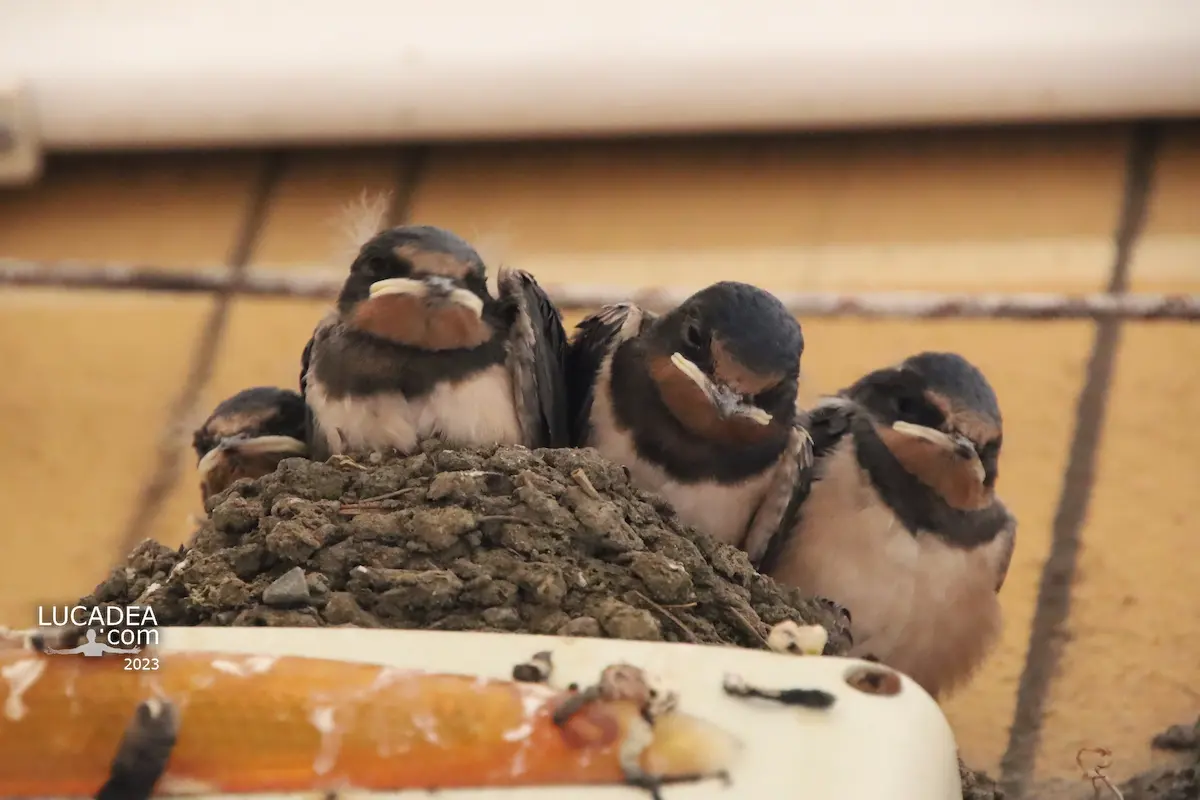
A swallow nest in the caruggio of Sestri Levante.
In spring and autumn, the caruggio of Sestri Levante is home every year to dozens of swallows that build their nests under balconies or beneath the awnings of the local shops.
It is one of those small natural spectacles that can be seen right in the center of town, without having to go anywhere special. All you need to do is look up while walking along the caruggio and, between the shops and old houses, you may find these little nests full of life.
The swallows fly above the houses, come and go from their nests and fill the street with their calls. Rather than simply chirping, as we often say, swallows chatter and twitter, and their distinctive calls immediately make me think of the warmer seasons.
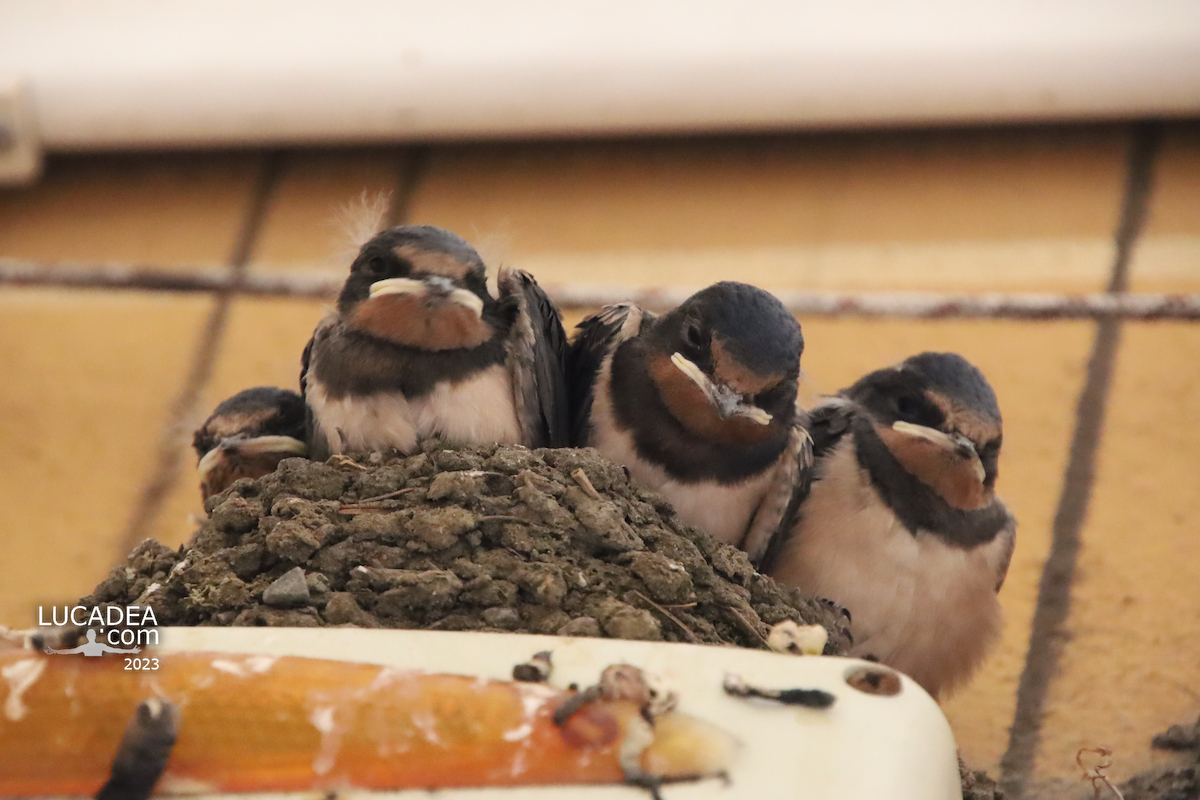
This time I stopped to photograph one of the nests in the caruggio. The young birds, who are not really that small anymore, were waiting impatiently for their parents to return, ready for the next meal.
It is a very simple scene, but that is exactly what I like about it. The caruggio is normally associated with people, shops, walks and everyday life in Sestri Levante. In spring, however, it also becomes a small natural habitat for these birds, which return every year to occupy the same kinds of sheltered spaces.
Photographing a swallow nest in the middle of a town is a reminder of how nature can find its own space even in urban environments. A balcony, a shop awning or a small recess beneath a roof can become a safe place to build a nest and raise a new generation.
And then there are the young birds themselves, with their wide-open beaks and impatient expressions as they wait for one of their parents to return. It is the kind of scene that always makes me smile.
Sestri Levante is best known for the Bay of Silence, the Bay of Fables and its coastline, but the historic center and the caruggio also tell an important part of the story of everyday life in the town. Sometimes you simply have to look up to find something worth photographing.
This photograph is therefore a small tribute to the swallows that return to Sestri Levante every year and, with their flights and calls, bring a little extra joy to the heart of the town.

Have you ever noticed the swallow nests in the caruggio of Sestri Levante? Add a comment or go to the bottom of the site to read what other visitors have written.

Swallow nest in the caruggio of Sestri Levante with young birds waiting for their parents

Swallow nest in the caruggio of Sestri Levante with young birds waiting for their parents

Swallow nest in the caruggio of Sestri Levante with young birds waiting for their parents

Photos taken with Canon EOS RP and lens Tamron 16-300.

Add one  comment to this article or read  here what other visitors have written.
 
Adv
 
Disclamer

The rights on images, videos, choruses, text and all other material on the LUCADEA.com website are governed as per  Copyright page.


This page has been viewed 0 times today.
This month it has been viewed 0 times.
In total it has been viewed 0 times.
 

The letter box of the Archdeacon’s House in Barcelona

Cassetta delle lettere decorata della Casa dell’Arcidiacono a Barcellona con rondini e tartaruga scolpite

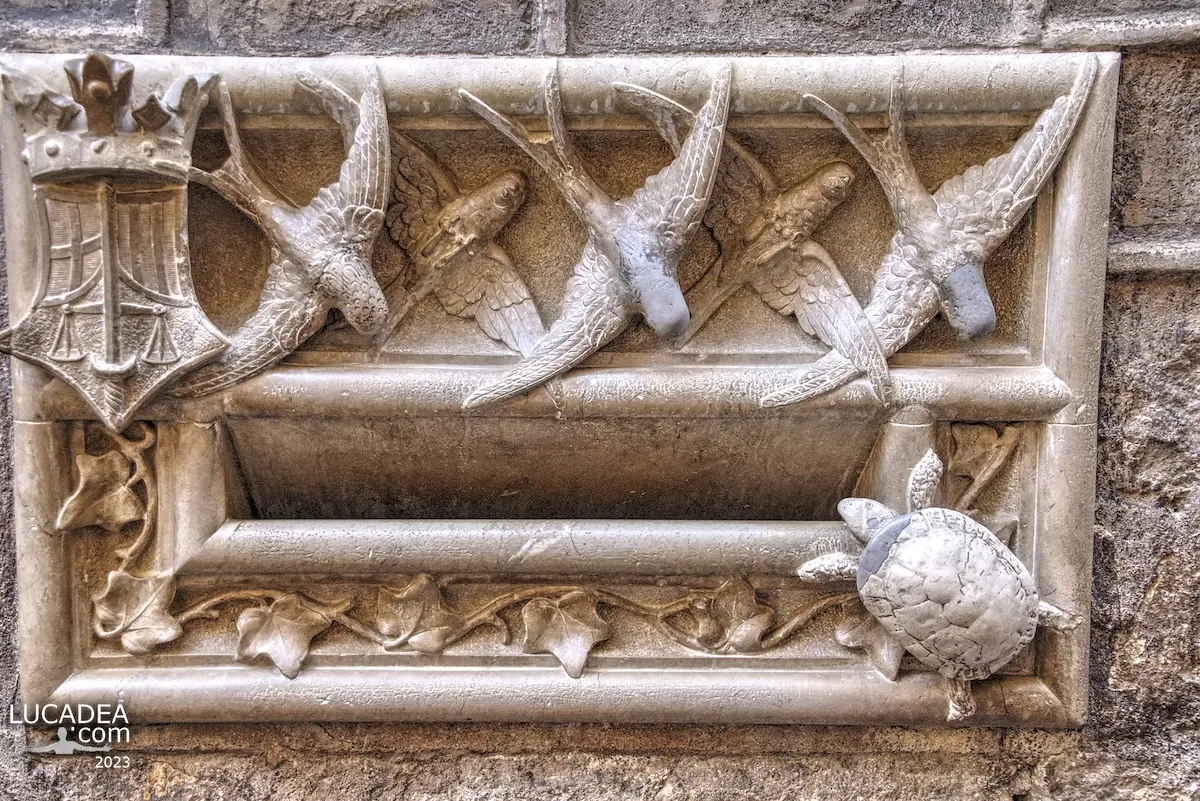
The letter box of the Archdeacon’s House in Barcelona.
Walking through the center of Barcelona, away from the most crowded paths of La Rambla, I discovered a small work of art hidden in the details of a historic building. This decorated letter box of the Archdeacon’s House in Barcelona caught my attention because of its refined shapes and the small symbols that tell a story.
I was heading toward Barcelona Cathedral when I noticed this unusual element on the facade of the Archdeacon’s House, something very different from ordinary letter boxes. The five swallows and the turtle carved into the decoration immediately attracted my attention, creating a small composition full of meaning. The coat of arms visible on the piece is still a mystery to me, and I could not identify with certainty which family it belonged to.
The photograph was taken in Barcelona, Catalonia, Spain, during a walk through the historic center. If you are visiting Barcelona and wondering what to see beyond the famous attractions, these small architectural details are often what make a walk truly memorable. A simple letter box can reveal something about the history of a building and the neighborhood around it.
The Archdeacon’s House, known in Catalan as Casa de l’Ardiaca, is a historic building located near Barcelona Cathedral and is one of the most interesting examples of the Gothic Quarter’s architecture. One curious detail is that the letter box was created at the end of the 19th century by modernist architect Lluis Domènech i Montaner and is considered a small decorative masterpiece.
What I enjoy about urban photography is the possibility of finding unexpected details while walking. There is not always a need to search for famous monuments or spectacular views; sometimes a door, a window or a small object on a wall can become the most interesting subject.
On my photoblog, I often share these kinds of accidental discoveries, where hidden elements of a city become the main focus of an image. This photograph was created in exactly that way: by leaving the usual route and following curiosity.
I stopped in front of this letter box because it seemed to preserve a story of its own, even though it is only a small part of a much larger building.

Have you ever discovered a surprising detail in a city just because you decided to take a different street? Add a comment or go to the bottom of the site to read what other visitors have written.

Cassetta delle lettere decorata della Casa dell’Arcidiacono a Barcellona con rondini e tartaruga scolpite

Photo taken with Canon EOS RP and Tamron 16-300 lens.

To see all the photos I took in Barcelona, ​​click here:
foto gallery

Here is where this monument is located:

The Casa de l’Ardiaca (in English, the Archdeacon’s House) is a building located in the Gothic Quarter of Barcelona. The building was constructed in the 12th century over the ancient Roman wall and was one of the residences of the canons of Barcelona. At the end of the 15th century, the building became the residence of Archdeacon Lluís Desplà, who transformed the house into a Gothic palace.
Continue and learn more at Wikipedia

Letter box of the Archdeacon’s House in Barcelona – Boîte aux lettres de la Maison de l’Archidiacre à Barcelone – Buzón de la Casa del Arcediano en Barcelona – Caixa de correio da Casa do Arcediago em Barcelona – Briefkasten des Erzdiakons-Hauses in Barcelona – Hộp thư của Nhà Tổng Phó tế ở Barcelona – 巴塞罗那副主教之家信箱 – バルセロナ大助祭の家の郵便受け

The text of this post was written with the help of ChatGPT, a language model from OpenAI.

Add one  comment to this article or read  here what other visitors have written.
 
Adv
 
Disclamer

The rights on images, videos, choruses, text and all other material on the LUCADEA.com website are governed as per  Copyright page.

This page has been viewed 0 times today.
This month it has been viewed 0 times.
In total it has been viewed 0 times.
 
🏠
  • Italiano