The Mangia Tower in the heart of Siena

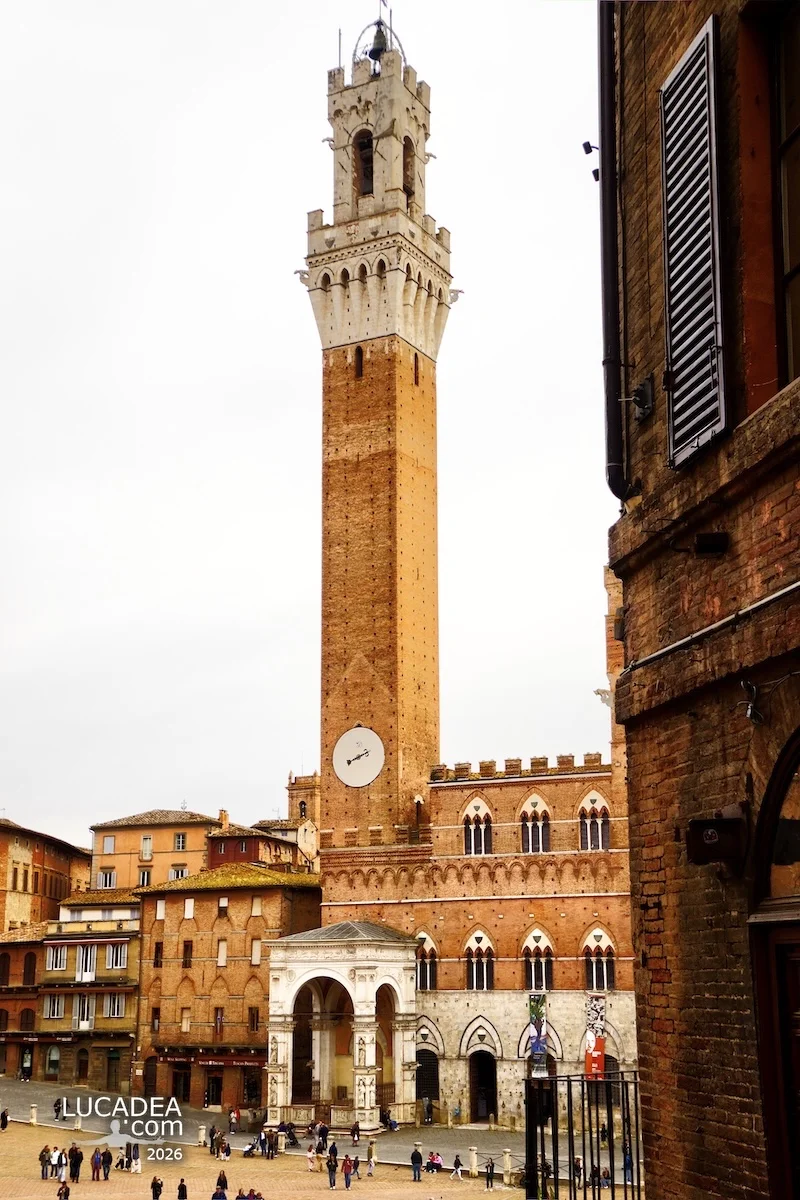
La Torre del Mangia nel cuore di Siena vista da Piazza del Campo con Palazzo Pubblico e architettura medievale

The Mangia Tower in the heart of Siena.
Through my lens, I captured the Mangia Tower in Siena, one of the most recognizable landmarks in Tuscany and one of the places to see in Italy for those who love medieval architecture and historic city squares. The side perspective of this photograph reveals the connection between the tower, Campo Square and the elegant Public Palace, creating a scene where centuries of history meet the rhythm of everyday life.
Looking at this image, what immediately catches my attention is the balance between the impressive height of the tower and the harmony of the surrounding buildings. The warm brick structure rises above the square with a strong vertical presence, while the lighter stone section at the top creates a refined contrast that makes the monument instantly recognizable. The Mangia Tower seems almost too tall for the frame, yet it remains perfectly connected with the architecture around it.
I took this photograph in Campo Square, in Siena, Tuscany, Italy, one of the most famous urban spaces in the country and a place where history is still part of daily life. Walking through this square, I noticed how visitors and locals share the same environment, stopping to admire the buildings, sit in the open space or simply experience the unique atmosphere created by centuries of architecture.
The Mangia Tower was built in the 14th century and became a symbol of Siena’s civic identity. One of the most interesting details about this monument is that its height was intentionally designed to be almost equal to the height of the cathedral, representing a symbolic balance between political and religious power. This historical choice gives the tower an even deeper meaning when viewed through photography.
If you are visiting Siena, Campo Square is a place worth seeing in Tuscany because it offers much more than a famous view. The relationship between the Mangia Tower, the Public Palace and the surrounding medieval buildings creates a unique setting where architecture tells the story of the city. It is a place that invites you to slow down and observe the details that are often missed when simply passing through.
This photograph also connects with other stories from my photo blog about historic Italian towns and old squares, where buildings become witnesses of time and preserve memories through their shapes, materials and details. Every corner can reveal something different, and this is what makes photographing these places so fascinating.
When I look again at this image, I feel that the Mangia Tower represents the true character of Siena: elegant, strong and deeply connected to its past. The tower is not only an architectural symbol but also a constant presence above Campo Square, watching generations of people experience this extraordinary place.

Which detail of the Mangia Tower or Campo Square would you like to discover first? Add a comment or go to the bottom of the site to read what other visitors have written.
La Torre del Mangia nel cuore di Siena vista da Piazza del Campo con Palazzo Pubblico e architettura medievale

Photo taken with Canon EOS R50 V and Tamron 16-300 lens.

To see all the photos I took in Siena, click here:
foto gallery

Add one  comment to this article or read  here what other visitors have written.
 
Adv
 
Disclamer

The rights on images, videos, choruses, text and all other material on the LUCADEA.com website are governed as per  Copyright page.

This page has been viewed 1 times today.
This month it has been viewed 2 times.
In total it has been viewed 3 times.
 

Details and columns inside Siena Cathedral

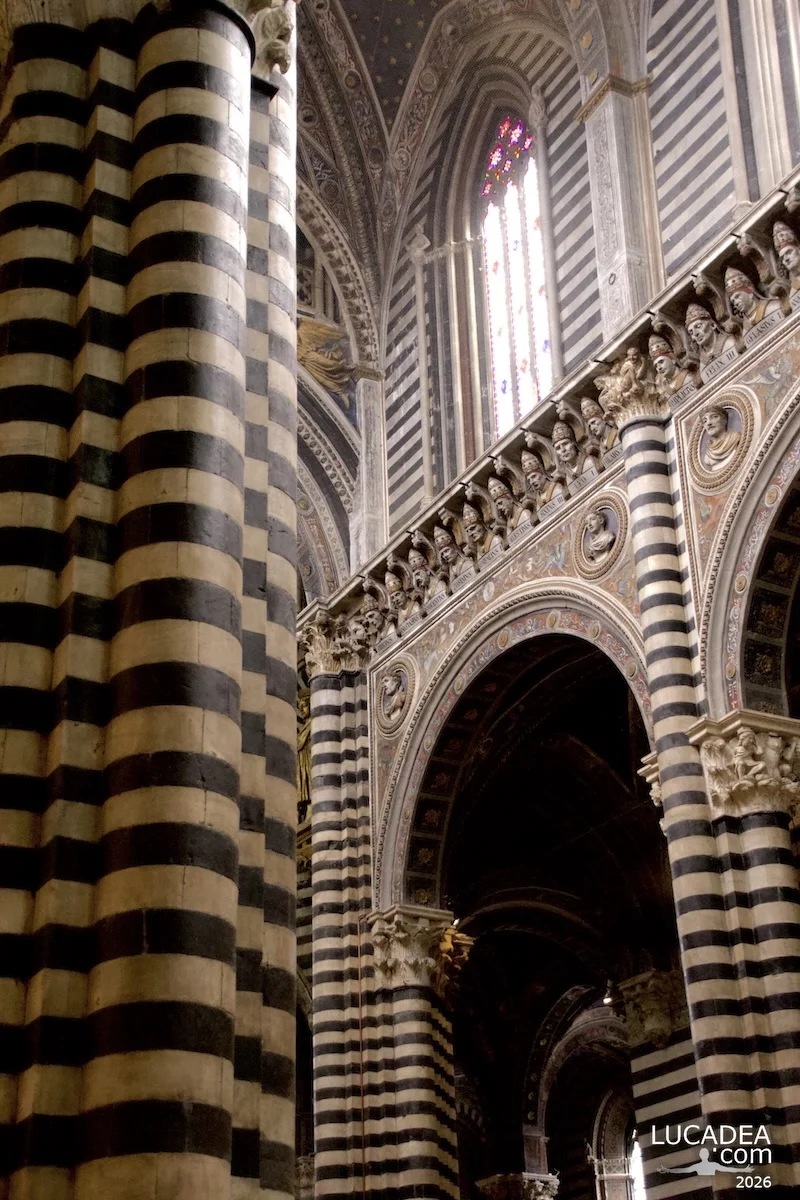
Dettagli delle colonne e capitelli nelle navate laterali del duomo di Siena con decorazioni in marmo bianco e nero

Details and columns inside Siena Cathedral.
There is something quietly captivating about walking inside Siena Cathedral, especially along the side aisles of Siena Cathedral where the columns and architectural details seem to guide your gaze without effort. In these views of Siena Cathedral, I focused on columns, capitals, and metopes, trying to frame fragments rather than the whole. Photographing details inside Siena Cathedral naturally slows you down and makes you notice more.
Siena Cathedral, located in Siena, Tuscany, Italy, is one of those places that reveals itself gradually. If you are visiting Siena and wondering what to see inside Siena Cathedral beyond the famous artworks, these side aisles are a place worth exploring. They feel slightly removed from the main flow, offering a quieter and more reflective atmosphere.
In the two shots I captured, I was drawn to the visual rhythm created by the alternating black and white marble columns. They almost pull your eyes upward, creating a natural sense of movement within the frame. The capitals, finely carved, show an incredible level of craftsmanship that feels both distant and immediate at the same time. Then there are the metopes—small decorative elements that might easily be overlooked, yet they play an essential role in shaping the visual identity of the space.
While taking these photos, I was reminded of another piece I shared on the site about architectural details in a coastal church. There too, I found that the smallest elements often hold the strongest visual impact. In Siena, though, everything feels more pronounced, almost theatrical in its presence.
One interesting detail is that the black and white marble pattern is not purely decorative; it reflects the symbolic colors of Siena, tied to local legends and identity. Knowing this adds another layer to what you see, even if the visual impact is already strong on its own.
For anyone looking for meaningful things to see in Siena Cathedral, these quieter corners offer a different perspective—less obvious, but deeply engaging.

Have you ever found yourself drawn more to the hidden details than to the main attractions? Add a comment or go to the bottom of the site to read what other visitors have written.

Photos taken with Canon EOS R50 V and Tamron 16-300 lens.

To see all the photos of the Duomo, click here:
foto gallery

Add one  comment to this article or read  here what other visitors have written.
 
Adv
 
Disclamer

The rights on images, videos, choruses, text and all other material on the LUCADEA.com website are governed as per  Copyright page.


This page has been viewed 1 times today.
This month it has been viewed 2 times.
In total it has been viewed 3 times.
 

The Main Altar of Fiesole Cathedral

Altare maggiore e abside affrescata del Duomo di Fiesole, sulle colline vicino a Firenze

The Main Altar of Fiesole Cathedral.
Inside the Cathedral of San Romolo, in the hills above Florence, I was immediately struck by the contrast between the rather austere interior and the richer presence of the main altar and the frescoed apse. This is the detail I wanted to capture with my camera.
Fiesole is only a few kilometres from Florence, but climbing into the hills quickly creates a different feeling. In this ancient Tuscan town I found a quieter dimension than the better-known centre of Florence, and the cathedral is one of the most important landmarks of the village.
The photograph shows one of the most visually significant parts of the church: the main altar in front of the apse, with its decorations and frescoes drawing the eye towards the end of the nave. The interior of San Romolo Cathedral is quite restrained, almost austere in places, and this makes the decorative elements around the altar stand out even more.
If you are wondering what to see in Fiesole, the cathedral is certainly one of the places I would include. Not only because of its religious importance, but also because it offers a glimpse into the history of a town that can easily be overshadowed by the much more famous Florence nearby.
Looking at this image, what I like most is the way the architecture guides the eye towards the apse. The altar becomes the visual centre of the composition, while the surrounding structure seems to frame it naturally. When I took the photograph, I wanted to preserve this relationship rather than isolate a single decorative detail.
The Cathedral of San Romolo has very ancient origins and has undergone several alterations and transformations over the centuries. One small curiosity is that its present appearance contains elements from different periods, reflecting the changes the building experienced throughout its long history. Looking carefully at the architecture, it is possible to sense that several generations have contributed to the appearance of the church we see today.
Fiesole, in Tuscany, within the Metropolitan City of Florence, is often considered mainly in relation to the nearby capital of the region. Yet the town has a strong historical identity of its own and preserves evidence of a past that developed alongside, and in some respects before, the better-known history of Florence.
That is one of the things I enjoy when photographing places that are close to famous destinations but have a character of their own. A visit to Fiesole can take you away from the usual Florence itinerary for a while, without actually taking you far from the city. The landscape, architecture and atmosphere change surprisingly quickly as you climb into the hills.
The interior of the cathedral stayed with me precisely because of its simplicity. It is not a church that tries to overwhelm the visitor with decoration at every turn, and perhaps that is why the main altar and the frescoed apse have such a strong visual presence. My attention was drawn to this particular view, and I preferred to preserve that impression in a photograph rather than turn the post into a detailed description of the entire building.
As with other photographs of churches and cathedrals I have shared on the blog, this image comes from the same personal approach: looking for the detail or viewpoint that stays with me after a visit. I have previously written about other religious interiors encountered during my travels, and this photograph from Fiesole naturally continues that thread.
Looking back at the image, I still like the balance between the severe character of the architecture and the richer decoration concentrated around the altar. It is probably something that becomes even clearer when standing inside the cathedral, with the nave leading the eye naturally towards the apse.

If you know Florence already, have you ever climbed up to Fiesole to discover this quieter side of Tuscan history and art? Add a comment or go to the bottom of the site to read what other visitors have written.

Main altar and frescoed apse inside Fiesole Cathedral, in the hills near Florence

Photo taken with a Canon EOS M100 camera and Canon EF-M 11-22 lens.

To see all the photos taken in the Cathedral, click here:

Here is where the cathedral is located:

A detail of Florence Cathedral

Lunetta sopra il portone principale del Duomo di Firenze con dettagli decorativi della facciata in marmo

A detail of Florence Cathedral.
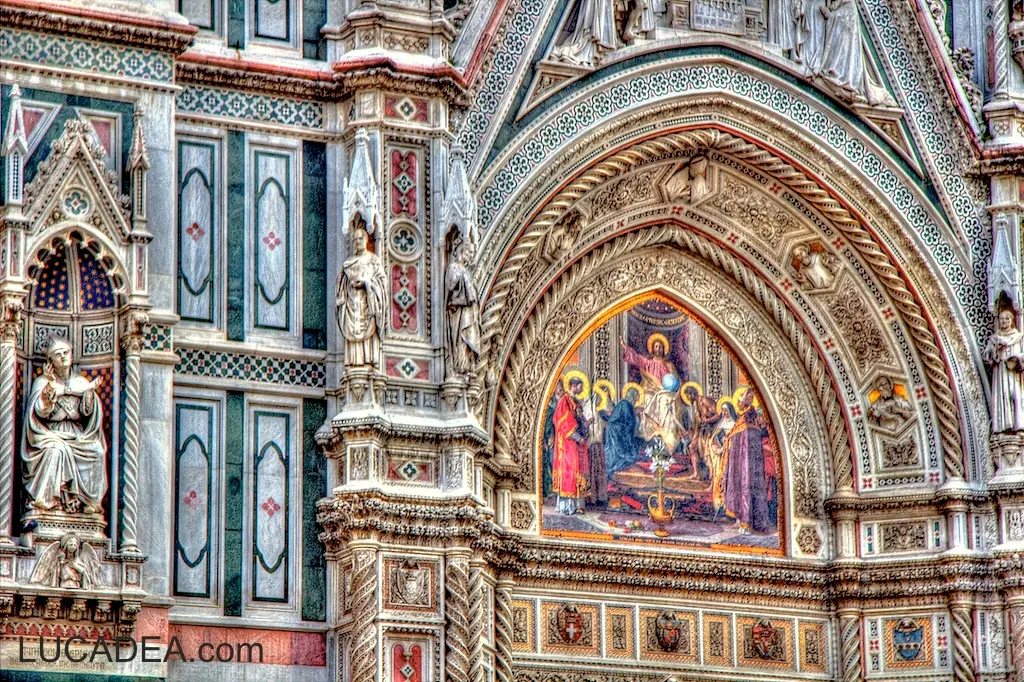
Walking through the historic center of Florence, Tuscany, Italy, it is almost impossible not to stop in front of Santa Maria del Fiore, one of the city’s most recognizable landmarks. If you are wondering what to see in Florence, the cathedral naturally deserves a place at the top of the list, but this time my attention was not on the entire façade. I chose instead to focus on the lunette above the main entrance.
This is exactly the kind of detail I enjoy looking for when photographing famous monuments. The overall view of Florence Cathedral has been captured countless times, while moving closer to a single part of the façade can reveal details that are easily overlooked. I wanted to capture this small section of Santa Maria del Fiore with my camera and give it the attention it deserves on its own.
The façade immediately stands out because of its combination of white, green and red marble, a color scheme that has become an essential part of the visual identity of Florence Cathedral. Looking more closely, however, it is not only the colors that catch the eye. The façade is filled with shapes, frames, sculptures, mosaics and ornamental details that work together to create an extraordinarily rich composition.
The lunette above the entrance is one small part of this larger decorative system. Photographing it means temporarily leaving aside the monumental scale of the cathedral and concentrating on a much smaller area, almost as if I were looking at an individual work of art inside a museum.
Florence, in the heart of Tuscany, is a city where it is remarkably easy to walk past a masterpiece without having time to notice every detail. The Santa Maria del Fiore complex, with the cathedral, Giotto’s Bell Tower and the Baptistery of Saint John, brings an enormous amount of art and history together within a relatively compact area.
A brief historical detail is worth mentioning: the façade we see today is not the original medieval façade. The present design was created during the second half of the nineteenth century and completed toward the end of that century, after the earlier unfinished façade had been removed.
This photograph also connects with the other images I have shared from Florence and with my previous photographs of details from the cathedral complex. After photographing Giotto’s Bell Tower and other elements around the Duomo, I find that returning to smaller architectural details offers a different way of telling the story of the same place.

Which detail of Florence Cathedral would you have photographed? Add a comment or go to the bottom of the site to read what other visitors have written.

Lunette above the main entrance of Florence Cathedral with decorative marble details on the facade

This is the church’s official website: duomo.firenze.it.

To see all the photos I took in the beautiful Tuscan city, click here:

The Metropolitan Cathedral of Santa Maria del Fiore—commonly known as the Florence Cathedral—is the city’s main church, a symbol of Florence, and one of the most famous in Italy. Upon its completion in the 15th century, it was the largest church in the world; today, it is considered the third-largest in Europe, following St. Peter’s in Rome and Milan Cathedral. It stands on the foundations of Florence’s earlier cathedral, the Church of Santa Reparata, on a site that has hosted places of worship since Roman times.
Read more on Wikipedia

Giotto’s Bell Tower in Florence

Campanile di Giotto a Firenze fotografato in HDR con dettagli del marmo bianco verde e rosso

Giotto’s Bell Tower in Florence.
There is probably no need to explain what is shown in this photograph, as it represents one of the most iconic landmarks of Florence. For those who may not recognize it, this is the beautiful bell tower of the Cathedral of Santa Maria del Fiore, designed by Giotto and completed in the 14th century.
I took this picture while walking through the historic center of Florence, aiming to highlight the architectural details and the rich colors of the monument. In this case, I used HDR photography, a technique that enhances both light and shadow, bringing out the textures and geometric decorations of the structure.
The bell tower is one of the finest examples of Italian Gothic architecture. What immediately stands out is the richness of its surfaces, decorated with white, green and red marble that creates a striking visual harmony. Every side of the tower is carefully designed, with panels, niches and geometric patterns that reflect the artistic style of the period.
Florence, the capital of Tuscany, Italy, is a city where every corner is filled with history and art. The cathedral complex, including the church, the bell tower and the baptistery, is one of the most important cultural landmarks in Italy and attracts millions of visitors each year.
A short note about Giotto: he is considered one of the greatest artists of the Middle Ages and played a crucial role in shaping the development of Western art, both in painting and architecture.
This photograph reflects my approach to capturing famous landmarks while still trying to add a personal perspective. Even when photographing such a well-known subject, the choice of light, framing and technique can make a real difference.
If you are visiting Florence and wondering what to see, Giotto’s Bell Tower is definitely a must-see.

Have you ever tried to photograph a famous landmark in a unique way? Add a comment or go to the bottom of the site to read what other visitors have written.

Giotto Bell Tower in Florence photographed in HDR showing white green and red marble details

Photo taken with a Canon 600D camera.

Giotto’s Campanile is the bell tower of Santa Maria del Fiore—Florence’s cathedral—and is located in Piazza del Duomo. Its foundations were excavated around 1298 at the start of the new cathedral’s construction, when Arnolfo di Cambio was the master builder. In 1334, Giotto di Bondone took over the role of master builder. In his *Life of Giotto*, Vasari recounts his arrival—”on July 9, 1334, at the campanile of S. Maria del Fiore”—noting that he immediately began working on the construction of the tower’s first level while showing no interest—according to Giovanni Villani—in the basilica’s construction site.
Read more on Wikipedia

The labyrinth on Lucca Cathedral facade

Il labirinto scolpito sulla facciata del Duomo di Lucca

The labyrinth on Lucca Cathedral facade.
While standing in front of San Martino Cathedral in Lucca, Tuscany, Italy, I photographed one of the most curious details of the building: the stone labyrinth carved on the facade, a symbol that continues to attract the attention of visitors exploring the historic center. Among the things to see in Lucca, the Cathedral is not only remarkable for its architecture but also for these small details that reveal stories hidden in the stone.
The labyrinth on Lucca Cathedral facade is one of the most photographed and recognizable elements of the monument. Its simple shape, together with the inscription carved beside it, has inspired many interpretations over the centuries. I wanted to focus my photograph on this detail because, compared with the impressive size of the whole cathedral, it offers a more personal and mysterious way to discover its history.
The carved inscription refers to the labyrinth of Daedalus, the famous figure from Greek mythology who created the legendary labyrinth of Crete for King Minos. The exact meaning of the words is still debated, but the reference suggests the idea of a difficult path, a journey, and the search for an exit.
San Martino Cathedral is one of the most important landmarks in Lucca and contains many remarkable works of art. As I already shared in my photographs of the Saint Martin statue on the facade and the other treasures inside the church, every corner of this cathedral can reveal something unexpected.
This photograph comes from my attention to the smaller details that often remain unnoticed. A monument does not always need to be photographed as a whole to tell its story. Sometimes a single symbol carved into stone can represent centuries of history, beliefs, and traditions.
The labyrinth of Lucca Cathedral is still a fascinating element for those who stop to observe it carefully. It is one of those details that can easily be missed during a quick visit, but it rewards anyone who takes the time to look closer.

When you visit historical places, do you also search for these hidden details instead of only photographing the main view? Add a comment or go to the bottom of the site to read what other visitors have written.

Stone labyrinth carved on Lucca Cathedral facade beside a medieval inscription in the historic city center

Photo taken with a Canon EOS M100 camera and Canon EF-M 11-22 lens.

To see all the photos I took of the Duomo, click here:

But what truly captures the attention of many visitors is the small stone-carved labyrinth located on the right-hand pillar of the façade’s portico. This bas-relief figure is one of the most enigmatic in Italy.
Read more and find out more on Wikipedia

Saint Martin on Lucca Cathedral’s facade

Statua di San Martino sulla facciata del Duomo di Lucca con il santo che divide il mantello

Saint Martin on Lucca Cathedral’s facade.
While walking in front of San Martino Cathedral in Lucca, Tuscany, Italy, I photographed one of the most recognizable details of the building: the statue of Saint Martin on the facade, showing one of the most famous scenes connected with Christian tradition. Among the things to see in Lucca, the Cathedral and its architectural details deserve a careful look, especially because many important stories are hidden in small details.
The statue represents Saint Martin sharing his cloak with a beggar, the episode most closely associated with the saint’s life. I wanted to capture this detail with my camera because looking closely at the facade reveals elements that tell the history and spirituality of this place in a way that a simple general view cannot.
San Martino Cathedral is one of the symbols of Lucca and stands in the heart of the historic center. Its construction began during the Middle Ages, and over the centuries the building was enriched with artworks, decorations, and architectural changes that still show the importance of the cathedral from both a religious and cultural point of view.
A small curiosity about Lucca Cathedral is its connection with pilgrimage routes. For centuries, the cathedral was an important stop for pilgrims traveling along the Via Francigena towards Rome, helping transform Lucca into a meeting place for travelers, believers, and different cultures.
The statue of Saint Martin on the facade is therefore much more than a decorative element. It is a symbol that introduces visitors to the history of the cathedral. Before entering the church, this stone sculpture already tells a story that continues inside, where important artworks such as Tintoretto’s Last Supper and the funerary monument of Ilaria del Carretto can be admired.
This photograph continues my personal story of Lucca, following the images I shared of the view from the Cathedral tower, San Martino Cathedral, and the other hidden treasures I discovered inside the historic churches of the city.
Often, the details on a facade are the first pages of a monument’s story, even before stepping through its entrance.

Have you ever taken a closer look at the facade of Lucca Cathedral and the statue dedicated to Saint Martin? Add a comment or go to the bottom of the site to read what other visitors have written.

Saint Martin statue on Lucca Cathedral facade showing the saint sharing his cloak with a beggar

Photo taken with a Canon EOS M100 camera and Canon EF-M 11-22 lens.

To see all the photos I took of the Cathedral, click here:

This is the cathedral’s official website, should you wish to visit it: museocattedralelucca.it.

As a *circitor*, his duties included making night rounds, inspecting guard posts, and keeping watch over the garrisons. It was during one of these rounds that a life-changing event occurred—an episode that remains the most remembered and frequently depicted in iconography to this day. In the harsh winter of 335, Martin encountered a half-naked beggar. Seeing the man suffering, he cut his military cloak—the white *chlamys* of the Imperial Guard—in two and shared it with the beggar.
Read more at touringclub.it

Lucca from above: the Duomo tower view

Il panorama sulla splendida città di Lucca, perla della Toscana

Lucca from above: the Duomo tower view.
From the tower of San Martino Cathedral in Lucca, Tuscany, Italy, I photographed one of the most beautiful views to see over the city: the historic rooftops, medieval towers, and the ordered pattern of ancient buildings that tell the story of Lucca. This panoramic view of Lucca reveals a side of the city that is difficult to fully understand while walking through its streets.
I took this photograph quite some time ago and only now have the chance to publish it. I still remember the feeling of looking at Lucca from above, with the old town opening below me and its many towers rising among the rooftops. I wanted to capture this moment with my camera because seeing a city from a higher perspective is often the best way to understand its structure and character.
The view from Lucca Cathedral’s tower is especially interesting because it highlights some of the most recognizable elements of the historic center. The towers, symbols of the city’s medieval past, still stand out in the urban landscape and remind us of a period when important families built these structures as signs of prestige and influence.
A small curiosity about Lucca is that the city once had many more towers than today. Over the centuries, several disappeared or were modified as the urban landscape changed. Among the surviving examples are Guinigi Tower, famous for the trees growing on its top, and the Clock Tower, another important landmark of the city.
If you are visiting Lucca and looking for what to see, climbing one of its historic towers offers a different way to discover the city. It is not only about the view itself, but also about reading the history of Lucca through the shapes of its buildings, squares, and streets.
This photograph continues my personal story of Lucca, following the images I shared of San Martino Cathedral, San Michele in Foro Church, and the many artistic and architectural details I discovered while exploring the historic center.
Whenever I look back at photographs taken during my travels, I realize that some places deserve to be shared even years later because an image can bring back a very specific perspective and memory.

Have you ever admired Lucca from the top of one of its towers? Add a comment or go to the bottom of the site to read what other visitors have written.

Panorama of Lucca from the Duomo tower with historic rooftops and medieval towers in the city center

Photo taken with a Canon EOS M100 camera and Canon EF-M 11-22 lens.

Famous for its historic monuments, it is one of the few provincial capitals to preserve its historic center—rich in ancient structures from various eras—completely enclosed by a 16th-century wall that remains largely intact and virtually unchanged over the centuries. It is a notable Italian city of art.
Read more on Wikipedia

Amphitheater Square in Lucca, the city’s heart

Piazza Anfiteatro a Lucca con le case colorate disposte sulla forma dell’antico anfiteatro romano

Amphitheater Square in Lucca, the city’s heart.
While walking through the historic center of Lucca, Tuscany, Italy, I reached one of the city’s most recognizable places: Amphitheater Square, one of the places worth seeing when visiting Lucca. Its elliptical shape, surrounded by colorful houses and historic buildings, makes this square a unique sight among Italian urban spaces.
As soon as I entered Amphitheater Square, I felt how strongly history is still present here, with the ancient Roman origins and everyday life of the city existing side by side. I wanted to capture this view with my camera because the unusual shape of the square is best understood by looking at the entire space, where the buildings still follow the outline of the ancient amphitheater.
Amphitheater Square is located in the heart of Lucca’s historic center and takes its name from the Roman structure that once stood here. In ancient times, this was the site of an amphitheater built around the second century AD, and although the original structure has disappeared, its shape remains clearly visible in the arrangement of the surrounding buildings.
One interesting detail about Amphitheater Square is how its role changed through the centuries. A place originally created for Roman public spectacles became a residential area, with houses built along the ancient perimeter. Today, simply observing the curved line of the buildings allows visitors to understand part of Lucca’s long history.
If you are visiting Lucca and looking for what to see in the historic center, Amphitheater Square is a place worth discovering slowly. It is not only an archaeological reminder of the Roman past but also a lively space where people meet, walk, and enjoy the atmosphere of the city.
This photograph continues my personal visual story of Lucca, following the images I shared of San Michele in Foro Church, San Martino Cathedral, and other corners I discovered while exploring the old town. Every photograph captures a different detail of a city that continues to surprise me even after several visits.
Sometimes the most famous places are also the ones that offer new perspectives when observed carefully.

Have you ever walked inside Amphitheater Square in Lucca? Add a comment or go to the bottom of the site to read what other visitors have written.

Amphitheater Square in Lucca with colorful houses following the shape of the ancient Roman amphitheater

Amphitheater Square in Lucca with colorful houses following the shape of the ancient Roman amphitheater

Photos taken with a Canon EOS M100 camera and Canon EF-S 10-18 lens.

Click here to see all the photos of Lucca:

It was not until the 19th century, through the work of the architect Lorenzo Nottolini from Lucca, that a decision was made to redevelop the ancient structure. The arena space was cleared of the small buildings that had crowded it, and the “Via dell’Anfiteatro” was opened, tracing the structure’s elliptical profile along the outside.

The Devil’s Bridge in Borgo Mozzano near Lucca

Ponte del Diavolo a Borgo Mozzano vicino Lucca con grande arcata sul fiume Serchio

The Devil’s Bridge in Borgo Mozzano near Lucca.
While returning from a trip to Lucca, Tuscany, Italy, I decided to leave the fastest route behind and take smaller roads to discover places I had never seen before. Among these unexpected discoveries was the Devil’s Bridge, one of the most interesting historic bridges to see near Lucca, with its unusual arches crossing the Serchio River.
As soon as I reached the bridge, I understood why this place has inspired so many stories and legends over the centuries. Its unique shape, with the huge central arch rising above the water, makes the Devil’s Bridge in Borgo Mozzano a fascinating subject for photography. I wanted to capture this view with my camera because it is not often that a spontaneous detour leads to such a recognizable and impressive landmark.
The bridge is located in Borgo Mozzano, in the province of Lucca, Tuscany, Italy, and it is one of the best-known examples of medieval architecture in the area. Its origins are traditionally connected to Countess Matilda of Canossa, although the structure we see today has been changed and expanded over different periods.
The most famous legend tells of a builder who was unable to complete the bridge on time and asked the devil for help. The agreement was that the devil would finish the construction in a single night in exchange for the soul of the first person crossing the bridge. According to the popular tale, the builder managed to trick him by sending an animal across first.
These stories are an important part of the bridge’s charm, but what truly impressed me was the way the structure blends with the surrounding landscape. The Devil’s Bridge is not only a place worth seeing in Tuscany, but also a meeting point between architecture, nature, and local traditions.
If you are visiting Lucca and looking for unusual places nearby, Borgo Mozzano is a destination that offers something different from the most famous Tuscan routes. This photograph continues my personal journey through the Lucca area, following the images I shared of Lucca’s churches, streets, and historic buildings.
Sometimes the roads taken without a strict plan are the ones that lead to the most memorable photographs and unexpected discoveries.

Have you ever crossed the Devil’s Bridge or visited Borgo Mozzano? Add a comment or go to the bottom of the site to read what other visitors have written.

Devil’s Bridge in Borgo Mozzano near Lucca with its large arch over the Serchio River

Devil’s Bridge in Borgo Mozzano near Lucca with its large arch over the Serchio River

Photos taken with a Canon EOS M100 camera and Canon EF-S 10-18 lens.

Here is the guide to the village on the Municipality’s website.

Here is the location of the village:

Legend tells of the master builder working on the bridge, who was deeply worried about the delays caused by the river’s frequent, raging floods. One evening, in a fit of despair, he uttered blasphemies that summoned Satan. The Devil then offered to complete the work in a single night in exchange for the first soul to cross the bridge; the master builder agreed, and the construction was finished.
Read more on Wikipedia

🏠
  • Italiano