The houses on Ponte Vecchio in Florence

Le case su Ponte Vecchio a Firenze

The houses on Ponte Vecchio in Florence.
From a viewpoint along the Lungarno, I photographed one of the most recognisable scenes of Florence’s historic centre: the houses built directly on Ponte Vecchio, standing above the Arno River between the two sides of the city. This unique architectural feature is one of the reasons why this bridge has become famous all over the world.
The houses on Ponte Vecchio in Florence, Tuscany, Italy, are one of the details that make this historic bridge unlike any other. When I took this photograph, I wanted to focus not only on the bridge itself, but on the relationship between the buildings, the old shops and the medieval structure crossing the river.
Ponte Vecchio is a place where even a small detail can tell a much larger story. Looking at the houses built above the bridge, you can still perceive its medieval origins and understand that it was created not only as a connection between the two banks of the Arno, but also as a place where people lived and worked.
I enjoy photographing famous locations while trying to find a personal point of view. This image comes from the search for a composition that could show the character of the bridge through its irregular shapes, windows and small structures that seem to continue the urban landscape of Florence.
If you are visiting Florence, Ponte Vecchio is certainly one of the most interesting places to see, but taking time to observe it carefully reveals many details that are easy to miss. The houses above the bridge, the historic workshops and the elevated Vasari Corridor tell the story of the connection between commerce, power and everyday life throughout the centuries.
A historical curiosity about Ponte Vecchio is linked to the Vasari Corridor, built in the sixteenth century for Duke Cosimo I de’ Medici and designed by Giorgio Vasari. This elevated passage allowed the Medici family to move between Palazzo Vecchio and Palazzo Pitti without walking through the crowded streets.
I wanted to capture this view with my camera because Ponte Vecchio keeps a strong visual identity even when seen from a distance. It is not simply a monument to admire, but a living part of Florence.
This photograph connects with other stories on my blog dedicated to Florence and its architectural details, because I often find that the smallest elements can make a photographic walk even more interesting.

Have you ever looked at Ponte Vecchio from a different viewpoint than the classic river perspective? Add a comment or go to the bottom of the site to read what other visitors have written.

Houses built on Ponte Vecchio in Florence viewed from the Lungarno with the Arno River

Photo taken with a Canon EOS M100 and a Canon EF-S 10-18 lens.

To see all the photos I took in the beautiful Tuscan town, click here:

Where the bridge is located:

The Ponte Vecchio is a bridge that spans the Arno River in Florence, about 150 meters downstream from the area where the river naturally has one of the narrowest points within the city, upstream from the Cascine.
Continue and learn more at Wikipedia

Add one  comment to this article or read  here what other visitors have written.
 
Adv
 
Disclamer

The rights on images, videos, choruses, text and all other material on the LUCADEA.com website are governed as per  Copyright page.


This page has been viewed 1 times today.
This month it has been viewed 1 times.
In total it has been viewed 16 times.
 

The facade of the Basilica of Santa Croce in Florence

La facciata della Basilica di Santa Croce a Firenze

The façade of the Basilica of Santa Croce in Florence.
I’ve been to the Tuscan city of Florence several times, but despite having long been meaning to, I only recently managed to visit the Basilica of Santa Croce.
And it was truly a wonderful visit, given the many beauties and pages of history this monument holds within.

Do you know or have you visited this beautiful church in Florence? Add a comment or go to the bottom of the site to read what other visitors have written.

La facciata della Basilica di Santa Croce a Firenze

Photo taken with Canon EOS M100 and Canon EF-M 11-22 lens.

To see all the photos of the basilica, click here:

This is the official website: santacroceopera.it.

The Basilica of Santa Croce in the square of the same name in Florence is one of the largest Franciscan churches and one of the greatest examples of Gothic architecture in Italy, and holds the rank of minor basilica. Santa Croce is a prestigious symbol of Florence, the meeting place of the greatest artists, theologians, religious figures, writers, humanists, and politicians, who, for better or worse, shaped the identity of the late medieval and Renaissance city.
Continue and learn more at Wikipedia

The facade of the Basilica of Santa Croce in Florence – La façade de la Basilique de Santa Croce à Florence – La fachada de la Basílica de Santa Croce en Florencia – A fachada da Basílica de Santa Croce em Florença – Die Fassade der Basilika Santa Croce in Florenz – Mặt tiền của Vương cung thánh đường Santa Croce ở Florence – 佛罗伦萨圣十字大教堂的正面 – フィレンツェのサンタクローチェ大聖堂のファサード
Add one  comment to this article or read  here what other visitors have written.
 
Adv
 
Disclamer

The rights on images, videos, choruses, text and all other material on the LUCADEA.com website are governed as per  Copyright page.


This page has been viewed 1 times today.
This month it has been viewed 2 times.
In total it has been viewed 7 times.
 

Details of the Sassetti Chapel in Santa Trinita in Florence

Particolari della cappella Sassetti in Santa Trinità a Firenze

Details of the Sassetti Chapel in Santa Trinita in Florence.
Walking through the historic center of Florence, Tuscany, Italy, it is possible to discover some of the greatest artistic treasures of the Renaissance. One of these is certainly the Sassetti Chapel, located inside Santa Trinita church, one of the less famous churches compared with Florence’s major monuments but a place full of extraordinary masterpieces.
The chapel was commissioned by the Sassetti family, one of the most important families in fifteenth-century Florence. Francesco Sassetti, a close figure to the powerful Medici family and to Lorenzo the Magnificent, entrusted the decoration of the chapel to Domenico Ghirlandaio, one of the greatest painters of his time.
Ghirlandaio’s frescoes, created between 1483 and 1486, are dedicated to the life of Saint Francis and represent one of the finest examples of Florentine Renaissance painting. The artist combined religious storytelling with many details of everyday life, including people, buildings, and settings that provide an extraordinary image of Florence during the fifteenth century.
In this photograph I wanted to focus on some details of the chapel because, very often, small elements are the ones that reveal the true greatness of an artwork. The decorations, colors, figures, and attention to every single detail show the extraordinary skill of Ghirlandaio and the artists who contributed to this magnificent space.
Visiting the Sassetti Chapel means taking a journey into the Renaissance. It is not only about admiring beautiful frescoes, but also about discovering the history of a family, a city, and a historical period that left an unforgettable mark on world culture.
I would also like to thank Lorenzo for a small but important correction: the name of the church is Santa Trinita, without an accent at the end. A seemingly small detail, but an important one when describing this beautiful place in Florence.
Santa Trinita church and the Sassetti Chapel are among the many hidden treasures of Florence: places where simply entering through a door can reveal works of absolute artistic value.

Do you know the Sassetti Chapel and Ghirlandaio’s frescoes inside Santa Trinita church in Florence? Add a comment or go to the bottom of the site to read what other visitors have written.

Details of Ghirlandaio frescoes in the Sassetti Chapel inside Santa Trinita church in Florence

Photo taken with Canon EOS M100 and Canon EF-S 10-18 lens.

To see all the photos I took in the beautiful Tuscan town, click here:

Here is where the basilica is located:

It houses an important fresco cycle depicting the Stories of Saint Francis of Assisi (1482-1485), considered Domenico Ghirlandaio’s masterpiece and among the most significant works of cultured, elegant, and antiquarian humanism of the Laurentian era.
Continue and learn more at Wikipedia

San Giovanni Square, Florence’s Stunning Cathedral View

Piazza di San Giovanni a Firenze con il Battistero e il Duomo

San Giovanni Square, Florence’s Stunning Cathedral View.
Arriving at San Giovanni Square in Florence from the railway station, you may find yourself stopping in amazement at the artistic beauty unfolding before your eyes. The square brings together the Baptistery of Saint John in the foreground, Florence Cathedral behind it, and Giotto’s Bell Tower peeking out above the Baptistery’s roof. It is an extraordinary first encounter with the historic heart of Florence, Tuscany, Italy.
The view is so rich in architectural detail that it can take a moment to decide where to look first. The buildings stand close together, yet each has its own character, from the geometric patterns of the marble façades to the towering dome that dominates the skyline. It is easy to understand why visitors stop here to take photographs, but the scene is worth enjoying without a camera, too.
In the foreground stands the Baptistery of Saint John, the monument that gives the square its name. Its distinctive octagonal shape and white and green marble decoration make it one of Florence’s most recognisable buildings. The Baptistery is also famous for its bronze doors. The eastern doors created by Lorenzo Ghiberti became known as the Gates of Paradise and are celebrated as a masterpiece of Renaissance sculpture.
Behind the Baptistery rises Florence Cathedral, officially known as Santa Maria del Fiore. Its enormous dome, designed by Filippo Brunelleschi, is one of the great achievements in architectural history. Even when seen from the square below, its scale and elegant shape make a powerful impression. Then there is Giotto’s Bell Tower, whose colourful marble decoration echoes the materials and patterns found on the cathedral itself.
What makes this view especially appealing is the way the three monuments form a single architectural composition. A small change in position can reveal a different relationship between the buildings, with the Baptistery framing part of the cathedral and the bell tower appearing behind it. For anyone who enjoys discovering a city on foot, this is a wonderful place to pause and appreciate the details.
If you are visiting Florence by train, the walk from Santa Maria Novella station towards the historic centre can lead to this remarkable sight. The sudden appearance of the Baptistery, the cathedral and the bell tower makes the arrival feel like an introduction to the city’s artistic heritage.
Florence is known throughout the world for its art and architecture, but San Giovanni Square brings so much of that beauty together in one memorable view.

Do you remember your first visit to this square? Which caught your attention most: the Baptistery, Brunelleschi’s dome or Giotto’s Bell Tower? Add a comment or go to the bottom of the site to read what other visitors have written.

San Giovanni Square in Florence with the Baptistery in the foreground, Santa Maria del Fiore Cathedral and Giotto's Bell Tower behind it

Photo taken with Canon EOS M100 and Canon EF-S 10-18 lens.

To see all the photos I took in the beautiful Tuscan town, click here:

The Portico Beneath Florence’s Vasari Corridor

Il portico sotto al corridoio vasariano a Firenze

The Portico Beneath Florence’s Vasari Corridor.
Walking between Ponte Vecchio and the Uffizi, it is hard not to notice this short covered passage running above the pedestrian route. It is one of those details of Florence that can easily be overlooked when focusing only on the city’s most famous landmarks, but it becomes much more interesting when you stop and look up.
This photograph focuses on the portico itself, which supports the famous Vasari Corridor, the elevated passage running through this part of Florence’s historic centre. What caught my attention was the way such an important structure in the city’s history fits almost naturally into the architecture surrounding Ponte Vecchio.
When thinking about what to see in Florence, Ponte Vecchio and the Uffizi are naturally among the first places that come to mind. Yet between these two famous landmarks there are countless architectural details that reveal a less obvious side of the city. This portico is one of those details I wanted to capture with my camera.
The Vasari Corridor was built in the sixteenth century for Cosimo I de’ Medici and designed by Giorgio Vasari. Its purpose was to allow the Medici family to move between Palazzo Vecchio and Palazzo Pitti without having to use the ordinary city streets. It is therefore often described as a kind of secret passage, although that expression does not really convey the full story behind it.
The detail I find most interesting is the reason for its construction. The corridor allowed the Medici to cross an important part of Florence while remaining separated, to some extent, from everyday street life. The route passed above Ponte Vecchio, continued alongside the Uffizi and crossed the Arno, creating a remarkable private route within the city’s urban fabric.
From below, however, none of this history is immediately obvious. What you see is mainly the portico, a structure that could easily appear to be just another architectural element of the street. That contrast is what interested me: behind an apparently secondary feature is one of the most unusual architectural projects of Medici Florence.
The scene photographed here is therefore right in central Florence, in Tuscany, Italy, where visitors constantly pass on their way to Ponte Vecchio, the Uffizi and the other landmarks of the historic centre. Yet taking a moment to look carefully reveals that even the less imposing structures have their own stories.
This photograph came from that particular way of looking at a city. I did not need to photograph Ponte Vecchio once again from its classic viewpoint. This time I was interested in what lies beneath the corridor, from the perspective of someone walking along the street and looking up at a structure originally designed to be experienced from above.
The Vasari Corridor is also part of a much wider route through the historic centre of Florence, and its relationship with the Uffizi and Palazzo Vecchio makes the Medici family’s architectural and political project particularly clear. It is a fascinating example of how architecture can also be used to shape movement and access within a city.
If you are visiting Florence and looking for details beyond the usual landmarks, this is exactly the kind of feature worth noticing. The portico itself may only occupy a small part of the scene, but knowing what stands above it changes the way you see the entire passage between Ponte Vecchio and the Uffizi.
I like photographs that begin with something apparently ordinary and then lead me towards a story I had not considered from quite the same angle before. That is what happened here. By photographing the portico from below, I wanted to show a less obvious part of the Vasari Corridor and let the structure itself suggest the history above my head.
As in other posts where I have photographed architectural details in historic cities, this image came from observation rather than from looking for the classic panorama. Florence constantly offers these opportunities, especially when you walk slowly and allow your attention to move beyond the places that normally dominate the view.

Next time you walk between Ponte Vecchio and the Uffizi, will you stop and look at the portico beneath the Vasari Corridor? Add a comment or go to the bottom of the site to read what other visitors have written.

Portico beneath the Vasari Corridor between Ponte Vecchio and the Uffizi in Florence's historic centre

Photo taken with Canon EOS M100 and Canon EF-S 10-18 lens.

To see all the photos I took in the beautiful Tuscan town, click here:

San Michele in Foro Church in Lucca

La bella chiesa di San Michele a Lucca

San Michele in Foro Church in Lucca.
Walking through the historic center of Lucca, Tuscany, Italy, it is impossible not to notice San Michele in Foro Church, one of the most beautiful places to see in the city and one of the finest examples of Pisan Romanesque architecture. Standing in the main square, its impressive facade immediately catches the eye with its many columns, carved decorations, and the large statue of Saint Michael dominating the entire structure.
During my walk through the streets of Lucca, I wanted to photograph this church because it perfectly represents the character of the city: elegant, historic, and full of unexpected details. I captured this image with my camera trying to show the grandeur of the facade while keeping the connection between the monument and the square that surrounds it.
San Michele in Foro Church stands where the ancient Roman forum of Lucca once existed, the center of public life during the Roman period. This connection between different historical eras is one of the reasons why the square is so fascinating: beneath the medieval stones there is still the memory of the ancient city.
The construction of the church began during the Middle Ages, and its facade is considered one of the masterpieces of Lucca’s Romanesque architecture. A small curiosity is that the upper part of the facade rises much higher than the roof of the church itself. This unusual feature creates a strong visual impact and makes San Michele in Foro one of the most recognizable landmarks of Lucca.
If you are visiting Lucca, San Michele in Foro Church is definitely a place worth seeing. It is not only a beautiful religious building but also a perfect starting point to explore the streets, squares, and historic buildings surrounding the heart of the city.
This photograph connects naturally with the other stories I have shared about Lucca, including the view of San Frediano bell tower from the city walls and the historic squares that reveal the unique atmosphere of this Tuscan town.
Looking again at this image, I am reminded that historic buildings are often made of small details: a column, a sculpture, or a carved decoration can preserve centuries of stories in a single view.

Have you ever stopped in Piazza San Michele while exploring the historic center of Lucca? Add a comment or go to the bottom of the site to read what other visitors have written.

San Michele in Foro Church in Lucca with Romanesque facade and statues in the historic city square

Click here to see all the photos of the Tuscan city of Lucca:
photo gallery

Where is the church located?

A Lucca legend says that under certain lighting conditions, a green sparkle can be seen emanating from the statue; according to legend, this is an emerald, set in ancient times and never recovered. Some sources, mostly from elderly residents of the city, confirm having seen the elusive sparkle, but it has never been proven that an emerald is set in the work, which is highly unlikely.
Continue on Wikipedia

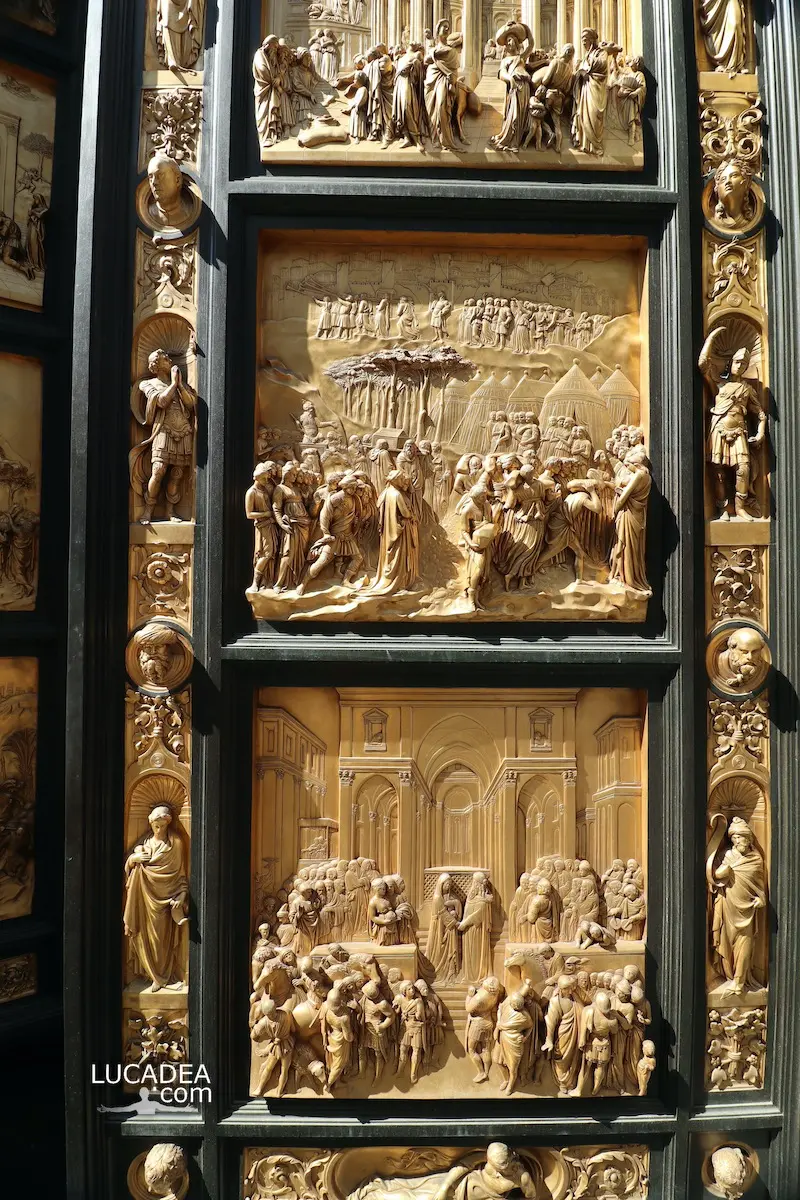
Details of the Baptistery Portal in Florence

Particolari del Portale del Battistero di Firenze

Details of the Baptistery Portal in Florence.
Walking through Florence, it is impossible not to stop and admire the façade of its magnificent cathedral (Santa Maria del Fiore) and the nearby Baptistery of Saint John, one of the city’s oldest and most important monuments.
On this occasion, I focused on the details of one of the three entrance doors of the baptistery: the famous Gates of Paradise, located on the eastern side and created by Lorenzo Ghiberti. This masterpiece of the Italian Renaissance is renowned worldwide for the refinement of its decorations and its artistic innovation.
Looking closely at the gilded bronze panels, one is immediately struck by the extraordinary level of detail. The scenes, taken from the Old Testament, are filled with figures, depth and perspective, showcasing Ghiberti’s exceptional skill. Every panel tells a story, and the more you observe, the more details you discover.
According to tradition, the name “Gates of Paradise” was given by Michelangelo, who considered them worthy of being the entrance to paradise itself. Even today, they remain one of the most admired and photographed artworks in Florence.
Florence, in the heart of Tuscany, is a city that preserves some of the greatest artistic treasures in the world, and the cathedral complex — including the church, the bell tower and the baptistery — is undoubtedly one of its most iconic landmarks.
This photograph comes from the desire to go beyond the classic wide view, focusing instead on the details that often go unnoticed but truly reveal the soul of a masterpiece.

Have you ever taken the time to closely observe the details of a famous monument and discovered something new? Add a comment or scroll down to read what other visitors have written.

Photos taken with Canon EOS M100 and Canon EF-S 10-18 lens.

To see all the photos I took in the beautiful Tuscan town, click here:

The door is divided into 10 large rectangular panels, arranged in five rows, each of which, with frames adorned with tondi with heads of prophets, occupies the entire width of one door. The panels depict scenes from the Old Testament, which follow one another on both doors from left to right and from top to bottom.
Continue and learn more at Wikipedia

Details of the Portal of the Baptistery of Florence – Details des Portals des Baptisteriums von Florenz – Thông tin chi tiết về Cổng thông tin về Bí ẩn Baptiste của Florence

Some photos of Sara and Savina’s Tuscany

Toscana

Some photos of Tuscany by Sara and Savina.
These are several photos of Tuscany that I must say are truly beautiful.
Looking through my archive, I noticed that since I changed my website, I haven’t added them back. So I’m going to fix that right away.

These photos were taken by: SARA and SAVINA

Toscana

To see all the photos, click here
foto gallery

Tuscany is an Italian region with ordinary statute and a population of 3,743,370, located in central Italy, with Florence as its capital. It borders Liguria to the northwest, Emilia-Romagna to the north, Marche and Umbria to the east, and Lazio to the south. To the west, its 397 km of continental coastline is bathed by the Ligurian Sea in the central-northern stretch between Carrara (the mouth of the Parmignola River, bordering Liguria) and the Gulf of Baratti; the Tyrrhenian Sea laps the southern stretch of coastline between the Piombino promontory and the mouth of the Chiarone River, which marks the border with Lazio. The regional capital is Florence, the most populous city (382,000 inhabitants) and its main historical, artistic, and economic-administrative hub; the other provincial capitals are: Arezzo, Grosseto, Livorno, Lucca, Massa, Pisa, Pistoia, Prato, and Siena.
Continue on Wikipedia

Some photos of Sara and Savina’s Tuscany – Quelques photos de Toscane par Sara et Savina – Algunas fotos de la Toscana por Sara y Savina – Algumas fotos da Toscânia por Sara e Savina – Einige Fotos der Toskana von Sara und Savina – Một số hình ảnh về Tuscany của Sara và Savina
🏠
  • Italiano