Walking under the arcades of Via XX Settembre

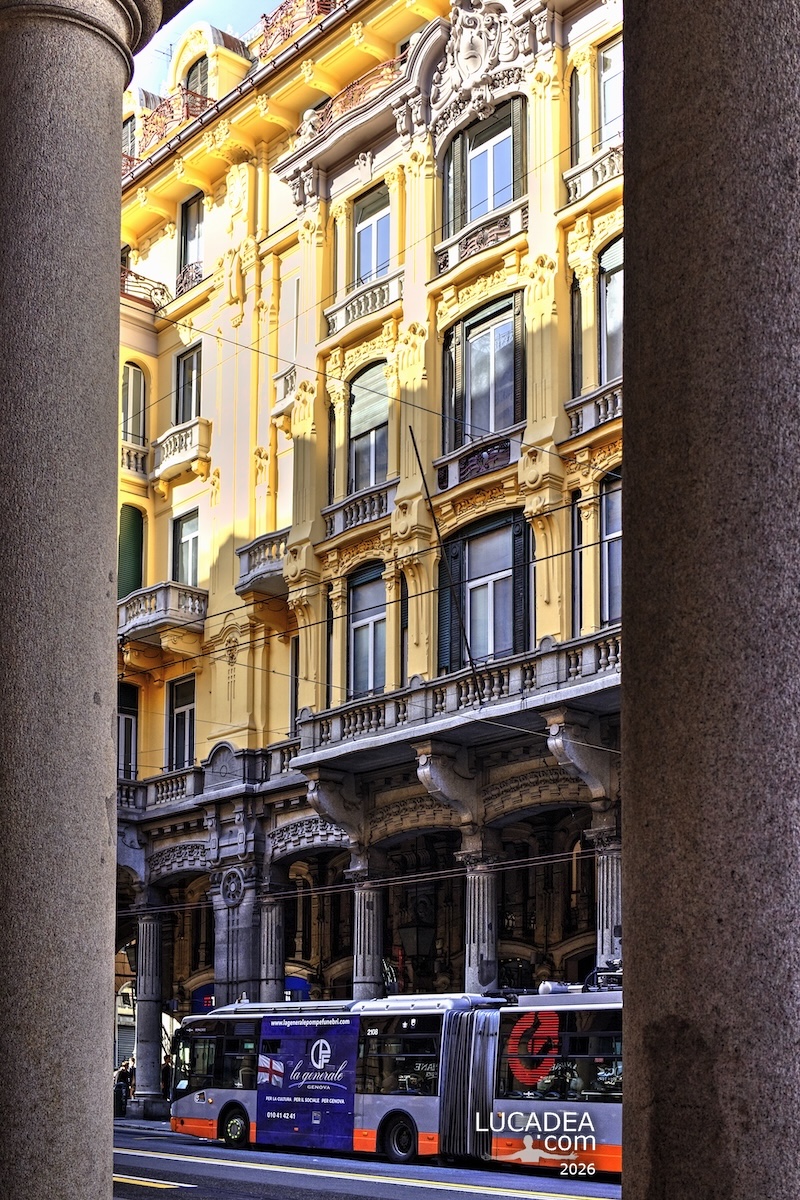
Portici di via XX Settembre a Genova con palazzo decorato giallo e autobus che passa tra le colonne

Walking under the arcades of Via XX Settembre.
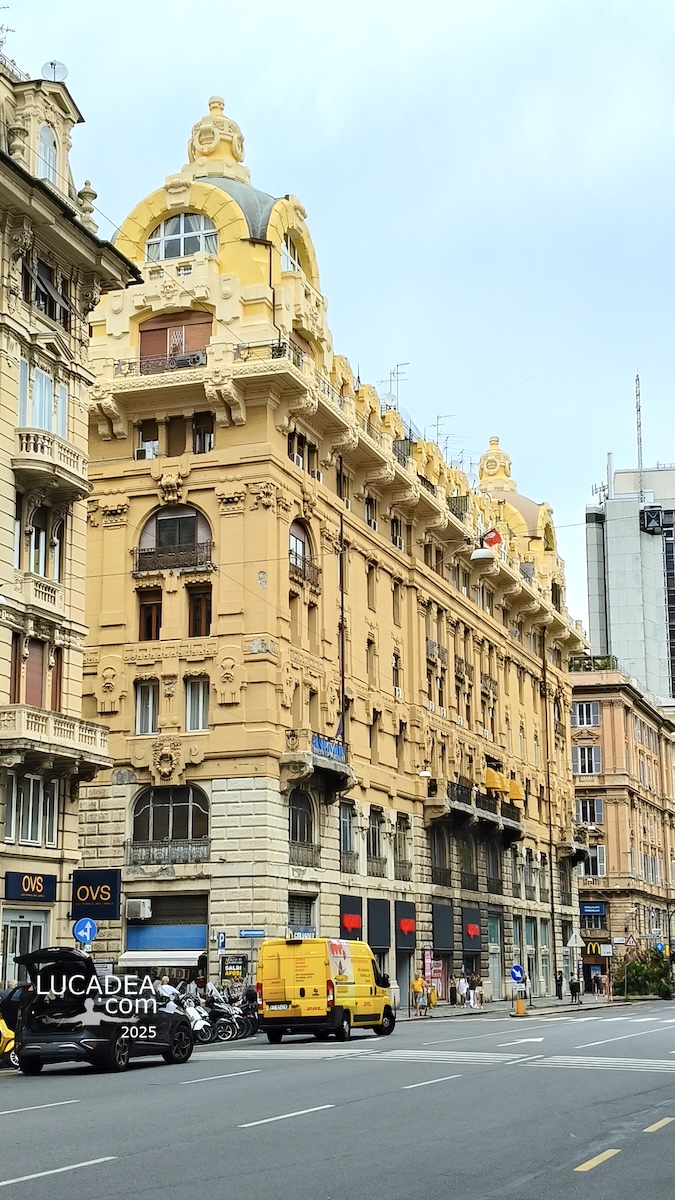
Walking under the arcades of Via XX Settembre in Genoa is one of those simple experiences that immediately shows what to see in Genoa without going far. This view of Via XX Settembre in Genoa captures both the elegance of the architecture and the everyday rhythm of the city.
I found myself standing between two large columns, almost hidden, watching the sunlight fall across the façade of the building in front of me. The details of the balconies and decorative elements drew my eyes upward, while below, the movement of buses and people reminded me that this is a living, breathing street. It’s a place where the past and present coexist naturally.
This scene is located in Genoa, Liguria, Italy, right in the heart of one of the most important streets in the city. If you are visiting Genoa, Via XX Settembre is definitely one of the most interesting places in Genoa to explore, not only for shopping but for its architecture. The arcades are among the longest in Europe, originally designed to protect pedestrians while enhancing the visual harmony of the street.
While taking this photo, I was reminded of another shot I had shared on my site from a quieter corner under similar arcades. Here, however, everything feels larger and more dynamic, almost like a stage where the columns frame the scene and the street becomes the action.
The passing bus added a contemporary touch to the scene without disrupting its balance. Instead, it highlighted the contrast between historic buildings and modern life, something that makes this street unique.

Have you ever looked up while walking through a busy street and suddenly noticed something you had never seen before? Add a comment or go to the bottom of the site to read what other visitors have written.
Portici di via XX Settembre a Genova con palazzo decorato giallo e autobus che passa tra le colonne

Photo taken with Canon EOS R50 V and lens Canon RF 28.

I portici di via XX Settembre a Genova – The arcades of via XX Settembre in Genoa – Les arcades de la via XX Settembre à Gênes – Los soportales de via XX Settembre en Génova – As arcadas da via XX Settembre em Gênova – Die Arkaden der Via XX Settembre in Genua – Các mái vòm của via XX Settembre ở Genoa – 热那亚二十世纪大街的拱廊

The text of this post was written with the help of ChatGPT, a language model from OpenAI.

Add one  comment to this article or read  here what other visitors have written.
 
Adv
 
Disclamer

The rights on images, videos, choruses, text and all other material on the LUCADEA.com website are governed as per  Copyright page.

This page has been viewed 1 times today.
This month it has been viewed 1 times.
In total it has been viewed 1 times.
 

A glimpse of Chiavari old town streets

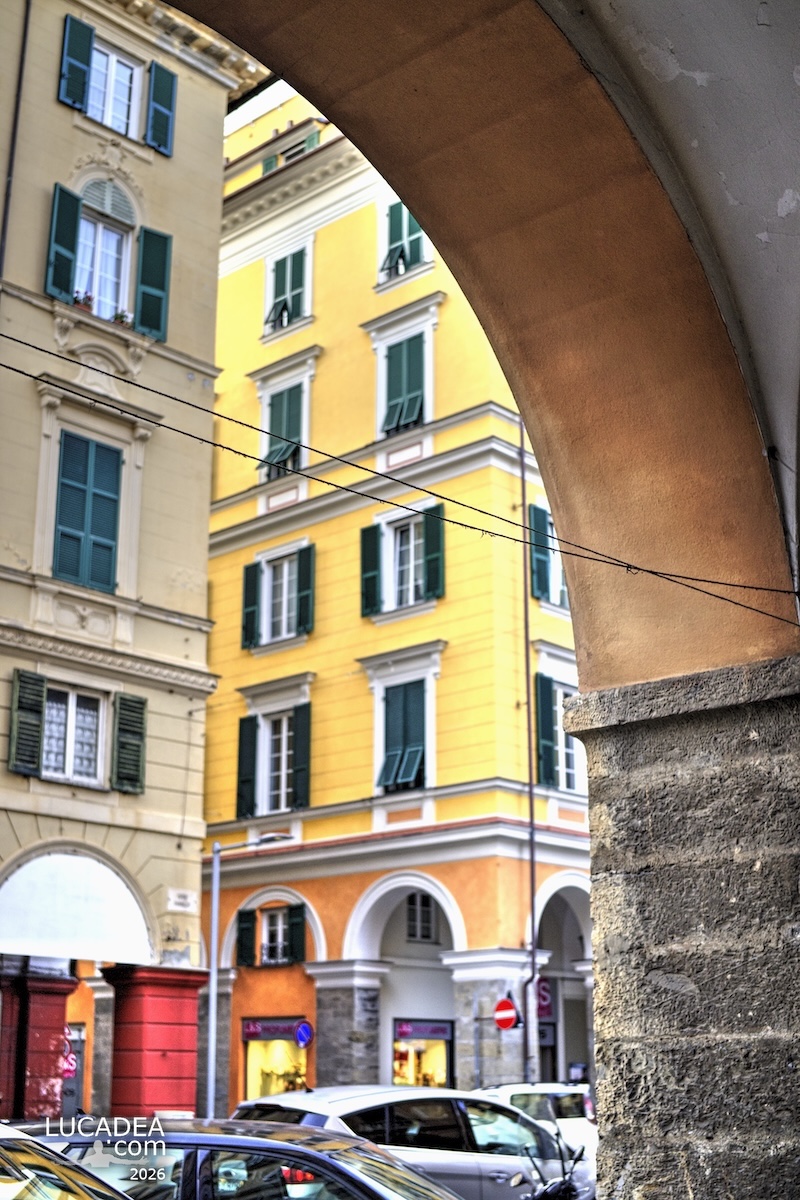
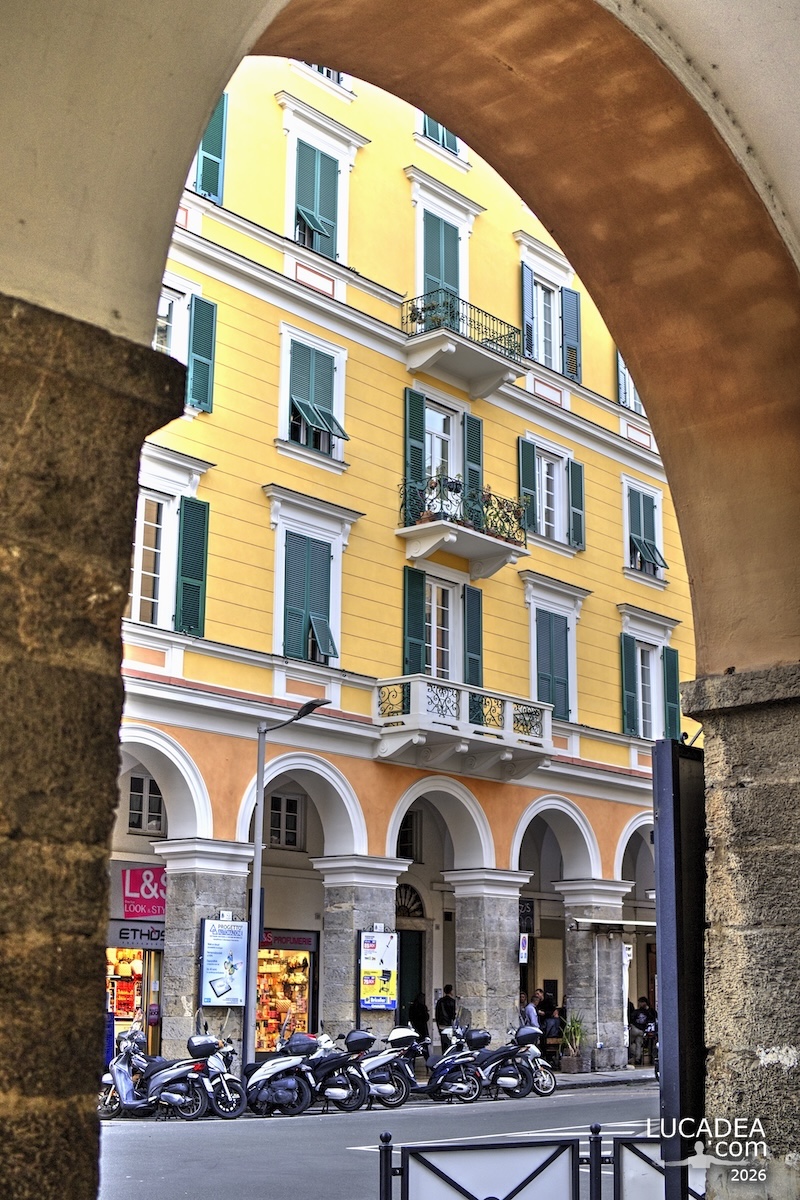
Portici del centro storico di Chiavari con palazzi gialli e persiane verdi incorniciati da un arco in primo piano

A glimpse of Chiavari old town streets.
Walking beneath the arcades in the old town of Chiavari is one of those simple experiences that shows you what to see in Chiavari without even trying. This view of Chiavari old town streets, with its colorful buildings and green shutters, feels like a natural introduction to the atmosphere of this coastal town in Liguria.
I paused under the arch almost without thinking, drawn by the way it framed the scene ahead. The curve of the stone created a soft border, guiding my eyes toward the yellow façade across the street. The repetition of windows and shutters gave the composition a quiet rhythm, something I always look for when photographing urban details.
In Chiavari, Liguria, Italy, the old town is not just a place to pass through but one of the most interesting places in Liguria to slow down and observe. If you are visiting this area, these arcades are definitely worth seeing, not only for their aesthetic but for the way they shape daily life. Historically, Chiavari is known for having some of the longest arcades in the region, offering shelter and continuity through centuries of local activity.
As I stood there, I remembered another photo I had taken along these same streets, shared on my site in a different season. The light had changed completely, yet the feeling remained familiar. That’s something I find fascinating: places like this hold their identity no matter the time or conditions.
Cars passing at the edge of the frame added a subtle contrast between past and present. They didn’t ruin the mood; instead, they reminded me that this is not just a preserved setting, but a living town.

Have you ever found yourself stopping for a moment in a place like this, realizing it’s more than just a street? Add a comment or go to the bottom of the site to read what other visitors have written.

Photos taken with Canon EOS R50 V and lens Canon RF 28.

Uno scorcio del centro storico di Chiavari – A glimpse of Chiavari old town – Un aperçu du centre historique de Chiavari – Un rincón del centro histórico de Chiavari – Um vislumbre do centro histórico de Chiavari – Ein Blick auf die Altstadt von Chiavari – Một góc khu phố cổ Chiavari – 基亚瓦里历史中心的一角

The text of this post was written with the help of ChatGPT, a language model from OpenAI.

Add one  comment to this article or read  here what other visitors have written.
 
Adv
 
Disclamer

The rights on images, videos, choruses, text and all other material on the LUCADEA.com website are governed as per  Copyright page.

This page has been viewed 0 times today.
This month it has been viewed 0 times.
In total it has been viewed 0 times.
 

A quiet corner of Via Olive Stanghe in Sestri

Scorcio di via Olive Stanghe a Sestri Levante con strada stretta del centro storico ligure tra muri e prospettive urbane

A quiet corner of Via Olive Stanghe in Sestri.
A glimpse of Via Olive Stanghe in Sestri Levante appears in front of me as a narrow and understated passage, where the rhythm of the town slows down and becomes more intimate. A glimpse of Via Olive Stanghe in Sestri Levante, Liguria, Italy, feels like one of those small urban moments that do not demand attention but gently hold it.
As I walk through Via Olive Stanghe in Sestri Levante, I notice how the street changes from the more open and familiar areas of the town into something more enclosed and personal. The light behaves differently here, bouncing softly off the walls and creating a quiet visual rhythm.
In Sestri Levante, Liguria, northern Italy, this kind of side street reveals another layer of the town, far from the postcard views of the coastline. It is in places like this that the real texture of daily life becomes visible, built from small architectural details and narrow perspectives.
One interesting aspect of these historic streets is that many of them still follow ancient pedestrian routes that once connected different parts of the village before modern expansion reshaped the area.
As I look at this scene, I am reminded of other contrasts I have photographed on the site, such as the open brightness of Baia del Silenzio, where everything expands toward the sea. Here in Via Olive Stanghe, everything contracts inward, creating a very different emotional tone.

This small view of Via Olive Stanghe in Sestri Levante becomes a reminder that not all meaningful places are grand or famous; sometimes they are simply quiet transitions between more visible spaces. Have you ever found a street that felt more honest than the main squares around it? Add a comment or go to the bottom of the site to read what other visitors have written.

Scorcio di via Olive Stanghe a Sestri Levante con strada stretta del centro storico ligure tra muri e prospettive urbane

Photo taken with Canon EOS R50 V and lens Tamron 16-300.

Where is the street:

A quiet glimpse of Via Olive Stanghe in Sestri Levante – Un angolo quieto di via Olive Stanghe a Sestri Levante – Un rincón de Via Olive Stanghe en Sestri Levante – Um recanto de Via Olive Stanghe em Sestri Levante – Eine ruhige Ecke der Via Olive Stanghe in Sestri Levante – Một góc yên tĩnh của Via Olive Stanghe ở Sestri Levante – 锡斯特里莱万特奥利韦街的安静一角 – セストリ・レヴァンテのヴィア・オリーヴェ・スタンゲの静かな一角

The text of this post was written with the help of ChatGPT, a language model from OpenAI.

Facade of the Court of Justice in Bergamo

Facciata del Palazzo di Giustizia di Bergamo in stile razionalista con statue all’ingresso e architettura istituzionale

Facade of the Court of Justice in Bergamo.
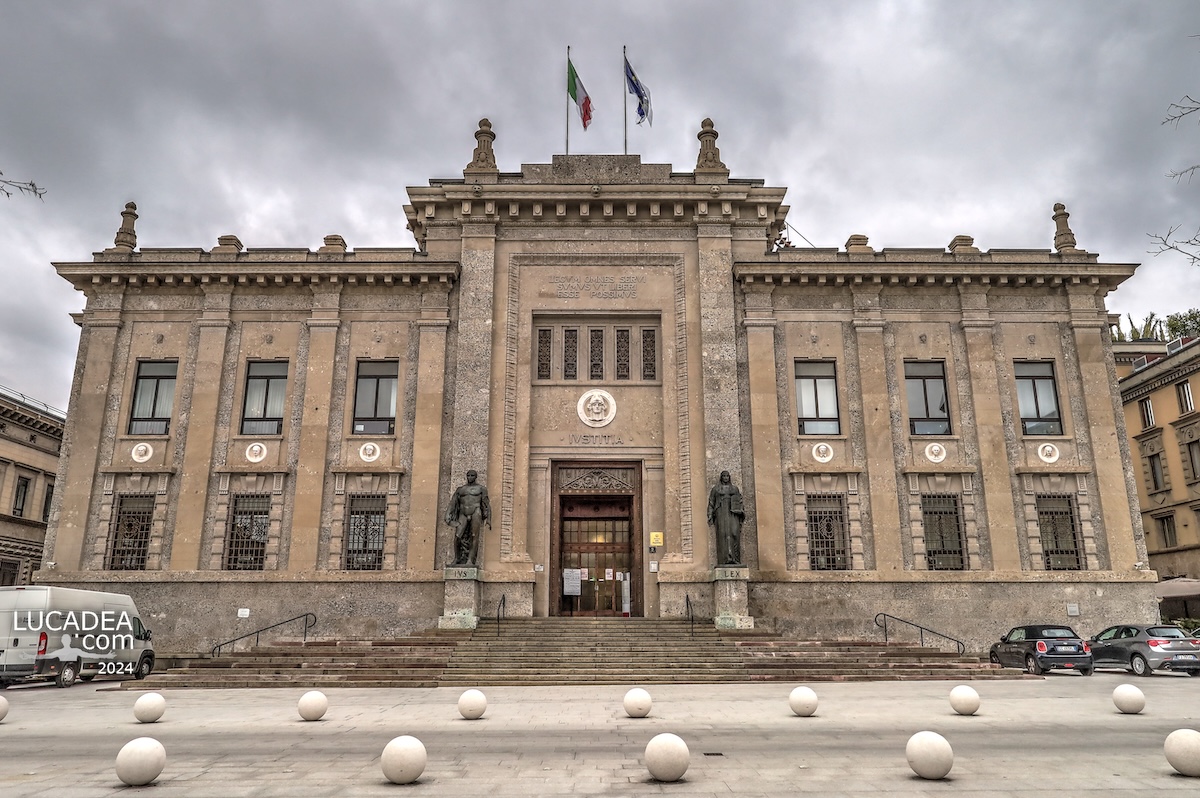
The facade of the Court of Justice in Bergamo is one of those architectural views that immediately draws attention when you find yourself in this institutional part of the city. The facade of the Court of Justice in Bergamo, with its strict geometric composition, clearly reflects the principles of 20th-century Italian public architecture and the language of rationalist design. Even in its simplicity, the facade of the Court of Justice in Bergamo expresses the ordered identity of Bergamo.
The building belongs to the tradition of Razionalismo italiano, an architectural movement focused on clarity, proportion, and the elimination of unnecessary decoration. The facade of the Court of Justice in Bergamo reflects this philosophy through its clean lines and balanced structure, giving the building a strong and authoritative presence in the urban landscape.
What makes the scene even more striking are the two statues placed at the entrance. These allegorical figures contrast with the rationalist severity of the facade of the Court of Justice in Bergamo, introducing a symbolic layer connected to justice and classical tradition. This combination of rationalist architecture and symbolic sculpture is typical of institutional buildings from that era.
Standing in front of it, I found myself observing how light interacts with the smooth surfaces of the facade of the Court of Justice in Bergamo, emphasizing its geometry and stillness. It is a reminder that even administrative buildings can carry a strong visual identity without relying on ornamentation.
An interesting fact is that many Italian judicial buildings from the rationalist period intentionally combine geometric rigor with allegorical elements to visually communicate authority and state power.
If you are visiting Bergamo and wondering what to see beyond the historic upper town, this kind of architecture reveals a quieter but meaningful side of the city.

Have you ever stopped in front of an institutional building and actually looked at its details instead of just walking past it? Add a comment or go to the bottom of the site to read what other visitors have written.

Facciata del Palazzo di Giustizia di Bergamo in stile razionalista con statue all’ingresso e architettura istituzionale

Photo taken with Canon EOS RP and Canon RF 24-50 lens.

To see all the photos I took in Bergamo, click here:

Where is the building located:

Facade of the Court of Justice in Bergamo – Façade du palais de justice de Bergame – Fachada del Palacio de Justicia de Bérgamo – Fachada do Palácio da Justiça de Bergamo – Fassade des Justizpalastes in Bergamo – Mặt tiền Tòa án Bergamo – 贝加莫法院外立面 – ベルガモ裁判所のファサード

The text of this post was written with the help of ChatGPT, a language model from OpenAI.

Atmospheres in Giacomo Matteotti Square in Chiavari

Scorci di Piazza Giacomo Matteotti a Chiavari con prospettive urbane, edifici storici e atmosfera del centro cittadino ligure

Atmospheres in Giacomo Matteotti Square in Chiavari.
The photographs I took in Giacomo Matteotti Square in Chiavari capture a quiet urban balance, where everyday movement and architectural order coexist in a natural rhythm. Known locally by many as Piazza delle Carrozze, this space in Chiavari reveals itself slowly, especially when observed through details rather than a single wide view.
Chiavari, Liguria, Italy, is a coastal town where the relationship between sea and historic center shapes the entire atmosphere of the city, and Giacomo Matteotti Square in Chiavari is one of its most recognizable urban spaces. If you are visiting Liguria and wondering what to see in Chiavari, this square is not about monuments alone, but about how people move through it every day.
In my two images, I focused on the geometry of the square, the rhythm of the facades, and the way light interacts with open urban space. Giacomo Matteotti Square in Chiavari becomes almost a stage where the city quietly performs its daily life.
While working on these photographs, I was reminded of another article I published on the site about Ligurian urban spaces, where I explored how architecture often reveals more through context than through individual landmarks. The same idea applies here, where the square gains meaning through use rather than appearance.
A small historical note about Chiavari is that Giacomo Matteotti Square has long been a central meeting point for the city, shaped by its role as a place of passage and exchange, which explains its popular nickname “Piazza delle Carrozze.”
Looking at these images again, I realize how often a place becomes truly visible only when it is frozen in a photograph.

Have you ever noticed how familiar places can look completely different when seen through a camera lens? Add a comment or go to the bottom of the site to read what other visitors have written.

Photos taken with Honor 20.

Atmospheres in Piazza Giacomo Matteotti in Chiavari – Atmosphères sur la Piazza Giacomo Matteotti à Chiavari – Atmosferas en la Piazza Giacomo Matteotti en Chiavari – Atmosferas na Piazza Giacomo Matteotti em Chiavari – Atmosphären auf der Piazza Giacomo Matteotti in Chiavari – Không khí tại Piazza Giacomo Matteotti ở Chiavari – 基亚瓦里贾科莫马泰奥蒂广场的氛围 – キアヴァリのジャコモ・マッテオッティ広場の雰囲気

The text of this post was written with the help of ChatGPT, a language model from OpenAI.

Building on Brigate Liguria Street in Genoa

Palazzo in Via Brigata Liguria a Genova con facciata regolare e piccolo dettaglio di bandiera su edificio urbano

Building on Brigate Liguria Street in Genoa.
The façade develops with a steady rhythm of aligned windows and restrained surfaces that guide the eye along the building on Brigate Liguria Street in Genoa, where architecture blends into the urban flow without trying to stand out. In this part of Genoa, Liguria, Italy, the building on Brigate Liguria Street in Genoa feels more like part of the street than a separate landmark.
Looking closer, the building on Brigate Liguria Street in Genoa reveals a functional urban architecture shaped by everyday city life rather than decorative intent. The lines are simple, the balconies minimal, and the overall structure reflects a quiet balance typical of this area. The building on Brigate Liguria Street in Genoa does not aim to dominate the street, yet it becomes noticeable precisely because of its simplicity.
Brigate Liguria Street is one of those urban corridors where the gaze naturally follows façades instead of open spaces, and where small details gain importance through slow observation. This area of Genoa reflects a more everyday urban identity, made of constant movement, offices, and transitional paths rather than iconic scenery.
At the end, a small flag appears on the façade, easy to miss at first glance. It is a subtle detail, but it provides context and hints at institutional presence within the building, without becoming the main focus of the scene.
Looking back at other photos on lucadea.com, I notice how often Genoa reveals itself through these quiet architectural fragments rather than through monuments or landmarks.

How often do we pass similar details without really noticing them? Add a comment or go to the bottom of the site to read what other visitors have written.

Palazzo in Via Brigata Liguria a Genova con facciata regolare e piccolo dettaglio di bandiera su edificio urbano

Photo taken with Oppo Reno 12.

Here’s the spot where I took the shot:

Architectural detail on XX Settembre street buildings

Fregio decorativo in un palazzo di via XX Settembre a Genova con motivi floreali scolpiti e segni del tempo

Architectural detail on XX Settembre street buildings.
Walking along XX Settembre street in Genoa, one of the things that always captures my attention is the presence of decorative friezes, those subtle architectural details that many people overlook but that truly define the character of the street; noticing architectural details in Genoa is one of the most interesting things to do if you are visiting Liguria and want to discover more than just the main attractions. It only takes a moment to slow down and really look.
In this photo, I focused on a decorative element with floral patterns, slightly worn by time but still full of personality. Architectural details like these are scattered all along the street, telling stories of craftsmanship and design. We are in Genoa, Liguria, Italy, and this kind of ornament belongs to a long tradition you can still see if you take the time to observe carefully.
What fascinates me most is the contrast between the busy street life and the stillness of these decorations. People walk by quickly, rarely looking up, while these elements remain unchanged, quietly witnessing everything. If you are looking for what to see in Genoa beyond the usual landmarks, paying attention to these details is definitely worth it.
This reminds me of another post I shared on the site about hidden architectural elements in the historic center, because that’s often what I enjoy capturing the most. Not just wide views, but the smaller, overlooked pieces that give a place its identity.
A small curiosity: XX Settembre street is one of the main streets in Genoa, developed between the 19th and 20th centuries, and many of its buildings feature Liberty or neoclassical decorations, reflecting a period of urban expansion.
I pause for a few seconds, observing the shapes and the marks left by time. These are the details that stay with you.

Do you ever stop and notice these small elements while walking through a city? Add a comment or go to the bottom of the site to read what other visitors have written.

Fregio decorativo in un palazzo di via XX Settembre a Genova con motivi floreali scolpiti e segni del tempo

Photo taken with Canon EOS R50 V and lens Canon RF 28.

Modern John Fitzgerald Kennedy Square in La Spezia

Piazza John Fitzgerald Kennedy alla Spezia con la moderna struttura di copertura che caratterizza lo spazio urbano

Modern John Fitzgerald Kennedy Square in La Spezia.
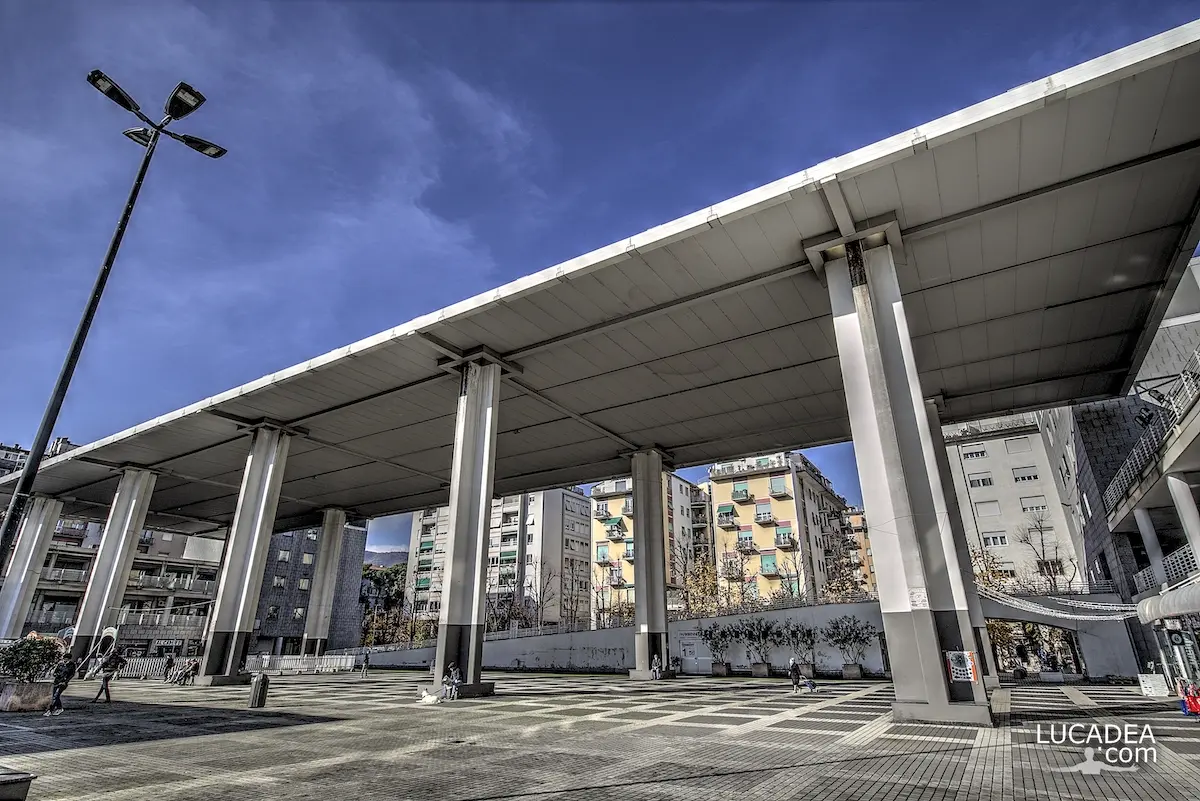
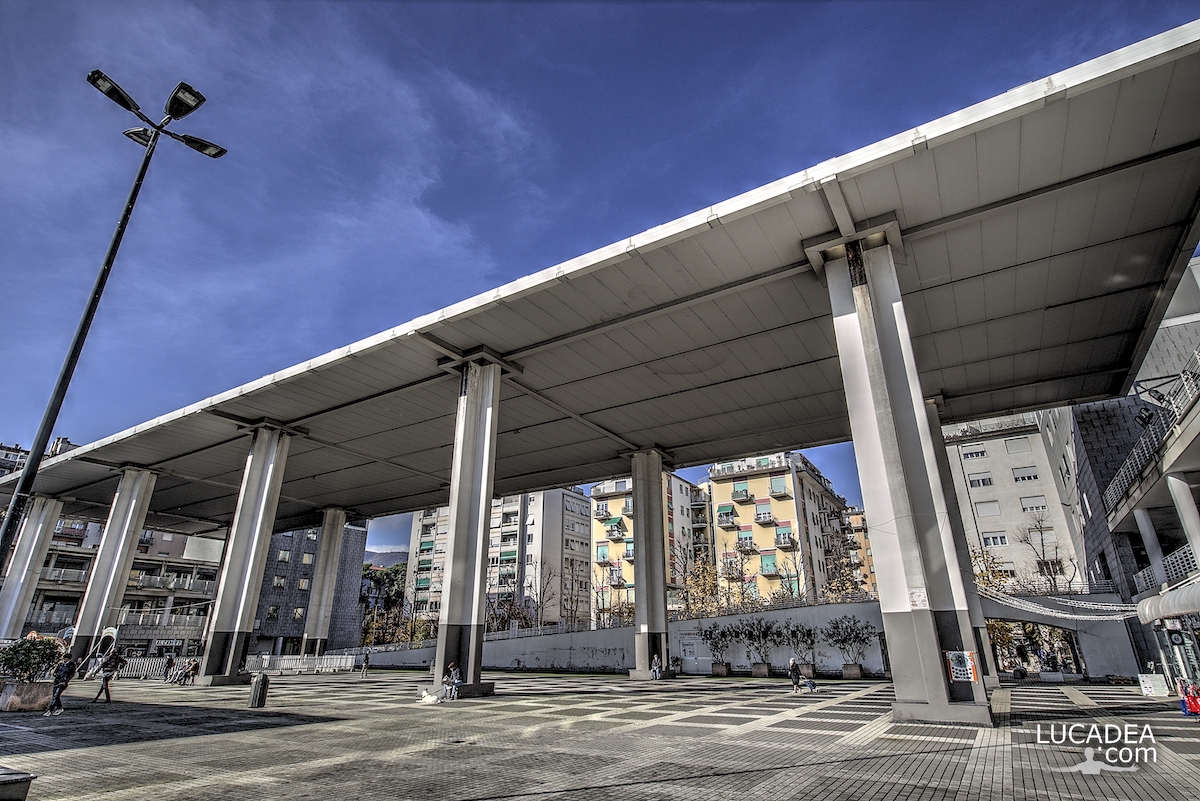
While walking through the eastern part of La Spezia, Liguria, Italy, I came across this very modern-looking square, quite different from the narrow streets and older buildings I usually associate with the city. What immediately caught my attention was the large structure covering part of the space, giving the square a distinctive and contemporary appearance.
When I took this photograph, I did not know much about the place. I had tried to find some information but had not discovered much, so I could only interpret what I was seeing. The large roof-like structure made me wonder whether the square was used for markets, public activities, or events where some protection from the weather might be useful.
Piazza John Fitzgerald Kennedy is in the eastern part of La Spezia, in Liguria, and it offers a completely different photographic subject from the historic streets I have photographed elsewhere in the city. There are no narrow alleys here and no old façades competing for attention. Instead, the open space and the modern architecture create a much simpler urban composition.
That difference is precisely what made me stop.
Since then, I have managed to learn a little more about the square. It is connected with the Kennedy Center, an area with commercial and everyday services. The square also hosts the local farmers’ market on Thursdays, with producers bringing fruit, vegetables, cheeses and other products. Knowing this gives the structure in my photograph a little more context. What first looked to me like an unusual piece of modern architecture is also part of a space designed to accommodate everyday activities in the city.
If you are looking for places to see in La Spezia beyond the better-known historic streets, this is the kind of urban detail I find worth noticing. It may not be a traditional landmark, but it shows another side of the city, one made of contemporary spaces, commercial areas and places used by local people every day.
I like photographs that begin with a question. This one certainly did. I had simply encountered an unusual square while walking around La Spezia and found myself wondering what the structure was actually intended for. Sometimes the curiosity comes before the information, and for me that is part of the reason for taking photographs in the first place.
It also reminds me of other photographs I have published from La Spezia, where ordinary corners of the city became interesting simply because something caught my eye while I was walking.

Do you know this part of La Spezia, and have you ever stopped to look at the unusual structure in this square? Add a comment or go to the bottom of the site to read what other visitors have written.

Piazza John Fitzgerald Kennedy alla Spezia con la moderna struttura di copertura che caratterizza lo spazio urbano

Photo taken with a Canon EOS M100 camera and Canon EF-M 11-22 lens.

If you want to see all the photos I took in the city, click here:

John Fitzgerald Kennedy—commonly known as John Kennedy, simply JFK, or by the nickname Jack (Brookline, May 29, 1917 – Dallas, November 22, 1963)—was an American politician and author who served as the 35th President of the United States from 1961 to 1963.
Read more and learn more on Wikipedia

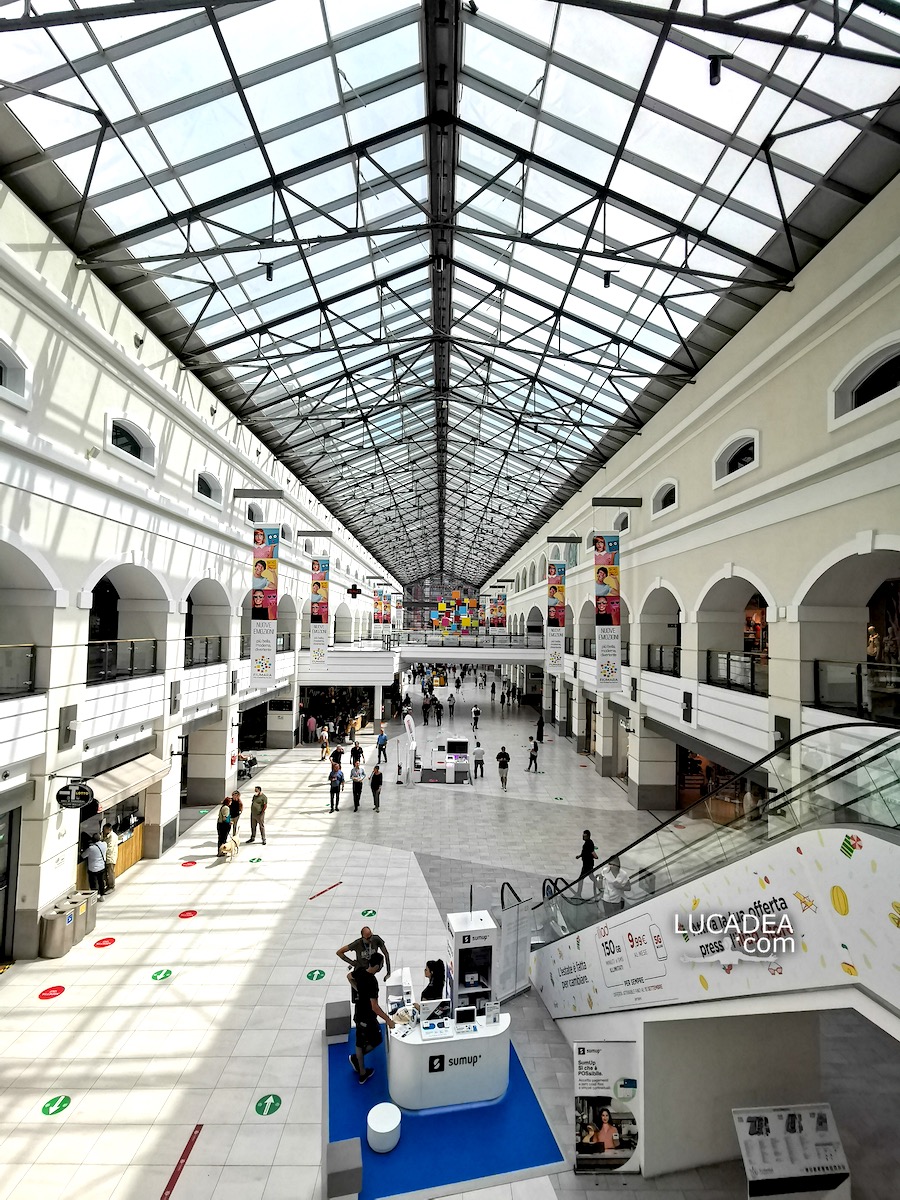
Fiumara Shopping Centre in Genoa

Centro commerciale Fiumara a Genova con gli spazi moderni dello shopping in Liguria

Fiumara Shopping Centre in Genoa.
Among the modern buildings of Sampierdarena, I stopped to look at one of the places for shopping in Genoa that may not immediately come to mind when thinking about the city. My photograph of Fiumara Shopping Centre is about this less familiar side of Genoa, away from the historic palaces and narrow streets that usually dominate photographs of the city.
When I think about what to see in Genoa, I naturally think of the old town, the harbour, the historic buildings and the many corners I have photographed over the years. But a city is also made of everyday places. Shopping centres, modern buildings and areas shaped by urban change can say something about the present just as older architecture tells us about the past.
Fiumara Shopping Centre is in the Sampierdarena area of Genoa, Liguria, Italy. Its position in the western part of the city makes it part of a very different urban landscape from the historic centre. If you are looking for where Fiumara Shopping Centre is in Genoa, Sampierdarena is the useful reference point, and the area itself helps put the building into the wider story of the city.
What caught my attention was not simply the fact that this is a shopping centre, but the way its modern architecture fits into the surrounding urban landscape. I wanted the photograph to show a contemporary side of Genoa that is easy to overlook when searching for the more traditional images of the city.
This is a photograph I took myself with my Honor 20. I did not set out to create a formal architectural record. Instead, I noticed the place while I was there and decided to stop and photograph it. That is one of the things I enjoy most about photography: a subject does not always have to be famous or spectacular. Sometimes an ordinary building becomes interesting simply because you decide to look at it carefully.
There is also a small detail about the name Fiumara that I find worth remembering. The name is connected with the history of this part of Genoa and with the watercourse that once characterized the area. It is a simple connection, but it gives the present-day landscape another layer of meaning.
Sampierdarena has experienced major urban changes over time, and the mixture of different buildings and functions visible today is part of that transformation. I prefer not to turn the photograph into a historical explanation, because the image itself remains the centre of the story. For me, the modern structure is interesting precisely because it belongs to the Genoa of everyday life.
If you are visiting Genoa and wondering what is worth seeing beyond the usual historic landmarks, places like this can offer a different perspective. They may not be traditional attractions, but they help reveal how the city works and how its landscape continues to change.
This photograph also connects naturally with other images I have taken around Genoa. I think especially of my photograph of the rooftops of central Genoa seen from Castelletto. That view shows the historic and compact side of the city from above, while Fiumara gives me the chance to look at a much more contemporary part of the same urban landscape.
The contrast between those two photographs is something I like. Genoa is not only its old streets, churches and historic buildings. It is also the modern city, the commercial areas, the buildings people use every day and the spaces that have changed together with the habits of its residents.
For anyone looking for practical information about the shopping centre, the official Fiumara website is the better place to check current details about shops, services and opening hours. Here, however, I prefer to keep the focus on the photograph and on the reason why this ordinary urban scene caught my attention.
That is ultimately what I try to do with photographs like this one: keep a visual record of Genoa as I actually encounter it, including the places that might otherwise be ignored. Fiumara is part of that everyday Genoa, and photographing it gives me another way to understand the city beyond its most recognizable views.

Have you ever photographed an ordinary place in your city that most people usually overlook? Add a comment or go to the bottom of the site to read what other visitors have written.

Fiumara Shopping Centre in Genoa with modern shopping spaces and contemporary urban architecture in Sampierdarena

Photo taken with Honor 20.

Glimpses of Market Square in Sestri Levante.

Scorci della piazza del Mercato a Sestri Levante con auto parcheggiate e vita quotidiana nel centro urbano ligure

I often find myself observing Market Square in Sestri Levante in those everyday moments where nothing seems staged, yet everything feels quietly significant. Piazza del Mercato Sestri Levante appears while cars come and go, while people pass through without stopping, and while light simply settles on surfaces without asking for attention. The square is not a place that tries to impress at first sight, and maybe that is exactly why I keep returning to it with my camera.
In Sestri Levante, Liguria, Italy, this space behaves like a transition zone rather than a destination. Every time I photograph Market Square in Sestri Levante, I notice how it resists becoming a postcard image, unlike more famous locations such as Baia del Silenzio, which often dominates visual expectations. Yet I feel that the most honest stories often happen away from the obvious landmarks, in places where daily life simply continues.
While reflecting on other photographic stories from my photoblog, especially those connected to Baia del Silenzio and its calm coastal mood, I realize how important it is to balance iconic views with everyday urban fragments. Market Square in Sestri Levante belongs to this second category, where meaning is not concentrated in a single frame but spread across ordinary moments.
One interesting aspect of many Ligurian town squares is how their function has shifted over time, often evolving from historical gathering or trading points into practical urban spaces shaped by modern needs, while still retaining traces of their original social role.
Photographing Market Square in Sestri Levante means accepting a quieter visual language, where imperfection becomes part of the narrative and where each small detail contributes to a broader, ongoing story of the town.

Have you ever noticed how some places only reveal their character when you stop treating them as simple passageways? Add a comment or go to the bottom of the site to read what other visitors have written.

Scorci della piazza del Mercato a Sestri Levante con auto parcheggiate e vita quotidiana nel centro urbano ligure

Photo taken with Canon EOS RP and Canon EF-S 10-18 lens.

Here’s where I took this photo:

Scorci di piazza del Mercato a Sestri Levante – Glimpses of Piazza del Mercato in Sestri Levante – Aperçus de la Piazza del Mercato à Sestri Levante – Vistas de la Piazza del Mercato en Sestri Levante – Eindrücke von der Piazza del Mercato in Sestri Levante – Góc nhìn Quảng trường Mercato ở Sestri Levante – 塞斯特里莱万特集市广场的景象 – セストリ・レヴァンテのメルカート広場の風景

The text of this post was written with the help of ChatGPT, a language model from OpenAI.

🏠
  • Italiano