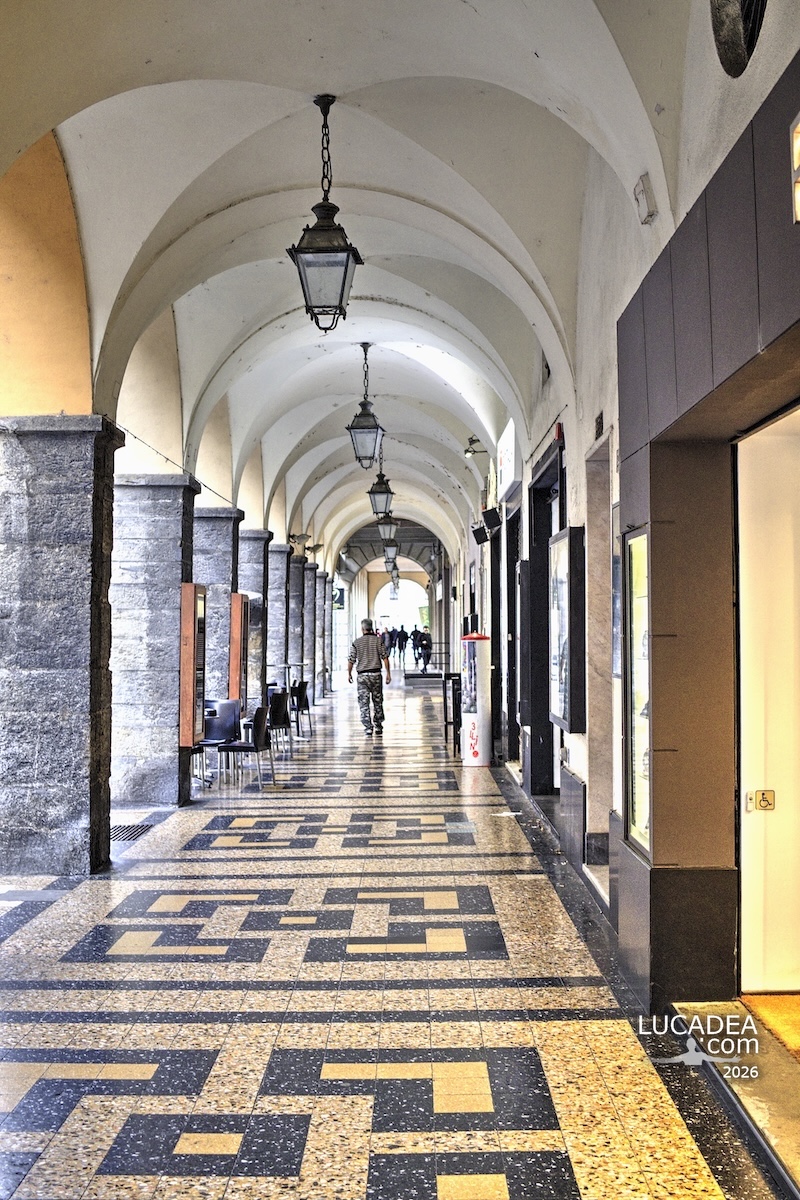
Chiavari, arcades of Garibaldi street

Porticato di Corso Garibaldi a Chiavari con pavimento decorato e arcate storiche nel centro urbano della città ligure

Chiavari, arcades of Garibaldi street.
The arcades of Garibaldi street in Chiavari immediately create a strong visual rhythm, and the arcades of Garibaldi street in Chiavari become the central element of this photograph as I walk through the covered passage. The arcades of Garibaldi street in Chiavari guide the eye forward with a continuous sequence of arches, stone columns, and patterned flooring that naturally shapes the perspective.
I am in Chiavari, Liguria, Italy, where the historic town center is built around these sheltered walkways that define both movement and daily life. The arcade feels almost like an architectural corridor, where sound, light, and space are compressed into a single linear experience.
Historically, arcades in Italian towns like Chiavari were designed not only for protection against weather conditions but also to support social and commercial life. They created a hybrid space between public street and private architecture, a feature that is still clearly readable today in many Ligurian and northern Italian cities.
If you are exploring Liguria, Italy, this is one of those urban elements worth noticing because it represents how architecture can shape behavior and perception at the same time. The repetition of arches becomes almost hypnotic, especially when seen in long perspective like in this stretch of Garibaldi street.
I have already described similar architectural passages in other posts on this site about Chiavari, where the relationship between light and covered walkways often changes the entire mood of a scene.
Walking through the arcades of Garibaldi street in Chiavari feels like moving inside a structured frame, where every step is part of a visual composition already defined by the city itself. The exit toward open light always feels like a sudden change of dimension.

Have you ever noticed how a simple arcade can completely change the way you perceive distance? Add a comment or go to the bottom of the site to read what other visitors have written.
Porticato di Corso Garibaldi a Chiavari con pavimento decorato e arcate storiche nel centro urbano della città ligure

Photo taken with Canon EOS R50 V and lens Canon RF 28.

Add one  comment to this article or read  here what other visitors have written.
 
Adv
 
Disclamer

The rights on images, videos, choruses, text and all other material on the LUCADEA.com website are governed as per  Copyright page.


This page has been viewed 1 times today.
This month it has been viewed 1 times.
In total it has been viewed 1 times.
 

A short walk along San Vincenzo Street in Genoa

Due passi in via San Vincenzo a Genova

A short walk along San Vincenzo Street in Genoa.
Every time I’m in Genoa without a car, I always try to catch the train back from Brignole railway station. To get there, after walking along XX Settembre Street, you need to pass through this large pedestrian street, which at the point in the photo slopes downhill.

Do you know this street in Genoa? Add a comment or go to the bottom of the site to read what other visitors have written.

Due passi in via San Vincenzo a Genova

Photo taken with Honor 20.

Here’s where I took the shot:

The neighborhood takes its name from the church of the same name, now deconsecrated, dedicated to San Vincenzo di Saragossa. Until the construction of the “Mura Nuove” in the 17th century, it was a village outside the city’s defensive walls called “Borgo di Bisagno” because it was located a short distance from the stream of the same name.
Continue and learn more at Wikipedia

Two steps in via San Vincenzo in Genoa – À deux pas de la via San Vincenzo à Gênes – A dos pasos de via San Vincenzo en Génova – Duas etapas na via de San Vincenzo em Génova – Zwei Schritte in der Via San Vincenzo in Genua – Hai bước qua San Vincenzo ở Genoa
Add one  comment to this article or read  here what other visitors have written.
 
Adv
 
Disclamer

The rights on images, videos, choruses, text and all other material on the LUCADEA.com website are governed as per  Copyright page.


This page has been viewed 1 times today.
This month it has been viewed 6 times.
In total it has been viewed 6 times.
 

The seaside walk in Framura, Liguria

La panoramica passeggiata del borgo di Framura in Liguria

The seaside walk in Framura, Liguria.
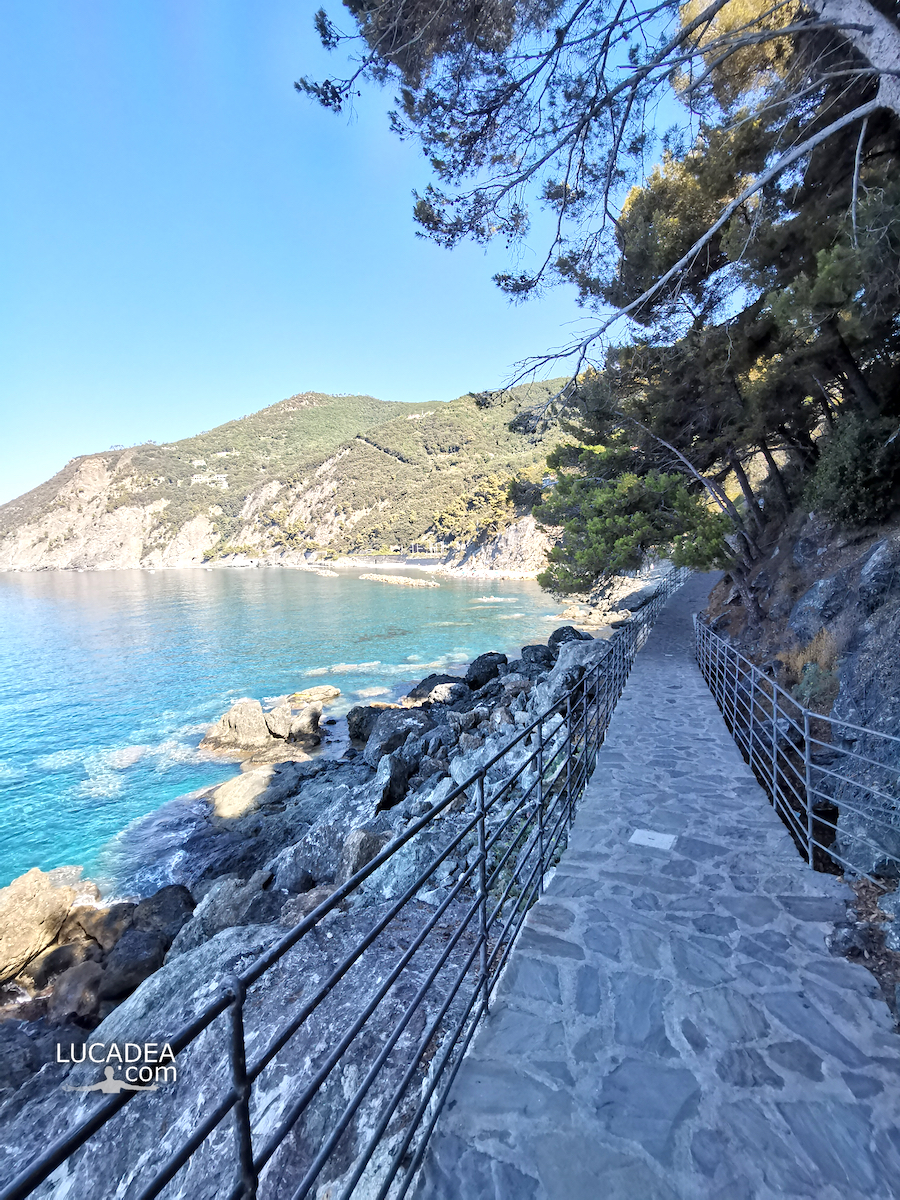
During one of my excursions along the eastern Ligurian coast, I photographed the panoramic seaside walk of Framura, a small Italian village overlooking the Mediterranean where you can find beautiful views and clear waters. It is one of the places worth seeing in Liguria if you are looking for a quieter coastline away from the busiest destinations.
This photograph captures the pleasure of walking along this coastal path, where the route follows the shape of the hills and continuously opens onto views of the sea. Framura does not need much to impress visitors: after arriving by train, a short passage leads directly from the station to the seaside promenade.
I wanted to capture this corner with my camera because it represents a more intimate side of Liguria, made of small villages, coastal paths and viewpoints where you can simply stop and enjoy the landscape. The experience here is different from the most famous seaside locations: you can walk slowly, listen to the sea and observe the coastline from a unique perspective.
Framura is located in the province of La Spezia, in the Liguria region of Italy, along the coast between Levanto and the Cinque Terre area. The village is made up of several small districts scattered between the hills and the sea, and this particular structure gives the landscape a very distinctive character.
One interesting detail about Framura is its railway station, which has become a very convenient access point to reach the sea without using a car. From the station, visitors can walk through the passage and immediately reach the coastal path, making this one of the easiest and most scenic seaside walks in Liguria.
The panoramic route is about three hundred metres long and ends near a small beach where you can stop for a swim. During the busiest summer weeks even Framura can become crowded, but outside the peak season it still keeps the peaceful atmosphere that makes this place so appealing.
When I photograph Liguria, I often look for places that have a particular identity, as I have done in other stories dedicated to villages and coastal views. This walk is another example of a less famous part of the region that can still offer memorable landscapes.
If you are visiting eastern Liguria and looking for what to see in the area, with a place that combines a train connection, sea views and a relaxing walk, Framura’s seaside path is certainly worth discovering.

Have you ever walked along the seaside promenade of Framura? Add a comment or go to the bottom of the site to read what other visitors have written.

Photo taken with Honor 20.

Here’s where the walk is:

Located on the Ligurian coast, the small town of Framura is nestled within one of the many inlets and coves typical of the rugged coastline of the eastern Ligurian Riviera. Mount Serro (421 m above sea level) is the highest peak in the Framura area and is part of the Cinque Terre protected area.
Continue on Wikipedia

The rose garden of Nervi Parks out of season

Il roseto dei Parchi di Nervi fuori stagione

The Rose Garden of the Nervi Parks Off-Season.
The Rose Garden of the Nervi Parks is a charming place to visit even off-season, when the roses aren’t in bloom. During these times, you can still enjoy the beauty of the park and the tranquility it offers. The green spaces, well-maintained paths, and sea views make the park an ideal place for relaxing walks and moments of reflection.
Furthermore, the Nervi Parks are home to other interesting attractions, such as the Museum of Modern and Contemporary Art and the Gallery of Modern Art, which can enrich your visit with a cultural touch. Even without the roses in bloom, the park retains its charm and offers a pleasant experience in every season.
Located in the splendid setting of the Nervi Parks, the Rose Garden is one of Genoa’s botanical jewels. Inaugurated in 1981 thanks to the initiative of Dr. Luigi Viacava, then director of the Gardens and Forestry Department of the City of Genoa, the Rose Garden covers an area of ​​approximately 6,000 square meters and houses a vast collection of roses of various varieties and colors.
The Rose Garden was founded with the aim of creating a space dedicated to the beauty and diversity of roses. Initially, it housed approximately 800 varieties, but over the years, that number has been reduced to about a third. Despite this, the Rose Garden continues to be a place of great botanical charm and interest.

Have you ever visited the Nervi Parks outside of spring? Add a comment or go to the bottom of the site to read what other visitors have written.

Il roseto dei Parchi di Nervi fuori stagione

Photo taken with Canon EOS RP and Canon RF 28 lens.

I took several photos during a couple of visits to the parks and the promenade. If you’d like to see them, click here:
foto gallery

The rose garden of the Nervi Parks out of season – La roseraie des Parcs Nervi hors saison – La rosaleda de los Parques Nervi fuera de temporada – O roseiral dos Parques Nervi fora de época – Der Rosengarten des Nervi Parks außerhalb der Saison – Vườn hồng của công viên Nervi hết mùa

This post was written with the help of Copilot, an AI-powered virtual assistant.

Spagnoli Gallery seen from Dante Avenue in Sestri Levante

Galleria Spagnoli vista da Viale Dante a Sestri Levante

Spagnoli Gallery seen from Dante Avenue in Sestri Levante.
This short gallery, which connects Dante Avenue with Vincenzo Fascie Street, has its own distinctive charm.
I must have walked through it hundreds of times—what about you?

Do you know this street in Sestri? Add a comment or go to the bottom of the site to read what other visitors have written.

Galleria Spagnoli vista da Viale Dante a Sestri Levante

Photo taken with Canon EOS RP camera and Canon RF 50 lens.

Where I took the photo:

The Spagnoli Gallery seen from Viale Dante in Sestri Levante – La galerie Spagnoli vue depuis Viale Dante à Sestri Levante – La galería Spagnoli vista desde Viale Dante en Sestri Levante – A galeria Spagnoli vista da Viale Dante em Sestri Levante – Die Spagnoli-Galerie von der Viale Dante in Sestri Levante aus gesehen – Phòng trưng bày Spagnoli nhìn từ Viale Dante ở Sestri Levante

Walking along Perugia’s medieval aqueduct arches

La vista sull'acquedotto medievale di Perugia

Walking along Perugia’s medieval aqueduct arches.
As I followed the path known as the aqueduct walkway in Perugia, Umbria, Italy, I suddenly found myself aligned with the stone arches of the Perugia aqueduct, quietly stretching between buildings. It’s one of those places worth seeing in Perugia that doesn’t immediately announce itself, but slowly reveals its presence as you walk.
I took this photo right there, trying to capture how the arches guide your взгляд forward, almost like a suspended path through time. The structure doesn’t feel like a monument in the traditional sense; instead, it blends into everyday life, connecting parts of the old city in a way that still feels natural.
If you are visiting Perugia and wondering what to see beyond the main squares, this aqueduct path offers a different perspective. It’s not about wide open views, but about moving through a space where history is built into the ground beneath your feet. The walkway follows the original route of the medieval aqueduct, allowing you to experience it from above.
In the historic center of Perugia, Umbria, Italy, the aqueduct becomes part of the city’s rhythm. You walk alongside houses, small passages, and quiet corners, and only occasionally do you realize that you’re standing on a piece of engineering that once carried water across the city.
A small but fascinating detail is how precisely the system was designed. Built between the 13th and 14th centuries, it relied entirely on gravity to transport water from Mount Pacciano to the Fontana Maggiore. Thinking about that while standing on the arches gives the whole structure a new meaning.
This moment also reminded me of other photos I took in Perugia’s narrow streets, where architecture quietly shapes the way you move and look around. There’s a continuity in these details, as if the city is constantly guiding your attention without being obvious about it.
It’s not a dramatic landmark, but it stays with you because of its subtle presence. The aqueduct doesn’t try to impress—it simply exists, and that’s exactly why it’s worth noticing.

Have you ever walked on something historic without realizing it at first? Add a comment or go to the bottom of the site to read what other visitors have written.

Stone arches of the medieval Perugia aqueduct along the walkway in the historic center of Umbria

Photo taken with Canon EOS RP and Canon RF 24-50 lens.

To see all the photos of Perugia, click here:

Where I took the photo:

The medieval aqueduct of the Fontana Maggiore is a medieval aqueduct located in the city of Perugia. The aqueduct, over 4 kilometers long, was built to bring water to the Fontana Maggiore. Historically less celebrated than the fountain and considered its poor cousin, it was nevertheless a work of enormous historical importance and extraordinary boldness for its time.
Continue and learn more at Wikipedia

Sestri Levante harbor at sunset

Il porto di Sestri Levante

The harbor of Sestri Levante is one of those places I’ve probably experienced without ever really paying attention. For a long time, it was just a point along the way—especially at night—when the focus was somewhere else entirely: music, friends, and the nearby clubs. But coming back here with a different mindset, I realize how much more this place has to offer.
I stand still for a moment, watching the boats gently moving with the water. There’s a quiet rhythm here that feels completely different from the lively atmosphere I used to associate with this area. The light slowly shifts, reflecting on the surface and creating subtle patterns I had never really noticed before. It’s surprising how a familiar place can feel new simply by slowing down.
From here, there’s also a clear view of the beach, and I find myself naturally drawn to that perspective. It’s not a dramatic or overwhelming view, but it has a balance that makes it enjoyable to look at. The harbor of Sestri Levante becomes a kind of viewpoint, a place where you can pause and take in the surroundings without distraction.
Recently, the pedestrian walkway has been completed, and that has changed the way this area is experienced. Walking along the sea, without any rush, listening to the water as it moves, creates a completely different feeling compared to the past. It invites you to slow down and enjoy the moment rather than just passing through.
Looking back, I think that’s what makes this place special. It hasn’t only changed physically, but also in how I see it. What used to be just a stop along the way has become a place worth staying.

Have you ever rediscovered a place you thought you already knew? Add a comment or go to the bottom of the site to read what other visitors have written.

Photo taken with Canon EOS M100 and lens Tamron 16-300.

Where is the port of Sestri:

The port of Sestri Levante – Le port de Sestri Levante – El puerto de Sestri Levante – O porto de Sestri Levante – Der Hafen von Sestri Levante – Cảng Sestri Levante – 塞斯特里莱万特港 – セストリ レバンテの港

The text of this post was written with the help of ChatGPT, a language model from OpenAI.

🏠
  • Italiano