The Heron Often Seen in Sestri Levante.
For the past few years, I have occasionally come across a heron in different parts of Sestri Levante, especially around waterways such as the Gromolo and Petronio rivers. I cannot say whether it is always the same bird, but by now its presence has become a small recurring part of my walks. This time, luckily, I had my telephoto lens with me and managed to photograph it reasonably well.
The heron was near the bridge over the Gromolo leading towards Santo Stefano, not far from Villa Sertorio. It was simply standing there, enjoying the sun, apparently unconcerned by the people nearby. It was one of those moments when being ready with the camera matters, because a bird like this can move away or fly off just as you are trying to find the right position.
If you are wondering what to see in Sestri Levante, a heron may not be the first answer that comes to mind. Yet this is exactly the kind of detail I enjoy documenting. Alongside the beaches, historic center and better-known views of the town, there is also a quieter natural side connected with the waterways and small habitats around them.
Sestri Levante is in Liguria, in the Metropolitan City of Genoa, Italy, and its position between the sea and the hills creates a surprising variety of environments within a relatively compact area. The Gromolo and Petronio waterways pass through areas that can provide birds with places to feed, rest or simply stop for a while.
It is along these routes that I have noticed the heron several times over the years. I obviously cannot know whether it is always the same individual, and that is not really the important part of the photograph. What interests me is the fact that a wild animal can become a recurring presence in the everyday life of a town.
This time, having my telephoto lens made a real difference. It allowed me to keep a respectful distance while still getting a reasonably close image. When I photograph wildlife, I prefer not to disturb the subject and instead wait for the situation itself to provide the right frame.
In this photograph, the heron looks almost completely relaxed as it enjoys the sun near the bridge. Its posture is quite different from the one it might have while searching the water for fish or other small prey. At that moment, it seemed simply to have found a quiet place to stop.
Herons are birds strongly associated with wetlands and are often found along rivers, streams, ponds, lagoons and coastal areas. One of their most recognizable features is their long neck, which can be folded back or extended quickly when the bird strikes at prey. It is a simple detail, but it helps explain why these birds are so closely connected with water.
Here, the Gromolo is therefore more than just a background element. It is part of the environment that makes this encounter possible. The bridge towards Santo Stefano and the area around Villa Sertorio provide a concrete setting, while the heron introduces something that was not placed there by people.
I enjoy this kind of photography because it is rarely planned. I did not go out that day specifically looking for a heron. I was simply walking around Sestri Levante when I came across a subject I had seen before, and this time I happened to have the right equipment to try to preserve the moment.
Looking at the photograph afterwards also made me think about how differently a familiar place can appear once you start recognizing some of its recurring wildlife. A bridge, a stream or an ordinary stretch of road can become much more interesting when a wild animal suddenly appears within the scene.
This is one of the reasons I keep photographing Sestri Levante. I am interested not only in the most recognizable landmarks, but also in the small events that belong to everyday life and rarely appear in conventional images of the town. In that sense, this heron has almost become a small recurring character in my local photographs.
I have already shared several photographs of Sestri Levante on the blog, including views and details around the town and the Gromolo area. This image naturally connects with those stories, although the subject is completely different. This time it is not a building, street or landscape that caught my attention, but a wild bird encountered almost by chance.
I do not know whether I will see this heron again the next time I walk near the Gromolo. It could be the same bird I have noticed before, or another individual that regularly uses the same area. In the end, I do not really need to know.
For me, it is enough to know that while walking through Sestri Levante, you can sometimes look towards the river and find a heron standing quietly near the water. These unexpected encounters are what make familiar places interesting even after many visits.
Have you ever spotted a heron around the Gromolo or Petronio? Add a comment or go to the bottom of the site to read what other visitors have written.


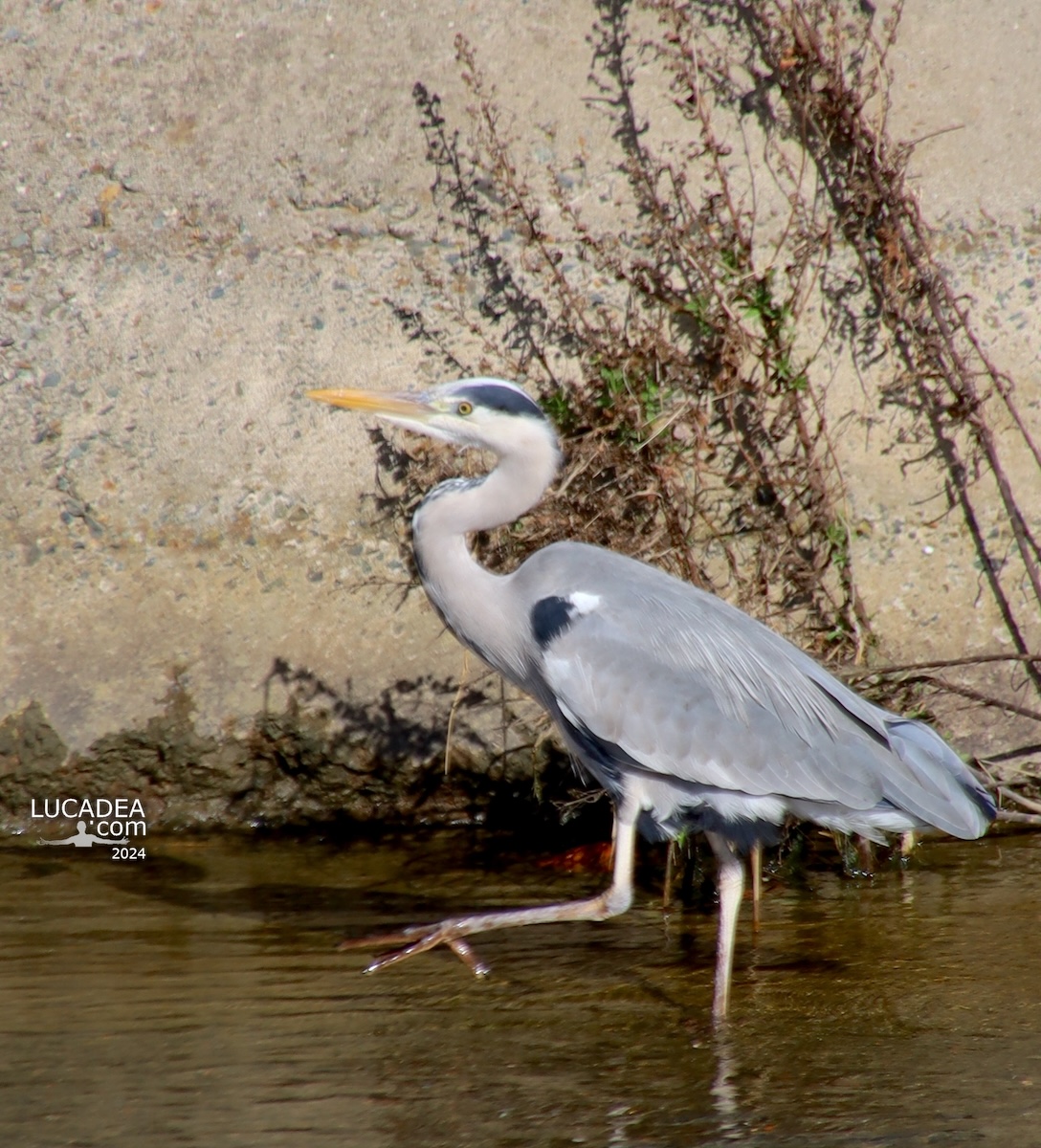
Photo taken with a Canon EOS RP camera and a Tamron 16-300 lens.
The grey heron (*Ardea cinerea* Linnaeus, 1758) is a bird belonging to the Ardeidae family. Native to the temperate regions of the Old World as well as Africa, it is the heron species that ranges furthest north; indeed, in summer, it is commonly found along the Norwegian coast, well beyond the Arctic Circle.
Read more on Wikipedia
The rights on images, videos, choruses, text and all other material on the LUCADEA.com website are governed as per Copyright page.