
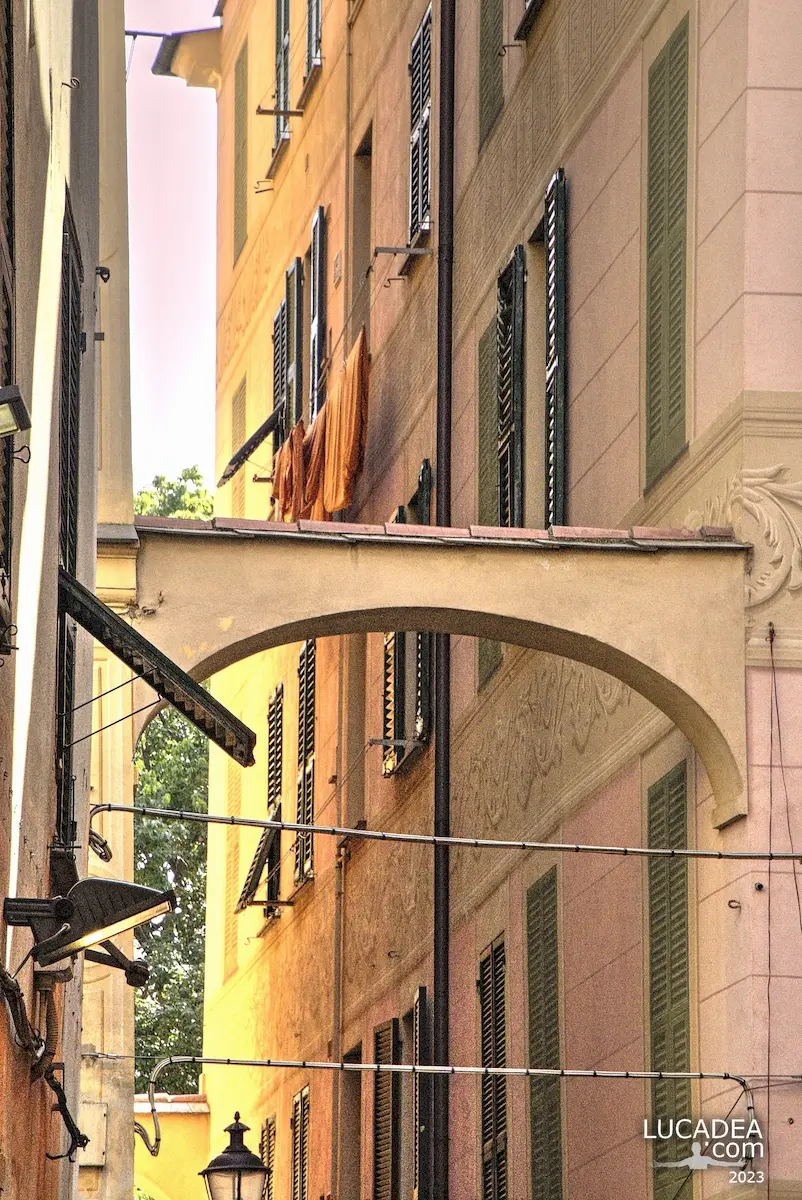

An archway in Chiavari’s old town
An archway in Chiavari’s old town.
While walking through the historic center of Chiavari, Liguria, Italy, I often look upward for the small arches connecting buildings above the narrow streets. Known as sbatacchio arches, these structures are part of the character of Ligurian old lanes and can become particularly interesting subjects when photographed with a telephoto lens.
I took this photograph during one of my walks through the center of Chiavari. The archway is in a small lane between the Caruggio Dritto and Rivarola street, in an area where moving just a few steps away from the main streets can reveal more intimate perspectives and architectural details that are very easy to overlook.
This is one of the things I enjoy most when photographing historic centers in Liguria. I do not always look for the most important monument or the most recognizable view. Sometimes a small architectural feature is enough, especially when it belongs naturally to the structure of the old town and helps define its character without immediately demanding attention.
Chiavari is particularly rewarding for this kind of observation. The Caruggio Dritto, now Martiri della Liberazione street, forms the main axis of the historic center, while a network of narrower side lanes opens around it. These smaller streets create a more intimate architectural setting, and this is where several sbatacchio arches can be found, suspended between the buildings.
Using a telephoto lens allows me to isolate these structures without necessarily including the entire lane in the photograph. Here I wanted to compress the perspective and draw attention to the arch, the nearby façades and the way the buildings seem to move closer together above the narrow passage.
There is also a practical side to these arches. They are not simply decorative features. In many historic towns, connections between buildings were used to improve structural stability and to reinforce constructions facing each other across narrow streets. What looks like a characteristic architectural detail can therefore also be understood as a small example of traditional building techniques.
That double meaning is what makes them interesting to me. From a photographic point of view, the shape and perspective are enough to create a compelling subject. At the same time, knowing why these arches exist gives the image another layer without turning the story into an architectural lesson.
If you are wondering what to see in Chiavari beyond the better-known streets, I would suggest simply paying attention to the side lanes and looking above eye level. Many details are difficult to notice from the middle of a busy street and reveal themselves only when you slow down.
It is also why I keep photographing places I already know. A historic center never really runs out of details. Changing the route, the lens or even the angle from which I look can reveal something completely different. With a telephoto lens, in particular, I enjoy searching for architectural elements that might otherwise disappear into the overall pattern of the façades.
This photograph naturally connects with other posts I have published about Ligurian old lanes. From the narrow streets of Genoa to the historic corners of Sestri Levante, I often return to this subject because these structures are part of the everyday landscape of Liguria and are among the details I most enjoy observing through a camera.
Chiavari is especially interesting because of the relationship between the Caruggio Dritto and the smaller streets around it. A short detour from the main route can completely change the perspective and produce an image that tells the story of the historic center in a much quieter way.
There is no major monument to celebrate in this photograph. It is simply a small architectural feature, one that many people probably walk beneath without ever looking up. For me, however, these are exactly the details that make a photographic walk worthwhile.
How many sbatacchio arches have you noticed while walking through Ligurian old towns? Add a comment or go to the bottom of the site to read what other visitors have written.
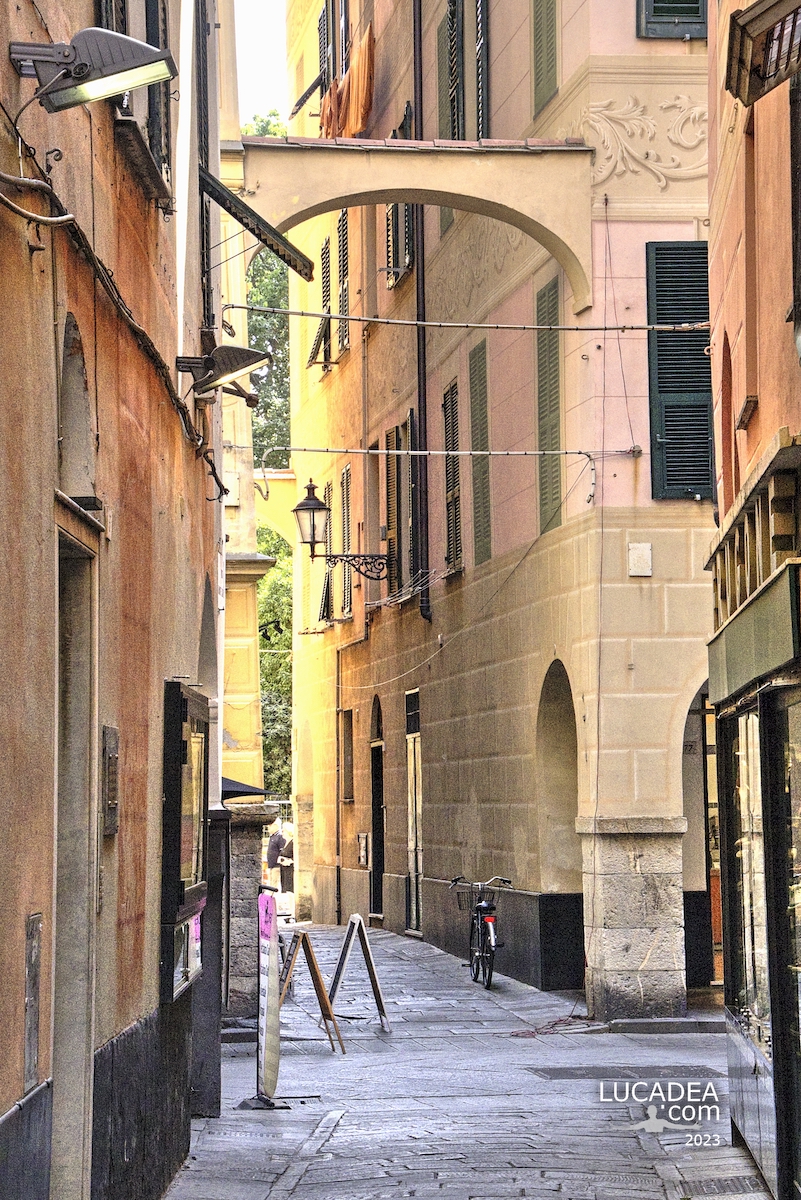
Photos taken with a Canon EOS RP camera and a Tamron 16-300 lens.
Here is the exact spot where I took the photo:
More articles on this topic:
The rights on images, videos, choruses, text and all other material on the LUCADEA.com website are governed as per Copyright page.
