In the Caruggio of Sestri Levante Among Colors

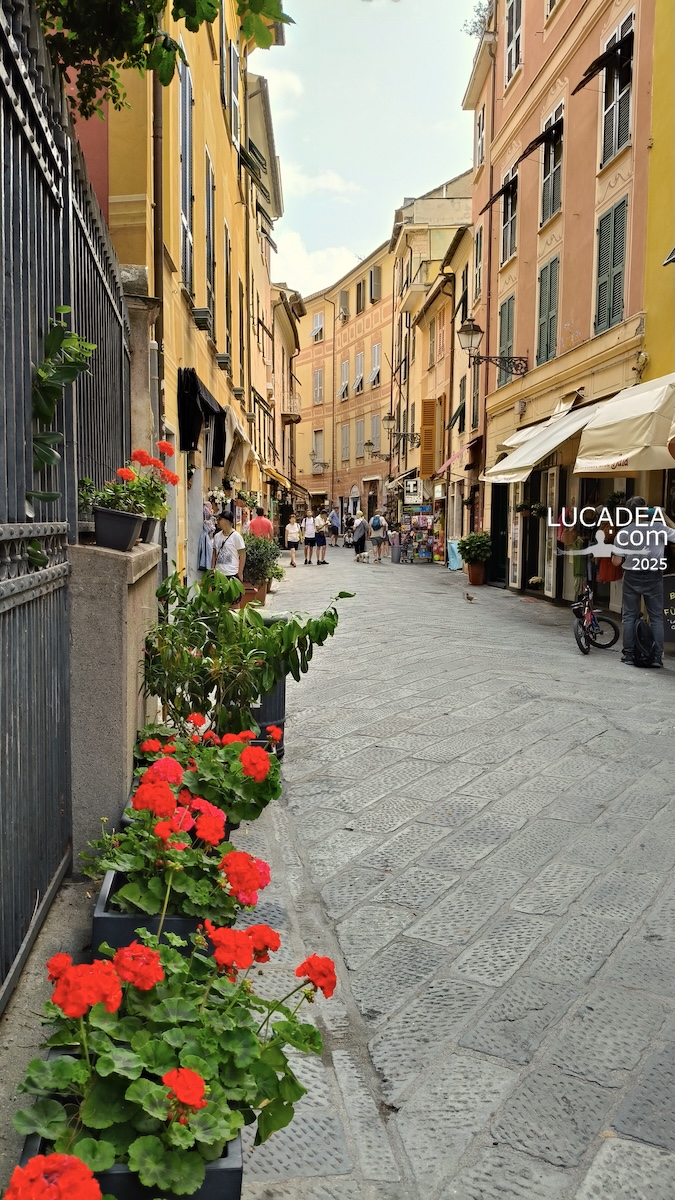
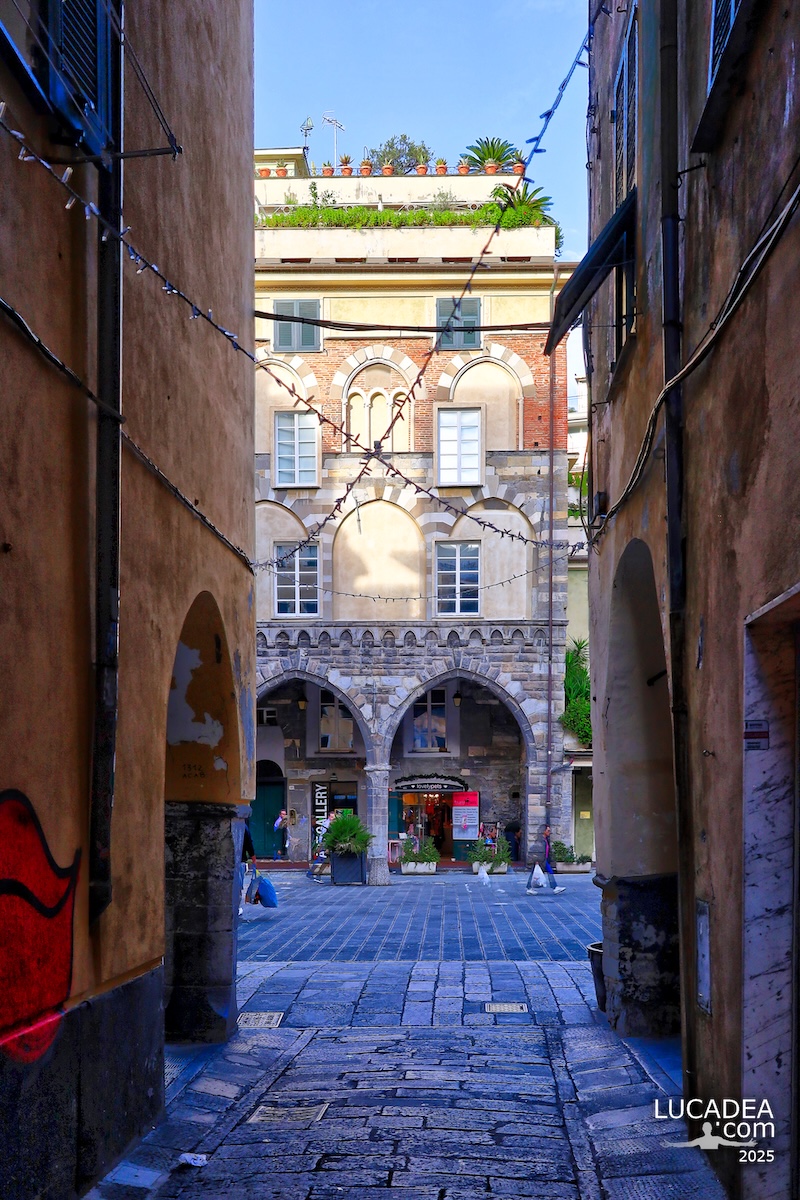
Caruggio di Sestri Levante con fiori rossi e palazzi colorati nel centro storico ligure tra vicoli suggestivi

In the Caruggio of Sestri Levante Among Colors.
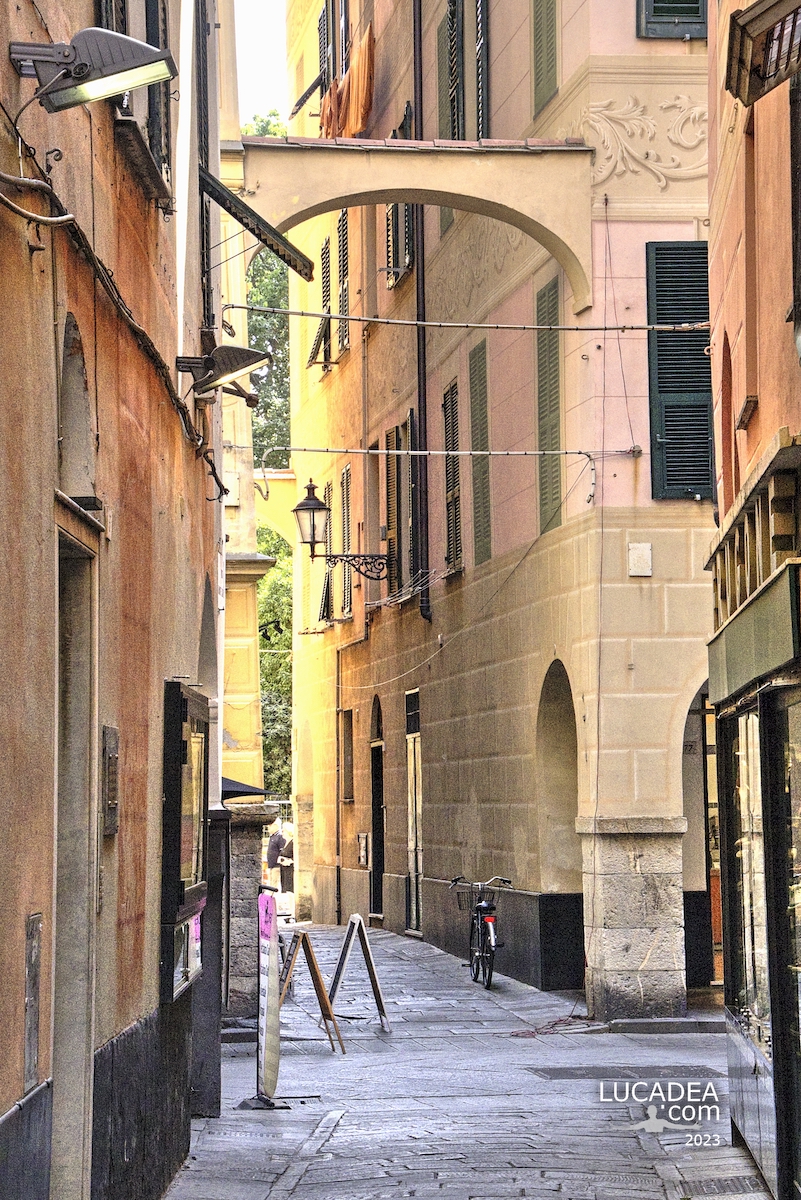
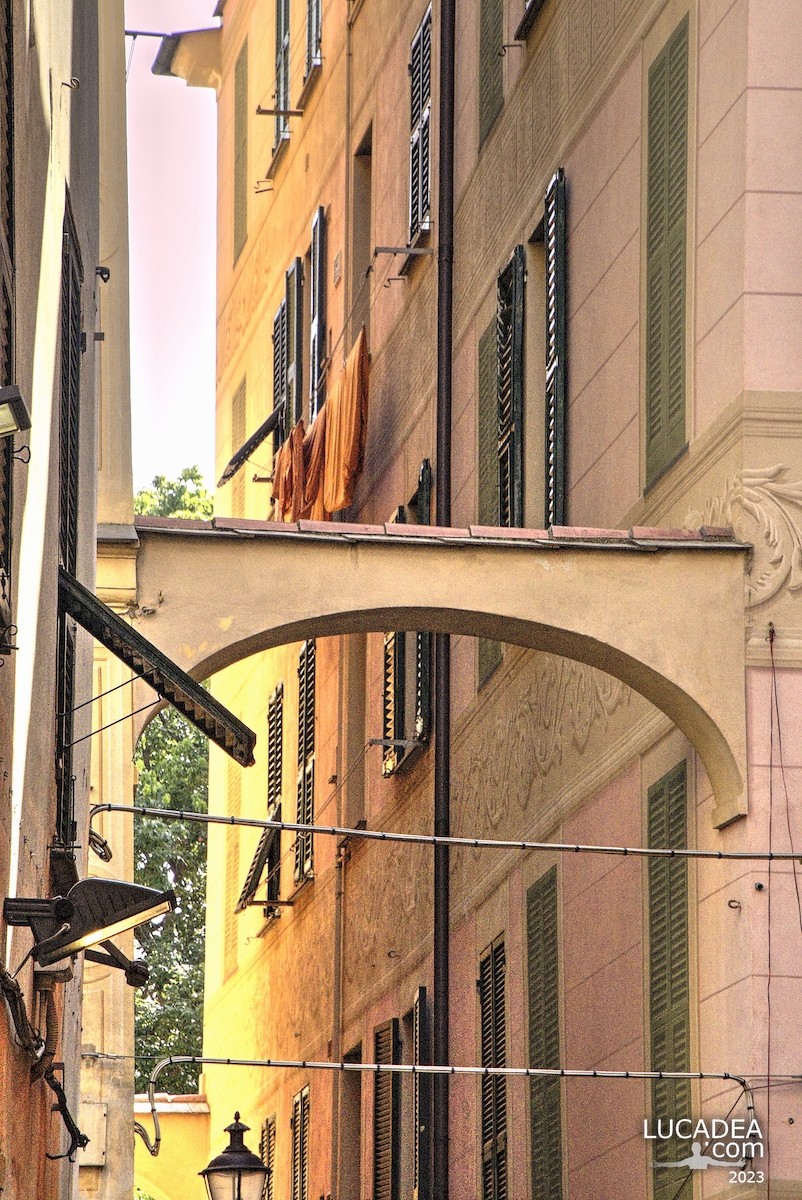
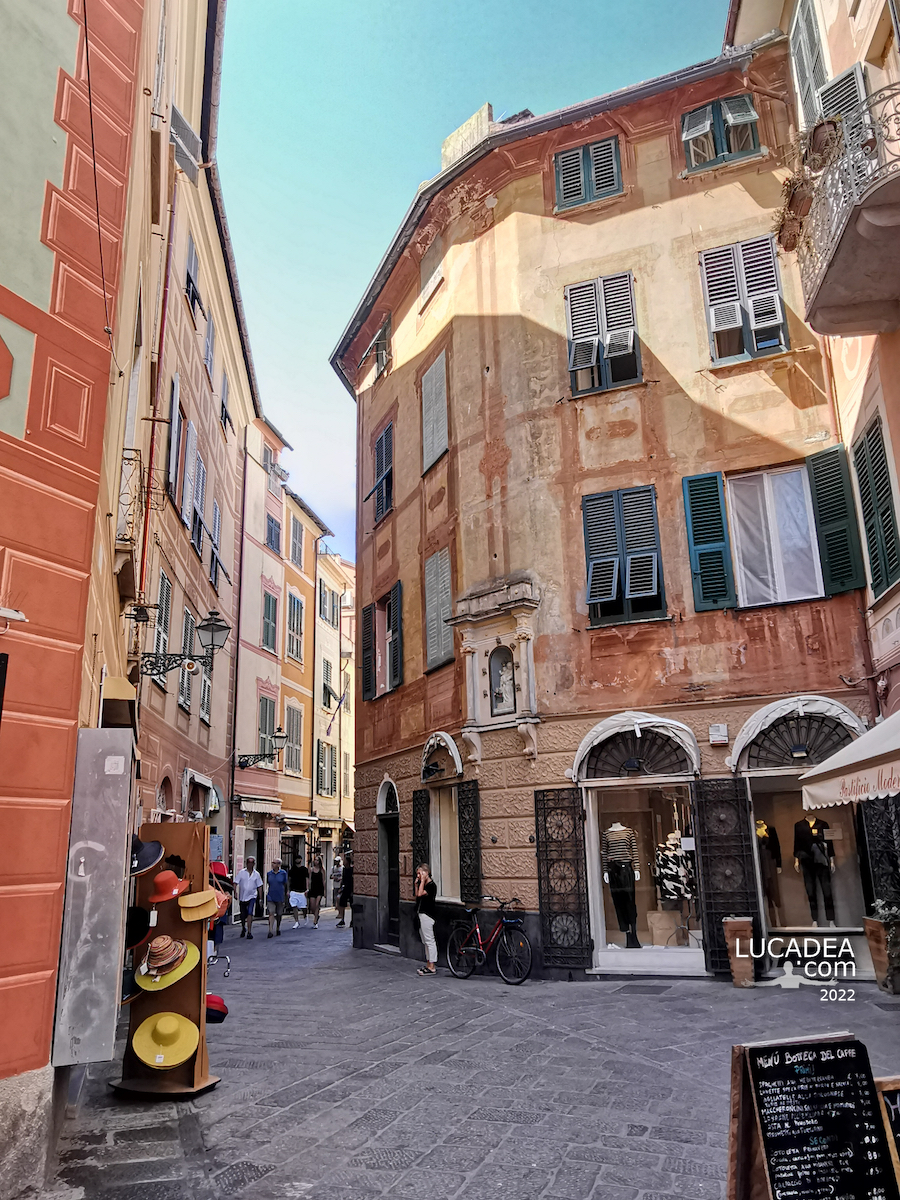
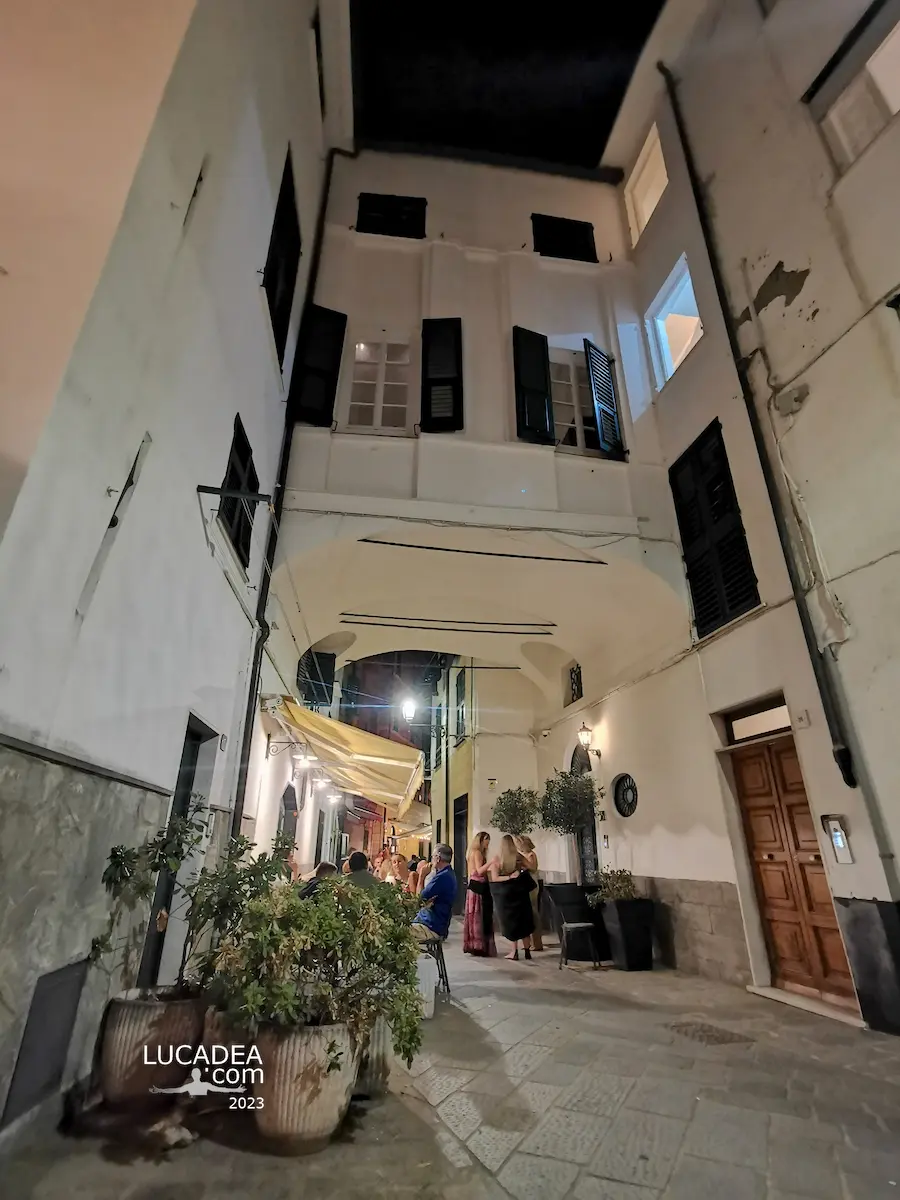
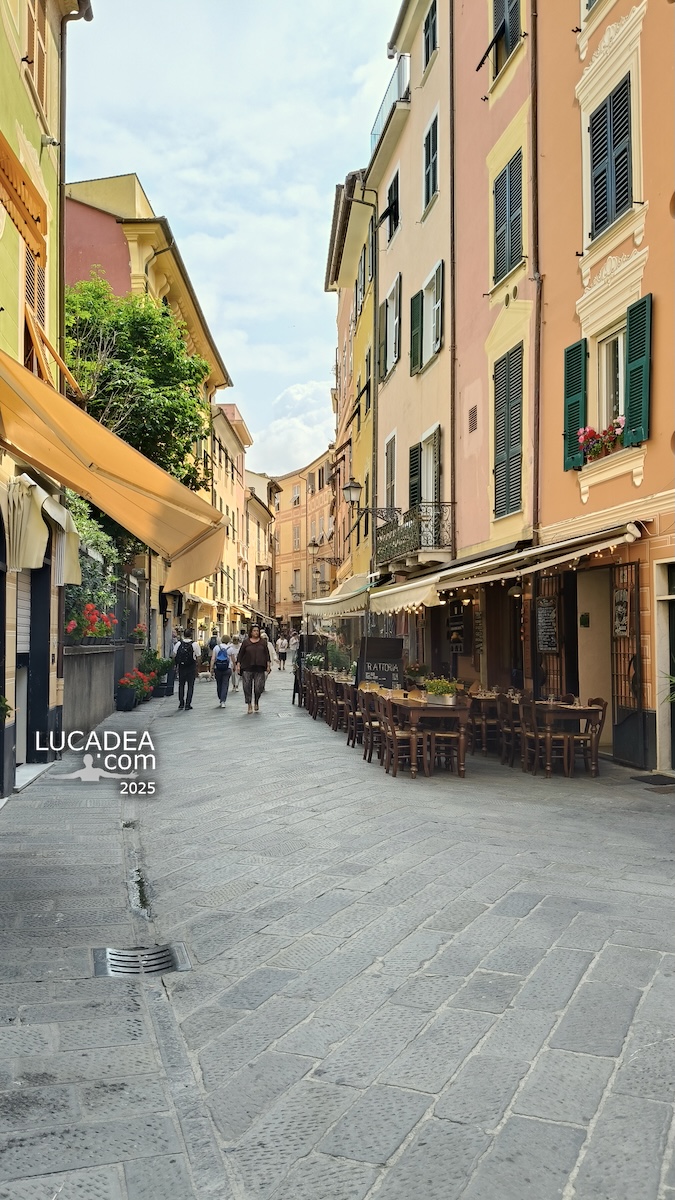
The Caruggio of Sestri Levante opens in front of me like a narrow ribbon of life, where pastel facades and small details guide every step deeper into its rhythm. The Caruggio of Sestri Levante feels immediately alive, not as a tourist image but as a lived-in passage where color and texture shape the experience.
I am in Sestri Levante, Liguria, Italy, walking through the historic center where every stone underfoot seems to carry memory. The narrow street is framed by tall buildings painted in warm tones, and red geraniums spill from balconies and windowsills, creating a contrast that feels both spontaneous and perfectly balanced. The Caruggio of Sestri Levante becomes a visual thread connecting these elements into a single continuous scene.
As I move forward, the soundscape softens. Footsteps, distant voices, and the faint echo of daily life blend into the architecture itself. The shutters, the shopfronts, and the slightly curved perspective of the street create a sense of depth that invites slow observation. If you are visiting Sestri Levante, Liguria, Italy, this is one of those places where you understand the charm not through monuments, but through atmosphere and detail.
There is a small but interesting aspect about these “caruggi”: they were historically designed to provide shade and shelter from coastal winds, shaping not only the look of the town but also the rhythm of daily life. In another post from my blog about Sestri Levante, I explored a similar street where light and architecture created an equally intimate feeling, almost like a visual conversation between different corners of the same town.
The Caruggio of Sestri Levante lingers in my mind as a space where color is not decoration but identity, where everyday life becomes composition without effort. It makes me wonder how many hidden stories are carried by streets like this all along the Ligurian coast.

What would you notice first if you walked through this narrow street in person? Add a comment or go to the bottom of the site to read what other visitors have written.
Photos taken with Honor 20.

The Caruggio of Sestri Levante among colors – Le caruggio de Sestri Levante parmi les couleurs – El caruggio de Sestri Levante entre colores – O caruggio de Sestri Levante entre cores – Die Caruggio von Sestri Levante zwischen Farben – Con hẻm Sestri Levante giữa sắc màu – 锡斯特里莱万特小巷的色彩之间 – セストリ・レヴァンテの路地の色彩の中で

The text of this post was written with the help of ChatGPT, a language model from OpenAI.

Add one  comment to this article or read  here what other visitors have written.
 
Adv
 
Disclamer

The rights on images, videos, choruses, text and all other material on the LUCADEA.com website are governed as per  Copyright page.

This page has been viewed 1 times today.
This month it has been viewed 1 times.
In total it has been viewed 1 times.
 

Under the Stone of Genoa Latin Inscription

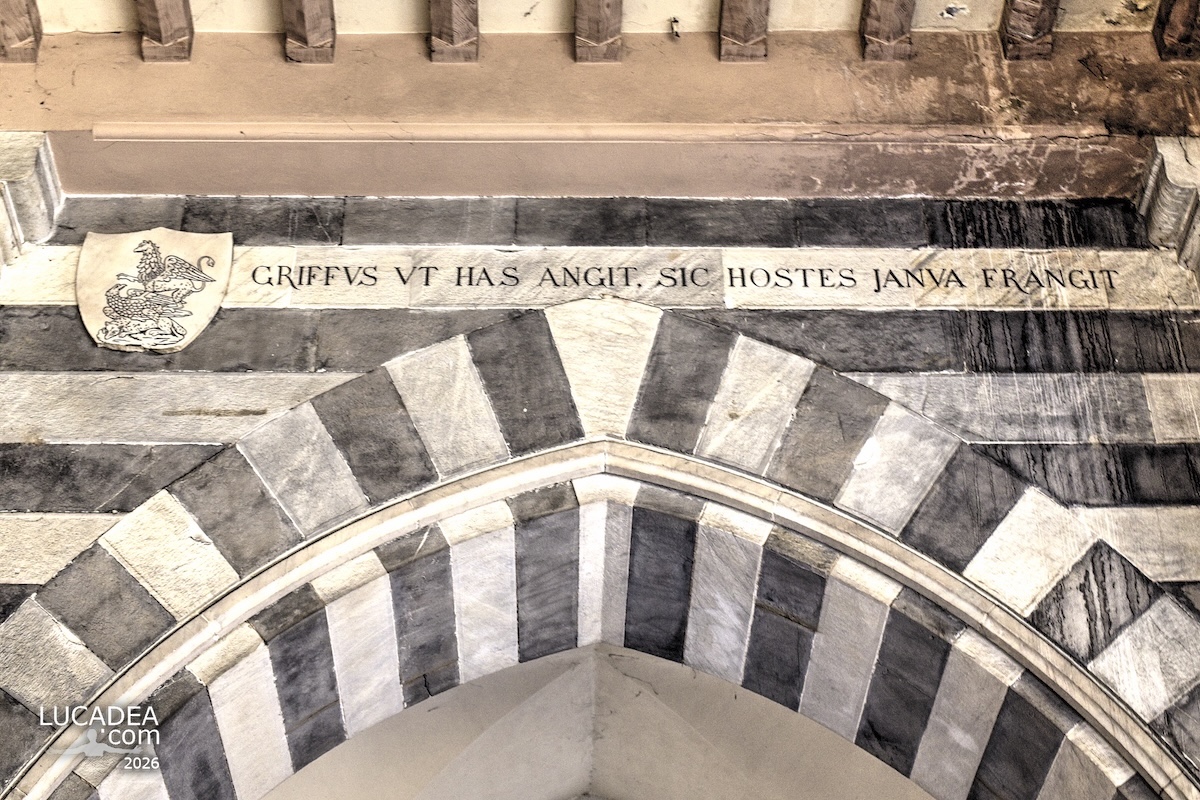
Dettaglio dell’arco marmoreo a Genova con iscrizione latina di Genova e stemma del grifone scolpito nella pietra storica

Under the Stone of Genoa Latin Inscription.
The marble arch stands quietly in front of me, carrying a sense of time that feels almost suspended, and the Latin inscription of Genoa immediately becomes the visual and emotional focus of the scene. The Latin inscription of Genoa is carved into the stone like a message that refuses to fade, guiding my attention through every groove and shadow.
I am in Genoa, Liguria, Italy, walking through a city where stone is never just architecture but a layered memory of centuries. The Latin inscription of Genoa appears here as a fragment of civic identity, something that still connects the present streets with a medieval past. The geometry of the arch, with its alternating marble tones, frames the inscription as if it were part of a larger dialogue between structure and meaning.
The griffin emblem carved nearby adds another level to the composition, suggesting protection and strength. A historical curiosity explains this symbol: the motto associated with Genoa refers to the griffin holding its power over enemies, a medieval representation of the city’s resilience and identity. This detail transforms the stone into something more than decoration, turning it into a statement of belonging and defense.
As I look closer, I think about how many times I might have passed similar details without noticing them. The Latin inscription of Genoa feels like a quiet reminder that cities speak through their surfaces, even when we are not paying attention. I remember a similar atmosphere in another post from my blog, where Genoa revealed itself through equally hidden architectural traces, almost like a visual conversation across time.
If you are visiting Genoa, Liguria, Italy, this is one of those small but meaningful details worth seeing, not because it is grand, but because it carries the weight of centuries in a few carved letters. It makes me wonder how many stories are still written into stone around us, waiting to be read.

What would you notice if you slowed down in front of an old city wall like this? Add a comment or go to the bottom of the site to read what other visitors have written.

Dettaglio dell’arco marmoreo a Genova con iscrizione latina di Genova e stemma del grifone scolpito nella pietra storica

Photo taken with Canon EOS R50 V and lens Canon RF 28.

Under the Stone of Genoa Latin Inscription – Sous la pierre de Gênes inscription latine – Bajo la piedra de Génova inscripción latina – Sob a pedra de Génova inscrição latina – Unter dem Stein von Genua lateinische Inschrift – Dưới đá Genoa bia khắc Latin – 热那亚石下的拉丁铭文 – ジェノヴァの石の下のラテン碑文

The text of this post was written with the help of ChatGPT, a language model from OpenAI.

Add one  comment to this article or read  here what other visitors have written.
 
Adv
 
Disclamer

The rights on images, videos, choruses, text and all other material on the LUCADEA.com website are governed as per  Copyright page.

This page has been viewed 1 times today.
This month it has been viewed 1 times.
In total it has been viewed 1 times.
 

Among the Black Arcades of Chiavari in Fenice Square

Vista del Palazzo dai Portici Neri a Chiavari in Piazza Fenice ripreso da vico Emanuele Gonzales tra archi e pietra storica

Among the Black Arcades of Chiavari in Fenice Square.
Stepping into this narrow opening from vico Emanuele Gonzales, I suddenly find myself facing the Palazzo dei Portici Neri in Chiavari, Liguria, Italy, and the view feels almost like a quiet reveal rather than a planned composition. The Palazzo dei Portici Neri immediately anchors the scene, and in this moment the Palazzo dei Portici Neri becomes the reason I pause longer than I expected, studying how stone and shadow interact across its façade.
There is a certain tension between the tightness of the alley and the openness of Piazza Fenice, and this contrast makes the Palazzo dei Portici Neri even more striking. When people search what to see in Chiavari historic center, this building often appears as one of the key landmarks, and standing here it is easy to understand why. The structure feels rooted in the medieval fabric of the town, close to the old walls and castle area, forming part of a dense urban story that has survived centuries.
As I continue to observe, I notice how the dark tones of the arcades give the building its identity, something that locals and visitors alike often mention when describing the Palazzo dei Portici Neri. I remember walking through nearby streets featured in other posts on lucadea.com, where the same atmosphere of layered history quietly returns in different forms.
One interesting detail is that the building’s name is linked to the dark coloration of its porticoes, a feature that makes it stand out within Ligurian architecture and contributes to its strong visual recognition. It is not just an isolated monument but part of a living urban system that still defines the character of Chiavari.

If you are visiting Chiavari and wondering what makes Piazza Fenice special, standing here in front of this palace from such a narrow perspective might be the answer. Have you ever found a place that changes completely just by changing the point of view? Add a comment or go to the bottom of the site to read what other visitors have written.

Vista del Palazzo dai Portici Neri a Chiavari in Piazza Fenice ripreso da vico Emanuele Gonzales tra archi e pietra storica

Photo taken with Canon EOS RP and lens Canon RF 24-50.

Where is the palace:

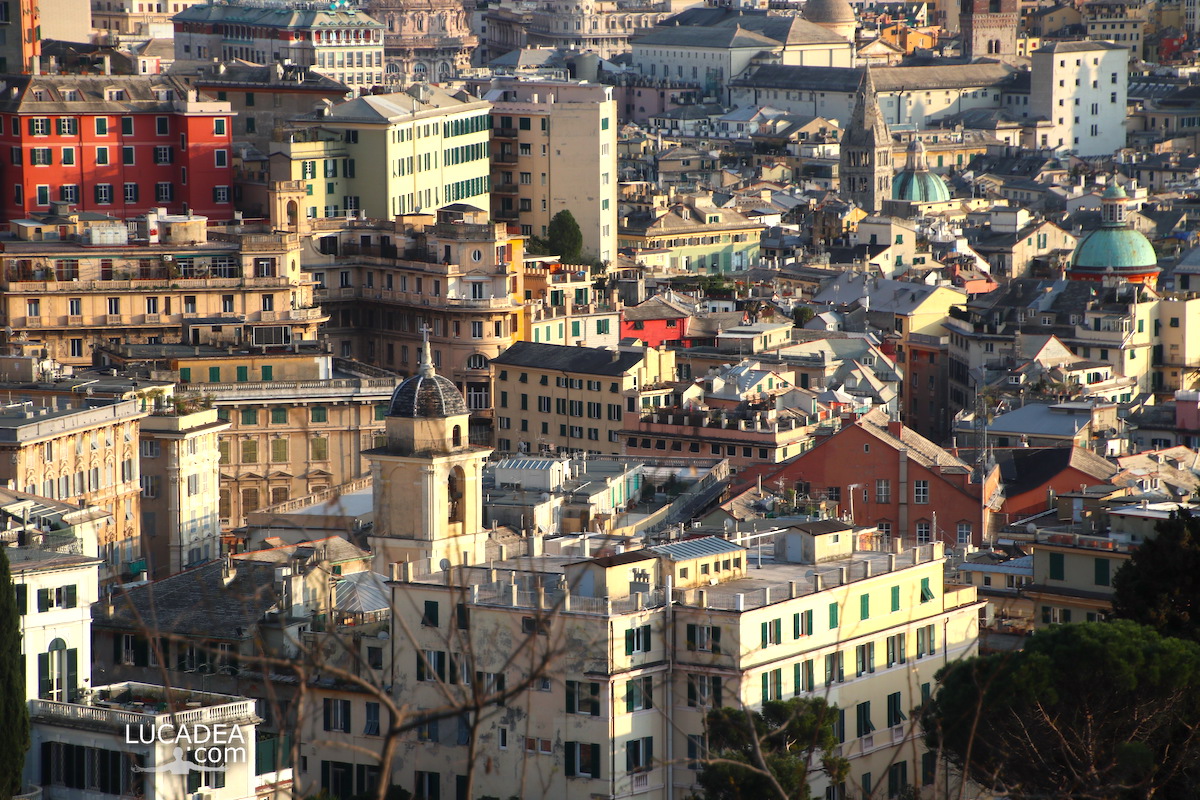
Genoa from above among rooftops and buildings

Il centro di Genova visto dall'alto

Genoa from above among rooftops and buildings.
I always enjoy photographing Genoa from above, especially when the atmosphere is clear enough to reveal the details of the city. From a higher viewpoint, central Genoa takes on a completely different appearance, with buildings, rooftops and streets forming a pattern that is difficult to appreciate while walking through the narrow lanes.
This is exactly the kind of photograph I keep looking for whenever I have my camera with me. Genoa is full of details, and many of them remain hidden when seen only from street level. From above, however, it becomes possible to follow the lines of the rooftops, recognise different buildings and understand just how dense and compact the city centre really is.
In this image, I wanted to focus mainly on the buildings in central Genoa. There is no single monument that needs to dominate the composition. The subject is the city itself, made up of overlapping buildings and rooftops that seem to come remarkably close to one another.
When I look for a view of Genoa from above, the sky becomes an important part of the photograph. I do not necessarily need a spectacular day; what matters to me is having enough clarity to read the shapes of the city. A reasonably clear sky helps preserve the attention on the architecture and allows the layers of rooftops and buildings to remain visible.
The vertical character of Genoa is particularly interesting from this perspective. The city stretches between the sea and the hills, and the dense historic centre makes this relationship especially clear. From above, you can better appreciate how little space separates one building from another and how the urban landscape has developed through centuries of changes.
There is a small detail about Genoa that becomes easier to understand from this kind of viewpoint. Its historic centre is one of the largest in Europe, with a dense network of narrow lanes, squares, historic buildings and passages. Seen from above, that complex urban fabric almost becomes a pattern, revealing connections that are much harder to notice from the street.
I have photographed Genoa from several viewpoints, including Castelletto esplanade, where the view opens across a much wider part of the city. This photograph is different because I wanted to concentrate more closely on the buildings and the urban texture rather than creating a traditional panoramic view.
For me, it is also a way of continuing to discover a city I have photographed many times. Even when returning to a familiar viewpoint, different visibility can completely change the result. A clearer sky, a newly noticed detail or simply a different section of rooftops can make the photograph feel new.
If you are looking for a view of Genoa worth seeing from above, these elevated perspectives offer something different from the usual street-level images. They show the city as a dense collection of buildings shaped by its geography and history, while still leaving plenty of room for personal observation.
I have always liked this side of photography: looking at a familiar place from an unfamiliar angle and finding something worth capturing without needing to search for a spectacular subject.

Do you prefer seeing Genoa from above or getting lost in its narrow streets? Add a comment or go to the bottom of the site to read what other visitors have written.

Central Genoa seen from above, with rooftops and historic buildings filling the cityscape

Photo taken with Canon EOS M100 and lens Tamron 16-300.

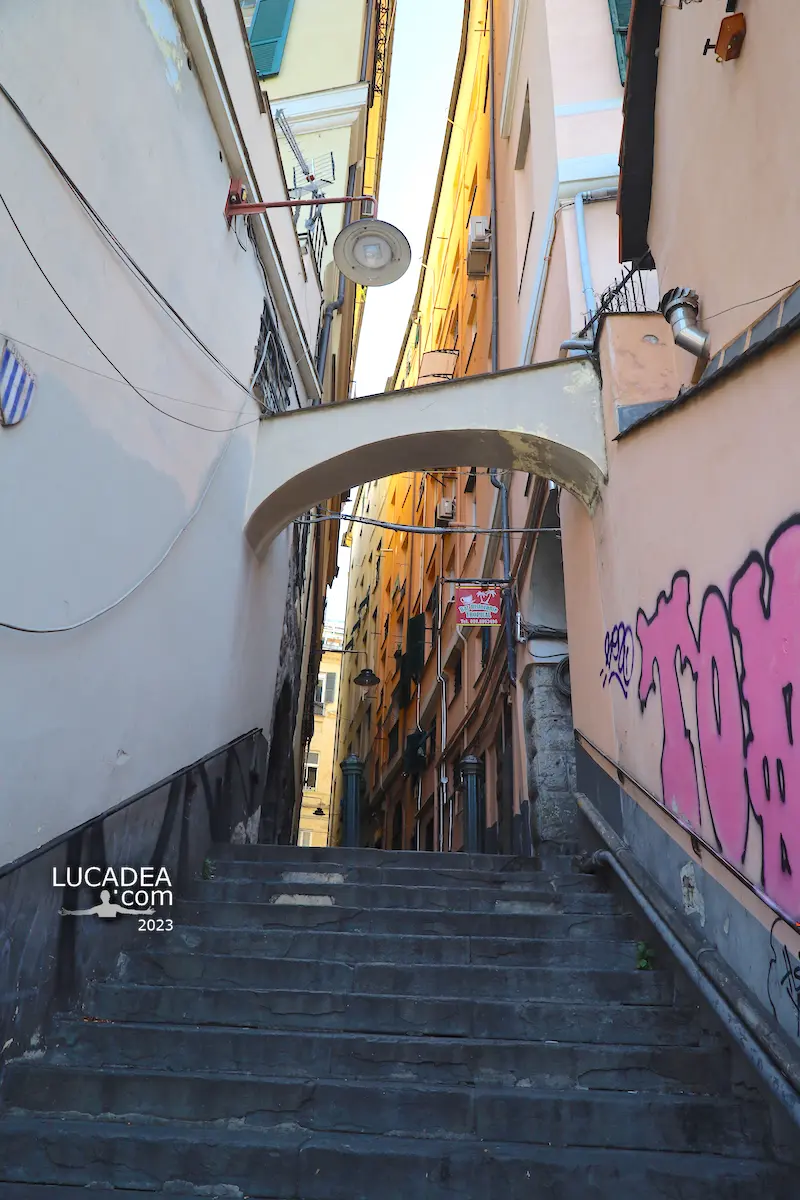
Campo Alley, a lane in Genoa’s old town

Vico del Campo: un vicolo di ingresso al centro storico di Genova

Campo Alley, a lane in Genoa’s old town.
Whenever I walk through the historic center of Genoa, Liguria, Italy, I usually carry my camera because I know that sooner or later some small detail will make me stop. This time it was Campo Alley, a narrow passage connecting Sottoripa street with the well-known Campo street.
This is exactly the kind of view I enjoy photographing in Genoa. Not necessarily the most famous monument or the most recognizable panorama, but an everyday passage, an arch, a facade or a street that reveals something about the unusual structure of the old town. Here, the main subject is the supporting arch spanning the lane, becoming almost a natural frame for anyone walking underneath it.
Campo Alley is in a particularly interesting part of Genoa’s historic center, close to the old port and to the network of streets running along the waterfront. Sottoripa street is one of the city’s historic routes and provides an immediate transition into the dense maze of Genoese lanes. A few steps down one of the side streets and the atmosphere changes completely.
If you are wondering what to see in Genoa’s old town, I think these less obvious passages are worth noticing as well. The historic center is so intricate that you can spend hours walking without following a fixed itinerary. That possibility of getting slightly lost is one of the things that makes it so rewarding to photograph.
The supporting arch visible in the photograph also has a practical purpose. These arches, often found in the narrow lanes of Ligurian historic centers, connect and reinforce buildings on opposite sides of the street, helping to stabilize the structures. At the same time, they have become distinctive elements of the urban landscape and immediately give a narrow Genoese lane its characteristic appearance.
I wanted to capture this particular detail because it represents the Genoa I most enjoy photographing. It is a dense city, built within limited space, where buildings stand so close to one another that streets, arches and houses can almost seem like parts of one continuous structure.
From this lane you can reach the famous Campo street. The street became known well beyond Genoa through the work of singer-songwriter Fabrizio De André, but even before reaching it, this small passage already offers an interesting glimpse of the city. It shows how, in Genoa’s old town, turning a corner can completely change the image in front of you.
I also like the fact that this photograph does not need to show everything. There is no large square and no open panorama, only a small section of the urban fabric. For me, that is enough. When I walk through the old lanes with my camera, these are exactly the situations I am looking for.
Campo Alley belongs to the kind of Genoa that reveals itself slowly. A doorway, a sign, a window, a staircase or an arch can become the reason to stop. I have found the same feeling in other photographs I have published on the blog about the old lanes of Genoa, including the arches and passageways around Sarzano, Campo Pisano and some of the oldest parts of the city.
Its connection with Sottoripa street is also significant. From a street close to the harbor and the sea, you can move within a few meters into a narrow and enclosed lane where the perception of space is completely different. It is one of Genoa’s most distinctive contrasts: the sea is nearby, but inside the old lanes it can almost disappear from sight.
Every time I return to the city, I realize that this way of photographing Genoa never gets tiring. In fact, the more familiar I become with the city, the more I want to look for details that I may have simply walked past without noticing in the past.

When you walk through Genoa’s old town, do you also stop to look at these small architectural details? Add a comment or go to the bottom of the site to read what other visitors have written.

Photos taken with a Canon EOS RP camera and Canon RF 24-50 lens.

Here is exactly where I took the photo:

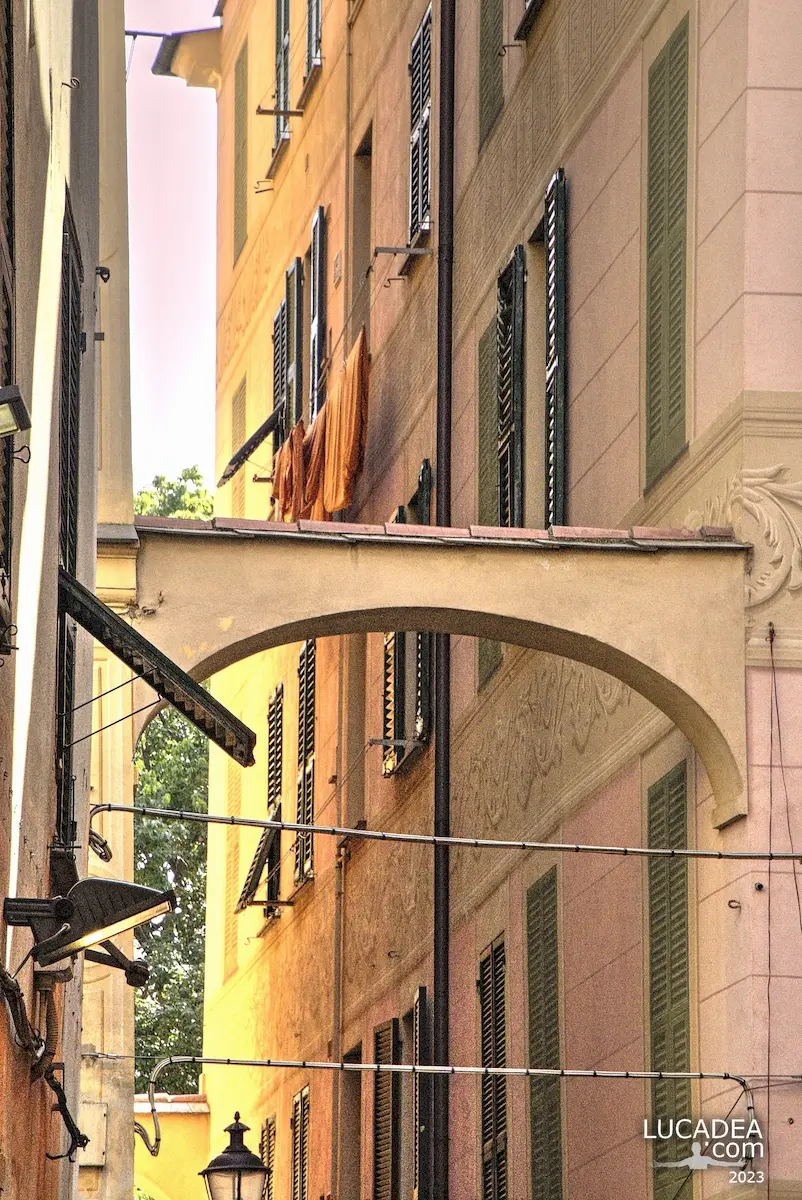
An archway in Chiavari’s old town

Uno scorcio del caruggio nel centro storico di Chiavari, in Liguria

An archway in Chiavari’s old town.
While walking through the historic center of Chiavari, Liguria, Italy, I often look upward for the small arches connecting buildings above the narrow streets. Known as sbatacchio arches, these structures are part of the character of Ligurian old lanes and can become particularly interesting subjects when photographed with a telephoto lens.
I took this photograph during one of my walks through the center of Chiavari. The archway is in a small lane between the Caruggio Dritto and Rivarola street, in an area where moving just a few steps away from the main streets can reveal more intimate perspectives and architectural details that are very easy to overlook.
This is one of the things I enjoy most when photographing historic centers in Liguria. I do not always look for the most important monument or the most recognizable view. Sometimes a small architectural feature is enough, especially when it belongs naturally to the structure of the old town and helps define its character without immediately demanding attention.
Chiavari is particularly rewarding for this kind of observation. The Caruggio Dritto, now Martiri della Liberazione street, forms the main axis of the historic center, while a network of narrower side lanes opens around it. These smaller streets create a more intimate architectural setting, and this is where several sbatacchio arches can be found, suspended between the buildings.
Using a telephoto lens allows me to isolate these structures without necessarily including the entire lane in the photograph. Here I wanted to compress the perspective and draw attention to the arch, the nearby façades and the way the buildings seem to move closer together above the narrow passage.
There is also a practical side to these arches. They are not simply decorative features. In many historic towns, connections between buildings were used to improve structural stability and to reinforce constructions facing each other across narrow streets. What looks like a characteristic architectural detail can therefore also be understood as a small example of traditional building techniques.
That double meaning is what makes them interesting to me. From a photographic point of view, the shape and perspective are enough to create a compelling subject. At the same time, knowing why these arches exist gives the image another layer without turning the story into an architectural lesson.
If you are wondering what to see in Chiavari beyond the better-known streets, I would suggest simply paying attention to the side lanes and looking above eye level. Many details are difficult to notice from the middle of a busy street and reveal themselves only when you slow down.
It is also why I keep photographing places I already know. A historic center never really runs out of details. Changing the route, the lens or even the angle from which I look can reveal something completely different. With a telephoto lens, in particular, I enjoy searching for architectural elements that might otherwise disappear into the overall pattern of the façades.
This photograph naturally connects with other posts I have published about Ligurian old lanes. From the narrow streets of Genoa to the historic corners of Sestri Levante, I often return to this subject because these structures are part of the everyday landscape of Liguria and are among the details I most enjoy observing through a camera.
Chiavari is especially interesting because of the relationship between the Caruggio Dritto and the smaller streets around it. A short detour from the main route can completely change the perspective and produce an image that tells the story of the historic center in a much quieter way.
There is no major monument to celebrate in this photograph. It is simply a small architectural feature, one that many people probably walk beneath without ever looking up. For me, however, these are exactly the details that make a photographic walk worthwhile.

How many sbatacchio arches have you noticed while walking through Ligurian old towns? Add a comment or go to the bottom of the site to read what other visitors have written.

Photos taken with a Canon EOS RP camera and a Tamron 16-300 lens.

Here is the exact spot where I took the photo:

Sestri Levante’s old lane toward the sea

Alla scoperta del caruggio di Sestri Levante, meraviglia di Liguria

Sestri Levante’s old lane toward the sea.
Walking through the historic center of Sestri Levante, Liguria, Italy, I often find myself passing through this old lane leading toward the Bay of Silence. It is a route I know well, yet it still manages to offer small details and perspectives that make me want to stop and take another photograph.
Calling Sestri Levante’s old lane a wonder of Liguria might sound a little too grand, as I admitted in the original text, but I still genuinely think it is one of the most attractive old lanes in this part of the region. Not because it is monumental or spectacular in the conventional sense, but because of the way it connects the everyday life of the town with one of its best-known coastal views.
I took this photograph during one of my walks through the town. The narrow lane, with houses opening directly onto the street, naturally draws you toward the sea. It is a simple perspective, but to me it captures something essential about Sestri Levante: you do not have to walk far to move from the atmosphere of the historic center into the landscape of the bay.
If you are wondering what to see in Sestri Levante, the Bay of Silence will almost certainly be near the top of the list. But reaching it from the town center means walking through streets that deserve attention in their own right. The old lane is therefore not merely a route to the bay; it is already part of the experience.
What I like photographing here is the continuity between the buildings and the street. In Ligurian old towns, façades often stand very close together and the relationship between private buildings and public space is immediate. Windows, shutters, doorways and small architectural details become part of one continuous scene rather than isolated subjects.
Sestri Levante also has a particular geography that makes this transition especially interesting. The historic center lies on the narrow isthmus connecting the peninsula with the mainland, while the Bay of Fables and the smaller Bay of Silence open on either side. This unusual shape makes it feel very natural to move from the town streets toward two completely different coastal settings.
There is a small historical curiosity behind the name of Sestri. The area was associated in antiquity with the name Segesta Tigulliorum, while the modern name developed through the historical evolution of the place name. It is a small reminder of how old the settlement is within the Gulf of Tigullio.
But coming back to the photograph, it is the lane itself that interests me most. I was not trying to create another postcard image of the Bay of Silence. Instead, I stopped before reaching the sea, when the bay is still only suggested by the direction of the street.
This is something I often enjoy doing in the photographs I publish on the blog. I like showing a place not only through its most famous viewpoint, but also through the route that leads there. In this case, the connection with my photographs of the Bay of Silence comes naturally: the old lane becomes the small journey that comes before the view.
Walking here also makes it clear how closely the center of Sestri Levante is connected with tourism. During summer, the lane can become busy, particularly when visitors are heading toward the bay, while at other times it retains a quieter and more local atmosphere. That contrast is one of the reasons I enjoy photographing the same streets at different moments.
For people who live here, familiar views can easily become invisible through repetition. Yet holding a camera changes the way I look at them. A façade, a perspective or a small architectural detail that I would normally walk past can suddenly become the reason to stop.
Perhaps that is why I continue to think of this old lane as one of the nicest corners of Liguria. It does not need exaggerated descriptions. Within a short distance, it brings together the houses, the historic center, the movement of people and, just beyond the end of the street, the sea.
And then there is that final destination that makes the route even more special: the Bay of Silence. Knowing that you only have to keep walking to reach the beach gives this otherwise ordinary street a different meaning.
This photograph also fits naturally with other posts I have published about Sestri Levante, especially those dedicated to the Bay of Silence and the less obvious corners of the town. Together they form a more personal record of a place I know well and continue to photograph.
So perhaps the real charm is not simply the lane itself, but everything it promises at the end of the walk.

Do you think Sestri Levante’s old lane deserves a place among the most beautiful lanes in Liguria? Add a comment or go to the bottom of the site to read what other visitors have written.

Photos taken with Honor 20.

Here’s where via XXV Aprile is located:

Summer nightlife in Sestri Levante

Archivolto di via Garibaldi a Sestri Levante con tavoli di un ristorante durante la vita notturna estiva

Summer nightlife in Sestri Levante.
In the historic center of Sestri Levante, Liguria, Italy, the streets gradually change character in the evening as restaurant tables fill and the town’s summer nightlife begins. It is a different way of experiencing Sestri Levante after dark, less connected with the crowds I remember from years ago and increasingly shaped by visitors choosing to spend the evening in the many restaurants around the old town.
This photograph, however, shows a much quieter moment. I was near the archway on Garibaldi street when I photographed this small corner occupied by a few restaurant tables. There is no large crowd here, no packed alleyway and no obvious rush. For that reason, I think the image captures a quieter side of nightlife in Sestri Levante that can still be found among the streets of the historic center.
Compared with the past, summer evenings in Sestri seem to me to have changed considerably. I remember the old town being particularly popular with younger people, who would often spend part of the evening walking through the center before continuing toward the Castelli swimming pool. The town center was then one of the stages of a longer night out.
In recent years, evening tourism has developed in a different direction. There are more restaurants and many more outdoor tables than I remember from years ago. During summer evenings, visitors often stay in the center for dinner, making the narrow streets feel like a natural extension of the restaurants themselves.
The character of the noise changes too. Once dinner is over and the restaurant tables begin to empty, the atmosphere can become considerably livelier. Groups of young people take over parts of the center and the relative quiet of the earlier evening can give way to a much noisier scene.
My photograph tells the other side of that story. The archway on Garibaldi street creates a small, enclosed space that feels almost separate from the movement elsewhere in the town. A few tables beneath the passage are enough to turn an ordinary corner into a place where people can sit, eat and talk.
That small detail is what caught my attention. I was not trying to photograph the busiest side of Sestri Levante or document its nightlife at its loudest. I was more interested in showing a brief moment of an evening, one of those places where the night is already underway but has not yet reached its more chaotic rhythm.
If you are wondering what to do in Sestri Levante at night, the historic center naturally offers plenty of choices during the summer season. But the evening is not necessarily about crowds and noise everywhere. There are still corners where the night moves at a slower pace, perhaps around a dinner table beneath an old archway like this one.
Sestri Levante is a place where the historic center, restaurants and seaside atmosphere are closely connected. The town is compact enough that its different evening moods eventually meet in the same streets. A quiet dinner, a walk through the old town and a much livelier late evening can all belong to the same night.
Looking at this photograph also reminds me how difficult it is to describe a town through a single image. A street can be almost empty at one moment and crowded shortly afterward. The same corner can have a completely different atmosphere depending on the hour and the particular stage of the summer season.
This is one of the things I enjoy photographing in Sestri Levante. I do not always want to photograph the classic views of the Bay of Silence or the most recognizable parts of the town. Sometimes I prefer recording small changes in everyday life, such as the way a quiet corner becomes part of the evening scene.
The photograph also connects naturally with other posts I have written about Sestri Levante, where I have focused on less obvious corners of the town rather than only its best-known views. Together, these images create a more personal record of a place that I have seen change over time.
The archway on Garibaldi street, with its few restaurant tables and discreet activity, feels almost like a small pause within the summer evening. It does not represent the loudest version of Sestri Levante, but perhaps that is exactly why I like the photograph.
Nightlife changes with habits, tourism and generations, and the way people experience a town during summer inevitably changes with them. Some things disappear, others take their place, while small details remain almost unnoticed. Photographing these changes is also a way of keeping a record of what an ordinary summer evening once looked like.

How do you remember summer evenings in Sestri Levante: did you prefer the livelier nights of the past or these quieter corners? Add a comment or go to the bottom of the site to read what other visitors have written.

Archway on Garibaldi street in Sestri Levante with restaurant tables during summer nightlife

Photo taken with Honor 20.

Here is the exact location:

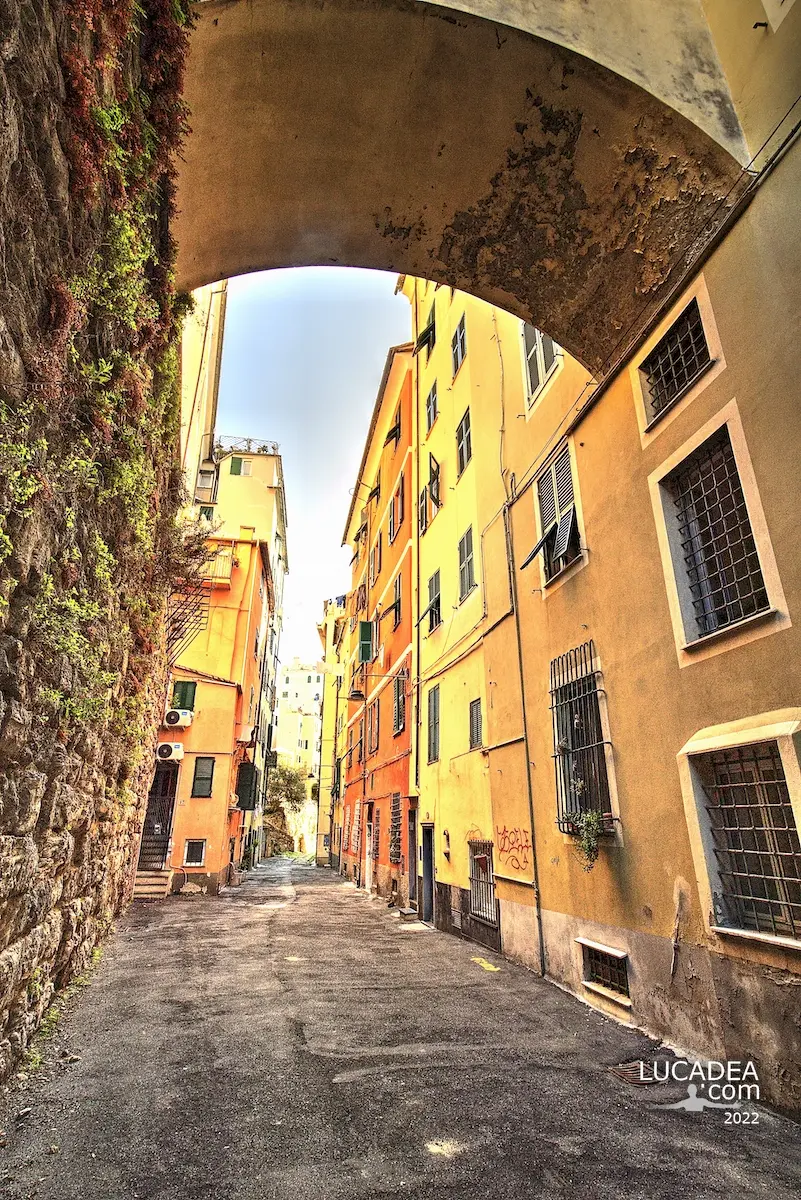
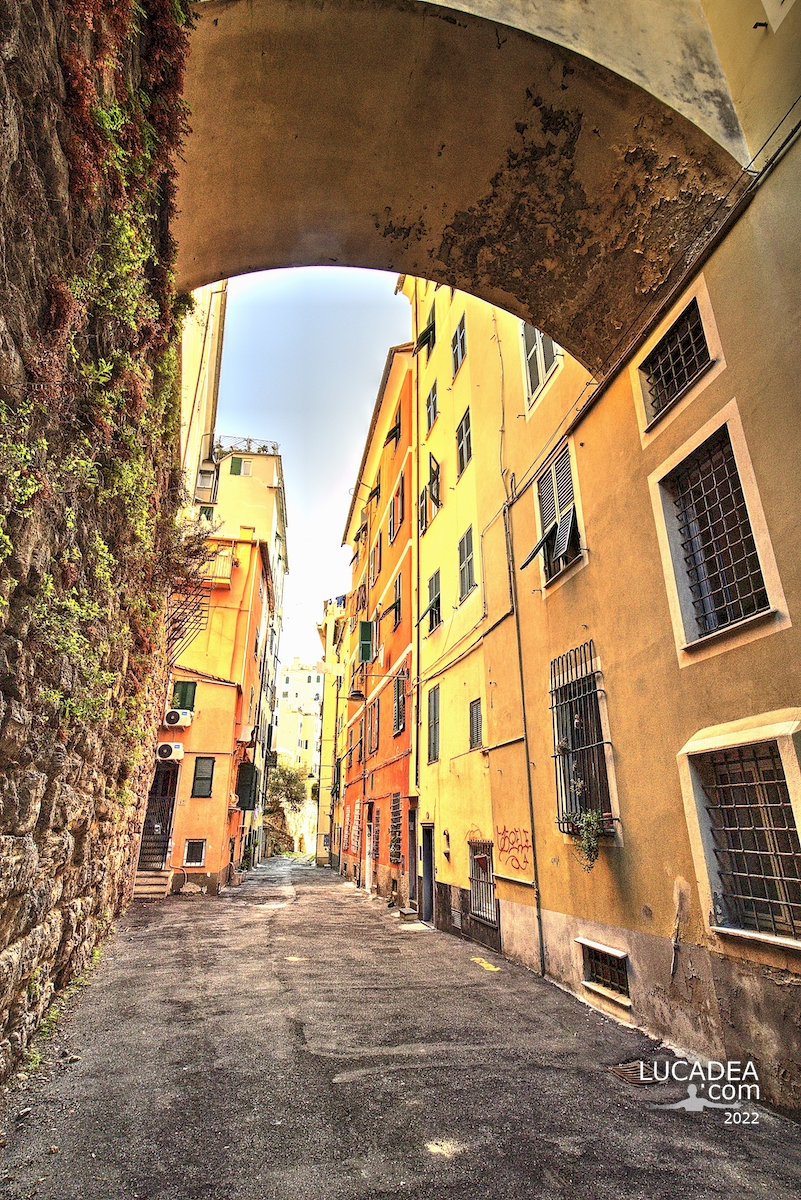
The archway of Vico Sotto le Murette in Genoa

Archivolto di Vico Sotto le Murette nel centro storico di Genova, tra Sarzano e Campo Pisano

The archway of Vico Sotto le Murette in Genoa.
While walking through the historic center of Genoa, Liguria, Italy, I often find that turning into a smaller street reveals a detail worth photographing. This time, I stopped at the archway of Vico Sotto le Murette, a passage below Campidoglio square that leads toward the nearby Campo Pisano square.
Getting lost among Genoa’s narrow caruggi is one of the things I enjoy most when walking through the old town. You can wander for a couple of hours following a completely improvised route and never seem to pass the same place twice. The streets change direction so often that even familiar areas can reveal a different view with just one turn.
This photograph came from one of those walks without a fixed itinerary. I wanted to capture the archway with my camera because I like the way it frames the narrow street continuing beyond it. It is not one of Genoa’s famous monuments, and it may not be the first place someone would look for when visiting the city, but these are exactly the small details that give the historic center much of its character.
If you are wondering what to see in Genoa’s old town, the famous palaces, churches, harbor and better-known streets will naturally come to mind. Yet part of the appeal lies in the network of smaller lanes, arches, stairways and passages connecting different parts of the city in ways that are not always immediately obvious.
Vico Sotto le Murette is in the Sarzano area, one of the oldest parts of Genoa. From here, the route can lead toward Campo Pisano, a distinctive square known for its black-and-white cobbled pavement and colorful surrounding buildings.
There is also a small historical curiosity behind the name Campo Pisano. Tradition connects it with Pisan prisoners captured by the Genoese after the Battle of Meloria in 1284, who were reportedly brought and held in this area. The name therefore recalls one of the episodes in the long medieval rivalry between Genoa and Pisa.
Beyond the history, what interests me most in this photograph is the relationship between the archway and the lane. The arch creates a kind of threshold, a point where the street changes character and naturally invites you to continue. These architectural details appear repeatedly throughout Genoa’s caruggi and can easily go unnoticed if you move through the historic center too quickly.
The Sarzano area is especially rewarding for this kind of wandering. Within a few minutes, relatively open spaces give way to narrow lanes, while monumental buildings can suddenly be replaced by houses standing directly along the street. The layout makes long, orderly views difficult, but it also means that new perspectives are constantly appearing.
When I photograph these corners of Genoa, I am not simply trying to document a location. I am interested in capturing a particular moment during the walk: the instant when an archway, staircase or small opening between buildings suddenly becomes the subject of the photograph.
This image naturally connects with other photographs I have published on the blog about Genoa’s historic lanes. In some posts I have focused on plaques and inscriptions, while in others I have simply recorded views discovered while walking. They are different photographs, but they belong to the same way of looking at Genoa, paying attention to details away from the city’s most familiar perspectives.
That is why I think wandering without a precise destination can be such a good way to photograph the old town. You do not necessarily need to search for a monument. Sometimes it is enough to follow a narrow street and see what appears around the next corner.
The archway of Vico Sotto le Murette is, in itself, a simple subject. But within the dense fabric of the caruggi, it becomes something more: a small threshold between two streets, one of the many passages that make Genoa’s historic center so rewarding to explore with a camera.

Have you ever walked through this archway on the way to Campo Pisano? Add a comment or go to the bottom of the site to read what other visitors have written.

Archway of Vico Sotto le Murette in Genoa's historic center, between Sarzano and Campo Pisano square

Photo taken with a Canon EOS M100 camera and Canon EF-M 11-22 lens.

Here is where this vaulted archway is located:

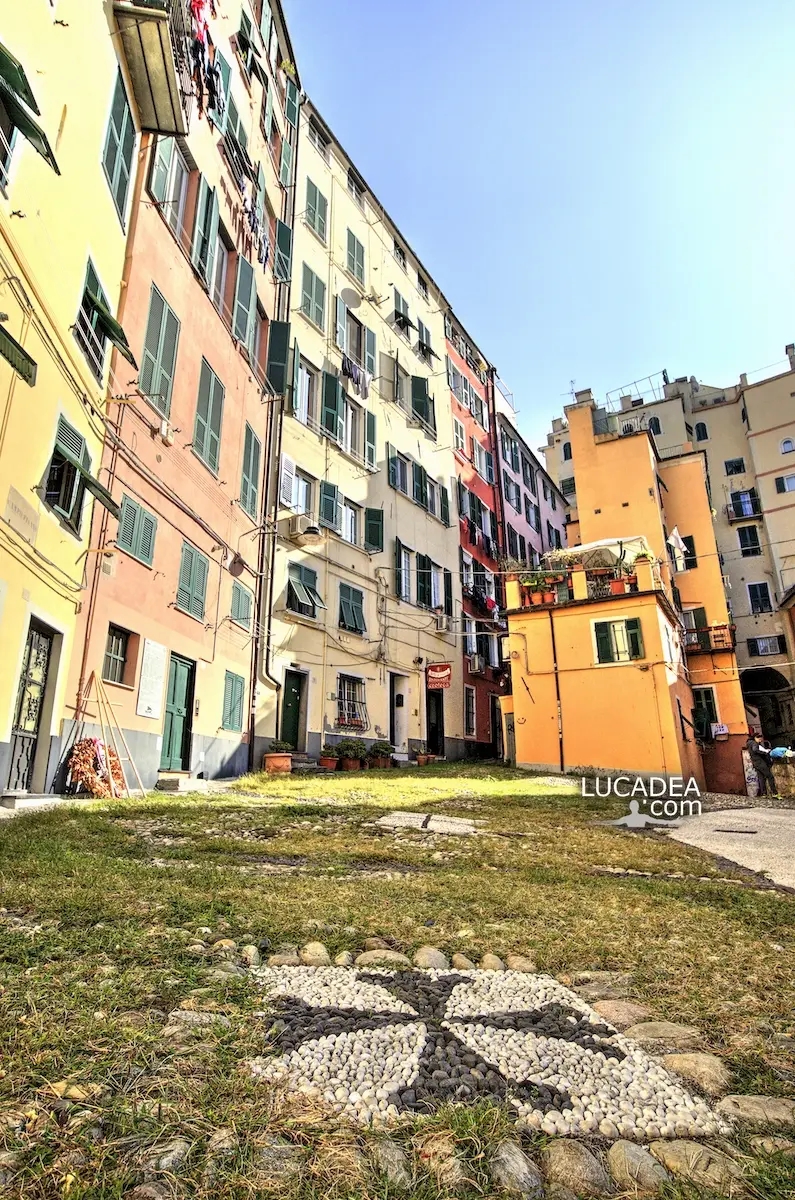
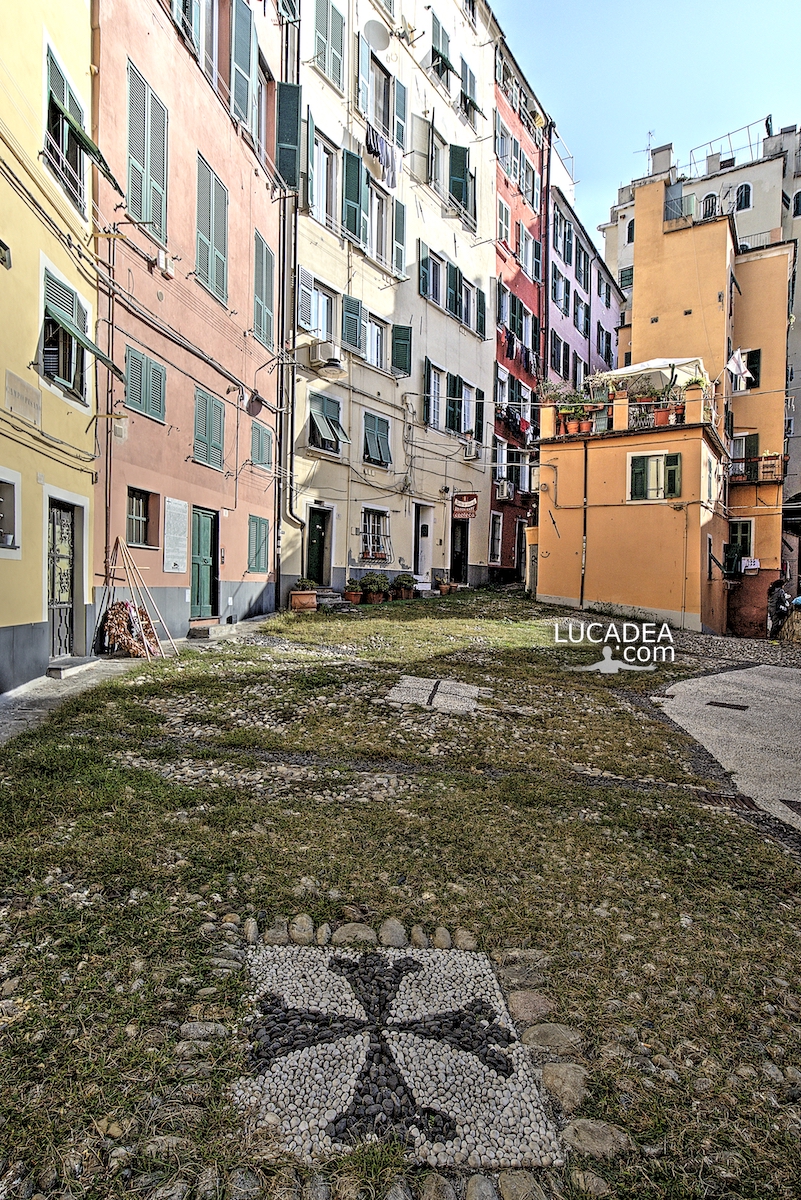
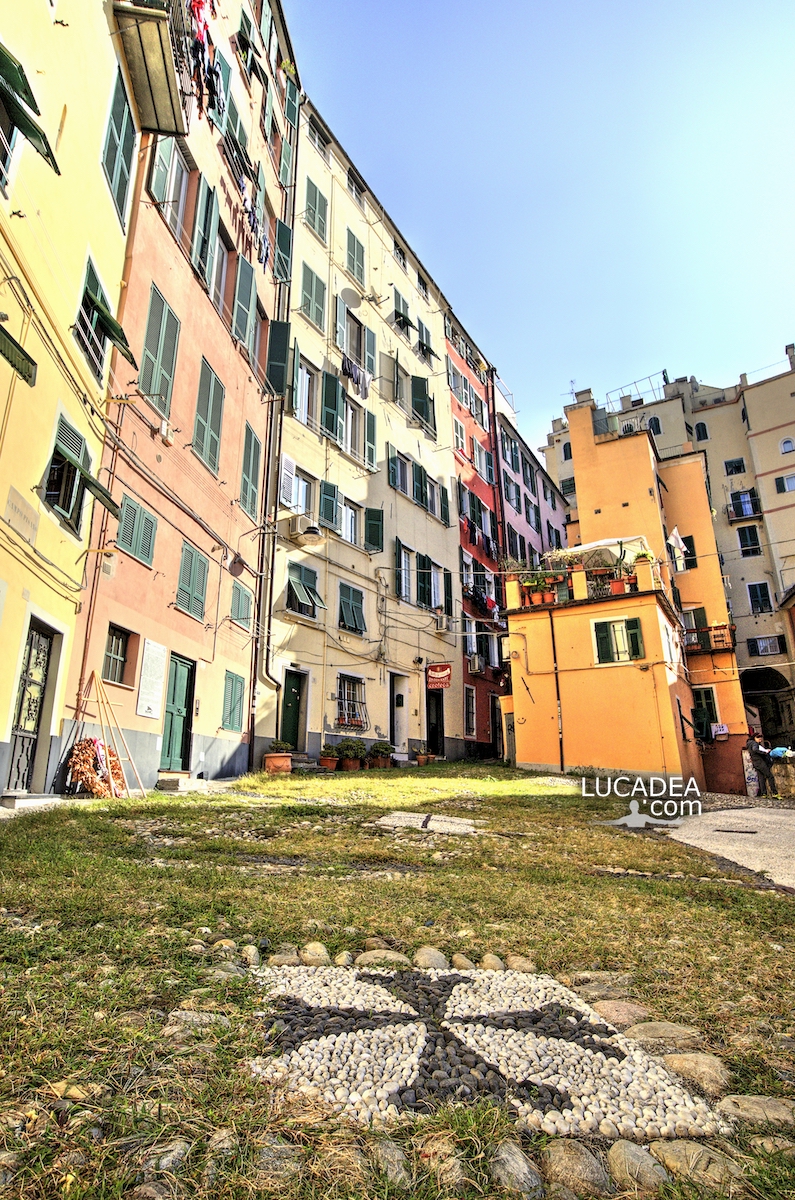
Campopisano Square in Genoa’s old town

La bella piazza Campopisano nel centro storico di Genova

Campopisano Square in Genoa’s old town.
Walking through Genoa’s narrow streets, I had passed near this small square many times without ever making the effort to look for it. When thinking about what to see in Genoa’s old town, it is easy to focus on the better-known landmarks, while smaller places such as Campopisano Square can remain hidden in plain sight.
For a long time, I had promised myself that I would finally find Campopisano Square. Whenever I wandered through the caruggi without a precise destination, I would remember the square and then, almost inevitably, take another turn and forget about it. A few months ago, my wife and I finally decided to make a point of finding it and visiting the place properly.
Reaching the square is part of the pleasure. Genoa’s historic centre is made of narrow passages, stairways and unexpected turns, and a small open space can appear almost suddenly between the surrounding buildings. Campopisano Square has this particular quality. After walking through the dense network of streets, arriving in the square creates a welcome change of perspective and gives you a moment to stop and look around.
This is one of the places worth seeing in Genoa if you enjoy discovering the less obvious side of the city. I was especially interested in the way the square fits into the surrounding historic fabric rather than standing apart from it. The buildings, the narrow streets leading towards the square and the compact open space all belong to the same urban setting.
I took this photograph myself during our visit, wanting to keep the impression of finally reaching a place I had postponed seeing for years. I was not searching for a spectacular postcard view. Instead, I wanted the photograph to preserve the character of the square and the feeling of being surrounded by the old streets of Genoa.
Campopisano Square is in Genoa, Liguria, Italy, in the heart of the historic centre. If you are visiting Genoa and looking for what to see beyond the city’s most famous attractions, this is the kind of small corner that can naturally become part of a walk through the caruggi. Its appeal comes precisely from the fact that it does not feel like a separate attraction, but like something you discover while exploring the city.
There is also a historical curiosity behind the name Campopisano. The square is traditionally associated with the long rivalry between Genoa and Pisa and with the Pisan prisoners brought to Genoa after the Battle of Meloria in 1284. It is a brief piece of history, but it adds another layer to a place that today can seem surprisingly quiet.
That contrast stayed with me while taking the photograph. Genoa’s history is enormous, but it is not always encountered through imposing monuments. Sometimes it appears in a small square hidden among narrow streets, in an old building or simply in the shape of the urban space around you.
Campopisano Square also reminded me of why I enjoy photographing Genoa’s historic centre. I often prefer these smaller discoveries to the places I already know I am going to photograph. There is a different kind of attention involved when I arrive somewhere after having looked for it, especially when the visit has been postponed several times.
It also connects naturally with other photographs of Genoa that I have shared on the site. The historic centre offers so many details that one photograph rarely feels like a complete story. A square can lead to a street, a street to another small corner, and before long the original plan of the walk has disappeared. For me, that is part of the pleasure of photographing this city.
Looking back at this image, I am pleased that my wife and I finally decided to stop postponing the visit. Campopisano Square may be a relatively small space, but finding it gave me exactly the kind of photographic moment I enjoy: no need for a grand panorama, just a place with enough character to make me stop, look carefully and take the camera out.

Have you ever discovered a small corner of Genoa only after walking past it many times? Add a comment or go to the bottom of the site to read what other visitors have written.

Photos taken with a Canon EOS M100 camera and Canon EF-M 11-22 lens.

And here is where the square is located:

🏠
  • Italiano