A Steep Alley in Montefalco’s Old Town

Un vicolo in salita del borgo di Montefalco

A Steep Alley in Montefalco’s Old Town.
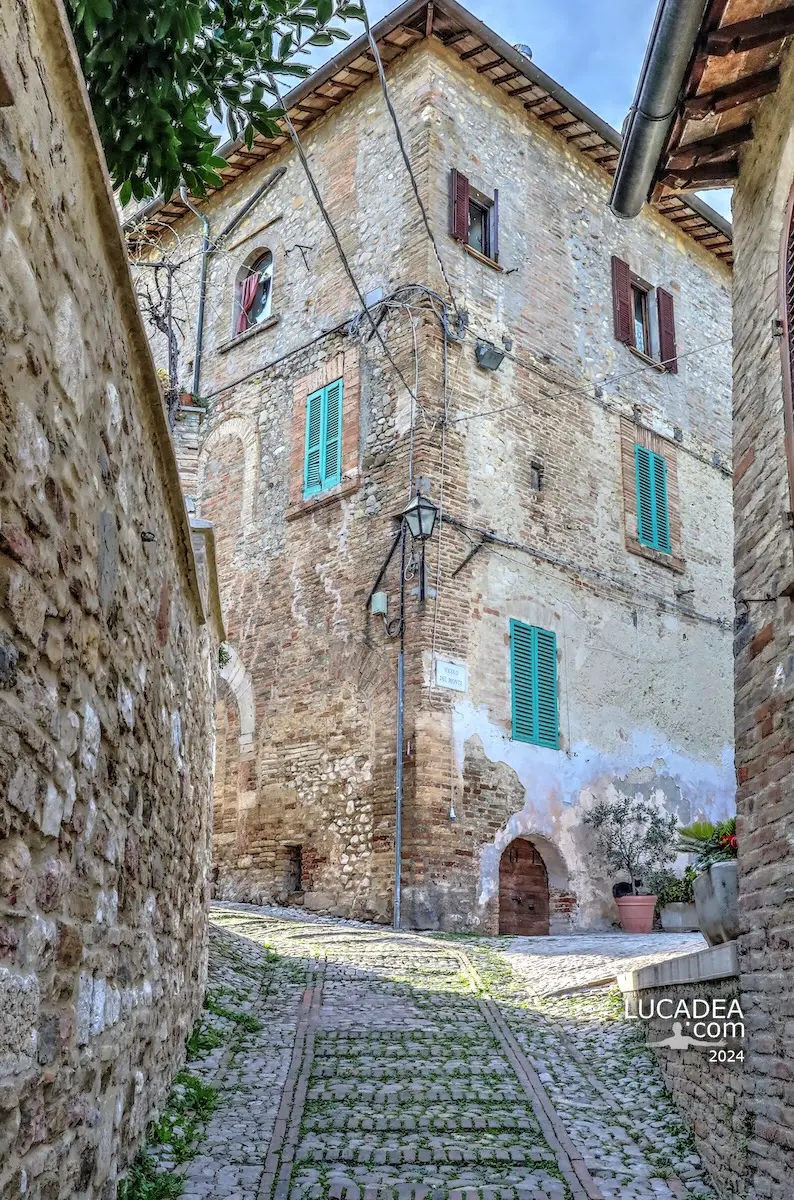
Walking through Montefalco in Umbria, I was drawn to the succession of sloping streets, stone walls and narrow passages leading towards the heart of the village. This alley in Montefalco is one of those simple scenes that makes me want to stop with my camera and look more carefully at the character of the place.
To reach the historic center, the streets gradually climb towards the highest part of the hill. You can feel the shape of the village simply by walking: the slope changes, the houses gather closely around the road and every turn can reveal another small perspective.
That sequence of little views is one of the things I enjoy most when photographing old villages. There is no need to search constantly for the most famous monument or the widest panoramic view. Sometimes a steep street, stone paving and old houses along both sides are enough to tell the story of a place.
I took this photograph because this particular alley seemed to express the structure of Montefalco very naturally. The stone houses and the traditional paving create a scene strongly connected with the historic character of the village. The road itself almost guides the eye upwards, following the direction towards the center.
If you are wondering what to see in Montefalco, it is easy to focus on its squares, churches and historic buildings, but I think the streets connecting these places deserve just as much attention. They give continuity to a walk and make the shape of the village easier to understand.
Montefalco is in the province of Perugia, Umbria, Italy, and its elevated position is one of the features that defines its appearance. From the upper part of the village, the surrounding Umbrian landscape opens towards the hills and countryside. Even without reaching a panoramic viewpoint, however, the elevated position becomes obvious simply by walking along these streets.
I took this photograph myself because I wanted to capture that particular relationship between the village and the hill. There is no spectacular monument in the center of the frame. Instead, several smaller elements work together: the stone, the incline of the road, the closely spaced houses and the sense that the path continues beyond the image.
There is a small historical curiosity connected with Montefalco’s position. The town is sometimes known as the “Balcony of Umbria” because of its elevated location and the broad views it offers across the surrounding landscape. The nickname helps explain why the hill is such an important part of the town’s identity.
But the panorama was not what I was looking for in this photograph. I was more interested in the intimate scale of the alley, where the houses seem to accompany the road and the street becomes the real subject. It is an ordinary part of the village, yet it says a great deal about its character.
Walking slowly through places like this also changes the way I photograph them. A window, a doorway, a section of stone wall or simply the way the paving follows the slope can become an important part of the composition. I prefer not to rush, because the most interesting frame is sometimes just a few steps further along.
This photograph also connects naturally with another Montefalco scene I shared on the blog, again focusing on the village’s characteristic stone streets. Together, the images can almost be seen as fragments of the same walk, following the quieter routes rather than concentrating only on the best-known landmarks.
That is one of the things I appreciate most about photographing Italian hill towns. Their identity is not created only by important buildings. It is also found in the shape of the streets, the materials used for the houses, the way the buildings stand close together and the way everything responds to the landscape.
In Montefalco, that relationship is particularly clear. The hill is not simply a background behind the village; it directly shapes the way the town is experienced. The climbs become part of the walk and, from a photographic point of view, create lines and perspectives that help describe the place.
Looking at this photograph again, I like its simplicity. It does not try to show all of Montefalco. It captures only a small section of the route towards the center, leaving the rest to the imagination. Sometimes these smaller details are what make a place feel more personal and recognizable.

Would you enjoy wandering through the steep alleys of Montefalco’s historic center? Add a comment or go to the bottom of the site to read what other visitors have written.

Steep alley in Montefalco, Umbria, with traditional stone houses and paving in the historic town center

Photo taken with a Canon EOS RP camera and a Canon RF 24-50 lens.

To see all the photos I took in the village, click here:

Here’s where Montefalco is located:

Montefalco, surrounded by vineyards and olive groves, is situated on top of a hill overlooking the plain of the Topino and Clitunno rivers. Because of this favorable panoramic position, since 1568 it has been given the nickname “Balcony of Umbria”. From here, on the clearest days, from various viewpoints it is possible to admire a 360° panorama that stretches across the entire valley between Perugia and Spoleto, from the slopes of the Sub-Apennines to those of the Martani Mountains.
Continue and learn more on Wikipedia

Add one  comment to this article or read  here what other visitors have written.
 
Adv
 
Disclamer

The rights on images, videos, choruses, text and all other material on the LUCADEA.com website are governed as per  Copyright page.


This page has been viewed 0 times today.
This month it has been viewed 0 times.
In total it has been viewed 27 times.
 

The entrance to Chiavari’s caruggio from Matteotti Square

Entrance to Chiavari's caruggio from Matteotti Square, with arcades, columns and colorful historic buildings

The entrance to Chiavari’s caruggio from Matteotti Square.
Looking towards Via Martiri della Liberazione, I immediately found myself facing one of the most recognizable perspectives in Chiavari’s historic center: a long sequence of arcades, columns and colorful façades packed closely together along the street. This glimpse of Chiavari is a good example of how the town can be understood simply by walking through its old streets rather than looking only for individual landmarks.
From Matteotti Square, the route leads into the heart of the historic center and gradually reveals the characteristic structure of the caruggio Dritto. The buildings stand tightly alongside one another, while the arcades create a continuous sheltered passage on either side. What caught my attention was not one particular façade, but the rhythm created by all these elements together.
The caruggio Dritto, now officially Via Martiri della Liberazione, is one of the streets most closely associated with the historic center of Chiavari. Walking along it means moving through a part of the town where shops, architecture and everyday life still share the same space. The businesses beneath the arcades keep the street active, while the buildings preserve the visual character that makes this part of Chiavari immediately recognizable.
Chiavari is in Liguria, in the Metropolitan City of Genoa, Italy, on the Gulf of Tigullio. If you are visiting Chiavari and wondering what to see in the historic center, walking along the caruggio Dritto is one of the simplest ways to experience the town at street level. For me, it is also one of the most rewarding areas to photograph because there are so many layers of detail within a relatively narrow space.
The depth of this particular view is what I like most about the image. The columns create a repeated rhythm that draws the eye forward, while the colorful façades fill the upper part of the scene. Because the houses are built so closely together, there are few empty spaces, and the street feels almost like a continuous architectural corridor.
I took this photograph myself because this perspective seemed to summarize several features that I associate with Chiavari’s old town. The arcades, columns, colors and tightly packed buildings are enough to establish a strong sense of place without needing a famous monument in the frame.
There is also a small historical curiosity about the arcades. They are not merely decorative architectural elements. Traditionally, covered passages such as these offered protection from rain and sun while creating a practical intermediate space between homes, shops and the street. In Chiavari, they have become one of the defining features of the historic urban landscape.
Looking at the photograph, I also notice how much the proportions contribute to the atmosphere. The relatively narrow buildings and their close arrangement create a strong sense of continuity. The street feels less like a simple route between two points and more like a place to experience slowly, paying attention to the façades, columns and small details along the way.
This is one reason I enjoy returning to Chiavari with my camera. A familiar historic center can still produce different photographs because the perspective changes with even a small shift in position. One day I might focus on a doorway or shop, while another visit may lead me to photograph the entire street from its entrance.
This image also fits naturally with other photographs I have shared from historic centers around the Tigullio area. From Lavagna to Sestri Levante and other Ligurian towns, I often find myself drawn to the same kind of subjects: arcades, streets, storefronts and everyday architectural details. They may not always be the most famous sights, but they are what give a town its visual identity.
Here, however, the caruggio Dritto remains the clear protagonist. I like the fact that the photograph begins at Matteotti Square and lets the eye move inward along the street, almost suggesting the walk that comes next. You do not need to show the whole historic center to tell its story. Sometimes choosing the right starting point is enough.
For anyone exploring Chiavari, this is the kind of street where I would slow down and look above the shop windows as well as at street level. The colorful façades, columns and covered walkways reveal details that can easily disappear if you simply pass through.
I stopped here, took the photograph, and then continued along the caruggio, as the perspective seemed to invite exactly that.

Do you prefer photographing historic streets through deep perspectives like this, or do you usually focus on individual buildings and architectural details? Add a comment or go to the bottom of the site to read what other visitors have written.

Entrance to Chiavari's caruggio from Matteotti Square, with arcades, columns and colorful historic buildings

Photo taken with Canon EOS RP and lens Canon RF 28.

Where I took the photo:

Add one  comment to this article or read  here what other visitors have written.
 
Adv
 
Disclamer

The rights on images, videos, choruses, text and all other material on the LUCADEA.com website are governed as per  Copyright page.


This page has been viewed 0 times today.
This month it has been viewed 0 times.
In total it has been viewed 24 times.
 

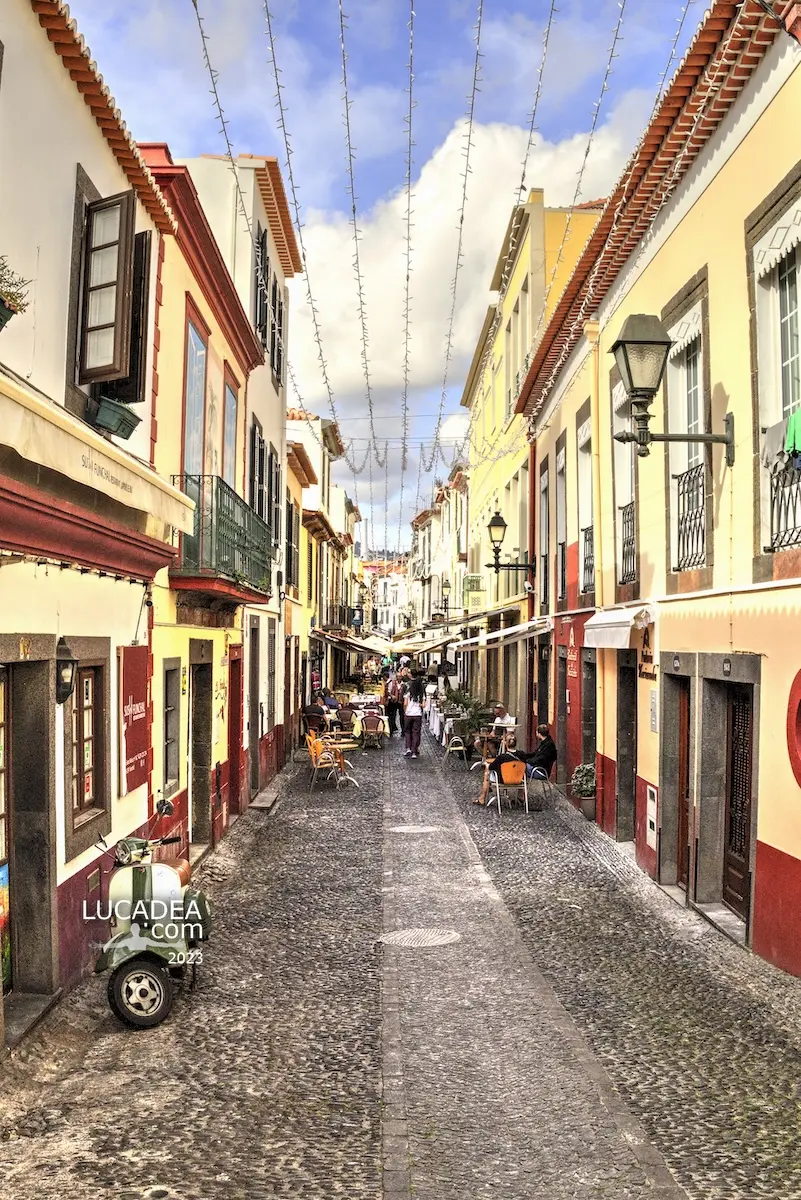
Rua de Santa Maria in Funchal, Madeira

La Rua de Santa Maria a Funchal nell'isola di Madeira

Rua de Santa Maria in Funchal, Madeira.
The painted doors are probably the detail that makes this street in Funchal’s old town so recognisable, but walking through the Zona Velha quickly reveals that there is more to it than the artwork. The old façades, stone paving, restaurants and everyday activity all contribute to the atmosphere I found while exploring this part of the city.
I took this photograph myself during my visit to Funchal, on the island of Madeira in Portugal. I stopped in front of one of those details that naturally makes you slow down. Along Rua de Santa Maria, moving just a few metres can reveal another doorway, a different colour or a façade that completely changes the composition.
The street is in the Zona Velha, Funchal’s historic district, close to the Mercado dos Lavradores and the waterfront. If you are wondering what to see in Funchal, Rua de Santa Maria is one of the streets I would include in a walk through the city centre, particularly if you enjoy architecture and urban photography.
My first impression was of a narrow, enclosed street, with the buildings standing close together. The façades lead the eye forward and, between one doorway and the next, there are restaurants, bars, signs and small details of everyday life. It feels very different from the large natural landscapes for which Madeira is famous, and that is exactly what makes it interesting from a photographic point of view.
The best-known feature of Rua de Santa Maria is connected with the Arte de Portas Abertas project. The initiative brought artists into the Zona Velha to transform old doors into works of art, helping to give the neighbourhood a new visual identity. The painted doors have since become part of the urban landscape and one of the main reasons photographers stop along this street.
That is also the detail I find most interesting about the project. It is not an art gallery separated from everyday life. The artworks are part of the street itself, existing alongside homes, restaurants and the normal activity of the historic district.
Looking at the photograph, I am particularly interested in this contrast. Some elements belong to older Funchal, while contemporary artwork brings new colours and ideas to the façades. I did not want to create an overly complicated composition. I simply wanted to preserve the impression I had while walking along the street.
If you are wondering where Rua de Santa Maria is in Funchal, its central location makes it easy to include in a wider walk. The street runs through one of the oldest parts of the city and can be reached while exploring the area around the market and waterfront. From here, you can continue through the other streets of the Zona Velha.
The atmosphere also changes throughout the day. Restaurants and bars are an important part of the street and make this section of the centre particularly lively. Even without stopping at one of the local establishments, however, I think the street is worth exploring slowly because much of its photographic interest is hidden in the details.
It is a street that encourages you to look around. One doorway may catch your eye because of its design, another because of its colours, while an old façade can become interesting simply because it stands next to a contemporary artwork. In that sense, Rua de Santa Maria feels almost like a sequence of small photographs waiting to be found.
During my time in Madeira, I also looked for urban scenes beyond the island’s better-known natural landscapes. On my photoblog I have collected several photographs of Funchal and its architecture, including another painted door on Rua de Santa Maria. I also photographed the cathedral tower in Funchal, a very different image connected with the same city centre.
I like linking photographs from the same journey because they allow Funchal to be seen from different perspectives. One photograph may focus on a doorway, another on a church or a street, but together they provide a better sense of the variety of the city.
Rua de Santa Maria is therefore interesting not simply because it has become famous for its painted doors. What makes it distinctive is the way contemporary art has been integrated into the historic fabric of the Zona Velha. Walking here, you can see a part of Funchal that has retained the character of an old neighbourhood while also showing how art can change the way an everyday urban space is perceived.
For me, it was mainly a street to photograph without rushing. I did not need to search for a major attraction. I could simply walk and let each small detail suggest the next composition.

If you have visited Funchal, have you already walked along Rua de Santa Maria, and which detail stayed with you the most? Add a comment or go to the bottom of the site to read what other visitors have written.

Rua de Santa Maria in Funchal with painted doors and colorful façades in Madeira's historic center

Photo taken with Canon EOS RP and Canon RF 24-50 lens.

To see all the photos I took in the street, click here:

Here’s where this street is located:

Garibaldi Gallery in Genoa near Portello Square

Ingresso della Galleria Garibaldi a Genova dal Portello con statue marmoree e scritta sopra l’entrata

Garibaldi Gallery in Genoa near Portello Square.
Arriving in Portello Square, in Genoa, Liguria, Italy, this gallery dedicated to Giuseppe Garibaldi opens up as one of those urban passages that quietly hold layers of history and detail. It is one of the places to see in Genoa if you enjoy noticing architecture and hidden elements rather than just the main landmarks.
Every time I walk by, I slow down before stepping inside. The inscription above the entrance always catches my attention first, almost like a small personal ritual. Then my eyes move to the two marble statues on each side, standing there as silent guardians of the passage. Just above, the Minaret tower adds an unexpected element, creating a contrast that makes this corner particularly interesting to photograph.
This photo comes from that habit of focusing on details that might otherwise go unnoticed. I wanted to capture the entrance of Garibaldi Gallery because it reflects something essential about Genoa: layered, slightly hidden, and full of character. It’s not a typical postcard view, and that’s exactly why I keep returning with my camera.
The gallery was built in 1927, as shown by the Roman numerals MCMXXVII still visible. Originally named after Vittorio Emanuele III, it was later renamed after World War II to honor Giuseppe Garibaldi, reflecting a broader shift in national identity during that time. It’s a small change in name, but one that carries historical weight.
If you are visiting Genoa and looking for something a bit different, this is a place worth seeing, especially if you enjoy discovering less obvious corners of the city. It also connects in my mind to other photos I’ve taken in Genoa, particularly in the narrow alleys and covered passages, where similar atmospheres can be found.
I’ve photographed this spot many times, yet it never feels repetitive. There is always a new angle, a new detail, something slightly different that makes me stop again.

Do you also have a place you keep photographing over and over? Add a comment or go to the bottom of the site to read what other visitors have written.

Entrance of Garibaldi Gallery in Genoa near Portello Square with marble statues and inscription above the doorway

Entrance of Garibaldi Gallery in Genoa near Portello Square with marble statues and inscription above the doorway

Photos taken with Canon EOS RP and lens Canon RF 24-50.

Here’s where the gallery is located:

The Asinelli Tower Framed by Bologna’s Arcades

La Torre degli Asinelli a Bologna

The Asinelli Tower Framed by Bologna’s Arcades.
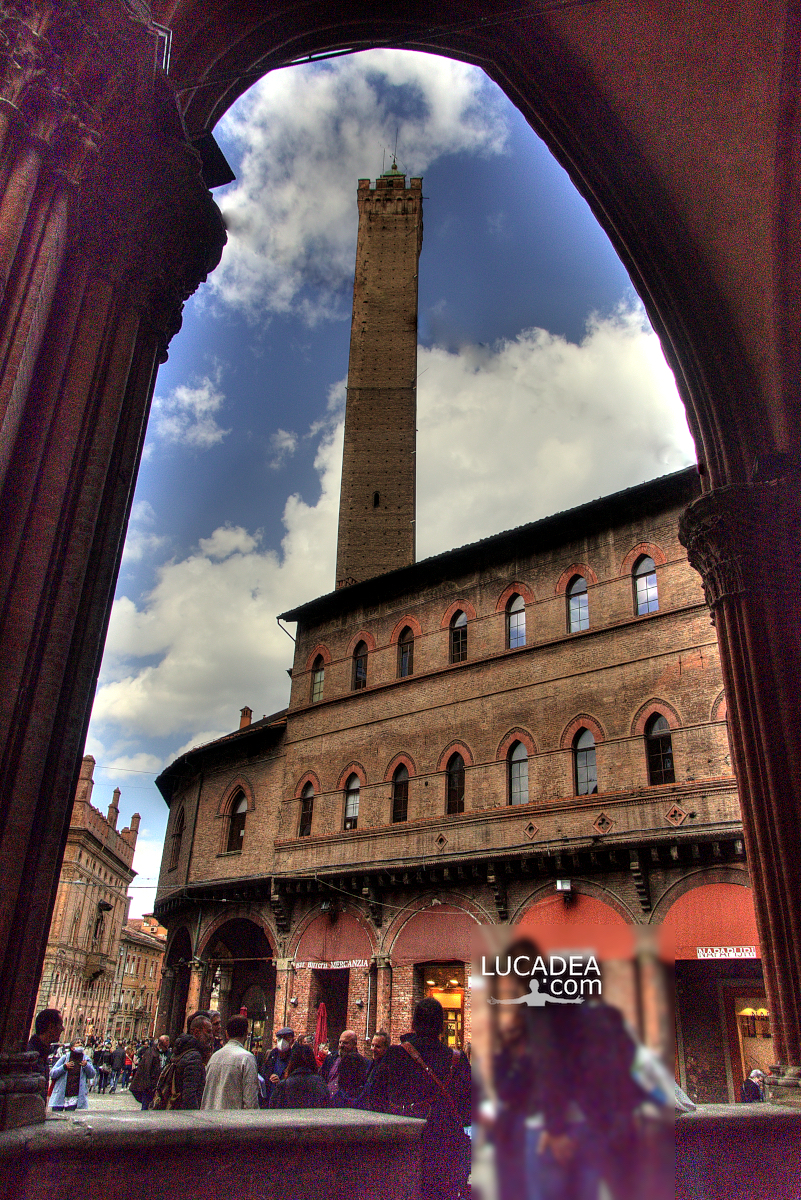
In Bologna, between the columns of the Mercanzia Palace, I found this unusual view of the city’s most famous tower. The Asinelli Tower appears framed by the surrounding arcades, creating a composition that immediately caught my attention as a photographer.
I took this photograph in the historic center of Bologna, Emilia-Romagna, Italy, using the lines and openings of the arcade to give the tower a different setting. Instead of photographing it directly from the street, I preferred to let it appear between the columns, almost as if the arcade itself had become a natural frame.
If you are wondering what to see in Bologna, the Two Towers are naturally among the first landmarks that come to mind. The Asinelli Tower, together with the nearby Garisenda Tower, is one of the city’s most recognizable symbols. Seeing it through the arcades adds another element that feels deeply connected with Bologna: the long sequences of columns and arches found throughout the historic center.
There was also a small problem with this photograph that I remember quite clearly. A cable ran across almost the entire tower and seriously interfered with the composition. If you look carefully at the image, you can see that I tried to remove it in order to recover some of the visual cleanliness of the original frame. Things are not always perfect when photographing busy urban landmarks, and sometimes you simply have to work with what is in front of the camera.
That is part of travel photography for me. You often have to adapt to the surroundings, looking for the best possible position and deciding whether a distracting element can be avoided by moving or, as in this case, corrected afterwards.
What I like most about the photograph is still the perspective. The columns of the Mercanzia Palace guide the eye towards the tower and make the image different from a straightforward view of the Two Towers. The main subject remains unmistakable, but it is surrounded by an important part of Bologna’s historic urban fabric.
The Asinelli Tower is the taller of the two medieval towers and has been one of the city’s most recognizable landmarks for centuries. Its noticeable lean, caused by ground settlement and construction-related changes, is one of the characteristics that makes it immediately recognizable.
I wanted to photograph it this way because I enjoy finding different ways to photograph monuments that are already extremely familiar. There is no need to search for the most obvious viewpoint every time. Sometimes moving only a few metres and looking through an arcade is enough to create a completely different image.
The photograph also reminds me how important Bologna’s arcades are when photographing the city. They are not simply architectural features in the background. They naturally become part of the composition, creating perspective, framing and depth.
Looking at the image again, I almost see the cable as part of the story behind the photograph. It was certainly not something I wanted in the frame, but it forced me to pay even more attention to the composition and to the editing afterwards.
That is one of the things I enjoy about keeping a photoblog: even a seemingly simple image can preserve the memory of how it was made.

What is your favorite viewpoint for photographing the Asinelli Tower? Add a comment or go to the bottom of the site to read what other visitors have written.

Asinelli Tower in Bologna seen through the arcades of the historic Mercanzia Palace

Photo taken with Canon EOS M100 and Tamron 16-300 lens.

If you want to see all the photos I took in the city, click here:

The Asinelli Tower is one of the so-called two towers of Bologna, a symbol of the city, located in Piazza di Porta Ravegnana, at the intersection of the ancient streets of San Donato (now Via Zamboni), San Vitale, Maggiore, and Castiglione. According to tradition, it was built between 1109 and 1119 by the nobleman Gherardo Asinelli.
Continue and learn more on Wikipedia

Carrugio Dritto in the old town of Chiavari

Carrugio Dritto a Chiavari

Carrugio Dritto in the old town of Chiavari.
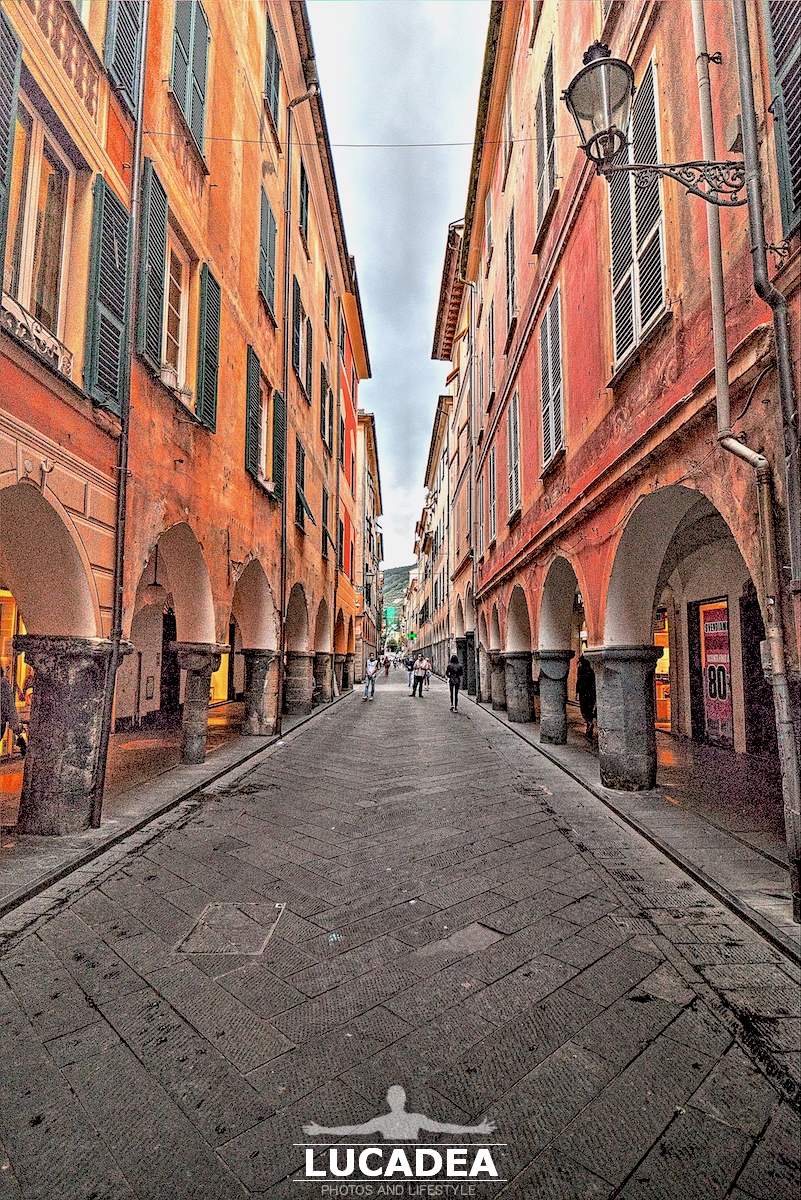
Walking through the centre of Chiavari, I found myself following one of the streets that best captures the everyday character of the town, with its arcades, shops, historic buildings and long perspective. This photograph is about Carrugio Dritto in Chiavari, a simple but very recognisable view of the old town.
I took this photograph myself during a walk through Chiavari, stopping for a moment to look along the street. I did not need a complicated composition: the succession of buildings and arcades already created an interesting perspective. Carrugio Dritto naturally draws the eye forward and makes it easy to appreciate the structure of this part of the historic centre.
Chiavari is in Liguria, in the Metropolitan City of Genoa, along the Gulf of Tigullio in Italy. If you are wondering what to see in Chiavari, the old town is one of the natural places to start, not only because of its historic architecture but also because the streets still have a very everyday atmosphere. This is one of the reasons I enjoy photographing Chiavari: interesting images can appear during an ordinary walk, without needing a special event or a particular occasion.
Carrugio Dritto crosses the historic centre along a route characterised by the typical Ligurian arcades. Walking through it, you encounter shops, entrances to homes, historic façades and small architectural details that change depending on where you stand. In this photograph, I wanted to preserve that feeling of continuity and allow the perspective of the street itself to lead the viewer through the image.
One of the details I find most interesting about the old streets of Chiavari is the relationship between the road and the arcades. This is not simply a narrow alley. The covered walkways create a more open urban space while providing shelter and allowing people to move between buildings. The result is an architectural feature that still belongs to everyday life in the city.
The historic centre of Chiavari is particularly known for its medieval arcades, which developed along important commercial streets. Their original purpose was practical: they offered shelter while creating useful spaces for commercial activities. It is a small historical detail, but it changes the way I look at a photograph like this because what may appear to be a simple architectural feature is actually connected with the practical needs of the city’s past.
When I photograph a street like Carrugio Dritto, I also enjoy looking at details that could easily be overlooked. Shop signs, façades, windows, columns and the changing lines of the arcades all become part of the image. There does not have to be a famous monument in the middle of the frame. Sometimes the combination of ordinary details says much more about a town.
Carrugio Dritto is also a useful starting point for exploring Chiavari on foot. From here, you can continue through other streets in the historic centre, reach Piazza Mazzini, the Sanctuary of Our Lady of Montallegro’s local reference points, and the areas closer to the harbour. Walking rather than following a strict itinerary makes it easier to notice the smaller details along the way.
If you are visiting Chiavari and looking for places worth seeing, I have also created a photographic guide to Chiavari on the site. I like connecting these stories because a single street such as Carrugio Dritto becomes more meaningful when it is seen alongside the other places I have photographed in the town.
Chiavari is a very rewarding place for urban photography. You can walk without a precise destination and still find different perspectives at every turn. A street can look completely different a few metres further on, while the arcades create repeating architectural lines that give each section its own character.
This photograph came from one of those walks. I stopped because the scene in front of me seemed worth preserving, even though for someone who lives in Chiavari it might be an entirely ordinary part of the daily landscape. That is also why I continue photographing familiar places: over time, you begin to notice details that might have escaped your attention on the first visit.
Carrugio Dritto is therefore more than just a street to cross on the way somewhere else. It is one of the views that helps reveal the structure of Chiavari’s historic centre and the relationship between its streets, buildings and commercial life.
Looking at this photograph again, what I like most is how quickly it brings me back to that walk. It is not an image intended to tell the entire story of Chiavari. It is simply one fragment of the town, seen from my own viewpoint. Over time, many fragments like this can become a larger visual memory of the places I have visited and photographed.

If you visit Chiavari, do you find yourself stopping to look at the old streets and arcades, or are you more attracted to the views towards the sea? Add a comment or go to the bottom of the site to read what other visitors have written.

Carrugio Dritto in Chiavari's old town, with traditional arcades, historic buildings and local shops

Photo taken with Canon EOS M100 camera and Canon EF-S 10-18 lens.

🏠
  • Italiano