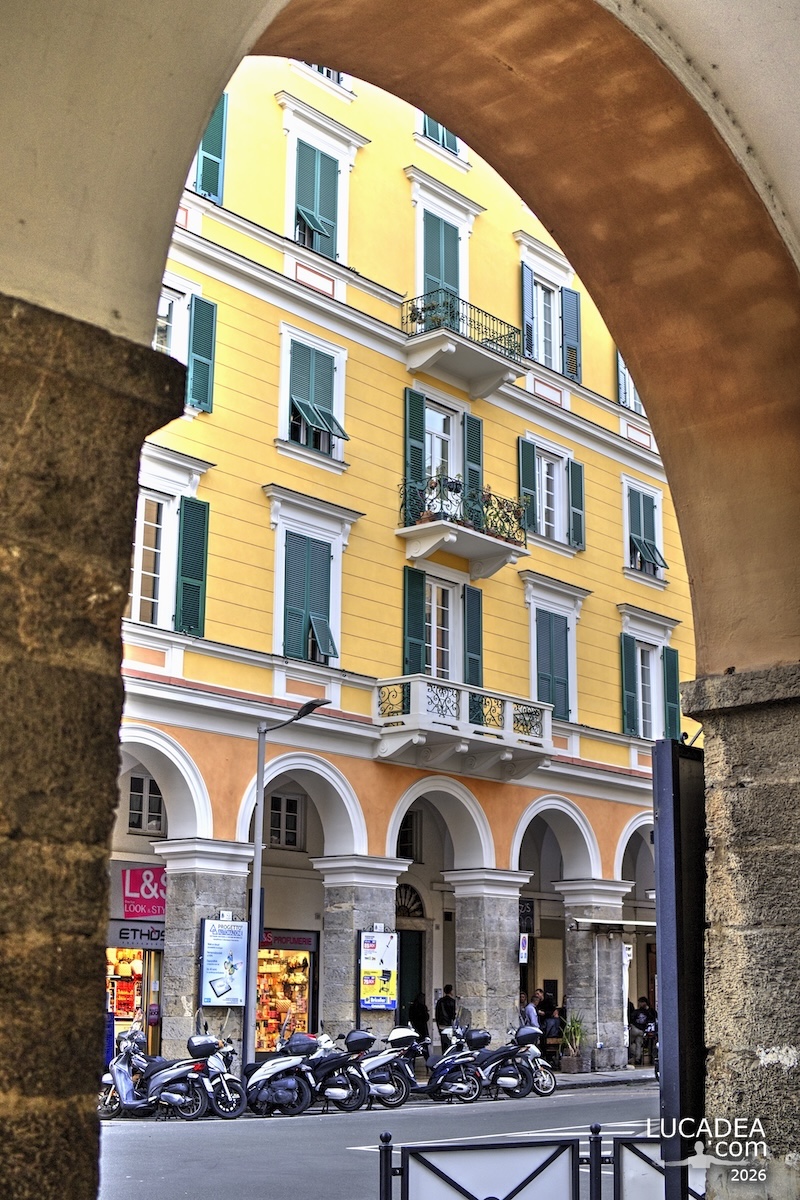
Walking under the arcades of Via XX Settembre

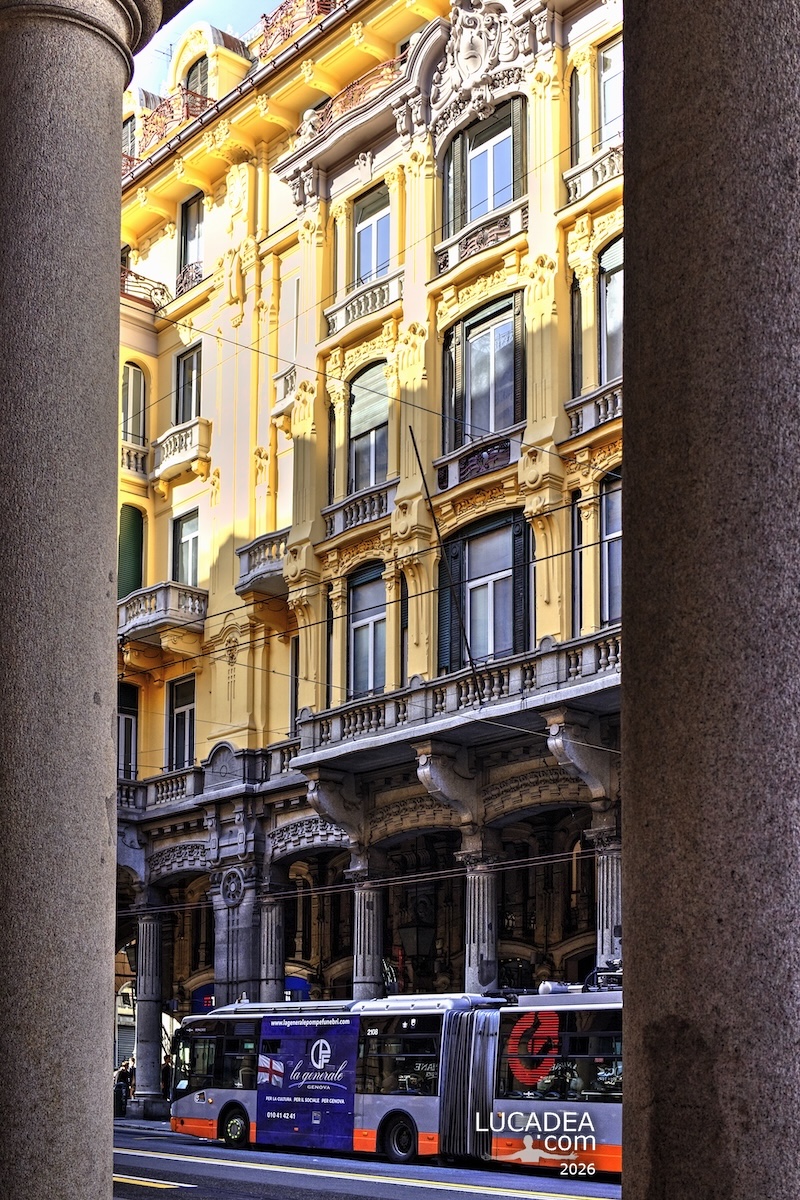
Portici di via XX Settembre a Genova con palazzo decorato giallo e autobus che passa tra le colonne

Walking under the arcades of Via XX Settembre.
Walking under the arcades of Via XX Settembre in Genoa is one of those simple experiences that immediately shows what to see in Genoa without going far. This view of Via XX Settembre in Genoa captures both the elegance of the architecture and the everyday rhythm of the city.
I found myself standing between two large columns, almost hidden, watching the sunlight fall across the façade of the building in front of me. The details of the balconies and decorative elements drew my eyes upward, while below, the movement of buses and people reminded me that this is a living, breathing street. It’s a place where the past and present coexist naturally.
This scene is located in Genoa, Liguria, Italy, right in the heart of one of the most important streets in the city. If you are visiting Genoa, Via XX Settembre is definitely one of the most interesting places in Genoa to explore, not only for shopping but for its architecture. The arcades are among the longest in Europe, originally designed to protect pedestrians while enhancing the visual harmony of the street.
While taking this photo, I was reminded of another shot I had shared on my site from a quieter corner under similar arcades. Here, however, everything feels larger and more dynamic, almost like a stage where the columns frame the scene and the street becomes the action.
The passing bus added a contemporary touch to the scene without disrupting its balance. Instead, it highlighted the contrast between historic buildings and modern life, something that makes this street unique.

Have you ever looked up while walking through a busy street and suddenly noticed something you had never seen before? Add a comment or go to the bottom of the site to read what other visitors have written.
Portici di via XX Settembre a Genova con palazzo decorato giallo e autobus che passa tra le colonne

Photo taken with Canon EOS R50 V and lens Canon RF 28.

I portici di via XX Settembre a Genova – The arcades of via XX Settembre in Genoa – Les arcades de la via XX Settembre à Gênes – Los soportales de via XX Settembre en Génova – As arcadas da via XX Settembre em Gênova – Die Arkaden der Via XX Settembre in Genua – Các mái vòm của via XX Settembre ở Genoa – 热那亚二十世纪大街的拱廊

The text of this post was written with the help of ChatGPT, a language model from OpenAI.

Add one  comment to this article or read  here what other visitors have written.
 
Adv
 
Disclamer

The rights on images, videos, choruses, text and all other material on the LUCADEA.com website are governed as per  Copyright page.

This page has been viewed 1 times today.
This month it has been viewed 1 times.
In total it has been viewed 1 times.
 

A glimpse of Chiavari old town streets

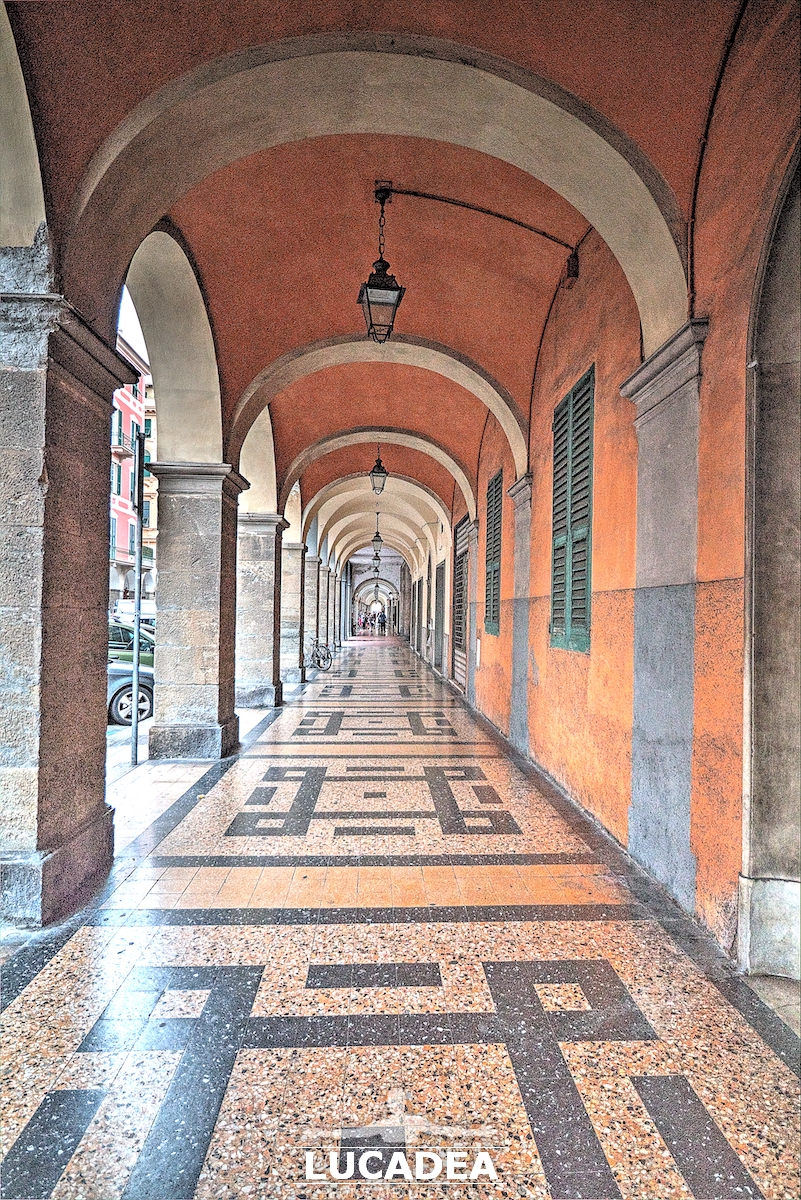
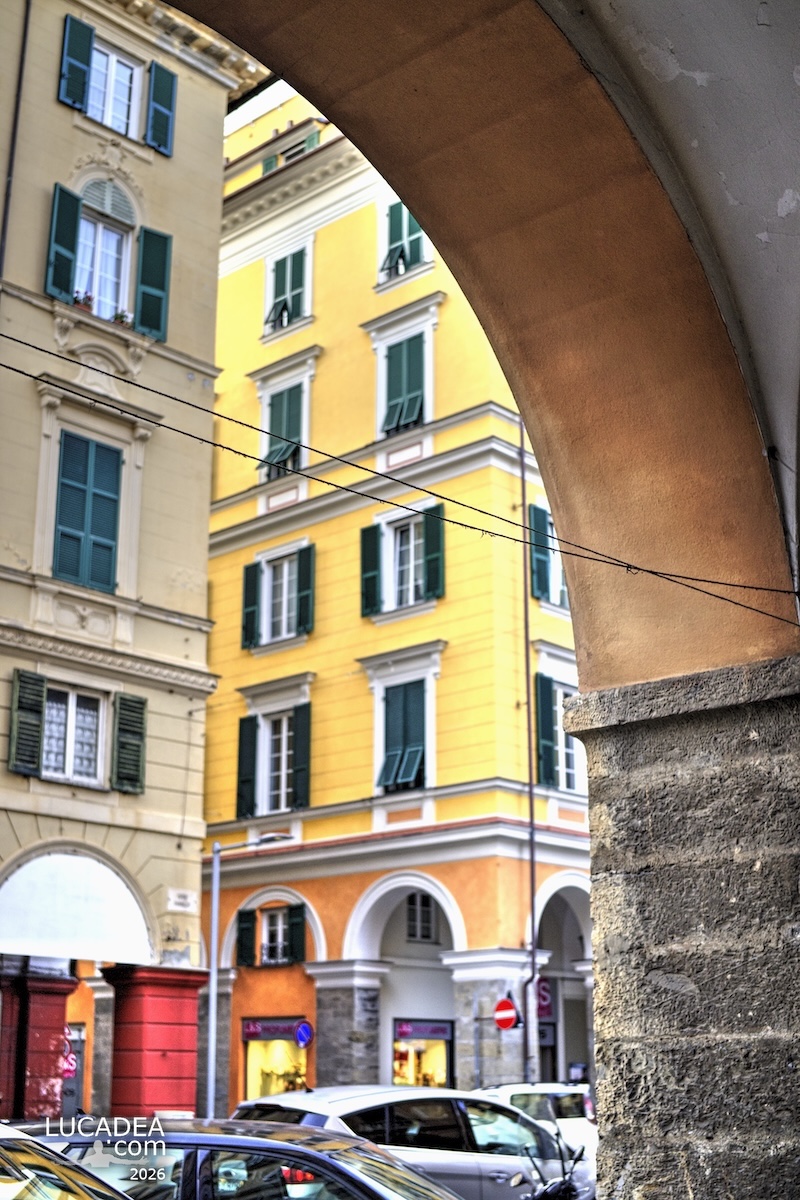
Portici del centro storico di Chiavari con palazzi gialli e persiane verdi incorniciati da un arco in primo piano

A glimpse of Chiavari old town streets.
Walking beneath the arcades in the old town of Chiavari is one of those simple experiences that shows you what to see in Chiavari without even trying. This view of Chiavari old town streets, with its colorful buildings and green shutters, feels like a natural introduction to the atmosphere of this coastal town in Liguria.
I paused under the arch almost without thinking, drawn by the way it framed the scene ahead. The curve of the stone created a soft border, guiding my eyes toward the yellow façade across the street. The repetition of windows and shutters gave the composition a quiet rhythm, something I always look for when photographing urban details.
In Chiavari, Liguria, Italy, the old town is not just a place to pass through but one of the most interesting places in Liguria to slow down and observe. If you are visiting this area, these arcades are definitely worth seeing, not only for their aesthetic but for the way they shape daily life. Historically, Chiavari is known for having some of the longest arcades in the region, offering shelter and continuity through centuries of local activity.
As I stood there, I remembered another photo I had taken along these same streets, shared on my site in a different season. The light had changed completely, yet the feeling remained familiar. That’s something I find fascinating: places like this hold their identity no matter the time or conditions.
Cars passing at the edge of the frame added a subtle contrast between past and present. They didn’t ruin the mood; instead, they reminded me that this is not just a preserved setting, but a living town.

Have you ever found yourself stopping for a moment in a place like this, realizing it’s more than just a street? Add a comment or go to the bottom of the site to read what other visitors have written.

Photos taken with Canon EOS R50 V and lens Canon RF 28.

Uno scorcio del centro storico di Chiavari – A glimpse of Chiavari old town – Un aperçu du centre historique de Chiavari – Un rincón del centro histórico de Chiavari – Um vislumbre do centro histórico de Chiavari – Ein Blick auf die Altstadt von Chiavari – Một góc khu phố cổ Chiavari – 基亚瓦里历史中心的一角

The text of this post was written with the help of ChatGPT, a language model from OpenAI.

Add one  comment to this article or read  here what other visitors have written.
 
Adv
 
Disclamer

The rights on images, videos, choruses, text and all other material on the LUCADEA.com website are governed as per  Copyright page.

This page has been viewed 0 times today.
This month it has been viewed 0 times.
In total it has been viewed 0 times.
 

The arcades of Garibaldi avenue in Chiavari

Portici e archi di Corso Garibaldi nel centro di Chiavari, tra palazzi più alti e abitazioni

The arcades of Garibaldi avenue in Chiavari.
After photographing Carrugio Dritto, I continued through this part of central Chiavari, which has a somewhat different and, at first glance, more modern character. Here the arcades become broader and the buildings larger, creating a very different urban perspective from the narrower streets and older buildings nearby.
The difference becomes especially noticeable when looking at the buildings along the street. Carrugio Dritto is strongly associated with traditional shops and historic businesses, while Garibaldi avenue has more offices and homes. The buildings also seem larger and taller, perhaps because they belong to a more recent phase of urban development.
That contrast was exactly what I wanted to photograph. There is no need to decide which part is more beautiful. Carrugio Dritto has the charm of its tighter proportions and historic shops, while Garibaldi avenue offers a more spacious scene, with taller arches and arcades that give the street a greater sense of openness.
In this photograph, I wanted to capture that feeling rather than focus on a single architectural detail. The arcades create a continuous sequence along the street, while the arches provide a natural rhythm and perspective. Even without a famous monument in the frame, a repeated architectural element like this can become a very interesting photographic subject.
In Chiavari, Liguria, Italy, arcades are an important part of the character of the central streets. They create a sheltered passage between the buildings and the public space, allowing people to walk along the street with some protection from the weather. This practical function is part of what makes them such an important element of traditional urban architecture.
What I particularly notice here is the change in proportions. The taller arches and larger buildings make Garibaldi avenue feel more open than the Carrugio Dritto. It is not simply a question of building height. The entire relationship between the street, the arcades, and the façades changes, and that is what I wanted the photograph to preserve.
There is also a small architectural curiosity behind the word “arcade” itself. Covered walkways have historically served a very practical purpose, providing shelter from rain and sun while keeping a direct connection between buildings and the street. Over time, that everyday function also became an important part of the architectural identity of many Italian towns.
What I like about Chiavari is that this architecture is not separated from everyday life. The arcades are part of the way people move through the town, alongside shops, homes, offices, and other ordinary activities. They are not simply decorative elements added to make a street look attractive; they are part of how the street works.
I wanted to photograph these arcades because I enjoy comparing different views of the same town. My photograph of Carrugio Dritto shows a more intimate side of Chiavari, closely connected with historic shops and narrow proportions. This image shows another side, with larger buildings and a more spacious architectural rhythm.
If you are looking for what to see in central Chiavari, Garibaldi avenue offers a different perspective from the streets best known for their historic shops. It may not be more interesting, but it is interesting for different reasons: the size of the buildings, the height of the arches, and the continuity of the arcades completely change the way the street feels.
That variety is one of the reasons I enjoy photographing towns like Chiavari. A city is not made only of its most famous corners. The differences between one street and the next can be just as revealing, and sometimes moving only a few steps is enough to find an entirely different perspective.
These arcades have a character of their own. They are less intimate than those around the Carrugio Dritto, taller and more imposing, but those very proportions give this part of Chiavari a different kind of beauty.
This photograph therefore becomes another small part of my personal visual record of Chiavari, alongside the other images I have published from the town center and its architecture. I like having different kinds of photographs together because they gradually create a broader portrait of the city rather than repeating the same familiar view.

Do you prefer the more intimate arcades around Carrugio Dritto, or do you like these wider perspectives along Garibaldi avenue? Add a comment or go to the bottom of the site to read what other visitors have written.

Arcades and arches along Garibaldi avenue in central Chiavari, with taller buildings and residential façades

Photo taken with Canon EOS M100 and lens Canon EF-S 10-18.

Genoa from above among rooftops and buildings

Il centro di Genova visto dall'alto

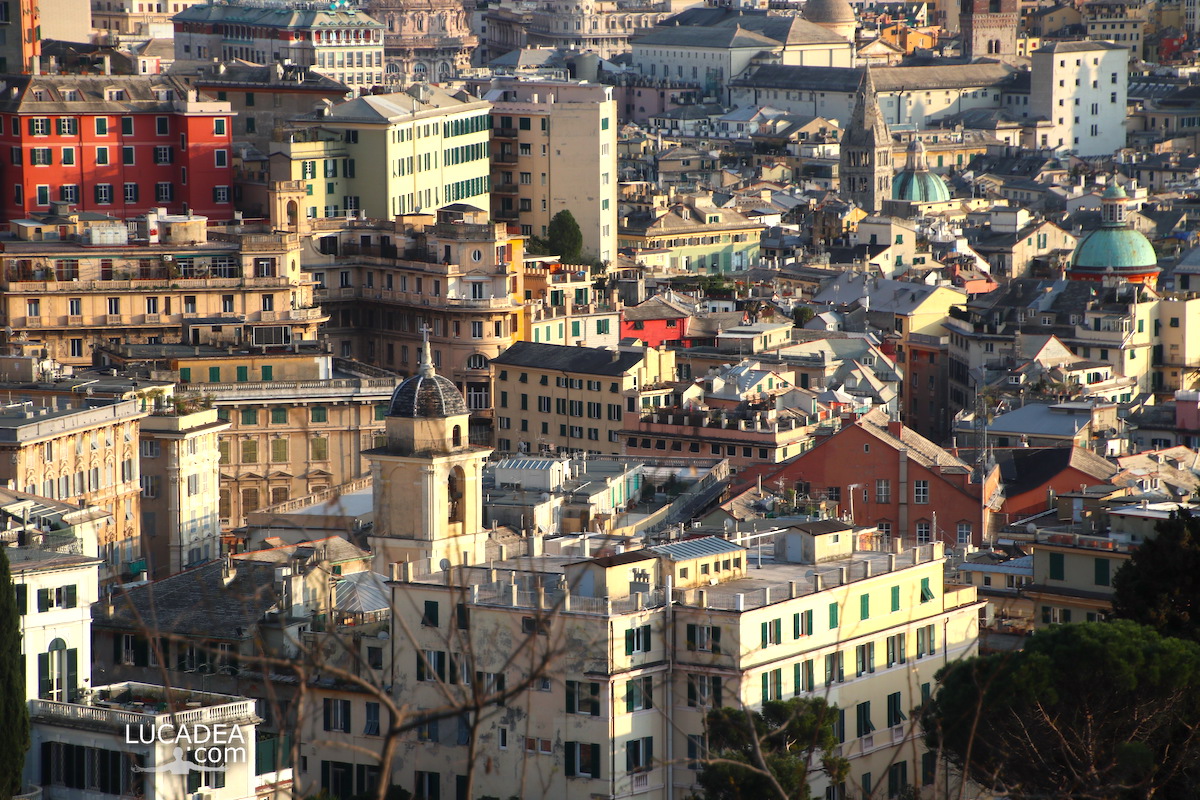
Genoa from above among rooftops and buildings.
I always enjoy photographing Genoa from above, especially when the atmosphere is clear enough to reveal the details of the city. From a higher viewpoint, central Genoa takes on a completely different appearance, with buildings, rooftops and streets forming a pattern that is difficult to appreciate while walking through the narrow lanes.
This is exactly the kind of photograph I keep looking for whenever I have my camera with me. Genoa is full of details, and many of them remain hidden when seen only from street level. From above, however, it becomes possible to follow the lines of the rooftops, recognise different buildings and understand just how dense and compact the city centre really is.
In this image, I wanted to focus mainly on the buildings in central Genoa. There is no single monument that needs to dominate the composition. The subject is the city itself, made up of overlapping buildings and rooftops that seem to come remarkably close to one another.
When I look for a view of Genoa from above, the sky becomes an important part of the photograph. I do not necessarily need a spectacular day; what matters to me is having enough clarity to read the shapes of the city. A reasonably clear sky helps preserve the attention on the architecture and allows the layers of rooftops and buildings to remain visible.
The vertical character of Genoa is particularly interesting from this perspective. The city stretches between the sea and the hills, and the dense historic centre makes this relationship especially clear. From above, you can better appreciate how little space separates one building from another and how the urban landscape has developed through centuries of changes.
There is a small detail about Genoa that becomes easier to understand from this kind of viewpoint. Its historic centre is one of the largest in Europe, with a dense network of narrow lanes, squares, historic buildings and passages. Seen from above, that complex urban fabric almost becomes a pattern, revealing connections that are much harder to notice from the street.
I have photographed Genoa from several viewpoints, including Castelletto esplanade, where the view opens across a much wider part of the city. This photograph is different because I wanted to concentrate more closely on the buildings and the urban texture rather than creating a traditional panoramic view.
For me, it is also a way of continuing to discover a city I have photographed many times. Even when returning to a familiar viewpoint, different visibility can completely change the result. A clearer sky, a newly noticed detail or simply a different section of rooftops can make the photograph feel new.
If you are looking for a view of Genoa worth seeing from above, these elevated perspectives offer something different from the usual street-level images. They show the city as a dense collection of buildings shaped by its geography and history, while still leaving plenty of room for personal observation.
I have always liked this side of photography: looking at a familiar place from an unfamiliar angle and finding something worth capturing without needing to search for a spectacular subject.

Do you prefer seeing Genoa from above or getting lost in its narrow streets? Add a comment or go to the bottom of the site to read what other visitors have written.

Central Genoa seen from above, with rooftops and historic buildings filling the cityscape

Photo taken with Canon EOS M100 and lens Tamron 16-300.

A view of Mazzini square in central Chiavari

Scorcio di piazza Mazzini con l'ex Tribunale nel centro di Chiavari, visto da una prospettiva urbana insolita

A view of Mazzini square in central Chiavari.
When I walk through the center of Chiavari, I always try to look at familiar places from a slightly different angle. In this photograph I chose a viewpoint that includes Mazzini square and the former courthouse, looking for a composition that might otherwise be easy to overlook.
Chiavari offers plenty of subjects for urban photography. You do not necessarily need a famous monument or a spectacular panorama. Sometimes all it takes is turning down a different street, stopping for a few seconds or looking at a familiar building from another position. Over time, this has become part of the way I photograph the places I know.
Mazzini square is in the center of Chiavari, Liguria, in the Metropolitan City of Genoa, Italy. The square is one of those urban spaces where you can get a sense of the character of the town, while the former courthouse provides a recognizable architectural element within the scene.
When I think about what to see in Chiavari, I do not like limiting myself to the best-known sights. I also enjoy looking at ordinary squares, streets and buildings that belong to everyday life. These are the details that gradually create the visual identity of a town and make it recognizable to the people who live there.
This photograph came from that way of looking at Chiavari. I was not walking around with the specific intention of photographing Mazzini square. Instead, I noticed a perspective that seemed interesting and decided to stop and take the picture. For me, this is often how photography works: the subject may already be there, but the photograph appears only when I find the right way to look at it.
The former courthouse is one of the elements that gives the scene its character. A public building does not necessarily have to be a major monument to become an important part of a city’s visual memory. Photographing it can also mean documenting a small piece of the architecture and more recent history of the town.
The real curiosity for me is the search for the viewpoint itself. When I photograph a city I already know, I try not to take anything for granted. A street I have walked through many times can suddenly offer a completely different composition, perhaps because something has changed in front of the camera or simply because this time I stopped to pay closer attention.
I find the same approach in several other photographs on my blog dedicated to historic centers and towns in Liguria. Streets, squares and buildings often do not need to be specifically searched for. They are already part of the landscape; the challenge is noticing them.
Chiavari is particularly interesting for this kind of urban photography because the center offers many different perspectives. You can move from broader views to architectural details, arcades, façades and smaller streets within a relatively short walk. For someone who enjoys photography, the problem is rarely finding something to photograph. It is deciding what should remain outside the frame.
I took this photograph with a simple idea in mind: look before pressing the shutter. A little imagination certainly helps, but curiosity matters just as much. Even in places I have visited many times, I can still find something worth photographing if I make the effort to see it differently.
That is probably what I enjoy most about urban photography. You do not always need to travel somewhere new to find an interesting image. Sometimes a walk through a familiar town is enough, provided you are willing to slow down and look around.

Have you ever found a new photographic viewpoint in a place you thought you already knew well? Add a comment or go to the bottom of the site to read what other visitors have written.

View of Mazzini square and the former courthouse in central Chiavari from an unusual urban perspective

Photo taken with Canon EOS RP and Tamron 16-300.

Here’s where I took the photo:

Lavagna’s Slate Porticoes in the Old Town

Portici del centro storico di Lavagna decorati con elementi in ardesia, tipici dell'architettura ligure

Lavagna’s Slate Porticoes in the Old Town.
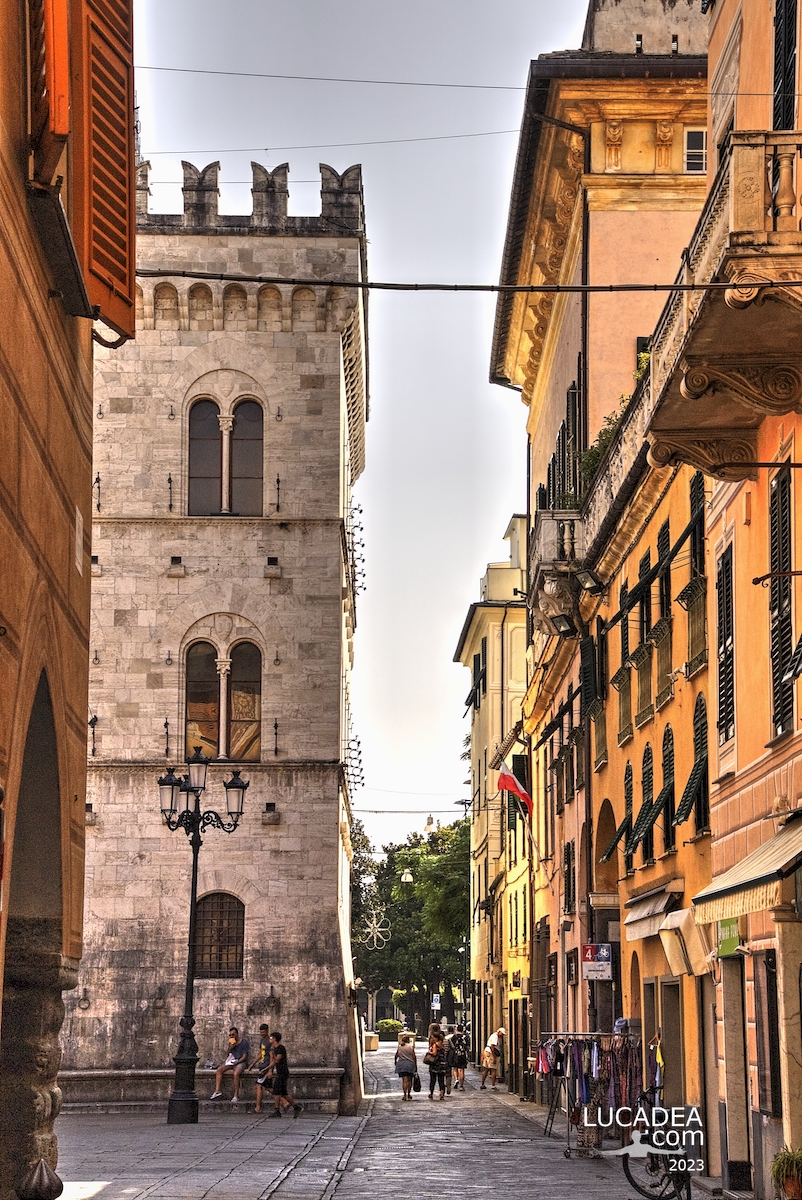
While walking through the historic center of Lavagna, I stopped to photograph one of the details that most clearly characterizes the town’s streets: the porticoes decorated with slate. It is a simple view, but that is exactly what I like about it, because it captures a very recognizable part of this corner of the Tigullio.
I took this photograph a few months ago in Lavagna, Liguria, Italy, in the Metropolitan City of Genoa, during a day spent photographing the historic center. I had started walking without a precise plan for the images I wanted to take and, as often happens to me, it was a small architectural detail that eventually made me stop.
The porticoes are one of the elements that make walking through the old streets so enjoyable. As I move beneath them, my attention keeps shifting between columns, doorways, façades and, above all, the slate. This dark stone is deeply connected with the building tradition of Liguria. In this photograph I wanted to capture that combination of materials and shapes without making the scene feel overly arranged.
Slate has a long history in Ligurian architecture, and it has a particularly strong connection with Lavagna and the surrounding area. Local slate quarries played an important role in the development of the material, which was used for centuries not only in architectural details and porticoes but also for roofs, paving and decorative elements.
It is the kind of feature that may not immediately stand out when visiting a town, but becomes much more obvious once you start paying attention to buildings. A dark stone panel, a column or a small decorative element can tell you something about a place beyond its appearance.
If you are wondering what to see in Lavagna, the porticoes of the old town are worth observing slowly. They are not necessarily something you visit as a single landmark, but they are part of the experience of walking through the historic streets. It is often while passing underneath them that some of the most interesting photographic details appear.
That is exactly how this image came about. I did not need a panoramic viewpoint or a famous monument. I simply had to look carefully at what was in front of me. The camera allowed me to stop and preserve a detail that would have been very easy to walk past without giving it much thought.
I took several other photographs in Lavagna on the same day. Some show different parts of the historic center, while others focus on buildings and architectural details that caught my attention during the walk. I like thinking of these images as a small collection from the same afternoon because, when seen together, they give a fuller impression of the town.
One of the photographs I have published over time also shows Santo Stefano Basilica, one of the buildings that most naturally draws attention in the center of Lavagna. The porticoes tell a quieter and more everyday story: they are the kind of architecture you encounter simply by walking through the town.
That is precisely the kind of photograph I enjoy adding to the blog. It does not necessarily need a monumental subject. It can simply preserve the memory of a walk and a detail that made me stop for a moment.
Lavagna is particularly well suited to this way of photographing. Walking slowly through the center reveals new compositions all the time, often created by the materials, colors and shapes of the buildings rather than by a single landmark.
Perhaps that is why, even months after taking this photograph, I still enjoy looking at it. It brings back that walk and the other images I made on the same day.

Which architectural detail in Lavagna do you most enjoy photographing? Add a comment or go to the bottom of the site to read what other visitors have written.

Porticoes in Lavagna's old town decorated with slate, a distinctive feature of traditional Ligurian architecture

Photo taken with a Canon EOS M100 camera and Tamron 16-300 lens.

The town is divided into several districts, named after the ancient *sestieri* (wards) into which the town was split during the era of the Fieschi family.
These are: the Borgo district, corresponding to the historic center; the Scafa district, located in the harbor area and bordering Chiavari; the Moggia district, in the inland part of the city; the Ripamare district in the east; and the Cavi district, which includes the hamlet of Cavi di Lavagna and the hillside hamlets of Santa Giulia, Sorlana, and Barassi.
Read more on Wikipedia

Arcades and a quiet street in Reggio Emilia center

Strada con portici e palazzi colorati nel centro di Reggio Emilia con persone e biciclette su asfalto bagnato

Arcades and a quiet street in Reggio Emilia center.
The wet asphalt softly reflects the warm tones of the buildings, while the street stretches ahead like a calm line inviting me to walk without any rush. The arcades guide my gaze, creating a rhythm of arches and shadows that repeat naturally along the center of Reggio Emilia. There is no need to look for something extraordinary; everything is already there, in the way the city lets itself be crossed.
I move slowly, noticing closed windows, tilted shutters, and small details that hint at a quiet daily life. The arcades are not just an architectural feature but a constant presence, almost protective. I realize that even the people passing by seem to adapt to this space: some walk close to the walls, others move along the edge of the street, while a bicycle passes through the scene with effortless ease.
The center of Reggio Emilia has a discreet character, one that doesn’t try to stand out loudly. The colors of the buildings, shifting between orange and yellow, seem softened by the even light, and for that very reason they feel more harmonious. It is a kind of beauty that does not demand attention but slowly reveals itself the longer you look.
An interesting detail that often goes unnoticed is that arcades in Emilia-Romagna cities were also designed for practical reasons: to provide shelter from rain and sun, allowing people to use the streets in every season. Here in Reggio Emilia, this idea is clearly visible, as if public space was meant to remain accessible at all times without interruption.
I stand still for a few seconds before taking the shot. The street is simple, but precisely because of that, it feels honest. I am not searching for a perfect scene, just a balance between lines, colors, and human presence. When I finally press the shutter, it feels like I’ve captured something ordinary that often goes unnoticed.

Have you ever found something special in what first seemed like an ordinary street? Add a comment or go to the bottom of the site to read what other visitors have written.

Arcades and a quiet street in Reggio Emilia center

Photo taken with Canon EOS RP and Canon RF 24-50 lens.

To see all the photos I took in the city, click here:
foto gallery

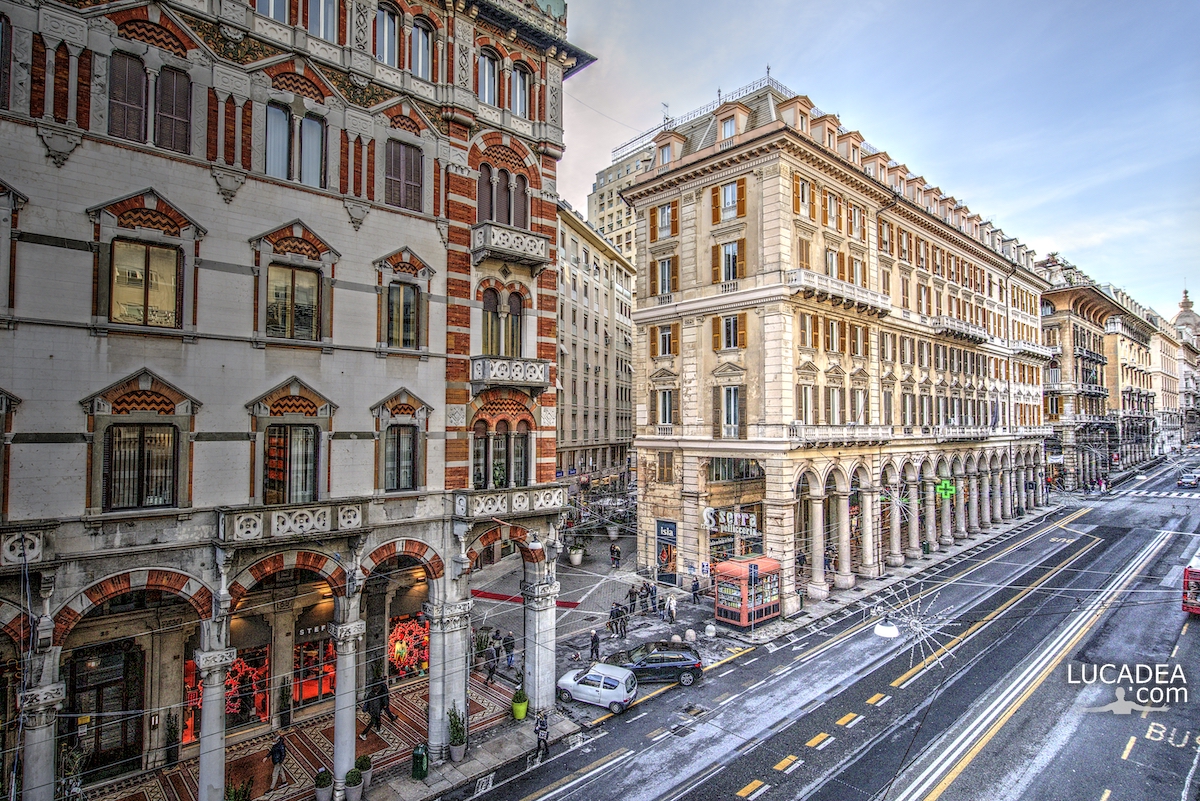
XX September Street in Genoa from Santo Stefano

Palazzi di Via XX Settembre a Genova osservati dall'alto del sagrato della chiesa di Santo Stefano

XX September Street in Genoa from Santo Stefano.
Whenever I find myself on XX September Street, I often take a few minutes to walk up to Santo Stefano church, because the view changes completely from there. From above, the buildings along XX September Street become the main subject, creating a perspective that is very different from the one you get while walking at street level.
It is one of my favorite viewpoints for photographing XX September Street in Genoa, mainly because there is no complicated route to find. If you are walking uphill, just after the Monumental Bridge, a small staircase leads to Santo Stefano church. It does not look particularly inviting at first, but reaching the top reveals a view that makes those few steps worthwhile.
The real surprise is the churchyard itself. Rather than feeling like an ordinary space in front of a church, it works almost like a terrace overlooking one of the main streets of Genoa. From here, the buildings along XX September Street can be seen from a completely different angle, and the road becomes an important visual line running through the scene.
This is Genoa, Liguria, in northwestern Italy, and XX September Street crosses one of the city’s central areas. At street level, the road is strongly associated with the busy urban character of Genoa, while from Santo Stefano the same place becomes quieter and easier to observe as a whole.
I took this photograph myself from the churchyard of Santo Stefano. Whenever I have the opportunity, I stop here to photograph the street and its buildings from above. Even though I have already taken several pictures from this viewpoint, I never find it completely repetitive. A small change in the framing is enough to bring different buildings, details or portions of the street into the composition.
What I particularly like about this perspective is the way the architecture becomes easier to read. From below, the buildings can feel imposing because they rise directly above the pedestrian and traffic levels. From the churchyard, their façades form a long sequence, with windows, balconies and decorative elements contributing to one broad urban pattern.
The relationship between Santo Stefano and the street is also quite unusual. The church is just a short distance from one of Genoa’s busiest central streets, yet the elevated churchyard creates a completely different atmosphere. You can look down towards the city while remaining in a much more enclosed and peaceful setting.
A small historical curiosity adds another layer to the place: Santo Stefano is a very old church, with origins going back many centuries. Its position has therefore remained closely connected with the development of central Genoa, even though the urban surroundings have changed considerably over time.
If you are visiting Genoa and wondering what to see beyond the most obvious landmarks, this is one of the viewpoints I would keep in mind. The churchyard of Santo Stefano offers a particularly useful perspective if you want to photograph XX September Street without leaving the center of the city.
For me, however, the attraction is not only the viewpoint itself. It is also the little discovery involved in reaching it. Walking along the street, the staircase is easy to overlook, and its appearance does not immediately suggest that something interesting is waiting at the top. Once you arrive at the church, the view suddenly makes sense.
Looking at the photograph again, I like the way the street seems to guide the eye between the rows of buildings. The elevated position changes the proportions of the scene and makes it possible to appreciate the architecture as a continuous urban landscape rather than as a series of separate façades.
This photograph naturally connects with other images I have published on the site about Genoa and its central streets. I often return to familiar parts of the city precisely because a different viewpoint can turn an ordinary route into a new photographic subject.
That is probably why, whenever I can, I still make the short climb to Santo Stefano when I happen to be on XX September Street. The staircase may not promise much at first glance, but the small church and its terrace-like churchyard offer one of those viewpoints that I am always happy to photograph again.

Have you ever looked at XX September Street from the churchyard of Santo Stefano? Add a comment or go to the bottom of the site to read what other visitors have written.

Buildings along XX September Street in Genoa seen from the elevated churchyard of Santo Stefano

Photo taken with a Canon EOS M100 camera and a Canon EF-M 11-22 lens.

Here is where this spot in Genoa is located:

Colombo Square and the harbor in Camogli

Piazza Cristoforo Colombo a Camogli con i grandi palazzi liguri di fronte al porticciolo

Colombo Square and the harbor in Camogli.
Every time I return to Camogli, I end up taking far more photographs than I can publish at once, and this image spent more than six months waiting in my archive. The small square facing the harbor, surrounded by tall buildings, is one of those views I naturally find myself photographing whenever I come back.
What stands out in the photograph is the relationship between the open space of the square and the buildings around it. Colombo Square faces directly toward the small harbor and offers one of those views where the character of Camogli becomes immediately recognizable. The sea is important, but so are the tall façades rising behind the square, which look very different from the smaller houses usually associated with Ligurian villages.
When I think about what to see in Camogli, the harbor is obviously one of the first places that comes to mind, but I also like looking at what happens immediately behind it. Here the urban character is particularly strong. The buildings are tall, close together and oriented toward the sea, creating a setting quite different from the low, compact houses found in many other coastal villages.
I took this photograph myself more than six months ago and, as often happens when I visit Camogli, it was part of a larger collection of images from the same visit. I like returning to photographs after some time has passed. An image that seemed like just one of many when I took it can sometimes become more interesting when I look at it again without the distractions of the original moment.
This is Camogli, in Liguria, in the province of Genoa, Italy, and just a few steps away from the harbor you can see how closely the town is connected to the sea. The square works almost like a small observation point: the water is in front, the buildings rise behind it and the space between them creates a very distinctive urban setting.
The tall buildings of Camogli are one of the features that most strongly define the appearance of the town. Their narrow and relatively high façades, often painted in different colors and placed closely beside one another, make efficient use of the limited space between the mountain and the sea. This vertical character is one of the reasons Camogli looks so different from the more familiar image of a small Ligurian house.
One interesting detail is connected to Camogli’s long relationship with the sea. The town developed as a maritime community, and the concentration of buildings reflects the need to organize a settlement within a narrow coastal area. From Colombo Square, the buildings can almost appear as a continuous wall rising behind the harbor, emphasizing just how compact the town is.
I was not trying to create a particularly elaborate composition when I took the picture. I simply wanted to capture the atmosphere of the square and the way the buildings fill the space around the harbor. This is one of those places I have photographed many times, yet it continues to offer different perspectives depending on where I happen to be standing.
Looking at the photograph again after more than six months, I am glad I kept it and finally decided to publish it on the blog. Camogli is one of those places where every visit can easily produce another collection of images. This photograph naturally joins the other pictures I have already shared on the site from the village and its waterfront.
If you are visiting Camogli and wondering what to see, the harbor is an obvious starting point, but I think the surrounding squares and buildings deserve the same attention. The character of the town becomes particularly clear in the relationship between its architecture and the sea. You do not necessarily need to search for a spectacular viewpoint; sometimes an ordinary square offers a more personal way of seeing the place.
That is one of the reasons I keep photographing Camogli whenever I return. The images slowly accumulate, some remaining in my archive for months before I decide to share them. This photograph belongs exactly to that group: an everyday view of the village that stayed with me long enough for me to eventually bring it back into the blog.

Do you have a square or a view in Camogli that you photograph every time you return? Add a comment or go to the bottom of the site to read what other visitors have written.

Colombo Square in Camogli with tall Ligurian buildings overlooking the small harbor

Photo taken with a Canon EOS M100 camera and a Canon EF-S 10-18 lens.

If you would like to see all the photos taken in this beautiful seaside town, click here:
foto gallery

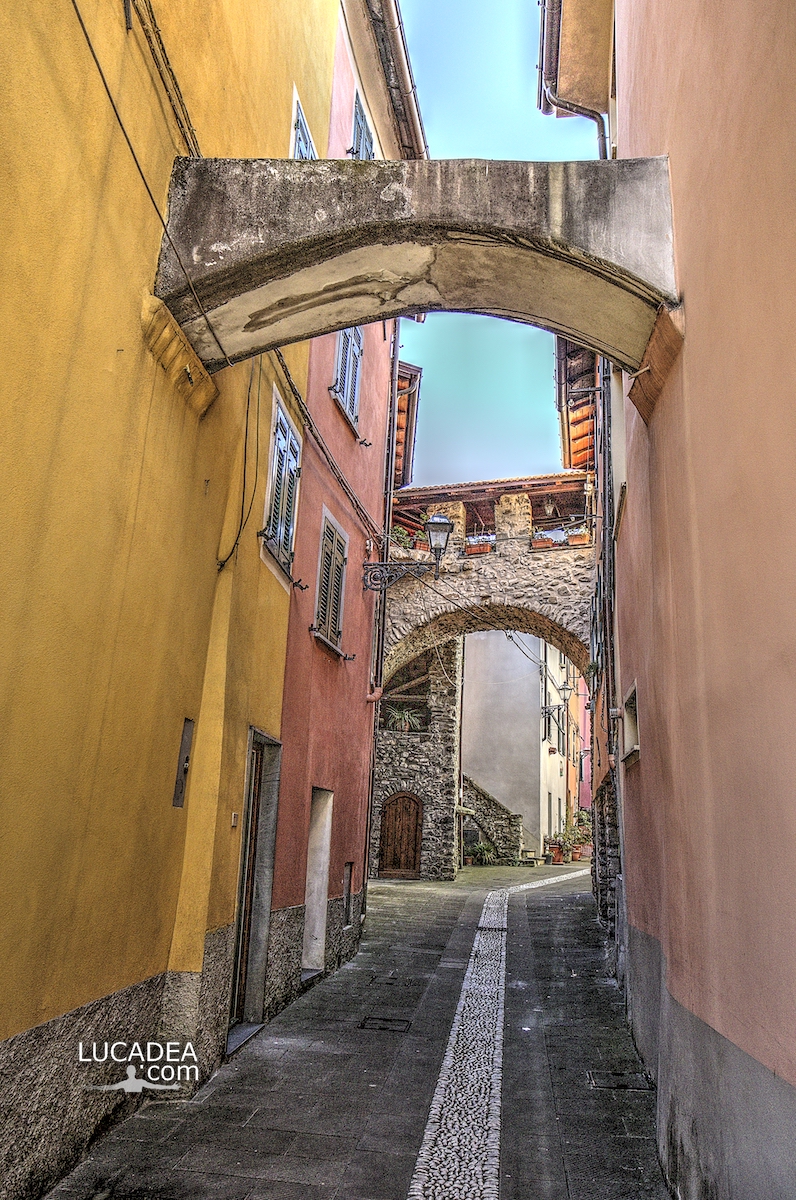
Sbatacchio arches in a narrow alley of Brugnato

Archi di sbatacchio in un vicolo stretto di Brugnato in Liguria con case ravvicinate collegate da piccoli archi

Sbatacchio arches in a narrow alley of Brugnato.
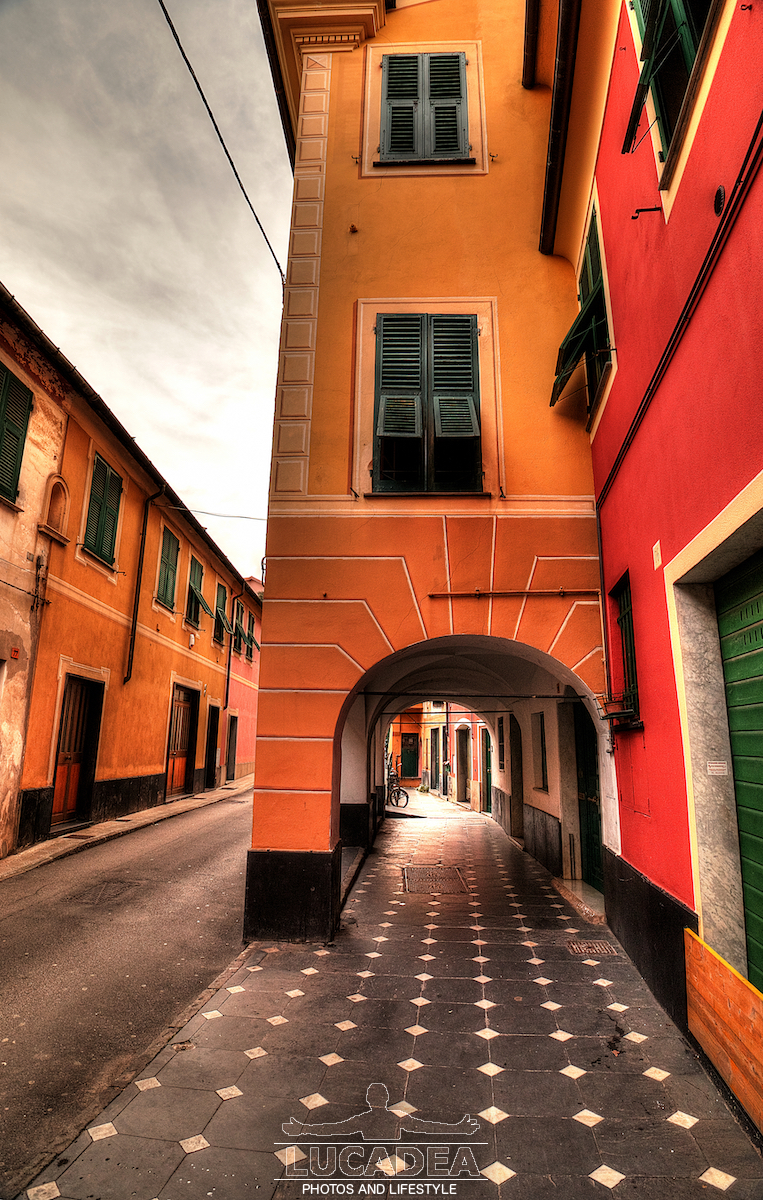
Walking through the narrow alleys of Brugnato in Liguria, Italy, I found myself under these sbatacchio arches connecting the buildings, one of those details you notice without really knowing what they are. In many Ligurian villages, these small arches appear above your head, and here in Brugnato, in the province of La Spezia, I finally understood something more about them.
For years I had photographed similar structures without thinking too much about them. They caught my eye, but I assumed they were just a visual feature of old towns. Then, thanks to a conversation on social media with a friend, I discovered their real name: sbatacchio arches. That moment completely changed how I look at them.
I took this photo in a narrow alley, trying to capture the sequence of arches crossing from one building to another. What struck me most was how they interrupt the straight perspective of the alley, creating a visual rhythm as you walk through. This image comes from my attention to small details that often go unnoticed but say a lot about a place.
These arches are not just decorative. They were built to connect nearby houses and improve structural stability, especially in dense historic centers. It’s a simple but clever solution that reflects how people adapted architecture to tight spaces.
Once I knew the correct name, I started looking into it more, and I came across this article that explains their function: ilcapochiave.it.
While walking through Brugnato, I also thought about other photos I had taken in Liguria where similar structures appeared without me realizing it. As I’ve shown in other posts on my site about Ligurian alleys, these small architectural details often tell more than the main landmarks.
Now every time I walk under one of these arches, I slow down and look at it differently. It’s no longer just a curious element, but part of a deeper story about how these villages were built and lived in.

Have you ever photographed something many times before learning what it actually was? Add a comment or go to the bottom of the site to read what other visitors have written.

Sbatacchio arches connecting buildings in a narrow alley in Brugnato Liguria with closely spaced houses

Photo taken with a Canon EOS M100 camera and Canon EF-M 11-22 lens.

To see all the photos I took in the village, click here:

Between the 7th and 8th centuries, following the Lombard conquest of Liguria, the Columbanian monks of Bobbio—who followed the Rule of Saint Columbanus and continued their evangelization efforts—established a monastery that grew over time into a vital religious and economic hub. The origins of Brugnato are thus linked to the founding of this abbey, which, like other monastic sites in Liguria and northern Italy, was subordinate to the Abbey of San Colombano in Bobbio.
Read more on Wikipedia

🏠
  • Italiano