Parma ham platter in Parma city center

Tagliere di prosciutto di Parma a Parma centro con fette sottili di prosciutto di Parma e atmosfera tipica da trattoria emiliana

Parma ham platter in Parma city center.
The smell of Parma ham reaches me before anything else, as the platter arrives on the table with a simplicity that only truly iconic food carries. This Parma ham moment feels deeply rooted in tradition, and the Parma ham slices on the board immediately set the tone for a slow and attentive tasting experience.
I find myself inside Trattoria Corrieri, right in the heart of Parma, Emilia-Romagna, Italy, where food is not just a meal but a cultural language. The Parma ham platter becomes the center of attention, with paper-thin slices that seem almost translucent under the warm light of the restaurant. Each bite reveals the delicate balance that makes Parma ham one of the most recognizable cured meats in the world.
As I continue tasting, I think about how Parma ham, also known as prosciutto crudo di Parma, is deeply connected to its territory. If you are visiting this part of Italy, one of the most interesting things to discover is how much the local climate influences the natural curing process. The air moving through the Parma hills plays a silent but essential role in shaping its flavor.
A small but fascinating detail is that Parma ham can be aged for more than 24 months, and sometimes even up to 36 months, developing richer and more complex aromas over time. This long waiting process is what transforms simple pork into something so refined.
I also recall similar culinary moments described in other posts on the site, where simple Italian tables become windows into regional identity and everyday culture.

Have you ever experienced a dish that stayed in your memory more for the place than for the ingredients themselves? Add a comment or go to the bottom of the site to read what other visitors have written.

Tagliere di prosciutto di Parma a Parma centro con fette sottili di prosciutto di Parma e atmosfera tipica da trattoria emiliana

Photo taken with Honor 20.

This, enjoyed at the always excellent Trattoria Corrieri in the center of Parma.
To learn more, visit the consortium’s official website: prosciuttodiparma.com.

Parma ham is a typical cured meat from the province of Parma; More precisely, the production area is located 5 km south of the Via Emilia, up to an altitude of no more than 900 m, bordered to the east by the Enza River and to the west by the Stirone River. It is famous throughout the world and is distinguished not only by its nutritional qualities (the only ingredients are pork and salt, without additives or preservatives) but also by the “corona,” the branding that is branded only on the original.
Continue and learn more at Wikipedia

Tagliere di prosciutto di Parma a Parma centro – Parma ham platter in Parma city center – Plateau de jambon de Parme au centre de Parme – Tabla de jamón de Parma en el centro de Parma – Parmaschinken-Platte im Zentrum von Parma – Đĩa thịt nguội Parma ở trung tâm Parma – 帕尔马火腿拼盘在帕尔马市中心 – パルマ中心部のパルマハム盛り合わせ

The text of this post was written with the help of ChatGPT, a language model from OpenAI.

Add one  comment to this article or read  here what other visitors have written.
 
Adv
 
Disclamer

The rights on images, videos, choruses, text and all other material on the LUCADEA.com website are governed as per  Copyright page.

This page has been viewed 1 times today.
This month it has been viewed 1 times.
In total it has been viewed 3 times.
 

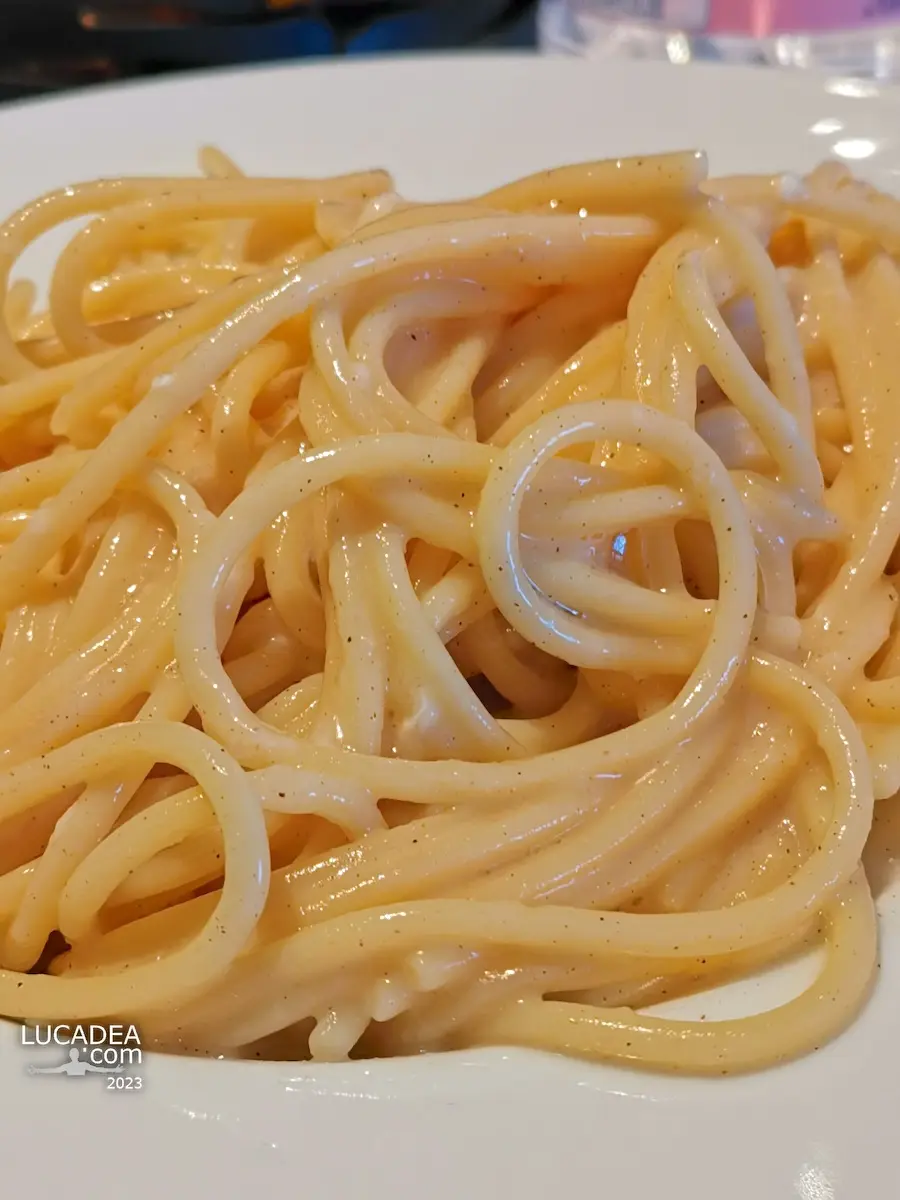
A plate of spaghetti cacio e pepe enjoyed on board a ship

Spaghetti cacio e pepe gustati in nave

A plate of spaghetti cacio e pepe enjoyed on board a ship.
It’s a dish I really appreciate, even though I’ve only been eating it for a relatively short time.
Despite having very simple ingredients, this type of pasta is not at all easy to prepare. Everything must be cooked properly, otherwise the cheese becomes stringy and clumps together.
At home, after a couple of failed attempts, I found the right balance, just like the chef on the ship who, when I took these photos, had prepared an excellent dish!

Do you like this dish? Add a comment or go to the bottom of the site to read what other visitors have written.

Photos taken with Honor 20.

To discover my recipe, click here.

Cacio e pepe is a typical dish from Lazio. As the name suggests, the ingredients are very simple and include only black pepper, Pecorino Romano cheese, and pasta. The most traditionally used type of pasta is tonnarello. Like other dishes from Lazio cuisine, it is prepared with simple, readily available, and shelf-stable ingredients (during the transhumance period, food was not easy to obtain). Its roots lie in the cuisine of farmers and shepherds in the Roman countryside.
Continue and learn more at Wikipedia

A plate of spaghetti cacio e pepe enjoyed on board – Une assiette de spaghettis au fromage et au poivre dégustée à bord du navire – Un plato de espaguetis con queso y pimiento que se disfruta a bordo del barco. – Um prato de esparguete com queijo e pimenta saboreado a bordo do navio – Ein Teller Spaghetti mit Käse und Pfeffer, den man an Bord des Schiffes genießt – Một đĩa spaghetti phô mai và hạt tiêu thưởng thức trên tàu
Add one  comment to this article or read  here what other visitors have written.
 
Adv
 
Disclamer

The rights on images, videos, choruses, text and all other material on the LUCADEA.com website are governed as per  Copyright page.


This page has been viewed 0 times today.
This month it has been viewed 0 times.
In total it has been viewed 0 times.
 

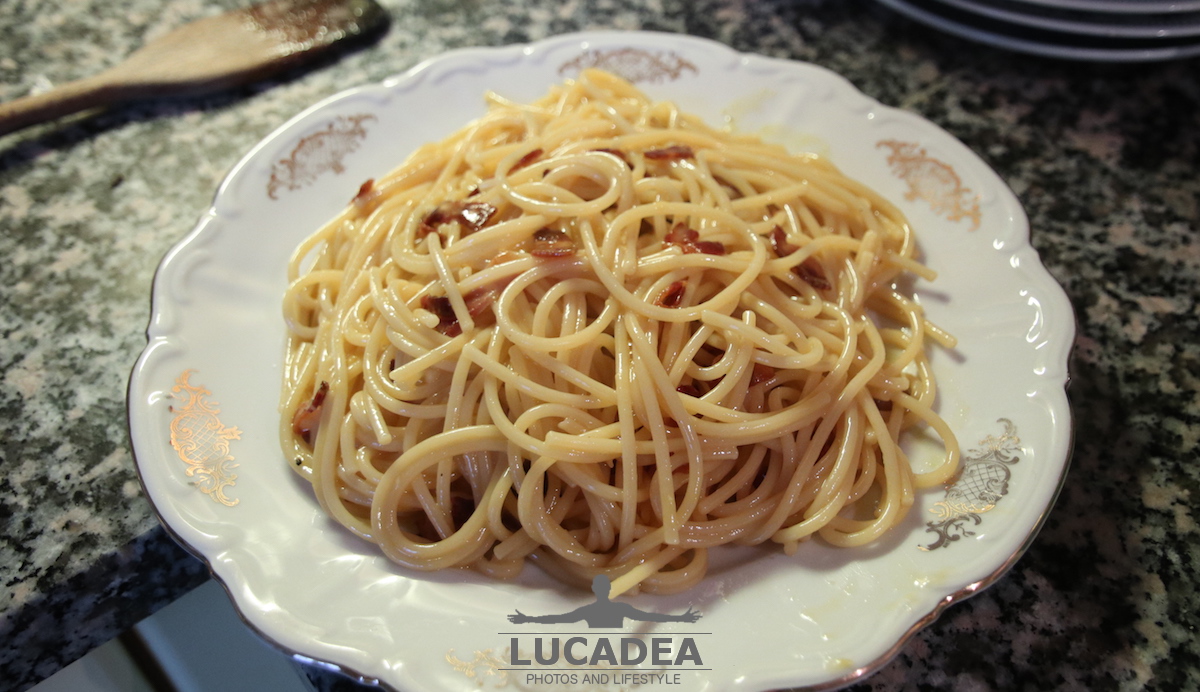
Pasta with garlic, oil, and chili pepper

Pasta aglio, olio e peperoncino

Pasta with garlic, oil, and chili pepper.
One of the classics of Italian cuisine is pasta simply dressed with garlic, oil, and chili pepper.
Who has never smelled its aroma or tasted a forkful?
These, as you can easily see from the photo, are spaghetti.

I love them so much, what about you? Add a comment or go to the bottom of the site to read what other visitors have written.

Pasta aglio, olio e peperoncino

Photo taken with Canon EOS M100 camera and Tamron 16-300 lens.

Spaghetti aglio e olio (spaghetti with garlic and oil) is a typical Neapolitan dish, part of the group of recipes known as cucina piccina partenopea.
Continue on Wikipedia

A dish of pasta with garlic, oil and chilli pepper – Un plat de pâtes à l’ail, à l’huile et au piment – Un plato de pasta con ajo, aceite y guindilla – Um prato de massa com alho, azeite e malagueta – Ein Nudelgericht mit Knoblauch, Öl und Chili – Món mì ống với tỏi, dầu và ớt

Pansoti in walnut sauce from the Ao Grumallo farmhouse

I pansoti in salsa di noci dell'agriturismo Ao Grumallo

Pansoti in walnut sauce from the Ao Grumallo farmhouse.
A good farmhouse in the hinterland is Ao Grumallo in the municipality of Ne.
These are their pansoti, green, in walnut sauce. Really good!

Do you like pansoti? If you prefer ravioli, check out my article with my personal ranking of the restaurants where I’ve eaten the best ravioli al ragù in the Province of Genoa. Add a comment or go to the bottom of the site to read what other visitors have written.

Photos taken with Honor 20.

Pansoti (pansòti in Ligurian, from the Ligurian word pansa, meaning “belly” in Italian) are a typical Ligurian stuffed pasta dish, similar to cappelletti, differing essentially in shape and size. Pansoti topped with walnut sauce are a characteristic dish of Genoese tradition.
Continue and learn more at Wikipedia

The pansoti in walnut sauce from the Ao Grumallo farmhouse – Le pansoti à la sauce aux noix de la ferme Ao Grumallo – Los pansoti en salsa de nueces del caserío Ao Grumallo – O pansoti com molho de nozes da quinta Ao Grumallo – Die Pansoti in Walnusssauce vom Bauernhof Ao Grumallo – Pansoti sốt óc chó từ trang trại Ao Grumallo

A tasty mixed fried fish dish in Genoa

Uno sfizioso fritto misto di pesce a Genova

A tasty mixed fried fish dish in Genoa.
Some time ago, for lunch, I went to Genoa to the Piedigrotta pizzeria-restaurant and my wife ordered a fried fish dish.
I have to say it was really good!

Do you like fried fish? Add a comment or go to the bottom of the site to read what other visitors have written.

Uno sfizioso fritto misto di pesce a Genova

Photo taken with Honor 20.

A delicious mixed fried fish in Genoa – Un délicieux poisson frit à Gênes – Un delicioso pescado frito mixto en Génova – Uma deliciosa mistura de peixe frito em Génova – Ein köstlicher gemischter frittierter Fisch in Genua – Món cá chiên trộn thơm ngon ở Genoa

My beef tartare enjoyed at home

La mia tartare di carne gustata in casa

My beef tartare enjoyed at home.
One of my favourite meat dishes is definitely tartare. Personally, I prefer tartare over “battuta” because I like finely cut meat.
I found Piedmontese beef at a very good price in a supermarket near my home, and I often buy it to prepare at home.
I prepare it about half an hour in advance, seasoned the way I like: lemon, oil, salt, pepper, finely chopped onion, finely chopped olives, and mustard (I don’t add capers, which I don’t like, or eggs). I mix it often and it’s truly delicious.

Do you like tartare? How do you season it? Add a comment or go to the bottom of the site to read what other visitors have written.

La mia tartare di carne gustata in casa

La mia tartare di carne gustata in casa

Photos taken with Canon EOS RP and lens Canon RF 28.

My home-cooked meat tartare – Mon tartare de viande dégusté à la maison – Mi tartar de carne disfrutado en casa – O meu tártaro de carne apreciado em casa – Mein Fleischtatar habe ich zu Hause genossen – Bánh tartare thịt của tôi được thưởng thức ở nhà

Fresh tagliolini with truffle enjoyed in Genoa

Dei tagliolini fresci al tartufo gustati a Genova

Fresh tagliolini with truffle enjoyed in Genoa.
I became a truffle lover quite recently, but now every time I find it on a menu, I order it.
Some time ago I was with my wife in the historic center of Genoa and we went to have lunch in this well-known restaurant.
Besides the carefully curated atmosphere, making use of the very ancient rooms where the tables are set, I must say the menu was excellent and these fresh tagliolini with truffle were absolutely delicious!

Do you like pasta with truffle? Add a comment or go to the bottom of the site to read what other visitors have written.

Photo taken with Honor 20.

This is the restaurant’s website: labucadisanmatteo.com.

A truffle is the fruiting body of an underground Ascomycete fungus. Most truffles belong to the Tuber genus, but there are also other genera of fungi belonging to this category, including Geopora, Peziza, Choiromyces, Leucangium, and over a hundred others. Truffles belong to the class Pezizomycetes and, with a few exceptions, to the order Pezizales. Truffles are mycorrhizal fungi, and therefore grow close to tree roots. Truffle spores are dispersed by mycophages, animals that feed on mushrooms.
Continue and learn more at Wikipedia

Fresh tagliolini with truffles enjoyed in Genoa – Tagliolini frais aux truffes dégustés à Gênes – Tagliolini frescos con trufas disfrutados en Génova – Tagliolini fresco com trufas apreciado em Génova – Frische Tagliolini mit Trüffeln, genossen in Genua – Tagliolini tươi với nấm cục được thưởng thức ở Genoa

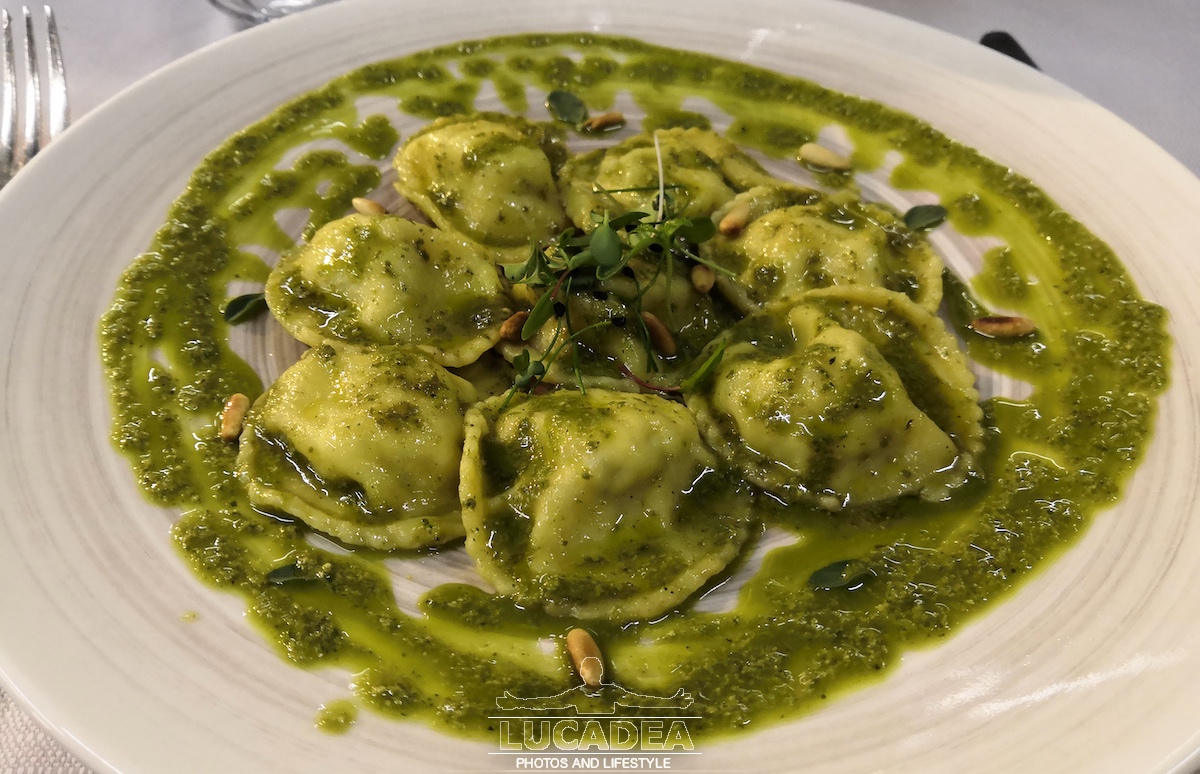
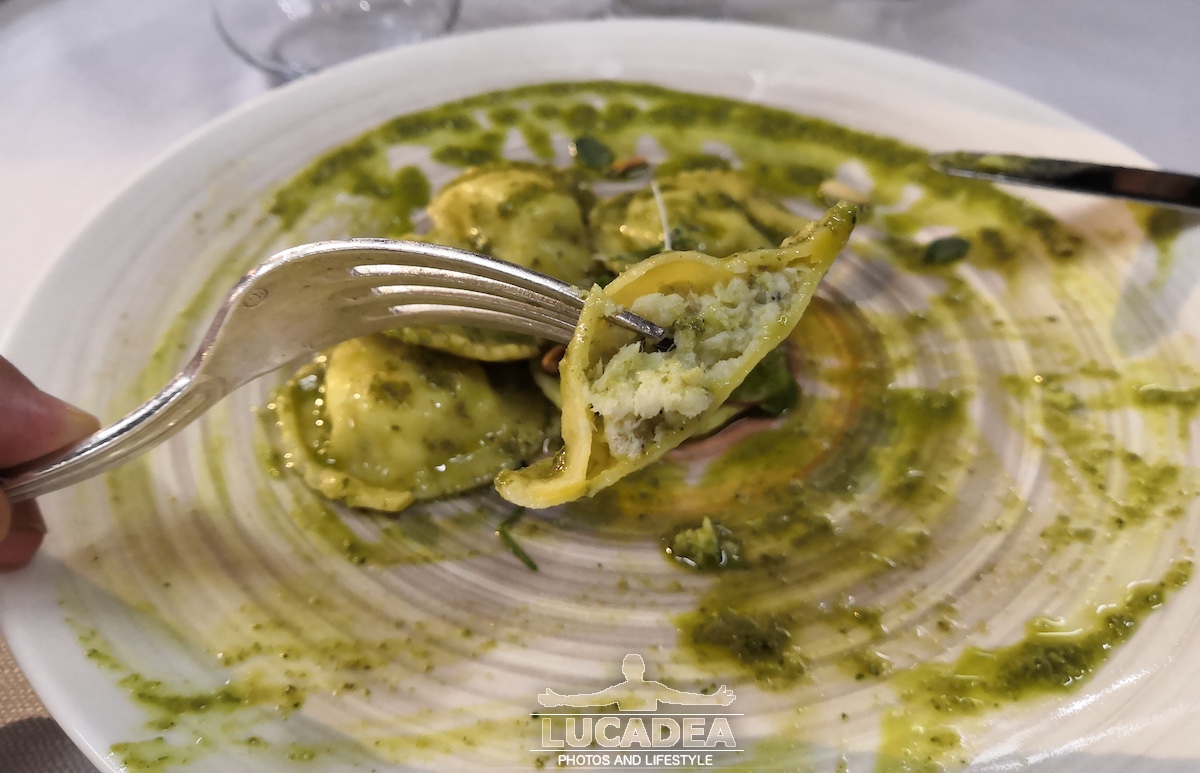
Fish ravioli with pesto, a tasty surprise

Ravioli di pesce con pesto

Fish ravioli with pesto, a tasty surprise.
Fish ravioli with pesto was a first for me, and I discovered the combination during a dinner in Sestri Levante. I usually associate fish ravioli with a seafood sauce, while pesto is something I would normally pair with ordinary pasta rather than a filled pasta dish.
A few evenings ago, at Delfino Bianco in Sestri Levante, I decided to try it anyway. I was curious to see how two flavours that I already knew very well would work together in the same dish. The result surprised me in a good way and made this simple plate worth remembering.
I took the photograph during that dinner, before starting to eat. I often like to photograph dishes when they are connected to a particular memory, and this was one of those occasions. There was nothing particularly elaborate about the scene I wanted to capture; what interested me was the combination itself and the fact that I had never tried it before.
Pesto is one of the flavours I most strongly associate with Liguria. Traditionally made with basil, pine nuts, garlic, cheese and extra virgin olive oil, it has a distinctive flavour that can easily become the main character of a dish. With fish ravioli, however, I wondered whether it might overpower the filling.
Instead, I found the combination surprisingly balanced. The pesto added plenty of character, while the fish filling still had its own presence. It was different from the seafood sauces I normally expect with fish ravioli, but that was exactly what made the experience interesting.
Delfino Bianco is in Sestri Levante, Liguria, Italy, and this was the restaurant where I first tried this particular combination. I could not find an official website for the restaurant, so the original post included a link to Tripadvisor for anyone wanting to look up the restaurant.
The link is useful for identifying the place, but the story behind this photograph is simply my own experience at the table. I am not trying to present the dish as a definitive version of a traditional recipe. What I found interesting was discovering an option that was outside my usual habits.
That is something I enjoy about eating out. Sometimes the most memorable dishes are not the ones you would automatically choose. I knew both flavours separately, but I had never thought much about putting them together. Trying something different gave me a reason to reconsider what I normally expect from fish ravioli.
The other issue was the portion. For my taste, I could easily have eaten twice as many. Fish ravioli often arrive in portions that feel more like a refined tasting than a serious attempt to fill the plate, and this was no exception. Just when I had started to appreciate the combination, the ravioli were already gone.
Still, perhaps that also helped the dish remain in my memory. It was not a huge meal or a complicated culinary experience. It was simply the first time I had tasted fish ravioli with pesto, and I was pleased that I had decided to order something different.
Looking at the photograph now, I remember the curiosity I had before taking the first bite. I knew exactly what pesto tasted like and I knew what to expect from fish ravioli, but I had no idea how the two would behave together. That small uncertainty was enough to make the dish more interesting.
I often photograph food during my outings, just as I photograph streets, buildings and landscapes. The reason is not necessarily that the dish is exceptional. Sometimes a photograph is worth keeping because it is connected to a personal moment, a first taste or an unexpected discovery.
That is also how I like to approach my photographs of Sestri Levante. They are not intended to be a complete guide to the town. They are fragments of places and moments I have actually experienced, from walks around the town to meals that caught my attention.
This plate of fish ravioli with pesto belongs to that same collection of memories. The photograph records the dish, but the story behind it is really about trying something outside my usual choices and finding out that the combination worked better than I expected.
For anyone searching for fish ravioli with pesto, I would say that it is certainly an interesting combination to try if you come across it. Whether it becomes your favourite version is another matter, but I am glad I did not stick to my usual order that evening.

Have you ever tried fish ravioli with pesto, or would you still choose a traditional seafood sauce? Add a comment or go to the bottom of the site to read what other visitors have written.

Fish ravioli with pesto served at Delfino Bianco in Sestri Levante, a Ligurian dish with an unusual combination

Fish ravioli with pesto served at Delfino Bianco in Sestri Levante, a Ligurian dish with an unusual combination

Photos taken with Honor 10.

Roman Pinsa with Prosciutto and Buffalo Mozzarella

Pinsa romana con prosciutto crudo e mozzarella di bufala fotografata da Santapizza Pinseria a Sestri Levante

Roman Pinsa with Prosciutto and Buffalo Mozzarella.
I usually choose traditional pizza when I want to enjoy Italian food, but this Roman pinsa with prosciutto and buffalo mozzarella gave me a good reason to try something different. I photographed this pinsa at Santapizza Pinseria in Sestri Levante, Liguria, Italy, during a moment that started as a simple meal and ended up becoming one of those food memories I wanted to keep with my camera.
The first thing that caught my attention was the combination of ingredients. The cured ham gives the pinsa a delicate savoury flavour, while the buffalo mozzarella adds a soft and creamy contrast. Together they make a topping that is simple enough to feel familiar, but different enough to make the dish stand out from the classic pizza I normally order.
If you are looking for Roman pinsa in Sestri Levante, this is the place connected with my photograph: Santapizza Pinseria, where I tasted the dish. The restaurant is located on Viale Dante Alighieri in the central part of town. I have also kept the link to the Santapizza Pinseria reviews on TripAdvisor for anyone who wants to see what other diners have experienced there.
What makes this photograph interesting to me is that it was not planned as a food review. I simply had the dish in front of me, noticed the contrast between the prosciutto, the mozzarella and the baked base, and decided to take a photograph before eating. That small decision turned an ordinary meal into something I could remember later.
Roman pinsa has become increasingly familiar outside Rome as well, and it is easy to understand why. Its elongated shape immediately sets it apart from a traditional round pizza, while the texture of the base creates a different eating experience. Toppings such as cured ham and buffalo mozzarella also work particularly well because they provide a clear contrast between savoury and creamy flavours.
For anyone wondering what to try in Sestri Levante beyond the more obvious dishes, a pinsa like this is an interesting option simply because it offers something different without moving too far away from the familiar flavours of Italian food. That is probably what surprised me most: I did not have to give up the ingredients I already enjoy to try something new.
The photograph also fits naturally with other food memories I have shared on the blog. I have previously photographed pizza with ham, olives and buffalo mozzarella, as well as a dish featuring culatello and mozzarella. They are not meant to form a restaurant guide, but together they create a visual record of the Italian food I have encountered while travelling and exploring different places.
I still prefer traditional pizza, but this Roman pinsa made me reconsider the idea that there is only one way to enjoy a good Italian pizza-style dish. Sometimes trying something slightly different is enough to find a new favourite.
For me, the best food photographs are not necessarily the most elaborate ones. They are the images that bring back a specific moment, a particular place and the anticipation of the first bite. This one does exactly that: whenever I see the prosciutto and buffalo mozzarella again, I remember that meal in Sestri Levante.

Would you try this Roman pinsa with prosciutto and buffalo mozzarella, or would you still choose a classic Italian pizza? Add a comment or go to the bottom of the site to read what other visitors have written.

Roman pinsa with prosciutto and buffalo mozzarella photographed at Santapizza Pinseria in Sestri Levante

Photo taken with Honor 20.

Strangozzi with Truffles: A Culinary Treasure from Umbria

Gli strangozzi al tartufo: un tesoro culinario dell'Umbria

Strangozzi with truffles: a culinary treasure from Umbria.
Umbria, the green heart of Italy, is famous for its authentic cuisine, rich in authentic flavors. Among the region’s most iconic dishes is strangozzi with truffles, a delicacy that combines the simplicity of homemade pasta with the unmistakable aroma of Norcia black truffles.
Strangozzi, also known as umbricelli or stringozzi, is a long, thick pasta, similar to spaghetti but rectangular in shape. Its origins are ancient, dating back to Umbrian peasant tradition, where it was prepared with durum wheat flour and water, without the use of eggs. This makes it a humble yet extremely versatile and delicious dish.
The Norcia black truffle, one of the most prized in the world, is the undisputed star of this recipe. Harvested in the Umbrian woods between November and March, the black truffle is prized for its intense aroma and unique flavor. Its presence transforms a simple pasta dish into an unforgettable culinary experience.
Truffle strangozzi is a dish that embodies the essence of Umbria: simplicity, authenticity, and a deep connection to the land. Each bite is a journey through the flavors and aromas of this wonderful region, paying homage to its rich culinary tradition.
Unfortunately, too much time has passed and I no longer remember where I tasted this dish.

Have you ever tried this dish? Add a comment or go to the bottom of the site to read what other visitors have written.

Gli strangozzi al tartufo: un tesoro culinario dell'Umbria

Photo taken with Honor 20.

Strangozzi are a long, rectangular pasta typical of the Foligno-Spoleto area, but also common throughout Umbria, Marche, Lazio, and Abruzzo. They are also called, depending on the area, stringozzi, strengozzi, or strongozzi; in the Terni area, they are known as ciriole or manfricoli. They look similar to tagliolini, but unlike them, they are thicker and contain no egg.
Continue and learn more on Wikipedia

Strangozzi with truffles: a culinary treasure from Umbria – Strangozzi aux truffes : un trésor culinaire de l’Ombrie – Strangozzi con trufas: un tesoro culinario de Umbría – Strangozzi com trufas: um tesouro culinário da Úmbria – Strangozzi mit Trüffeln: ein kulinarischer Schatz Umbriens – Stragozzi với nấm cục: kho báu ẩm thực của Umbria

The text of this post was written with the help of Copilot, a virtual assistant based on artificial intelligence.
References:
– https://blog.giallozafferano.it/zialora/strangozzi-al-tartufo-ricetta-tipica/
– https://www.granconsigliodellaforchetta.it/cucina-tipica/strangozzi-al-tartufo/

🏠
  • Italiano