Salita del Prione Seen from Piano di Sant’Andrea

Salita del Prione a Genova vista dall'alto da Piano di Sant'Andrea, di fronte alle torri medievali di Porta Soprana

Salita del Prione Seen from Piano di Sant’Andrea.
The downhill stretch of Salita del Prione, seen from Piano di Sant’Andrea directly opposite Soprana Door, offers a characteristic view of the historic centre of Genoa, in Liguria, Italy. This photograph captures the street from above, with the eye following its descent between the buildings of the old town.
Piano di Sant’Andrea is a lovely place to pause and take in this part of the city. The towers of Porta Soprana, one of Genoa’s best-known medieval gateways, are just a short distance away. All around them, a network of streets, stairways and passages tells the story of the city’s historic urban layout. From here, even a small change in viewpoint can reveal a different perspective on streets that people often walk through without giving them much thought.
Salita del Prione is one of those streets where Genoa’s distinctive urban structure becomes clear. The spaces are narrow, changes in level are frequent, and the buildings seem to follow the slope of the route. The word “salita”, meaning ascent, appears frequently in Genoese street names, reflecting how the city’s hilly terrain has shaped its roads and connections between neighbourhoods. In this photograph, looking down from above, the descending street becomes the main line guiding the composition.
I enjoy photographing Genoa from these less obvious viewpoints as well. The city is famous for its harbour, historic palaces and monuments, but much of its character can also be found in everyday passages, streets connecting one square to another, and unexpected views between old façades. You do not always need a wide panorama to tell the story of a place. Sometimes, a sloping street is enough to reveal the complexity of the historic centre.
Its proximity to Porta Soprana makes this spot particularly interesting for anyone exploring the area on foot. The medieval towers provide an unmistakable landmark, but turning towards Piano di Sant’Andrea also reveals the more everyday side of the neighbourhood, with its urban routes and changing perspectives at every turn.
This image came from simply stopping for a moment and looking at a street from a different angle. On Lucadea.com, I often share photographs of places and details I come across while walking around, because even an ordinary street view can tell us something about a city’s identity.

When visiting Genoa, do you take time to notice the steep streets of the historic centre, or are you more drawn to its famous monuments and squares? Add a comment or go to the bottom of the site to read what other visitors have written.
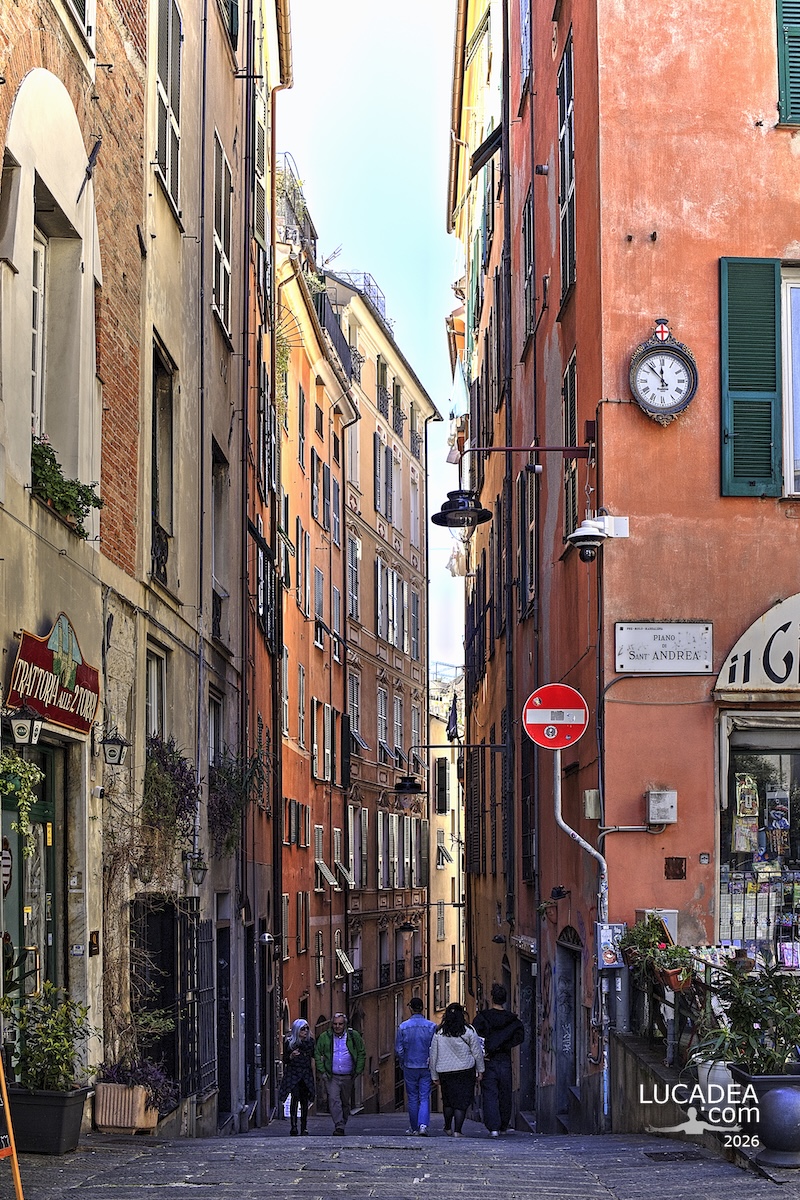
Salita del Prione descending through Genoa's historic centre, viewed from Piano di Sant'Andrea opposite the medieval towers of Porta Soprana

Photo taken with Canon EOS R50 V camera and Canon RF 28 lens.

Where I took the photo:

Add one  comment to this article or read  here what other visitors have written.
 
Adv
 
Disclamer

The rights on images, videos, choruses, text and all other material on the LUCADEA.com website are governed as per  Copyright page.

This page has been viewed 1 times today.
This month it has been viewed 1 times.
In total it has been viewed 1 times.
 

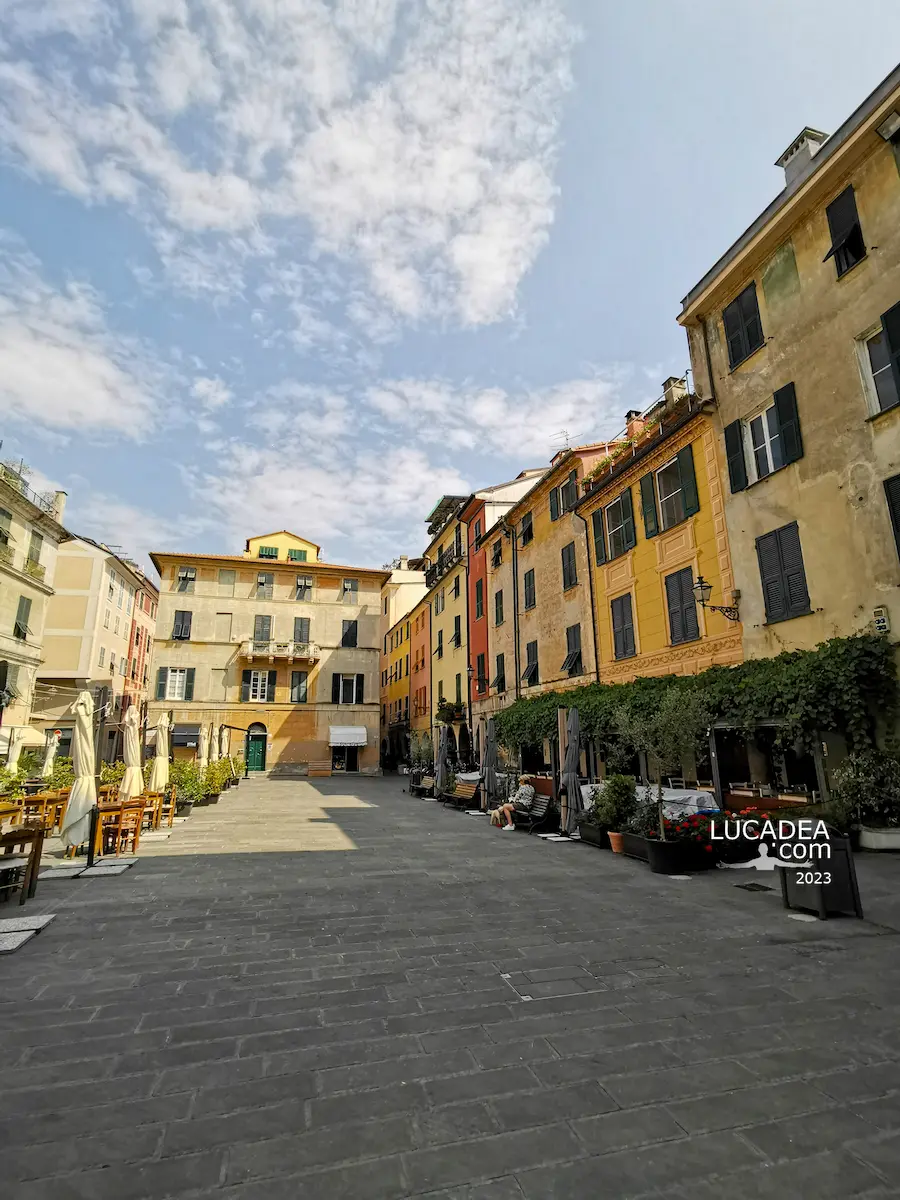
Fenice Square, a quiet corner of Chiavari

La bella e riservata piazza fenice nel centro storico di Chiavari

Fenice Square, a quiet corner of Chiavari.
In the heart of Chiavari’s historic centre, in Liguria, Italy, this small and secluded square offers a lovely view, away from the constant movement of the town’s main pedestrian streets. I enjoy coming back here from time to time, stopping to look at the historic buildings around it and rediscovering the particular atmosphere that makes this place different from the busier parts of the old town.
Fenice Square is not a large open space, and perhaps that is precisely why it feels so intimate. Visitors walking through Chiavari along the main shopping street can easily continue on their way without noticing this little square. Yet just a few steps away from the usual route, the atmosphere changes. Instead of shop windows and people strolling past, attention turns to the façades, the porticoes and the harmonious proportions of the surrounding buildings. It is one of those places that does not need to be imposing to be memorable. A few quiet minutes are enough to appreciate it.
One of the most distinctive buildings here is Palazzo dei Portici Neri, standing along the square and visible in the background of these photographs. It is among the most interesting historic palaces in Chiavari. Its origins date back to the thirteenth century, and it is traditionally associated with the Fieschi family. More specifically, it belonged to Opizzo Fieschi, at a time when this family played an important role in the political and social life of medieval Liguria. Its position near the castle and the old town walls is a reminder of the close relationship between noble residences and the layout of the medieval settlement.
The palace takes its name from its dark porticoes, one of the features that make it immediately recognisable. Its façade combines different materials and colours, with architectural details that reveal the various stages of its history. The building underwent substantial alterations over the centuries, particularly during the sixteenth and seventeenth centuries. Restoration work in 1959 brought important elements of its earlier appearance back to light. Even when viewed from across the square, it is easy to understand how much this palace contributes to the character of the whole setting.
The square also had a practical role in the everyday life of the town. A covered market once stood here, housed in an iron structure, and the area also provided services for the local community. Today the space has a different, more open appearance, allowing the historic buildings to take centre stage. I sometimes imagine the generations of Chiavari residents who came here to shop, meet friends or simply make their way through the old town.
With these photographs, I wanted to preserve precisely this feeling: the understated beauty of a corner that often remains outside the usual walking route. I have shared other photographs of Chiavari and its less familiar streets on my website, and whenever I return to this part of town, I find another detail worth noticing: a window, an arch or a perspective I had not paid attention to before.

Have you visited Fenice Square, or have you ever walked past without stopping to take a closer look? Add a comment or go to the bottom of the site to read what other visitors have written.

Photos taken with Honor 20.

Here’s where it is:

Add one  comment to this article or read  here what other visitors have written.
 
Adv
 
Disclamer

The rights on images, videos, choruses, text and all other material on the LUCADEA.com website are governed as per  Copyright page.


This page has been viewed 1 times today.
This month it has been viewed 2 times.
In total it has been viewed 2 times.
 

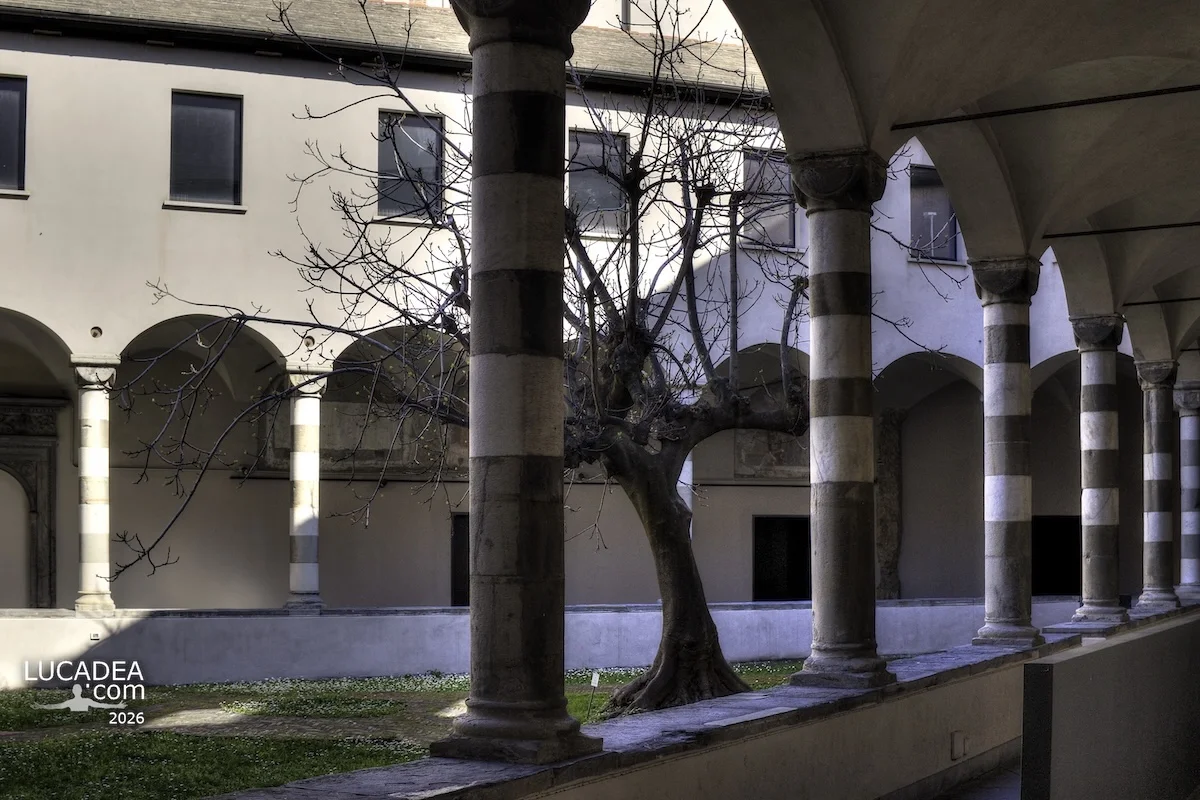
A Glimpse of the Cloister of Sant’Agostino in Genoa

Scorcio del chiostro medievale di Sant'Agostino a Genova, parte dell'antico complesso conventuale nel quartiere di Sarzano

A Glimpse of the Cloister of Sant’Agostino in Genoa.
There are corners of Genoa where the atmosphere seems to slow down, even when the busy streets of the historic centre are only a short walk away. The cloister of Sant’Agostino is one of these places, offering a glimpse of the city’s medieval heritage and the quiet character of an ancient religious complex.
The former church and convent stand in the Sarzano area, one of the historic districts of Genoa’s old town. Today, the complex houses the Museo di Sant’Agostino, a museum whose collections focus particularly on sculpture and architectural fragments from churches and historic buildings in Genoa and the surrounding Ligurian region.
Construction of the church began around 1260, when the Augustinian friars established their community here. The building became an important example of Genoese Gothic architecture and witnessed several significant moments in the city’s history. Over the centuries, the complex underwent numerous changes. Following the suppression of religious orders in the late eighteenth century, the former convent was put to different uses and gradually suffered periods of neglect. Restoration work was undertaken in the twentieth century, but the Second World War brought further damage to the site, including part of the cloister.
Despite these difficult chapters, the surviving structures still reveal something of the character and historical importance of the original complex. The cloister offers a more intimate view of Genoa’s architectural past, away from the bustle of the main streets. Its enclosed spaces and medieval features invite visitors to pause and imagine the daily routines of the religious community that once lived here.
When I photograph places like this, I enjoy looking for a composition that conveys the atmosphere of the setting. Sometimes, a simple architectural detail or a glimpse through an old passage can tell a story more effectively than a wide view. These quiet corners are part of what makes exploring Genoa so rewarding: history is not found only in major landmarks, but also in the spaces that remain tucked between streets and squares.
The surrounding Sarzano district is worth exploring on foot, with its historic lanes, small squares and buildings that reveal different layers of the city’s past. The Sant’Agostino complex is a valuable stop for anyone interested in medieval architecture and the artistic heritage of Liguria. The museum’s collections offer another way to discover the sculptures and fragments that have survived from Genoa’s changing urban landscape.
On Lucadea.com, I enjoy sharing photographs of these less obvious places, preserving small glimpses of the city that can easily be missed when travelling too quickly.

Have you ever visited the cloister of Sant’Agostino in Genoa, or would you like to discover it on a walk through the historic centre? Add a comment or go to the bottom of the site to read what other visitors have written.

A view of the medieval cloister of Sant'Agostino in Genoa, part of the former Augustinian convent in the Sarzano district

Photo taken with a Canon EOS R50 V camera and a Canon RF 28 lens.

The magnificent Palazzo della Ragione in Padua

Il meraviglioso Palazzo della Ragione a Padova

The magnificent Palazzo della Ragione in Padua.
One of the symbols of the city of Padua is the magnificent Palazzo della Ragione.
Once the ancient seat of the city’s court, it now hosts a covered market and a museum.

Have you ever visited beautiful Padua? Add a comment or go to the bottom of the site to read what other visitors have written.

Il meraviglioso Palazzo della Ragione a Padova

Photo taken with Honor 20.

To see all the photos I took in the city of the Saint, click here:

The Palazzo della Ragione (also known as the Salone, by synecdoche) was the ancient seat of the city courts and the covered market of Padua. The lower part already existed in 1166, but it is estimated that it was erected between 1218 and 1219, and between 1306 and 1309, Giovanni degli Eremitani added the portico and loggias and raised the roof, which he gave the characteristic shape of an upturned ship’s hull.
Continue and learn more at Wikipedia

The famous palace called della Ragione in Padua – Le célèbre Palazzo della Ragione à Padoue – El famoso Palacio della Ragione en Padua – O famoso Palazzo della Ragione em Pádua – Der berühmte Palazzo della Ragione in Padua – Palazzo della Ragione nổi tiếng ở Padua – 帕多瓦著名的 Palazzo della Ragione – パドヴァの有名なパラッツォ デッラ ラジョーネ

The Stone Staircase of San Pietro

La scalinata in pietra della chiesa di San Pietro a Portovenere

The Stone Staircase of San Pietro.
The stone staircase of the Church of San Pietro in Portovenere, Liguria, in the province of La Spezia, Italy, is one of those architectural details that help make this beautiful seaside village so distinctive. The church stands on a rocky promontory extending into the Gulf of Poets, directly opposite Palmaria Island, and is one of the most recognisable landmarks along the Ligurian coast. In this particular view, the focus is on the steps leading to the terrace beside the bell tower.
I enjoy looking at details like these because they tell the story of a place in a different way from the familiar views of its main monuments. A stone staircase might seem like a simple, almost secondary feature, but in a setting like Portovenere it becomes an essential part of the landscape. The worn surfaces, irregular shapes and relationship with the surrounding structures create an atmosphere that immediately evokes the village’s long history.
The Church of San Pietro has very ancient origins. The present complex brings together an older section associated with early Christian and Romanesque architecture and a Gothic structure built by the Genoese during the thirteenth century. The distinctive alternating bands of light and dark stone have become one of Portovenere’s most recognisable architectural features. Its dramatic position between the rocky headland and the open sea makes the entire complex even more remarkable.
The staircase leads visitors towards the terrace beside the bell tower, where beautiful views open across the coastline and the waters surrounding the promontory. It is a place worth exploring slowly, noticing how the stonework blends with the natural rock and how the architecture seems to follow the shape of the ground. Here, the landscape is not simply a backdrop; it is an essential part of the experience.
When exploring places like this, I often try to pay attention to less obvious features that might go unnoticed while everyone searches for the most famous photograph. A staircase, an old wall or a corner beside a bell tower can reveal a great deal about a place’s character and offer interesting photographic perspectives.
On Lucadea.com, I share photographs of landscapes, villages and architectural details discovered during my travels. This staircase is another small fragment of Portovenere, a place where history and natural beauty come together in a remarkable way.

Have you visited the Church of San Pietro in Portovenere? Do you also stop to admire architectural details, or are you more drawn to the views across the sea? Add a comment or go to the bottom of the site to read what other visitors have written.

Stone staircase at the Church of San Pietro in Portovenere, with steps leading to the terrace beside the historic bell tower

Photo taken with Canon EOS RP and Canon RF 24-50 lens.

I also recorded a short video of me walking around the village:

Video recorded with Gopro Hero5.

Click here to see all the photos of the village:
foto gallery

Where is the church:

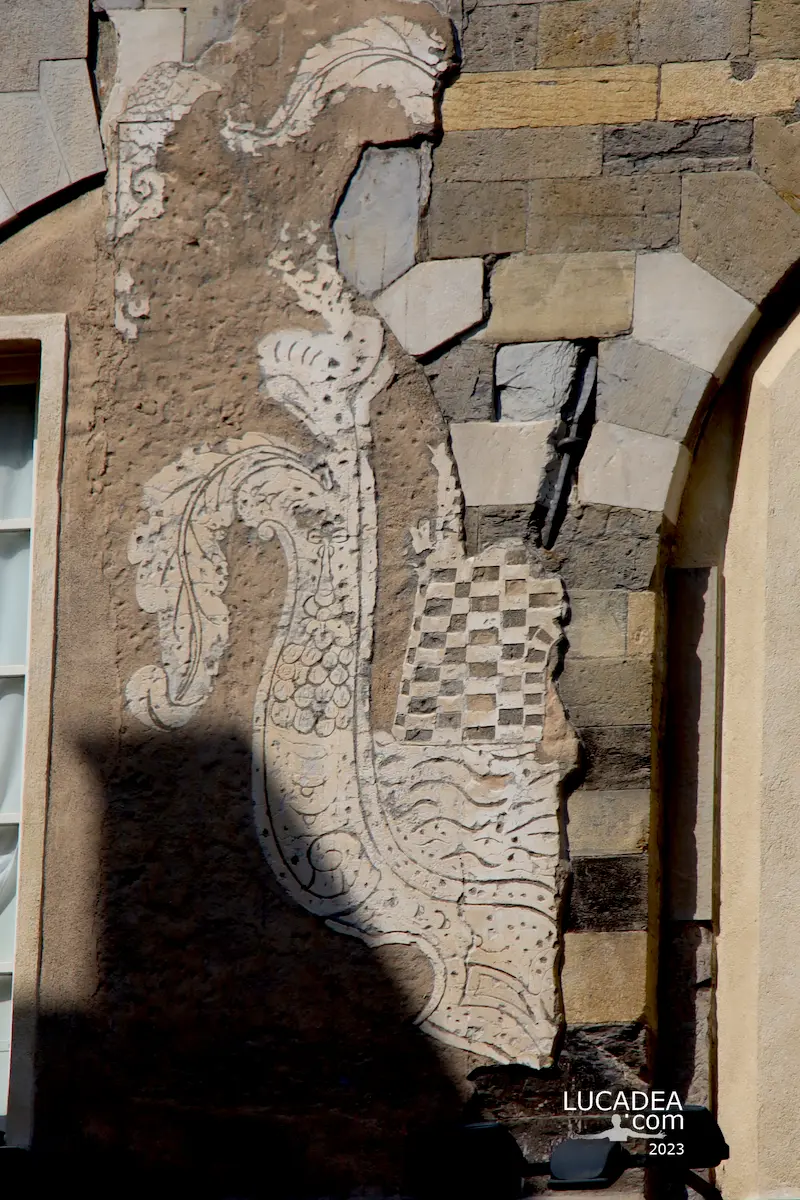
A Detail of the Black Porticoes Palace in Chiavari

Un particolare del Palazzo dei Portici Neri a Chiavari

A Detail of the Black Porticoes Palace in Chiavari.
In Chiavari, Liguria, Italy, in the heart of the historic centre, the Palazzo dei Portici Neri is one of the buildings that fascinates me most. Located on Ravaschieri Street, where it meets Fenice Square, this old palace has a façade full of details that reflect the different periods it has lived through. In this photograph, I wanted to focus on one particular feature, taking a closer look at a detail that contributes to the building’s distinctive character.
The Black Porticoes Palace stands out for its imposing appearance and medieval character. Its Italian name refers to the dark porticoes on the ground floor, which contrast with the alternating light and dark bands on the upper façade. Looking carefully, it becomes clear that the building is not architecturally uniform. Its windows, masonry and decorative features reveal changes made over many centuries.
This combination of styles and alterations is what makes the palace such an interesting photographic subject. It is not simply an old building to capture in its entirety, but a surface on which traces of different historical periods can still be read. Every detail, even one that might initially seem insignificant, contributes to the story of the architecture and the people who once lived here.
The palace dates back to the medieval period and is documented as having belonged to Opizzo Fieschi in the thirteenth century. In later centuries, it underwent substantial changes. During the sixteenth and seventeenth centuries, the façade was altered and partly covered with decorated plaster, while further works changed the appearance of the building. Restoration work in 1959 brought medieval features back to light after they had been hidden for centuries.
One of the details that catches the eye is a coat of arms, or what remains of it, on the central part of the façade. In the update accompanying this post, the emblem is identified as belonging to the Torre family, who reportedly lived in the palace for a period. This adds another intriguing element to the building’s history and encourages us to see it not simply as a monument, but as a record of the families who helped shape Chiavari over time.
I enjoy photographing architectural details like this because they draw attention to features that people may miss while walking through the historic centre. Sometimes, all it takes is a fragment of decoration, an old window or a weathered coat of arms to raise new questions about the past.

Have you ever noticed this coat of arms, or discovered other curious details on the façade of the Palazzo dei Portici Neri? Add a comment or go to the bottom of the site to read what other visitors have written.

Detail of the medieval façade of the Black Porticoes Palace in Chiavari, showing historic masonry and traces of a coat of arms

Photo taken with Canon EOS RP camera and Tamron 16-300 lens.

Here’s where the building is located:

The Terrace of San Pietro in Portovenere

La spianata della chiesa di San Pietro a Portovenere

The Terrace of San Pietro in Portovenere.
The terrace of the Church of San Pietro in Portovenere, in Liguria, in the province of La Spezia, Italy, is one of the most beautiful places along the eastern Ligurian coast. Set on the rocky tip of the headland, where the village seems to end above the open sea, this stone-paved area offers remarkable views of the cliffs, the sky and the waters of the Gulf of Poets.
When I visit a place like this, what strikes me most is the relationship between architecture and nature. The stone paving and the old walls seem to belong naturally to this stretch of coastline. On one side stands the famous Church of San Pietro, with its distinctive black-and-white stripes; on the other, the sea opens towards the horizon and Palmaria Island. Together, they create a landscape that is both dramatic and peaceful.
It is difficult to imagine a more striking location for a church. The building stands on the rocky promontory overlooking the sea, and its distinctive appearance has become one of the symbols of Portovenere. The present church brings together structures from different periods. The oldest section is associated with the early Christian origins of the site, while the Gothic church commissioned by the Genoese was built during the thirteenth century. This combination of historical layers makes the entire complex even more fascinating.
However, it is the open space outside the church that particularly captures my attention. Here, visitors can walk at a leisurely pace, stop to admire the rocks descending towards the water and watch the light change throughout the day. The wind, the sound of the waves and the vastness of the view create an atmosphere quite different from the narrow, lively streets of the village. On the terrace, everything seems to open out towards the sea.
From this vantage point, it is also possible to appreciate the rugged character of the coastline, with its weathered cliffs and the water breaking against the rocks below. Not far away lies the famous Byron’s Grotto, associated with the English poet who was drawn to this landscape and the Ligurian sea. It is easy to understand why places like this have inspired artists and writers: natural beauty and historic architecture come together here without needing any elaborate explanation.
On Lucadea.com, I enjoy sharing photographs of places that catch my attention because of their atmosphere and their relationship with the surrounding landscape. The terrace of San Pietro is one of those places where it is worth slowing down, looking around and appreciating the details.

Have you visited the Church of San Pietro in Portovenere? What impressed you most: its architecture, the terrace or the spectacular sea views? Add a comment or go to the bottom of the site to read what other visitors have written.

The stone terrace of the Church of San Pietro in Portovenere, overlooking the sea and rugged cliffs along the Gulf of Poets in Liguria

Photo taken with Canon EOS RP camera and Canon RF 24-50 lens.

Click here to see all the photos of the village:
foto gallery

Here’s the spot where I took the shot:

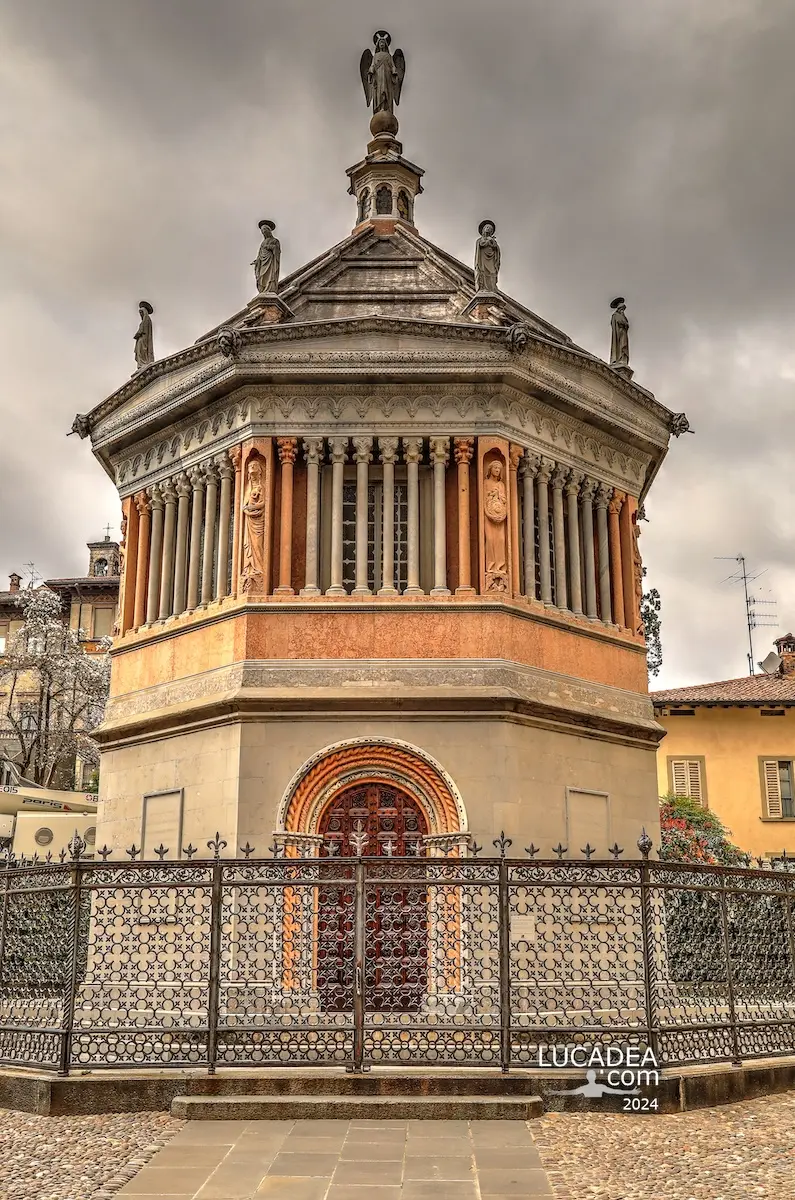
The Baptistery of the Cathedral of Bergamo

Il Battistero della Cattedrale di Bergamo

The Baptistery of the Cathedral of Bergamo.
In the heart of Bergamo’s Upper Town, surrounded by ancient walls and narrow cobbled streets, stands the imposing Cathedral of Saint Alexander, one of the most important examples of sacred art in Lombardy. Among its most precious gems is the Baptistery, a structure of great artistic and historical significance that enchants visitors with its beauty and intrinsic spirituality.
The Baptistery of the Cathedral of Bergamo, dedicated to Saint John the Baptist, dates back to the medieval period, with some parts going as far back as the 9th century. Its architecture reflects the Romanesque style, with later Gothic and Renaissance influences, bearing witness to the different historical periods that shaped the city over the centuries.
The exterior of the Baptistery is characterized by a simple yet elegant façade, decorated with blind arches, pilasters, and a portal adorned with sacred sculptures. Inside, medieval frescoes and Renaissance architectural elements create an atmosphere of sacredness and contemplation.
One of the Baptistery’s greatest treasures is the frescoes that decorate its walls, mainly dating from the 13th and 14th centuries. These works of sacred art, created by anonymous artists of the time, depict biblical stories and scenes from the life of Saint John the Baptist, bringing faith and devotion to life.
Among the most famous frescoes is the cycle of the life of Saint John the Baptist, which includes episodes such as his miraculous birth, his ministry in the desert, and his martyrdom. The vivid representations and skillful use of color give them a timeless charm, transporting visitors on a spiritual journey through the history of Christianity.
The Baptistery is a place of great spiritual importance for the people of Bergamo and for visitors seeking reflection and contemplation. It is here that many Christians receive the sacrament of baptism, a rite of initiation into the Christian faith symbolizing spiritual rebirth and communion with God.
Beyond its liturgical function, the Baptistery also represents a symbol of the continuity of the Christian faith through the centuries. Generations of believers have left their mark on this sacred place, helping preserve its beauty and historical importance for future generations.
The Baptistery of the Cathedral of Bergamo is open to visitors who wish to admire its artistic beauty and experience a moment of spirituality. Tourists can join guided tours organized by the local diocese or explore the Baptistery on their own, letting themselves be captivated by its artworks and evocative atmosphere.
In conclusion, the Baptistery of the Cathedral of Bergamo represents a masterpiece of sacred art and a place of deep spiritual significance. With its fascinating architecture, breathtaking decorations, and millennia-old history, it continues to inspire and uplift those who visit, offering a unique experience of beauty and contemplation.

Do you know Bergamo? Add a comment or go to the bottom of the site to read what other visitors have written.

Il Battistero della Cattedrale di Bergamo

Photo taken with Canon EOS RP and Canon RF 24-50 lens.

This is the Cathedral’s official website: cattedraledibergamo.it.

To see all the photos I took in Bergamo, click here:

Where is the baptistery located:

The beautiful Fuga Gate in the city of Spoleto

La bella Porta Fuga nella città di Spoleto

The beautiful Fuga Gate in the city of Spoleto.
The city of Spoleto, located in the heart of Umbria, is rich in history and charm. Among its most precious treasures is Fuga Gate, an ancient gate that tells stories of courage and resilience.
Porta Fuga takes its name from a legendary episode that took place in 217 BC. During the invasion of Hannibal, the inhabitants of Spoleto managed to repel the Carthaginian army by pouring boiling oil from the nearby Torre dell’Olio. This act of heroic defense gave the gate its name, meaning “gate of escape,” referring to the retreat of the invaders.
Originally built during the Roman era, Porta Fuga was later modified over the centuries. Experts believe that the current structure dates back to the late 12th century. The gate was raised in 1655 on the occasion of the visit of Christina of Sweden, and these modifications are still visible today.
Today, Porta Fuga is not only a historical monument but also a symbol of Spoleto’s identity and resilience. Walking along Via Porta Fuga, you can almost hear the echoes of past battles and imagine the determination of the ancient inhabitants of the city.
For those visiting Spoleto, Porta Fuga is a must-see. Located within the first city walls, it offers a fascinating glimpse into the city’s defensive past. Not far away stands Torre dell’Olio, another historic structure that completes the picture of this legendary era.
Porta Fuga is more than just a gate; it is a silent witness to the history of Spoleto. Every stone tells a story of courage and resistance, making this place a key point of interest for anyone who wants to discover the deep roots of this charming Umbrian city.

Do you know Spoleto? Add a comment or go to the bottom of the site to read what other visitors have written.

Photos taken with Canon EOS RP and Canon RF 24-50 lens.

To see all the photos I took in the city, click here:

Where is the door located:

The street takes its name from the gate that was part of the city walls in Roman times, before the medieval development of the Borgo San Gregorio. It later took the name Porta Fuga (Fugue Gate) to allude to the legendary episode of the expulsion of Hannibal’s Carthaginian army from beneath the walls of Spoleto (217 BC), driven away by the jet of boiling oil that the Spoleto people hurled from the nearby Torre dell’Olio (Oil Tower).
Continue and learn more on the Municipal website

The beautiful Fuga gate in the city of Spoleto – La belle porte d’évasion dans la ville de Spoleto – La hermosa puerta de escape en la ciudad de Spoleto – A bela porta de fuga na cidade de Spoleto – Die schöne Fluchttür in der Stadt Spoleto – Cửa thoát hiểm tuyệt đẹp ở thành phố Spoleto

This post was written with the help of Copilot, an AI-powered virtual assistant.

The Old Town Gate of Portovenere

La Porta del Borgo di Portovenere

The Old Town Gate of Portovenere.
The Old Town Gate of Portovenere, in Liguria, in the province of La Spezia, Italy, is one of the most charming entrances to the historic centre of this beautiful village overlooking the Gulf of Poets. I find it fascinating to imagine how many people have passed beneath its arch over the centuries and how many stories these ancient stones could tell. It is a place where medieval architecture remains part of everyday life in the village.
The gate stands within the old defensive walls and opens onto Giovanni Capellini Street, the characteristic narrow lane that runs through the heart of the historic centre. Beyond the entrance, a maze of narrow alleys, stairways, arches and tall, colourful houses invites visitors to explore. Every turn seems to reveal another interesting view. This is more than a simple passage into the village: walking through it feels like stepping into another period of history.
The Old Town Gate is closely connected to Portovenere’s medieval past and its relationship with the Republic of Genoa. During the twelfth century, Genoa developed the village into an important fortified settlement on the eastern Ligurian coast. Above the entrance, the historic inscription “Colonia Ianuensis 1113” recalls the village’s connection with Genoa. The gate and the surrounding walls formed part of a defensive system designed to protect a strategically important settlement for trade and coastal control.
What catches my attention most is the imposing simplicity of the stone structure. Elaborate decoration is not necessary to make this entrance impressive. The strength of the arch, the uneven surfaces of the stone blocks and the contrast with the buildings around it give the gate its distinctive character. Imagining Portovenere as it might have appeared centuries ago makes it easier to appreciate how important this entrance must have been for both residents and visitors arriving at the village.
Once through the gate, I can follow the narrow main lane and explore at my own pace, passing shops, small restaurants and picturesque corners along the way. The streets also lead towards some of Portovenere’s best-known landmarks, including the Church of San Pietro and Doria Castle, both important features of the village’s historic landscape.
On Lucadea.com, I enjoy sharing architectural details like this because small features often reveal something special about a place. The Old Town Gate is more than an ancient entrance: it is a tangible reminder of Portovenere’s past and an invitation to discover its historic streets.

When you visit a historic village, do you stop to admire its old gates and defensive walls, or do you prefer to wander straight into the narrow streets? Add a comment or go to the bottom of the site to read what other visitors have written.

The Old Town Gate of Portovenere, a medieval stone archway set within the historic defensive walls of this Ligurian village in Italy

Photo taken with Canon EOS RP camera and Canon RF 24-50 lens.

At another time, I also recorded a short video of me walking around the village:

Video recorded with GoPro Hero5.

Click here to see all the photos of the village:
foto gallery

Where is Portovenere?

🏠
  • Italiano