
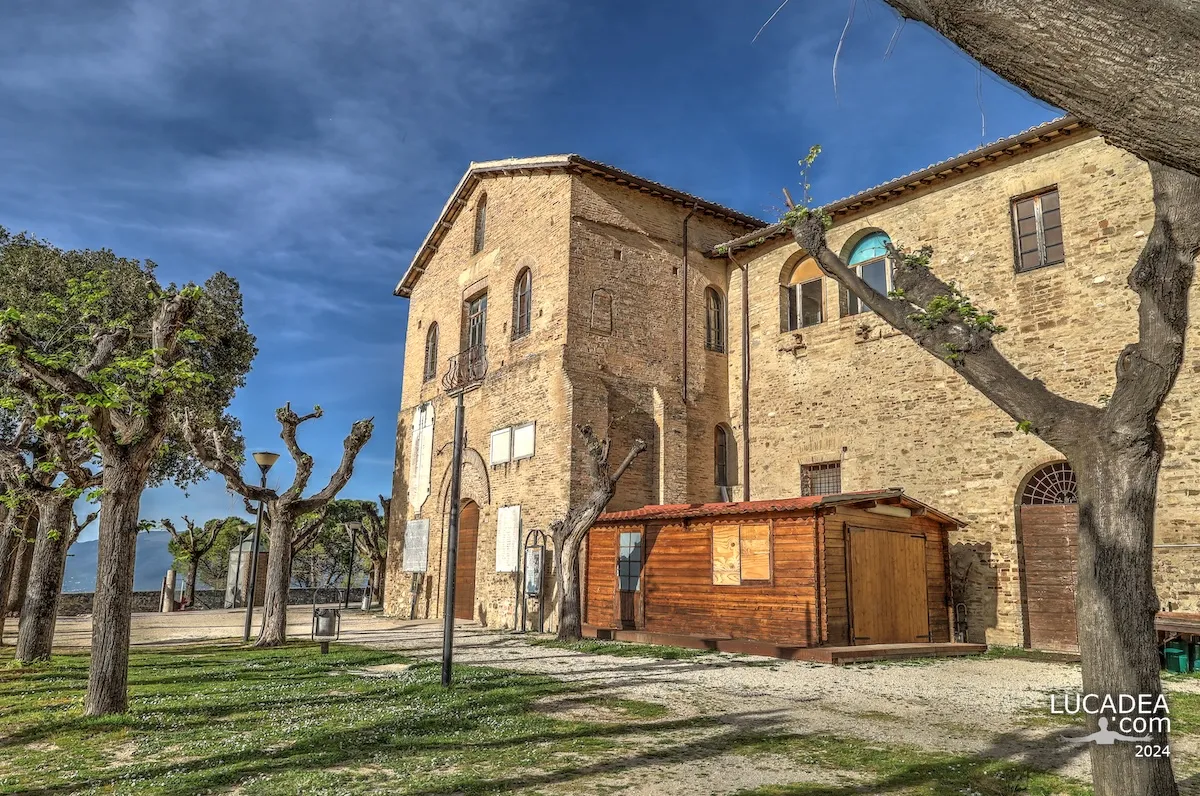
A Hidden Corner of Montefalco: The Church of Sant’Agostino

Un angolo nascosto di Montefalco: la Chiesa di Sant'Agostino

A Hidden Corner of Montefalco: The Church of Sant’Agostino.
In the heart of this Umbrian village, in the province of Perugia, Italy, there is a peaceful spot that reveals a less familiar side of this beautiful hilltop town. The rear of the Church of Sant’Agostino and the small panoramic area nearby offer a chance to pause, step away from the busier walking routes and admire Montefalco from a different perspective.
The church stands in the historic centre and is one of the village’s most important religious buildings. Its construction dates back to the second half of the thirteenth century: work began in 1279 and was completed around 1285, while the building was enlarged in 1327. It preserves an important artistic heritage, including frescoes and traces of different periods. In this photograph, however, the focus moves outside, towards a part of the building that often receives less attention than its main façade.
I enjoy looking for these less obvious corners when visiting a place. The most famous monuments and main squares are not always the places that leave the strongest impression. Sometimes a side view, an old wall or a quiet little space is enough to reveal something of a town’s character. Here, the church walls and their surroundings create a simple composition, far removed from the grand appearance of some of the other views in the historic centre.
Nearby, a panoramic viewpoint opens up towards the Umbrian Valley. Montefalco is known as the Balcony of Umbria because of its elevated position and the wide views it offers across the surrounding countryside. On clear days, the landscape stretches across rolling hills, cultivated fields, vineyards and olive groves, with the outlines of other Umbrian towns visible in the distance. The view changes constantly with the light and the weather, making every visit a little different.
Sunset can make this landscape particularly beautiful. The colours become warmer, the hills take on softer shades and the countryside seems to slow down along with the rhythm of the village. Even without looking for a spectacular panorama, it is worth taking a break and simply observing the surroundings.
I wanted to share this corner because it captures a quieter and more intimate side of Montefalco, made up of architectural details, peaceful surroundings and beautiful scenery. On Lucadea.com, I also share other photographic stories about Umbrian villages and their lesser-known views.

When visiting a village, do you prefer discovering its famous landmarks or searching for hidden corners like this one? Add a comment or go to the bottom of the site to read what other visitors have written.

Rear view of the Church of Sant'Agostino in Montefalco, a quiet corner of the Umbrian village near a panoramic viewpoint

Rear view of the Church of Sant'Agostino in Montefalco, a quiet corner of the Umbrian village near a panoramic viewpoint

Photos taken with Canon EOS RP and Canon RF 24-50 lens.

To see all the photos I took in the village, click here:

Add one  comment to this article or read  here what other visitors have written.
 
Adv
 
Disclamer

The rights on images, videos, choruses, text and all other material on the LUCADEA.com website are governed as per  Copyright page.


This page has been viewed 1 times today.
This month it has been viewed 1 times.
In total it has been viewed 27 times.
 

Perugia’s Historic Aqueduct Seen from Above

L'acquedotto storico di Perugia dall'alto

Perugia’s Historic Aqueduct Seen from Above.
Perugia’s historic aqueduct is one of the most fascinating medieval features of this beautiful hilltop city in central Italy. Seen from above, the old aqueduct offers a different way to appreciate the historic centre, revealing a remarkable walkway that runs between medieval buildings, rooftops and narrow streets. What was once an essential part of the city’s water supply has become one of its most distinctive places to explore on foot.
The story of the aqueduct is closely connected to the Fontana Maggiore, the famous fountain in Piazza IV Novembre, in the heart of Perugia. Built during the second half of the thirteenth century, the aqueduct was designed to bring water into the city at a time when supplying its growing population was a major challenge. Construction took place between 1254 and 1277, reflecting the technical knowledge and ambition of medieval Perugia.
The system extended for several kilometres and demonstrated considerable engineering skill. One of its most remarkable features was the way it helped bring water towards the higher parts of the city despite the difficulties created by the local terrain. The project became an important example of medieval hydraulic engineering and remains a fascinating reminder of how practical needs inspired ambitious solutions long before modern infrastructure existed.
Today, the surviving route offers a very different experience from a conventional city street. The pedestrian walkway passes close to historic façades and above sections of the surrounding streets, creating unusual views of rooftops, stone walls and the compact layout of the old town. Looking down on the aqueduct makes it easier to understand how closely this historic structure is woven into the urban landscape.
Walking along the old aqueduct feels like stepping into another period of Perugia’s history. The stones and buildings tell the story of a city shaped by centuries of development, from its ancient Etruscan roots to its medieval streets and historic palaces. It is a place where architecture is not simply displayed behind barriers; it forms part of everyday life and the routes people use to move through the city.
I enjoy photographing places like this because they reveal a side of a destination that can be missed when following the main tourist itinerary. This photograph captures the aqueduct from above, highlighting its relationship with the neighbouring buildings and the dense historic centre. The view encourages us to slow down and notice how an engineering structure can become an architectural feature in its own right.
If you are planning a visit to Perugia and wondering what to see beyond the main squares and monuments, the historic aqueduct is well worth adding to your walk through the old town. You can also explore other travel photographs and stories from historic Italian destinations on Lucadea.com.

Have you ever walked along Perugia’s medieval aqueduct and enjoyed its unusual views over the historic city? Add a comment or go to the bottom of the site to read what other visitors have written.

Perugia's historic aqueduct seen from above, with its medieval walkway running between rooftops and old town buildings

Photo taken with Honor 20.

To see all the photos of Perugia, click here:

Where I took the photo:

Add one  comment to this article or read  here what other visitors have written.
 
Adv
 
Disclamer

The rights on images, videos, choruses, text and all other material on the LUCADEA.com website are governed as per  Copyright page.


This page has been viewed 1 times today.
This month it has been viewed 3 times.
In total it has been viewed 25 times.
 

The Cloister Columns at Bologna’s Seven Churches

Le colonnine del chiostro delle Sette Chiese a Bologna

The Cloister Columns at Bologna’s Seven Churches.
The Basilica of Santo Stefano is undoubtedly one of the places worth visiting when exploring Bologna. Commonly known as the Seven Churches, this remarkable religious complex stands in the historic centre and brings together several churches, courtyards and architectural spaces shaped by centuries of history. It is one of those places that deserves to be explored slowly, taking time to appreciate not only the main buildings but also the smaller architectural details.
Admission to the complex is free, and visitors can discover some truly fascinating spaces. One of my favourites is the cloister, with its peaceful atmosphere and beautiful architectural features. In this photograph, I wanted to focus on the columns on the upper floor. They may seem like relatively small details within such a large historic site, but their shapes, proportions and arrangement make them particularly interesting to look at.
The cloister is especially distinctive because of its two levels. The upper floor features a gallery with a series of openings and columns that create a beautiful visual rhythm. The different shapes of the supports, the proportions of the arches and the decorative details of the capitals give the gallery a character of its own. This is much more than a practical structure connecting different parts of the complex: it is an important element of its architectural identity.
I enjoy photographing details like these because they often reveal aspects of a building that might otherwise go unnoticed. At first glance, we see a sequence of columns supporting a gallery, but by looking more carefully we can appreciate the differences in their forms, the craftsmanship and the building techniques of earlier periods. Light passing through the openings also creates a fascinating play of shadows, bringing out the shapes of the columns and arches.
The history of the Basilica of Santo Stefano is particularly old and complex. The site is traditionally associated with Saint Petronius, the fifth-century bishop of Bologna, and with the idea of creating a religious complex inspired by the holy places of Jerusalem connected with the Passion of Christ. Over the centuries, the buildings underwent numerous changes, additions and restorations. The popular name Seven Churches comes from the different places of worship that were brought together here over time. Not all the original structures have survived unchanged, but the complex still preserves a remarkable arrangement and atmosphere.
Walking through Santo Stefano means moving from one church to another, passing through courtyards and rooms that seem to belong to different historical periods. This sequence is part of what makes the visit so interesting. It is not simply a matter of entering a single basilica and admiring its interior: the whole site feels like a small architectural world, with each space offering something different.
The cloister, with its galleries and columns, also provides a welcome moment of quiet away from the busy streets of central Bologna. It is easy to imagine how important these spaces once were to the religious community that lived and worshipped here. Today, visitors arrive from all over the world, yet the cloister still retains an intimate quality that encourages people to slow down and look more closely.
In the photograph I took, I wanted to highlight the upper gallery and its elegant sequence of columns. Their repeated forms create a harmonious pattern, while the individual details give the structure its own character. It is a small architectural scene that reveals something of Bologna’s extraordinary artistic and historical heritage.
The Basilica of Santo Stefano is a place where history can be discovered through large spaces as well as through the smallest details. The columns of this cloister are a good example: they are part of a much larger monument, but they deserve a photograph and a moment of attention in their own right. They help make this complex one of the most memorable places to visit in Bologna, Emilia-Romagna, Italy.

And what about you? When visiting a historic monument like Santo Stefano, do you prefer to admire the whole building or take time to notice architectural details such as these columns? Add a comment or go to the bottom of the site to read what other visitors have written.

Stone columns along the upper gallery of the cloister at the Basilica of Santo Stefano in Bologna, Italy

Photo taken with Canon EOS M100 and Tamron 16-300 lens.

If you want to see all the photos I took in the city, click here:

This is the official website: santostefanobologna.it.

🏠
  • Italiano