A purple rose in the home garden

Rose porpora in un giardino vicino casa con abitazione sullo sfondo

A purple rose in my garden.
This morning I went out early, when the air is still cool and everything seems quieter. Near our house, there’s a small garden I like to look at every now and then, slowly. Today, however, something immediately caught my eye: a rose with an intense color, a red so deep it almost looks purple.
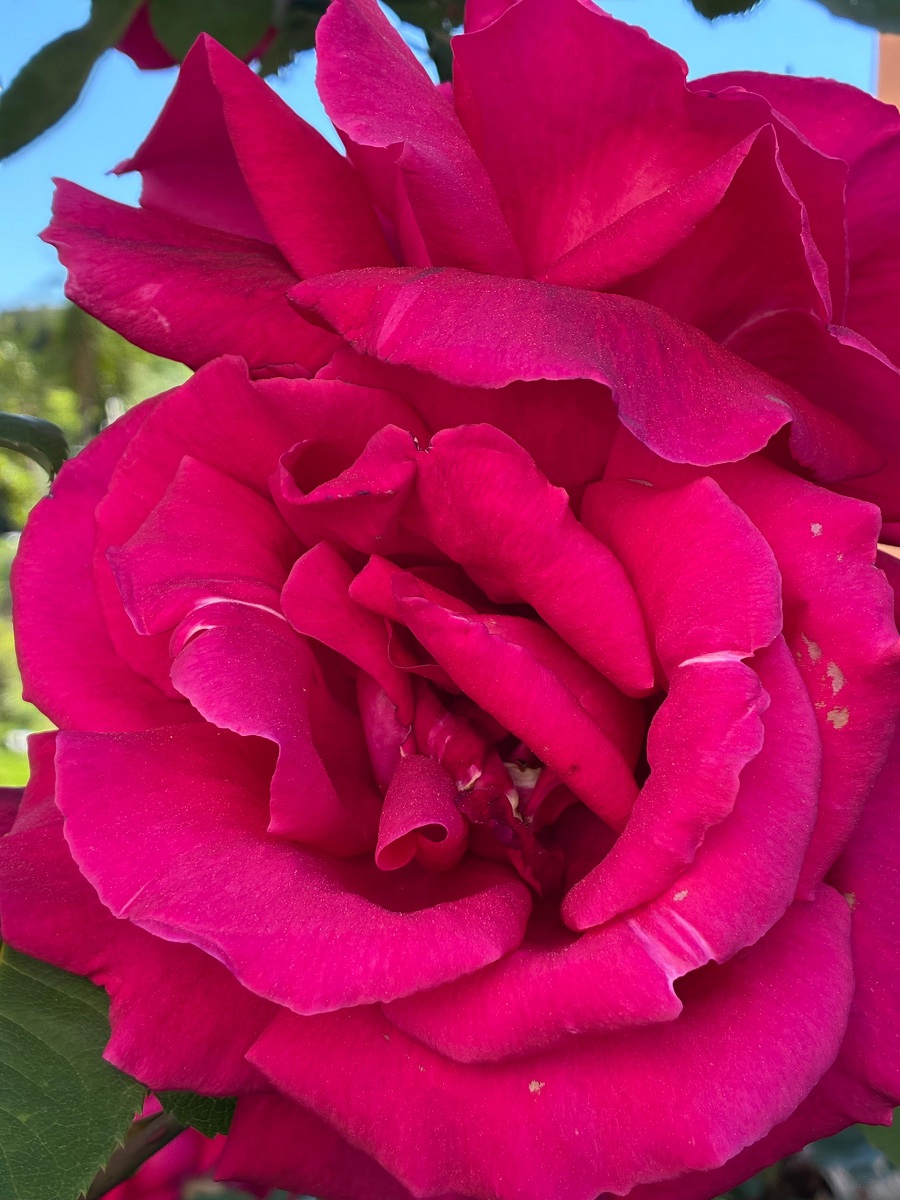
I took the first photo from a distance. I liked the overall effect: the roses in the foreground and, behind them, the house and garden in the background. It’s a simple, everyday scene, but precisely for this reason, authentic. You don’t have to go far to find something beautiful; sometimes, all it takes is a moment to stop and take a closer look at what’s around you.
Then I moved closer. The other two photos reveal a more intimate, quieter detail. The petals are full, soft, slightly open. The morning light barely touches them, delicately changing the color: in some places, it’s darker, almost velvety, in others, it sparkles with brighter reflections. Looking at them so closely, it came naturally to me to pause for a moment, as if that rose deserved a little more time.
There’s something special about photographing flowers like this, without preparation, without trying to get the perfect shot. It’s a simple gesture, but one that makes me feel present. This purple rose, in its little corner of the garden, has become a moment to remember for me: a gentle light, an intense color, and a feeling of calm.
Roses have always fascinated me, especially those with darker hues. They have a different, deeper, almost mysterious character. But beyond the meanings, what I carry with me today is the feeling of this morning: tranquil, silent, full of small details that often go unnoticed.

Do you ever stop to observe a flower like this, for no particular reason?
Add a comment or go to the bottom of the site to read what other visitors have written.

Photos taken with iPhone 17e.

Deep purple rose in a garden near home – Rose pourpre dans le jardin près de la maison – Rosa púrpura en el jardín cerca de casa – Rosa púrpura no jardim perto de casa – Purpurrote Rose im Garten nahe Zuhause – Hoa hồng tím đậm trong khu vườn gần nhà – 靠近家中的花园里的深紫色玫瑰 – 家の近くの庭に咲く濃い紫のバラ

The text of this post was written with the help of ChatGPT, a language model from OpenAI.

Add one  comment to this article or read  here what other visitors have written.
 
Adv
 
Disclamer

The rights on images, videos, choruses, text and all other material on the LUCADEA.com website are governed as per  Copyright page.


This page has been viewed 1 times today.
This month it has been viewed 5 times.
In total it has been viewed 14 times.
 

A White Sundevilla Among the Nursery Plants

Un fiore bianco tra le piante del vivaio: sundevilla

A White Sundevilla Among the Nursery Plants.
That afternoon I stopped at the nursery near my home without any particular plan, simply wanting to look around among the plants and see if there was a flower that might catch my eye. Among the green leaves and neatly arranged rows of plants, this white sundevilla stood out almost immediately, mainly because of the contrast between its pale flowers and the stronger colours surrounding it.
The white sundevilla was not a subject I had planned to photograph. It was one of those unexpected encounters that, for me, make even an ordinary visit to a plant nursery worthwhile. The white petals stood out among the green leaves and the brighter flowers nearby, especially the orange and yellow ones. I stopped for a while before taking out my camera, simply because I wanted to look at the flower before deciding how to photograph it.
As I moved closer, I began noticing the details of the flower more clearly: the slightly curved petals and the delicate centre. I took several photographs, looking for an angle that would emphasize the contrast between the light-coloured flower and the much deeper greens around it. When I photograph a subject like this, I am not particularly interested in creating a complicated composition. I prefer to let the flower itself suggest the photograph.
Sundaville is a commercial name used for several ornamental Mandevilla varieties, plants appreciated for their flowers and climbing habit. Their blooms can appear in different colours, including white, pink and red, and they are commonly used during the warmer months to decorate balconies, terraces and gardens. That range of colours is also part of what makes the plant interesting to photograph.
In this case, though, I was not looking for a particular botanical subject. The flower simply caught my attention among all the other plants in the nursery. Sometimes a small detail like this is enough to change the way we look at an otherwise ordinary environment, which at first might seem like nothing more than rows of pots and plants.
I tried to move close enough to isolate the flower while still keeping part of its surroundings in the frame. The leaves help reveal where the photograph was taken and keep the connection with the nursery. I did not want to turn the sundevilla into a completely abstract image; I preferred to leave some visual trace of the place where I found it.
This photograph also connects naturally with some of the other flower images I have shared on the site, including the one featuring a common primrose. They are very different subjects, but they have something important in common: neither requires a famous location or a special journey. Even a nursery close to home can offer something worth photographing when you slow down and pay attention.
Looking at this image again now, what I like most is its simplicity. There is no spectacular landscape and no famous monument behind the subject. There is simply a flower that, for some reason, managed to stand apart from everything around it that afternoon.
Perhaps that is one of the things I enjoy most about photography: being surprised by something I was not looking for. The white sundevilla was there among countless other plants, and in the end it was the one that made me stop.

Have you ever stopped to photograph a flower you happened to find almost by chance in a nursery? Add a comment or go to the bottom of the site to read what other visitors have written.
White sundevilla flower among green nursery plants, photographed close up during a quiet visit to a local plant nursery

White sundevilla flower among green nursery plants, photographed close up during a quiet visit to a local plant nursery

Photos taken with Canon EOS RP camera and Canon RF 50 lens.

The nursery I visited was: Vivai Gaggero in Carasco.

Add one  comment to this article or read  here what other visitors have written.
 
Adv
 
Disclamer

The rights on images, videos, choruses, text and all other material on the LUCADEA.com website are governed as per  Copyright page.


This page has been viewed 0 times today.
This month it has been viewed 0 times.
In total it has been viewed 20 times.
 

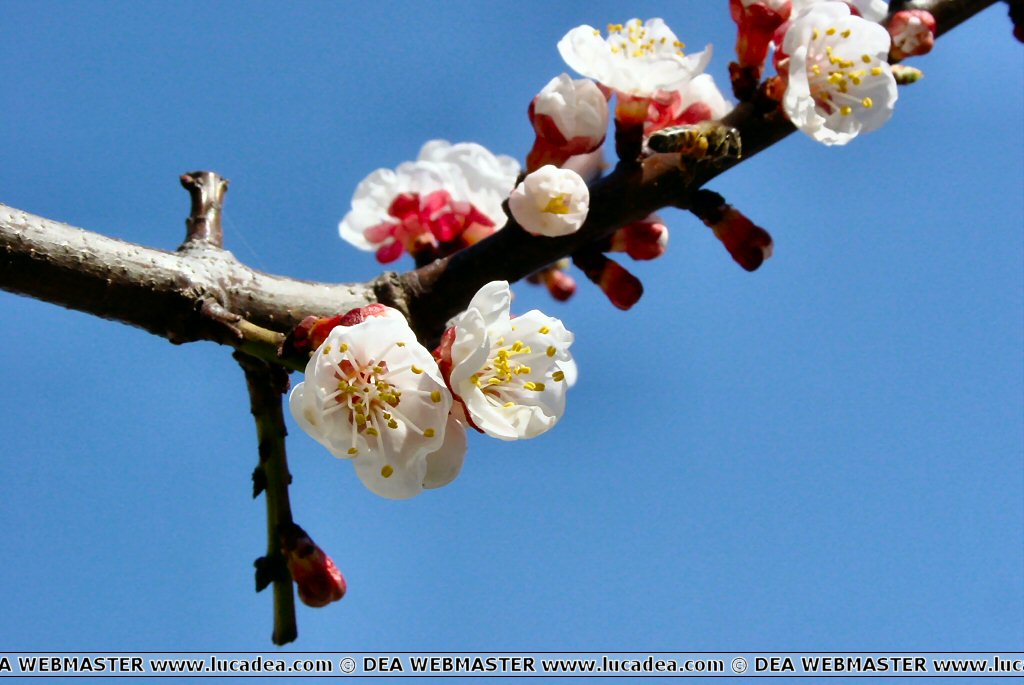
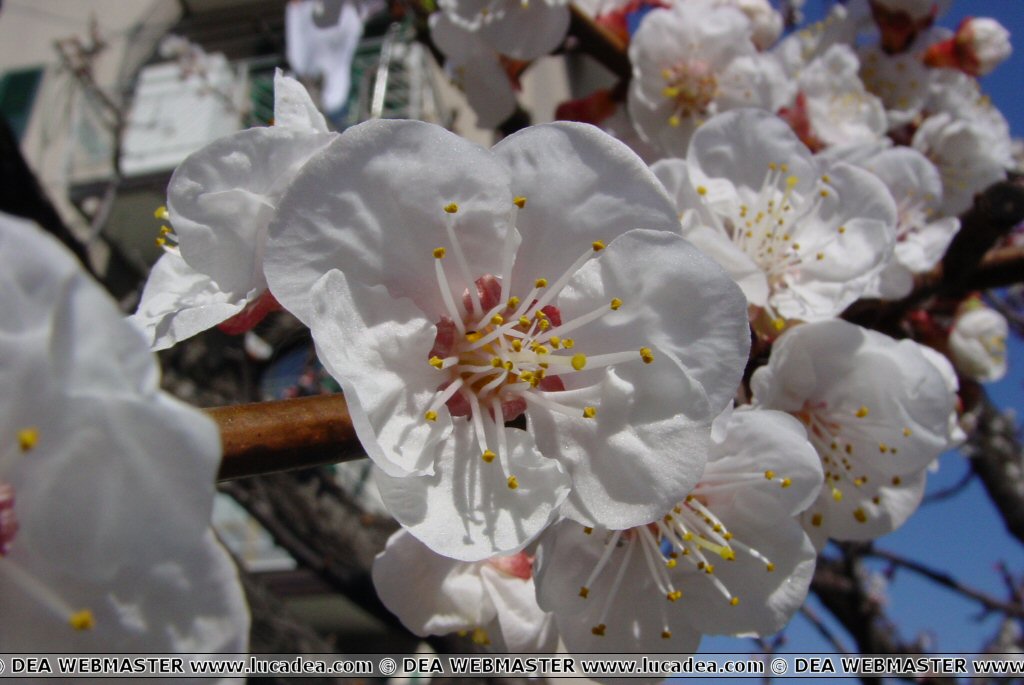
Delicate apricot blossoms in springtime

fiori albicocco

Delicate apricot blossoms in springtime.
Among the flowers of fruit trees that I love photographing, apricot blossoms are definitely some of my favorites. This image comes from my attention to these small natural details that announce the arrival of spring and transform a simple branch into something worth observing.
Apricot blossoms are one of the subjects I have photographed many times over the years, and there is a reason why they continue to attract my attention. Before the fruit appears, the flowers already tell the story of the new season and the awakening of the tree. Looking closely at a flowering branch means discovering small details such as delicate petals, young buds and the contrast with the still bare parts of the plant.
I took this photograph to preserve a specific moment in the natural cycle of the apricot tree. I enjoy photographing these seasonal changes because they are simple images, but they can still tell a story about time, nature and the small transformations that happen around us.
When people search for apricot blossom photos or spring flowers, they often imagine large colorful landscapes. However, even a single branch can become an interesting photographic subject. In this case, I chose to focus on the details and let the flowers themselves become the center of the image.
The apricot tree belongs to the Rosaceae family, and its blossoms usually appear before the fruit develops. Flowering is an important stage for the future production of apricots and is closely observed by those who cultivate these trees.
One curiosity about apricot blossoms is that they can appear quite early in the season, making the tree particularly vulnerable to sudden temperature changes and possible spring frosts.
As I have already shared in other nature photographs on Lucadea.com, I enjoy looking for simple subjects close to everyday life that can still offer a different perspective. Even a flower growing in a garden or along a walk can become a small photographic story.
I think this is exactly what makes some natural subjects special: they do not need to be spectacular to capture attention. They only need the right moment and someone willing to stop and look.

Which spring flower do you enjoy photographing the most? Add a comment or go to the bottom of the site to read what other visitors have written.

Apricot blossoms in spring with delicate pale petals growing on a flowering branch

Apricot blossoms in spring with delicate pale petals growing on a flowering branch

A fruit tree, also known as armellino in Venetian dialects following trade with the East, Linnaeus believed it to be native to Armenia—hence the specific epithet “armeniaca”—but the plant was originally from China. It was imported to Europe by the Roman Lucullus.
Continue and learn more at Wikipedia

Silent magic of the Baia in Sestri Levante

Magia della Baia del Silenzio a Sestri a marzo

The silent magic of the Bay of Sestri Levante.
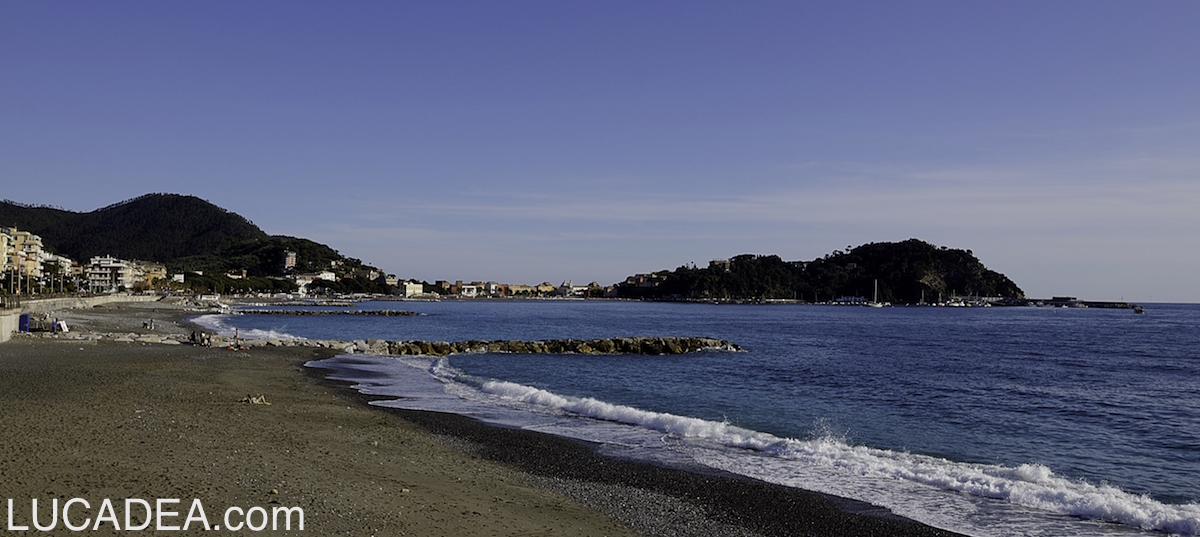
Photographed on March 14, 2024, the Bay of Silence in Sestri Levante appears suspended in an atmosphere of rare serenity. In the photo, the calm water reflects the cloudy March sky and the pastel colors of the houses overlooking the sea, creating a perfect, almost painterly scene. The white boats at anchor add a touch of life without disturbing the tranquility, while the golden sand of the shore and the surrounding cliffs frame the bay in a natural embrace.
The soft morning light highlights the building facades, from the warm tones of the yellow and orange houses to the delicate contrast with the lighter hues of the church and historic buildings. Strolling along the promenade or simply stopping on the sand becomes a contemplative experience: every reflection on the water, every small movement of the waves or seagulls contributes to creating a suspended and magical atmosphere.
The Bay of Silence offers authentic emotions in spring: a place where time seems to slow down, where the sea and light guide the gaze and mind toward calm. Perfect for those who love photography or simply enjoy the discreet beauty of Liguria’s most poetic side.

Do you know the Bay of Silence?
Add a comment or go to the bottom of the site to read what other visitors have written.

Photos taken with Canon EOS RP and lens Canon RF 24-50.

Silent magic of the Baia in Sestri – Magie silencieuse de la Baia à Sestri – Magia silenciosa de la Bahía en Sestri – Magia silenziosa della Baia di Sestri – Stille Magie der Baia in Sestri – Phép màu yên tĩnh của Vịnh Sestri – 塞斯特里寂静湾的静谧美 – セストリの湾の静かな魔法

The text of this post was written with the help of ChatGPT, a language model from OpenAI.

Spring silence on Chiavari sea

Primavera silenziosa sul mare di Chiavari

Silent Spring on the Chiavari Sea.
In spring, the beach at the mouth of the Entella River in Chiavari transforms into a rare haven of solitude. The still-warm days and the absence of tourists leave the sand almost entirely to itself. The pebbles and seaweed carried by the river seem to create an untouched natural landscape, while seagulls soar over the calm water, marking the rhythm of the quiet.
The light wind caresses the shore, and the soft light of the season highlights the golden and gray tones of the sand and pebbles. Walking along the shore becomes a meditative experience: each step is accompanied by the sound of the waves slowly breaking and the breath of the sea. The mouth of the Entella River adds a special charm, creating small canals and inlets where fresh and salt water meet in a silent interplay.
In summer, this stretch of coast comes alive with umbrellas and swimmers, but in spring, the panorama is suspended in a different time: almost private, wild, and delicate. The local boats, anchored near the mouth, seem like silent witnesses to a Liguria that is still authentic. Here, the sea and nature speak for themselves, inviting you to slow down, observe, and breathe.
For those who love photography or simply walking immersed in nature, spring in Chiavari offers a unique experience: direct contact with the water, the sky, and the sand in a free and silent landscape, far from the frenetic pace of the tourist seasons.

Do you enjoy walking on the beach?
Add a comment or go to the bottom of the site to read what other visitors have written.

Primavera silenziosa sul mare di Chiavari

Primavera silenziosa sul mare di Chiavari

Primavera silenziosa sul mare di Chiavari

Primavera silenziosa sul mare di Chiavari

Foto scattate con macchina Canon EOS RP e lente Canon RF 24-50.

Spring silence on Chiavari sea – Printemps silencieux sur la mer de Chiavari – Primavera silenciosa en el mar de Chiavari – Primavera silenziosa sul mare di Chiavari – Frühling stille am Meer von Chiavari – Mùa xuân yên tĩnh trên biển Chiavari – 奇亚瓦里海上的宁静春天 – チアヴァリの海の静かな春

The text of this post was written with the help of ChatGPT, an OpenAI language model.
References:
– https://www.comune.chiavari.ge.it/it/news/revoca-divieto-temporaneo-di-balneazione-a-chiavari-tra-la-foce-del-fiume-entella-e-la-spiaggia-del-porto
– https://www.riviera-ligure.org/chiavari/spiaggechiavari.php
– https://www.britannica.com/place/Chiavari

A beautiful expanse of Persian cyclamen

Una bella distesa di ciclamini di persia

A beautiful display of Persian cyclamens.
On Valentine’s Day, I found a lovely photo of some beautiful pink flowers (a beautiful cyclamen) to celebrate the day.

Do you like this flower? Add a comment or go to the bottom of the site to read what other visitors have written.

Una bella distesa di ciclamini di persia

Photo taken with Canon EOS RP camera and Tamron 16-300 lens.

The nursery I visited was: Vivai Gaggero in Carasco.

Herbaceous plant with globose or slightly compressed red-purple tubers, with few roots, from which several waxy leaves arise directly on long petioles. They are ovate-cordate in shape, with serrated or entire margins, dark green with lighter variegation on the upper surface and reddish on the lower surface, and are very decorative. The wild variety reaches a height of 15 cm, while hybrid varieties can reach 35–40 cm.
Continue and learn more at Wikipedia

A beautiful expanse of Persian cyclamen – Une belle étendue de cyclamens persans – Una hermosa extensión de ciclámenes persas – Uma bela extensão de ciclames persas – Eine wunderschöne Fläche persischer Alpenveilchen – Những loài hoa anh thảo Ba Tư rộng lớn xinh đẹp

Mimosa flowers blooming for Women’s Day

Albero di mimose in fiore con grappoli gialli per celebrare la Festa delle Donne

Mimosa flowers blooming for Women’s Day.
Every year, when the beginning of March arrives, this bright yellow flower becomes an instantly recognizable symbol carrying a message of appreciation and respect. With this photograph, I wanted to dedicate a small space to all the women who visit this website and who, according to my statistics, represent the majority of my readers.
Mimosa flowers in bloom create a simple but meaningful image: a tree covered with small yellow blossoms that bring a feeling of joy and remind us of a special day dedicated to women around the world. It is not only a beautiful subject to photograph, but also a flower connected with memories, traditions, and symbolic gestures.
I chose this image to celebrate March 8, International Women’s Day, with a natural subject that represents the arrival of spring. The intense yellow color of mimosa blossoms always attracts attention and makes this one of the most recognizable seasonal flowers.
A curious detail is that mimosa became the symbol of Women’s Day in Italy after the Second World War, partly because it blooms during this period and grows easily in many areas of the country.
I enjoy photographing these small details of everyday life, not only famous landmarks or spectacular landscapes. Like other images on my blog dedicated to nature and seasonal moments, this photograph was created to capture something simple but able to share a feeling.

I would also like to share a thought from French writer Daniel Pennac that I find particularly meaningful:
What God can no longer do, a woman can sometimes do.
With this image, I want to send a special wish to all the women who visit these pages and share with me a passion for photographs, places, and stories.

Which flower reminds you most of the arrival of spring? Add a comment or go to the bottom of the site to read what other visitors have written.

Albero di mimose in fiore con grappoli gialli per celebrare la Festa delle Donne

Photo taken with Canon EOS M100 and lens Tamron 16-300.

Here’s where I took this photo:

In common parlance, as well as in the press and advertising, it is often mistakenly referred to as “Women’s Festival” (*Festa della donna*), although it is more accurate to call it “International Women’s Day” (*Giornata internazionale della donna*), since the underlying purpose of the occasion is not celebration, but reflection.
Read more on Wikipedia

Mimosa in bloom for Women’s Day – Le mimosa en fleurs pour la Journée des femmes – La mimosa en flor para el Día de la Mujer – A mimosa em flor para o Dia da Mulher – Die blühende Mimose zum Frauentag – Cây mimosa nở hoa mừng Ngày Phụ nữ – 为妇女节盛开的含羞草 – 女性の日を祝うミモザの花

The text of this post was written with the help of ChatGPT, a language model from OpenAI.

The pink flowers of the magnolia in spring

The pink magnolia flowers.
I don’t know why, but I often photograph pink flowers…
In front of these pink flowers, I always stop a little longer than necessary. The photo is born this way, without haste, almost instinctively. The magnolia was there, in full bloom, with those large, soft petals that seem to be painted one by one. The morning light barely filtered through them, making the pink deeper in the center and almost transparent at the edges. Taking the picture was a natural gesture, but staying to look at it was even more so.
Every time I encounter a magnolia in bloom, I have the feeling that something delicate and unrepeatable is happening. The branches are still bare, the air is not yet completely warm, yet those flowers explode without hesitation. This apparent fragility is perceptible in the photo: a gust of wind, a sudden rain, and everything changes. Perhaps this is also why they attract me so much, because they tell of an intense but brief beauty, which does not try to last longer than necessary.
While I was taking the picture, I realized that the pink of the magnolia is never just one color. There is the bright pink of the newly opened petals, the softer pink of the mature ones, and then the shades that almost turn white when the light hits them in a certain way. Photography tries to capture all this, but in real life it is a continuous movement, a silent dialogue between light, air, and time.
The magnolia is one of the first trees to bloom, often when winter is not yet completely over. Its flowers appear before the leaves, making it immediately recognizable. It’s as if the tree decides to show itself to the world without filters, without protection, entrusting everything to those large petals. This simple but powerful detail is part of its charm and explains why it is often associated with the idea of ​​rebirth and transition.
Looking at the photo again, I realize that it doesn’t just depict a flower, but a precise moment of the year, a state of mind. The pink magnolia blossoms become a silent signal: something is changing, even if we don’t notice it immediately. And perhaps that’s what I’m truly looking for when I take photographs, even more than the image itself.

Have you ever stopped in front of a flowering tree like this, feeling that it was speaking directly to you?
Add a comment or go to the bottom of the site to read what other visitors have written.

Photo taken with a Canon 600D camera and Tamron 16-300.

The pink flowers of the magnolia in spring – Les fleurs roses du magnolia au printemps – Las flores rosas de la magnolia en primavera – As flores rosas da magnólia na primavera – Die rosa Blüten der Magnolie im Frühling – Hoa mộc lan hồng vào mùa xuân – 玉兰的粉色花朵在春天 – 春に咲くモクレンのピンクの花

The text of this post was written with the help of ChatGPT, a language model from OpenAI.

The Bay of Fables in Sestri Levante in May

Baia delle Favole a Sestri Levante in Liguria con spiaggia ampia e primi bagnanti nelle giornate di maggio

The Bay of Fables in Sestri Levante in May.
With the arrival of the first truly warm days of May, the Bay of Fables begins to shift its rhythm and atmosphere. The light becomes stronger yet still soft, and the long stretch of beach slowly starts to fill again after the quieter winter months. It is a gradual transition, almost natural, where the sea and the town reconnect in a more direct way.
The Bay of Fables, extending from the center of Sestri Levante to the Sant’Anna area, offers a much wider and more open space compared to the more enclosed Bay of Silence. Here the beach unfolds in length, creating a shoreline that already welcomes the first bathers of the season, often drawn by the sense of openness and space.
During these May days, the change is clearly visible: the promenade becomes livelier, the first umbrellas appear along the coast, and the sea reflects a different kind of light compared to winter. It is not yet the peak of summer, but there is a strong feeling that the season is starting again.
Walking along the Bay of Fables, you notice how the landscape is designed to be experienced in motion: promenade, beach, and sea flow into one another without sharp boundaries. It is a place that transforms significantly throughout the year, shifting from a nearly empty space to a lively meeting point for both locals and visitors.
An interesting fact about Sestri Levante is that the Bay of Fables owes its name to the Danish writer Hans Christian Andersen, who stayed here in the 19th century, helping to connect the town to a fairytale-like identity that is still present today.
In this time of year, there is a clear feeling that the season is truly beginning, between first swims, seaside walks, and increasingly long days.

Do you prefer the Bay of Fables in spring or at the height of summer? Add a comment or go to the bottom of the site to read what other visitors have written.

Baia delle Favole a Sestri Levante in Liguria con spiaggia ampia e primi bagnanti nelle giornate di maggio

Bay of Fables in Sestri Levante – Baie des Fables à Sestri Levante – Bahía de los Cuentos en Sestri Levante – Baía das Fábulas em Sestri Levante – Bucht der Fabeln in Sestri Levante – Vịnh Truyện Cổ Tích ở Sestri Levante – 塞斯特里莱万特童话湾 – セストリ・レヴァンテの童話の入り江

The text of this post was written with the help of ChatGPT, a language model from OpenAI.

🏠
  • Italiano