The Main Altar of Santa Croce in Florence

L'Altare Maggiore della Basilica di Santa Croce a Firenze

The Main Altar of Santa Croce in Florence.
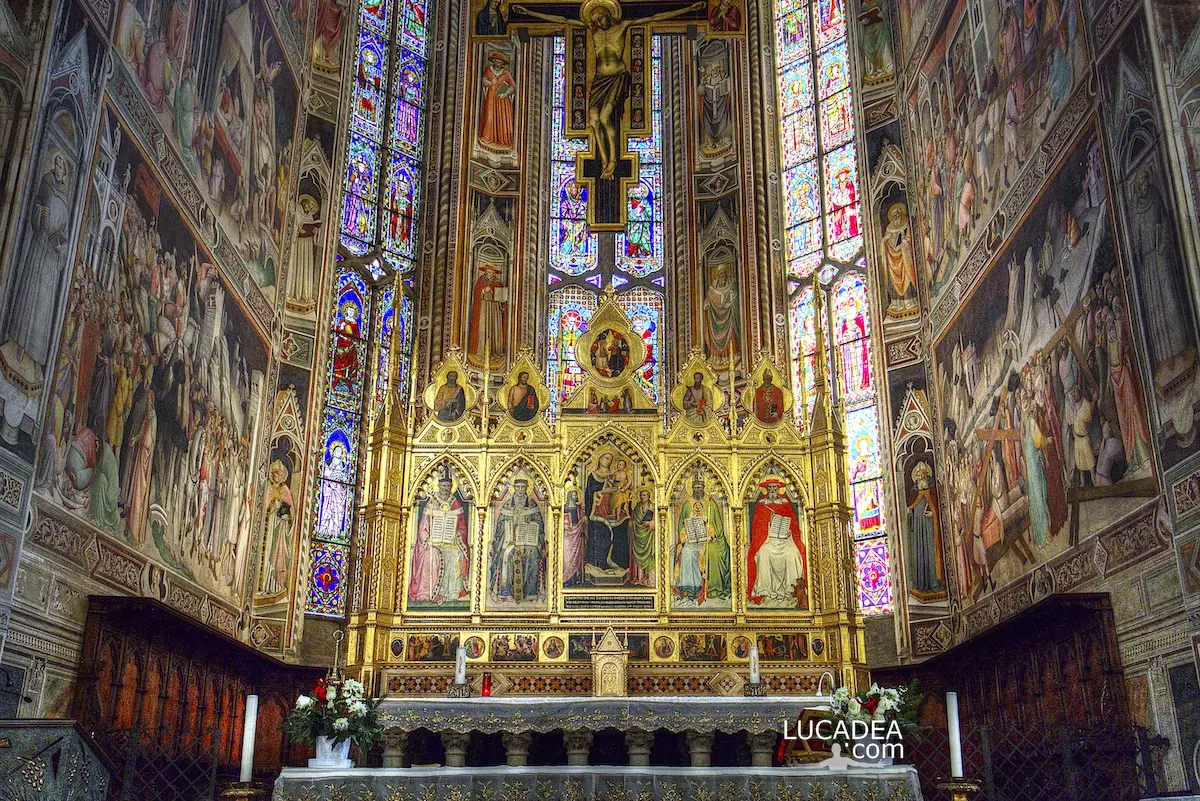
Entering the Basilica of Santa Croce in Florence, Tuscany, Italy, I found myself looking at one of the details that best represents the artistic richness of the city: the Main Altar of the Cappella Maggiore. This photograph of Santa Croce’s altar shows a quieter subject compared with the most famous artworks inside the church, but it captures an important part of what to see in Florence when exploring its artistic heritage.
During my visit, I wanted to spend some time observing this area of the basilica, looking at the structure of the altar, the decorations, and the way every element contributes to the atmosphere of the space. I took this photograph with my camera because I was fascinated by how many details could be contained in a single view. In places like Santa Croce, visitors are often focused on the famous people connected to the church, but the architectural and artistic details deserve the same attention.
The Cappella Maggiore is one of the central areas of the Basilica of Santa Croce and represents one of the most important parts of the building. Looking at the altar, it is possible to feel the connection between art and spirituality that can be found in many Italian churches, where painting, sculpture, and architecture come together in the same space.
Santa Croce is also known as the “Temple of the Italian Glories” because it contains the tombs and monuments of many important figures, including Michelangelo, Galileo Galilei, and Niccolò Machiavelli. This historical aspect gives the basilica an additional importance, as every corner is connected to centuries of culture and history.
Among my photographs of Florence, I have also shared other views of the city’s landmarks, such as the Cathedral and Piazza della Signoria. Here too, my goal was to capture a detail that might be overlooked among the many famous artworks surrounding it.
The Main Altar of Santa Croce represents an invitation to slow down and observe carefully. Photography cannot replace the experience of being inside the basilica, but it can preserve a small fragment of that moment and the feeling of standing in front of a place shaped by centuries of artistic work.

When visiting a church full of artworks, do you prefer focusing on the famous masterpieces or discovering the smaller details that reveal themselves slowly? Add a comment or go to the bottom of the site to read what other visitors have written.

Main Altar of the Basilica of Santa Croce in Florence with artistic decorations inside the Cappella Maggiore

Photo taken with Canon EOS M100 and Canon EF-M 11-22 lens.

To see all the photos of the basilica, click here:

This is the official website: santacroceopera.it.

The designs for the stained glass windows are also by Agnolo Gaddi, except for the uppermost oculi, which are older. The painted cross is by the Master of Figline, while the polyptych of the high altar is the result of a recomposition: the Madonna in the center is by Niccolò Gerini, while the Doctors of the Church are by Giovanni del Biondo and another unknown painter.
Continue and learn more at Wikipedia

Add one  comment to this article or read  here what other visitors have written.
 
Adv
 
Disclamer

The rights on images, videos, choruses, text and all other material on the LUCADEA.com website are governed as per  Copyright page.

This page has been viewed 1 times today.
This month it has been viewed 1 times.
In total it has been viewed 33 times.
 

The golden dome of San Vittore in ciel d’oro

LaCupola dorata del Sacello di San Vittore in ciel d’oro nella Basilica di Sant’Ambrogio a Milano

The golden dome of San Vittore in ciel d’oro in Milan.
Since today, December 7th, is the feast day of Saint Ambrose, I decided to share a photograph taken inside the famous basilica dedicated to him in Milan.
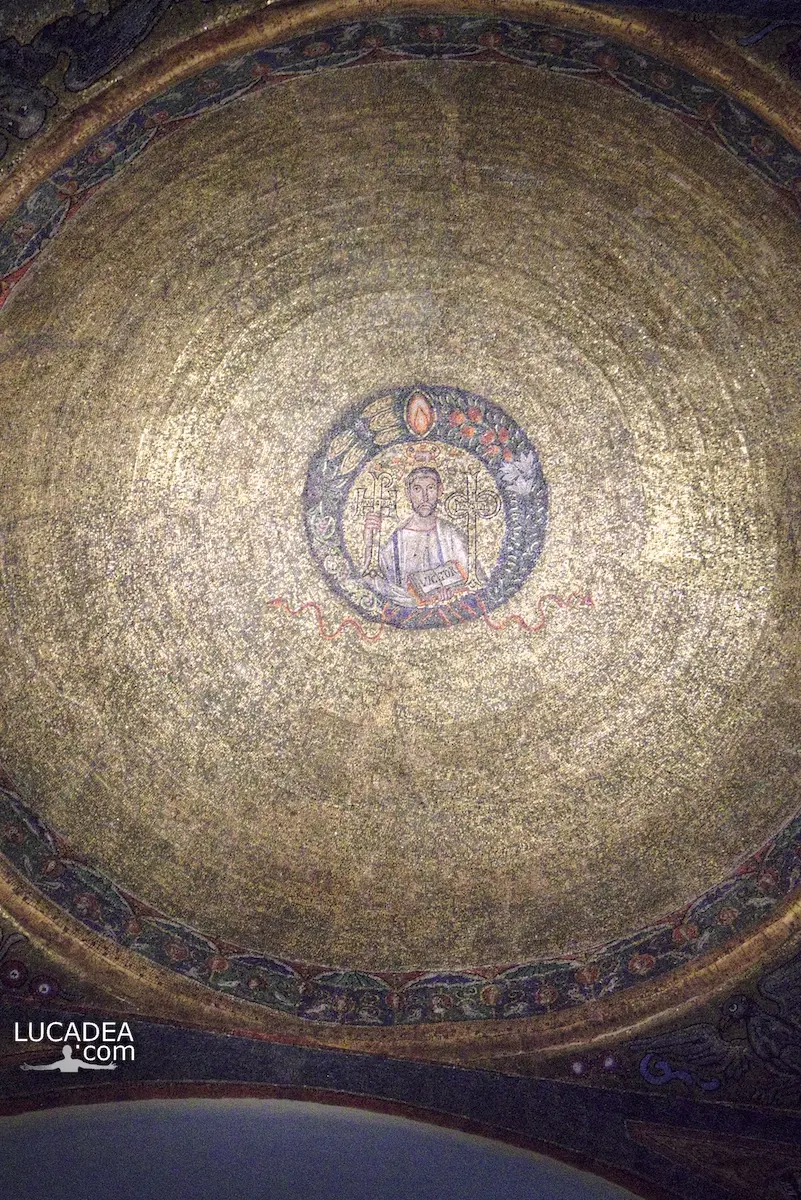
However, the subject of this image is not Saint Ambrose, but another important Milanese saint: Saint Victor. The photograph shows the dome of the Sacello di San Vittore in ciel d’oro, one of the oldest and most precious areas preserved inside the basilica.
This small early Christian chapel immediately impresses visitors with the magnificent golden mosaic covering the dome. At the centre of the composition is the portrait of Saint Victor, surrounded by a golden sky that creates an atmosphere of extraordinary brightness and solemnity.
The Sacello di San Vittore in ciel d’oro dates back to the 5th century and is considered one of the most important examples of early Christian art in Milan. The mosaic decorations, created with golden and coloured tesserae, tell the story of Christian tradition in that period and demonstrate the remarkable artistic quality already achieved during the first centuries of Christianity.
I wanted to photograph this detail because when visiting a famous basilica like Sant’Ambrogio, it is easy to focus only on the best-known elements. Instead, some of the most fascinating treasures are often hidden in smaller and quieter spaces.
Sant’Ambrogio Basilica is located in the centre of Milan, Lombardy, Italy, and is one of the symbols of the city. Inside, it preserves the famous golden altar, the apse mosaic and this extraordinary chapel dedicated to Saint Victor.
A small curiosity about the name “in ciel d’oro” is that it comes from the golden background of the dome mosaic, which gives the impression of looking at a luminous sky surrounding the saint’s figure.
Standing in front of this artwork, you can truly feel the power of history: a small space that has survived for more than fifteen centuries and still manages to amaze every visitor who enters the basilica.

Have you ever visited the Sacello di San Vittore in ciel d’oro inside Sant’Ambrogio Basilica? Add a comment or go to the bottom of the site to read what other visitors have written.

Golden dome of the Sacello di San Vittore in ciel d’oro inside Sant’Ambrogio Basilica in Milan

Photo taken with a Canon EOS M100 camera and Canon EF-M 11-22 lens.

To see all the photos I took at the Basilica, click here:

The vault of the small chapel is entirely covered in gold mosaic. At the center, the portrait of Victor—positioned directly above his tomb—is encircled by a wreath of wheat ears (representing summer) and fruit (representing autumn), pagan symbols of the changing seasons and, by extension, eternity. Six full-length figures of saints are depicted on the sides of the dome.
Read more on Wikipedia

Add one  comment to this article or read  here what other visitors have written.
 
Adv
 
Disclamer

The rights on images, videos, choruses, text and all other material on the LUCADEA.com website are governed as per  Copyright page.


This page has been viewed 1 times today.
This month it has been viewed 1 times.
In total it has been viewed 1 times.
 

The Last Judgment in the Bolognini Chapel

Il Giudizio Universale nella Cappella Bolognini del Duomo di Bologna

The Last Judgment in the Bolognini Chapel.
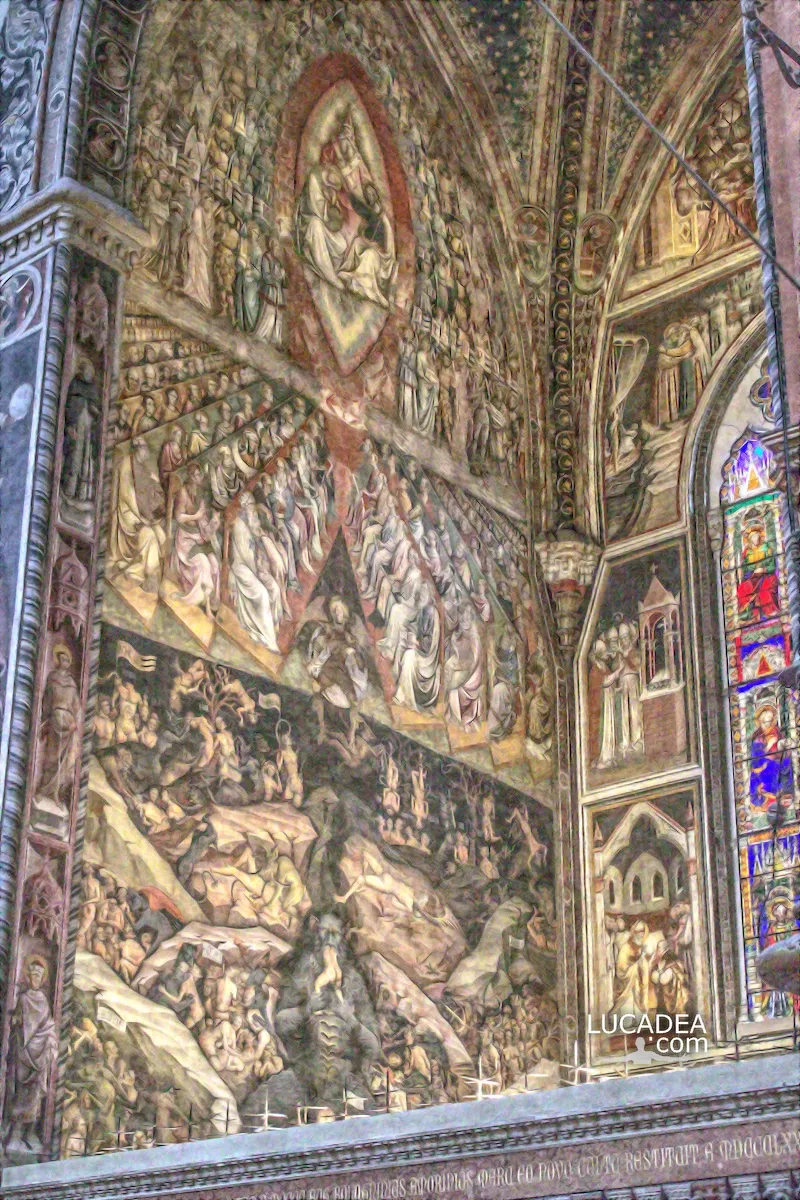
In Bologna, Emilia-Romagna, Italy, the Bolognini Chapel inside the Basilica of San Petronio houses one of the most striking fresco cycles of Italian medieval art: the Last Judgment by Giovanni da Modena. Photographing this monumental composition is a fascinating experience, as the eye keeps discovering new details in both the depiction of Paradise and the dramatic scenes of Hell.
When I stood in front of this wall, I tried to capture as much of the composition as possible in a single photograph. Unfortunately, I had to take the picture from an angle, so the perspective is not ideal. Nevertheless, I think the image still conveys something of the richness and complexity of the artwork. With a scene this crowded with figures and details, even a photograph taken from an oblique position can offer plenty to explore.
What strikes me most is the contrast between the two worlds depicted. On one side is Paradise, with its sacred figures and the solemnity of the heavenly scene. Below, Hell is filled with the damned and terrifying creatures, portrayed in a dramatic and remarkably detailed way. Giovanni da Modena created a visual world in which every section seems to tell its own story, inviting visitors to stop, look closely and gradually discover the many elements within the fresco.
The painting dates to the fifteenth century and occupies the left wall of the Bolognini Chapel, also known as the Chapel of the Magi. The chapel contains other important scenes, but the depictions of Paradise and Hell are among the most memorable parts of the cycle. The images have considerable narrative power: they do more than decorate the walls, conveying ideas, fears and beliefs through expressive gestures, faces and a wide variety of situations.
Photographing a work of art like this also means accepting certain limitations. The position from which you take the picture, the perspective and the conditions inside a church may prevent you from achieving the composition you had hoped for. In this case, however, I preferred to take the photograph rather than miss the opportunity altogether. Looking at the image afterwards, I can still examine its many details and remember the impression made by standing in front of such an extraordinary wall.
This is what I enjoy most about photographing art: it is not simply about documenting what I see, but also about preserving an image that allows me to return to the experience later. A photograph can never replace seeing a masterpiece in person, but it can keep the memory alive and encourage us to look again.

Have you ever seen Giovanni da Modena’s Last Judgment? Which detail of this remarkable fresco would catch your attention first? Add a comment or go to the bottom of the site to read what other visitors have written.

Angled photograph of Giovanni da Modena's Last Judgment fresco in the Bolognini Chapel of San Petronio Basilica in Bologna, Italy

Photo taken with Canon EOS M100 and Tamron 16-300 lens.

Click here to see all the photos I took in San Petronio:

The Chapel of the Crucifix in Naples

Il Cappellone del Crocifisso della chiesa di San Domenico Maggiore a Napoli

The Chapel of the Crucifix in Naples.
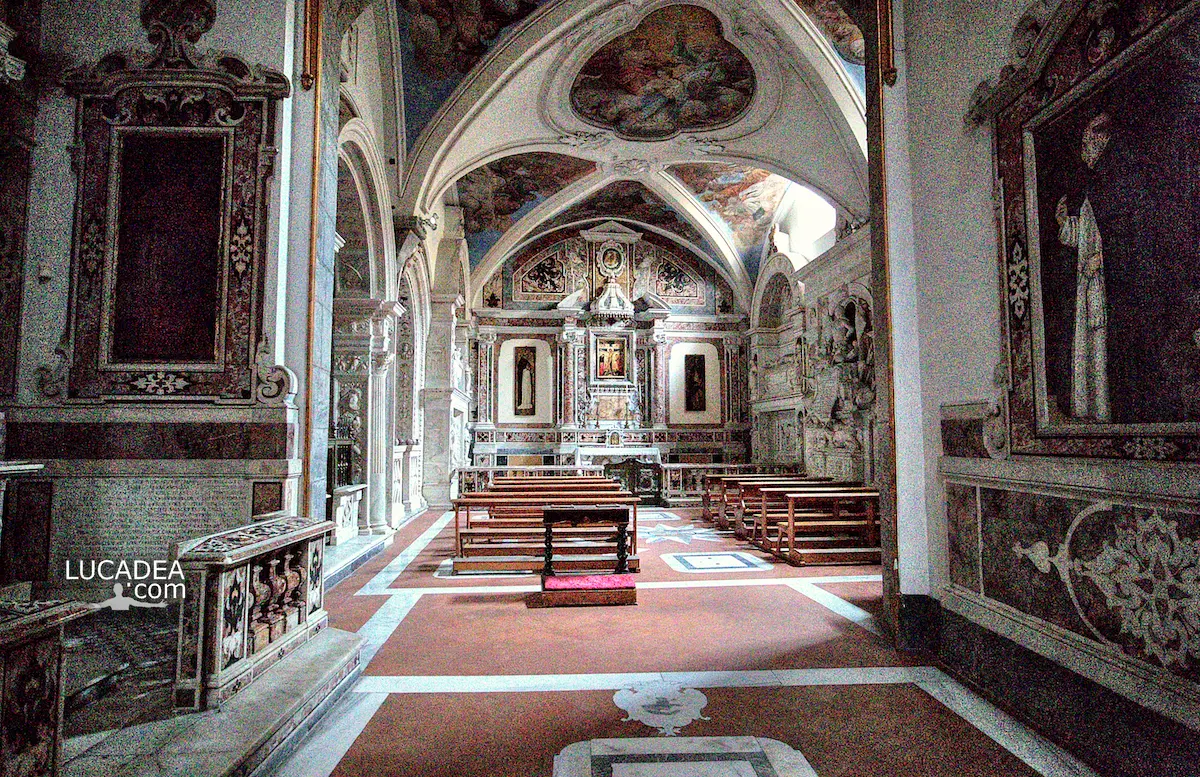
Inside San Domenico Maggiore, among the many chapels along the church, this large space caught my attention because of the number of details gathered within it and the strong presence of the Carafa family tombs. The Chapel of the Crucifix is one of those places in the historic centre of Naples where I naturally slowed down, especially once I began looking more closely at the monuments along the walls and the architectural details surrounding the altar.
This photograph was my way of preserving that first impression. Rather than focusing on a single work, I wanted to show the chapel as a whole and capture the sense that it forms a distinct environment within the larger church. After photographing the central nave of San Domenico Maggiore, which I have also featured in another story on the blog, I wanted to continue looking around and give this important space its own place in my photographic record of Naples.
The chapel stands on the right side of the basilica and is also known as the Carafa Chapel. Its history is closely connected with the ancient Carafa family, one of the most prominent noble families of Naples. Over the centuries, the space became almost a family pantheon because of the numerous funerary monuments dedicated to members of the family and people associated with them.
What I find particularly interesting when looking at the photograph is the way these different elements share the same space. There is no single detail demanding all of the attention. Architecture, decoration, tombs and the Crucifix that gives the chapel its name all contribute to the composition. The longer I looked, the more small details I noticed.
I took this photograph myself because the chapel seemed to represent something I often encounter when walking through Naples: an extraordinary concentration of history within a relatively small area. During a walk through the historic centre, you can step into a church and, within a few moments, find yourself surrounded by works connected with different periods, artists, families and historical figures.
The Chapel of the Crucifix is in Naples, Campania, Italy, inside the Basilica of San Domenico Maggiore in the heart of the historic centre. The location is part of its appeal because the basilica is deeply integrated into the oldest urban fabric of the city. If you are visiting Naples and wondering what to see beyond its most famous landmarks, this is the kind of interior that can add another layer to your understanding of the city.
There is also an old tradition connected with the Crucifix that gave the chapel its name. According to the story, the thirteenth-century Crucifix spoke to Saint Thomas Aquinas, telling him that he had written well about Christ and asking what reward he wanted. The traditional account says that Thomas replied that he wanted nothing but Christ himself. The original Crucifix is no longer displayed on the chapel’s altar and is now kept within the convent.
That story gives the room another dimension, but when I look at my photograph I prefer to let the architecture and the details remain at the centre. The Carafa tombs are especially important to the visual character of the chapel. Among them is the funerary monument of Francesco Carafa, attributed to Tommaso Malvito and dated to the late fifteenth century, while the monument to Diomede Carafa is associated with several important sculptors working in Renaissance Naples.
These monuments are more than decoration. They reflect the importance that the Carafa family wanted to give to memory, status and artistic patronage. In this chapel, architecture and sculpture work together to create a space where family history remains physically present.
For me, however, the photograph is still about the experience of being there. A single image cannot include every detail of a chapel this rich, and I would not want it to. What it can preserve is the viewpoint I had at that particular moment, the arrangement that caught my eye and the reason I decided to raise the camera.
The Chapel of the Crucifix is also one of the reasons I find San Domenico Maggiore so rewarding to photograph. After the nave, there are chapels and other spaces that continue to reveal new details. The photograph I previously published of the Madonna Enthroned mosaic inside the Basilica of Santa Restituta came from a similar experience: discovering an important work while simply paying attention to what was around me.
For me, this is one of the pleasures of photographing historic churches. I do not always need a planned subject. Sometimes the architecture itself suggests where to stop.
Looking at this photograph again, I think the richness of the whole space is what makes it memorable. There is no need to choose a single detail immediately. The eye can move slowly through the chapel and discover its different elements one by one.

Is this one of the places in Naples that has impressed you during a visit? Add a comment or go to the bottom of the site to read what other visitors have written.

Chapel of the Crucifix inside San Domenico Maggiore in Naples, with Carafa tombs and historic decorations

Photo taken with Canon EOS M100 camera and Canon EF-M 11-22 lens.

To see all the photos I took in Naples, both that weekend and on other trips, click here:

The Chapel of Santa Rosalia in Palermo

Cappella di Santa Rosalia nella Cattedrale di Palermo

The Chapel of Santa Rosalia in Palermo.
Among the things to see inside Palermo Cathedral, this chapel is one of the places that caught my attention because so many details are concentrated in a relatively small space. As I entered the cathedral, the silver altar and the reliquary containing the remains of the city’s patron saint immediately drew my attention.
I took this photograph myself during my visit to Palermo, Sicily, using my Canon EOS M100 with a Tamron 16-300 lens. I had already photographed several parts of the city, but inside the cathedral I wanted to stop and capture one of the details that gave the building a very different atmosphere.
The Chapel of Santa Rosalia is located in the southern nave of Palermo Cathedral and is one of the most important places connected with the city’s devotion to its patron saint. The space contains several decorative elements, but the silver reliquary is undoubtedly the feature that gives the chapel its particular significance.
Looking at the photograph, I can still notice details that would be easy to overlook during a quick visit. The silver surface of the altar, the decorations and the surrounding works create a compact visual composition that invites you to stop for a moment. It does not feel like just another part of the cathedral to walk past. It is a place where architecture and religious devotion become closely connected.
The reliquary was one of the details that interested me most. Made in 1631, it was commissioned by the Palermo Senate to contain the remains of Santa Rosalia. The relics are still taken through the city during the celebrations dedicated to the saint, keeping a strong connection between this chapel and the people of Palermo.
The story of Santa Rosalia is deeply connected with Palermo. According to tradition, her bones were discovered on Mount Pellegrino in 1624, during the plague that was affecting the city. Her veneration quickly grew and she became the patron saint of Palermo.
That connection with the city is also what makes the chapel interesting to photograph. I am not simply photographing a richly decorated altar. I am trying to preserve the image of a place that has a strong religious and cultural meaning for the people of Palermo.
The walls of the chapel also contain reliefs connected with the miracles attributed to the saint. Together with the reliquary and the silver altar, these details contribute to the visual story of the space and help explain its importance.
One detail I find particularly interesting is that the silver reliquary was not created merely as a container for the relics. It was also designed as an important work of art and as an object that could be displayed during religious celebrations and processions. Its artistic and religious functions are therefore closely connected.
While I was visiting, I tried not to concentrate only on the main subject. When I photograph the interior of a church, I often let small details guide my composition: a decorative element, a metallic surface, a sculpture or an architectural feature can completely change the way a space appears through the camera.
Palermo Cathedral offers countless photographic possibilities. Its architectural history stretches across many centuries, and the building contains traces of different periods. That is why the Chapel of Santa Rosalia seemed particularly interesting to me within the larger cathedral: it shifts the attention away from the monumental architecture and towards devotion, memory and smaller details.
If you are visiting Palermo Cathedral, this is one of the places worth taking a little time to observe. Not only because the relics of Santa Rosalia are kept here, but because the altar, reliquary and surrounding decorations preserve an important part of the city’s religious history.
I also like connecting this photograph with the other images I have taken during my travels in Sicily. As with other historical places I have photographed for the blog, I am interested not only in the most famous view, but also in the details that make me stop and take out my camera.
In this case, it was the richness of the details that made me press the shutter. I did not need a spectacular scene. I simply had to pay attention to what was in front of me.
Looking at the photograph now, I see it mainly as a record of that visit. The Chapel of Santa Rosalia allowed me to experience another side of Palermo, quieter and more intimate than the city’s large streets and monumental façades, but just as closely connected with its history.
The photograph preserves that moment for me, and especially the memory of a place where art, religion and the identity of Palermo are closely intertwined.

Have you ever visited the Chapel of Santa Rosalia inside Palermo Cathedral? Add a comment or go to the bottom of the site to read what other visitors have written.

Chapel of Santa Rosalia inside Palermo Cathedral, with the silver altar and reliquary containing her remains

Photo taken with Canon EOS M100 and Tamron 16-300 lens.

Remember that there is also the Cathedral’s official website: cattedrale.palermo.it which offers a complete virtual tour of the monument.

Click here to see more beautiful images of the city:
foto gallery

🏠
  • Italiano