The Galleria Vittorio Emanuele II in Milan

La Galleria Vittorio Emanuele II di Milano

The Galleria Vittorio Emanuele II in Milan.
In the heart of the Lombardy capital, just a short walk from the Cathedral and its famous Madonnina statue, stands one of the city’s most elegant and recognisable landmarks. This magnificent covered arcade has brought together architecture, shops, cafés and everyday city life for more than a century and a half.
Some time ago, I had to travel to Milan to take care of an errand, and I decided it was the perfect opportunity to bring my camera along. Despite being only a couple of hours away by train, Milan is a city I still know surprisingly little about. Every visit makes me realise how much there is left to explore, so I hope to return one day with more time to discover it properly. Of course, I couldn’t miss the chance to walk through the Galleria, one of the places most closely associated with the city’s image.
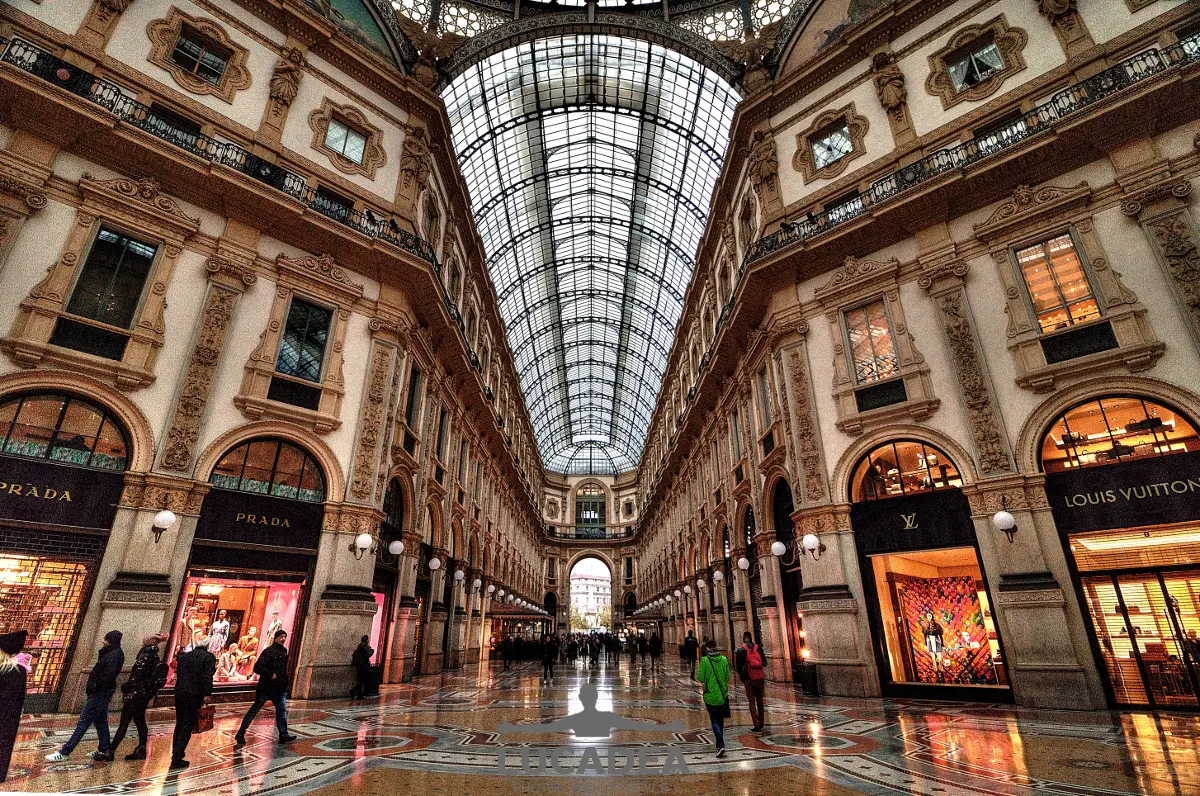
This photograph shows one of the classic views of the building: its monumental covered space, architectural decorations and the distinctive atmosphere beneath the glass roof. The Galleria is particularly famous for its luxury boutiques, international fashion brands, jewellers and prestigious shops. Yet it is much more than a shopping destination. It is also a pedestrian passage connecting Cathedral Square with La Scala Square, and a meeting place where residents and visitors stroll, admire the shop windows or stop for a coffee in one of its historic establishments.
Construction began in 1865, following a design by architect Giuseppe Mengoni. The Galleria was officially inaugurated on 15 September 1867 in the presence of King Victor Emmanuel II, after whom it was named. Some parts of the project, including the monumental entrance arch facing Cathedral Square, were completed later. The building has a cross-shaped layout and is covered by an impressive structure of iron and glass, with a large central dome above the octagonal space. At the time, this was an ambitious and modern architectural achievement, designed to give Milan a bright, monumental passage through the city centre.
Today, the Galleria is often described as Milan’s drawing room. It is an expression that captures its role rather well: this is not simply a covered shopping street, but a prestigious public space where local residents and international visitors come together. Luxury retail sits alongside historical architecture, decorative details and the pleasure of walking through an environment that has retained a strong identity over the years.
For now, I have simply taken a few photographs during that short visit. I would really like to return to Milan with more time available, explore its streets and discover some less familiar corners away from the busiest tourist routes. The Galleria, however, is one of those places that deserves to be photographed whenever the opportunity arises. Even a familiar view can be worth stopping for, especially when the architecture is as impressive as this.

Do you know Milan well, or do you still have plenty of places to discover there, as I do? Add a comment or go to the bottom of the site to read what other visitors have written.

The Galleria Vittorio Emanuele II in Milan, an elegant covered arcade linking Cathedral Square and La Scala Square

Photo taken with a Canon EOS M100 camera and Tamron 16-300 lens.

Click here if you want to see all the photos I took:
foto gallery

Here’s where the famous Gallery is located:

Add one  comment to this article or read  here what other visitors have written.
 
Adv
 
Disclamer

The rights on images, videos, choruses, text and all other material on the LUCADEA.com website are governed as per  Copyright page.


This page has been viewed 1 times today.
This month it has been viewed 1 times.
In total it has been viewed 1 times.
 

The Fountain in San Babila Square, Milan

Fontana di piazza San Babila a Milano, opera moderna in pietra progettata da Luigi Caccia Dominioni e ispirata al paesaggio lombardo

The Fountain in San Babila Square, Milan.
When exploring central Milan, it is easy to walk through busy squares on the way to the shopping streets or the Duomo without paying much attention to the details around you. The fountain in San Babila Square is one of those urban features that deserves a closer look. It is a contemporary work that combines architecture, water and natural stone in one of the city’s busiest areas.
San Babila Square lies in the heart of Milan, where important streets such as Corso Vittorio Emanuele II and Corso Venezia meet. The square developed into its present form mainly during the twentieth century and is now a busy crossroads surrounded by shops, offices and prominent buildings. With its metro connections and its position near the main shopping district, it is a place that many residents and visitors pass through every day.
The fountain was designed by architect Luigi Caccia Dominioni and completed in 1997. Its design is more than a decorative feature: it represents the landscape of Lombardy and the journey of water from the mountains through rivers and lakes towards the plains. The vertical stone structure suggests a stylised mountain, from which water flows down towards the lower basins. The overall composition creates a symbolic representation of the natural water cycle and the geography of the region.
The materials are an important part of the design. Different types of stone, including granites and rocks with reddish and grey tones, evoke the geological variety of Lombardy. Their surfaces respond differently to sunlight and water, adding texture and subtle changes of colour to the composition. Rather than copying the historical monuments found elsewhere in Milan, the fountain introduces a contemporary architectural element that fits into the surrounding urban space.
I enjoy photographing details like this because they reveal another side of a city. Milan is often associated with its cathedral, historic galleries, elegant buildings and modern architecture, but its public spaces also have their own character. A fountain can become a place to pause amid the movement of a busy square, offering a moment to observe the materials, shapes and ideas behind an urban design.
The next time you walk through San Babila, take a moment to look at the fountain and consider what it represents. It is not simply a combination of stone and water, but a small interpretation of the Lombard landscape in the centre of Milan. On Lucadea.com, I enjoy sharing these details discovered while exploring cities, because sometimes an ordinary walk reveals places and stories that deserve to be remembered.

Had you noticed the fountain in San Babila Square before, or did you already know about its connection to the landscape of Lombardy? Add a comment or go to the bottom of the site to read what other visitors have written.

Fountain in San Babila Square, Milan, a contemporary stone installation designed by Luigi Caccia Dominioni and inspired by Lombardy's landscape

Photo taken with a Canon EOS R50 V camera and Canon RF 28 lens.

Click here if you want to see all the photos I took:
foto gallery

Add one  comment to this article or read  here what other visitors have written.
 
Adv
 
Disclamer

The rights on images, videos, choruses, text and all other material on the LUCADEA.com website are governed as per  Copyright page.


This page has been viewed 1 times today.
This month it has been viewed 2 times.
In total it has been viewed 2 times.
 

The Ancient Columns of San Lorenzo in Milan

La zona di Milano con le Colonne di San Lorenzo

The Ancient Columns of San Lorenzo in Milan.
While walking around Milan, in Lombardy, northern Italy, I came across the famous Colonne di San Lorenzo, one of the city’s most recognisable historic landmarks. This impressive marble colonnade stands in front of the Basilica of San Lorenzo Maggiore, along Corso di Porta Ticinese. It is a fascinating place where the remains of Roman Milan meet the energy of modern city life.
There are sixteen columns, arranged in a long row, with marble shafts and elegant Corinthian capitals. In the centre, a brick arch interrupts the sequence and gives the monument its distinctive appearance. I like the contrast between the ancient architecture and the open square around it. The columns have stood here for many centuries, yet the area is still a lively meeting place where locals and visitors pass through throughout the day.
The monument is closely connected with the history of Mediolanum, the Roman city that once occupied this area. The columns themselves date back to the Roman imperial period, probably to the second century AD, and were originally part of a large public building. Their precise original location is uncertain. Towards the end of the fourth century, or at the beginning of the fifth, they were moved to their present position to form the monumental entrance area in front of the Basilica of San Lorenzo. This is a remarkable example of the reuse of ancient architectural elements in the construction of early Christian buildings.
The colonnade has also changed over time. The brickwork above the columns, including the central arch, was modified during the Middle Ages, probably between the eleventh and twelfth centuries. Looking closely at the capitals, visitors can notice that they are not all identical: some differ in style and dimensions, suggesting that the pieces came from more than one original structure.
Today, the Colonne di San Lorenzo are famous for another reason too. The square is one of Milan’s best-known meeting points, particularly in the evening. Young people, students, residents and tourists gather here before heading to the bars and restaurants along Corso di Porta Ticinese and in the surrounding streets. The atmosphere is very different from the one you might imagine when looking at an ancient Roman monument, and that is precisely what makes this place so interesting. In Milan, saying “See you at the Columns” is a familiar way of arranging to meet friends.
There is another historic detail worth noticing: the bronze statue of Emperor Constantine standing in the square. It was installed in 1937 and is a modern copy of an original kept in Rome. The space between the columns and the basilica also looked very different until the 1930s, when a group of buildings was demolished to reveal the monument more clearly.

I took these photographs while exploring Milan on foot. I wanted to capture not only the beauty of the marble columns but also the atmosphere of a place where history remains part of everyday life. If you are visiting Milan, the Colonne di San Lorenzo are well worth a stop, and the nearby basilica is another interesting place to explore. Have you ever visited this famous Milanese meeting point? Add a comment or go to the bottom of the site to read what other visitors have written.

The ancient marble Columns of San Lorenzo standing in front of the basilica in the historic centre of Milan, Italy

The ancient marble Columns of San Lorenzo standing in front of the basilica in the historic centre of Milan, Italy

Photos taken with a Canon EOS M100 camera and Canon EF-M 11-22 lens.

To see all the photos I took in the Milanese city, click here:

Here’s where the area is:

The Historic Grain Market in Arnaldo Square

L'antico palazzo del mercato dei Grani a Brescia

The historic Grain Market in Arnaldo Square.
Located in the historic centre of Brescia, in Lombardy, northern Italy, Arnaldo Square is one of the city’s most spacious and attractive public spaces. Bright and open, it is surrounded by historic buildings and arcades, and has become a popular meeting place for locals and visitors alike. In the evening, its many bars and restaurants fill with people, making it one of the main settings for Brescia’s nightlife.
One side of the square is defined by the long portico of the old Grain Market. This is the building I wanted to capture in my photograph. Its arcades create a distinctive architectural rhythm along the edge of the square, giving the whole space a sense of continuity and character. The portico is not simply a backdrop for the cafés and the people who gather here: it is a historic structure that reflects an earlier chapter in the city’s commercial life.
The name of the building recalls its original purpose as a place connected with the trade of grain and agricultural produce. It is an interesting reminder that many historic urban spaces were shaped by practical needs. Markets, covered walkways and porticoes once provided shelter and a setting for everyday commerce. Today, the same architecture serves a different role. Instead of merchants and customers trading goods, the square welcomes residents and visitors meeting for drinks, dinner or an evening out.
The building has recently undergone restoration work, carried out with the approval of the heritage protection authorities responsible for safeguarding historic architecture in the area. Restoring a structure like this is important not only because it preserves its physical features, but also because it protects the identity of the square itself. The portico remains part of the public space and continues to give Arnaldo Square much of its distinctive appearance.
I find places like this particularly interesting to photograph because they bring together different layers of a city’s identity. There is the architectural heritage, visible in the old masonry and the repeated arches, and there is the contemporary life of the square, with its bars, restaurants and evening crowds. These two aspects are not in conflict: they coexist and give the place its character. A building that once served a commercial function can still be central to the social life of a city centuries later.
Arnaldo Square is well worth including in a walk through Brescia. It offers a pleasant place to pause, enjoy the atmosphere and look more closely at the historic buildings around it. I enjoy documenting these details because they tell stories that can easily be missed when visiting a destination in search of its most famous landmarks. You can find more photographs and impressions of Brescia and other Italian cities in the photo stories on lucadea.com.

When you visit a historic square, do you pay attention to its architecture as well as its atmosphere? Add a comment or go to the bottom of the site to read what other visitors have written.

The historic portico of the Grain Market forming one side of Arnaldo Square in the centre of Brescia

Photo taken with a Canon EOS M100 camera and Canon EF-M 11-22 lens.

To see all the photos I took of the Castle of Brescia, click here:

The Piacentiniano Center in Bergamo

Porticato del Centro Piacentiniano a Bergamo con colonne, iscrizione latina e vista prospettica verso la piazza

The Piacentiniano Center in Bergamo.
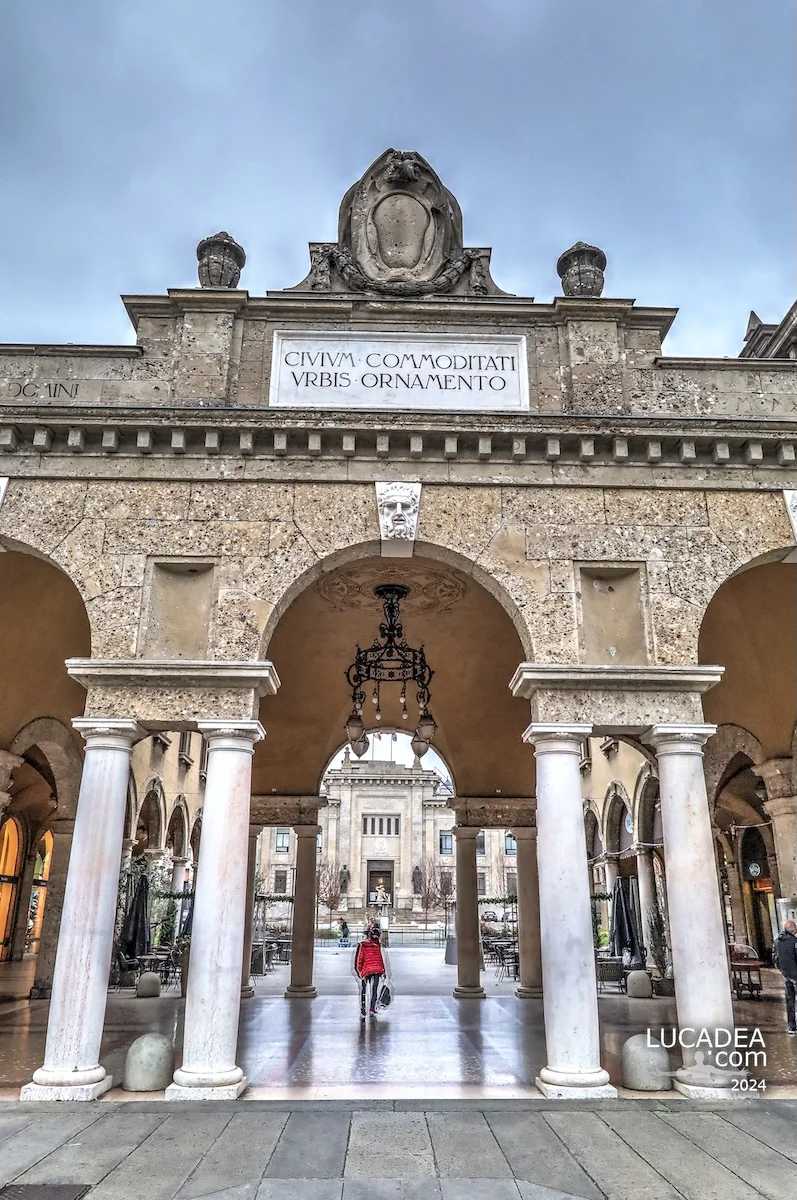
Walking through the heart of Bergamo’s lower town, I found one of the most elegant and balanced urban spaces in modern Italian architecture. The Piacentiniano Center stands out for its symmetry, the use of stone, and that sense of order that invites you to slow down and observe.
In this shot, I tried to capture one of the most representative arcades, with columns perfectly framing the view toward the building in the background. The central perspective naturally guides the eye, while the person walking through the scene adds a sense of everyday life.
Bergamo, in Lombardy, Italy, is well known for its dual identity: the historic upper town and the more modern lower city. The Piacentiniano Center belongs to this second part and was designed in the early 20th century by architect Marcello Piacentini, creating a spacious and well-organized urban area.
A notable detail visible in the photo is the Latin inscription above the arch: “CIVIVM COMMODITATI VRBIS ORNAMENTO,” emphasizing that this space was designed for the comfort of citizens and the beautification of the city.
Photographing a place like this means capturing not only architecture but also how it is lived. The arcades host cafés and shops, people pass through, stop, and meet. It is a space designed for everyday life.
On the blog, I have shared other Italian locations where architecture and daily life come together, because these are the places that best express the true identity of a city.

This image makes me reflect on how the balance between aesthetics and function can create truly enjoyable spaces. Do you prefer historic old towns or more modern and rational architecture? Add a comment or go to the bottom of the site to read what other visitors have written.

Photos taken with Canon EOS RP and Canon RF 24-50 lens.

To see all the photos I took in Bergamo, click here:

La Taverna degli Scudi, a Brewery in Salò

La Taverna degli Scudi a Salò

La Taverna degli Scudi, a Brewery in Salò.
Last weekend, I finally managed to visit my friends Alejandro and Leonardo at their place in the centre of Salò. They had opened their bar several months earlier, but it was only recently that I found the time to stop by. I was glad to see what they had created and spend some time with them in this lovely town on the shores of Lake Garda.
La Taverna degli Scudi is the kind of place where good beer, a few snacks and friendly company are the main ingredients for an enjoyable evening. Sometimes a night out does not need much planning. A relaxed atmosphere, something good to drink and the chance to catch up with friends can be more than enough. In this case, the visit also meant seeing how Alejandro and Leonardo had brought their idea to life and established a new meeting place in town.
Salò is in the province of Brescia, in Lombardy, northern Italy, on the western shore of Lake Garda. Its historic centre is made up of narrow streets, small squares and lively corners that invite visitors to explore on foot. The waterfront is one of the town’s most recognizable features, but there is also plenty to discover away from the lake, among the streets where local businesses are part of everyday life. La Taverna degli Scudi fits into this setting as a place to stop for a drink and spend time with friends.
My visit happened to coincide with a live music evening. That made the occasion even more enjoyable, turning an ordinary catch-up into a night with something extra to experience. Live music can change the feel of a bar, encouraging people to stay longer, talk, listen and share the moment. It is also a way for independent venues to offer something beyond their everyday service and become part of the social life of the town.
When I write about places on Lucadea.com, I like to include these personal encounters alongside photographs of landscapes, buildings and well-known sights. A town is not only defined by its architecture or its views; it is also shaped by the people who live and work there, the businesses they create and the places where people meet. Visiting La Taverna degli Scudi gave me the chance to reconnect with two friends and see their project for myself.
The name La Taverna degli Scudi is distinctive and easy to remember. It suits the character of a beer bar where the idea is to enjoy a drink without too much formality. Having snacks available makes it a convenient stop whether you want something small to eat or prefer to settle in for a longer evening. The live music events provide another reason to return, especially for anyone who enjoys venues that bring people together around shared interests.
If you are visiting Salò and looking for a place to enjoy a beer and a bite to eat, this is a venue worth keeping in mind. The town is a pleasant place to explore before or after a stop at a local bar, with the historic streets and lakeside setting offering plenty of opportunities for a relaxed walk. If live music is what you are looking for, it is best to check directly with the venue for upcoming dates, since the programme may change from week to week.
This visit also connects with the other stories I share on Lucadea.com about places I discover while travelling and the people who make those stops memorable. Not every photograph needs to feature a famous monument or an impressive landscape. Sometimes a personal visit, a friendly conversation and a lively evening are enough to capture a different side of a place.
I wish Alejandro and Leonardo every success with their new venture. It was good to finally see them at work and experience the atmosphere they are creating at La Taverna degli Scudi. I hope to return on another occasion, perhaps for another live music night and another chance to spend time with friends in the heart of Salò.

When you visit Salò, do you prefer a drink by the lakeside or discovering a beer bar tucked away among the streets of the historic centre? Add a comment or go to the bottom of the site to read what other visitors have written.

La Taverna degli Scudi, a beer bar in central Salò near Lake Garda, run by friends Alejandro and Leonardo

Se volete rimanere informati, collegatevi sulla sua pagina Facebook.

The golden apse of San Babila in Milan

Catino absidale dorato della Basilica di San Babila a Milano con luce calda e decorazioni architettoniche interne

The golden apse of San Babila in Milan.
As soon as I step inside the Basilica of San Babila in Milan, the golden apse immediately draws my attention, radiating a warm glow that contrasts with the subdued atmosphere of the church. The golden apse of San Babila in Milan, located in Milan, Lombardy, Italy, is one of those details that can easily go unnoticed unless you take the time to stop and look upward.
I remain still for a few moments, watching how the golden apse of San Babila in Milan reflects the available light, creating subtle variations across its curved surface. There is a quiet balance here, where architecture and light work together to shape the space in a way that feels both simple and deeply intentional.
If you are visiting Milan and wondering what to see beyond the most famous landmarks, this is a place worth seeing in Milan for those who appreciate hidden details and quieter spaces. The golden apse of San Babila in Milan offers a different perspective on the city, one that is less about movement and more about observation.
This moment reminds me of other interior photographs I’ve shared on lucadea.com, where focusing on architectural details reveals aspects of a place that are often overlooked. Here, the golden apse becomes the focal point of that slower, more attentive way of seeing.
A small historical note: in many churches, the apse is the most symbolically important area, often decorated to highlight its spiritual significance and to draw the viewer’s attention toward the altar.

I linger there just a bit longer, wondering how many people pass through without ever noticing this quiet glow above them. Have you ever looked up and discovered something unexpected? Add a comment or go to the bottom of the site to read what other visitors have written.

Catino absidale dorato della Basilica di San Babila a Milano con luce calda e decorazioni architettoniche interne

Photo taken with Canon EOS R50 V and Canon RF 28 lens.

To see all the photos of the Basilica, click here:
foto gallery

The mosaic in the apse, depicting Saint Babila and the three children martyred with him, was created in 1890 by Luigi Cavenaghi. The lunettes between the side arches and the dome, decorated with the figures of the Redeemer and the Virgin surrounded by various saints, are mosaics superimposed in 1929 over the original frescoes by the same artist.
Continue and learn more at Wikipedia

The golden apse of San Babila in Milan – L’abside dorée de San Babila à Milan – El ábside dorado de San Babila en Milán – A abside dourada de San Babila em Milão – Die goldene Apsis von San Babila in Mailand – Hậu cung dát vàng của San Babila ở Milan – 米兰圣巴比拉教堂的金色后殿 – ミラノのサンバビラ教会の金色の後陣

The text of this post was written with the help of ChatGPT, a language model from OpenAI.

The rose window of the Blessed Sacrament Chapel

Rosone della Cappella del Santissimo Sacramento a Brescia con luce filtrata e dettagli decorativi all’interno della chiesa

The rose window of the Blessed Sacrament Chapel in Brescia.
I look up at the rose window of the Blessed Sacrament Chapel in Brescia and immediately feel drawn into the quiet balance between light and structure, as the filtered glow shapes the space around me. The rose window of the Blessed Sacrament Chapel in Brescia, located in Brescia, Lombardy, Italy, is one of those details that often appear when people search what to see inside the city’s historic cathedral complex.
I stand still for a while, observing how the rose window of the Blessed Sacrament Chapel in Brescia transforms the light into something almost tangible, spreading softly across the interior surfaces. It is not just an architectural element but a focal point that connects space, symbolism, and atmosphere.
If you are visiting Brescia and wondering what to see beyond the main attractions, this chapel and its rose window represent a place worth seeing in Brescia for those who appreciate quieter, more intimate details. The experience feels less like sightseeing and more like a pause within the city.
As I’ve done in other photographic stories shared on lucadea.com, I find myself drawn to these smaller elements, the ones that don’t immediately demand attention but reward those who take the time to look. Here, the rose window of the Blessed Sacrament Chapel in Brescia becomes the center of that slow observation.
A small historical note: chapels dedicated to the Blessed Sacrament in Italian churches are often richly decorated, reflecting their importance in Catholic tradition and the central role of the Eucharist.

Have you ever paused long enough to notice how light alone can define a place? Add a comment or go to the bottom of the site to read what other visitors have written.

Rosone della Cappella del Santissimo Sacramento a Brescia con luce filtrata e dettagli decorativi all’interno della chiesa

Photo taken with Canon EOS RP and Canon RF 50 lens.

To see all the photos I took in the city of Brescia, click here:

The rose window of the Chapel of the Blessed Sacrament in Brescia – Le rosace de la chapelle du Saint-Sacrement à Brescia – El rosetón de la Capilla del Santísimo Sacramento en Brescia – O rosáceo da Capela do Santíssimo Sacramento em Brescia – Das Rosettenfenster der Kapelle des Allerheiligsten in Brescia – Hoa hồng cửa sổ của Nhà nguyện Thánh Thể ở Brescia – 布雷西亚至圣圣体小堂的玫瑰窗 – ブレシアの聖体礼拝堂のバラ窓

The text of this post was written with the help of ChatGPT, a language model from OpenAI.

Bergamo’s Campanone in the Old Square View

Il Campanone di Bergamo in Piazza Vecchia a Bergamo, Lombardia, Italia con Torre Civica e centro storico storico

Bergamo’s Campanone in the Old Square View.
Standing in the Old Square of Bergamo in Bergamo, Lombardy, Italy, I immediately find my attention drawn to the Campanone of Bergamo, also known as the Civic Tower of Bergamo, rising above the stone surroundings with a calm but constant presence. The Campanone of Bergamo and the Civic Tower of Bergamo define the visual rhythm of the Old Square of Bergamo, shaping how I experience the historic center.
As I walk closer, the Campanone of Bergamo feels less like a monument and more like a living marker of time. If you are searching for what to see in Bergamo, the Civic Tower of Bergamo in the Old Square is often considered one of the essential stops in the historic center, especially for those trying to understand the city’s identity.
The Old Square of Bergamo is not just an architectural space but a layered environment where daily life and history overlap. I often think back to other related images from the site, like those connected to the Venetian Walls, which expand the story of the city beyond this central point. The Campanone of Bergamo remains a constant reference in that visual memory.
A small but meaningful detail is the tradition of the tower’s bell, which still marks the evening with its hundred chimes, echoing an older civic rhythm. It is one of those places worth seeing in Bergamo, Lombardy, Italy, especially if you are visiting the historic center and wondering how past and present coexist so naturally.

Have you ever stayed long enough in the Old Square to really feel the Campanone of Bergamo? Add a comment or go to the bottom of the site to read what other visitors have written.

Il Campanone di Bergamo in Piazza Vecchia a Bergamo, Lombardia, Italia con Torre Civica e centro storico storico

Photo taken with Canon EOS RP and Canon RF 24-50 lens.

To see all the photos I took in Bergamo, click here:

Where is the tower located:

Pomodoro’s Large Disk in Milan

Grande Disco di Pomodoro a Milano in bronzo con incisioni complesse, tra le opere da vedere a Milano nel centro città

Pomodoro’s Large Disk in Milan.
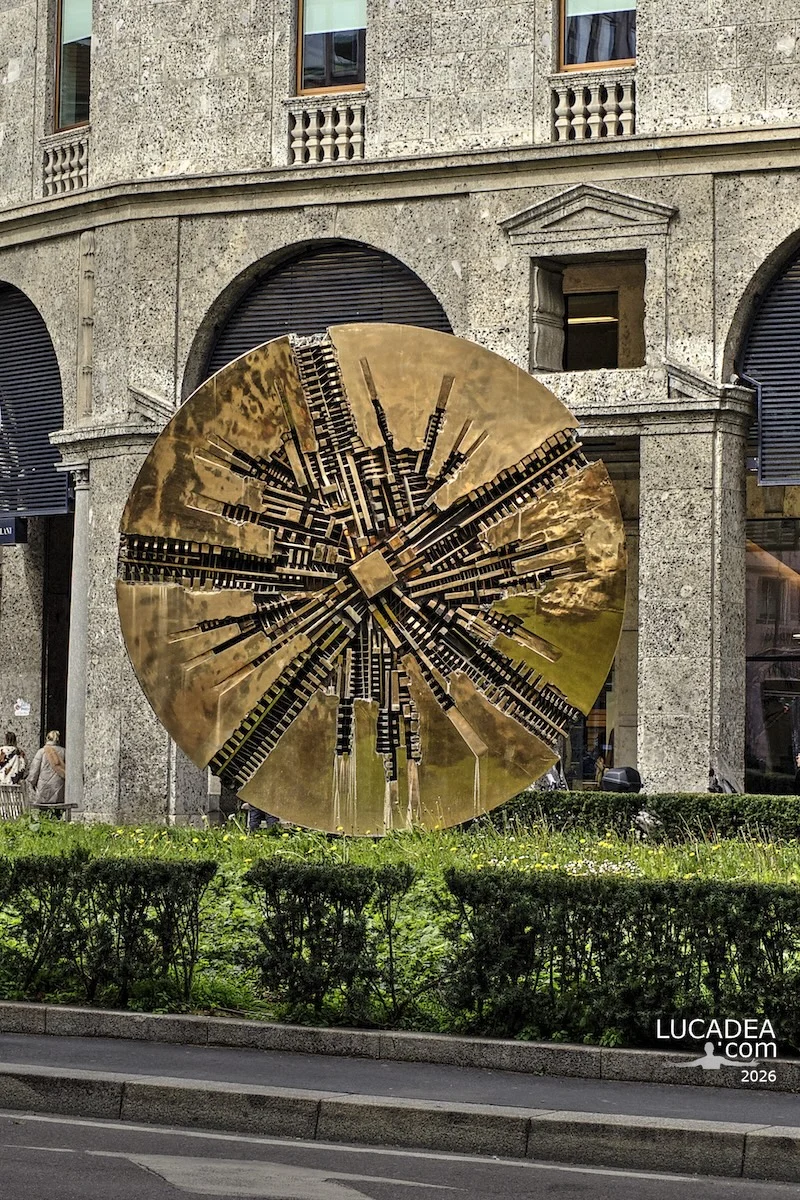
Walking through the center of Milan, trying to figure out what to see in Milan beyond the most famous landmarks, I unexpectedly came across the Large Disk by Pomodoro. Among the places to see in Milan, this sculpture stands out immediately, even in a city that is already full of visual contrasts.
It doesn’t blend into the background. The bronze surface, full of intricate carvings and openings, seems to shift as the light changes, creating different impressions depending on where you stand. When you search for what to see in Milan, you might think of cathedrals or historic buildings, but works like this offer a completely different perspective on the city.
Here we are in Milan, Lombardy, Italy, where everything feels fast-paced and dynamic. Yet standing in front of this sculpture, I slowed down without even realizing it. The details suggest hidden mechanisms, almost like the object is alive beneath its surface. It’s not just something to look at, but something to observe carefully.
If you are visiting Milan and wondering what to see, this is a place worth seeing not only for its artistic value but for the way it interacts with the surrounding space. It becomes part of the urban landscape rather than something separate from it.
It reminded me of another photo I shared on my site, also taken in Milan, where contemporary art blended seamlessly with everyday city life. There’s a continuity in these scenes that makes the city feel layered and complex.
A small interesting fact: the sculpture was created by Arnaldo Pomodoro, one of the most important contemporary Italian sculptors, known for his bronze works that reveal complex inner structures beneath smooth outer surfaces.
If you’re exploring what to see in Milan, you might discover that some of the most interesting spots are not the most obvious ones.

Have you ever stopped in front of a piece of art without fully understanding why it caught your attention? Add a comment or go to the bottom of the site to read what other visitors have written.

Grande Disco di Pomodoro a Milano in bronzo con incisioni complesse, tra le opere da vedere a Milano nel centro città

Photo taken with Canon EOS R50 V camera and Canon RF 28 lens.

Click here to see all the photos I took:
foto gallery

🏠
  • Italiano