The Ducal Court of Milan’s Sforza Castle

Corte Ducale del Castello Sforzesco a Milano con il colonnato del Portico dell'Elefante

The Ducal Court of Milan’s Sforza Castle.
During my last visit to Milan, I finally spent much more time walking around the city with my camera, and the Ducal Court of Sforza Castle was one of the places I wanted to photograph. Milan, Lombardy, Italy, is only a couple of hours away from where I live by train, yet I had not visited the city as a tourist nearly as often as I might have expected.
This time was different. I walked a lot, took plenty of photographs and tried not to concentrate only on the places I already knew from photographs or guidebooks. Sforza Castle was an obvious stop, but once inside I found myself paying more attention to its courtyards and architectural details than to the fortress as a whole.
This photograph shows the Ducal Court and the famous colonnade known as the Elephant Portico. What attracted me was the way the arches create a strong perspective across the open space of the courtyard. The architecture naturally guides the eye through the image, while the surrounding walls give the scene a sense of depth.
I took this photograph because I liked the composition rather than because I was trying to create a conventional picture of the castle. From outside, Sforza Castle is mainly perceived as a massive fortified complex, with its towers, walls and imposing entrances. Once inside, however, the atmosphere changes and the courtyards reveal a much more detailed architectural side.
If you are wondering what to see inside Sforza Castle, the Ducal Court is one of the spaces I would take time to look at rather than simply crossing on the way to another room. For a photographer, there are plenty of perspectives created by the arcades, columns and walls, and the architecture changes considerably depending on where you stand.
One small curiosity about the photograph is the name Elephant Portico. It comes from a fresco depicting an elephant, which gave the portico its traditional name. It is an interesting detail because the first thing most people notice when looking at the structure is its elegant colonnade rather than the decorative element behind the name.
Sforza Castle has undergone many changes throughout its history. It began as a military stronghold and later became associated with the ruling Sforza family and the ducal court. The complex we see today therefore contains different layers of Milan’s history, something that becomes particularly apparent when moving from the massive exterior fortifications into the more refined interior spaces.
For me, the Ducal Court is interesting precisely because it brings these different aspects together. The walls still suggest the original defensive role of the castle, while the arcades and architectural details remind us of its later role as a ducal residence.
I like photographs where the subject is not necessarily one isolated object. Here, the entire court became the subject. The columns, arches, walls and open space all contribute to the composition, and I spent some time looking for a viewpoint that made those elements work together.
That is one of the advantages of visiting a familiar city with more time than usual. During a quick visit, I might have entered the castle, looked around and moved on. On this occasion I had my camera with me and was paying attention to details, so I noticed several views that I would probably otherwise have overlooked.
Milan surprised me in that respect. Although it is relatively close to home, I had never really explored it at this pace. The last visit gave me the chance to walk much more extensively and photograph both the well-known landmarks and the smaller architectural details.
Sforza Castle was particularly rewarding because there are so many different photographic possibilities within the same complex. The exterior, towers, courtyards and arcades all offer completely different subjects, even though they belong to the same historic building.
The Ducal Court was one of the views that stayed with me. I liked the rhythm of the columns and the way the perspective leads through the courtyard. It is a relatively quiet architectural composition compared with the imposing appearance of the castle from outside.
I also like the fact that the photograph records something about my visit rather than simply documenting a famous Milan landmark. I was actually there, walking through the courtyard with my camera, looking for details that interested me. That personal connection is what I want to preserve when I add photographs to Lucadea.
For anyone visiting Milan, Sforza Castle is naturally one of the city’s major historic sights, but I think the experience becomes more interesting when you allow yourself enough time to look beyond the most obvious views. The courtyards are part of that experience, and the Ducal Court offers several perspectives that work particularly well through a camera lens.
This photograph is therefore less about presenting the castle as a tourist attraction and more about remembering a particular moment of my last visit to Milan. I had finally taken the time to explore the city properly, and the camera helped me notice details that might otherwise have passed unnoticed.
Looking back at the image, what I remember most is the perspective created by the Elephant Portico and the feeling of standing inside such a large historic complex after seeing the castle from the outside.

Have you visited Sforza Castle, and which part of the complex did you enjoy photographing the most? Add a comment or go to the bottom of the site to read what other visitors have written.

Ducal Court of Sforza Castle in Milan with the historic Elephant Portico and its columns

Photo taken with a Canon EOS M100 camera and a Canon EF-M 11-22 lens.

To see all the photos I took in Milan, click here:

This is the official website of the Castle: milanocastello.it.

Add one  comment to this article or read  here what other visitors have written.
 
Adv
 
Disclamer

The rights on images, videos, choruses, text and all other material on the LUCADEA.com website are governed as per  Copyright page.


This page has been viewed 1 times today.
This month it has been viewed 1 times.
In total it has been viewed 1 times.
 

A classic view of Milan’s Duomo Square

Piazza del Duomo a Milano con la cattedrale, la statua di Vittorio Emanuele II e la Galleria Vittorio Emanuele II

A classic view of Milan’s Duomo Square.
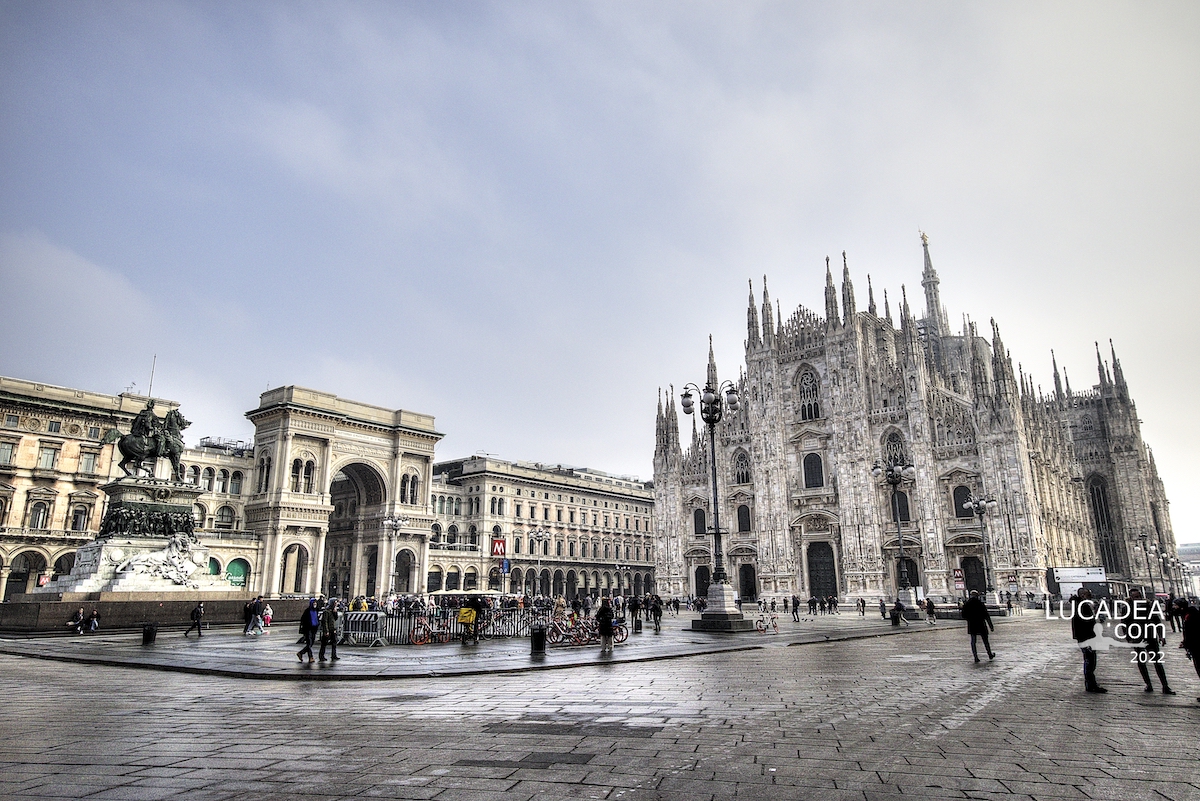
In front of me was one of the most recognisable views of Milan, with the Duomo, the statue of Victor Emmanuel II and the monumental entrance to Galleria Vittorio Emanuele II gathered within the same urban space. If you are wondering what to see in Milan, it is difficult to imagine a more familiar starting point, yet I still find something interesting in photographing a place whose details have been seen countless times.
I took this photograph during a visit to Milan and decided to keep the composition deliberately traditional. I was not trying to find an unusual angle or a hidden corner. Instead, I wanted to capture the square as I encountered it, with the cathedral dominating the scene and the Galleria opening on one side.
What makes this view work for me is the relationship between its individual elements. The Duomo naturally attracts most of the attention, but the statue in the centre of the square and the entrance to the Galleria are equally important in creating the overall composition. Together they make the location immediately recognisable, even without any additional explanation.
For anyone visiting Milan, Duomo Square is one of the places worth seeing simply because so much of the city’s identity comes together here. The cathedral, the Galleria and the surrounding buildings belong to different periods and have very different architectural characters, yet they form a remarkably coherent urban setting.
The Duomo itself has a particularly long history. Construction began at the end of the fourteenth century and continued, with changes and additions, for centuries. The result is the extraordinary accumulation of pinnacles, statues and architectural details that makes the cathedral difficult to take in as a whole. Even from a familiar viewpoint, there always seems to be another detail to notice.
For me, however, the photograph remains primarily a memory of being there. When I photograph a famous place, I do not always feel the need to search for something completely different. Sometimes I prefer to record the view that immediately defines the location and then let the surrounding details add their own story.
The Galleria Vittorio Emanuele II is particularly important in this composition. Its monumental entrance creates a strong architectural counterpoint to the cathedral. Beyond it lies the famous covered gallery leading towards Piazza della Scala, making this square part of a natural pedestrian connection between two of Milan’s best-known places.
Milan, Lombardy, Italy, is often associated with fashion, design and modern architecture, but this view shows another side of the city. Standing here, the historical identity of Milan becomes impossible to overlook. The square brings together religious architecture, civic symbolism and nineteenth-century urban design in one place.
The statue in the centre is dedicated to Victor Emmanuel II, the first king of unified Italy, and was unveiled in 1896. It can be easy to overlook when the eye is drawn immediately towards the enormous cathedral, but it plays an important role in the balance of the square and gives the foreground a strong central reference point.
There is also something particularly Milanese about the combination of the cathedral and the Galleria. They are very different architectural experiences. The Duomo rises vertically and is covered with countless decorative details, while the Galleria invites you to look inward through its monumental entrance. From the square, however, the two become part of the same visual story.
The famous Milanese expression came to mind while looking at this scene: “Ma Milan l’è on gran Milan!”, the line from a song by Giovanni D’Anzi. Even without translating it, the phrase captures something of the pride and affection associated with the city.
I like photographs of places like this because they become visual reference points. Later, when looking back at the image, I do not only remember the architecture. I remember being in the middle of the city and seeing all these familiar elements together, from the statue in the square to the entrance of the Galleria and the enormous façade of the cathedral.
This also fits naturally with the way I use Lucadea.com to document places I have actually visited. Some photographs show small details that might otherwise go unnoticed, while others record famous views exactly because they are part of the experience of being there. This one belongs firmly to the second category.
A classic view does not necessarily mean a predictable photograph. The challenge is simply to observe the scene and decide which elements deserve to remain in the frame. Here, I wanted the cathedral, the statue and the Galleria to remain connected, because together they tell much more about this part of Milan than any one of them could do alone.
Looking at the photograph now, I still think that this is one of those views that explains immediately why Duomo Square is such an important part of Milan. It is not only the cathedral that makes the place recognisable, but the entire architectural setting surrounding it.

Have you ever photographed Milan’s Duomo Square from this classic viewpoint? Add a comment or go to the bottom of the site to read what other visitors have written.

Milan’s Duomo Square with the cathedral, Victor Emmanuel II statue and Galleria Vittorio Emanuele II

Photo taken with a Canon EOS M100 camera and Canon EF-M 11-22 lens.

There is also the official website: duomomilano.it

To see all the photos I took on the roof and inside the Duomo, click here:

Add one  comment to this article or read  here what other visitors have written.
 
Adv
 
Disclamer

The rights on images, videos, choruses, text and all other material on the LUCADEA.com website are governed as per  Copyright page.

This page has been viewed 1 times today.
This month it has been viewed 1 times.
In total it has been viewed 1 times.
 

The Entrance to Brescia Castle, Italy’s Falcon

Ingresso del Castello di Brescia sul colle Cidneo, con il grande portale della fortificazione del Falcone d’Italia

The Entrance to Brescia Castle, Italy’s Falcon.
Walking up towards Brescia Castle on Cidneo Hill, the large gateway is one of the first details that made me feel the scale of the fortress. If you are visiting Brescia and wondering what to see beyond the streets of the city centre, I think a short walk up to the castle is well worth it, even simply for the walls and the changing view over the city.
I took this photograph at the entrance to the first line of walls. Beyond this passage, the fortification continues towards the top of the hill, with further walls, towers, bastions and paths that reveal how complex the defensive system once was. What interested me was precisely this transition: the gateway feels like a threshold between the city below and the world of the fortress.
Brescia Castle occupies Cidneo Hill and remains a constant presence above the city. Its elevated position is also the reason behind the nickname “Falcon of Italy”. Once you reach the castle, it is easy to understand the idea. The hill provides a commanding position over Brescia and helps explain why this site was so important for defence over such a long period.
I was not trying to create a spectacular view when I took this photograph. I was interested in the gateway itself, with its stonework and the heavy walls surrounding it. When I photograph historic places, I often prefer to stop at a particular detail rather than always looking for the most famous viewpoint. Here, the entrance already said a great deal about the character of the castle.
The gateway belongs to the major transformation of the fortress during the sixteenth century. One small detail is particularly interesting: the Lion of Saint Mark, the symbol of the Republic of Venice, appears on the monumental entrance. Brescia remained under Venetian rule for more than four centuries, so the symbol provides a direct visual connection between the architecture and an important period in the city’s history. Municipality of Brescia – Brescia Castle
The rest of the castle is much more complex than this single photograph might suggest. As you climb higher, you encounter structures belonging to different periods, showing how the fortress changed over time. This layering is one of the things I find most interesting about the place: it is not simply one historic building, but a collection of spaces shaped by different military and historical needs.
If you are visiting Brescia, the castle offers more than another historic monument to photograph. The climb itself gradually changes your relationship with the city below. From street level, Cidneo Hill can seem like a natural feature rising above the historic centre. Once inside the walls, it becomes much easier to understand how the position of the hill influenced the development of the fortress.
I like places where a photograph can begin with something very simple. A gateway, a tower or a section of wall may initially seem like just another architectural detail, but when you stand in front of the real structure it becomes part of a much larger experience. This image preserves that beginning for me, before I had continued further into the complex.
Today, the castle is of course much more than a military stronghold. The site is also a place to walk and explore, and it contains museums including the Luigi Marzoli Museum of Arms and the Museum of the Risorgimento. I do not want to turn this post into a visitor’s guide, though. What matters to me here is the reason I stopped at this particular entrance and decided to take the photograph.
The position of the castle is probably its most distinctive feature. Cidneo Hill rises beside the historic part of Brescia, making it easy to understand why this location was used for defensive purposes for so many centuries. The different layers of the fortress also make the history of the site visible without needing to know every detail beforehand.
I also like the fact that the former military site now has a very different relationship with the city. People can walk through the walls and along the paths of the hill without the place feeling closed or inaccessible. The fortress is still imposing, but it has also become part of everyday life in Brescia.
Looking at this photograph, however, I mainly remember that first passage through the entrance. It is the point where the climb into the actual fortified complex begins and, for me, where the visit started to feel different from an ordinary walk through the city.
This is the kind of photograph I enjoy keeping on the blog: not necessarily an image that explains an entire place, but one that brings back a precise moment. In this case, the large gateway is enough to take me back to the walls of the Falcon of Italy and to the beginning of that walk through Brescia Castle.

Have you ever visited Brescia Castle and walked through this entrance? Add a comment or go to the bottom of the site to read what other visitors have written.

Entrance to Brescia Castle on Cidneo Hill, showing the large gateway of the Falcon of Italy

Photo taken with a Canon EOS M100 camera and Canon EF-M 11-22 lens.

To see all the photos I took at Brescia Castle, click here:

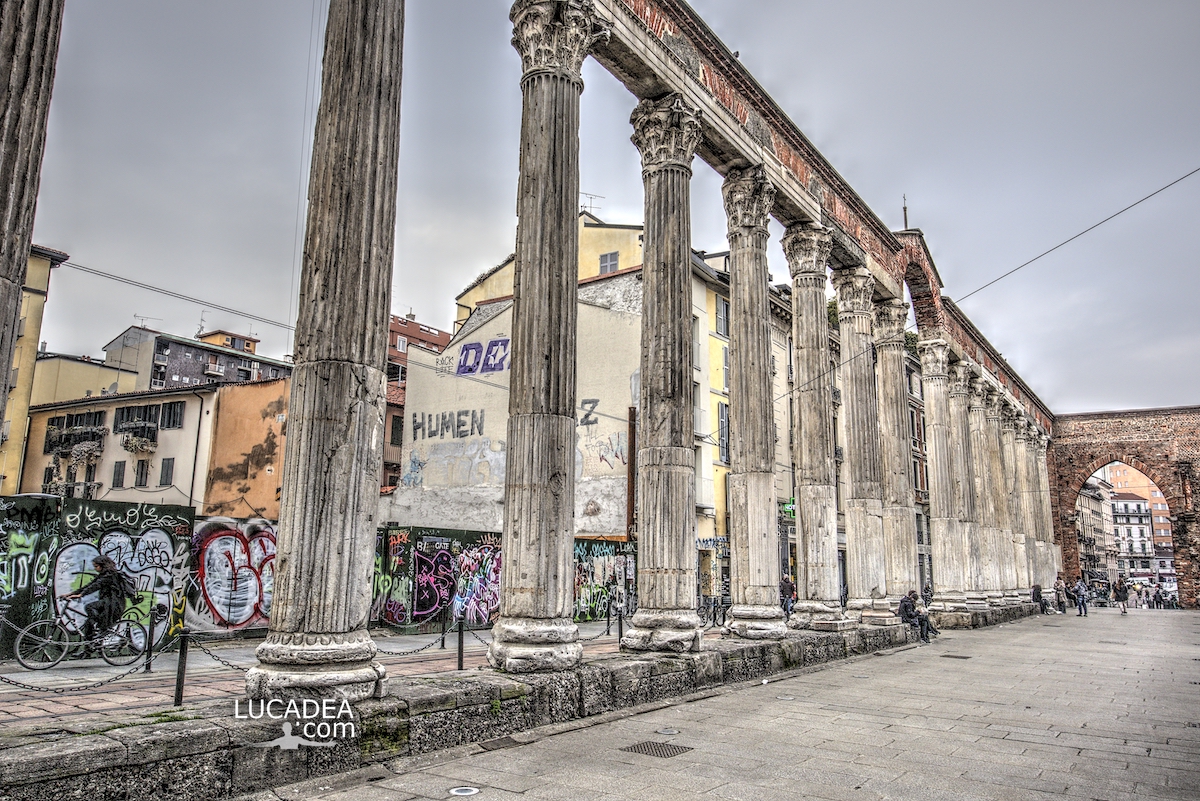
The Columns of San Lorenzo in Milan

Colonne di San Lorenzo a Milano, antiche colonne romane davanti alla basilica nel centro storico della città

The Columns of San Lorenzo in Milan.
While walking through Milan without a particular destination, we came across this group of columns, a place I mostly knew because of its reputation for nightlife. The Columns of San Lorenzo are one of the city’s best-known meeting places, especially for younger people, but looking at them more carefully reveals a much older story behind the lively atmosphere.
The photograph came from that moment, when an unplanned walk brought us to this particular corner of the city. I wanted to capture the columns and the surrounding space with my camera, keeping the feeling of standing in front of something that belongs to several very different periods of history.
When thinking about what to see in Milan, it is easy to focus on the Duomo, Sforza Castle and the city’s other famous landmarks. The Columns of San Lorenzo offer a completely different way of looking at Milan because the past and present occupy almost exactly the same space here. You can look at the people and buildings around you, then turn your attention to the columns and suddenly find yourself looking at part of Roman Milan.
The columns stand in front of the Basilica of San Lorenzo Maggiore, south of the historic center. There are sixteen Roman columns, probably taken from an earlier public building and reused during the construction of the basilica. Their survival makes this one of the most significant visible reminders of ancient Mediolanum in modern Milan.
That contrast is what caught my attention. On one side are the remains of Roman Mediolanum; on the other is modern Milan, with traffic, apartments, bars and people gathering there, particularly in the evening. The columns are not separated from everyday city life. People walk around them, meet there and pass through the same space every day.
I find it especially interesting that a place mainly known today as a meeting point for young people can also be an important archaeological site. You do not necessarily need to enter a museum to encounter Milan’s history. Here, the history is right beside the street, surrounded by a city that continues to change.
One small historical detail is that the Roman columns were transported and reused in the construction of the Basilica of San Lorenzo, helping create the architectural setting that survives today. Reusing Roman architectural elements in later buildings was common in many Italian cities, but here the result remains particularly visible.
For me, the photograph began with the simple surprise of finding such a historic place during an ordinary walk. We had not planned to come here, and perhaps that is one reason I like the image. Some photographs are created while deliberately looking for a subject; others happen when something unexpectedly interrupts the rhythm of a walk.
The Columns of San Lorenzo are therefore a good example of how Milan can preserve its history in places that now have a completely different everyday role. During the day they can be appreciated primarily as a monument and archaeological reminder; later in the evening, the same area becomes one of the city’s popular gathering places.
This kind of discovery connects naturally with the other photographs I have taken in Milan, where I often come across architectural details and historic places while moving through the city without following a fixed itinerary. That is one of the reasons I enjoy photographing cities: you do not always need to know beforehand what you are going to find.
In this image, I simply wanted to preserve a small fragment of a Milan where distant periods exist side by side. The columns are ancient, the surrounding city is modern, and the people who gather around them belong entirely to the present. Everything occupies the same space without needing to be separated.
If you are visiting Milan and wondering what to see beyond its most famous landmarks, this is certainly one of those places where it is worth stopping for a few minutes and looking more closely.

Have you ever discovered a historic place almost by accident while simply walking through a city? Add a comment or go to the bottom of the site to read what other visitors have written.

Columns of San Lorenzo in Milan, ancient Roman columns standing in front of the basilica in the city center

Photo taken with a Canon EOS M100 camera and a Canon EF-M 11-22 lens.

To see all the photos I took in Milan, click here:

Here is where the area is located:

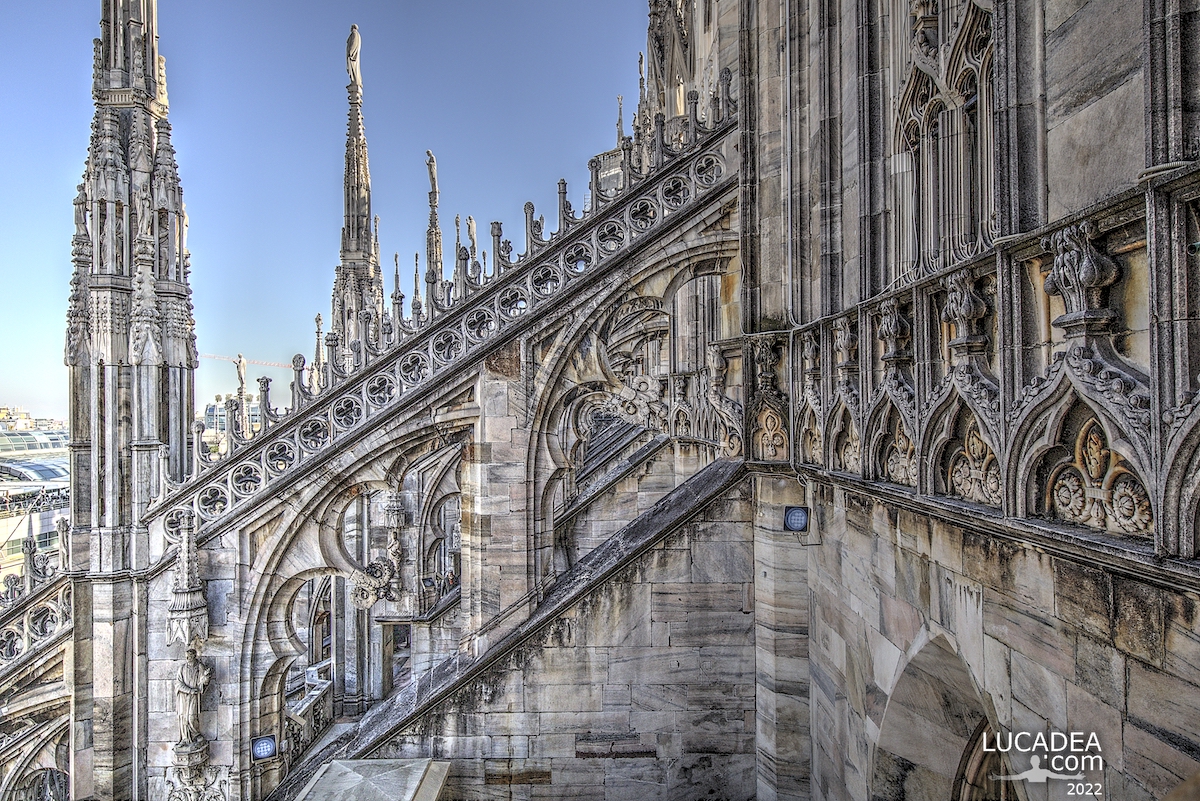
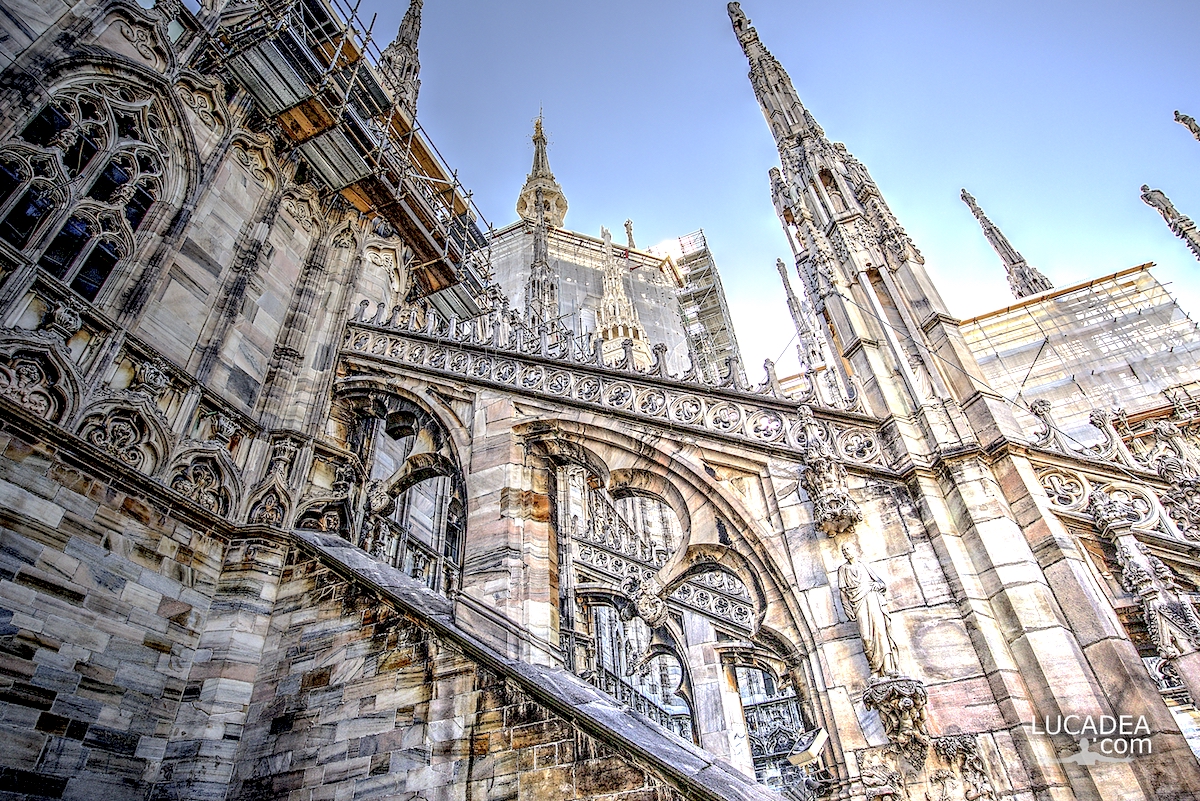
The spires of Milan Cathedral

Guglie e statue del Duomo di Milano viste da vicino, tra pinnacoli e dettagli dell’architettura gotica

The spires of Milan Cathedral.
Whenever I stop to look at Milan Cathedral, I often find my attention moving upward from the huge façade towards the spires, statues and countless details that shape the skyline of the building. In this photograph, I wanted to focus on that upper part of the cathedral, where the architecture seems to turn into an almost endless combination of shapes, points and carved decorations.
Milan Cathedral, in Lombardy, Italy, is one of those monuments that is difficult to take in all at once. Its size and the sheer number of architectural details mean that even after seeing it several times, there always seems to be another element worth noticing. The spires are among the features that define its appearance most strongly, especially when the eye moves away from the main façade and follows the highest parts of the cathedral.
That abundance of detail is what I enjoy photographing. I was not trying to show the cathedral through its most familiar overall view. Instead, I wanted to isolate part of the structure and let the spires and decorations become the main subject of the image. When photographing such a famous monument, I find it interesting to avoid repeating the obvious view and look for a smaller detail within the much larger architectural composition.
The spires are tall, pointed architectural elements that contribute strongly to the silhouette of Milan Cathedral. Together with the statues, pinnacles and ornamental details, they create the distinctive texture that makes the building recognizable even from a distance. Up close, however, the experience is completely different. There are so many sculptures and shapes that it becomes difficult to keep your eyes on just one detail.
The construction of Milan Cathedral began at the end of the fourteenth century and continued for many centuries, involving different phases of work and generations of architects, artists and craftsmen. One detail I find particularly interesting is this extraordinary continuity of construction and restoration. The cathedral we see today is the result of a very long architectural history, in which the original Gothic project was followed by later interventions and restorations that helped shape its present appearance.
The spires should therefore not be considered simply as decoration placed on top of a large church. They are an essential part of the cathedral’s identity and of the way it rises above Milan. Their vertical lines emphasize the upward movement that is so characteristic of Gothic architecture, creating a strong relationship between the stone structure and the sky above it.
If you are visiting Milan and wondering what to see, the cathedral is naturally one of the places that comes first to mind. Yet even people who have already visited it can discover something new by changing the way they look at it. Looking closely at the spires reveals details that can easily disappear when the cathedral is viewed only from the square. Statues, pinnacles, arches and carved decorations form a complex composition that rewards a slower look, especially when photography is involved.
This photograph came from exactly that kind of observation. I wanted to capture a detail of the monument that is often perceived only as part of the cathedral’s enormous silhouette. Once you look closer, however, every element seems to have its own shape and position within the larger structure.
There are already other photographs on the blog exploring Milan Cathedral, including views of its façade and earlier images focusing on its arches and spires. This photograph naturally continues that small visual exploration, with the intention of finding another detail rather than simply repeating the same familiar image.
That is one of the things I enjoy about photographing famous monuments. The more recognizable they are, the more interesting it becomes to look for something that usually escapes attention. With Milan Cathedral, the spires offer almost endless possibilities. A different viewpoint, a closer look at the sculptures or simply raising the camera towards the roof can completely change the way the same monument appears.
For anyone searching for photographs of Milan Cathedral or wondering what makes it so distinctive, the spires are perhaps one of the best places to start looking beyond the familiar postcard view. They are not just part of the skyline: they are a collection of individual details that together create one of Milan’s most recognizable architectural profiles.

Have you ever looked closely at the spires of Milan Cathedral and tried to pick out their individual details? Add a comment or go to the bottom of the site to read what other visitors have written.

Milan Cathedral spires and statues seen up close, with pinnacles and detailed Gothic architectural decorations

Milan Cathedral spires and statues seen up close, with pinnacles and detailed Gothic architectural decorations

Photos taken with a Canon EOS M100 camera and a Canon EF-M 11-22 lens.

This is the official website of the cathedral: duomomilano.it.

Click here if you would like to see all the photos I’ve taken:
foto gallery

Here is where the cathedral is located:

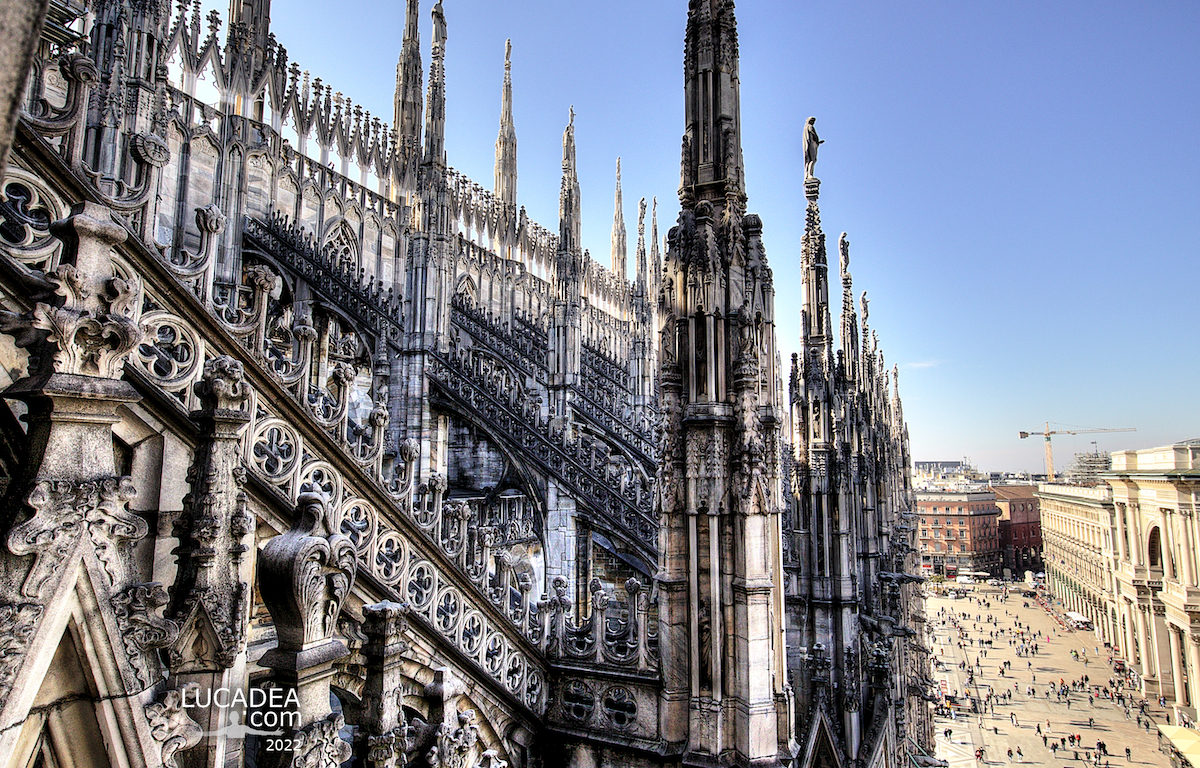
Spikes and arches on Milan Cathedral

Guglie e archi in pietra sulle terrazze del Duomo di Milano, tra le intricate decorazioni della cattedrale

Spikes and arches on Milan Cathedral.
Standing on the rooftop terraces of Milan Cathedral, I found myself surrounded by an extraordinary amount of carved stone, with arches, spires and decorations appearing in almost every direction. It is a completely different perspective from the one you get from the square below, because here you are almost inside the architecture itself.
The main subject of this photograph is the collection of spires and arches on Milan Cathedral, but deciding what to include in the frame was not easy. Every time I moved my eyes, another detail appeared: a statue, a decorative element or a new overlapping arrangement of lines. Photographing such a dense architectural scene without losing the balance of the composition felt like a small challenge.
What struck me most was the feeling of being surrounded by a kind of stone maze. From street level, we are used to seeing the Duomo as one enormous cathedral, while from the rooftops the perception changes completely. The shapes become closer, the proportions are harder to read and the sheer number of architectural elements makes it difficult to understand where one structure ends and another begins.
I took this photograph while visiting the cathedral terraces. I was not trying to make another general picture of Milan Cathedral. Instead, I wanted to preserve the sensation of standing among all those arches and spires, with the carefully worked stone surrounding me.
If you are wondering what to see at Milan Cathedral, the terraces offer a particularly interesting perspective. They are not only a place from which to look across Milan from above, but also an opportunity to get close to architectural details that remain distant and difficult to distinguish from the street.
Milan Cathedral is one of the major examples of Gothic architecture in Italy, and its construction developed over several centuries. One of its most recognisable characteristics is the extraordinary number of spires, pinnacles and decorative elements that shape its silhouette. The famous Madonnina, standing on the highest spire, has also become one of the enduring symbols of Milan.
For this photograph, however, I wanted to stay much closer to the architecture. Rather than looking for the classic image of the cathedral, I chose to concentrate on a small section of the rooftops. Sometimes a detail can tell the story of a building more effectively than a complete view, especially when the architecture is as complex as this.
The biggest difficulty for me was finding a composition that did not become visually confusing. The terraces are filled with architectural elements, and moving only a little can completely change the image. Arches and spires overlap, creating depth while also producing an enormous number of lines that the camera has to organise.
That is one of the things that makes photographing Milan Cathedral so interesting from close range. It is not simply about photographing a famous monument. It is about constantly searching for another point of view. The same building can look completely different depending on the distance, height and portion of the architecture included in the frame.
Standing on the rooftops also makes you realise how much work lies behind the seemingly continuous surface of the cathedral. From a distance, the stone appears almost uniform. Up close, countless details emerge, each with its own shape and position.
I wanted this photograph to retain some of that sensation. I was not simply trying to show that I had visited the terraces. I wanted the image to communicate what it felt like to stand inside that extraordinary collection of forms.
This photograph also connects naturally with other images I have taken over the years of Milan and its landmarks. I enjoy returning to familiar places and looking for a different detail each time, because even a building we know well can reveal an entirely new perspective when we change the way we observe it.
Here, it was the spires and arches that caught my attention. Together they create an almost abstract scene, even though every shape belongs to one of the most recognisable monuments in Italy.
Perhaps that is the real challenge, and also the pleasure, of photographing Milan Cathedral. When there is so much architectural richness in front of the camera, the difficult part is deciding what not to include.

Which detail of Milan Cathedral’s rooftops would have caught your eye first? Add a comment or go to the bottom of the site to read what other visitors have written.

Stone spires and arches on the rooftops of Milan Cathedral, surrounded by intricate Gothic architectural details

Photo taken with a Canon EOS M100 camera and Canon EF-M 11-22 lens.

To see all the photos I took on the roof and inside the Duomo, click here:

This is the official website of the Duomo: duomomilano.it.

Here is where the Duomo is located:

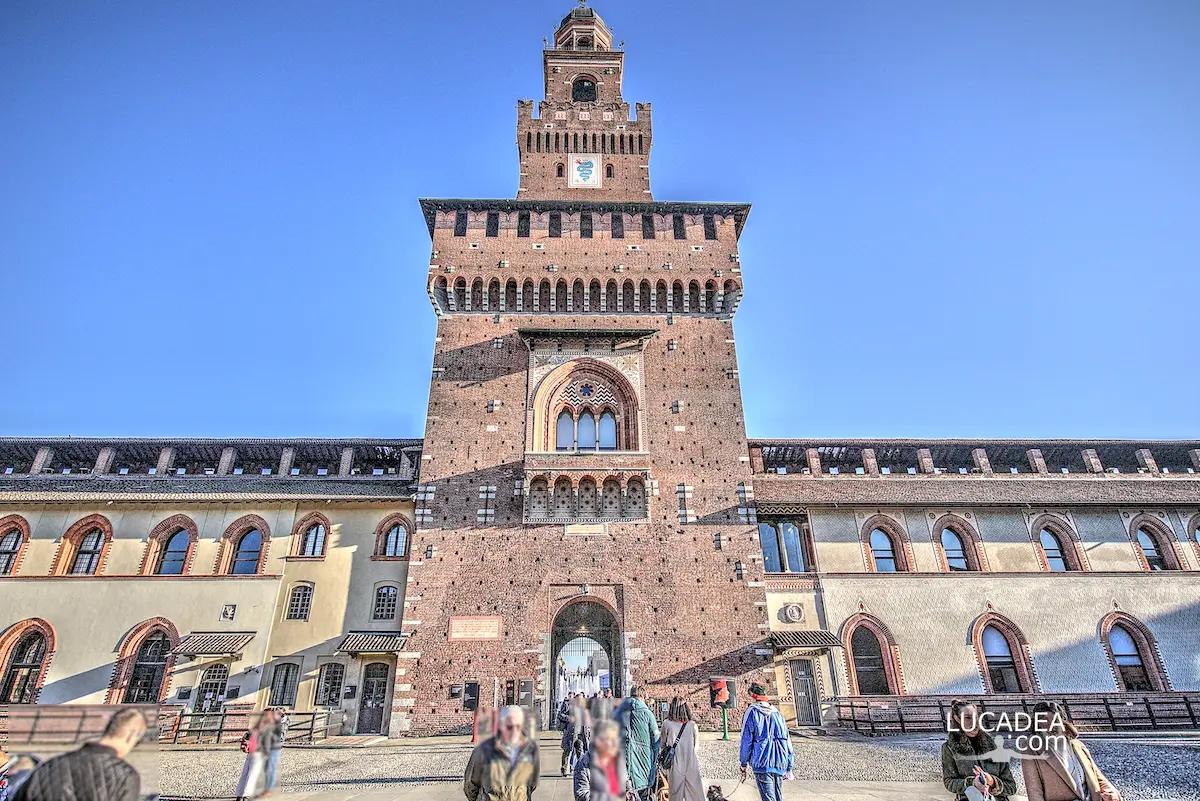
The Filarete Tower at Sforza Castle

Torre del Filarete del Castello Sforzesco fotografata dalla Piazza d'Armi interna a Milano

The famous Filarete Tower of Sforza Castle in Milan.
In the heart of Milan, Lombardy, Italy, stands one of the city’s most representative monuments: Sforza Castle. Although it is not Milan’s main symbol, like the Cathedral or other iconic landmarks, its main tower, known as the Filarete Tower, is certainly one of the most recognizable and photographed elements.
The photograph I am sharing today has a particular feature: unlike many images that are taken from outside the castle walls, this one was captured from inside the complex, precisely from the castle’s Parade Ground. This viewpoint allows the tower to be seen from a different perspective, surrounded by the monumental spaces and historic architecture of the castle.
The Filarete Tower takes its name from the Tuscan architect Antonio Averlino, known as Filarete, who designed the original tower in the fifteenth century for Francesco Sforza. However, the tower had a troubled history: the sixteenth-century structure was destroyed in 1521 due to a gunpowder explosion and disappeared from the castle’s skyline for centuries.
At the beginning of the twentieth century, it was rebuilt by architect Luca Beltrami, who based his work on historical documents and period evidence. The new tower, inaugurated in 1905, is now one of the most photographed parts of Sforza Castle and represents the connection between Renaissance Milan and the modern city.
Walking inside the castle, visitors can feel the historical importance of this place, originally built as a military fortress and later transformed into one of Milan’s most important cultural complexes. Today it houses museums and important art collections while preserving the charm of its centuries-old history.
I always enjoy looking for unusual viewpoints when photographing famous monuments: sometimes simply changing perspective reveals new details even in the most well-known places.

Do you know the Filarete Tower and have you ever visited Sforza Castle in Milan? Add a comment or go to the bottom of the site to read what other visitors have written.

Filarete Tower of Sforza Castle photographed from the internal Parade Ground in Milan

Photo taken with a Canon EOS M100 camera and a Canon EF-M 11-22 lens.

To see all the photos I took in Milan, click here:

This is the official website of the Castle: milanocastello.it.

The central tower—the castle’s tallest and its main entrance—is known as the Filarete Tower, named after the Tuscan architect commissioned to design it by Duke Francesco I. Destroyed by an explosion in the early 16th century[18], it was rebuilt in the early 20th century on the site of the original, which had been lost.
Read more on Wikipedia

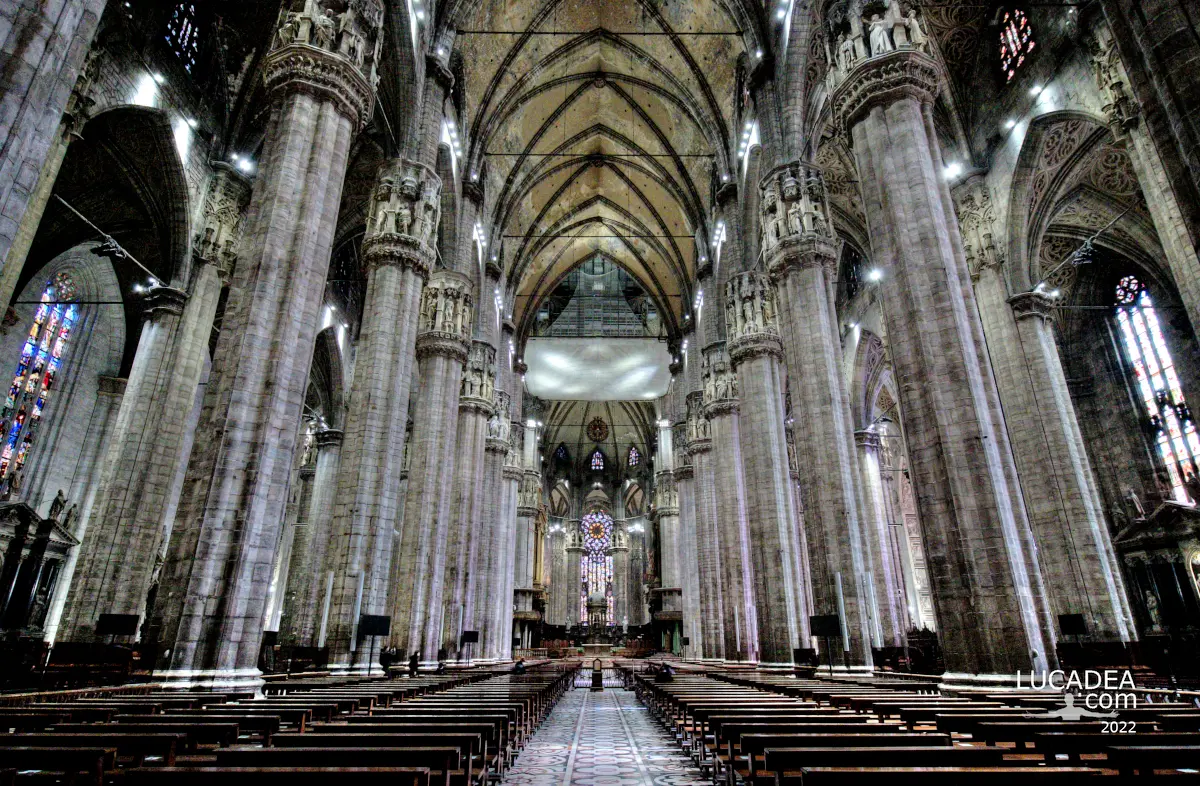
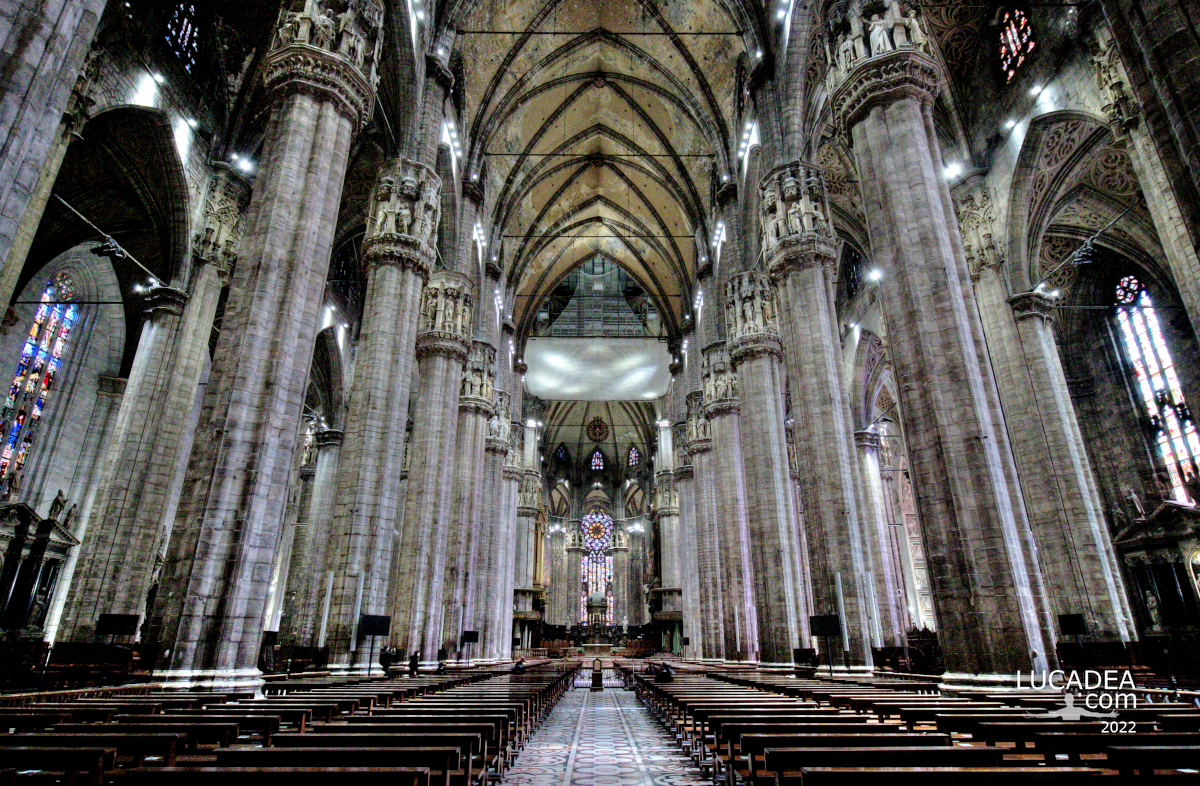
Inside Milan Cathedral between art and history

Interno del Duomo di Milano con colonne gotiche, navate, altari e dettagli artistici della celebre cattedrale italiana

Inside Milan Cathedral between art and history.
Stepping inside Milan Cathedral, in the heart of Lombardy, Italy, I found one of the most recognizable places to see in Milan and a perfect subject for photography. The interior of Milan Cathedral immediately captures attention with its enormous scale, endless columns, and the impressive sense of depth created by the long central nave.
When I took this photograph, I wanted to preserve more than just the architectural details. I wanted to capture the relationship between the vast space of the cathedral and the people moving through it, because the Duomo is not only a monument to admire but also a living place where history and everyday visits meet.
Walking inside, you discover carved marble, decorated altars, statues, and stained glass windows that add different shades and textures to the atmosphere. The tall columns guide the view toward the main altar, while the Gothic vaults make the ceiling feel even farther away. This combination of scale and detail is what makes photographing Milan Cathedral so fascinating: every angle reveals a different story.
I chose to capture this scene with my camera because some places stay in your memory not only for their appearance but also for the feeling they create. Here, it is the balance between stone, decoration, silence, and movement that makes the experience unique. The architecture naturally leads your eyes through the space, inviting you to look at small details as well as the overall structure.
A short historical note: construction of Milan Cathedral began in 1386 and continued for centuries, involving many generations of craftsmen and artists. This long process helped create a building where different artistic influences can be found while maintaining its strong Gothic identity.
After exploring the interior, visiting the cathedral terraces offers another perspective, with the famous spires rising above the city skyline. I previously photographed another view of Milan from this area, and together these images show two different ways of experiencing the same landmark.
If you are visiting Milan and looking for places to see, the interior of Milan Cathedral is an experience that reveals not only the history of the city but also the incredible attention behind every architectural detail.

Which detail of Milan Cathedral impressed you the most during a visit? Add a comment or go to the bottom of the site to read what other visitors have written.

Interior of Milan Cathedral with Gothic columns, nave, altars and artistic details inside the famous Italian cathedral

Photo taken with a Canon EOS M100 camera and Canon EF-M 11-22 lens.

There is also the official website: duomomilano.it

To see all the photos I took on the roof and inside the Duomo, click here:

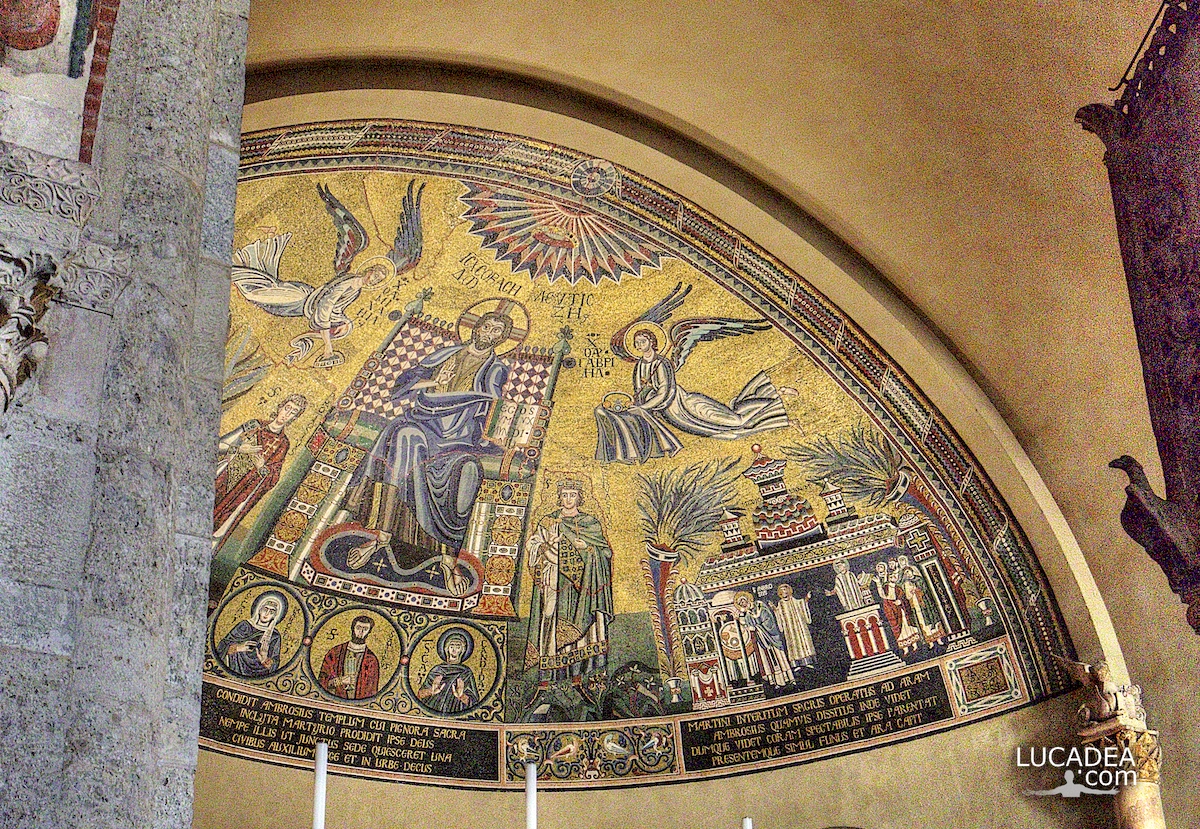
The apse mosaic of Sant’Ambrogio

Mosaico absidale dorato della Basilica di Sant’Ambrogio a Milano con Cristo Pantocratore

The apse mosaic of Sant’Ambrogio.
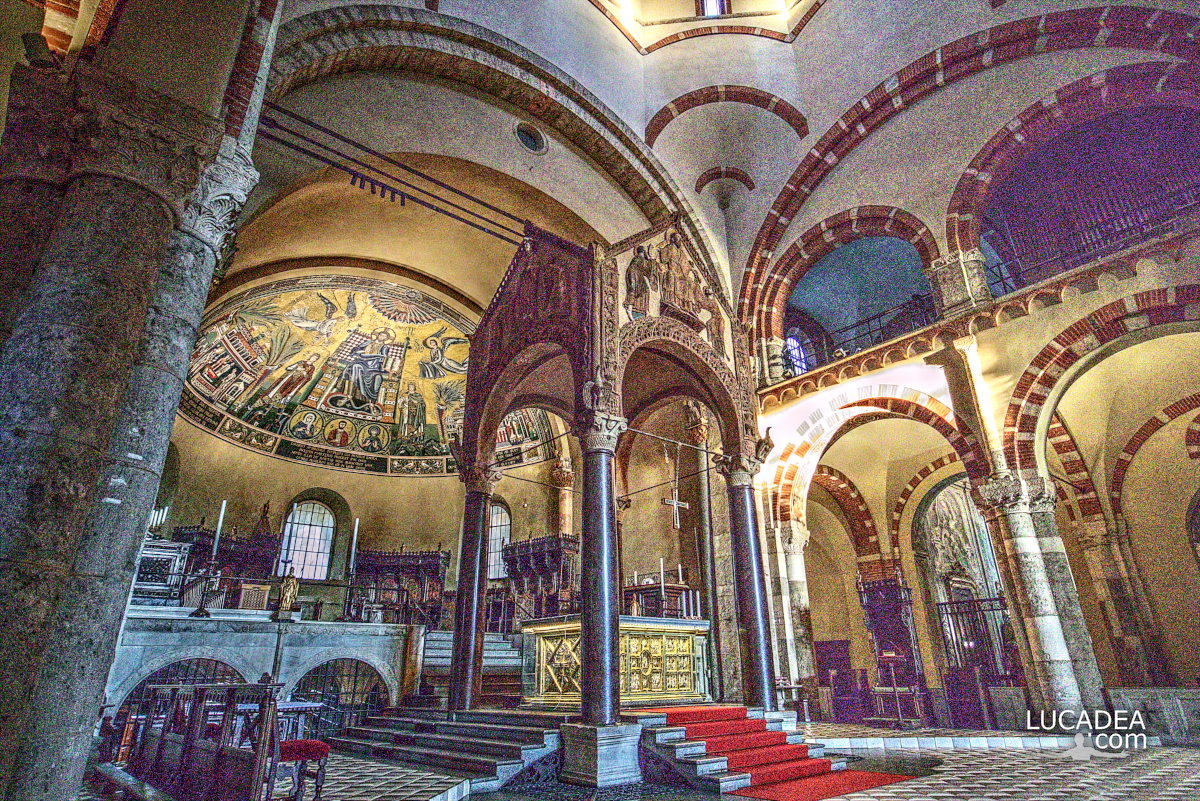
Inside Sant’Ambrogio Basilica in Milan, one of the elements that immediately captures the visitor’s attention is the large mosaic covering the apse, an extraordinary testimony to medieval art and the religious history of the city.
During my visit to the basilica, I wanted to photograph this detail because, besides the famous golden altar and the impressive ciborium, the apse creates one of the most spectacular areas of the entire building. The light reflecting on the golden tiles gives the mosaic a unique atmosphere and highlights the richness of its details.
At the centre of the composition is Christ Pantocrator, seated on a throne with the open book and surrounded by the symbols of the Evangelists. On both sides there are several saints, including Saint Ambrose, the patron saint of Milan to whom the basilica is dedicated.
The mosaic follows the principles of Byzantine medieval iconography, with a solemn and majestic representation of Christ. The vivid colours, the use of gold and the arrangement of the tiles create effects of light and depth that bring the figures to life.
I wanted to capture this detail with my camera because when visiting a church so rich in history, it is easy to focus only on the most famous elements and miss smaller masterpieces that deserve attention.
Sant’Ambrogio Basilica is located in Milan, Lombardy, Italy, and it is one of the most important monuments in the city. Founded in the 4th century by Bishop Ambrose, it preserves many valuable artworks and represents one of the finest examples of Lombard Romanesque architecture.
A small curiosity is that the apse mosaic, despite its ancient origins, has undergone several restorations over the centuries, including work after the damage suffered during the Second World War. Its current beauty is therefore also the result of careful conservation.
After photographing the golden altar of the basilica, I could not miss the opportunity to capture this magnificent golden wall dominating the altar area and welcoming visitors with its impressive presence.
Standing in front of such an artwork, it is natural to think about how many people, throughout the centuries, have looked up at the same mosaic and found in it both an artistic and spiritual reference.

Have you ever visited Sant’Ambrogio Basilica in Milan? Add a comment or go to the bottom of the site to read what other visitors have written.

Golden apse mosaic of Sant’Ambrogio Basilica in Milan featuring Christ Pantocrator

Photo taken with a Canon EOS M100 camera and Canon EF-M 11-22 lens.

This is the church’s official website: basilicasantambrogio.it.

To see all the photos I took at the Basilica, click here:

The mosaic adorning the semi-dome of the apse in the Basilica of Sant’Ambrogio depicts Christ enthroned against a gold background, flanked by Saints Gervasius and Protasius.
Read more and explore further at lombardiabeniculturali.it

The golden altar of Sant’Ambrogio Basilica

Altare maggiore dorato della Basilica di Sant’Ambrogio a Milano con mosaici dell’abside

The golden altar of Sant’Ambrogio Basilica.
Entering Sant’Ambrogio Basilica in Milan, your eyes are naturally drawn towards the centre of the church, where the magnificent golden altar stands beneath the ciborium, with the colourful mosaics of the apse behind it.
During my visit to the basilica, I wanted to capture this detail with my camera because, beyond its famous brick facade and beautiful cloister, the interior also preserves remarkable artistic and historical elements. Often, these less obvious details are the ones that reveal the true character of a place.
The main altar of Sant’Ambrogio Basilica is one of the most important masterpieces kept inside the church. Its golden and silver surfaces stand out beneath the ciborium, creating a fascinating composition together with the apse mosaic behind it. The richness of the decorations invites visitors to stop and observe carefully.
This photograph comes from my desire to tell the story of this part of the basilica, rather than focusing only on the most famous views. When I visit historic churches, I often try to photograph details that can communicate the feeling of standing in front of something that has survived through many centuries.
Sant’Ambrogio Basilica is located in Milan, Lombardy, Italy, and it is one of the most important religious buildings in the city. For anyone looking for places to see in Milan beyond the Duomo, this church offers a different perspective on the history and origins of the city.
A small curiosity about the altar is that it was created between the 9th and 10th centuries by order of Archbishop Angilberto II. Known as the Altar of Sant’Ambrogio, it is decorated with precious gold and silver panels, enriched with enamel work and gemstones. Beneath it are preserved the relics of Saints Gervasius and Protasius and of Saint Ambrose himself.
On my website I have already shared other views of Milan, from the Navigli area to the Brera district, but this basilica shows a different side of the city: older, quieter and deeply connected to its origins.
Photographing a detail like this means preserving a small fragment of a much larger story, hidden inside the walls of one of Milan’s most important churches.

Have you ever visited Sant’Ambrogio Basilica and looked closely at this remarkable altar? Add a comment or go to the bottom of the site to read what other visitors have written.

Golden main altar of Sant’Ambrogio Basilica in Milan with apse mosaics in the background

Photo taken with a Canon EOS M100 camera and Canon EF-M 11-22 lens.

This is the church’s official website: basilicasantambrogio.it.

To see all the photos I took at the Basilica, click here:

The Altar of Saint Ambrose is the high altar of the Basilica of Saint Ambrose in Milan. The altar is the focal point of the renovation carried out at the basilica by the Frankish bishop Angilbert II. The ancient basilica, with its wealth of relics, serves as the setting for the political and religious agenda guiding the bishop—a representative of Carolingian authority—in his reorganization of the city and its territory.
Read more on Wikipedia

🏠
  • Italiano