Milan Navigli between canals and old courtyards

Navigli di Milano con il canale e gli edifici storici della zona famosa per la vita urbana

Milan Navigli between canals and old courtyards.
Walking along the Navigli in Milan, I photographed one of the city’s most recognizable areas, where canals, historic buildings and modern city life create a unique urban atmosphere.
The Milan Navigli district is one of the places worth seeing when discovering a different side of the city, away from the most famous landmarks. This photograph was taken during a lunchtime walk, when the area was much quieter than the lively evening scene that usually makes the Navigli famous.
These quieter moments are often the ones I enjoy most for photography. Without the crowds of the nightlife hours, I could focus on the details of the neighbourhood, the reflections on the water and the relationship between the old structures and everyday life. I wanted to capture this view because it shows a more ordinary and authentic side of the Navigli, not only the image connected to restaurants and nightlife.
The Navigli are located in Milan, Lombardy, Italy, and they are among the most characteristic areas of the city. Today they are known for their cafés, restaurants and bars along the canals, but their history is connected to the important network of waterways that supported trade and transportation for centuries.
A small historical curiosity is that Milan once had a much larger system of canals than the ones visible today. These waterways were used to move goods across the city and played a role in transporting materials, including those used for the construction of the Duomo.
This photograph is the last image from that Milan trip and completes a small series dedicated to exploring different corners of the city. As in other posts on my blog about streets and urban details, I like finding places where history and daily life meet naturally.
The Navigli are interesting because they change completely depending on the moment of the day. They can become one of Milan’s busiest nightlife areas in the evening, but during quieter hours they reveal a different personality, made of old buildings, water and simple city scenes.
If you are visiting Milan and looking for places to see beyond the classic attractions, the Navigli offer a different way to experience the city and understand part of its history through a simple walk.

Have you ever visited the Navigli during the daytime, when the atmosphere is calmer? Add a comment or go to the bottom of the site to read what other visitors have written.

Milan Navigli with the canal and historic buildings in the famous urban district of the city

Photo taken with a Canon EOS M100 camera and a Canon EF-M 11-22 lens.

To see all the photos I took in Milan, click here:

The Navigli of Milan are a system of navigable irrigation canals centered on the Lombard city of Milan; they connected Lake Maggiore, Lake Como, and the lower Ticino River, opening up waterways from the Lombard capital to Switzerland and northwestern Europe, to the Canton of Grisons and northeastern Europe, and finally to the Po River and the Adriatic Sea.
Read more and find out more at milanofree

Add one  comment to this article or read  here what other visitors have written.
 
Adv
 
Disclamer

The rights on images, videos, choruses, text and all other material on the LUCADEA.com website are governed as per  Copyright page.


This page has been viewed 0 times today.
This month it has been viewed 0 times.
In total it has been viewed 0 times.
 

The iconic Bar Brera in Milan’s artistic district

Bar Brera nel quartiere Brera a Milano con tavolini esterni e atmosfera delle vie del centro storico

The iconic Bar Brera in Milan’s artistic district.
Walking through the streets of Brera in Milan, I photographed one of the most recognizable cafés in this famous neighbourhood, a place that perfectly reflects the elegant and lively atmosphere of the city centre.
Bar Brera in Milan is one of the places worth seeing when exploring the Brera district, an area known for art, historic buildings, small streets and outdoor cafés. Starting from the Duomo area, it only takes a short walk to reach this different side of Milan, where the rhythm becomes slower and the streets invite you to look around.
I took this photograph while walking through the city because I liked the way the café blends with the surrounding architecture. It is not only a place to stop for a coffee, but also a visual element of the neighbourhood itself, with its outdoor tables and its familiar presence among the streets of Brera.
When I photograph urban places, I always try to capture the connection between a single detail and the atmosphere around it. A sign, a doorway or a simple corner can often tell the story of a neighbourhood better than a large monument. In this case, the café became the subject because of the role it plays in the everyday life of the area.
This photograph was taken in Milan, in the Lombardy region of Italy, inside the historic Brera district. If you are visiting Milan and looking for places to see beyond the most famous landmarks, walking through Brera is a good way to discover another side of the city, where art, architecture and daily life meet.
A small curiosity about Brera is the origin of its name, which probably comes from the Lombard word “braida”, referring to an open area or field outside the ancient city walls. Over time, the neighbourhood became one of Milan’s most artistic and recognizable areas.
I enjoy photographing places like this because they preserve a sense of everyday life. Just as in my photographs of Ligurian villages and hidden corners of Italian towns, I like looking for details that create a connection with a place.
Bar Brera represents a typical Milanese experience: sitting outside, watching people walk by and enjoying the atmosphere of a historic neighbourhood. The photograph is not only about a café, but about the feeling of a street that continues to be lived every day.

Have you ever walked through Brera and stopped to enjoy the atmosphere around Bar Brera? Add a comment or go to the bottom of the site to read what other visitors have written.

Bar Brera in Milan’s Brera district with outdoor tables and the historic streets of the city centre

Photo taken with a Canon EOS M100 camera and Canon EF-M 11-22 lens.

I couldn’t find a link to the official website, only to the review on TripAdvisor.

To see all the photos I took in Milan, click here:

The area takes its name from Via Brera. The name Brera derives from *braida*, meaning uncultivated land or a vegetable garden. The term *Braidense*—associated with the library of the same name—also stems from this word. Artists who gravitated toward the Academy of Fine Arts starting in the 19th century transformed the neighborhood into one of Milan’s most distinctive districts.
Read more and find out more at milanofree

Add one  comment to this article or read  here what other visitors have written.
 
Adv
 
Disclamer

The rights on images, videos, choruses, text and all other material on the LUCADEA.com website are governed as per  Copyright page.


This page has been viewed 0 times today.
This month it has been viewed 0 times.
In total it has been viewed 0 times.
 

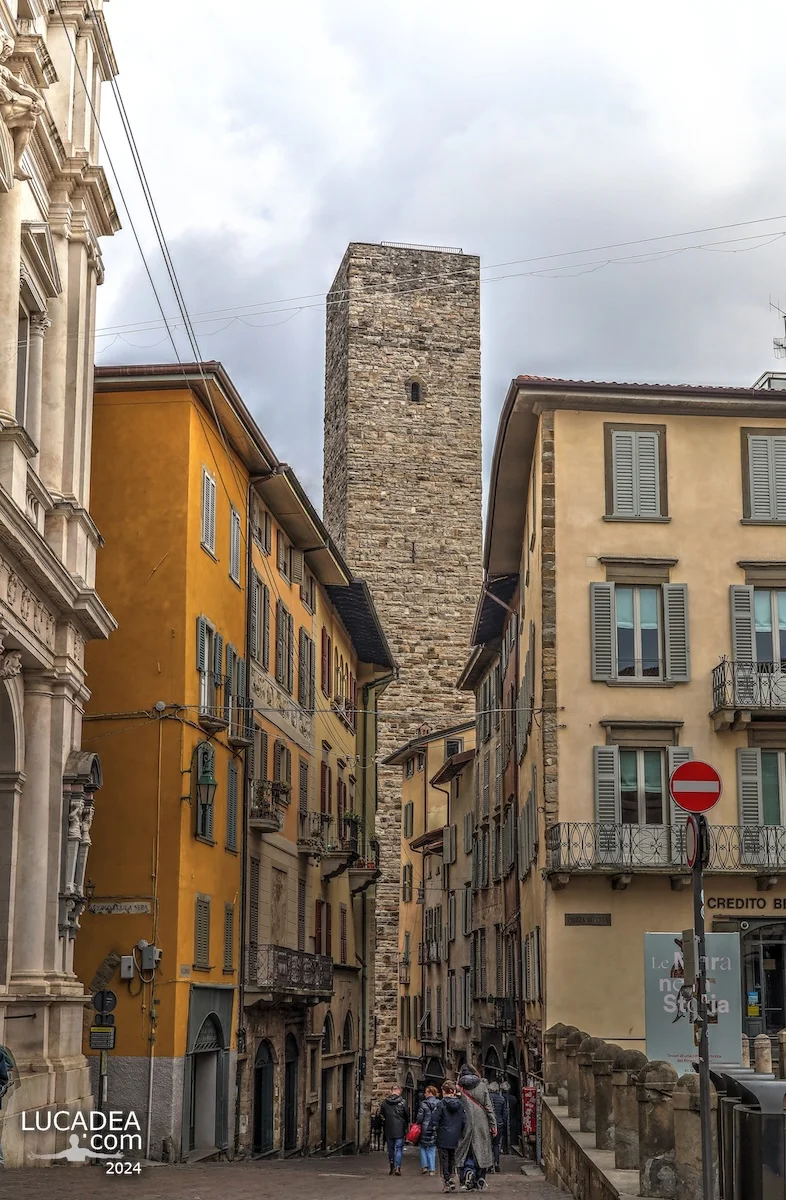
Gombito Tower along the streets of Bergamo Upper Town

Vista della Torre del Gombito a Bergamo Alta tra edifici colorati, strada in discesa e persone che camminano

Gombito Tower along the streets of Bergamo Upper Town.
The street slopes gently downward in front of me, framed by warm-toned buildings, while the Gombito Tower rises suddenly at the center of the scene, acting like a visual anchor where every line seems to converge. The tower doesn’t dominate aggressively, yet it draws attention in a quiet and natural way.
Walking through this part of Bergamo Upper Town, I notice how the buildings shape the perspective: shuttered windows, small balconies, and worn facades that suggest everyday life unfolding over time. The Gombito Tower stands apart, vertical and solid, its stone surface absorbing light rather than reflecting it, giving it a grounded and almost timeless presence.
Looking at the photograph, I appreciate how naturally the composition forms. The street leads the eye forward, the buildings contain it, and everything ultimately gathers around the tower. Even the overhead wires and small urban details contribute to the authenticity of the moment, making it feel unfiltered and real.
The Gombito Tower is one of the tallest structures in Bergamo Upper Town, built in the 12th century, and its name comes from the intersection—“gombito”—of the two main streets of the old city. This detail feels visible even without knowing it beforehand, as the tower clearly marks a meeting point both physically and visually.
There are people walking down the street, small in comparison to the structure above them, yet essential to the scene. Without them, the tower would be just architecture; with them, it becomes part of daily life.
Looking back at this image, I find myself thinking about balance—between stillness and movement, between structure and life. The Gombito Tower remains unchanged while everything else slowly shifts around it.

Have you ever stood somewhere where every line seemed to guide your gaze toward a single point? Add a comment or go to the bottom of the site to read what other visitors have written.

Vista della Torre del Gombito a Bergamo Alta tra edifici colorati, strada in discesa e persone che camminano

Photo taken with Canon EOS RP and Canon RF 24-50 lens.

To see all the photos I took in Bergamo, click here:

The Gombito Tower among the streets of Bergamo Alta – La tour du Gombito dans les rues de Bergame Haute – La Torre del Gombito entre las calles de Bérgamo Alta – A Torre do Gombito entre as ruas de Bergamo Alta – Der Gombito-Turm zwischen den Straßen von Bergamo Alta – Tháp Gombito giữa các con phố Bergamo Alta – 冈比托塔位于贝加莫上城的街道之间 – ゴンビト塔とベルガモ旧市街の通り

The text of this post was written with the help of ChatGPT, a language model from OpenAI.

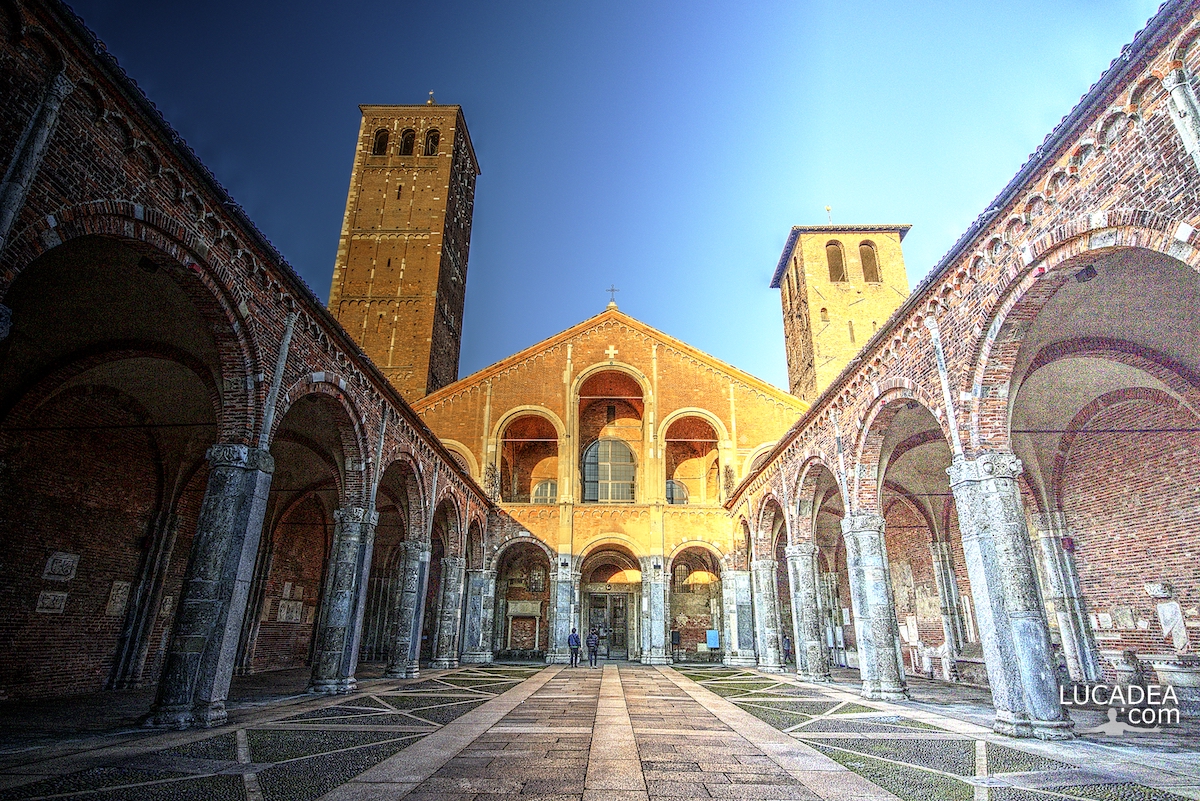
The facade of Sant’Ambrogio Basilica in Milan

Facciata della Basilica di Sant’Ambrogio a Milano con il quadriportico storico davanti alla chiesa

The facade of Sant’Ambrogio Basilica in Milan.
When I visited Sant’Ambrogio Basilica in Milan, one of the most important symbols of the city, I stopped to admire its famous facade with the quadriportico, the architectural element that makes this historic complex instantly recognizable. This photograph is not only about an ancient building, but also about a personal memory connected with a poem I studied many years ago.
While standing in front of the basilica, I remembered “Sant’Ambrogio”, a poem written by Giuseppe Giusti that I learned during middle school. The first verses came back to my mind because the poem begins with the writer describing his arrival at the famous Milanese church:

“Vostra Eccellenza, che mi sta in cagnesco…”

The poem uses the visit to Sant’Ambrogio as a starting point for reflections about history and politics during the period in which it was written. Seeing the place in reality after knowing it from school books gave the visit a special meaning, connecting literature with a real location.
Sant’Ambrogio Basilica is located in the centre of Milan and is dedicated to Saint Ambrose, the patron saint of the city. The current structure mainly dates back to the Romanesque period and is considered one of the most important examples of Romanesque architecture in Lombardy. The large quadriportico in front of the church is one of its most distinctive features and was historically used as a gathering space for visitors and worshippers.
One interesting historical detail is the strong connection between the basilica and Saint Ambrose, the fourth-century bishop who played a fundamental role in the history of Milan and Christianity. Inside the church there are also important artworks, including the famous Carolingian golden altar.
I wanted to capture this facade with my camera because often the exterior of a building is the first element that creates a connection with a place. In this case, it is not just an impressive architectural view, but a meeting point between personal memories, literature and history.
On my blog I often share photographs of Italian places connected with art and culture because I enjoy discovering how a building can preserve stories beyond its appearance.

Have you ever visited Sant’Ambrogio Basilica in Milan, or found yourself in a place you first knew from books? Add a comment or go to the bottom of the site to read what other visitors have written.

Facade of Sant’Ambrogio Basilica in Milan with the historic quadriportico in front of the church

Photo taken with a Canon EOS M100 camera and Canon EF-M 11-22 lens.

This is the church’s official website: basilicasantambrogio.it.

To see all the photos I took at the Basilica, click here:

The basilica features a broad, low-slung gable façade and two superimposed loggias. The sides of the lower loggia—which consists of three equal-sized arches—connect to the portico, which has slightly taller arches.
Read more on Wikipedia

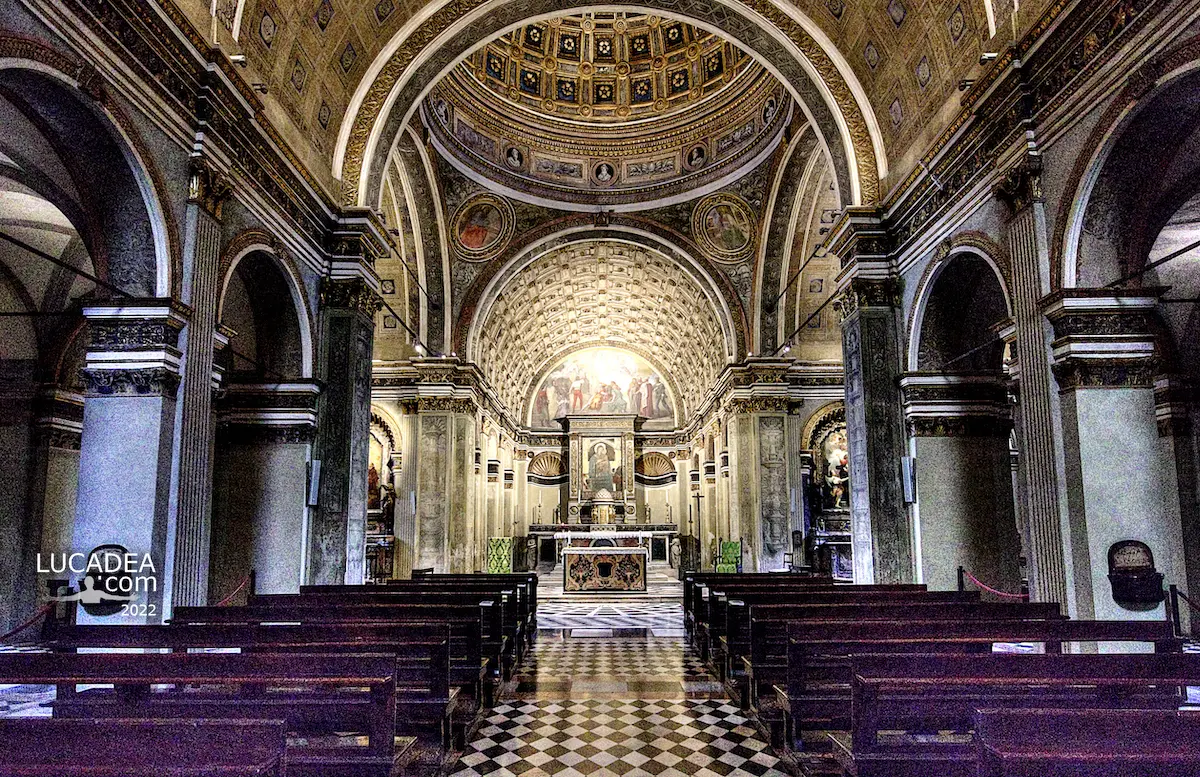
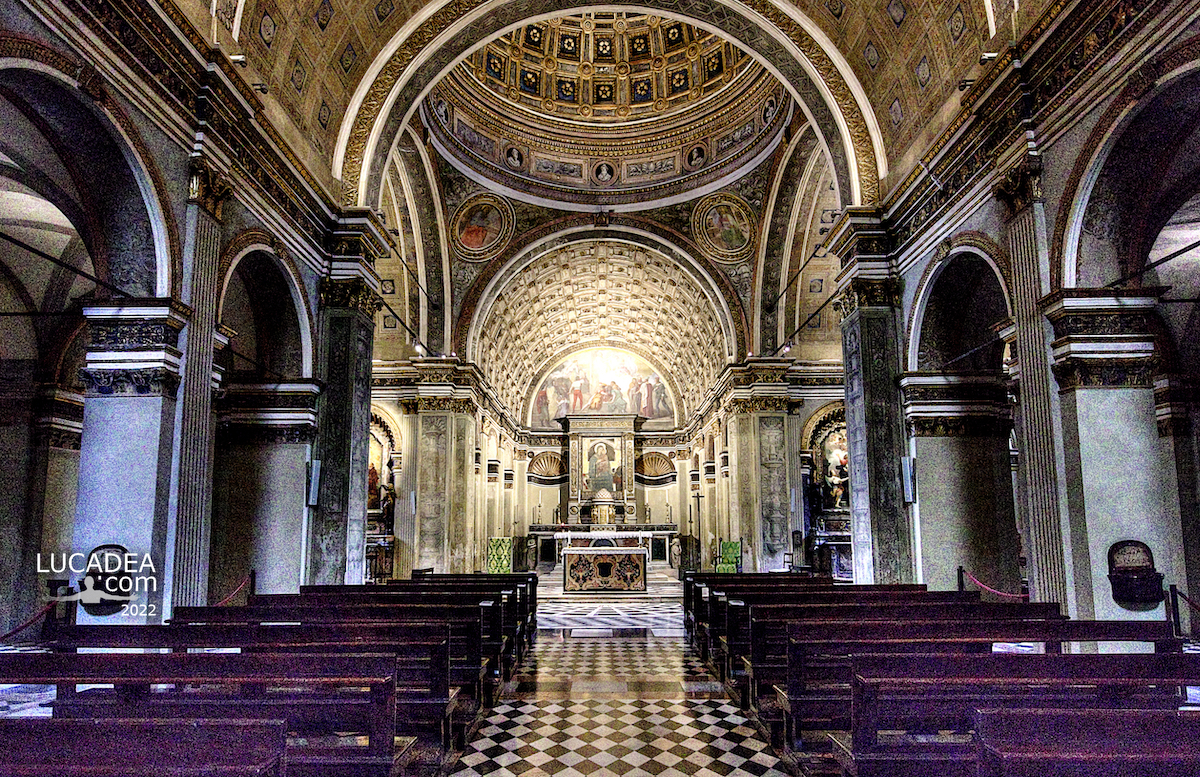
Bramante’s perspective in Renaissance Milan

La prospettiva del Bramante a Milano

Bramante’s perspective in Renaissance Milan.
Entering Santa Maria presso San Satiro in Milan, I found myself facing one of those details that completely changes the way a place is perceived. Bramante’s perspective in Milan is one of the most fascinating things to see in Milan for anyone interested in Renaissance art, because it transforms a practical limitation into an extraordinary creative solution.
At first glance, it looks like a real architectural space continuing beyond the walls. Only by observing carefully do you realize that your eyes are being guided by an incredible illusion. Bramante’s perspective creates the impression of a deep choir behind the altar, combining architecture and painting to create a space that feels much larger than it actually is.
I was in Milan, Lombardy, Italy, in the historic center of the city, and this small church reminded me that some of the greatest discoveries are often hidden in modest places. I have shared similar experiences on the blog while photographing details of Italian cities, where a single corner can reveal centuries of creativity and history.
Santa Maria presso San Satiro was built at the end of the 15th century, during the period when Milan was ruled by the Sforza family and had become an important cultural center of the Italian Renaissance. Donato Bramante, one of the most influential architects of the period, faced a difficult challenge: there was not enough space to create a traditional deep choir.
His answer was extraordinary. Instead of accepting the limitation, he created a painted false choir using perspective techniques that make it appear much deeper than it really is. An interesting detail is that the actual depth of the illusion is only a few centimeters, yet the visual effect is powerful enough to deceive the human eye.
Photographing this place was not only about capturing a building. It was about trying to preserve an idea, a moment where perception and reality meet. The camera records the image, but the experience comes from understanding the creativity behind it.
If you are visiting Milan and looking for something beyond the most famous landmarks, this Renaissance masterpiece is a place worth seeing because it shows how imagination can overcome physical limits.
Bramante’s perspective in Milan remains fascinating today because it is not only an architectural solution, but also a reminder of how art can change the way we see the world.

Have you ever visited a place where your eyes had to question what was real? Add a comment or go to the bottom of the site to read what other visitors have written.

La prospettiva del Bramante a Milano

Photo taken with a Canon EOS M100 camera and Canon EF-M 11-22 lens.

The Ambrosian Diocese website: chiesadimilano.it/.

Click here if you would like to see all the photos I have taken:
foto gallery

Here is where the church is located:

One of the main obstacles to creating a monumental structure was the lack of space for the choir, as the area behind the transept was occupied by the Falcone district. Bramante brilliantly solved this problem by creating terracotta reliefs and moldings—subsequently painted—to form a perspective view; within a depth of just 97 centimeters, this simulated a space matching the 9.7-meter length of the transept arms—a design inspired by earlier studies seen in the Prevedari Engraving—thereby becoming the building’s standout feature.
Read more and explore further on Wikipedia

Bramante’s perspective in the church of San Satiro in Milan – Le point de vue de Bramante dans l’église de San Satiro à Milan – La perspectiva de Bramante en la iglesia de San Satiro de Milán – A perspectiva de Bramante na igreja de San Satiro em Milão – Bramantes Perspektive in der Kirche San Satiro in Mailand – Phối cảnh của Bramante tại nhà thờ San Satiro ở Milan – 布拉曼特在米兰圣萨蒂罗教堂的视角 – ミラノのサン・サティロ教会におけるブラマンテの視点

The text of this post was written with the help of ChatGPT, a language model from OpenAI.

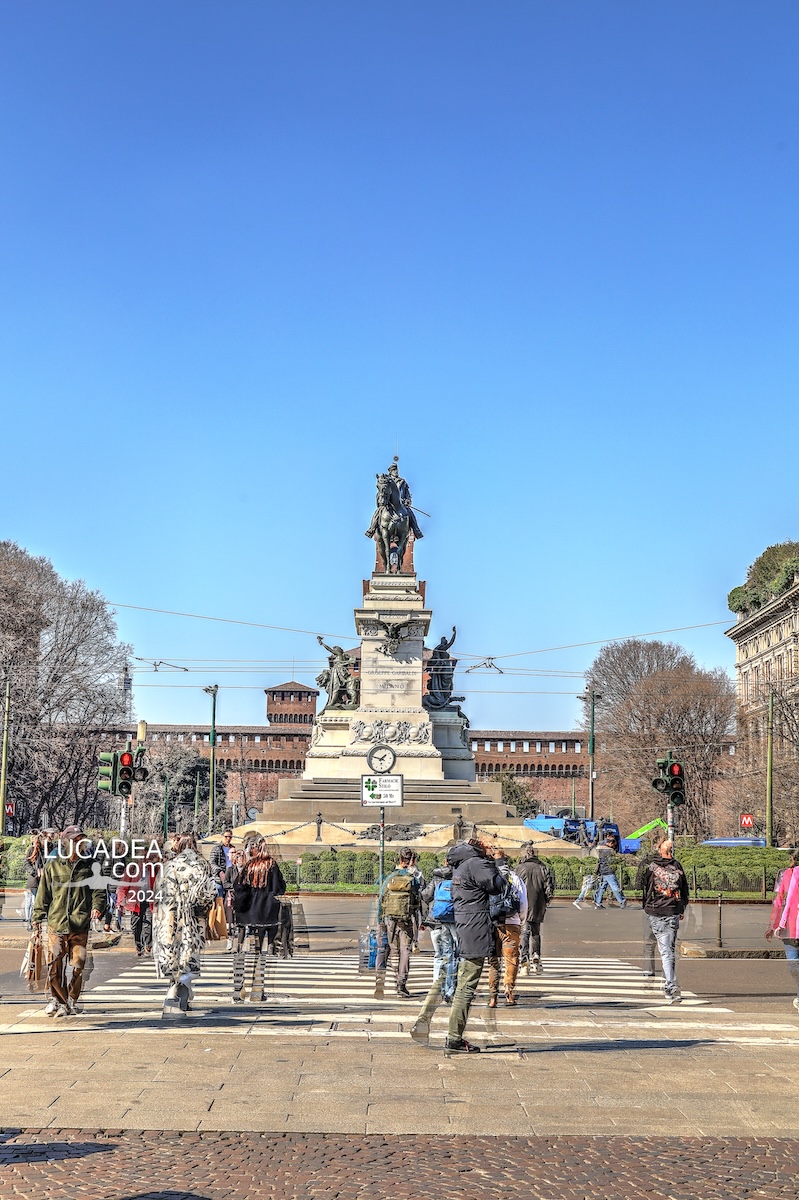
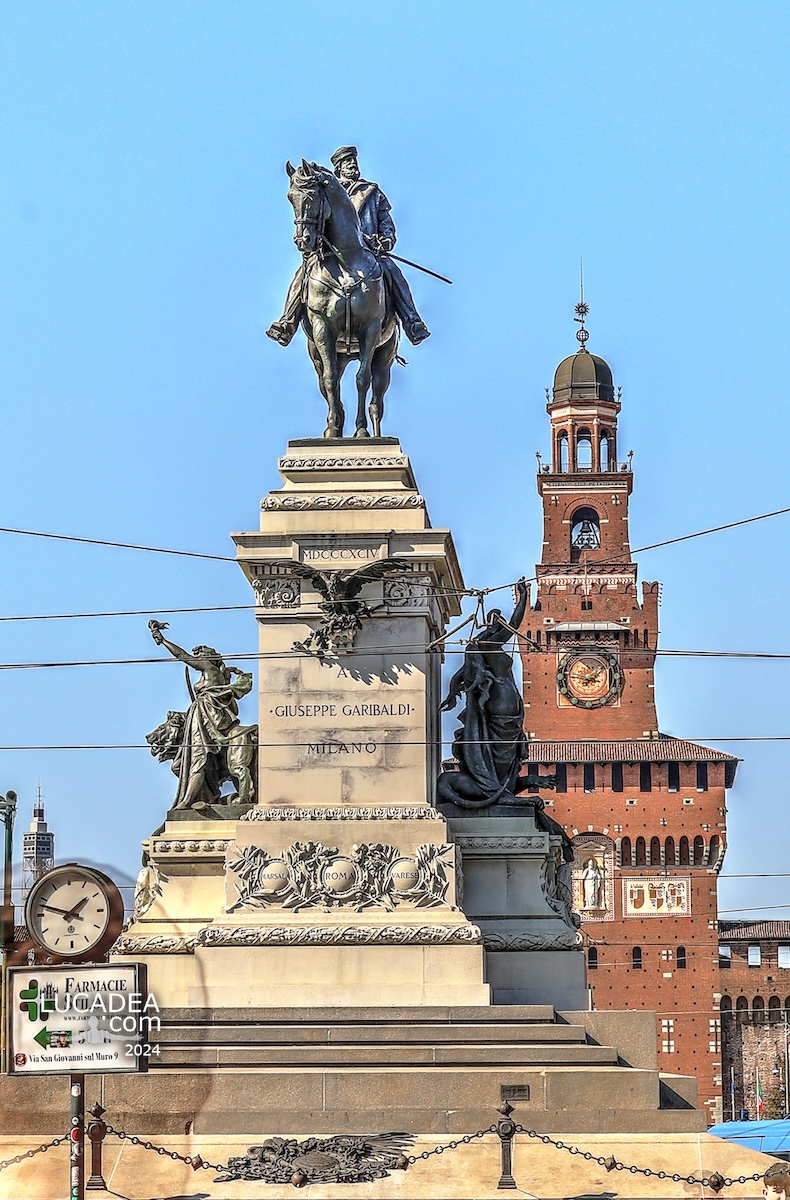
The statue of Garibaldi in Cairoli Square in Milan

La statua di Garibaldi in largo Cairoli a Milano

The statue of Garibaldi in Cairoli Square in Milan.
Walking along Dante Street, the road that connects Milan Cathedral to Sforza Castle, you reach a wide open space known as Cairoli Square. It is one of those places where the constant flow of people meets history, creating a lively atmosphere that still preserves a strong connection with the past.
At the center of the square stands the equestrian statue dedicated to Giuseppe Garibaldi, one of the most important figures in Italian history. The monument shows him on horseback in a strong and dynamic pose, overlooking the surrounding space. It is a landmark that many people pass by every day, often without realizing its historical significance.
Milan, in Lombardy, Italy, is a city where modern life blends with historical heritage, and routes like the one between the Cathedral and Sforza Castle offer many interesting details to discover. Cairoli Square is both a crossing point and a place where visitors can stop and observe the city.
The statue was created by the sculptor Ettore Ximenes and inaugurated at the end of the nineteenth century. It celebrates Garibaldi’s role in the unification of Italy, especially his leadership during the Expedition of the Thousand and other military campaigns that contributed to the creation of the Italian state.
Photographing this monument means capturing not only the sculpture itself but also the urban environment around it. What struck me most was the contrast between the historical figure represented and the everyday movement of people in the square.
On lucadea.com I have often shared photos of monuments and historical places, because I believe that even a simple image can preserve the memory of a place and tell part of its story.
Milan is full of interesting views, and sometimes it is enough to stop for a moment along a busy street to notice a detail that deserves attention.

Have you ever noticed this statue while walking between the Cathedral and Sforza Castle? Add a comment or go to the bottom of the site to read what other visitors have written.

Photos taken with Canon EOS RP and Canon RF 24-50 lens.

Click here if you want to see all the photos I took:
foto gallery

Here’s where the statue is located:

Considered by 20th-century historiography and popular culture as Italy’s foremost national hero, he began his travels around the world as a merchant ship’s officer, later becoming a sea captain. His most famous exploit was the victorious Expedition of the Thousand, which led to the annexation of the Kingdom of the Two Sicilies to the nascent Kingdom of Italy, a pivotal episode in the unification process of the new nation.
Continue and learn more at Wikipedia

The statue of Garibaldi in Cairoli Square in Milan – La statue de Garibaldi sur la place Cairoli à Milan – La estatua de Garibaldi en la plaza Cairoli de Milán – A estátua de Garibaldi na praça Cairoli em Milão – Die Garibaldi-Statue auf dem Cairoli Platz in Mailand – Tượng Garibaldi tại quảng trường Cairoli ở Milan – 米兰开罗利广场的加里波第雕像 – ミラノのカイローリ広場にあるガリバルディ像

The text of this post was written with the help of ChatGPT, a language model from OpenAI.

The famous Naviglio Grande in Milan

Naviglio Grande di Milano con canale storico, edifici affacciati sull’acqua e atmosfera urbana

The famous Naviglio Grande in Milan.
Walking along the banks of the Naviglio Grande, I stopped to observe one of those places where the history of a city still lives together with everyday life. Between the water of the canal, reflections on the buildings, and the movement of people, the Naviglio Grande in Milan always offers new perspectives to discover through photography.
This image was born from the desire to capture a detail of an environment that is not only one of the most recognizable views of the city, but also a place experienced by residents and visitors. Milan’s Navigli have become a meeting point between architecture, culture, and social life, where ancient waterways are surrounded by cafés, workshops, and historic buildings.
The Naviglio Grande is located in Milan, Lombardy, Italy, and is one of the city’s most famous landmarks. Originally created as an important waterway for transporting goods, over the centuries it changed its role and became one of the most loved areas for walking and discovering a different side of Milan.
I enjoy photographing places like this because even famous locations can reveal something unexpected. A bridge, a railing, a small boat, or simply a reflection on the water can become the main subject of an image.
A small curiosity is that the Navigli system was also important for transporting building materials, including the marble used for Milan Cathedral, which arrived through these waterways.
This photograph reminded me of other articles on the site about Italian cities and their architectural details, because often the simplest elements are the ones that best express the identity of a place.

What famous place in a city have you discovered had a completely different hidden side? Add a comment or go to the bottom of the site to read what other visitors have written.

Naviglio Grande di Milano con canale storico, edifici affacciati sull’acqua e atmosfera urbana

Photo taken with Canon EOS M100 and Canon EF-M 11-22 lens.

To see all the photos I took in Milan, click here:

Here’s where I took the shot:

Bergamo Alta, Angelo Mai Library among the streets

Scorcio della Biblioteca Civica Angelo Mai a Bergamo Alta vista dai vicoli di via Bartolomeo Colleoni nel centro storico

Bergamo Alta, Angelo Mai Library among the streets.
Walking through the narrow streets of the upper town of Bergamo, Lombardy, Italy, I often slow down without planning to, and the Angelo Mai Civic Library in Bergamo Alta becomes one of those visual anchors that naturally catch the eye. The Angelo Mai Civic Library in Bergamo Alta appears in the background while I move along Bartolomeo Colleoni street, where stone walls and historic façades shape a dense and continuous urban rhythm.
The Angelo Mai Civic Library in Bergamo Alta is not a building that dominates the scene, but rather one that integrates into it, almost quietly, as part of the living structure of the old town. I am in Bergamo Alta, Bergamo, Lombardy, Italy, and every corner feels like a potential photograph, even when I am simply walking without a specific intention.
This library is one of the most important cultural institutions in the city, housing historical collections and archives that reflect centuries of local history. If you are visiting Bergamo Alta, this is one of those places worth noticing even from the outside, because its presence connects directly with the intellectual identity of the city.
I have already shared other photographic impressions from Bergamo Alta on this site, and every time I return to these streets I notice how the same locations can feel completely different depending on perspective and movement.
The Angelo Mai Civic Library in Bergamo Alta remains in the background as I pause for a moment, letting the composition settle naturally. It makes me think about how many travelers might walk past without realizing what they are looking at, especially in a place as layered as this historic center.

Have you ever passed a place many times before truly seeing it? Add a comment or go to the bottom of the site to read what other visitors have written.

Scorcio della Biblioteca Civica Angelo Mai a Bergamo Alta vista dai vicoli di via Bartolomeo Colleoni nel centro storico

Photo taken with Canon EOS RP and Canon RF 24-50 lens.

To see all the photos I took in Bergamo, click here:

Here’s the spot where I took the photo:

The Angelo Mai Civic Library of Bergamo is the main historical preservation institution in the Bergamo library network. It is housed in the Palazzo Nuovo in the Upper Town, opposite the Palazzo della Ragione, bordering Piazza Vecchia to the northeast. It was founded between the late 1760s and early 1770s, when the book bequest that Cardinal Alessandro Giuseppe Furietti had left to the city was made available to the citizens. Its first location was in a room in the Palazzo Nuovo, which housed the City Hall. Transferred in 1797 to the rectory of the Cathedral, it was housed in the Palazzo della Ragione from 1843 until 1928, when it returned to its original location, now occupying the entire building.
Continue and learn more at Wikipedia

View of the Angelo Mai Civic Library in Bergamo Alta – Vue de la Bibliothèque civique Angelo Mai à Bergame Alta – Vista de la Biblioteca Cívica Angelo Mai en Bérgamo Alta – Vista da Biblioteca Cívica Angelo Mai em Bérgamo Alta – Blick auf die Stadtbibliothek Angelo Mai in Bergamo Alta – Cảnh Thư viện thành phố Angelo Mai ở Bergamo Alta – 贝加莫上城区安杰洛·迈市立图书馆景观 – ベルガモ旧市街のアンジェロ・マイ市立図書館の眺め

The text of this post was written with the help of ChatGPT, a language model from OpenAI.

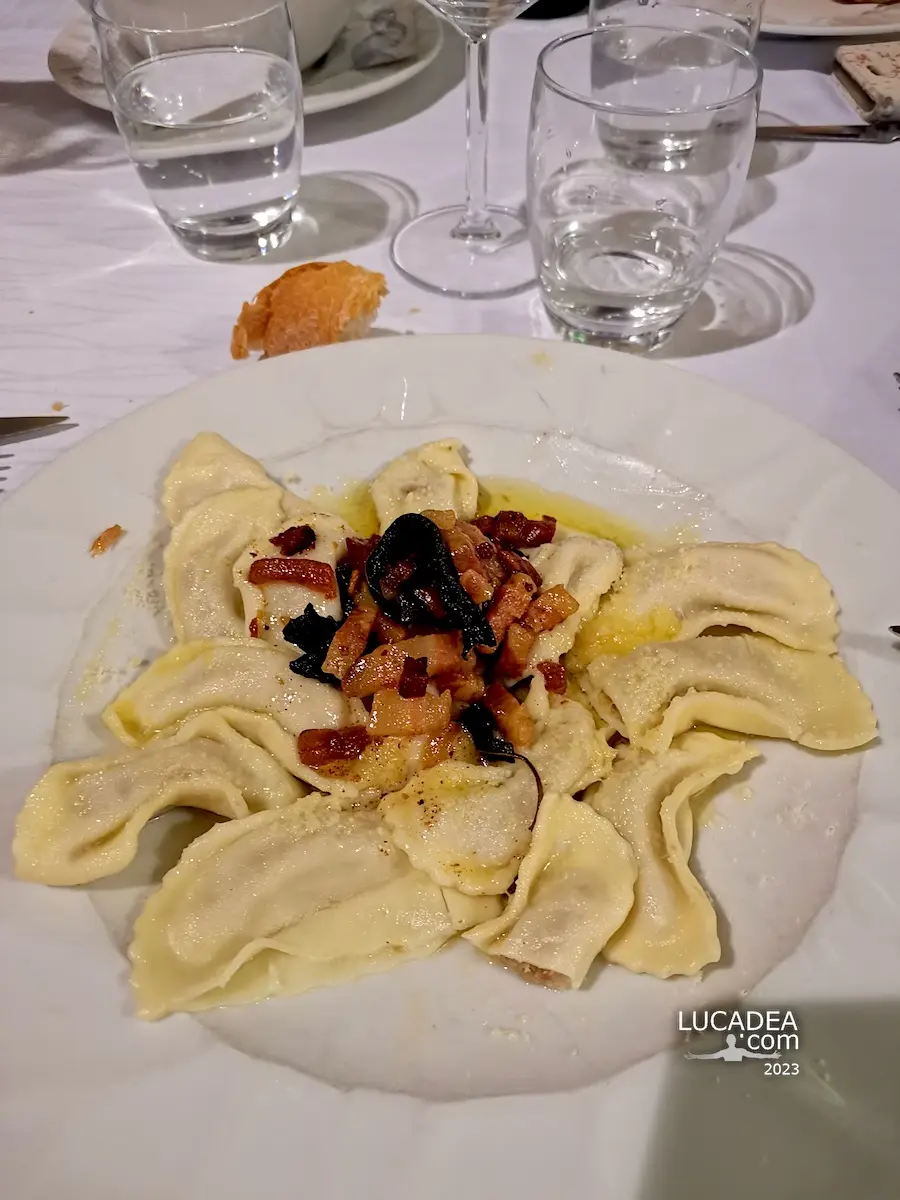
Casoncelli alla Bergamasca in the Heart of Bergamo

Casoncelli alla bergamasca serviti in tavolo esterno a Bergamo, piatto tipico della città con burro e salvia e atmosfera serale

Casoncelli alla bergamasca in the heart of Bergamo.
It was evening, and sitting at an outdoor table in a restaurant in Bergamo, the casoncelli alla bergamasca felt like the most direct expression of the city itself. The warm scent of butter and sage drifted through the night air, while the idea of casoncelli bergamaschi became inseparable from Bergamo, Lombardy, Italy.
Everything around the table seemed to belong to the same story: the soft noise of the city, the calm movement of people, and the slow arrival of a dish that represents Bergamo more than many of its landmarks. The casoncelli alla bergamasca are not just food here; they are part of the city’s identity, something deeply rooted in its everyday culture.
With the first bite, the filling revealed its richness: meat, cheese, and a subtle sweetness that balances the savory base. The casoncelli bergamaschi carry a sense of history in every fold of pasta, reflecting the culinary traditions of Bergamo that have been passed down for generations.
Sitting outside, I realized how strongly this dish connects to the city itself. It’s impossible to separate casoncelli alla bergamasca from Bergamo, because they feel like two parts of the same story. Even on this site, in another post about Lombard cuisine, food was described as a way to understand a place more deeply than any guidebook.
A small but meaningful detail is that casoncelli were traditionally reserved for special occasions, making them a dish tied to celebration and family gatherings rather than everyday meals.
When the plate was empty, what remained was not just satisfaction, but a clearer sense of Bergamo through its most iconic dish.

Have you ever understood a city just by tasting one of its traditional dishes? Add a comment or go to the bottom of the site to read what other visitors have written.

Casoncelli alla bergamasca serviti in tavolo esterno a Bergamo, piatto tipico della città con burro e salvia e atmosfera serale

Photo taken with Honor 20.

Enjoyed at the Bergamo Alta restaurant dafrancobergamo.it.

Here’s the location of the restaurant where I tried them:

The filling gives casoncelli a slightly sweet flavor, a typical characteristic of the medieval and Renaissance culinary landscape from which they originate; reliable documentation attests to their existence as early as 1386. Under Venetian rule, the filling was enriched with spices, amaretti biscuits, and ingredients from distant origins. The current recipe consolidates the 19th-century version. In dialect, they are called casonséi.
Continue and learn more at Wikipedia

Casoncelli alla bergamasca nel cuore di Bergamo – Casoncelli à la bergamasque au cœur de Bergame – Casoncelli a la bergamasca en el corazón de Bérgamo – Casoncelli à moda bergamasca no coração de Bergamo – Casoncelli nach Bergamasca-Art im Herzen von Bergamo – Casoncelli kiểu Bergamo giữa lòng Bergamo – 贝加莫市中心的卡松切利 – ベルガモ中心部で味わうカソンチェッリ

The text of this post was written with the help of ChatGPT, a language model from OpenAI.

The Southern Portal of Santa Maria Maggiore in Bergamo

Bergamo Città Alta porta sud Santa Maria Maggiore ingresso con arco decorato colonne leoni pietra facciata romanica torre campanaria cielo nuvoloso

The Southern Portal of Santa Maria Maggiore in Bergamo.
The southern portal of Santa Maria Maggiore in Bergamo revealed itself unexpectedly as I wandered through the cobbled streets of Città Alta with no particular destination in mind. The southern portal of Santa Maria Maggiore in Bergamo is not just an entrance, but a quiet and solid presence, shaped by time and defined by its intricate stonework.
As I got closer, my eyes followed the curve of the decorated arch, naturally guided toward the large wooden door. The columns framing the entrance felt almost alive in their detail, each one telling a fragment of a larger story. On either side, the stone lions stood still, guardians of a space that has welcomed visitors for centuries.
The soft light of a cloudy sky flattened the contrasts, allowing every texture to emerge gently. The warm tones of the stone seemed to hold onto the light, giving the façade a sense of depth without harsh shadows. I paused longer than I expected, drawn into the quiet strength of the structure.
What struck me most was the balance. Despite the richness of decoration, nothing felt excessive. Everything seemed placed with intention, yet without forcing attention. There is a kind of harmony here that does not need to be explained, only observed.
Places like this do not demand your attention loudly. They simply hold it, quietly, letting you take your time. Standing there, I realized that I didn’t need to understand every detail to feel connected to it.

Have you ever stopped in front of a doorway that felt like it held more than just an entrance? Add a comment or go to the bottom of the site to read what other visitors have written.

Bergamo Città Alta porta sud Santa Maria Maggiore ingresso con arco decorato colonne leoni pietra facciata romanica torre campanaria cielo nuvoloso

Photo taken with Canon EOS RP and Canon RF 24-50 lens.

To see all the photos I took in Bergamo, click here:
Galleria delle foto

The Southern Portal of Santa Maria Maggiore in Bergamo – Le portail sud de Santa Maria Maggiore à Bergame – La puerta sur de Santa Maria Maggiore en Bérgamo – O portal sul de Santa Maria Maggiore em Bérgamo – Das Südportal von Santa Maria Maggiore in Bergamo – Cổng phía nam của Santa Maria Maggiore ở Bergamo – 贝加莫圣母大教堂南门 – ベルガモのサンタ・マリア・マッジョーレ南門

The text of this post was written with the help of ChatGPT, a language model from OpenAI.

🏠
  • Italiano